A production line can look automated and still behave like a collection of disconnected islands. One workstation has a PLC, another relies on a standalone HMI, inspection data sits on a local computer, and operators carry information between steps because the systems don't share a common operating picture. When a fault appears during a changeover, the maintenance technician has to determine whether the cause is a sensor, sequence, safety circuit, network path, recipe, or mechanical condition.
That situation is common in plants upgrading manual processes without replacing every machine. The practical answer isn't always full automation. A well-designed integrated controls system can connect semi-automated equipment, people, and production data while preserving flexibility, maintainability, safety, and quality evidence. The value comes from making the line easier to understand and control, not from adding technology for its own sake.
Table of Contents
- What Integrated Controls Systems Actually Deliver for Manufacturers
- Specifying and Designing Integrated Controls for Semi-Automated Lines
- Building GMP-Aware Integration and Cybersecurity by Design
- Implementation, Commissioning, Testing, and Validation Steps
- Common Pitfalls and Costly Integration Mistakes to Avoid
- Sustaining Integrated Controls Through Workforce and Ownership Clarity
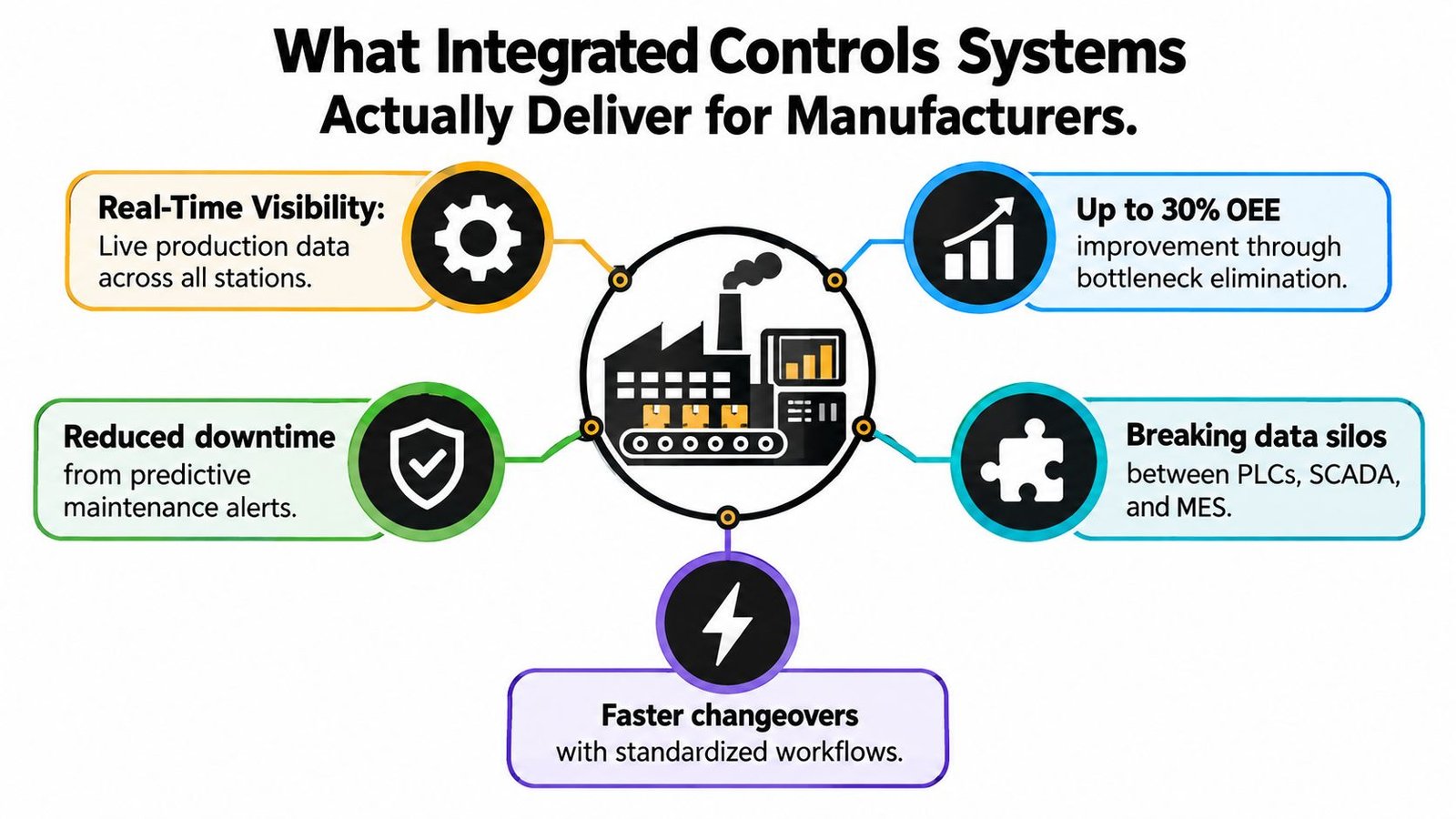
What Integrated Controls Systems Actually Deliver for Manufacturers
Manufacturers usually feel the cost of disconnected controls before they identify the architecture problem. An operator resets one station without knowing that the downstream machine is waiting for a permissive. A quality technician records a result separately from the batch record. A supervisor sees output at the end of a shift but can't easily connect scrap, alarms, downtime, and manual interventions to the relevant process conditions.
Integrated controls systems coordinate sensors, programmable logic controllers, HMIs, safety logic, drives, supervisory software, and production records around a defined workflow. The system can still include manual decisions and operator loading, but each role receives the information needed to act consistently. That distinction matters for manufacturers seeking practical solutions to optimize production and services. Semi-automation often works best when product mix, changeovers, or inspection requirements make a fully automatic line too rigid.
Production decisions need usable data
NIST defines smart manufacturing as the coordinated use of advanced sensors, controls, platforms, and software across factory operations and supply chains. These systems collect and share data to describe current conditions, diagnose problems, predict future performance, and prescribe corrective actions, as described in NIST's smart manufacturing framework.
That definition changes the design question. The issue isn't whether a PLC can run a sequence. The issue is whether the controls architecture helps the operations team detect abnormal conditions, isolate bottlenecks, stabilize output, and make decisions across shifts. A useful HMI shows the operator what requires attention. A historian preserves process context. A supervisory layer turns isolated events into information that engineers and managers can use.
Integration should serve the process
A connected line can improve cycle consistency, reduce avoidable manual intervention, and support traceability, but integration also creates dependencies. A shared network, common data layer, or remote service connection can become a pathway into physical operations if security and recovery aren't designed with the automation.
Manufacturing leaders should therefore evaluate each connection against a specific outcome:
- Quality: Can the system record the parameters that influence acceptance?
- Throughput: Can operators see where the process is waiting?
- Maintenance: Can technicians distinguish control faults from equipment faults?
- Flexibility: Can authorized staff change recipes or workflows without rewriting the application?
- Recovery: Can the team restore a known configuration after a failure?
The automation control systems services from System Engineering & Automation illustrate the broader principle. Integrated controls are most valuable when they connect equipment behavior to the decisions people make every shift.
Specifying and Designing Integrated Controls for Semi-Automated Lines
Start specification with the process, not the preferred controller brand. Bring operations, controls engineering, IT/OT security, maintenance, quality, and safety into the project before hardware selection. Each group sees a different failure mode, and the specification is incomplete if it only describes normal machine operation.
Operations should define takt expectations, changeover behavior, material presentation, operator decisions, and acceptable manual intervention. Controls engineers translate those requirements into sequences, permissives, modes, alarms, and interfaces. Maintenance identifies access points, spare parts, diagnostic needs, and realistic service conditions. Quality defines records, approvals, recipes, and parameter limits. Safety establishes risk controls and fail-safe responses. IT/OT security defines identity, segmentation, remote access, logging, and recovery requirements.
Build the asset and dependency picture first
Inventory the existing environment before designing the new cell. Include controllers, HMIs, engineering workstations, historians, safety devices, drives, firmware, network paths, remote-access routes, and dependencies between stations. Legacy devices often lack current authentication or documentation, so the inventory should record what exists, who owns it, how it communicates, and what happens if it becomes unavailable.
A useful specification distinguishes control traffic, safety traffic, supervisory data, engineering access, and business reporting. Segment the environment according to process and risk. Restrict communications to required industrial protocols, authenticate users individually, and separate engineering privileges from routine operator functions. A flat network may appear inexpensive during installation, but it makes troubleshooting, containment, and controlled access harder later.
The control system design approach from System Engineering & Automation reflects an important discipline, planning control architecture, panel design, logic, interfaces, and commissioning evidence as one engineering problem rather than separate purchases.
Define the behavior before choosing the hardware
Write the controls narrative in terms of states and responses. Describe automatic, manual, setup, maintenance, and fault modes. Specify what each station needs to know from upstream and downstream equipment, which conditions create a permissive, how an interrupted cycle resumes, and what the operator must acknowledge.
| Component | Design Focus |
|---|---|
| PLC and remote I/O | Sequence logic, deterministic behavior, diagnostics, expansion, and maintainable program structure |
| HMI | Role-based screens, clear modes, alarm response, recipe control, and guided recovery |
| Safety system | Risk-based protective functions, reset behavior, safe states, and verification evidence |
| Sensors and drives | Measurable process conditions, diagnostics, calibration, and fault handling |
| SCADA or historian | Required records, timestamps, trends, access control, and data retention |
| Network architecture | Segmentation, permitted communications, redundancy where justified, and service access |
| MES or enterprise interface | Approved data exchange, ownership of records, and failure behavior when higher-level systems are unavailable |
Avoid specifying connectivity just because a device supports it. Every interface adds a maintenance obligation, a security consideration, and a recovery requirement. The right design often connects fewer systems more deliberately, with clear ownership and documented fallback behavior.
Building GMP-Aware Integration and Cybersecurity by Design
A line can be mechanically sound, sequence correctly, and still become a compliance problem the first time someone needs to restore a controller, change a recipe parameter, or explain an unexpected software revision during an audit. That failure usually starts in design. If cybersecurity, GMP records, and ownership are handled as separate workstreams, the plant inherits a system that runs, but is hard to defend, recover, or keep validated after handoff.
Industrial control security became a board-level and regulatory concern as plants shifted from isolated proprietary equipment to software-based SCADA, distributed control, and networked operational technology. The path is visible in Presidential Decision Directive 63 in 1998, the National Plan for Information Systems Protection in 2000, and the discovery of Stuxnet in 2010, which showed that malware could alter an industrial process rather than only extract information, as described in this Congressional Research Service report.
That history matters at specification time.
Security requirements shape architecture, account design, service access, and documentation long before startup. A usable integration package should identify assets, system owners, user roles, approved access paths, firmware and software baselines, backup scope, and dependencies that can stop production or compromise quality. It should also define how unauthorized changes are detected, how historical data is protected, how remote support is controlled, and how the site restores operation after an incident.
The practical lesson is straightforward. Connect systems only where the process, records, or support model require it, then control those connections with segmentation, named accounts, least-necessary privileges, monitoring, tested backups, and an agreed recovery method. I have seen teams spend more time troubleshooting the consequences of unnecessary connectivity than getting any operating benefit from it.
ISA/IEC 62443 is useful here because it assigns lifecycle responsibility across asset owners, suppliers, integrators, and service providers. Put those responsibilities in project documents, not in assumptions. The machine builder may deliver the PLC program and HMI application, but the manufacturer still needs a clear owner for access reviews, patch evaluation, change approval, backup testing, incident response, and restoration after handoff. If nobody owns those tasks, they do not get done consistently.
GMP documentation has to be built into that same design. FDA process validation guidance defines validation as collecting and evaluating data from process design through commercial production to establish scientific evidence that a process can consistently deliver quality product. For validated processes, manufacturers are expected to monitor and control process parameters and document validation activities and results, including approval dates, signatures, and, where applicable, major equipment validated, as explained in the FDA process validation guidance.
That changes controls decisions in concrete ways. Capture the parameters that affect product quality. Restrict recipe and setpoint changes to approved users. Preserve audit trails that investigators can follow. Keep procedures, records, and system versions aligned so the team can show not only what the process did, but which approved configuration produced that result.
FDA inspection guidance reinforces the breadth of that expectation across sterilization, molding, soldering, machining, blending and mixing, water purification, cleanrooms, testing methods, packaging, and labeling. It also distinguishes prospective validation before distribution of a new product or revised process that may affect product characteristics from retrospective validation based on accumulated production, testing, and control data, as described in FDA's inspection guidance.
For connected medical-device operations, the FDA's June 2025 final guidance ties cybersecurity risk management and documentation to quality-system activities such as software validation, risk analysis, complaint handling, CAPA, audits, and servicing. It also addresses vulnerability monitoring, coordinated disclosure, postmarket updates, and a software bill of materials in the FDA's medical-device cybersecurity guidance. A design is incomplete if it records process data but cannot show who changed software, why the change was approved, what risk was assessed, and how the validated state was restored and sustained by the team that owns the system after turnover.
Implementation, Commissioning, Testing, and Validation Steps
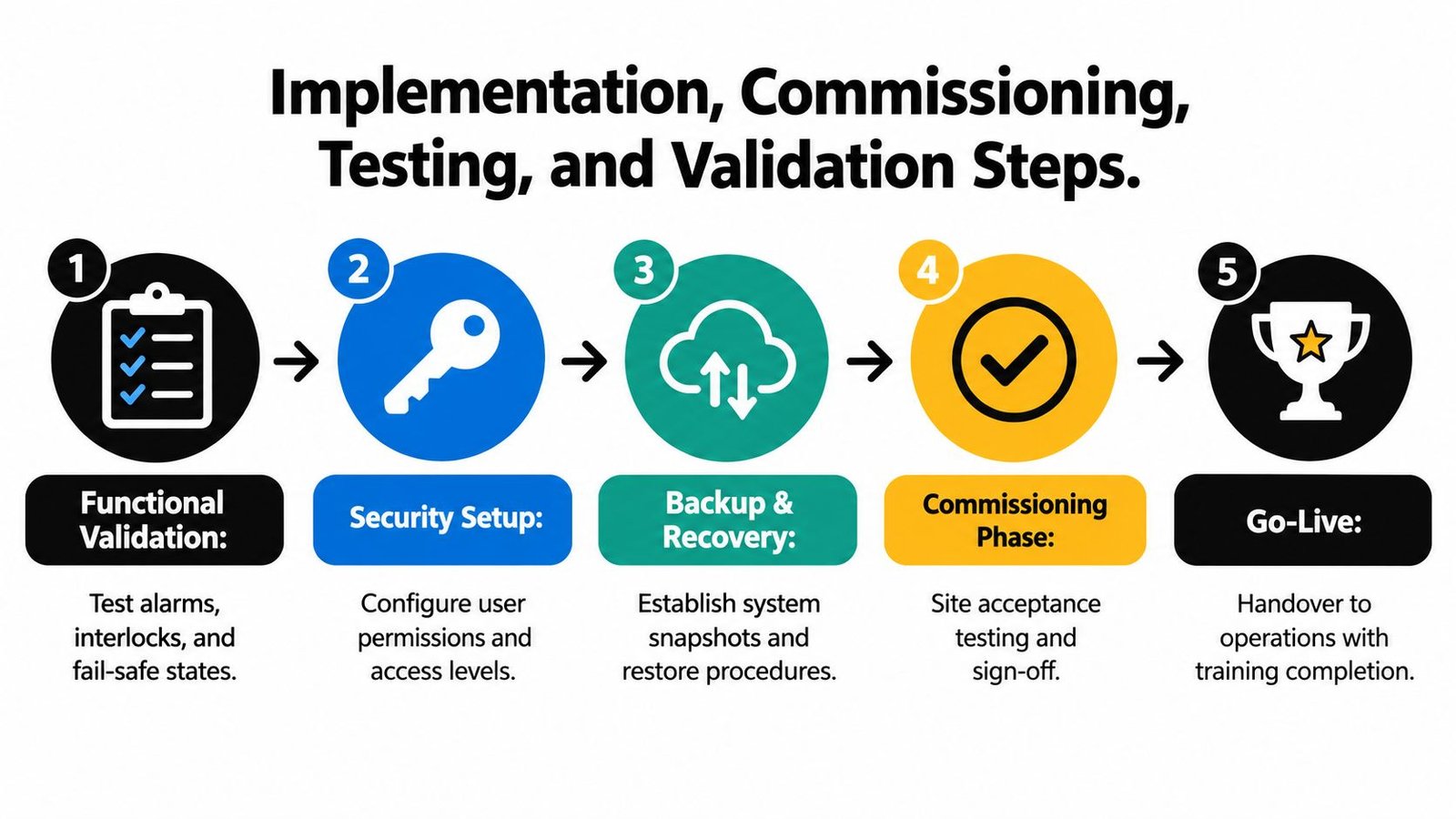
Commissioning should prove more than startup. A machine can run a normal cycle and still fail when a sensor is unplugged, an operator loses authorization, a network path disappears, or a backup needs restoration. Test the conditions that reveal whether the system is safe, recoverable, and maintainable.
Use a staged evidence model
Begin with a representative test environment. Validate logic, interfaces, alarm behavior, interlocks, fail-safe states, user permissions, backups, and recovery procedures before equipment reaches production. Where possible, test simulated devices and representative hardware together so the team can catch sequencing and communication problems without consuming the production window.
A practical sequence looks like this:
- Confirm functional requirements: Map every critical requirement to a test case with an expected response, owner, revision history, and recovery method.
- Test abnormal conditions: Remove inputs, create permissive failures, interrupt communications, attempt unauthorized access, and verify that the system reaches the intended safe state.
- Verify records: Confirm timestamps, recipes, batch or job identifiers, alarm history, audit information, and controlled change records.
- Run factory acceptance testing: Resolve defects in a controlled environment before site work. The factory acceptance testing service from System Engineering & Automation reflects this emphasis on finding issues before installation and startup.
- Commission under an approved plan: Perform site acceptance tests, confirm wiring and I/O, verify network behavior, train users, and obtain documented sign-off.
Set an acceptance threshold people can audit
Every safety or production-critical function should have a documented test case, expected response time, accountable owner, revision history, and recovery method. A successful demonstration of one normal cycle isn't evidence that the system will behave correctly across modes, faults, or restoration scenarios.
Transfer the asset inventory and configuration baseline into operations and maintenance at handoff. Include software versions, firmware, network diagrams, access roles, backups, spare parts, calibration needs, alarm-response guidance, and open defects. Then schedule periodic access reviews, patch planning, change-control review, and restoration tests. Handoff is successful when plant personnel can operate, troubleshoot, approve changes, and recover the system without depending on undocumented knowledge held by the integrator.
Common Pitfalls and Costly Integration Mistakes to Avoid
A line can pass startup, make product for a few weeks, and still be set up to fail. The pattern is familiar. One legacy drive was never added to the asset list, a vendor modem stayed enabled after commissioning, backup files were saved without a restore test, and the GMP record set never caught up with the final configuration. Nothing looks urgent until a batch deviation, a fault investigation, or a recovery attempt exposes the gaps.
The expensive mistakes usually start early, in specification and design, then follow the system into handoff. Teams focus on getting equipment talking and overlook who will own accounts, how changes will be documented, which devices need patch review, and what evidence quality will expect after modification. Those omissions create rework later because operations inherits a running system without the information needed to support it safely and consistently.
The shortcuts that create long-term exposure
- Undocumented legacy devices: Build the asset register before integration starts, not after startup. Record firmware, communication paths, credentials, owner, spare-part status, and the production or quality impact if the device fails.
- Flat networks: Segment by process area and risk. Convenience routing creates paths that are hard to justify once cybersecurity review and troubleshooting begin.
- Shared administrator accounts: Assign individual identities and role-based permissions. Accountability matters during investigations, change approval, and post-handoff support.
- Untested backups: Keep rollback images and prove they can be restored. A backup file alone does not give the plant a recovery method.
- Uncontrolled remote access: Require approval, logging, time limits, and a named owner. Service access should fit plant procedure and documentation requirements.
- Late security controls: Set access rules, segmentation, and monitoring before production release. Retrofitting them after validation or under schedule pressure usually means more downtime and more paperwork.
Patch management causes its own failures when teams copy standard IT practice into deterministic control environments. A patch can change timing, driver behavior, HMI response, historian connectivity, or vendor support status. In regulated operations, it can also trigger documentation updates, retesting, and approval steps that were never planned. Test offline where possible, use approved maintenance windows, preserve rollback images, verify alarms and control behavior afterward, then update the configuration baseline and controlled records.
NIST's ICS security guidance supports that lifecycle approach. Identify assets, assess risk, apply mitigation controls, plan maintenance, and train the people who will own the system after the integrator leaves.
Sustaining Integrated Controls Through Workforce and Ownership Clarity
An integrated controls project isn't finished when the line starts making product. It becomes useful only when operators, maintenance technicians, quality personnel, and process engineers can sustain it without treating the integrator as the only source of knowledge.
The workforce constraint is documented. Deloitte's 2025 survey of 600 manufacturing executives found that 35% identified adapting workers to the factory of the future as a top concern, while human capital was the least mature smart-manufacturing category. The same survey found that 46% ranked process automation as a first- or second-priority investment, as reported in Deloitte's 2025 smart manufacturing survey. Auburn's 2025 smart-manufacturing study also identified business-case and workforce-skill gaps as primary adoption barriers, with reported skill gaps across technologies at roughly 10% to 17%, according to the verified findings summarized in that research.
Design for the people who will support the line
Training should match roles and failure decisions, not just screen navigation. Operators need clear mode rules, alarm-response steps, standard work, recipe permissions, and guidance for manual bypasses. Maintenance technicians need fault trees, electrical and network diagnostics, spare-parts information, backup procedures, and a readable explanation of the sequence. Quality staff need to understand which records are controlled, which parameters require approval, and how a deviation is preserved.
A sustainable handoff includes:
- Role-based training: Define what each role must perform independently before ownership transfers.
- Fault-response guides: Show symptoms, likely causes, safe checks, escalation points, and restoration actions.
- Readable documentation: Keep schematics, I/O lists, network diagrams, software inventories, and change records current.
- Teach-mode governance: Control who can enter setup or teach modes, what changes are permitted, and how changes are approved.
- Spare-parts planning: Identify critical sensors, drives, controllers, communication hardware, and replacement configurations.
- Capability checks: Observe staff handling normal operation, a controlled fault, a permissions issue, and a recovery task.
Assign ownership after handoff
Security ownership must be explicit. The equipment builder, plant engineering team, IT/OT group, regulated manufacturer, and service provider may share responsibilities, but shared responsibility without named tasks becomes nobody's responsibility. Define who reviews access, owns the asset inventory, approves patches, manages vulnerabilities, maintains backups, performs restoration tests, and signs off on validated changes.
Semi-automation can be the right choice when product mix, staffing, and changeovers remain unstable. A flexible workstation with guided operator steps, smart tooling, inspection capture, and integrated safety may deliver more durable value than a rigid fully automated line that only an integrator can troubleshoot. The DOE identifies intelligent controls as a way to improve energy, labor, and capital productivity while improving quality and reducing waste and pollutants, supporting the case for prioritizing control functions tied to measurable operating outcomes in its industrial sensors and automation guidance.

Ownership test: If the plant can't explain who will maintain the configuration, train the next technician, approve a change, and restore the system, the project hasn't reached operational maturity.
For manufacturers optimizing production and services, the strongest return comes from an integrated controls system that remains understandable after installation. Connect equipment and data deliberately, document the validated state, secure the architecture, and build workforce capability into the specification rather than treating training as a final presentation.
System Engineering & Automation provides semi-automated and fully automated manufacturing solutions, custom tooling, fixtures, integrated controls, installation, commissioning, and ongoing maintenance support. Visit System Engineering & Automation to discuss a controls architecture that fits your production goals, quality requirements, budget, and post-handoff capabilities.