A production line stops during a shift change. The operator has checked the obvious causes, but the servo fault remains. Your maintenance team calls the service provider, only to hear that the response window applies to remote diagnosis, not technician arrival, and that the failed drive may be excluded as a specialist repair. While both sides interpret the contract, finished goods stop moving.
A maintenance support agreement earns its value here. It converts informal promises into defined service levels, covered interventions, escalation routes, and commercial responsibilities. For manufacturers supplying regulated markets, semi-automated lines, or equipment with a narrow production bottleneck, those details protect more than maintenance budgets. They protect throughput, quality, and customer commitments.
A strong agreement also gives operations leaders a basis for choosing the right pricing model. Some equipment suits fixed preventive coverage. Other assets need condition-based inspections or an outcome-based arrangement tied to availability, energy consumption, or production continuity. The contract should reflect how the equipment is used, not how a vendor prefers to invoice service hours.
Table of Contents
- The True Cost of Vague Service Contracts
- Structuring the Core Clauses of Your Agreement
- Choosing the Right Pricing and Performance Model
- Negotiating Terms That Protect Production Goals
- Onboarding Your Vendor and Tracking KPIs
- When to Renegotiate or Shift to Condition-Based Maintenance
The True Cost of Vague Service Contracts
The most expensive sentence in a service contract is often the one nobody defined.
A plant manager sees “standard maintenance included” in a proposal and assumes that inspections, adjustments, replacement of normal wear parts, troubleshooting, and corrective work are covered. The vendor may interpret the same phrase more narrowly. When a machine fails, the provider points to an exclusion for electrical components, controls work, contamination, operator error, or specialist repairs. The plant team then discovers that the agreement covers a visit, but not necessarily the work needed to restore production.
That dispute creates a second failure alongside the equipment failure. The first is mechanical or electrical. The second is commercial, and it consumes the same scarce resource, production time.
An ABB survey of 3,215 plant maintenance decision-makers found that over two-thirds of industrial businesses experience unplanned outages at least monthly, with a typical outage cost of around $125,000 per hour. The exact impact varies by process, but the operational lesson is consistent. A vague agreement turns a known maintenance risk into an uncontrolled business interruption.
Why informal expectations fail
Informal expectations work when the equipment is noncritical, the internal team has broad capability, and the vendor relationship is simple. They fail on machines that combine robotics, vision, pneumatics, safety controls, motion systems, and custom tooling. They fail even faster when several parties share responsibility for the line.
A semi-automated assembly cell may involve the equipment builder, an electrical controls specialist, an OEM for a servo or PLC, and the plant's own maintenance staff. If the agreement doesn't identify who owns each layer, every failure can become a handoff exercise. The vendor may reset the controller but decline to modify the sequence. The OEM may supply a component but not troubleshoot the surrounding application. Your team is left coordinating a repair while output remains at zero.
Medical-device manufacturing adds validation and documentation requirements. A technician cannot replace a component, change a program, or alter a process condition without considering the effect on approved procedures and production records. The support agreement should therefore state how service work is documented, reviewed, tested, and released back to production.
Practical rule: If two reasonable people could interpret a clause differently during a breakdown, the clause isn't finished.
A formal agreement should define the asset list, covered locations, maintenance activities, response mechanics, exclusions, reporting requirements, and escalation path. It should also connect service obligations to the plant's operational priorities. That may mean prioritizing a bottleneck station over a noncritical utility asset, even when both sit within the same facility.
This distinction matters for total cost of ownership planning. The cheapest annual fee isn't necessarily the lowest-cost option if it leaves the plant exposed to specialist callouts, repeated diagnosis, or long parts delays. A useful agreement makes those risks visible before signature, when the buyer still has room to negotiate.
Structuring the Core Clauses of Your Agreement
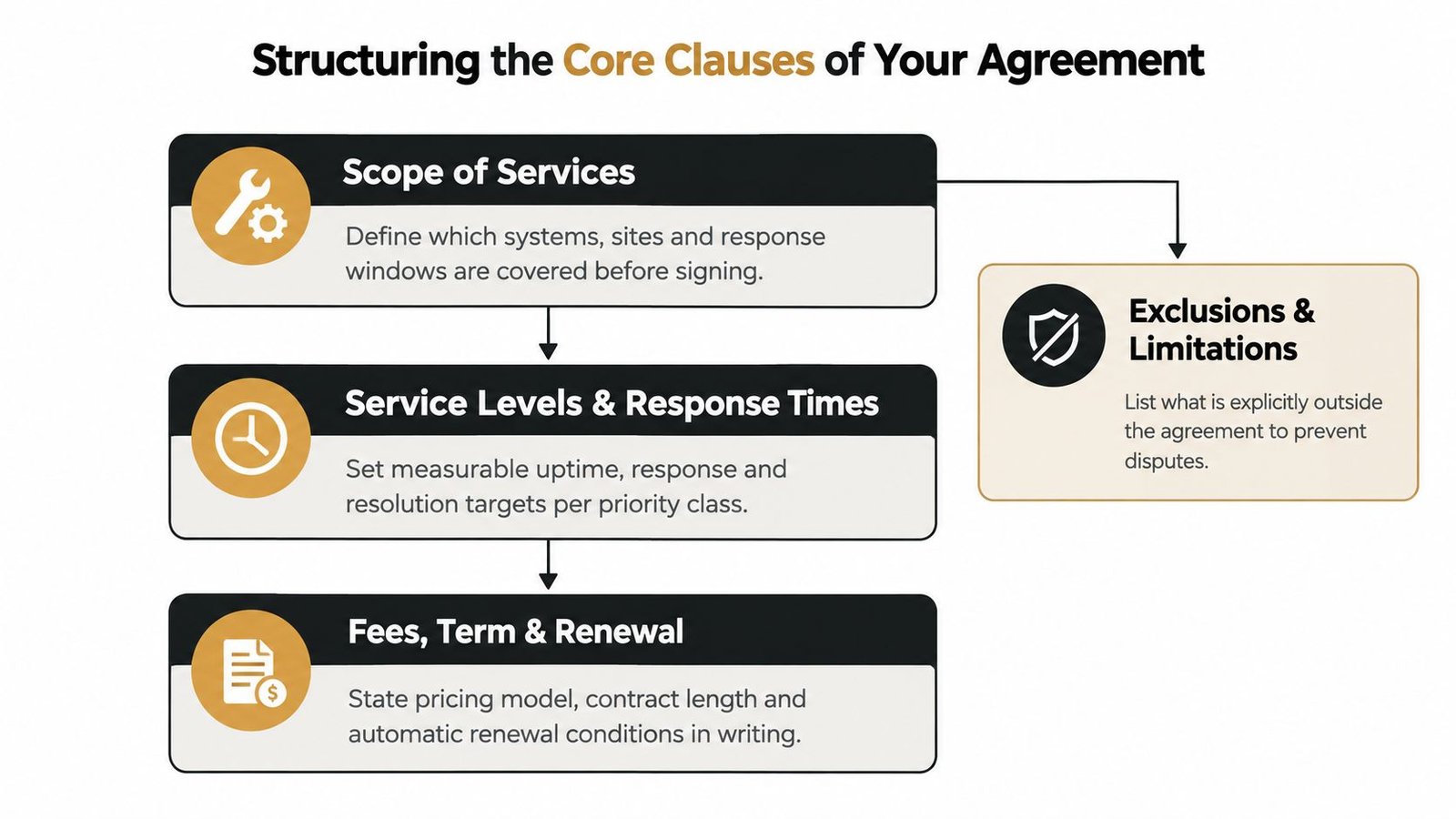
A maintenance support agreement should be drafted as an operating document, not treated as a vendor brochure. Start with the equipment register, then build the service obligations around the consequences of failure.
Define scope by asset and intervention
List each covered machine, system, site, and relevant subsystem. “Assembly line” isn't precise enough. Identify the robot, PLC, HMI, safety circuit, vision station, fixtures, sensors, drives, pneumatics, and any custom controls that the provider is expected to support.
Then specify the work:
- Preventive maintenance: State whether the provider will inspect, lubricate, clean, calibrate, adjust, test, and replace defined wear parts.
- Corrective maintenance: Clarify whether troubleshooting, labor, travel, programming, configuration backups, and post-repair testing are included.
- Condition-based work: Explain which alarms, measurements, sensor readings, or operating conditions trigger an intervention.
- Documentation: Require intervention reports, parts used, findings, recommendations, and confirmation of return-to-service checks.
- Specialist responsibility: Identify whether the provider manages OEM escalation or whether your plant must open a separate ticket.
Industrial agreements commonly combine preventive, corrective, and condition-based work, and may cover one machine, a process, or an entire plant. Fives describes maintenance services that can be structured around measurable outcomes, including availability, response times, or energy consumption. That distinction is important because a contract based on labor activity isn't the same as a contract based on operating performance.
Separate the clocks in the SLA
Response time, diagnosis time, on-site arrival, and resolution time are different commitments. A provider that acknowledges an email within the response window hasn't necessarily diagnosed the fault, dispatched a technician, or restored production.
Write each clock separately. Define when the clock starts, which communication channels qualify, how priority is assigned, and when the clock pauses. If the provider needs information from the plant, the agreement should state what information is required and how that affects the measurement.
Benchmarks cited for internal plant teams set 15 minutes for critical failures, 2 hours for high-priority issues, 8 hours for normal issues, and 48 hours for low-priority issues. These figures appear in maintenance SLA guidance for manufacturing plant teams. Use them as discussion points, not automatic promises. A remote facility, a validated production area, and a line with local spares may need different targets.
Match frequency to risk
Don't schedule every asset on the same calendar. Tier equipment by operational criticality, failure consequence, redundancy, utilization, and access requirements. A bottleneck station may require inspections by operating hours, while a lightly used fixture may need a less frequent visit.
Contract language can specify weekly, monthly, quarterly, annual, or usage-based service. CIMEC's explanation of maintenance contracts describes common inclusions such as scheduled inspections, calibration, spare-parts coverage, documentation, and a single point of contact. Your agreement should go further by identifying the exact checklist and acceptance criteria for each visit.
Check warranty interactions before signing. Confirm who may perform the work, which parts are approved, how records must be kept, and whether third-party intervention affects the manufacturer's warranty. A low-cost maintenance arrangement that creates a warranty dispute later isn't a saving.
For practical drafting, use vendor management best practices to verify responsibilities, escalation contacts, documentation standards, and review processes before the contract enters procurement.
Choosing the Right Pricing and Performance Model
The pricing model should follow the risk profile of the equipment. A semi-automated line with stable utilization may need predictable preventive coverage. A validated production asset that constrains the entire plant may justify a commercial structure that gives the provider a direct incentive to protect availability.
Fixed preventive pricing
A fixed upfront premium can cover defined preventive and corrective maintenance over an agreed period. This approach works when the asset population, usage pattern, service intervals, and likely intervention types are reasonably understood. It gives the plant a predictable service budget and gives the provider a known operating envelope.
The weakness is scope. If the premium covers only scheduled visits but excludes the failures that matter most, the plant pays for activity without receiving dependable protection. Fixed pricing also becomes inefficient when utilization changes significantly or when the equipment proves more reliable than the original assumptions.
An empirical study of about 5,000 contracts across roughly 3,000 machines found that preventive maintenance was usage-based and scheduled by operating hours. The study of maintenance contracts and machine usage supports pricing around expected maintenance risk rather than relying on ad hoc break-fix work.
Condition-based pricing
Condition-based maintenance links intervention to equipment health rather than a calendar alone. The provider may use vibration readings, temperature, lubrication condition, alarm history, cycle counts, or other available data to determine whether an inspection or replacement is justified.
This model suits assets with variable utilization or detectable failure patterns. It can reduce unnecessary visits, but only if the data is reliable and both parties agree on thresholds. The contract must identify who owns the sensors, who reviews the data, how often alerts are assessed, and what happens after an alert.
A condition-based model isn't automatically predictive maintenance. It becomes commercially useful only when the agreement connects a signal to a defined action, response window, parts decision, and record of the result.
Outcome-based pricing
Outcome-based agreements tie payment, incentives, or service credits to results such as equipment availability, response performance, or energy efficiency. They can align vendor behavior with production goals, but they require clean baselines, agreed exclusions, and shared control over the outcome.
A provider can't fairly guarantee uptime if the plant controls production scheduling, operator training, utilities, raw materials, changeovers, and process recipes without sharing that information. The buyer should also distinguish equipment availability from total line output. A machine may be available while upstream material shortages prevent production.
| Model Type | Best Use Case | Risk Allocation | KPI Focus |
|---|---|---|---|
| Fixed preventive | Stable equipment with predictable utilization and defined service intervals | More risk remains with the buyer when exclusions are broad | Scheduled compliance, covered interventions, service spend |
| Condition-based | Assets with variable use and measurable health indicators | Risk is shared through agreed thresholds and actions | Alert response, condition trends, avoided failures, parts decisions |
| Outcome-based | Critical assets where uptime or energy performance has direct business value | More provider risk, provided the buyer controls and reports operating conditions | Availability, response performance, resolution performance, energy consumption |
For GMP-sensitive environments, outcome-based pricing can be attractive because the commercial conversation centers on reliable, documented production continuity rather than the number of technician hours. It also demands stronger governance. Define how validation work, approved changes, deviations, release testing, and production holds affect the KPI.
The best contract may be hybrid. Fixed coverage can handle routine preventive work, condition-based triggers can govern variable interventions, and outcome incentives can reward the provider for maintaining agreed performance. That structure avoids forcing every asset into the same commercial box.
Negotiating Terms That Protect Production Goals
Vendor templates usually reflect the supplier's preferred risk position. They may be reasonable starting points, but they rarely reflect the cost of your bottleneck, your validation process, or the consequences of a delayed specialist repair. Negotiate from the production goal backward.
Begin with exclusions. Every exclusion should answer three questions: what is outside scope, who becomes responsible, and what commercial treatment applies when the issue occurs. “Specialist repair excluded” isn't enough. Name the specialist category, identify the escalation route, state whether the primary provider coordinates it, and define whether travel, diagnosis, and project engineering are billed separately.
Spare parts deserve the same precision. Specify whether normal wear parts, critical spares, consumables, emergency stock, shipping, and obsolete components are covered. If the provider recommends a spare-parts list, make it part of the operating plan rather than an optional sales attachment. A plant that owns the right critical parts can shorten recovery, but only if the agreement defines storage, replenishment, compatibility, and responsibility for unused inventory.
Trade labor rates for shared risk
A low hourly rate can distract buyers from a weak service model. The core questions are whether the provider arrives quickly, brings the correct expertise, fixes the fault properly, and prevents repeat failures.
Preventive programs can reduce unplanned downtime by 30–50%, while emergency repairs after failure can cost 50–100% more than scheduled service, according to preventive maintenance guidance from BuildOps. Those figures support a commercial preference for planned work, but they don't justify paying a premium for visits that don't address the actual risk.
Ask for service credits, fee adjustments, or corrective action requirements when agreed performance isn't met. Don't make penalties so aggressive that the provider just prices in the maximum exposure. Shared-risk terms work better when both sides define controllable causes, plant-caused delays, force majeure events, parts availability, and validation holds.
Protect the handover from commissioning
The transition from equipment commissioning to long-term support often creates a hidden gap. The project team knows the machine, the service team receives incomplete records, and the plant assumes the one-year guarantee covers issues that the service contract treats as chargeable.
Require a formal handover package. It should include as-built drawings, software and parameter backups, manuals, spare-parts recommendations, maintenance checklists, known defects, safety documentation, training records, and open punch-list items. State which issues remain under the guarantee and when the maintenance support agreement takes responsibility.
Escalation should reach a named service manager, not a generic inbox. Require an incident review for repeated failures, unresolved tickets, missed response targets, or any event that affects validated production. A vendor becomes a partner when it accepts accountability after the invoice is issued, not merely when it promises availability during the sales process.
Onboarding Your Vendor and Tracking KPIs
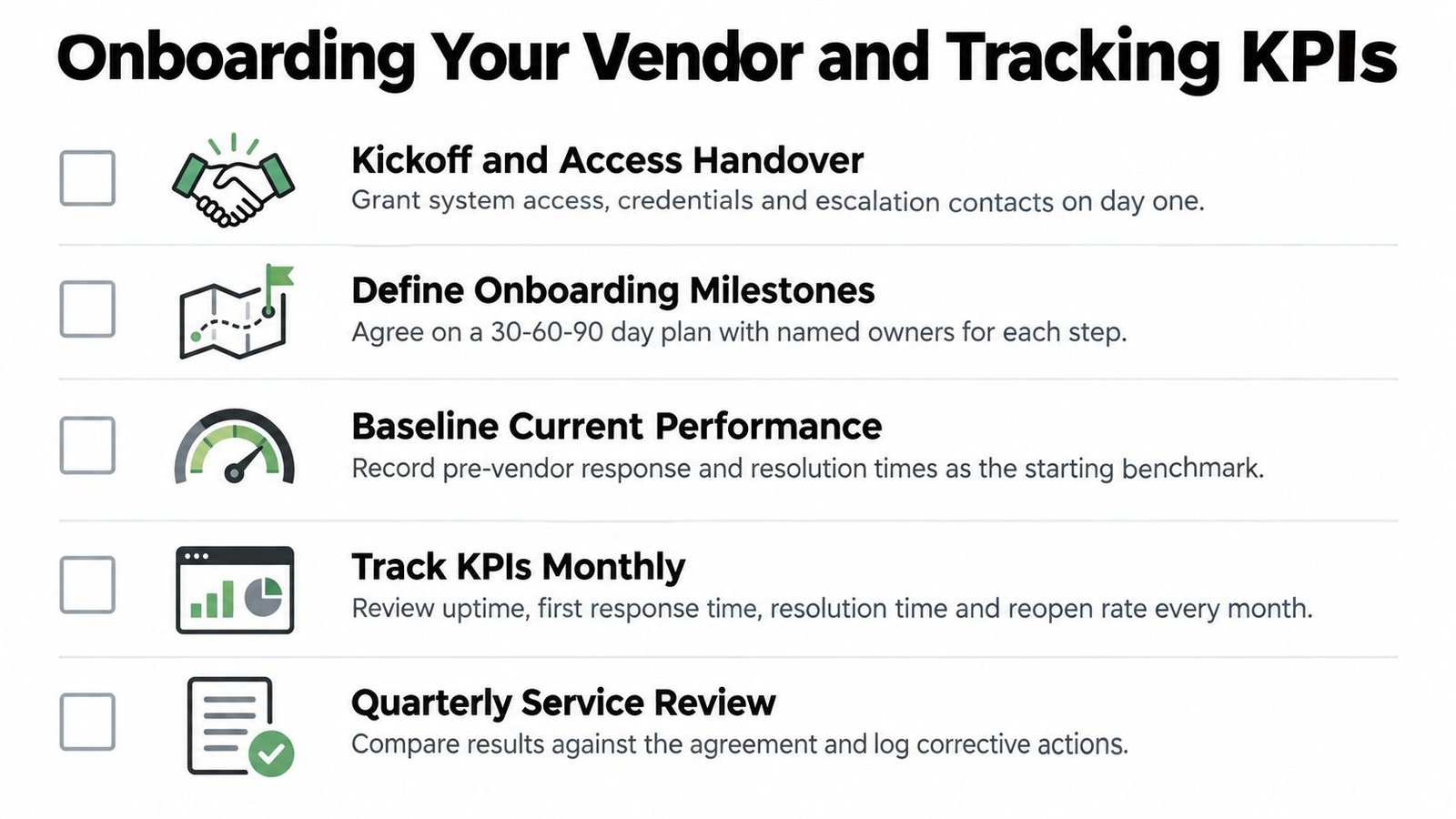
Signing the agreement doesn't put a technician inside your operating system. The provider needs access, context, procedures, contacts, and a shared definition of acceptable performance. Your plant team also needs to know what to report and how to escalate a problem before it becomes a line stop.
Establish the operating baseline
Start with an asset walkdown. Verify serial numbers, software versions, safety interfaces, access restrictions, utility requirements, critical spares, and the location of technical records. On a medical-device line, include the quality representative early. The vendor needs to understand which changes require approval, which records must be completed, and what testing is needed before release.
Assign one plant owner and one vendor owner. Everyone can contribute information, but accountability should remain clear. Create an escalation tree with operations, maintenance, quality, engineering, purchasing, and the provider's technical and commercial contacts.
The CMMS should be the system of record for work orders. Don't rely on technician emails or handwritten notes to build the history. Every event should record the asset, symptom, failure mode, response time, arrival time, diagnosis, action, parts, test result, and closure approval.
Track KPIs that expose weak service
A dashboard should show whether the agreement protects production, not just whether the vendor completed visits. Useful measures include:
- First-time fix rate: Shows how often the technician resolves the issue without a repeat visit or avoidable parts delay.
- Mean time to repair: Measures the elapsed time from failure notification to restored function. Define whether waiting for production access or validation approval is included.
- Schedule compliance: Shows whether planned preventive tasks occurred within the agreed window.
- Repeat failure rate: Identifies repairs that restore operation temporarily without correcting the underlying cause.
- Response and arrival performance: Keeps remote acknowledgement separate from physical attendance.
- Reopen rate: Reveals tickets closed before the plant confirmed stable operation.
- Documentation quality: Confirms that reports, parameter changes, calibration records, and release checks are complete.
Don't let a strong schedule-compliance score hide poor first-time fixes. A provider can complete every planned visit and still perform badly if faults recur, reports lack useful detail, or technicians repeatedly escalate basic issues.
The agreement should define how each KPI is calculated. For example, mean time to repair needs a clear start point, end point, clock-pausing rules, and treatment of parts or quality holds. Without that definition, monthly reviews become arguments about arithmetic rather than decisions about reliability.
Make reviews operational
Hold a regular service review using CMMS records, not presentation slides alone. Examine the largest interruptions, repeated alarms, deferred preventive work, parts consumption, missed SLA events, and recommendations that remain open. Ask the provider to identify the failure mechanism, not merely describe the corrective action.
Use the review to update the maintenance plan. If a component fails repeatedly, change the checklist, stocking strategy, design, or operating method. If the provider lacks access to the data needed for diagnosis, resolve that constraint instead of blaming the technician.
The following video can help frame the practical relationship between support activities and production performance:
A maintenance support agreement should evolve when evidence changes. Monthly KPI tracking and periodic commercial reviews keep the document connected to actual equipment condition instead of allowing it to become a static attachment to a purchase order.
When to Renegotiate or Shift to Condition-Based Maintenance
A fixed annual contract becomes questionable when the equipment's operating reality no longer matches the assumptions used to price it. Low utilization, stable condition data, repeated first-time-fix failures, and volatile spare-parts exposure all indicate that the original arrangement deserves review.
Start with utilization. If a line now runs fewer hours, seasonal production has changed, or a redundant machine carries most of the load, calendar-based visits may no longer reflect actual maintenance risk. Ask the provider to review service frequency against operating hours, failure history, and condition indicators. The answer might be fewer routine visits, usage-based scheduling, or a revised asset tier.
Repeated first-time-fix failures point to a different problem. They may indicate poor diagnosis, insufficient technician training, missing parts, weak documentation, or a design issue. Don't respond by only adding more visits. Require a root-cause review and decide whether the agreement should include engineering support, remote data access, a critical-spares commitment, or a performance obligation.
Use data as a commercial trigger
Sensor data can support a shift toward condition-based maintenance when it shows stable equipment health and the plant can act on meaningful deviations. The contract should identify the monitored variables, alarm thresholds, review ownership, data retention, and response process. If nobody has authority to interpret the signal or schedule the intervention, the sensor adds cost without changing maintenance behavior.
Spare-parts volatility also deserves attention. If a component is frequently unavailable, obsolete, or subject to long lead times, the right response may be redesign, alternate qualification, local stocking, or a broader lifecycle agreement. A condition-based model won't solve a supply problem by itself.
Use predictive maintenance implementation guidance to assess whether your equipment data, controls architecture, and maintenance process can support the transition. The decision should be based on actionable information, not on adding sensors because the technology is available.
Service contract optimization can deliver 15–34% contract cost reduction and 12–18 month ROI when CMMS data is used effectively to move toward managed maintenance contracts, according to industry guidance on maintenance contract optimization. Treat those figures as a reference point, not a guaranteed result. Your outcome depends on data quality, asset criticality, vendor capability, and the commercial terms you negotiate.
Renegotiation should preserve reliability while removing waste. Keep fixed coverage where failures are difficult to predict or consequences are severe. Shift variable-use assets toward operating-hour or condition-based triggers. Add outcome incentives only where the baseline is credible and both parties control the factors being measured.
System Engineering & Automation provides equipment design, installation, commissioning, maintenance planning, and ongoing support for semi-automated and custom manufacturing systems, including GMP-aware applications. Visit System Engineering & Automation to discuss a maintenance support approach that matches your equipment, production goals, and service-risk profile.