Equipment failures without documented maintenance history take 40% longer to diagnose and repair than failures supported by complete logs. A well-designed equipment maintenance log turns that lost time into usable evidence for safer work, more predictable production, and better automation decisions.
A semi-automated workstation can look simple from the operator's side. A fixture locates the part, a sensor confirms presence, an actuator performs the movement, and a controller coordinates the sequence. When one component fails, however, the whole station may stop. The technician asks what changed, which parts were replaced last time, and whether the same fault has appeared before. If nobody recorded the answers, diagnosis starts from scratch.
That situation is common in small and mid-sized facilities. Maintenance knowledge lives in one technician's memory, handwritten notes sit beside a machine, and a work order says only “fixed.” The equipment runs again, but the organization hasn't learned enough to prevent the next stoppage.
A practical log changes that pattern. It creates a time-stamped operating history that connects failures, inspections, repairs, parts, measurements, and verification results. For manufacturers improving production and services, that history supports decisions about tooling, fixtures, controls, preventive maintenance, and the right level of automation.
Table of Contents
- Why Equipment Maintenance Logs Matter More Than Compliance
- Essential Fields Every Maintenance Log Entry Must Capture
- Paper Versus Digital Maintenance Logging Approaches
- GMP and FDA Requirements for Medical Device Manufacturing
- Implementing a Practical Maintenance Log Template
- Turning Maintenance Data into Production Improvements
Why Equipment Maintenance Logs Matter More Than Compliance
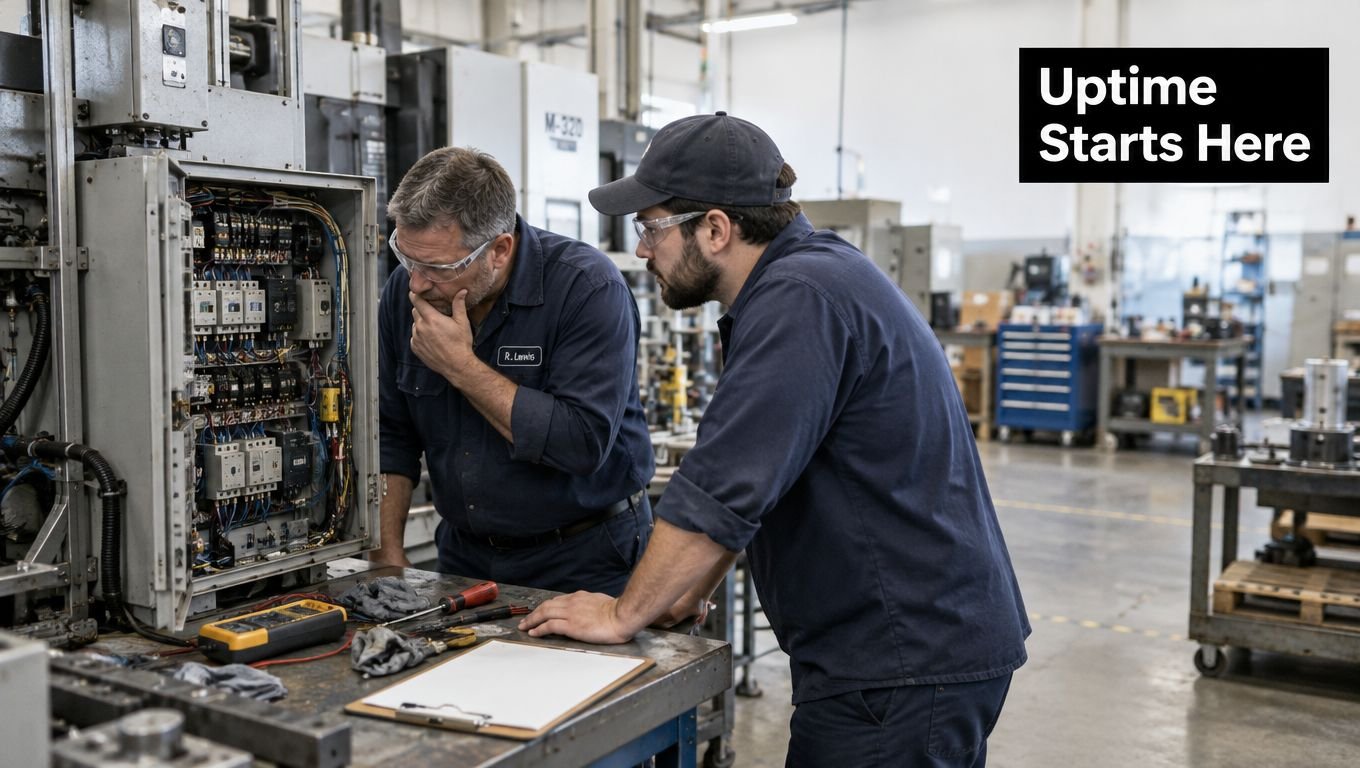
A production supervisor receives a call during a busy shift. A semi-automated assembly station has stopped cycling. The operator reports that the fixture clamps, the sensor light flickers, and the controller shows an intermittent input fault. Two technicians open the control panel and search for a previous repair record. There isn't one.
They inspect wiring, replace a sensor, adjust the fixture, and restart the station. The work gets the line moving, but the record says little more than the date and the replacement part. The next technician won't know whether the original issue was a loose connection, poor sensor alignment, vibration, contamination, or a failing input card.
The log is a reliability record
Equipment maintenance logs are central to measuring and improving reliability because they create the time-stamped history needed to calculate mean time between failures, mean time to repair, and planned-maintenance percentage. An industry survey cited in maintenance-log best-practice guidance found that failures with no prior maintenance history took 40% longer to diagnose and repair than failures supported by documented records.
That figure isn't a universal constant for every plant. It is a useful benchmark for the cost of undocumented knowledge. With a complete record, technicians can review earlier symptoms, inspection results, replaced components, repair methods, and recurring patterns instead of repeating the same investigation.
The log also helps managers separate isolated faults from systemic problems. If the same actuator fails under the same operating condition, the corrective action may involve a redesigned mount, a revised maintenance interval, a different spare part, or a change to the workstation. Without historical data, teams often keep replacing the symptom.
Practical rule: If a technician can't use the record to understand what happened before touching the machine, the log is documenting activity, not improving reliability.
Why this matters for semi-automation
Semi-automated equipment often concentrates risk in a small number of components. A single sensor, pneumatic cylinder, servo, fixture, or control input can constrain the output of an entire workstation. That makes the maintenance history valuable even when the plant doesn't need an expensive predictive-maintenance platform.
Manufacturers can use the record to evaluate whether an automation upgrade improved availability, whether spare parts are stocked at the right level, and whether planned service prevents emergency work. A disciplined equipment maintenance procedure should therefore define not only how technicians repair equipment, but also what evidence they must preserve.
Compliance still matters, but it shouldn't be the reason the log exists. The stronger reason is operational control. A record that supports troubleshooting, production planning, safety reviews, and engineering changes earns its place on the shop floor.
Essential Fields Every Maintenance Log Entry Must Capture
A useful equipment maintenance log doesn't need endless questions. It needs a controlled minimum data set that technicians can complete while the facts are still visible. Free text has a place, but consistent fields make history searchable and comparable.
Start each entry with the asset's name, unique identification number, location, and equipment family. “Assembly station” is too broad. “Station 04, clamp fixture, asset ID F-004” lets a supervisor connect the event to the right drawings, spare parts, procedures, and prior work orders.
Record the event as it happens
Capture the date and time, technician, work-order number, operating condition, and production state. Note whether the asset was running, in setup, recently cleaned, under unusual load, or idle. For a sensor fault, record the symptom in observable terms, such as “presence sensor failed to confirm part after clamp closed,” rather than “sensor bad.”
A controlled structure should include the following fields, consistent with maintenance-log compliance guidance:
- Asset and work order: Identify the machine, component, location, and job reference.
- Failure description: Record the symptom, failure mode, alarm, affected cycle, and operating conditions.
- Corrective action: State what the technician inspected, adjusted, repaired, or replaced.
- Parts and materials: Include the component, part identification, and any traceability details required by site procedures.
- Measurements: Add readings such as pressure, voltage, alignment, temperature, force, or cycle confirmation where relevant.
- Downtime: Record when the stoppage began, when intervention started, and when the equipment returned to production.
- Next due date: Identify the next inspection, calibration, lubrication, replacement, or preventive task.
For GMP-aware or laboratory equipment, add calibration or verification results, adjustments, service-provider identity, and the interval or due date for the next calibration. These fields connect maintenance work to equipment performance rather than treating service as an isolated event.
Verify before closing
The most frequently missed field is often the final one. A technician may replace a component and close the job without recording whether the machine passed a functional check. The entry should state the acceptance criteria, test result, and person authorized to release the equipment.
Use standardized failure and cause codes alongside a short narrative. Codes make it possible to trend recurring sensor faults or pneumatic leaks, while the narrative preserves the context. A monthly review should flag entries containing only “fixed,” missing symptoms, missing downtime, or no post-repair verification.
A good record answers five questions quickly: What failed? Why did it fail? What changed? How was it tested? Who released it?
Paper Versus Digital Maintenance Logging Approaches
A filler line stops on the capper during second shift. The operator calls maintenance, a tech clears the fault, production restarts, and the only record is a note on a clipboard with a time and a signature. That may satisfy a local habit, but it does very little for the next stoppage on the same machine.
Paper still has a place. In a small shop with few assets, stable equipment, and simple preventive work, a paper log is fast to start and easy to carry. It also keeps working when Wi-Fi drops, tablets are broken, or no one has time to configure software during a busy week.
The limit shows up once the log needs to support decisions on the floor. Supervisors cannot quickly pull the last three seal failures on one machine, compare repeat faults across similar assets, or see which preventive tasks keep slipping. Handwritten entries arrive late, wording varies by technician, and damaged pages are common in oily, high-touch environments. In practice, paper turns the maintenance log into storage, not an operational tool.
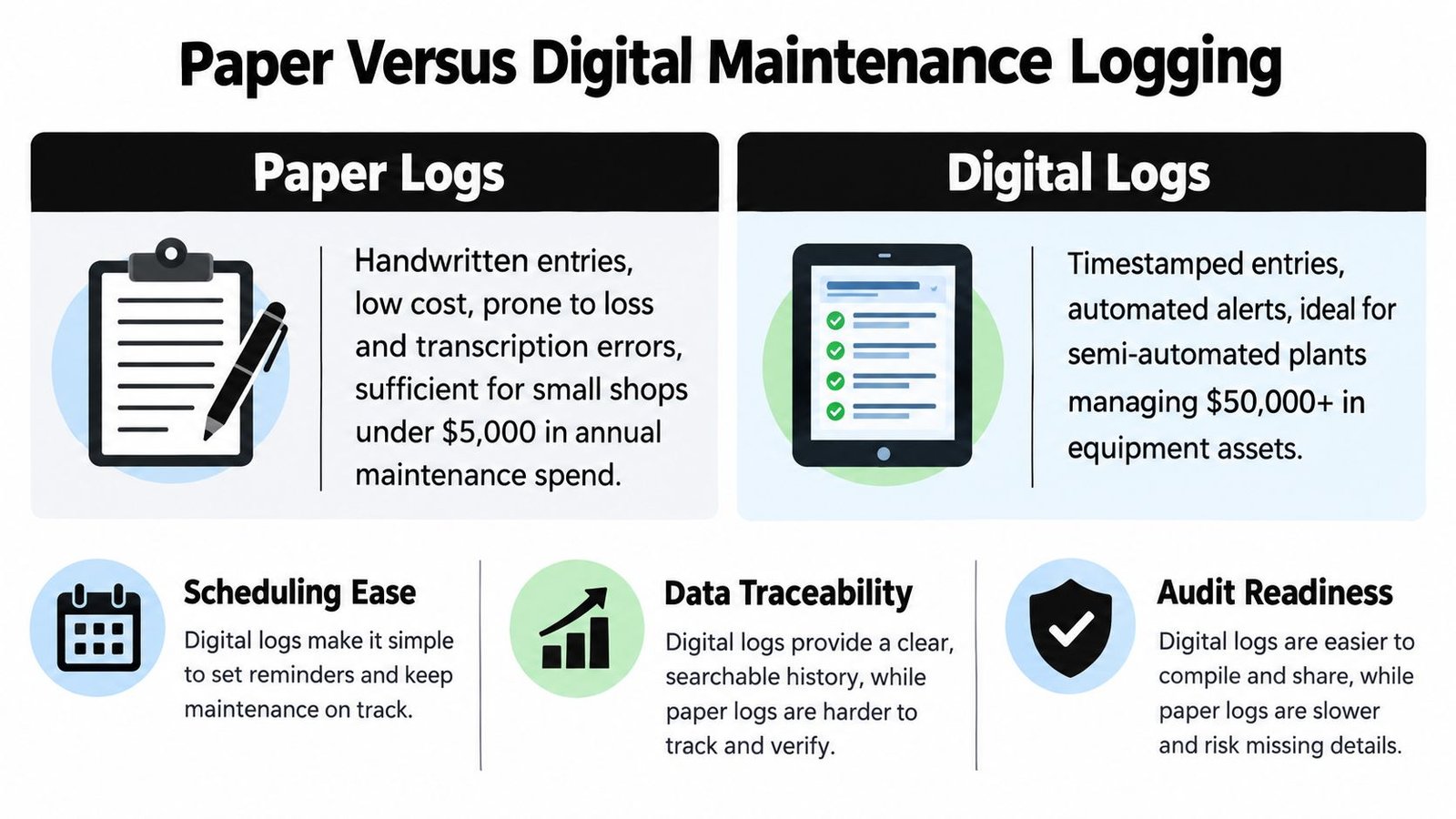
Digital systems solve different problems, but only if they match the plant. I have seen small facilities buy software built for large enterprise teams, then watch technicians click through irrelevant fields while a semi-automatic line waits for release. Setup takes work. Someone has to define assets, set mandatory fields, train users, control access, and keep the forms aligned with how the equipment is maintained.
Done well, digital logging changes the job from recordkeeping after the fact to control during the event. A technician can pull the asset record by QR code or ID, see the right checklist, enter readings at the machine, attach a photo, choose a failure code, and document the release decision before the work order closes. That matters most in small to mid-sized plants running semi-automated equipment, where the same machine may need mechanical, pneumatic, electrical, and operator-context notes in one place.
The practical choice is usually between paper and a focused digital tool, not paper and a full enterprise CMMS. Use paper if supervisors can review entries the same day and the asset count stays manageable. Move to digital when work spans several areas, missed PMs are recurring, history searches are routine, or maintenance records need to line up with downtime and quality results. If the digital form makes bad entries harder and useful entries faster, it is doing its job.
GMP and FDA Requirements for Medical Device Manufacturing
A semi-automatic assembly station stops for a sensor fault, maintenance swaps the part, and production wants the line back now. In a medical-device plant, the job is not finished when the alarm clears. The maintenance record has to show what failed, what was checked, what was adjusted, and who authorized the equipment to return to service. Under FDA quality-system expectations, equipment maintenance, inspection, and the related records sit inside the documented quality system, with requirements for schedules, procedures, and documented periodic inspections, as outlined in the FDA quality-system overview.
For small and mid-sized facilities, that matters because semi-automated equipment rarely fails in one clean category. A feeder issue can become a sensor fault. A pneumatic drift can create a reject trend that looks like an operator problem. If the log only proves that someone did maintenance, it satisfies paperwork but does very little for release decisions, investigations, or repeat-failure control.
Retention rules are strict. Records tied to the medical-device quality framework must be kept for the device's design and expected life, and never for less than two years from the date of commercial release. In practice, retrieval matters just as much as retention. A record no one can find during a deviation review has little value.
Good traceability connects the maintenance event to the production reality around it. That usually means the asset ID and location, the scheduled or triggered maintenance date, the findings, any calibration or verification result, the person who performed the work, and the check that allowed return to production. It should also show equipment status during the event, available, restricted, or removed from service, because that detail often becomes important later when a batch, complaint, or device history record is reviewed.
The best time to set this up is before commissioning, while the machine builder, controls engineer, validation team, and maintenance lead can still define service points, inspection criteria, wear parts, fault recovery, and release checks together. I have seen plants postpone that work until after startup. They usually end up with vague logs, inconsistent entries, and investigations that rely too heavily on memory.
Paper and electronic systems can both meet GMP expectations. The test is simple. The record must stay legible, attributable, retrievable, protected, and consistent with site procedures. Electronic systems also need access control and backup. Paper systems need controlled forms, secure storage, and a filing method that works under production pressure.
Implementing a Practical Maintenance Log Template
At 2:13 a.m., a semi-automated station stops between cycles. The operator resets it, production restarts, and by day shift the only record says “machine fault, adjusted sensor.” That kind of entry satisfies paperwork, but it does not help the next technician decide whether the problem was a drifting bracket, a contaminated photoeye, a loose connector, or an intermittent control issue. A practical template has to support decisions at the machine.
Start by setting up the log around asset risk and failure behavior, not around whatever fields the software happens to offer. On small and mid-sized lines, that means separating the line from the workstation, then breaking out fixtures, sensors, actuators, controls, and safety devices where failures change quality, uptime, or restart conditions. Rank those assets by their effect on safety, product quality, delivery, and time to recover. That ranking determines how much evidence the log should require.
Two field levels work well in production. Required fields cover traceability, safe release, and work-order closure. Optional fields capture deeper detail when a technician has a reading, a photo, or time to document a non-routine condition.
For semi-automated equipment, the entry should move in the same order the work happens on the floor: identify the asset, link the work order, note the machine state and recent operating context, record the symptom and inspection findings, document the intervention, capture verification results, then record release status and any follow-up. In practice, that means fields such as asset ID, workstation, work-order number, priority, run state, recent setup, alarm or symptom, failure mode code, suspected cause, corrective action, parts used, labor time, downtime, measurements, acceptance criteria, functional test result, release-to-service status, next due date, and supervisor review.
Keep coded fields tight. Keep one narrative field open.
Technicians need both. Codes make repeat failures sortable. The short narrative explains what the code cannot, such as “fault appears only after changeover” or “sensor bracket shifted during washdown.” Enter observations while the work is happening. End-of-shift reconstruction usually wipes out the original symptom and turns downtime into an estimate.
Photos and instrument readings should be attached when they change the release decision or help prove equipment condition later. That matters most for safety devices, quality-critical fixtures, calibration activity, and chronic repeat failures. As noted in this equipment calibration and maintenance-management reference, stronger maintenance control depends on documented evidence, not memory.
A short form completed accurately beats a detailed form filled out from memory.
Rollout should stay narrow at first. Use the template on a small set of semi-automated workstations that create the most disruption, keep the core fields the same across all of them, and add machine-specific checks only where they affect repair, release, or escalation. Tie recurring work to a defined equipment maintenance schedule so planned tasks and breakdown records live in the same system.
Then audit how the form performs in real use. Review a monthly sample for mandatory-field completion, repeat failures, MTTR, MTBF, maintenance-related downtime, and open follow-up actions. The goal of the audit is to identify fields that are unclear, unavailable at the machine, or irrelevant to the actual task. Good templates get revised. If technicians skip a field every week, either the field is poorly designed or the process around it is.
Turning Maintenance Data into Production Improvements
A completed log becomes valuable when managers use it to change production decisions. Review planned and emergency work, downtime hours, repeat failures, parts consumption, labor time, and post-maintenance quality results together. One metric alone can mislead. A high preventive-maintenance completion rate may coexist with repeated failures if the tasks are poorly designed or technicians close them without checking effectiveness.
Read the pattern, not just the event
A useful dashboard pairs PM compliance and schedule adherence with emergency-work percentage, repeat-work percentage, MTTR, MTBF, and verified first-pass yield after maintenance. Segment those measures by asset family. A fixture that creates repeated quality escapes needs a different response from a sensor that fails only during an unusual setup.
NIST's 2021 survey of U.S. manufacturers found that plants relying more heavily on preventive and predictive maintenance recorded 52.7% less unplanned downtime and 78.5% fewer defects than plants relying more on reactive maintenance, according to the NIST maintenance-costs survey. NIST also estimated average total annual maintenance-related costs and losses at $222 billion using Monte Carlo analysis.
Those figures don't tell a plant which machine to automate. The maintenance history does. Repeated manual adjustments may justify better tooling. A fixture that loses alignment may need a redesigned locating strategy. A sensor with measurable drift may need condition monitoring or scheduled replacement. A workstation that repeatedly waits for maintenance may need improved access, spare-parts control, or a more resilient control architecture.
Convert findings into engineering action
Use a monthly review with clear owners:
- Operations assigns production impact and confirms whether downtime coding reflects reality.
- Maintenance validates failure modes, repair duration, parts use, and recurrence.
- Quality reviews post-repair acceptance and any affected product or process results.
- Engineering decides whether the response should be a revised PM task, tooling change, control change, training update, or automation project.
- Management compares the intervention cost with recurring downtime, labor dependency, safety exposure, and quality risk.
This creates a practical route to predictive-maintenance implementation without jumping directly to advanced sensors. First make the records reliable. Then identify assets where condition data can support a better service decision.
A maintenance log should ultimately answer whether the plant is becoming more predictable. Are emergency interventions becoming planned? Are repeat faults declining? Does the equipment pass functional and quality checks after service? Do engineering changes remove the original cause?
For manufacturers upgrading manual processes, the answer may be a focused semi-automated workstation rather than a fully automated line. A well-maintained fixture, integrated control, or serviceable actuator can deliver practical gains while preserving flexibility. The log provides the evidence needed to choose that level of investment responsibly.
To move forward, audit your current records, define the minimum required fields, train technicians on observable failure descriptions, and schedule a monthly review with operations, maintenance, quality, and engineering. Then use the first reliable trend to select one recurring problem for correction.
System Engineering & Automation can help manufacturers connect maintenance readiness with practical production improvements through semi-automatic systems, custom tooling, fixtures, integrated controls, commissioning, and ongoing equipment support. Review your current failure history, then visit System Engineering & Automation to discuss a cost-effective solution aligned with your production goals and service requirements.