The line is running, orders are increasing, and the same few people are still compensating for every weak point. An operator records downtime on paper, maintenance hears about failures after the fact, and a production engineer spends the afternoon reconciling spreadsheets instead of improving the process. Management asks whether the plant is ready for a smart factory, while the practical question is simpler: which upgrade will improve output without putting live production at risk?
That's the reality behind manufacturing digital transformation for many small and mid-sized plants. The answer usually isn't a full replacement of existing equipment. It's a carefully sequenced combination of smart tooling, connected controls, targeted data capture, semi-automated workstations, and disciplined adoption. The plants that make progress treat transformation as an operating improvement program, not a technology shopping exercise.
Table of Contents
- What Manufacturing Digital Transformation Really Means on the Plant Floor
- Assessing Readiness Before You Spend a Dollar
- Prioritizing Use Cases Without Overpromising
- Designing Pilots That Actually Reach Production
- Keeping GMP and Compliance Discipline as You Move Faster
- Measuring ROI and Building the Business Case
- Scaling Without Breaking What Already Works
What Manufacturing Digital Transformation Really Means on the Plant Floor
A new machine can raise capacity. A sensor can expose a recurring fault. A dashboard can make a loss visible. None of those changes, by themselves, constitutes transformation.
Manufacturing digital transformation means connecting equipment, information, processes, and people so the plant can make better operating decisions and repeat them consistently. The test is practical. Can a supervisor identify the current constraint? Can maintenance see a developing equipment problem before it becomes a stoppage? Can quality trace a component, recipe, inspection result, and software revision to the finished unit? Can an operator complete the work correctly without relying on one experienced person's memory?
The term Industry 4.0 was formally framed in Germany in 2011 around cyber-physical production systems, connected machines, and data-driven factories. OECD work later established a measurement framework for studying how digital technologies affected productivity, business dynamism, concentration, mark-ups, and mergers and acquisitions across periods including 2001–03 and 2013–15. That history matters because transformation is broader than installing automation. It changes how factories measure performance, organize work, and compete. The OECD's manufacturing digital transformation research provides that wider economic context.
The useful definition
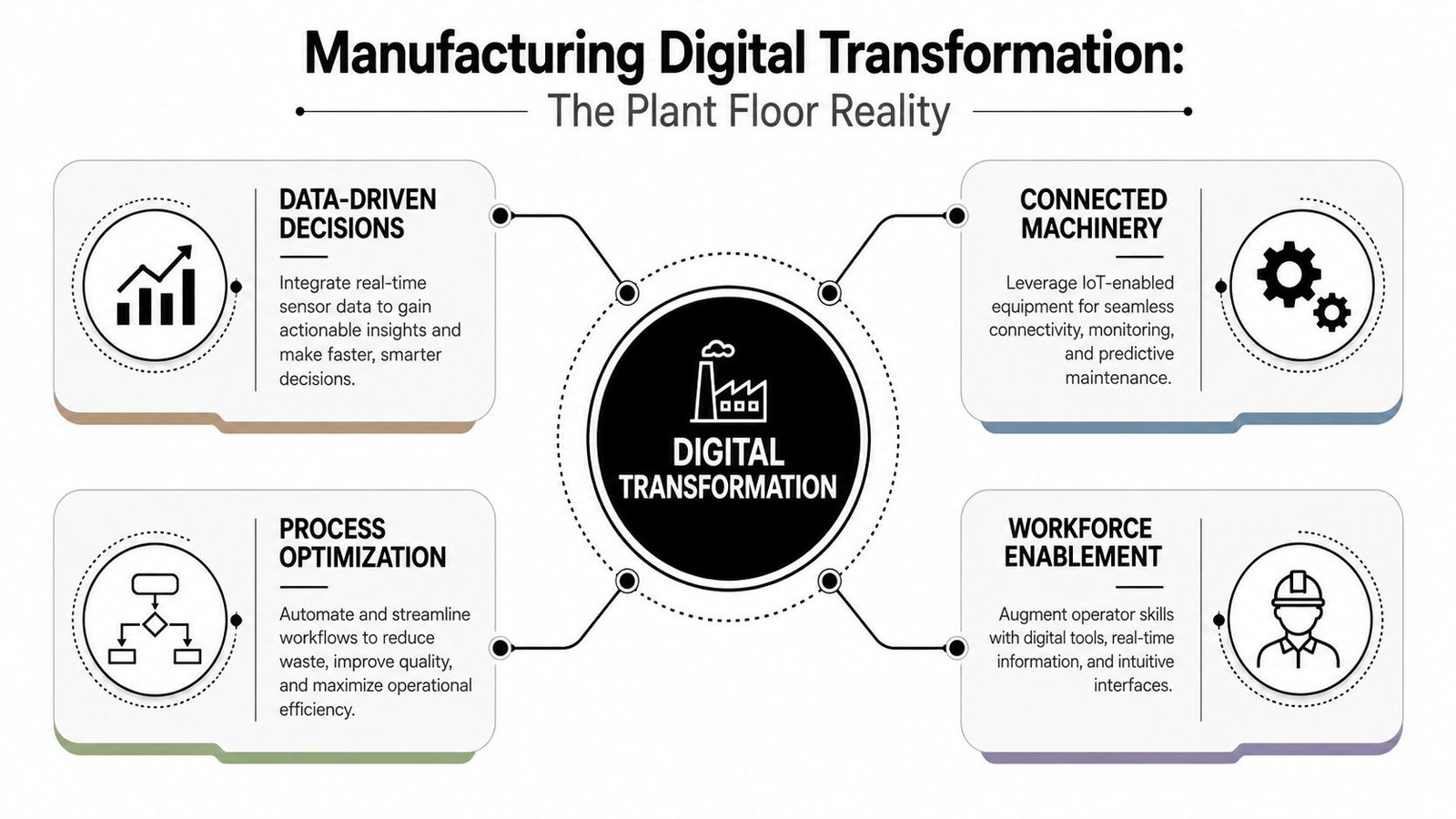
On a brownfield plant floor, transformation usually has four connected parts:
- Data-driven decisions: Capture reliable cycle, fault, quality, and maintenance information at the point where work happens.
- Connected machinery: Link controls, sensors, tooling, and inspection devices without pretending every legacy asset must be replaced.
- Process optimization: Remove repeated handoffs, ambiguous work instructions, and avoidable variation.
- Workforce enablement: Give operators and technicians information that helps them act, rather than adding another screen nobody trusts.
The investment case is significant. Global spending on digital transformation in manufacturing has been estimated at about $440 billion in 2025, with a projection of roughly $847 billion by 2030 and a 13.83% compound annual growth rate, according to manufacturing digital transformation market statistics. Yet the same source reports that only about 10% of manufacturing companies are fully digitized. Adoption is widespread, but deep integration remains uncommon.
That gap explains why a sequenced roadmap beats a big-bang smart-factory pitch. Most plants don't need more disconnected pilots. They need a controlled path from visible problem, to measurable intervention, to standard work, to repeatable rollout. For practical implementation guidance, manufacturers can also review smart manufacturing solutions that connect automation decisions to production and service outcomes.
Assessing Readiness Before You Spend a Dollar
Readiness isn't a maturity score produced by a consultant. It's an honest view of whether the plant can install, operate, maintain, validate, and improve the proposed system.
Start with the equipment. Walk the line with maintenance and document the condition of drives, actuators, guarding, electrical panels, pneumatic circuits, and control hardware. A retrofit makes sense when the mechanical base is sound and the failure modes are understood. It becomes false economy when a new control layer is attached to equipment that already has unstable mechanics, obsolete safety components, or no supportable spare parts.
A one-week readiness check
Use a short floor-based review rather than a long questionnaire.
- Equipment condition: Record recurring faults, available spares, safety deficiencies, and the remaining useful life of the assets that the project will touch.
- Data availability: Identify which signals already exist, which are trustworthy, and which still require manual observation. A tag in a PLC isn't automatically a useful production metric.
- Network and cybersecurity: Confirm how industrial devices communicate, who owns access, how backups work, and whether the proposed connection respects the plant's operational technology boundaries.
- Workforce capability: Ask operators and technicians to demonstrate the current process. Their workarounds often reveal the actual sequence, not the sequence shown on an engineering drawing.
- Quality and compliance: Determine which records, approvals, electronic signatures, calibration controls, and change histories the process requires before design begins.
- Leadership alignment: Agree on the problem owner, the budget owner, the production sponsor, and the person who can stop the project when it creates unacceptable operational risk.
Four signals indicate that a plant is ready to start. The problem is visible in production data or repeatable observation. A responsible owner can define the desired result. The equipment can accept the intervention without destabilizing the line. Operators, maintenance, quality, and engineering agree that the proposed change addresses a real constraint.
Three warning signs call for foundation work first. Nobody agrees on the baseline. The project depends on undocumented tribal knowledge held by one employee. Or the proposed system requires network, validation, or safety decisions that haven't been assigned to anyone. Funding a pilot under those conditions usually produces a demonstration, not a production asset.
Bring maintenance, quality, and operators into the first walkdown, not the final review. A structured automation risk assessment can help expose integration and safety risks before a purchase order turns them into schedule problems.
Prioritizing Use Cases Without Overpromising
Use case selection is where attractive roadmaps often lose contact with the plant. Leaders choose the most advanced technology, then discover that the line has inconsistent work methods, incomplete data, or product variation that the proposed automation can't tolerate.
Score each candidate against four questions: How much production or service value can it create? How likely is it to fail? How difficult is integration? How quickly can the team prove value? I also add a fifth filter, reversibility. If the intervention fails, can the plant return to the previous process without extended downtime?
For many smaller plants, semi-automation is the sensible starting point. A fixture can locate a part, a sensor can confirm presence, a press can complete a controlled operation, and the operator can still load variants or make decisions that software can't yet handle reliably. Full automation earns its place when demand, product stability, takt requirements, safety exposure, and available maintenance capability justify the added complexity.
| Factor | Manual + Smart Tooling | Semi-Automation | Full Automation |
|---|---|---|---|
| Flexibility | Highest, especially for product variation | Strong, with controlled operator involvement | Lowest unless the system is designed for many variants |
| Integration effort | Usually limited to the workstation | Moderate, involving controls, sensors, tooling, and operator interfaces | High, often involving material flow, software, safety, and line coordination |
| Capital exposure | Lower | Moderate and easier to stage | Highest |
| Main strength | Fast improvement to repeatability and ergonomics | Balanced gains in consistency, labor dependency, and throughput | High repeatability for stable, high-volume processes |
| Main risk | Improvement remains dependent on operator discipline | Poor handoff between manual and automated steps | Long commissioning, complex recovery, and difficult changeovers |
| Best fit | Brownfield constraints and mixed production | Small and mid-sized plants seeking practical scale | Stable products and processes with a strong business case |
What to put near the top
Smart tooling and fixtures often deliver the cleanest first move. They can prevent incorrect orientation, control part location, provide poka-yoke feedback, and create a stable interface for later automation. A good fixture also makes operator training easier because the process becomes physically obvious.
Vision inspection deserves a controlled evaluation, not automatic approval. It works well when the defect is visually distinguishable, lighting can be controlled, and the inspection decision can be validated. It won't rescue a poorly defined acceptance criterion.
Connected material handling can reduce searching, waiting, and unnecessary movement, but it must follow the actual value stream. Adding autonomous movement to a poorly sequenced process moves inefficiency faster.
The right first project is rarely the one with the most robotics. It's the one that removes a recurring constraint while preserving uptime, flexibility, and a clear path to the next improvement.
Designing Pilots That Actually Reach Production
A pilot should be treated as a small production launch. It needs an owner, a baseline, controlled requirements, operator involvement, maintenance support, and a decision date. A prototype that works during an engineering demonstration isn't enough.
Start by freezing the scope. Define the product variants, operating range, interfaces, safety functions, quality checks, and recovery behavior. Record the current cycle time, first-pass yield, scrap, rework, minor stops, major downtime, labor content, and ergonomic concerns. If the baseline is vague, the pilot can appear successful because nobody agreed on what success meant.
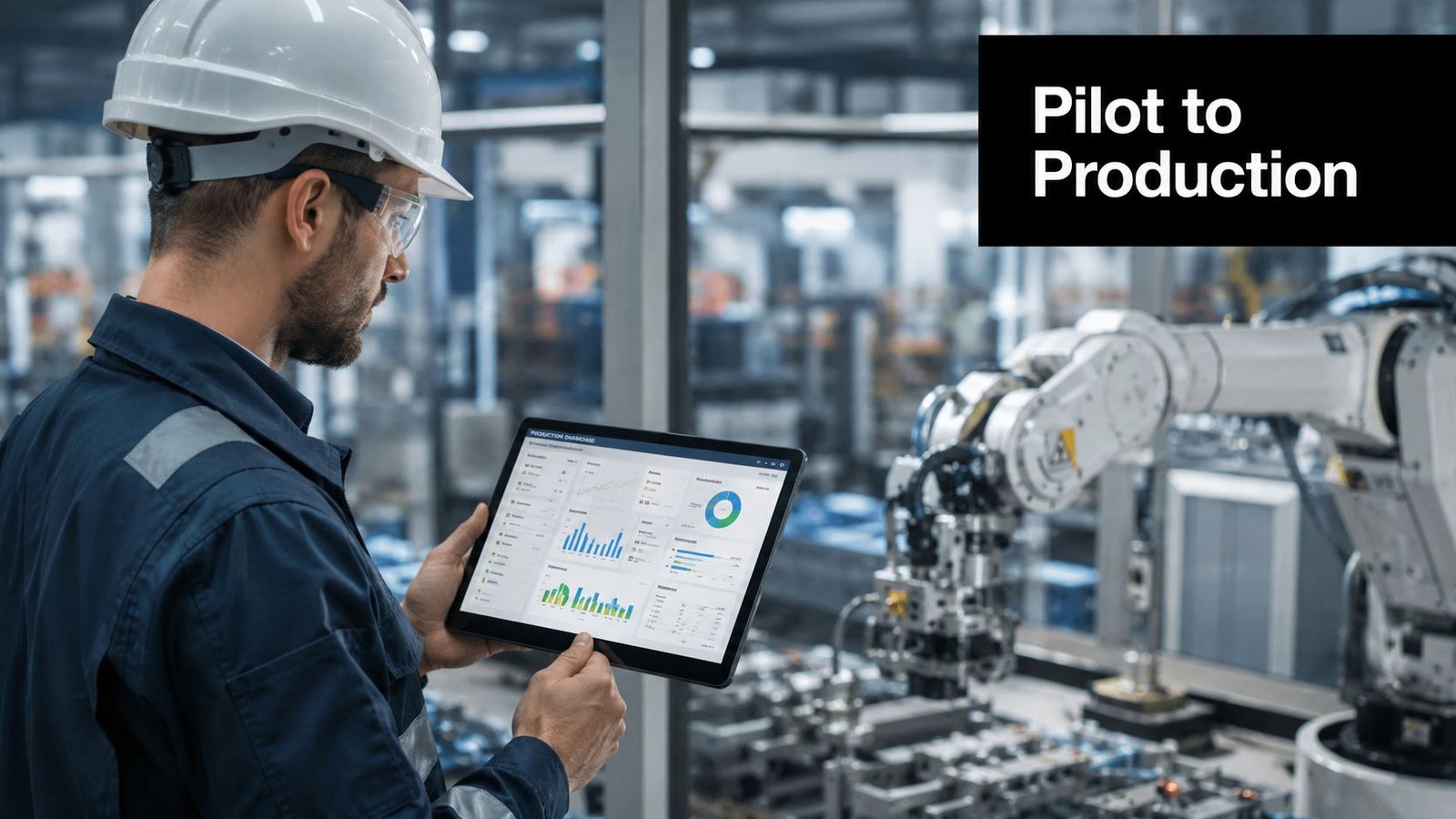
A disciplined 90-day cycle
Days 1 through 30 should establish the design and operating truth. Confirm the process sequence at the workstation, verify the failure modes, select the sensor and control architecture, and involve the people who will troubleshoot the cell. Vendor evaluation should cover documentation quality, service response, spare-parts strategy, controls ownership, safety competency, and willingness to support the handoff.
Days 31 through 60 should prove the system under controlled production conditions. Commission in stages. Test individual devices first, then sequences, fault recovery, changeover, inspection logic, and operator interaction. Capture every nuisance stop and workaround. A cell that reaches its ideal cycle but requires an engineer to reset it isn't ready.
Days 61 through 90 should test repeatability and absorption. Run representative products and shifts. Let operators perform the work and let maintenance resolve faults using the supplied documentation. The go/no-go gate should consider output, quality, recovery time, safety, training completion, and whether the plant can support the system without its original designer standing beside it.
Practical rule: A pilot is ready to scale only when production, maintenance, and quality can operate it correctly without engineering improvisation.
The KPI set should stay small enough to manage. Track cycle time, availability, first-pass yield, unplanned stops, changeover behavior, scrap or rework, and operator interventions. The point isn't to collect every signal. It's to prove that the intervention changes the constraint identified at the start.
The evidence supports short-cycle deployment. A 2023 survey of senior smart-manufacturing decision-makers found that 71% said their initiatives were delivering expected results, while 81% reported first tangible results within 12 months, as reported by Engineering.com's smart-manufacturing coverage. That doesn't justify rushing commissioning. It supports disciplined pilots with early KPI validation instead of multi-year programs that postpone learning.
Before handoff, provide electrical drawings, pneumatic diagrams, software backups, alarm descriptions, parts lists, calibration information, risk assessments, standard work, troubleshooting steps, and training records. The original engineer should be able to leave the area without taking the system's operating knowledge with them.
Keeping GMP and Compliance Discipline as You Move Faster
Regulated production adds a critical requirement: the digital system must produce trustworthy evidence, not merely faster motion. In medical device manufacturing, a semi-automated cell can affect product acceptance, traceability, process parameters, inspection results, and release decisions. Those controls belong in the design from the first concept review.
Begin with intended use. Define what the equipment does, what it does not do, which decisions it supports, and which records become part of the quality system. Then identify the critical process parameters, critical quality attributes, alarms, interlocks, data fields, and user permissions that need control.
Build validation into the cell
IQ, OQ, and PQ thinking remains useful even when the project is modest.
- Installation qualification: Verify that the equipment, utilities, software versions, instruments, drawings, and approved components match the design.
- Operational qualification: Challenge defined operating ranges, alarms, interlocks, reject logic, access controls, and fault conditions.
- Performance qualification: Demonstrate that trained personnel can run the process consistently with approved materials and representative production conditions.
The documentation should tell the same story as the machine. Hardware revisions, PLC or robot programs, HMI screens, recipes, vision configurations, inspection limits, and user roles need controlled identification. A backup that exists but can't be tied to the released configuration isn't a reliable recovery plan.
Data integrity also requires practical attention. Record who changed a parameter, when the change occurred, what approval supported it, and how the system prevents unauthorized alteration. Define retention, review, backup, restore testing, and audit-trail expectations before the system begins collecting production history. Don't add a generic dashboard and assume it meets regulated record requirements.
Preserve production speed without bypassing control
Change control should cover more than physical components. A seemingly minor software adjustment can alter a reject threshold, sequence timing, torque limit, or operator prompt. Quality and engineering need a clear path to assess the change, test it, approve it, and release it.
The best implementation partner understands both the process and the compliance burden. That partner can help translate a production objective into controlled requirements, qualification protocols, traceable documentation, and maintainable equipment. The alternative is asking an internal team to improvise validation after the cell has already been built, which creates avoidable delays and audit exposure.
Fast transformation doesn't mean skipping discipline. It means designing the discipline early enough that it supports progress instead of stopping it.
Measuring ROI and Building the Business Case
Finance leaders rarely approve automation because a technology sounds modern. They approve a credible operating case tied to measurable losses, controlled risk, and a reasonable path to value.
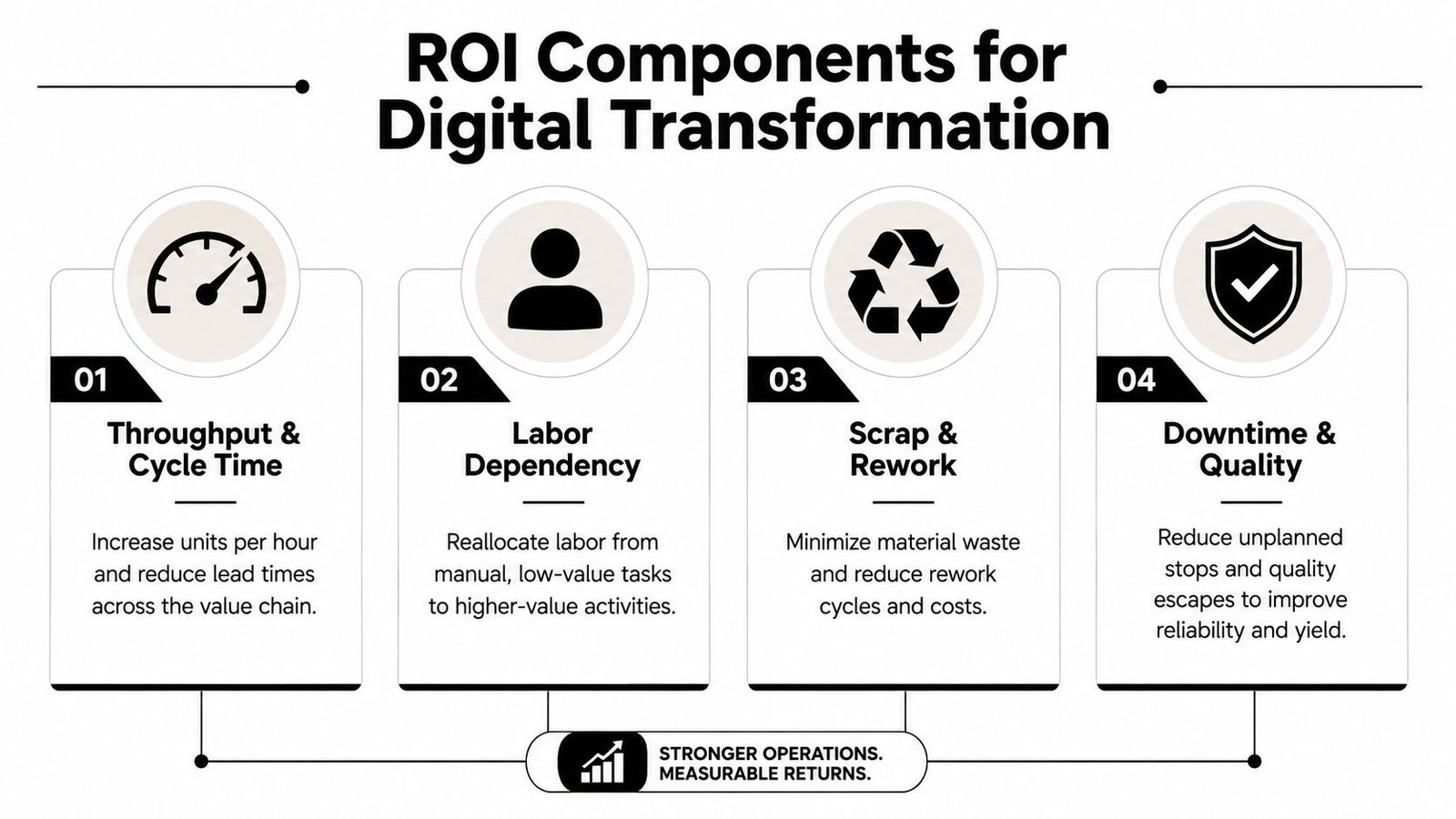
Build the case around four components:
- Throughput and cycle time: Measure actual completed units, not theoretical machine speed. Include waiting, loading, changeover, minor stops, and downstream constraints.
- Labor dependency and ergonomics: Separate direct labor hours from the specialized knowledge required to keep the process running. A project can create value by reducing repetitive handling, exposure to awkward work, or dependence on one highly experienced operator.
- Scrap and rework: Quantify material, inspection, labor, delay, and disposition costs. Prevention at the source is usually more defensible than assuming every avoided defect becomes immediate revenue.
- Downtime and quality escapes: Connect stoppage causes to lost production, expedited maintenance, delayed shipments, complaint handling, and customer risk.
Use conservative assumptions
Establish the baseline from production records, maintenance logs, quality reports, time studies, and direct observation. Don't build the model around the best shift or an ideal product mix. Use a conservative Year 1 case that includes commissioning disruption, training, planned maintenance, consumables, integration effort, and the possibility that the system won't perform at its final design condition immediately.
Then separate Year 1 expectations from longer-term outcomes. The early case should prove that the process is stable and that the main loss is moving in the right direction. A later case can include broader rollout, improved standard work, better data quality, and the value of redeploying people to higher-priority work. Don't count the same saving in both labor and throughput.
Autodesk's 2024 State of Design and Make survey found that 41% of respondents across automotive, process manufacturing, building products, and industrial machinery identified increased productivity as the top benefit of digitization, and those organizations reported an average productivity improvement of 62% from digital investments. The Autodesk digital factories report offers useful sector context, but an individual plant should still build its own baseline rather than copy an external outcome.
Savings that don't appear cleanly in the ERP still belong in the business case when they reduce firefighting, ergonomic strain, turnover pressure, or quality risk.
A second validation point comes from adoption data. One 2024 survey summary reported that about 80% of manufacturing respondents said digitalization was operational or being implemented across supply chain optimization, product planning and development, production efficiency, data analytics, and business intelligence, according to Automation World's manufacturing digitalization coverage. The breadth of activity reinforces the need to connect an automation proposal to both factory-floor and upstream business outcomes.
Use an automation ROI calculator to organize assumptions, then review the result with operations, finance, quality, and maintenance. A risk-adjusted payback is more useful than a perfect-looking spreadsheet.
Scaling Without Breaking What Already Works
A successful pilot creates an obligation to scale carefully, not permission to copy it blindly. Before adding another cell, standardize the interfaces that made the first project supportable. Define naming conventions, alarm structures, electrical design practices, software backup rules, network boundaries, HMI expectations, spare-parts policies, and training requirements.
Preserve optionality in the architecture. Use open, documented interfaces where practical. Keep safety functions understandable. Avoid allowing one vendor's proprietary layer to become the only place where production data, recipes, or fault history can be interpreted. Brownfield plants need the freedom to add capability in stages because product mix, equipment condition, and capital availability change.
Sequence the next investment
Use a simple decision rule: choose the next project that removes the largest validated constraint with the lowest integration risk, while strengthening a capability required for later projects. That might mean improving a fixture before installing a robot, capturing reliable downtime data before buying predictive software, or stabilizing inspection criteria before deploying vision.
A rollout also needs a human operating rhythm. Supervisors should review the same core measures at a consistent cadence. Operators need time to practice recovery, not just normal operation. Maintenance needs access to backups, diagnostic information, and replacement parts. Quality needs change control that works at production speed.
The industry's scaling problem is clear. Reporting on North American process and discrete manufacturers found that only about 10% had completed transformation projects and realized the benefits, while digitally advanced manufacturers were more likely to report prosperity than laggards, 44% compared with 28%, according to Aptean's manufacturing digital transformation analysis. The lesson isn't to launch a larger program. It's to build governance that turns one working improvement into a repeatable plant capability.
Manufacturing digital transformation works when every project leaves the plant more capable than before. The next vendor conversation should address the specific constraint, integration boundary, service model, and evidence required for scale. The next internal commitment should assign an owner who will maintain the process after commissioning. That's how a brownfield plant adds digital layers without sacrificing flexibility or uptime.
System Engineering & Automation helps manufacturers choose the right level of intervention, from smart tooling and custom fixtures to semi-automated systems, integrated controls, and fully automated equipment. Visit System Engineering & Automation to discuss a practical upgrade path for your production goals, budget, service requirements, and GMP-aware operating needs.