More automation doesn't automatically produce better manufacturing process control. A fully automated line can still hide poor measurement, weak recovery logic, inflexible tooling, and data that operators can't trust. It can also lock a mid-sized plant into a long commissioning cycle before the team has proved that the underlying process is stable enough to automate.
The practical alternative is right-sized modernization. Keep the equipment that works, instrument the variables that matter, automate repeatable decisions, and validate each improvement before expanding it. That approach gives operations managers a clearer path to better quality and throughput while preserving flexibility, controlling capital exposure, and protecting GMP readiness.
Table of Contents
- The Automation Trap in Modern Manufacturing
- Core Architectures and Control Technologies
- Balancing Statistical and AI-Driven Quality Control
- A Phased Roadmap for Semi-Automated Upgrades
- Navigating GMP and Process Validation Requirements
- Measuring Success with the Right Production Metrics
- Partnering for Practical Engineering and ROI
The Automation Trap in Modern Manufacturing
The popular advice is simple: replace manual production with a fully automated line and process control will take care of itself. In practice, automation only controls the decisions, measurements, and physical actions that engineers have designed correctly. If the process window is poorly understood, a robot can repeat the wrong sequence with impressive consistency.
A rip-and-replace project also changes several risk factors at once. The plant may introduce new controls, new interfaces, new fixtures, new maintenance requirements, and new validation obligations while production is expected to continue. The technical complexity isn't limited to the machine. It extends to spare parts, operator training, software ownership, fault recovery, cybersecurity, and the ability to adjust the station when a product variant changes.
Practical rule: Automate the constraint first, not the entire factory.
Control is a spectrum
Manufacturing process control sits on a spectrum between manual work and lights-out production. A manual station with a calibrated gauge, a poka-yoke fixture, and a clear work instruction can control a critical characteristic better than an expensive automated cell with weak error handling. A semi-automatic press with force monitoring may be enough to prevent an assembly defect without replacing the operator, material presentation system, and downstream inspection.
The right level depends on the process, not on the novelty of the technology. Start by asking:
- Where does variation enter? Is it caused by positioning, torque, temperature, material condition, operator sequence, or tool wear?
- Which decisions repeat? Repetitive choices are strong candidates for sensors, interlocks, recipe control, or guided work.
- What must remain flexible? High-mix production may benefit from configurable tooling and operator-assisted automation rather than fixed robotics.
- What evidence is required? Regulated processes need data integrity, traceability, controlled changes, and documented verification.
Why incremental upgrades often hold up better
A targeted upgrade creates a smaller learning loop. The team can establish a baseline, modify one workstation, observe failure modes, and improve the design before the plant commits to a broader architecture. The project also keeps production knowledge close to the people who operate and maintain the equipment.
Incremental work isn't a refusal to automate. It's a disciplined way to decide what deserves automation. A smart fixture, localized sensor package, or custom control panel can expose the actual process behavior before a larger investment follows. For a mid-sized manufacturer serving demanding customers, that flexibility often matters as much as cycle time.
Core Architectures and Control Technologies
Modern process control still follows the logic established by Walter A. Shewhart at Bell Telephone Laboratories. Shewhart issued a memorandum on May 16, 1924 that included a sketch of a modern control chart, then published Economic Control of Quality of Manufactured Product in 1931. The historical significance is practical: manufacturing moved toward monitoring process variation during production instead of relying only on end-of-line inspection. NIST's history of statistical process control describes how this foundation helped manufacturers identify special causes before defects accumulated.
The digital architecture doesn't replace that principle. It gives the plant faster ways to capture, evaluate, display, and act on process data.
The control layers in practical terms
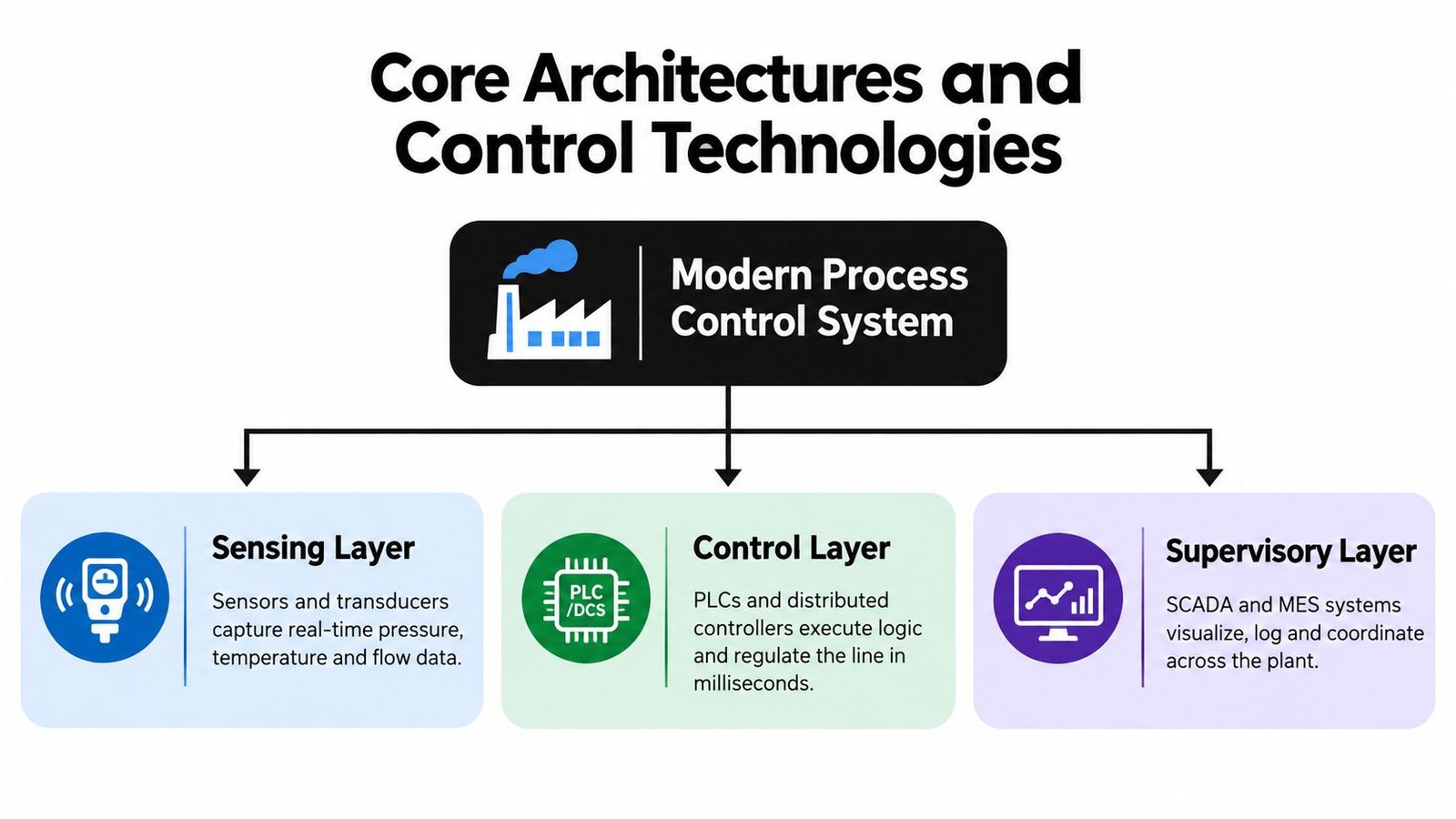
Sensors and transducers form the measurement layer. They capture conditions such as pressure, temperature, flow, position, force, presence, or dimensional results. A sensor isn't automatically useful because it produces a signal. Engineers must confirm its range, repeatability, calibration status, mounting, response time, and suitability for the environment.
PLCs execute real-time logic. They sequence actuators, check permissives, enforce interlocks, manage timers, and respond to faults. For a discrete assembly station, a PLC with a localized HMI may provide all the control the process needs. The HMI should show operators what happened, what the machine expects, and how to recover safely, not just display a collection of alarms.
SCADA adds supervisory visibility across equipment. It can collect statuses, trends, alarms, and operator actions so production and maintenance teams can see behavior beyond a single station. SCADA is useful when managers need a common operational view, but it shouldn't become a costly dashboard project disconnected from corrective action.
DCS architectures fit continuous and batch environments where distributed regulatory control, process loops, and centralized operations are central to production. A discrete manufacturer may not need DCS capability just because it is available.
MES connects execution data with production orders, genealogy, quality records, and enterprise workflows. It can close the gap between what the PLC did and what the plant needs to prove about a batch or unit. However, MES delivers value only when the underlying equipment data is consistent and the operating process is defined.
For a practical overview of how these technologies can be combined in production environments, see industrial automation and control systems.
Choose architecture by decision burden
The best architecture is the smallest one that reliably captures critical variables, controls the required sequence, supports safe recovery, and produces usable evidence. A workstation may need a PLC, HMI, sensors, and local data logging. A connected line may justify SCADA. A regulated, multi-product operation may need MES integration for genealogy and controlled records.
Start with the decisions the system must make. Then select the technology that supports them. This keeps the architecture understandable to operators and maintainers instead of turning process control into an oversized IT project.
Balancing Statistical and AI-Driven Quality Control
Statistical Process Control and AI-driven monitoring solve different problems. SPC works well when the process is sufficiently characterized and the team can define meaningful measurements, limits, and response rules. AI becomes more useful when the quality signal is multivariate, subtle, difficult to describe with fixed rules, or spread across operating conditions that change over time.
SPC has a major operational advantage: people can understand why a chart generated a signal. A control chart can show that a measured variable shifted, drifted, or developed an unusual pattern. That transparency supports operator response, root-cause investigation, and audit discussions. It also makes SPC a sensible first layer for many plants.
Where SPC earns its place
Use SPC when the plant has a stable measurement system and a process variable that relates clearly to product quality. Examples include monitored force, torque, temperature, pressure, fill behavior, or dimensional characteristics. The method helps distinguish expected common-cause variation from a special cause that deserves investigation.
SPC also fits environments where explanation and controlled response matter more than novelty. A live chart embedded in an HMI, SCADA application, or MES can give operators a direct signal while preserving a documented decision path. Manufacturing data analytics can extend that visibility across stations, but the analytical layer still depends on reliable source data.
Where AI adds value
AI can examine relationships that are hard to encode as a small set of rules. It may identify combinations of signals associated with emerging defects, equipment drift, or changing process conditions. That doesn't make it a replacement for SPC. An opaque model can create a new quality risk if the plant can't explain its inputs, maintain its training data, control model changes, or verify its outputs.
A hybrid design is usually more defensible:
- Use SPC for established controls. Operators can act on transparent charts and defined limits.
- Use AI for early warning. Apply anomaly detection to complex patterns that fixed limits may miss.
- Keep human review in the loop. Treat model output as a decision aid until validation supports a more autonomous response.
- Govern the data. Check sensor quality, missing values, timestamps, recipe context, and equipment changes before trusting predictions.
More automation doesn't guarantee more control. In a regulated plant, a simpler validated control with a clear response may be safer than an advanced model that no one can maintain. AI should earn its place through a defined risk reduction, not through an abstract modernization goal.
A Phased Roadmap for Semi-Automated Upgrades
A semi-automated upgrade should be treated as a controlled production experiment, not a miniature version of a factory-wide transformation. The plant keeps the parts of the workstation that already work, then adds measurement, guidance, and repeatability where they address a known loss.
Start with the process as it operates
Assess the current station. Walk the workstation with operators, maintenance, quality, and production engineering. Map the sequence, record manual judgments, identify recurring stops, and list the data that isn't captured. Look for variation introduced by loading, alignment, fastening, curing, inspection, or material presentation.
Prioritize one constraint. Don't choose the easiest station merely because it is easy to modify. Choose the point where a control improvement can affect quality, flow, safety, or labor dependency without creating an unmanageable validation scope. A bottleneck workstation, repeated assembly error, or unstable manual measurement is often a better candidate than a high-volume station with no clear failure mechanism.
Pilot a bounded solution. Add only the controls needed to test the hypothesis. That might include a presence sensor, force transducer, torque tool interface, recipe selection, custom fixture, or interlock. Define the baseline before installation and decide how the team will judge the pilot. The evidence may include good output, first-pass yield, downtime causes, operator interventions, scrap, rework, and time spent on inspection.
Scale what the team can support
After the pilot, review failures rather than hiding them. Did the fixture prevent the wrong part orientation? Did the sensor detect the condition early enough? Could an operator recover without calling maintenance? Did the data record the event in a form quality staff can use? These questions reveal whether the design controls the process or merely adds equipment.
A successful pilot becomes a reusable module. Standardize the electrical design, I/O approach, alarm philosophy, software structure, documentation, and training package before applying it to another line. The plant can then scale with less downtime and fewer surprises.
Use the following video as a visual reference while reviewing the mechanics of a staged upgrade:
Design test: If an upgrade can't be explained to the operator, maintained by the plant, and verified by quality, it isn't ready to scale.
Navigating GMP and Process Validation Requirements
For medical-device manufacturers, process control and GMP compliance are part of the same operating system. The plant must control production, preserve evidence, manage changes, and demonstrate that the process remains in a validated state when validation applies.
The FDA doesn't require process validation for every manufacturing process. It requires validation when the result can't be fully verified through later inspection and testing. The FDA defines validation as establishing by objective evidence that a process consistently produces a result or product meeting predetermined specifications. FDA inspection guidance on process validation provides the relevant distinction.
Validate where inspection can't finish the job
Sterilization, welding, and aseptic filling are common examples of processes that may require validation because final inspection can't fully establish the quality of the result. A control system for such a process must do more than run a sequence. It should preserve critical parameters, recipe identity, operator actions, alarms, deviations, and relevant environmental or equipment status.
That evidence needs clear ownership. Engineering should define the control logic and data behavior. Quality should approve acceptance criteria, review deviations, and determine the validation approach. Production and maintenance must be able to operate the system consistently after release.
For manufacturers building or updating a regulated production environment, GMP in manufacturing should be considered alongside the machine design, not after commissioning.
Design for inspection readiness
WHO GMP guidance says process validation data should be generated for all products and held at the manufacturing location whenever possible so it is available for inspection. The WHO GMP validation guidance makes local availability part of the practical evidence model.
That requirement affects architecture. Store records in a controlled location, define retention and access rules, synchronize timestamps, protect audit trails, and document how data moves from sensors and controllers into reports. A dashboard without reliable records won't support an inspection.
Revalidation also needs to be part of change control. Changes to equipment, formulation, batch size, or the manufacturing process can affect product quality and may require revalidation, particularly for critical validated operations. Engineers should identify these triggers before modifying the station, then involve quality early enough to avoid commissioning a technically successful system that can't be released for production.
Measuring Success with the Right Production Metrics
A control system can collect extensive data without improving production. Useful metrics connect machine behavior with acceptable output, labor consumption, quality losses, and customer requirements. Unit count alone gives a misleading picture. A station may produce more units while increasing scrap, rework, or inspection work.
Consider a mid-sized manufacturer with a manual assembly bottleneck. Operators load components into a fixture, complete a fastening step, and inspect the result. An incremental upgrade adds a guided fixture, tool confirmation, and localized sensing. Its value depends on whether the station produces more acceptable units with fewer avoidable interventions, not on the amount of new hardware installed.
Use OEE as a diagnostic, not a trophy
Overall Equipment Effectiveness combines availability, performance, and quality. Each component points to a different loss. Availability exposes downtime, performance shows speed losses, and quality captures the effect of defects and rework on useful output.
Scrap directly lowers the quality component because scrapped units remain part of production volume but do not become good output. Scrap rate is the share of produced units that are defective beyond economical correction and must be discarded. Calculate it by dividing scrapped units by total units produced and multiplying by 100. Scrap rate and rework rate guidance explains this definition and its relationship to OEE.
| Metric | Definition | Target Benchmark |
|---|---|---|
| Availability | The share of planned production time during which the equipment is available to run | Improve by removing recurring, classified downtime |
| Performance | Actual production speed compared with the intended speed while the station is running | Reduce minor stops and speed losses |
| Quality | Good output compared with total output, including the effect of scrap and rework | Protect first-pass yield and prevent defect escape |
| Scrap rate | Scrapped units divided by total units produced, multiplied by 100 | Below 5% is described as acceptable in some manufacturing guidance, while below 2% is presented as a stronger benchmark per the scrap-rate guidance cited above |
Treat these benchmarks as prompts for investigation, not universal targets. Segment losses by product, shift, tool, material lot, and failure mode. A fixture may reduce misalignment while material replenishment continues to limit station speed. In that case, quality improves but performance remains constrained.
Track rework separately from scrap. A reworked unit may eventually pass inspection, but it still consumes labor, capacity, and inspection time. Review whether the upgrade prevents the defect, detects it at the source, or only makes sorting easier. Prevention and early detection strengthen control. Detection alone can leave the plant with a costly interruption. For a semi-automated upgrade, pair the OEE review with labor hours spent on rework and inspection so the return reflects the full operating cost, not just the headline output.
Partnering for Practical Engineering and ROI
The integration partner often determines whether a control project becomes a reliable production asset or an expensive machine that the plant works around. A catalog solution may look efficient at purchase, but it can force the factory to change its product flow, operator method, maintenance practices, or validation approach.
A practical engineering partner starts with the operation. The team should be able to move from a preliminary concept to custom tooling, fixtures, controls, drawings, material sourcing, installation, commissioning, training, and ongoing maintenance. That end-to-end responsibility matters because small interface failures often appear between disciplines, not inside a single component.

Evaluate the working relationship
Ask prospective partners:
- Can they explain the control strategy? Look for clear I/O behavior, sequence logic, safety functions, alarm handling, and recovery logic.
- Can they work with the existing plant? Brownfield integration, legacy equipment, and phased installation should be part of the conversation.
- Will quality be involved early? GMP-aware design should address verification, validation evidence, change control, and data integrity before commissioning.
- Do they support the equipment after launch? Maintenance plans, spare parts, troubleshooting, and responsive service protect the original investment.
- Will they define acceptance clearly? The project should connect technical tests to production metrics and agreed operating outcomes.
System Engineering & Automation offers manual, semi-automatic, and fully automated equipment, along with custom tooling, fixtures, and integrated controls. Its engineering support covers early concepts through design, manufacturing drawings, sourcing, installation, commissioning, and continuing maintenance, with GMP-aware practices for manufacturers that need controlled production.
The strongest project isn't the one with the most robotics. It's the one that improves a real constraint, produces trustworthy evidence, fits the plant's budget, and leaves operators with a system they can run confidently.
Visit System Engineering & Automation to discuss a workstation, bottleneck, or regulated process that needs practical control improvement. Their team can help scope a semi-automated or integrated solution around your production goals, existing equipment, GMP requirements, and path to measurable ROI.