A $30,000 robot can become a $150,000 deployment once integration, safety systems, and training are included. For most manufacturers, the actual cost of automation is the total installed system, not the equipment price on the quotation.
That gap usually appears after the capital request has been approved. An operations manager sees a robot, fixture, or automated station priced within reach, then discovers that controls engineering, guarding, validation, commissioning, operator training, and ongoing support weren't included in the number she presented to leadership. The equipment may be affordable, but making it work reliably in production is a much larger project.
Manufacturers that provide production and service solutions need a business case built around throughput, quality, capacity, safety, and maintainability, not a machine catalogue price. This is especially important for small and mid-sized plants, where one underestimated integration task can absorb the budget for an entire improvement program.
Table of Contents
- Why Your Automation Budget Keeps Growing
- Breaking Down Every Cost Category
- How to Calculate Total Cost of Ownership and Payback
- Semi Automation vs Full Automation Decision Criteria
- GMP and Medical Device Cost Considerations
- Worked Examples and Budgeting Templates
- Making Your Automation Decision with Confidence
Why Your Automation Budget Keeps Growing
A mid-sized manufacturer approves a collaborative robot for a repetitive workstation. The quotation looks manageable until the application review identifies custom tooling, end-of-arm equipment, guarding, controls changes, risk assessment, installation, validation, training, and production support.
The first quotation was not necessarily wrong. It covered the equipment, while the plant still had to fund the work required to make that equipment operate safely and reliably.
Practical rule: Treat the equipment quotation as the start of the budget, not the automation budget itself.
The gap is especially difficult for a small plant with limited engineering capacity. A $30,000 robot may become a $150,000 deployment after integration, safety systems, and training are included. A complete industrial deployment can typically fall between $150,000 and $500,000, according to technical guidance on robot deployment and operations costs. The installed cost can cover mechanical design, electrical work, programming, guarding, commissioning, documentation, and modifications to the surrounding process.

The quote is rarely the whole project
Integration is only one hidden category. Installation and ramp-up can remove production hours, while operators need revised work instructions and hands-on training. Maintenance staff need diagnostic skills, spare-parts plans, and access to the required software. Quality teams may also require inspection records, process studies, or formal validation before the station reaches full production volume.
These costs explain why automation can appear affordable during capital planning and expensive during implementation. The 2024 SMART Manufacturing Adoption Study identified high cost as the top barrier, cited by 21% of respondents, followed by workforce skill-set shortages at 20% in Auburn University's SMART Manufacturing Adoption Study. The follow-up 2025 study again described high cost as the predominant barrier throughout the study period, alongside workforce skill gaps, capital requirements, and shortages.
Operations managers should test the proposal with four practical questions:
- What must change around the robot for the station to run?
- Who will validate and maintain it after the integrator leaves?
- How much production time will the plant lose during installation and acceptance?
- What happens when the product, fixture, or process changes?
The answers define the installed cost, the disruption risk, and the resources required to keep the system productive.
Breaking Down Every Cost Category
A credible automation budget separates capital expenditure, operating expenditure, and production disruption. The equipment price is only the starting point. Integration, validation, and maintenance often determine whether a small or mid-sized manufacturer stays within budget.
Capital costs arrive in layers
The first layer is the equipment, such as a robot, conveyor, vision system, press, feeder, fixture, or programmable controller. The next covers mechanical design, electrical panels, controls programming, safety circuits, robot programming, tooling, line interfaces, installation, and commissioning. Each item should appear separately in the quotation.
Safety work needs its own allowance. A practical line-item list includes guarding fabrication, scanners, interlocks, emergency stops, a risk assessment, safety PLC validation, and corrective changes found during testing. In regulated production, add qualification protocols, traceable records, software review, and controlled work instructions. A low equipment price does not reduce these requirements.
Installed cost benchmarks discussed earlier illustrate the multiplier effect. A robot deployment cost guidance source describes how integration and related requirements can materially increase the purchase price. For a small plant, even a modest cell may require a new electrical drop, fixture redesign, network connection, guarding, and acceptance testing before it can produce saleable parts.
Operating costs continue after handover
The handover is the start of the maintenance budget, not the end of the project. Plan for maintenance labor, replacement parts, software subscriptions or updates, energy, cybersecurity, operator training, and technical support. Include preventive maintenance, calibration, backup procedures, and time for troubleshooting when performance depends on measured accuracy.
The monthly burden varies with system complexity. Manufacturing automation cost analysis identifies maintenance, software, training, energy, and cybersecurity as recurring categories. A connected production cell requires more support than a standalone workstation, particularly when production depends on networked data, proprietary software, or specialist diagnostic skills.
Disruption carries a real price
Ramp-up losses rarely appear on a vendor quote. Operators may need time to learn the sequence, while technicians adjust recipes, fixtures, sensors, and work instructions. Contractors may also occupy production space during installation. For a small manufacturer running one shift, a few lost production days can affect customer commitments and overtime planning.
| Category | Typical Range | Commonly Forgotten? |
|---|---|---|
| Equipment and robot hardware | $30,000 to $150,000 or more, depending on scope | Often |
| Integrated industrial system | $150,000 to $500,000 | Yes |
| Post-deployment operating costs | Recurring monthly support, maintenance, and software | Frequently |
| Integration, safety, and training | Site-specific and potentially substantial | Very often |
| Validation and documentation | Application-dependent | Especially in regulated production |
Treat the table as a planning prompt, not a quotation. Before approving a concept, ask every supplier to identify included work, excluded work, assumptions, acceptance criteria, and recurring charges. Then assign internal owners for integration, validation, operator training, and maintenance. That exercise exposes cost and responsibility gaps before equipment arrives.
How to Calculate Total Cost of Ownership and Payback
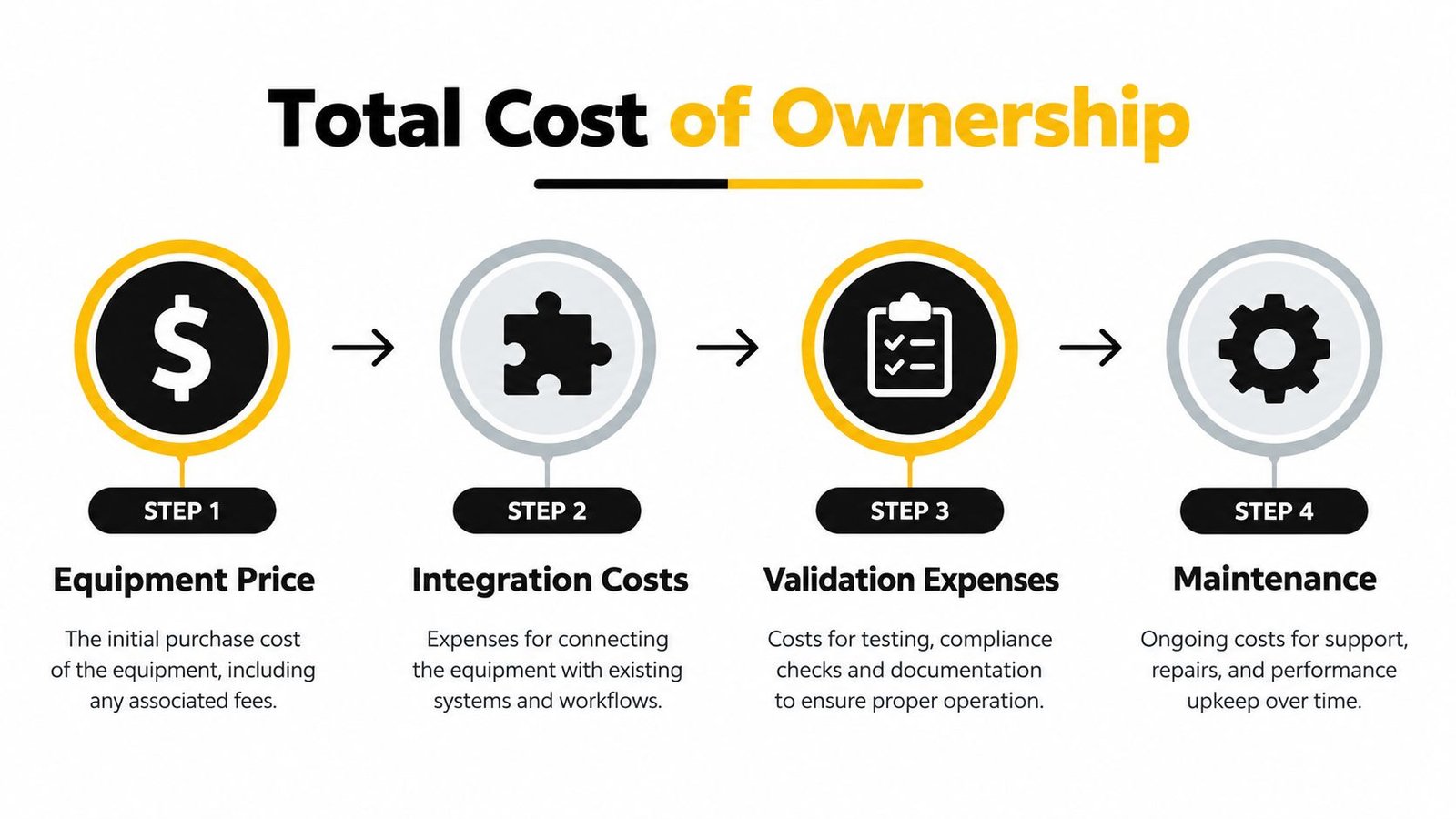
A machine priced at $80,000 can become a much larger commitment once integration, validation, training, and maintenance are included. Build the business case around total cost of ownership, or TCO, before comparing payback. A useful total cost of ownership framework keeps the calculation tied to the system's full working life rather than its purchase order.
Build the cost side first
Start with equipment, tooling, fixtures, integration engineering, safety systems, installation, commissioning, validation, training, software, maintenance, energy, cybersecurity, and spare parts. For a small or mid-sized manufacturer, also record temporary labor, overtime, scrap, and downtime during the changeover. These items can decide whether a project works financially.
Calculate labor benefit with:
Positions eliminated × fully loaded labor rate = direct annual labor savings
The loaded rate includes benefits and overhead, not just the wage on the payslip. For example, a worker paid $25 per hour at a 1.4 multiplier produces a $35 hourly loaded rate. At 2,080 hours, that equals $72,800 in annual labor cost for one full-time position. Use the multiplier appropriate to your payroll structure, as described in the manufacturing automation ROI calculation framework. A redeployed operator is not the same as an eliminated position, so count only the saving the company can capture.
Test the assumptions that can break the case
Run low, expected, and strong cases for the variables most likely to change:
- Utilization: How many shifts will the system run?
- Labor displacement: Will it remove a position, reduce overtime, or redeploy an operator?
- Performance: What throughput, scrap, quality, and uptime gains can production records verify?
- Support burden: How much maintenance, validation work, and specialist assistance will the system require?
Payback is a useful screening measure, not the complete financial analysis. For larger investments, calculate net present value using the company's weighted average cost of capital as the discount rate. Review the after-tax model as well, including applicable bonus depreciation and Section 179 treatment. The automation investment guide can provide a further reference point for structuring the investment calculation.
A single-shift project may look weak if the model assumes unused capacity, while a multi-shift operation may support the same equipment more effectively. Labor savings may also understate the case when automation protects quality, releases constrained capacity, or removes a difficult safety exposure. Show those benefits as separate assumptions instead of inflating the labor reduction.
Semi Automation vs Full Automation Decision Criteria
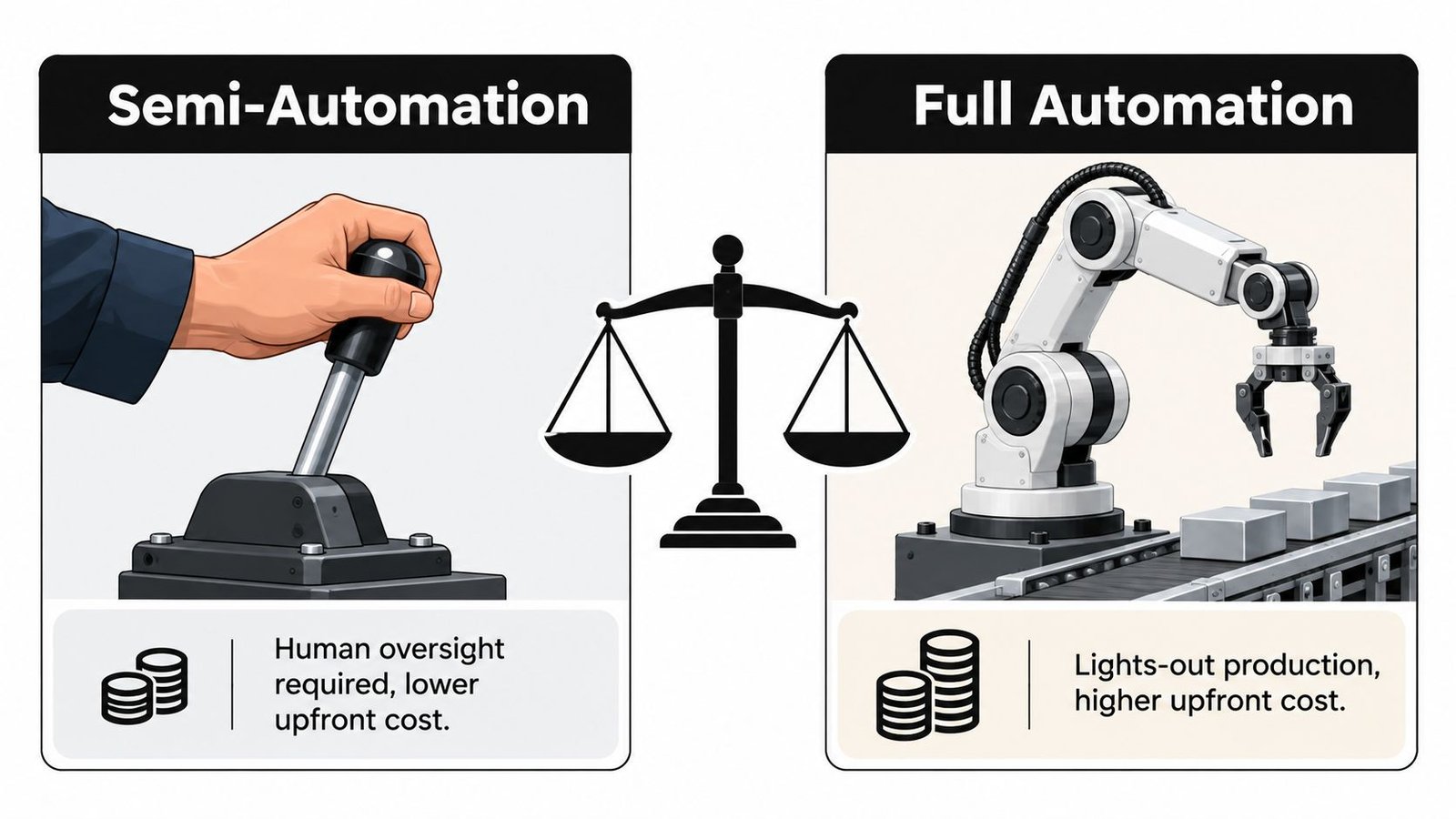
Full automation is not automatically the economical choice. For many small and mid-sized manufacturers, a semi-automated workstation delivers a better balance of investment, flexibility, and operational control.
The equipment price is only one part of the decision. Full systems usually require more interfaces, controlled sequences, safeguarding, software coordination, and specialized support. They also demand stronger process discipline. If the upstream process is unstable, a robotic cell can produce defective parts faster and make troubleshooting harder.
Choose the level of control the process can support
Semi-automation suits processes where a skilled operator still adds judgment, handles variation, loads parts, or manages changeovers. The machine controls repetitive, force-sensitive, or error-prone work, while the operator handles exceptions. This approach can reduce integration effort and allow fixtures or tooling to be reused across products.
Full automation fits better when product presentation is stable, demand is predictable, the process has already been proven, and the plant can support the controls and maintenance workload. Review the semi-automatic versus fully automatic comparison alongside your own production constraints, rather than choosing based only on headline throughput.
| Factor | Semi-Automation | Full Automation |
|---|---|---|
| Initial investment | Lower and easier to phase | Higher, with broader system scope |
| Flexibility | Stronger for product variation and changeovers | Best when inputs and sequences remain stable |
| Human involvement | Operator loads, monitors, and handles exceptions | Limited routine intervention |
| Fixture reuse | Often practical across several products | May require dedicated nests and presentation systems |
| Maintenance skills | General mechanical and controls skills may suffice | More robotics, interfaces, software, and troubleshooting expertise |
| Changeover time | Usually shorter and easier to adjust | Can be longer when recipes, tooling, and sequences are rigid |
| Best fit | Manual process upgrades and constrained budgets | Proven, repeatable production at sustained volume |
Consider a job shop running 15 SKUs per month. A semi-automatic fixture with guided loading may support frequent changeovers and let the operator accommodate variation. A fully automatic cell could produce more parts per cycle, but dedicated tooling, validation of each recipe, and specialist maintenance may outweigh that capacity unless volumes are stable.
Match automation to the bottleneck
Start with the constraint, not the technology. If loading limits output, automate loading. If inconsistent measurement causes defects, automate measurement and error-proofing. If operators lose time during changeovers, improve fixture design and recipe handling before specifying a larger cell.
A semi-automatic system can also provide a controlled learning step. Operators and engineers gain experience with sensors, fixtures, recipes, maintenance tasks, and acceptance criteria before the plant commits to a more rigid architecture. That staged approach can expose integration and upkeep problems while they are still affordable to correct.
GMP and Medical Device Cost Considerations
Medical device and pharmaceutical manufacturers face a different cost structure because equipment performance must be demonstrated, documented, and maintained under controlled conditions. A production cell isn't finished when it makes a good part. The manufacturer must also show that the process performs consistently and that changes remain controlled.
Budget for installation qualification, operational qualification, and performance qualification, along with requirements analysis, risk assessment, software documentation, training records, cleaning considerations, calibration, and change control. The exact scope depends on the product, process, facility, and quality system, but the principle is consistent. Validation and documentation aren't optional extras that can be removed to protect the equipment budget.
Validation changes the project plan
A GMP-aware automation project brings quality and engineering into the concept phase. The team should define critical process parameters, acceptance criteria, electronic records, alarms, access controls, cleaning needs, and data-retention expectations before the design is frozen.
That planning can increase upfront cost, but late validation work is usually more disruptive. Retrofitting sensors, changing software behavior, or reconstructing missing documentation after commissioning can delay release and create avoidable rework. For a medical device manufacturer, the lowest initial quotation may not be the lowest total cost if it leaves qualification gaps for the plant to resolve.
Capacity and quality belong in the business case
Labor replacement is only one possible benefit. A controlled automated process can support repeatability, traceability, safer handling, and predictable production capacity. Deloitte's 2025 smart manufacturing findings report that, when implemented well, smart manufacturing can deliver up to 20% improvements in production output and employee productivity and up to 15% freed capacity, as reported in Deloitte's 2025 smart manufacturing findings.
The right question is whether those gains are achievable in the specific process, not whether a generic benchmark can be copied into a capital request. Manufacturers evaluating automation in medical device manufacturing should price validation, controlled documentation, training, and ongoing compliance support alongside the equipment and integration work.
Worked Examples and Budgeting Templates
A useful automation budget exposes assumptions before a supplier quote becomes a commitment. These planning examples focus on installed cost, recurring cost, measurable benefit, and the payback calculation. Replace the illustrative values with data from the target process.
Example one, a single workstation
A small manufacturer has a repetitive manual station with inconsistent ergonomics. The proposed upgrade uses a custom fixture, poka-yoke sensors, operator controls, and a collaborative robot for a narrow handling task.
The equipment quote may show $30,000, while the installed project reaches $150,000 after tooling, safety, integration, training, and commissioning, as documented in robot deployment cost guidance. The station should run frequently, handle a stable task, and address measurable operator burden or quality variation.
| Measure | Planning value |
|---|---|
| Installed cost | $150,000 |
| Annual operating cost | Confirm maintenance, software, energy, and consumables |
| Annual benefit | $45,000 annual savings |
| Payback calculation | $150,000 ÷ $45,000 = 3.3 years |
Frequent product changeovers can invalidate the business case if the fixture requires repeated redesign. Include that risk in the benefit estimate rather than assuming full utilization.
Example two, a semi-automated medical device station
A medical device manufacturer could automate a critical insertion or fastening step while an operator loads parts and handles exceptions. The budget should cover custom tooling, controls, guarding, work instructions, qualification activities, training, maintenance planning, and production support.
| Measure | Planning value |
|---|---|
| Installed cost | Supplier quote plus tooling, validation, installation, and commissioning |
| Annual operating cost | Maintenance, training, software, support, and consumables |
| Annual benefit | Labor, quality, capacity, traceability, and compliance value |
| Payback calculation | Installed cost ÷ quantified annual benefit |
Keep labor savings separate from quality and compliance benefits. Retaining an operator can produce better financial results when the process changes often, because a fully unattended cell may require expensive redesign after each product revision.
Example three, a fully automated packaging cell
A packaging cell may combine product presentation, robotic handling, inspection, case packing, conveyors, controls, and data collection. Budget the complete line and its ongoing maintenance and software burden, not only the robot or primary machine.
Post-deployment costs for maintenance, software, training, energy, and cybersecurity can total approximately $3,500 to $16,500 per month. That equals roughly $42,000 to $198,000 annually before other site-specific costs. One industry source places common automation payback in the 18 to 36 month range when one operator's labor is eliminated across shifts, as summarized in manufacturing automation cost analysis.
| Measure | Planning value |
|---|---|
| Installed cost | Complete packaging line, integration, safety, and commissioning |
| Annual operating cost | $42,000 to $198,000, plus confirmed site costs |
| Annual benefit | Quantified labor, scrap, capacity, quality, and downtime gains |
| Payback calculation | Installed cost ÷ annual benefit |
Use conservative utilization and include delayed ramp-up, extra support, and product changes in the risk case. A stable, high-volume process may justify a full cell. A low-volume operation may get better value from semi-automation or upgraded fixtures. The cheapest machine is rarely the cheapest project. The stronger proposal survives conservative assumptions.
Making Your Automation Decision with Confidence
A sound automation decision begins on the factory floor. Measure the current process, identify the constraint, document product variation, and establish the labor, quality, changeover, and downtime baseline before selecting equipment. Without that baseline, the business case will depend on promises rather than evidence.
Ask vendors and integrators to provide a scope that separates equipment from engineering, safety, validation, training, commissioning, and recurring support. Require clear acceptance criteria. For small and mid-sized manufacturers, phased investment can reduce exposure. A well-designed fixture, controls upgrade, or semi-automatic station may solve the bottleneck without committing the plant to a full production cell.
Decision test: If the team can't explain how the system will be operated, maintained, validated, and changed, the project isn't ready for approval.
Use these final checks:
- Financial fit: Does the project work under conservative utilization and labor assumptions?
- Process fit: Is the operation stable enough for the selected automation level?
- People fit: Can operators, technicians, and quality staff support the system?
- Lifecycle fit: Are maintenance, software, cybersecurity, spare parts, and training funded?
- Growth fit: Can the system handle foreseeable product or volume changes without a costly rebuild?
Cost of automation should be evaluated against the value the system creates. That value may come from labor savings, but it may also come from consistent quality, safer work, improved throughput, newly opened capacity, and a more reliable service operation. Manufacturers that size the solution around the actual bottleneck usually make better decisions than those that buy the most automation available.
System Engineering & Automation provides custom tooling, fixtures, controls, semi-automatic systems, fully automated equipment, installation, commissioning, and ongoing maintenance support for manufacturers. Visit System Engineering & Automation to discuss a production or service process and develop an automation concept aligned with your budget, quality requirements, and operating goals.