Most advice on process improvement and automation gets one thing backwards. It treats full automation as the default answer, then tries to justify the spend after the fact. On the plant floor, that usually means locking in a messy handoff, overbuilding controls, and paying for capability the line doesn't need.
The better approach is harder to sell and easier to defend. Start with the process, remove waste, standardize what's stable, then choose the lightest automation level that solves the constraint. That mindset fits manufacturers who need quality, throughput, flexibility, and compliance without turning every workstation into a capital project.
Table of Contents
- Why Most Automation Projects Fail Before They Start
- Assessing Your Process and Establishing Baseline Metrics
- Choosing the Right Level of Automation for Your Operation
- Designing Controls and Meeting Compliance Requirements
- Running Pilots and Commissioning the System
- Measuring ROI and Sustaining Continuous Improvement
Why Most Automation Projects Fail Before They Start
The most expensive mistake is not choosing the wrong robot or PLC. It's deciding too early that the answer has to be full automation. If the process still has unclear exceptions, informal workarounds, or inconsistent data entry, automation doesn't fix that. It freezes it.
That's why process improvement comes first. Historical process-improvement systems like lean manufacturing and Six Sigma made waste removal, variation reduction, and throughput control mainstream management practice. Modern summaries note that roughly 50% of all work activities can be automated with current technology, and some industry research reports process improvement initiatives can reduce operational costs by about 25% and processing times by 40% (process improvement statistics). The lesson isn't “automate everything.” It's that the biggest gains come from redesigning work before mechanizing it.
Right-sizing beats over-engineering
A plant manager once told me the fastest way to burn a budget is to automate a bad process and call it innovation. That's not cynicism, it's field experience. If the team can't explain where parts wait, why rework happens, or who owns exceptions, the line is not ready for expensive controls.
Practical rule: if you can't describe the failure mode clearly, you can't automate the fix cleanly.
A structured risk review matters, especially when capital is tight. A useful starting point is a formal automation risk assessment that forces the team to separate process defects from automation candidates. In many plants, the best first move is not a full machine cell. It's a fixture, a poka-yoke, a better gauge, or a semi-automatic station that reduces operator variation without killing flexibility.
The right question is not “Can we automate this?” It's “What level of automation solves the constraint without creating a new one?” For many operations, especially regulated or low-volume/high-mix environments, that answer is selective semi-automation, not full replacement.
Assessing Your Process and Establishing Baseline Metrics
Before a machine builder touches the layout, the process needs to be mapped with engineering discipline. Start with inputs, outputs, handoffs, decision points, and the people who own each step. IBM's process-improvement framework emphasizes identifying the process, measuring a baseline, then moving into root-cause analysis, standardization, and sustainment reviews (IBM process improvement). That sequence matters because it keeps teams from redesigning based on opinion.
What to measure first
Capture the current state in a way that can survive a design review. The minimum useful baseline includes cycle time, error rate, throughput, and customer feedback. If the process feeds a regulated product or a critical internal service, document where rework enters, where approvals stall, and where operators improvise.
A process map should show:
- All manual steps, including touchpoints that look small but consume time.
- Every handoff, especially where work changes owners.
- Decision points, because exceptions often hide there.
- Inputs and outputs, so the team can see what gets transformed and what gets delayed.
The common failure is starting with a target state and reverse-engineering a story to match it. That feels productive, but it makes validation impossible later. If the baseline is missing, you can't tell whether the improvement came from the new system or from temporary operator attention during startup.
Bottom line: no baseline, no proof.
The same discipline is why many process-improvement programs stall. A literature review referenced in IBM's framework reports that 60 to 70% of BPI projects fail or are not completed. The problem usually sits in scoping, ownership, or sustainment, not in the technology itself.
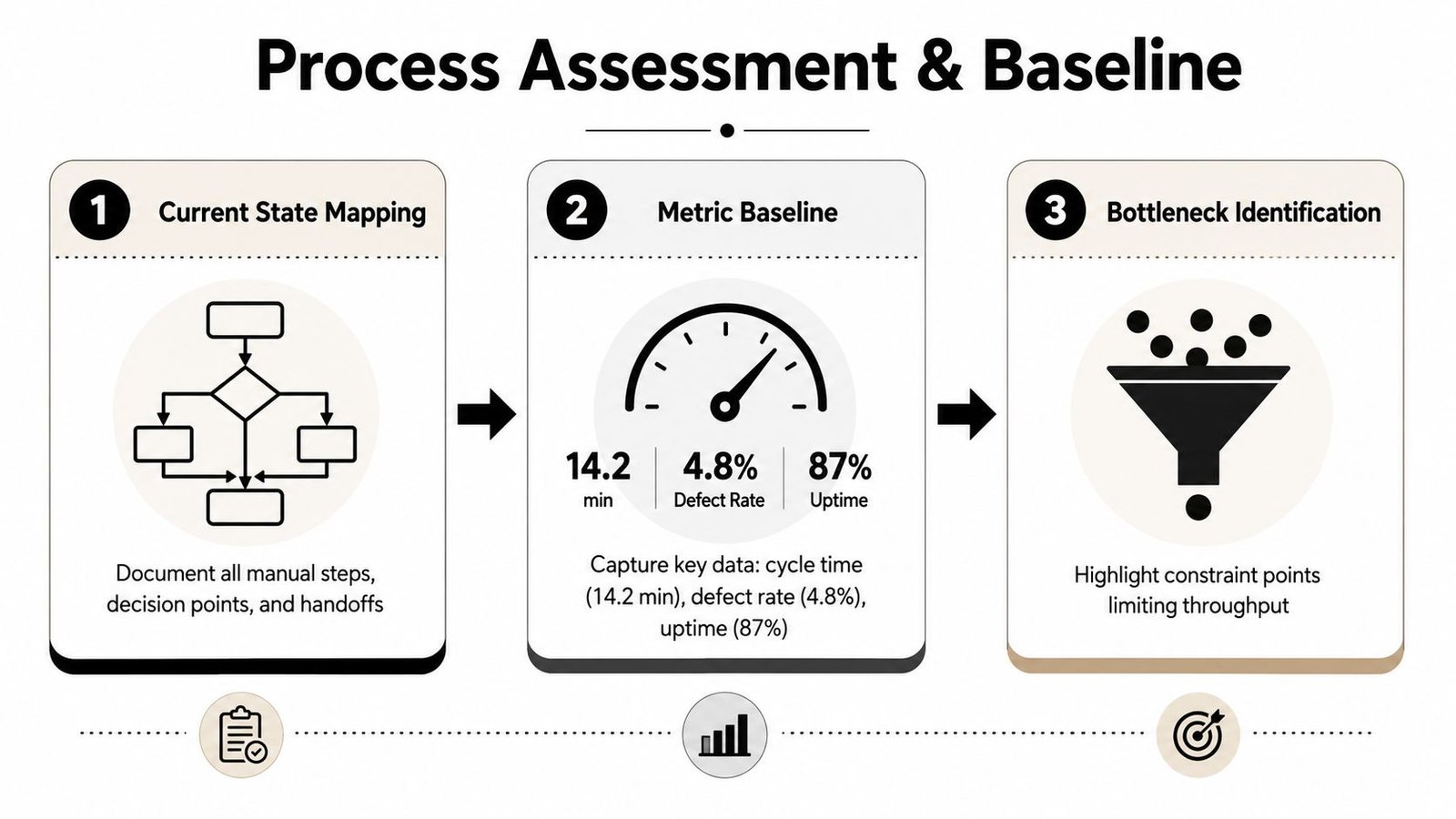
The most useful output from this stage is not a pretty diagram. It is a defensible list of constraints. Some problems belong in process redesign, like redundant approvals or unnecessary motion. Others are true automation candidates, like repetitive pick-and-place, data capture, or machine tending. If you separate those two buckets early, the later ROI discussion gets much cleaner.
For teams already doing lean work, it helps to connect the map to lean manufacturing process improvement so the process is cleaned up before equipment is specified. That keeps automation from becoming a bandage over waste.
Choosing the Right Level of Automation for Your Operation
The decision should usually come down to three options, not one. Manual work with smart tooling and fixtures. Semi-automation. Full automation. Each has a place, and each can be the wrong choice if the process, volume, or budget doesn't fit.
The best framing is task-level, not job-level. A widely cited McKinsey estimate found that about 60% of occupations have at least one-third of activities that could be automated (McKinsey automation estimate). In practice, that means most plants don't need a wholesale line replacement. They need to isolate the repetitive or error-prone tasks and decide how much machine support is justified.
Automation Level Decision Matrix
| Criteria | Manual + Tooling/Fixtures | Semi-Automation | Full Automation |
|---|---|---|---|
| Capital burden | Lowest. Good when budgets are tight and the process is still evolving. | Moderate. Works when the business case supports targeted machine assist. | Highest. Only makes sense when the workflow is stable and the volume supports it. |
| Flexibility | Very high. Operators can adapt to variants and exceptions. | High enough for many mixed-model environments. | Low. Changeovers and exceptions can become costly. |
| Quality control | Depends on operator skill, but fixtures can reduce variation. | Strong balance of operator judgment and machine precision. | Strongest consistency when the process is highly repeatable. |
| Compliance fit | Useful for low-risk or simple operations. | Often the sweet spot for GMP-aware work, because it preserves traceability without overcomplicating the line. | Strong in tightly controlled environments, but documentation and validation effort rise fast. |
| Labor dependency | Still significant. | Reduced without removing human oversight. | Lowest on the line, but support skills still matter. |
| Best use case | Short runs, frequent changes, limited capex. | Repetitive steps with enough variation to need operator oversight. | Stable, high-volume, narrowly defined workflows. |
Manual fixtures are underrated because they solve real problems cheaply. A good fixture can cut positioning error, reduce fatigue, and speed up handling without forcing a full control architecture. Semi-automation is often the better business move when you need speed and consistency but still expect product variation, engineering changes, or operator judgment.
Full automation belongs where the process is predictable enough to justify the rigidity. If exception handling is frequent, if product mix shifts often, or if the line needs human visual checks, full automation can become a liability.
Use this filter: if changeovers, exceptions, or compliance reviews are still unsettled, stop short of full automation.
That's also where a practical provider like System Engineering & Automation can fit, because it offers semi-automatic systems, manual equipment, custom tooling, fixtures, and integrated controls in one engineering path. The right level of automation is the one that matches the constraint, not the one that looks most advanced in a sales deck.
Designing Controls and Meeting Compliance Requirements
Once the automation level is chosen, the controls architecture has to be simple enough to maintain and resilient enough to survive real production. Start with the logic in the PLC, the operator interface in the HMI, and the field devices that detect, move, and confirm. If those pieces are vague, the system will be hard to troubleshoot and even harder to validate.
In regulated environments, the design has to support auditability, traceability, and documented exception handling from day one. That means the controls engineer, quality team, and operations lead need the same definition of what constitutes a good unit, a reject, a hold, and a manual override. If that language differs across departments, the plant will pay for it later in deviations and rework.
Build for exceptions first
A lot of controls systems are over-specified in the wrong places. Teams add screens, alarms, and interlocks everywhere, then discover operators are bypassing them because the flow feels clumsy. Better design starts with the exception path.
The system should answer four questions cleanly:
- What happens when an input is missing?
- What happens when a sensor disagrees with expected state?
- Who can clear the fault, and what record is kept?
- How does the operator resume without creating hidden scrap or rework?
The image below is a useful reminder that controls should be layered, not tangled.
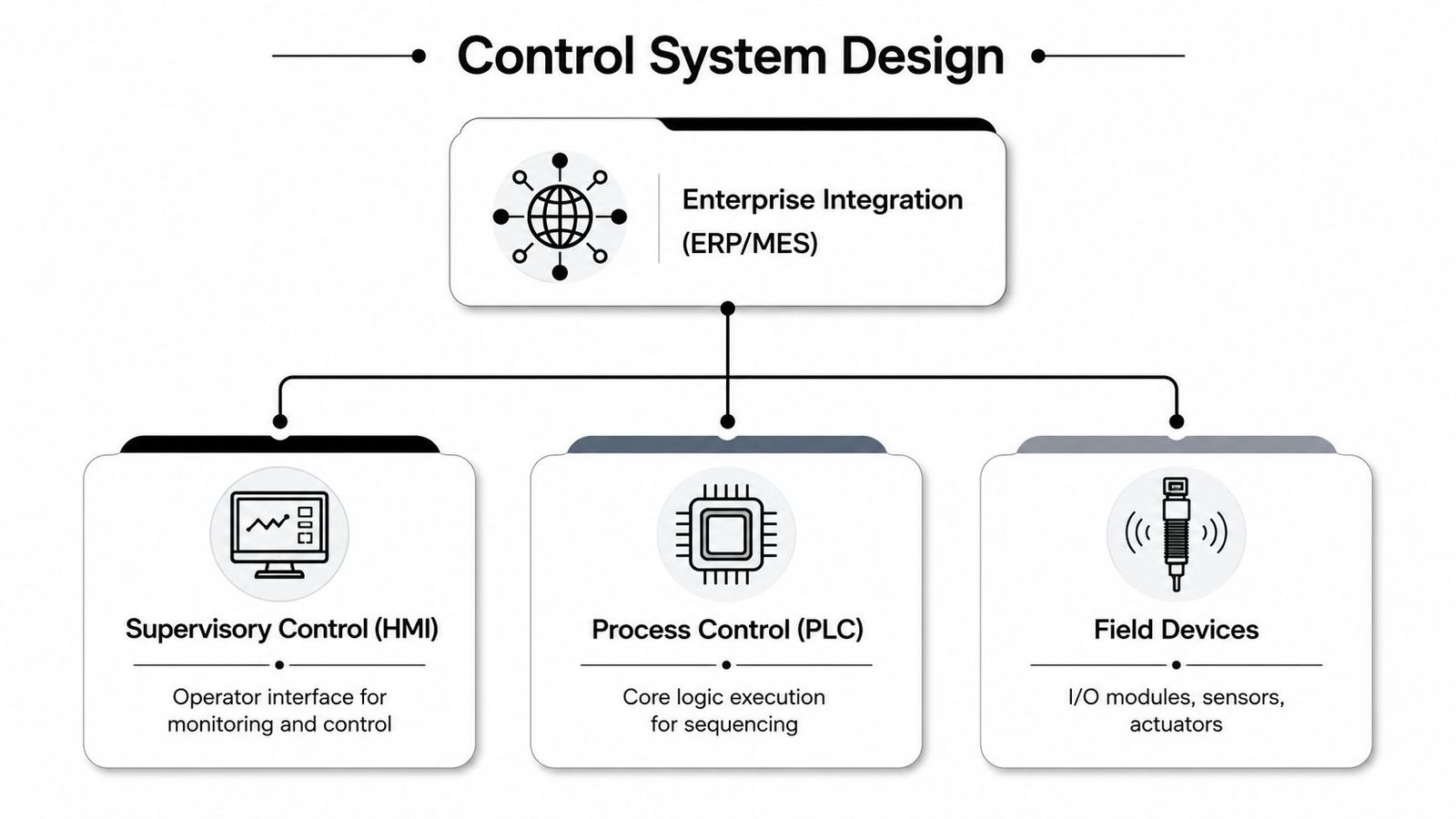
That hierarchy matters because enterprise systems, supervisory control, process logic, and field devices all solve different problems. Mixing them together creates brittle code and awkward troubleshooting. Keep the PLC responsible for sequencing, keep the HMI focused on operator control, and keep the data layer clean enough that quality can audit it without deciphering the machine.
For GMP-aware builds, that separation also protects documentation quality. When the control narrative is clear, validation gets easier, training gets cleaner, and maintenance stops depending on one senior technician's memory. That's not overhead. It's what keeps a system supportable after the integrator leaves.
Running Pilots and Commissioning the System
A pilot run should feel uncomfortable in the right way. It needs to expose the system to real operators, real parts, and real interruptions before the plant commits to full release. That's where design assumptions get tested, and it's where the team learns whether the process is stable enough to live with the chosen automation level.
One commissioning sequence I've seen work well started with installation qualification, then operational qualification, then performance qualification, especially in GMP settings. The equipment was installed exactly as designed, the control logic was challenged under expected operating modes, and the team only moved forward when the results matched the baseline intent. The factory acceptance test stage reduced surprises, but the pilot still mattered because the line had to prove itself in the actual plant environment.
Operator training sat at the center of the rollout. The supervisor didn't just show people which button to press. He walked through fault recovery, cleaning, startup, safe shutdown, and what to do when a part didn't present correctly. That made the crew better at handling the edge cases that always show up after go-live.
The video below is a good reminder that commissioning is a coordination problem, not just an equipment event.
The biggest difference between smooth and painful pilots is maintenance readiness. Spare parts have to be identified before startup, not after the first sensor fails. The maintenance lead should know what's critical, what's consumable, and what can wait. A system that is impossible to maintain is not finished, it's merely installed.
Responsiveness matters too. Good commissioning includes quick adjustments, clear ownership, and enough support to stabilize the line without creating dependency. That's when a new system starts behaving like part of production instead of a special project with its own rules.
Measuring ROI and Sustaining Continuous Improvement
ROI only matters when the numbers stay tied to the same process baseline you captured at the start. The useful KPIs are the ones that show whether the change improved the work, not just whether the machine ran. Track cycle time reduction, error rate improvement, labor cost savings, throughput gains, and first-pass yield.
The harder part is holding the gain after the project team leaves. A line can look stable for a few weeks and still drift back to old habits if the SOPs, training, and review cadence are not maintained. Sustainment reviews keep that from happening. They force the team to check whether the process is still running the way it was designed, instead of slipping back into the old routine.
What to review after go-live
Use a short, disciplined review cycle that checks both performance and behavior.
- Cycle performance: confirm that the new process still matches the intended rhythm.
- Quality signals: look for repeat defects, misfeeds, or rework patterns.
- Operator feedback: ask where the process is still awkward or unclear.
- Maintenance findings: review recurring adjustments before they become normal.
The most reliable programs treat automation as a living system. They document lessons learned, update work instructions, and close the loop on exceptions that surfaced during the pilot. That makes each later project easier because the plant is building institutional memory instead of starting from zero.
Sustainment is not paperwork. It is what keeps the gain from leaking out of the system.
Industry summaries also show why the business case can be strong before a line goes fully automatic. workflow automation statistics reports average ROI of 200 to 300% within 12 months for some workflow deployments, and process improvement statistics notes that process improvement initiatives are reported to reduce processing times by 40% and operational costs by about 25% in the earlier cited summaries. The headline number matters less than the follow-through. The true test is whether the plant can hold the gain after the novelty wears off.
If you are working through a manual station, a semi-automatic upgrade, or a regulated-line retrofit, System Engineering & Automation can help define the right level of automation, design the controls, and support commissioning with practical manufacturing constraints in mind. Visit System Engineering & Automation to discuss process improvement and automation solutions that fit your production goals, your budget, and the realities of the plant floor.