
USD 55 to USD 180 per hour is the practical outsourced wire EDM range buyers should expect in 2026, and the number that really matters is the per-part cost, not the hourly rate. Thickness, tolerance, setup, and electrode choice usually move the final price more than the headline shop rate ever will.
You're probably looking at three EDM quotes that don't agree with each other, wondering why one shop sounds cheap and another sounds reckless. That's normal. EDM pricing gets messy because the quote is hiding the work, fixturing, programming, consumables, inspection, and unattended cutting, and buyers who only compare hourly rates end up making the wrong call.
Table of Contents
- The Moment Operations Managers Worry About EDM Machining Cost
- How Wire, Sinker, and Hole-Drill EDM Create Different Costs
- The Six Cost Drivers Behind Every EDM Quote
- A Sample EDM Cost Calculation You Can Reuse
- When EDM Is Worth the Price and When It Is Not
- GMP and Medical-Device Considerations That Increase Cost
- Practical Ways to Lower EDM Machining Cost
The Moment Operations Managers Worry About EDM Machining Cost
An RFQ lands, the geometry is ugly, and three shops hand back numbers that do not belong in the same universe. One quote looks high, one looks suspiciously low, and the third is packed with line items nobody bothered to explain. That is the point where operations managers stop treating EDM machining cost like a rate card and start seeing it for what it is, a per-part problem.
Stop comparing hourly rates in isolation
Hourly rate is the least useful number on the page if you do not know what it includes. A shop can quote a lower rate and still deliver the more expensive part once setup, wire use, retries, inspection, fixturing, and slow cutting through thick stock are all counted. Published shop-rate bands already show how wide the spread is, from USD 35–80/hour in Asia-Pacific precision shops to USD 90–180/hour in North American and European shops, with U.S. wire EDM shops commonly quoted at USD 55–125/hour.
That spread looks dramatic until you ask the only question that matters, “What does the finished part cost?” On a simple job, the difference may just be annoying. On a hard, thick, tolerance-sensitive part, the wrong choice can bury margin fast.
Practical rule: if the quote does not separate setup, machine time, consumables, fixturing, inspection, and post-processing, you are not buying transparency. You are buying risk.
Think in system costs, not machine time
EDM cost lives inside a system. The machine is only one part of it, and often not the dominant one. A published cost study found the overall machining cost depended mainly on wire electrode cost and electricity cost, with wire estimated at USD 9.5×10^-6/mm and electricity at USD 1.7×10^-1 per kWh (published cost study).
That same logic shows up on the buyer's side too. If the part forces more setup time, more threading, more skim passes, more electrode handling, or more inspection, the hourly rate barely matters. The quote grows because the job got slower and messier, not because the shop's sticker price was high.
Tooling and fixturing can swing the final number more than machine time ever does, especially on awkward jobs that need stable positioning, repeatable alignment, or unattended runs. That is why a shop with the right CNC EDM machines can often beat a cheaper-looking quote from a shop that has to babysit every part (CNC EDM machines).
The cleanest way to buy EDM is to ask one question up front, “What drives the per-part number on this geometry?” If the shop cannot answer that clearly, the quote is not ready for approval.
How Wire, Sinker, and Hole-Drill EDM Create Different Costs
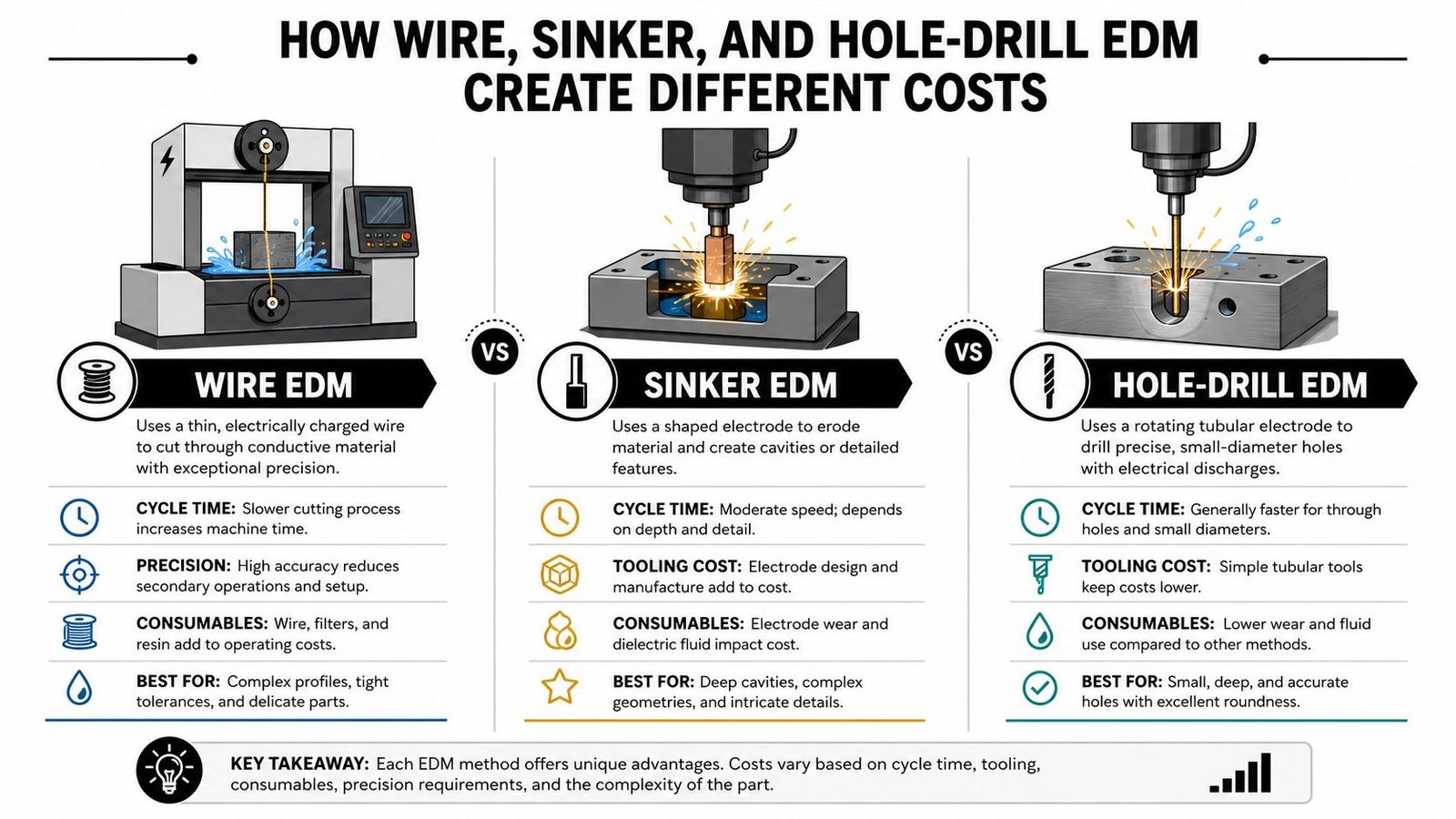
Wire EDM is the slow, precise bandsaw of the EDM family. Sinker EDM is a controlled lightning strike that carves cavities by spark erosion. Hole-drill EDM is the tiny drill that gets through conductive material where standard drilling starts failing. If you buy the wrong process, you pay for it immediately.
Wire EDM for profiles and tight geometry
Wire EDM dominates 2D cuts, tight internal features, and hard materials where a cutter can't physically do the job. It's the right call when you need through-profiles, sharp internal corners, and repeatable dimensions in hardened steel. On the cost side, wire EDM tends to look expensive per hour because the machine is doing delicate work, but it often wins on total part cost when the geometry is complex and the setup stays stable.
Thickness is the part buyers miss most. One neutral cost guide notes that every additional inch of material thickness can roughly halve cut speed, which is why a flat hourly quote tells you almost nothing about the actual bill (wire EDM cost guide).
Sinker EDM for cavities and 3D forms
Sinker EDM is what shops use when the part isn't a through-cut and the cavity shape matters. Think mold work, deep pockets, and forms that milling can't reach cleanly. It usually carries a different cost structure because the electrode itself becomes part of the machining economics, and the job often demands more electrode management than wire EDM does.
Hole-drill EDM for small deep holes
Hole-drill EDM is a specialist process. You don't buy it by the hour in the same mental frame as wire EDM, you buy it because a standard drill cannot make the hole cleanly, to the required depth, or repeatedly enough. For buyers, that means the quote should be judged by hole count and hole quality, not by generic machine time.
SEA's CNC EDM machine overview is useful if you want to line up the process choice before you send an RFQ.
Wire EDM is often the right answer for precision profiles, but it's the wrong answer for every job that merely needs a hole or a pocket. Pick the process first, then negotiate the price.
The Six Cost Drivers Behind Every EDM Quote
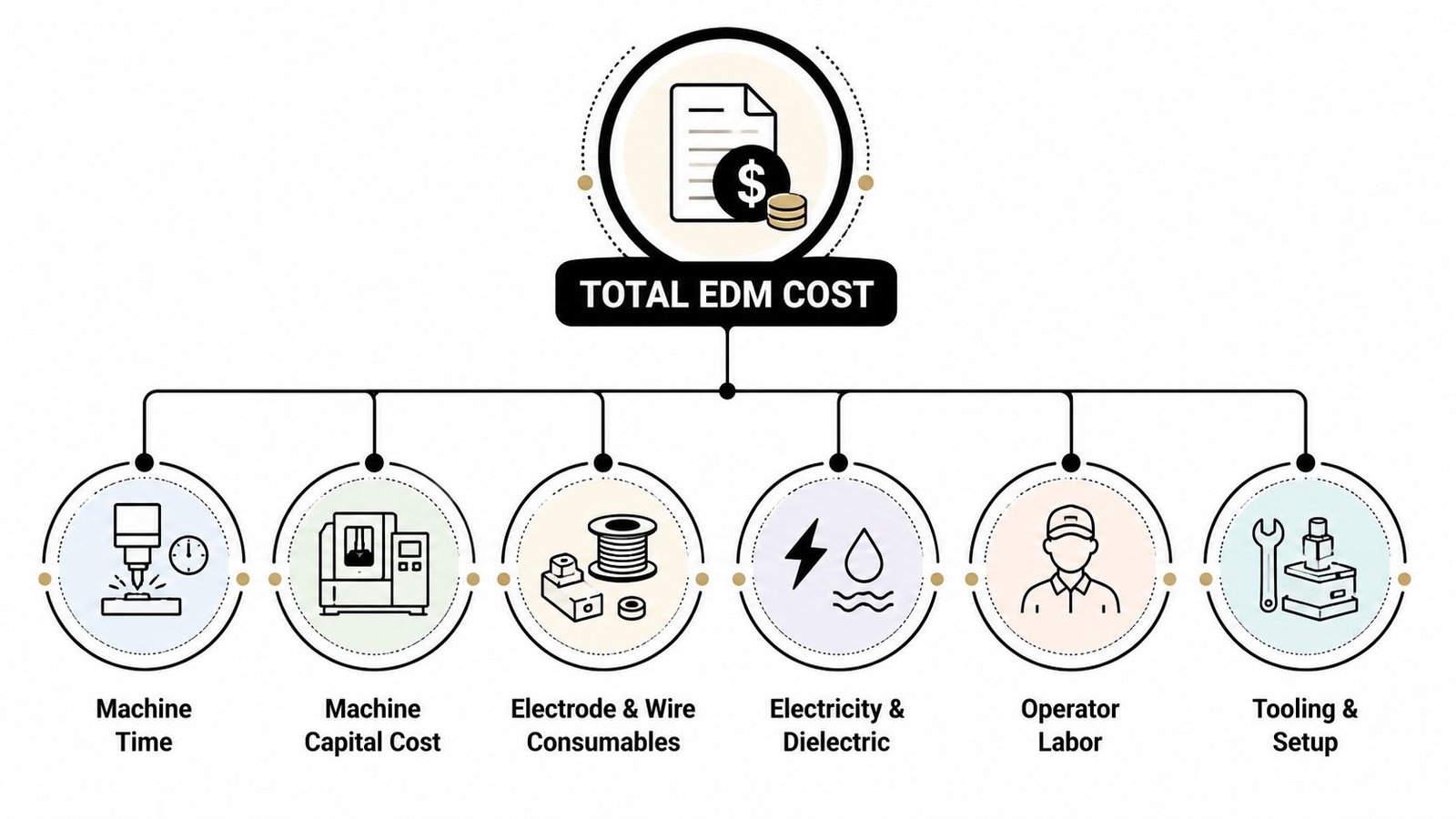
A quote looks tidy only because the shop has bundled several costs into one number. Break it apart, and the same six drivers show up again and again: machine time, machine capital cost, electrode and wire consumables, electricity and dielectric, labor and programming, and secondary operations. Stop arguing about the hourly rate and you start seeing where the part cost moves.
Consumables and power are not rounding errors
Wire EDM can burn through a lot of wire over the life of a machine. A hidden-cost analysis found that a machine running 2,000 hours per year could consume 2,320 lb of wire, which at USD 5/lb works out to about USD 11,600/year in wire alone (thesis analysis). Electricity matters too. The same published study placed electricity at USD 1.7×10^-1 per kWh in its model.
That is not background noise. It is real spend built into the job. When buyers push for a lower rate without changing geometry or process strategy, they are asking the shop to hide cost, not remove it.
Time, setup, and thickness control the bill
A 2024 economic comparison of EDM variants modeled cost using energy, electrode, dielectric, labor, and machine depreciation, with inputs priced at 50 PKR/kWh electricity, 153.8 PKR/hour labor, and 190.63 PKR/hour machine depreciation (2024 study). The same study reported INR 534 per part for vibration-assisted EDM, which was 8% lower than conventional EDM at INR 576.60.
The lesson is blunt. Cut machine time, and you usually cut more than one cost bucket. Labor drops. Machine time drops. Consumable burn drops. Dielectric use usually improves too.
Throughput is the true price lever
A cost-index model in the EDM literature ties machining cost directly to machining duration and tool/electrode removal cost, which makes the economics plain instead of vague (cost-index model). Faster removal and less electrode wear are not technical niceties. They are cost controls.
- Machine Time: Longer runs raise the total even if the hourly rate stays flat.
- Wire or Electrode Use: Consumables keep spending active every minute the cut runs.
- Thickness: Deeper stock slows the cut and stretches the quote.
- Setup: Fixturing and programming can swing the whole job.
- Inspection and Finishing: These are often silent add-ons, not freebies.
- Automation: Unattended cutting helps only when the setup supports it.
If you want a fast read on any EDM quote, ask which of those six buckets is biggest. That answer tells you where the savings live. For a cleaner breakdown of how those buckets show up in a production quote, use this production cost analysis for EDM work.
A Sample EDM Cost Calculation You Can Reuse
A believable quote starts with a believable part. Take a hardened D2 tool-steel insert for a medical-device punch, held to a ±0.0005 in tolerance. The point here isn't to invent a universal answer, it's to show the structure buyers should demand on their own jobs.
Build the quote from the job outward
Start with the cut time. Then add setup and programming, because those hours don't disappear just because the geometry is small. After that, add wire or electrode consumption, inspection, and any post-process cleanup that the part can't escape. The cost-index model that combines machining duration with electrode removal cost is the right mental model here, because it keeps the labor and wear piece visible instead of buried (cost-index model).
| Sample EDM Cost Build-Up for a Hardened Tool-Steel Insert | Assumption | Cost (USD) |
|---|---|---|
| Setup and programming | One fixture, one program | Qualitative, quote-specific |
| Wire or electrode consumption | Sized to the cut path | Qualitative, quote-specific |
| Machine time | Driven by thickness and tolerance | Qualitative, quote-specific |
| Inspection | CMM or equivalent check | Qualitative, quote-specific |
| Deburr and cleanup | Only if required | Qualitative, quote-specific |
That table is intentionally not padded with fake precision. A bad estimate that looks exact is worse than a good estimate that admits uncertainty. In EDM, the uncertainty usually sits in setup, thickness, and finish specification, not in the machine's ability to cut.
Use process choices to change the answer
The 2024 study on vibration-assisted EDM matters because it proves the point that process choice can alter total spend, not just cycle time. It found the vibration-assisted method landed at INR 534 per part, versus INR 576.60 for conventional EDM, an 8% lower total expenditure on the same comparison basis (2024 study).
If the part were 50% thicker, the quote would rise because cut speed falls. If it were carbide instead of tool steel, the answer changes again because the material removal behavior shifts. That's why the buyer who sends a complete drawing package gets a better quote than the buyer who asks for a number without process context.
For teams building a repeatable quoting workflow, SEA's production cost analysis page is the kind of reference that belongs in the internal playbook, not in the sales pitch.
Don't ask, “What's your EDM rate?” Ask, “What changes the part cost on this print?” That question forces the shop to tell you what actually matters.
When EDM Is Worth the Price and When It Is Not
EDM is not a universal fix. It's the right tool when the geometry, hardness, or tolerance makes other processes clumsy, risky, or flat-out impossible. It's the wrong tool when the part is simple, the volume is high, and another process can make it faster.
Use EDM for the jobs other machines hate
EDM is the right answer for hardened steels, especially where conventional milling starts to lose the fight. It's also the cleaner choice for tight internal corners, delicate forms, and work where contact forces would distort the part. Because the process is electrical rather than mechanical, it avoids the cutting load that can damage thin or fragile features.
That's why precision buyers keep EDM in reserve for prototypes, low-volume die work, and difficult internal geometry. You're paying to remove risk, not just metal.
Don't force EDM onto the wrong part
If the part is simple 2D geometry in soft material, EDM is usually the expensive answer. If the feature can be drilled, milled, ground, or laser cut more efficiently, use the cheaper process and move on. The cost guide at Lemhunter's wire EDM pricing overview calls out the same basic truth, thickness and geometry matter more than the hourly rate.
If the only reason you're considering EDM is that the shop gave you a familiar quote format, stop there. The process choice is probably wrong.
The capital cost backdrop matters too. New wire EDM machines are often priced around USD 99,000 to USD 150,000 for mainstream models, with entry-level or used machines commonly starting near USD 30,000–100,000 and high-end precision systems reaching USD 200,000–500,000+ (cost guide). Those bands explain why EDM belongs on hard, tight-tolerance, low-volume work, not on high-volume rough machining.
The buyer's rule is simple. Choose EDM when geometry, hardness, or tolerance makes alternate processes inefficient or unsafe. Skip it when another process can make the part faster and cheaper without compromising function.
GMP and Medical-Device Considerations That Increase Cost
Medical-device EDM pricing gets heavier once the part carries validation and traceability requirements. The cut itself is usually the easy part. The expensive part is proving it, documenting it, and repeating it the same way every time without drift.
Compliance adds real work to the job
For implantable or surgical components, the quote has to cover lot documentation, validated cut parameters, clean dielectric handling, and traceability on materials and electrodes. None of that is decorative. It consumes labor, engineering attention, and inspection time. If the part lives in a regulated environment, the shop cannot just run it hot and hope the result stays acceptable.
That is why a low quote on a Class III orthopedic component can become a poor purchase later. The bill rises when the buyer asks for CMM validation, traceability paperwork, and controlled process records after the quote is already out the door.
Automation helps when it removes manual logging
Smart fixturing and barcode-tracked electrodes reduce cost when they replace manual steps. They do not help when they add complexity without removing anything else. Multi-part fixturing is especially useful because it spreads setup effort across more parts, which is how buyers should think about EDM economics in a GMP environment.
Internal documentation for SEA's EDM machined parts work belongs in the same conversation as the quote because medical-device buyers pay for repeatability as much as they pay for cut time. That is the cost shift. A “simple” part becomes expensive when it has to stand up under audit.
The right answer is not to ignore compliance. It is to design the job so compliance work is built into the process from the start, not patched on at the end.
Practical Ways to Lower EDM Machining Cost
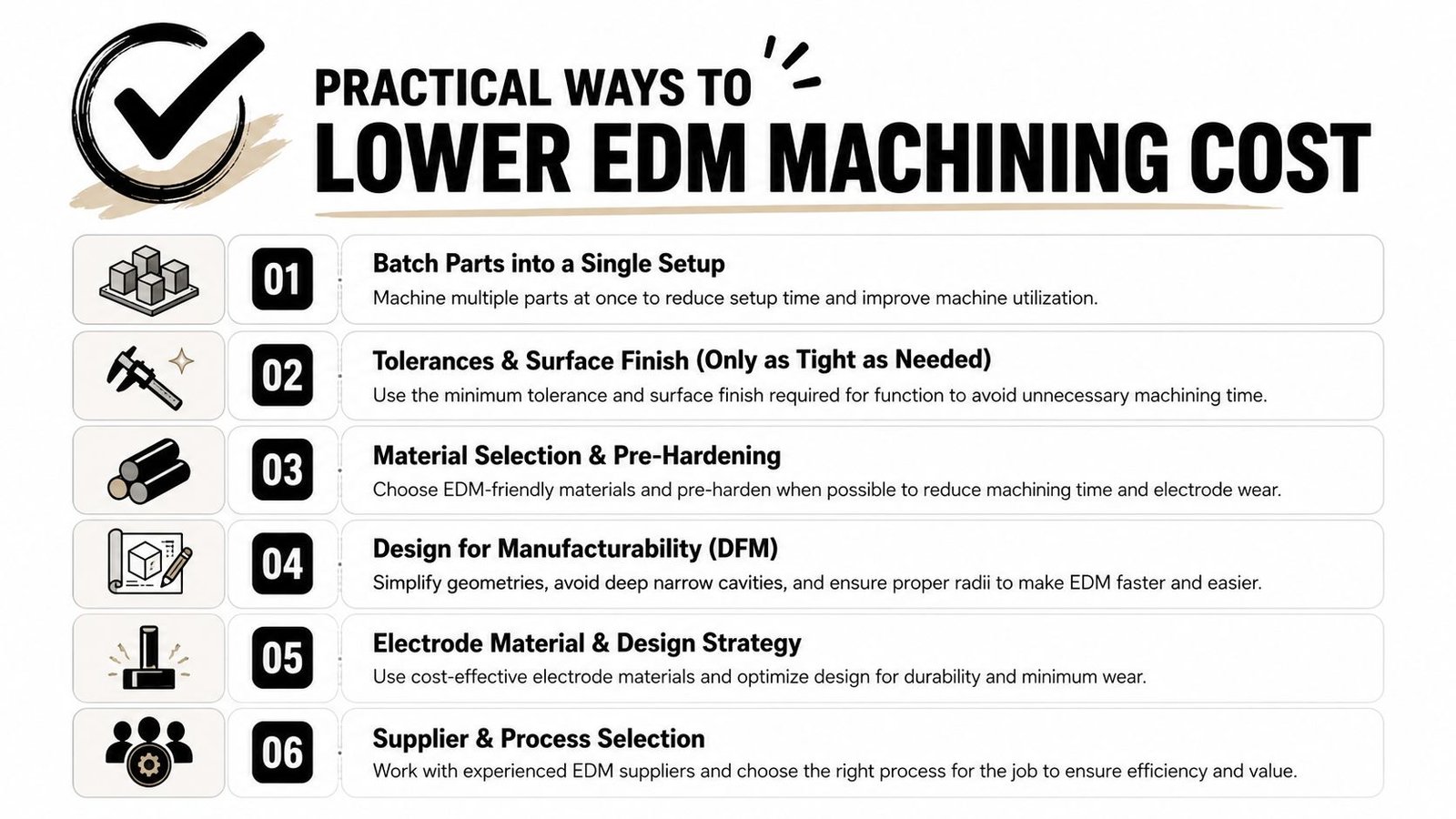
The fastest way to lower EDM cost is to stop asking the shop to solve problems the print created. Most savings come from setup control, smarter tolerancing, and better process selection, not from squeezing the shop over a rate card. If you want the bill to fall, change the job.
Cut the waste out of the quote
- Batch Parts Into a Single Setup: One fixture, one program, one test cut. That's where setup savings start.
- Tighten Tolerances Only Where Needed: Don't pay for fine-finish EDM on surfaces that never affect function.
- Standardize Consumables: Ask for electrode or wire materials the shop already stocks instead of exotic one-offs.
- Design for Manufacturability: Simplify internal corners and geometry before the RFQ goes out.
- Request Unattended Run Time: Let the machine work overnight if the setup is stable enough to trust.
- Choose the Right Supplier Model: A shop with better automation and fixturing usually beats a lower hourly rate.
The logic is simple. If the part takes less setup, less cut time, and less inspection, it costs less. That's true whether the work is outsourced or run in-house.
Know when in-house makes sense
Capital cost matters once annual spend gets high enough to justify ownership. New wire EDM machines commonly sit between USD 99,000 and USD 150,000, entry-level or used machines often start near USD 30,000–100,000, and high-end precision systems can reach USD 200,000–500,000+ (cost guide). That range gives buyers a real benchmark for the buy-versus-outsource decision.
If you're quoting a steady stream of difficult parts, the right automation and fixturing strategy can matter more than the lowest hourly rate on paper. Buyers who understand that stop paying for avoidable setup and start paying for actual part value.
If you want help turning EDM from a quote-line problem into a controlled production cost, talk to System Engineering & Automation. SEA builds practical automation, custom tooling, and fixtures that help manufacturers cut waste, stabilize quality, and reduce labor dependency without losing flexibility.