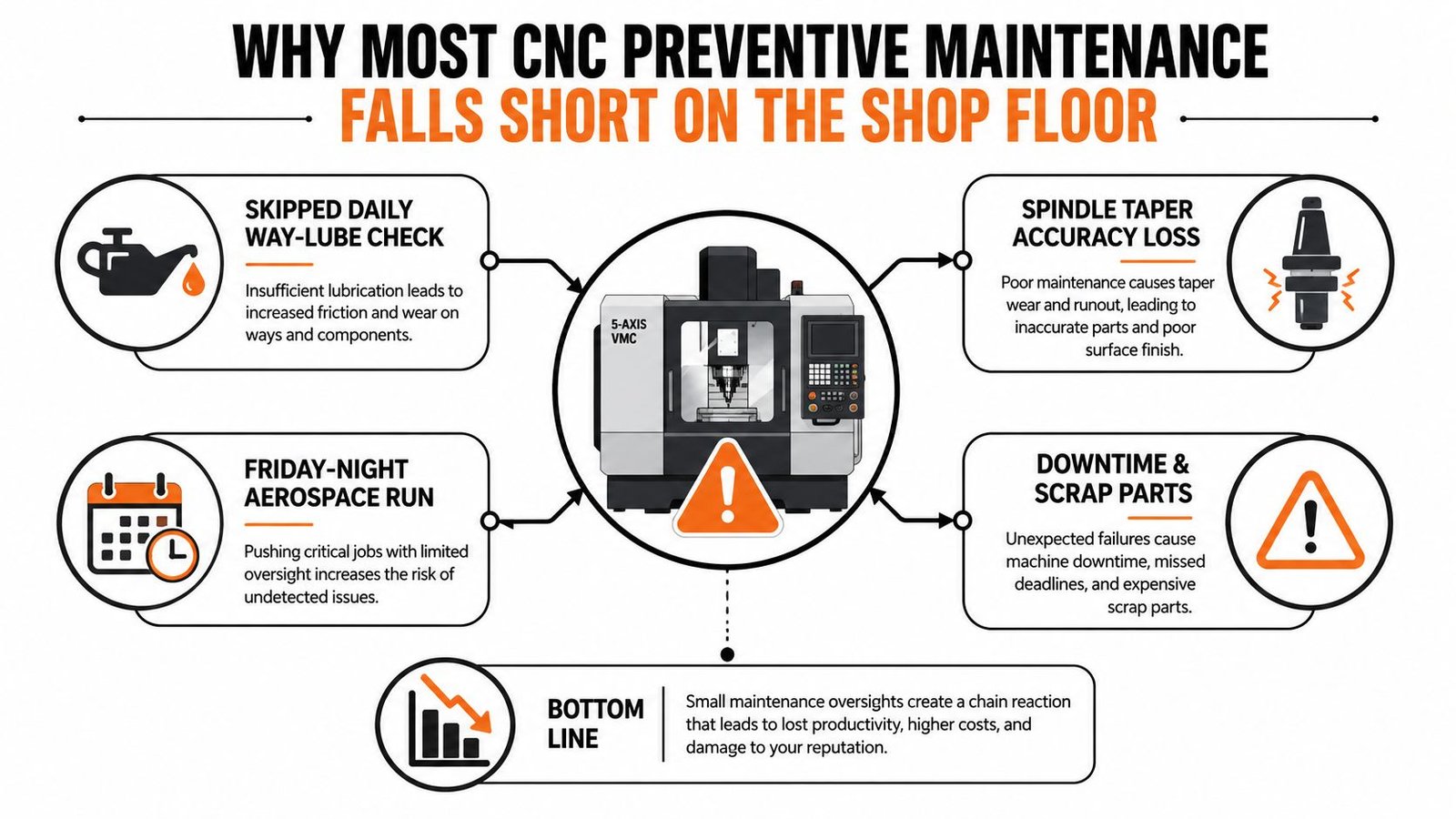
The spindle alarm usually arrives at the worst possible time. A five-axis VMC is deep into a Friday-night aerospace run, the next batch is already staged, and the operator discovers that the spindle taper has lost accuracy. The daily way-lube reservoir check was skipped. What looked like a minor omission has become a precision problem, delayed production, and a maintenance decision made under pressure.
That situation exposes the weakness in many CNC preventive maintenance programs. A calendar says what to inspect, but it doesn't explain which failures deserve the most attention, which signals require an immediate stop, or when a machine has outgrown time-based servicing. A reliable program connects failure modes, component history, operating conditions, and production risk so operators and managers can use the same language when deciding whether to monitor, repair, escalate, or outsource.
For manufacturers working to optimize production and services, the practical objective isn't a longer checklist. It's a maintenance system that protects spindle hours, preserves part quality, and gives production leaders defensible evidence for every intervention.
Table of Contents
- Why Most CNC Preventive Maintenance Falls Short on the Shop Floor
- The Failure Modes That Should Drive Your Maintenance Plan
- Building the Daily, Weekly, Monthly, and Annual Routine
- Spindle, Axes, Coolant, Lubrication, and Control Care
- Moving From Calendar Checks to Condition-Based Monitoring
- Documentation, KPIs, and Audit-Ready Records
- In-House, Outsourced, and the Real ROI of a Mature Program
Why Most CNC Preventive Maintenance Falls Short on the Shop Floor
The VMC in that Friday-night example may have had a completed monthly checklist. It may even have passed a recent general inspection. Yet the machine still lost accuracy because the check that mattered most for its current condition wasn't completed at the right time.
Generic schedules fail because they treat every machine and every component as if they carry the same risk. A lightly used machine making simple parts doesn't need the same inspection intensity as a heavily loaded spindle producing tight-tolerance aerospace components. A checklist copied from an OEM manual also puts the burden on operators who may already be balancing setup changes, tool offsets, quality checks, and output targets.
Paper compliance isn't machine reliability
A paper record can show that someone initialed a task. It can't prove that lubricant reached the intended way, that a filter was clear, or that a rising spindle temperature was investigated. Maintenance becomes useful only when the result changes a decision on the machine.
The distinction matters because technical and maintenance issues were the main causes of downtime in a 2024 study of CNC preventive maintenance at PT MTAT Indonesia. That study reported an average Overall Equipment Effectiveness of 86.52% from January through March 2023, above the commonly cited global benchmark of 85%, while comparing uptime, defect rates, and non-productive time to connect maintenance with broader production performance. The findings are detailed in the PT MTAT CNC preventive maintenance study.
A targeted program starts with questions that a generic calendar can't answer:
- What fails most often? Rank incidents by component and failure mode.
- What causes the greatest loss? Separate frequent nuisance alarms from failures that stop production or create scrap.
- What shows warning signs? Trend temperature, vibration, lubrication flow, current, pressure, and accuracy before failure.
- Who can act? Define what an operator can correct, what maintenance must inspect, and what requires an OEM or specialist.
Practical rule: A task belongs on the front line of the PM plan only when it has a clear failure mode, a defined owner, and an action tied to the result.
The strongest programs give operators a short list of high-value checks and give managers a clear escalation path. That approach reduces the chance that a missed reservoir check becomes a spindle repair during a critical production run.
The Failure Modes That Should Drive Your Maintenance Plan
Maintenance time pays back where failure risk meets production consequence. A structured failure-mode review lets managers rank labor, spare parts, inspections, and monitoring equipment by expected loss instead of giving every subsystem the same attention.
One CNC failure analysis reported mechanical issues at 33% of incidents, electrical failures at 25%, software-related errors at 18%, and human-induced errors at 15%. It also identified spindle overheating as responsible for 35% of downtime, servo motor burnout for 22%, and improper tool loading for 14%. The maintenance response therefore needs both physical checks and operator controls. See the detailed CNC failure-mode analysis.
Prioritize the components that stop the cell
| Failure Mode | Typical Share of Downtime | PM Focus |
|---|---|---|
| Spindle overheating and bearing or taper problems | 35% of downtime | Temperature trend, cooling flow, taper cleanliness, vibration, drawbar condition |
| Servo motor burnout | 22% of downtime | Cabinet cooling, motor temperature, drive alarms, coupling condition, current trend |
| Improper tool loading | 14% of downtime | Gripper inspection, tool-setting verification, operator training, alert response |
| Mechanical failures | 33% of incidents | Ballscrew, linear guide, way cover, lubrication delivery, alignment |
| Electrical failures | 25% of incidents | Filters, fans, terminals, backup battery, thermal inspection |
| Software-related errors | 18% of incidents | Controller backups, version control, parameter protection, alarm review |
| Human-induced errors | 15% of incidents | Standard work, setup verification, reset training, escalation rules |
The categories overlap. A blocked coolant path can increase spindle temperature, and inadequate training can lead to an alarm being reset without correcting its cause. Use the table to select the next inspection, then verify the mechanism at the machine.
Spindle problems often begin with duty cycle, heat, or contamination before age becomes the deciding factor. Ballscrew and linear-rail wear can appear as backlash, finish changes, or positioning drift. Lubrication starvation develops gradually, while an ATC gripper or servo drive may fail abruptly after prolonged marginal performance.
The escalation rule should match the warning pattern. Operators can report temperature, noise, alarms, and tool-loading abnormalities. Maintenance should investigate recurring trends and perform guarded or instrumented checks. OEM or specialist support is appropriate when the evidence points to spindle bearings, drive electronics, geometry, or repairs beyond the shop's test capability.
A 2023 case study shows why component-level tracking matters. Before preventive maintenance, annual downtime totaled 88 hours. Spindle reliability was 37%, with an MTTF of 785,232 hours, while the V-Belt Turret showed 21% reliability and an MTTF of 344,760 hours. After the program, spindle reliability reached 55%, V-Belt Turret reliability reached 84%, and downtime fell to 56 hours per year, a 36% decrease, according to the CNC reliability and downtime case study.
Those results do not support servicing every component more often. They support identifying the components that dominate loss, then matching each inspection to its observable warning behavior. Components without a reliable warning may need planned replacement or specialist review, while measurable degradation can justify condition-based monitoring.
Building the Daily, Weekly, Monthly, and Annual Routine
A useful routine has layers. Operators handle visible, repeatable checks at the machine. Lead hands and maintenance technicians perform tasks requiring instruments or guarded access. Managers schedule inspections that need specialized equipment, planned downtime, or outside expertise.
The frequency should reflect duty cycle and failure history. An OEM schedule is a starting point, not a substitute for the machine's own evidence.
Daily ownership stays with the operator
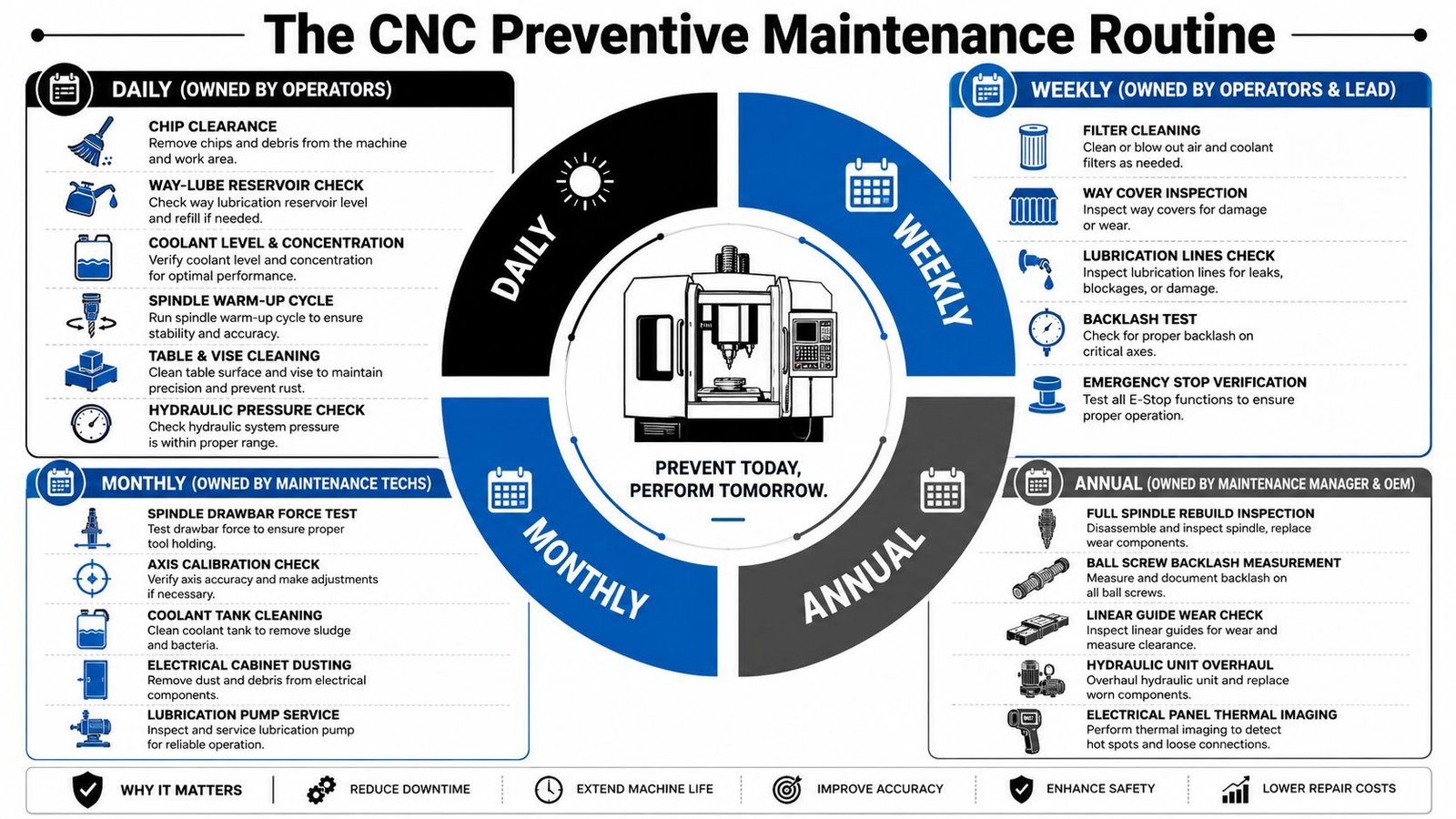
At the start and end of a shift, the operator should remove chips from the table, enclosure, toolchanger area, and way covers. The operator should verify way-lube level and visible delivery, inspect coolant level and concentration according to the plant's approved method, clean the table and vise, check hydraulic or pneumatic pressure, and run the spindle warm-up sequence required for the machine.
These checks work because they're close to the failure. Chips can obstruct movement and contaminate seals. Low lubricant can starve ways. Incorrect coolant condition can accelerate corrosion, odor, tool wear, and heat transfer problems. A warm-up cycle exposes unusual noise, vibration, or temperature before the machine reaches production load.
Weekly checks catch drift
The lead or maintenance technician should inspect control-cabinet filters, way covers, lubrication lines, ATC grippers, hydraulic hoses, pneumatic leaks, and emergency-stop operation. A simple backlash check can reveal motion deterioration before a quality complaint does.
The weekly record should capture the result, not just completion. “Filter checked” is weak evidence. “Filter cleaned, fan airflow restored, no alarm history change” gives the next technician something useful.
Monthly and annual work protects precision
Monthly tasks should include spindle taper inspection, drawbar or clamping checks where applicable, ballscrew backlash verification, coolant tank cleaning, concentration and pH review, electrical cabinet cleaning, and lubrication pump service. Annual planning should include oil sampling, backlash and squareness surveys, electrical thermal scanning, full controller backup verification, and a review of calibration history.
A published CNC preventive maintenance checklist also organizes work by recurring intervals, including daily chip removal and coolant checks, weekly control-cabinet filter cleaning, monthly coolant and backlash tasks, and less frequent calibration and safety audits.
The routine should change when a machine's failure history changes. If spindle temperature appears repeatedly in alarm records, the program needs more spindle-focused checks. If coolant contamination correlates with finish defects, tank care must move from a monthly assumption to a condition-triggered task.
Spindle, Axes, Coolant, Lubrication, and Control Care
A CNC machine is a group of coupled systems, not a collection of independent checkboxes. Poor coolant management can raise spindle heat. A lubrication leak can damage axes. Cabinet dust can reduce cooling and create drive faults. A controller backup can preserve production recovery even when the physical repair takes longer.
What to watch at the machine
For the spindle, inspect taper cleanliness, drawbar force, bearing temperature trend, vibration drift, cooling flow, and grease or oil service hours. A clean taper isn't cosmetic. Contamination changes tool seating and can turn a small accuracy issue into repeat scrap.
For the axes, verify lubricant reaches the way or strip wiper, inspect way covers and scrapers, measure ballscrew end-play and backlash, and check gib adjustment on dovetail machines. Servo couplings should be inspected and re-torqued according to the plant's engineering standard, especially after repeated alignment or motor work.
Lubrication requires the correct product, not just more product. Use the specified ISO VG grade, purge old grease when the procedure calls for it instead of burying contamination under a fresh layer, and log consumption by axis. A sudden increase can indicate a leak, while a sudden decrease can indicate a blocked line or failed pump.
Coolant control should include tramp-oil removal, concentration titration rather than relying on a hydrometer alone, pH stability, and scheduled tank and chip-pan cleaning. The goal is stable heat transfer and corrosion control, not merely a full reservoir.
Signals need defined responses
| Subsystem | Signal to Watch | Action Threshold | Response |
|---|---|---|---|
| Spindle | Temperature, vibration, taper condition | Trend moves outside the established machine baseline or accuracy changes | Stop escalation, inspect cooling and taper, involve maintenance before the next critical run |
| Axes | Backlash, end-play, finish, position error | Measurement or part result drifts beyond the approved process limit | Hold affected work, verify lubrication and alignment, schedule axis inspection |
| Lubrication | Reservoir level, flow confirmation, consumption | Low level, no visible delivery, or unexplained consumption change | Correct supply, inspect lines and pump, don't return to production without confirmation |
| Coolant | Concentration, pH, tramp oil, odor, debris | Condition leaves the plant's approved operating window | Skim, test, clean, or replace coolant according to the controlled procedure |
| Electrical | Cabinet temperature, fan operation, filter loading, alarms | Cooling restriction, abnormal heat, repeated drive alarms | Isolate safely, clean or replace components, perform thermal inspection if needed |
| Control | Backup status, parameter changes, alarm history | Missing backup, uncontrolled change, or recurring alarm | Restore verified image, lock revision, investigate root cause |
Electrical care includes filter inspection, fan-hour tracking, backup battery replacement on a fixed plant cycle, and controller backups with versioned names. A backup that can't be identified or restored isn't a recovery plan.
Moving From Calendar Checks to Condition-Based Monitoring
The shift from calendar maintenance to condition-based maintenance shouldn't start with a sensor purchase. It should start with a failure-mode-weighted calendar program and a clear decision about whether the asset's risk justifies better information.
Three practical stages
Stage one is disciplined calendar PM. Increase inspection frequency for the components that cause the most downtime. Record operating hours, part mix, alarms, defects, and interventions. This stage is inexpensive, but it depends heavily on consistent execution and useful records.
Stage two adds condition-based monitoring. Suitable tools include spindle vibration sensors, electrical-cabinet thermography, oil-debris analysis on way-lube or gearbox circuits, and ultrasonic leak detection on pneumatic lines. These tools show condition at a point in time or across a trend, but they don't remove the need for operator checks.
Stage three is predictive maintenance. Prediction becomes credible only after the plant has enough historical trend data and a failure library that connects patterns to causes. A recent CNC PdM study emphasizes multi-sensor data fusion involving vibration, acoustic emission, spindle current, and temperature, while also highlighting the practical question of what minimum data stack and baseline period a real plant needs. The CNC predictive-maintenance research is useful for framing that implementation problem.
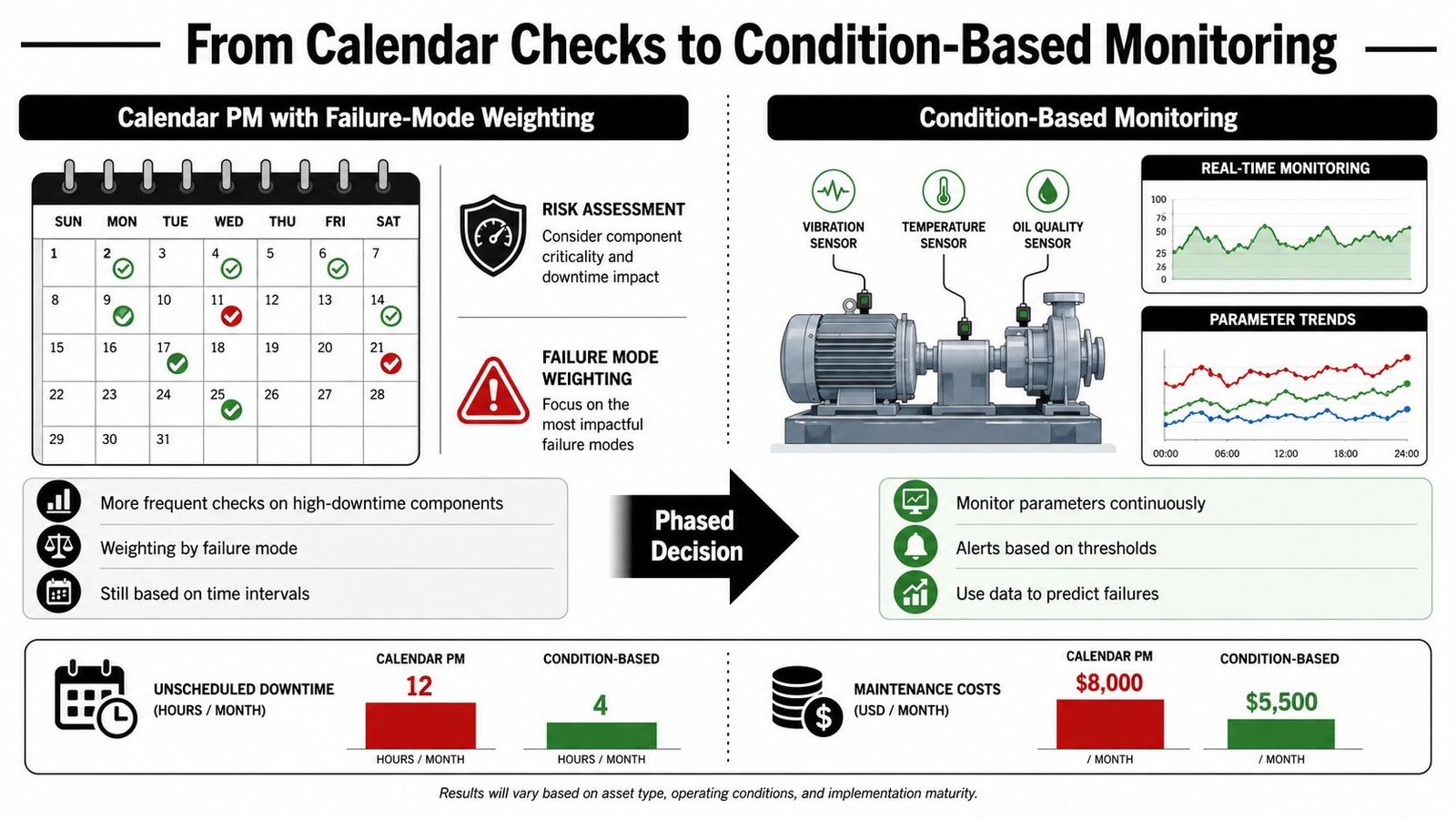
The graphic's cost examples are illustrative, not a plant benchmark. Use your own downtime cost, spindle hours, customer penalties, and machine criticality to build the decision.
A reasonable trigger for stage two is a machine whose annual unplanned downtime exposure exceeds the cost of the proposed sensor package, including installation, analysis, and upkeep. For stage three, wait until the plant has a meaningful trend history and documented failure modes. A vibration reading from a lightly loaded spindle during warm-up can produce noise instead of a useful signal.
Use machine monitoring software when it helps connect controller data, alarms, utilization, and maintenance decisions. The tool matters less than whether someone reviews the signal and has authority to act.
Documentation, KPIs, and Audit-Ready Records
A maintenance record should be created during the work, not reconstructed afterward. The system should pull timestamps from the controller where possible, attach photographs to work orders, and trace replaced parts by lot or serial number. That gives production, maintenance, quality, and finance one version of what happened.
The record needs to answer four questions without a manual investigation:
- Who performed the task? Identify the operator, technician, contractor, or approver.
- When was it completed? Capture the actual work time and machine status.
- What was changed? Record parts, lubricant, settings, measurements, and observations.
- How was the fix verified? Document a test cut, alarm-free run, calibration result, or other approved verification.
Four KPIs that change decisions
Mean Time Between Failures shows whether the machine is staying available for longer intervals.
Mean Time To Repair reveals whether the team can diagnose, access, repair, and verify the machine efficiently.
Planned-versus-unplanned maintenance ratio exposes whether the department is controlling work or constantly responding to breakdowns.
OEE availability loss attributable to maintenance connects maintenance activity to production impact instead of treating all lost time as one category.
Trend these measures monthly in the same meeting where production reviews throughput and quality. A maintenance KPI that never reaches operations won't influence scheduling, spare-parts planning, or capital decisions.
For regulated or GMP-adjacent production, add electronic signatures on closed work orders, validated backup retention, and a controlled change log for machine parameters that can affect product quality. A controller image should have a version, owner, approval status, and restore test. The purpose isn't administrative polish. It is to make the machine's condition and history defensible when a customer, auditor, or quality investigator asks for evidence.
In-House, Outsourced, and the Real ROI of a Mature Program
The in-house versus outsourced decision should follow capability and risk, not habit. Keep work inside when the team has the skill, response time, tools, and authorization to complete it safely. Outsource when a task requires scarce expertise, specialized equipment, or a response window the plant can't support.
Use three breakpoints
Skill scarcity is the clearest breakpoint. Spindle rebuilds, ballscrew reconditioning, precision alignment, and complex controller retrofits can require experience that a general maintenance team doesn't use often enough to retain.
Response time matters when one bottleneck machine supports a critical customer run. A regional partner with planned and emergency coverage may reduce exposure more effectively than trying to build every specialty in-house.
Cost per intervention must include more than the service invoice. Compare the contractor's rate with fully loaded technician time, travel, tooling, training, lost production, and the opportunity cost of pulling internal staff away from other assets.
| Task Category | Recommended Owner | Outsource Trigger | Typical Cost per Intervention |
|---|---|---|---|
| Daily cleaning, checks, and basic lubrication | Operator | No trained coverage or recurring compliance failures | Calculate from internal labor and scheduled time |
| Weekly inspection and minor correction | Maintenance technician | Repeated defects require specialist diagnosis | Calculate from labor, parts, and production access |
| Spindle, ballscrew, and precision alignment work | OEM or regional specialist | Required measurement equipment or expertise isn't available | Obtain a task-specific quote |
| Controller rebuild, retrofit, or parameter recovery | Controls specialist | Backup is incomplete, fault repeats, or architecture is obsolete | Obtain a scope-based service estimate |
| Vibration, thermography, and oil analysis | In-house with specialist support | No trained analyst or no reliable baseline | Price the monitoring program and reporting separately |
A 12-month ROI model should include direct savings from downtime hours avoided, scrap reduction, and improved MTBF. Add indirect value from extended component life and warranty preservation, then separate the softer capital case from the hard savings. A 3% to 5% OEE lift can be tested against a documented baseline, but it should remain an assumption in the model until the plant verifies it.
A useful industry case reported predictive maintenance reducing annual maintenance costs by 43.7% and equipment downtime by 73%, with downtime reduced to 120 hours and annual maintenance cost reduced to ₦15.34 million. Those figures come from the industrial predictive-maintenance case study, and they should be treated as a reference case, not a promise for every shop.
A hybrid structure often works well. Keep daily and weekly routines with multi-skilled technicians, use a regional OEM partner for spindle and axis work, and retain a vibration specialist when the data supports it. For the CFO, the one-page business case should show downtime cost per hour, MTBF trend, scheduled versus unscheduled maintenance ratio, and payback period for any predictive upgrade.
If your plant needs to connect CNC reliability with broader manufacturing improvements, System Engineering & Automation's maintenance support services can sit alongside the internal team for equipment support, controller work, upgrades, and ongoing maintenance planning.
System Engineering & Automation offers equipment installation, maintenance, support, and CNC controller system services, including rebuilding, retooling, and retrofitting controllers. Visit System Engineering & Automation to discuss a practical maintenance or automation solution built around your production goals, machine risk, and available budget.