At 5:45 a.m., the line is already telling you what your next capital project should address. Two operators are taping cases by hand because the case erector overloaded, while the case packer waits for a changeover that has already consumed forty minutes. Production is moving, but labor is absorbing the failure, output is below plan, and every workaround adds another opportunity for inconsistent quality.
That moment is more useful than a glossy equipment catalog. Production line equipment affects labor exposure, throughput limits, changeover performance, safety, quality, and the skills your plant will need to support the system for years. The right purchase can remove a bottleneck and stabilize a process. The wrong one can turn a variable operation into an expensive maintenance problem.
This guide is for manufacturing managers, plant engineers, and operations teams weighing manual, semi-automatic, and fully automated equipment under real labor, skills, flexibility, and return-on-investment constraints. It focuses on how to place your operation on the automation spectrum, select the mechanical and control architecture, manage commissioning, and test whether a vendor can support the line after installation.
Table of Contents
- Why Production Line Equipment Decisions Matter Now
- Manual, Semi-Automatic, and Fully Automated Lines Explained
- Core Components and Tooling Inside a Modern Line
- How to Choose the Right Level of Automation
- Real-World Examples and Case Study Snapshots
- Integration and Commissioning From Concept to Production
- Maintenance, Support, and the Skills Gap Most Buyers Miss
- Vendor Evaluation Checklist and Questions to Ask
Why Production Line Equipment Decisions Matter Now
A production line decision rarely stays confined to the equipment budget. It determines how many operators you'll need at each station, how much output the line can sustain, how often quality depends on individual technique, and whether your maintenance team can recover a fault without waiting for an outside specialist.
Ford's moving assembly line at Highland Park, introduced in 1913, established the basic logic of modern flow production. The conveyor-based system divided work into repetitive tasks and reduced Model T chassis assembly time from more than 12 hours to about 93 minutes within roughly 18 months, according to this historical account of Ford's assembly line. By June 4, 1924, Highland Park had produced the 10-millionth Model T. The lesson for today's buyer isn't that every plant needs a conveyorized, high-volume line. It's that equipment architecture changes the economics of the whole process.
The purchase locks in operating behavior
A line built around a single product and stable demand can justify dedicated transfer equipment, automatic inspection, and integrated controls. A line serving frequent product changes may need quick-release tooling, accessible change parts, and operators who can safely intervene without stopping the entire system.
The common mistakes run in both directions:
- Over-automation: A variable, low-utilization process receives a complex system that spends too much time waiting, being adjusted, or supported.
- Under-automation: A stable, repetitive process remains dependent on manual handling even though a targeted machine could improve ergonomics, consistency, and capacity.
- Lifecycle blindness: The buyer evaluates the purchase price but overlooks integration, training, maintenance, spares, and downtime during installation. A manufacturing automation ROI framework specifically calls for those costs to be included in the model.
Practical rule: Buy the level of automation your process can feed, maintain, validate, and economically use. Aspirational automation is still a poor investment if the floor can't support it.
The most useful question isn't “How automated should we become?” It's “Which constraint is costing us the most, and what equipment removes it without creating a larger constraint somewhere else?” That answer leads to a practical design, whether the solution is a smart fixture, a powered workstation, a robotic cell, or a fully integrated line.
Manual, Semi-Automatic, and Fully Automated Lines Explained
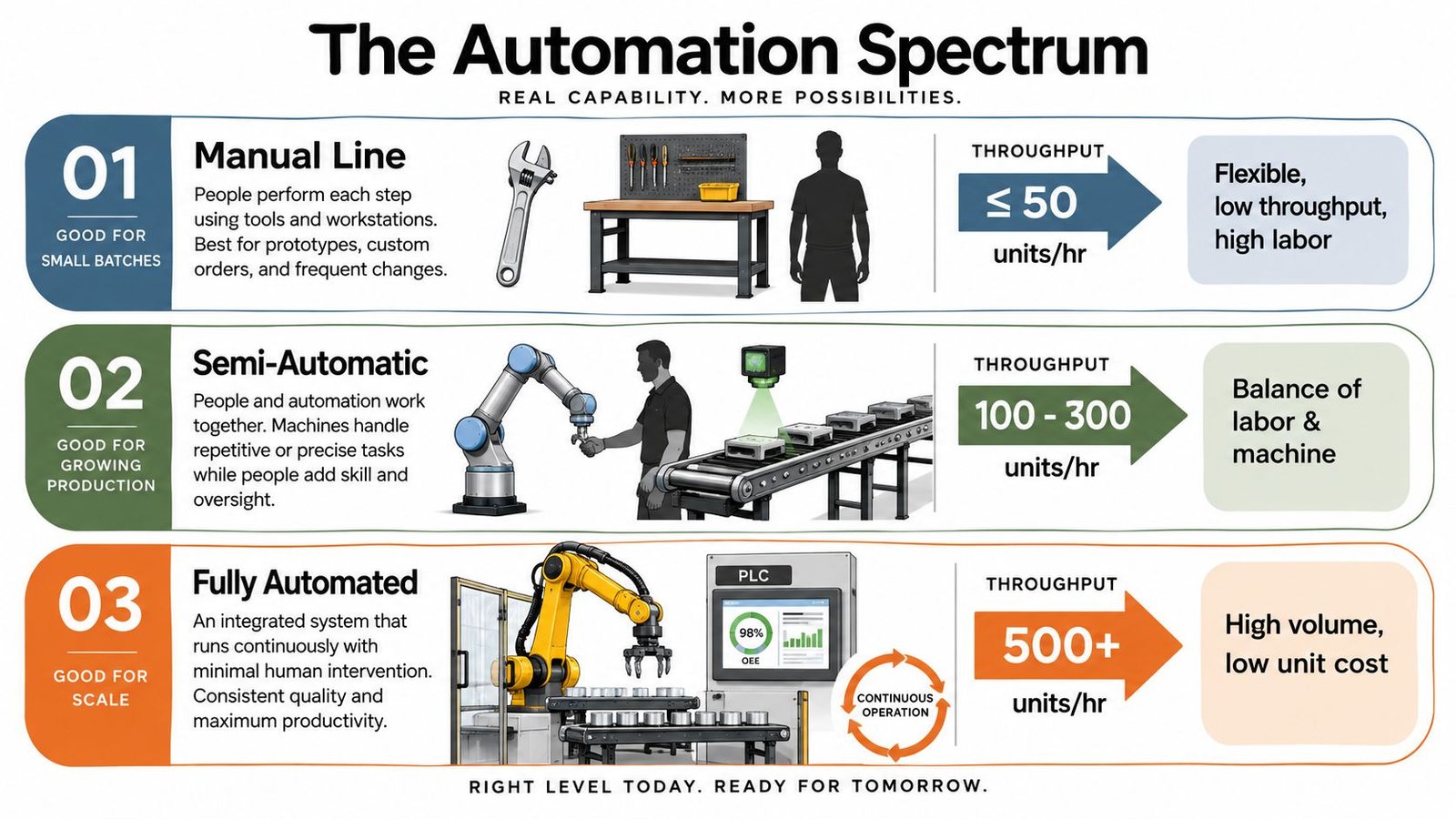
Automation is a spectrum, not a label printed on a quotation. Place your line on that spectrum by observing what the machine does, what the operator does, and how the process behaves when a product, material, or format changes.
A manual line resembles a craft workshop. Operators load, position, assemble, inspect, and move product using benches, hand tools, and standalone equipment. This arrangement offers maximum flexibility and a low barrier to process changes, but throughput depends heavily on operator pace, training, fatigue, and consistency. Manual work can be the sensible choice for prototypes, high-mix products, or demand that doesn't justify dedicated equipment. A manual equipment approach for precision and control can be appropriate when human judgment remains central to the process.
Semi-automatic equipment bridges the gap
A semi-automatic line puts powered control where it creates the most advantage, while keeping operators involved in loading, inspection, replenishment, or format changes. Examples include an automatic filler with manual container loading, a powered labeler with operator-fed product, a robotic pick-and-place station between manual operations, or an automatic case packer supported by manual material handling.
This is more than a compromise. Semi-automation often lets a manufacturer address the worst bottleneck without rebuilding the entire line. It can also preserve manual fallback, which matters when product mix changes or the automated station needs service.
Fully automated lines demand stable conditions
A fully automated line combines conveyors, robotics, sensors, vision inspection, and centralized control into a synchronized system. Operators typically supervise the process, replenish materials, respond to alarms, and perform planned interventions rather than repeating every production step.
The model works best when volume, repeatability, product presentation, and maintenance capability support the investment. The first industrial robot installation illustrates the transition. In 1961, Unimate was installed on a General Motors die-casting line in New Jersey. The robot weighed about 4,000 pounds and cost $25,000 at the time, according to this timeline of assembly-line automation. Modern systems are far more integrated, but the selection principle remains unchanged. Automation must match the physical process and the people supporting it.
Core Components and Tooling Inside a Modern Line
A line is a system of interdependent layers. A reliable PLC won't compensate for a flexible frame, and a precise robot won't deliver repeatable output if the fixture locates parts inconsistently. The practical design review should examine the mechanical layer, control layer, and tooling layer together.
Mechanical structure carries the process
Frames, conveyors, drives, pneumatics, guarding, transfer devices, and access panels form the physical foundation. Rigidity matters because vibration and deflection can shift product position, disturb sensors, and change the relationship between tooling and workpieces. Accessibility matters just as much. If technicians can't reach a drive, remove a guard safely, or inspect a pneumatic connection, routine maintenance becomes deferred maintenance.
Conveyor selection deserves attention beyond belt width and rated load. Product orientation, accumulation, transfers, speed control, cleanability, and access for sanitation or inspection determine whether the conveyor supports the process or becomes the source of jams.
Controls turn hardware into a usable machine
The control layer usually includes a PLC, HMI, sensors, motor starters or drives, safety relays, and networked devices. The PLC sequences events and manages interlocks. The HMI gives operators a way to select recipes, identify faults, and confirm recovery steps. Sensors verify presence, position, pressure, temperature, or other process conditions. Safety relays and related circuits help bring hazardous motion to a controlled state.
A poorly placed photoeye can create false rejects. An HMI that displays only “fault” forces operators to troubleshoot by trial and error. A controls design that ignores maintenance access may leave technicians dependent on the original integrator for simple diagnosis.
Tooling determines repeatability and changeover behavior
Change parts, fixtures, nests, format sets, guides, punches, grippers, and wear items determine daily performance. A fixture that locates a component positively can remove operator guesswork. A standardized format set can make a product change predictable. Missing drawings or poorly identified spare parts can extend every setup and make the line dependent on one experienced technician.
| Layer | Component | What It Does | Why It Matters on the Floor |
|---|---|---|---|
| Mechanical | Frames and guarding | Supports equipment and separates people from hazards | Rigidity protects alignment, while accessible guarding supports safe service |
| Mechanical | Conveyors and drives | Moves and accumulates product | Poor transfers create jams, scuffs, and upstream starvation |
| Controls | PLC and HMI | Sequences the line and communicates status | Clear diagnostics shorten fault recovery |
| Controls | Sensors and safety devices | Detects conditions and manages safe stops | Correct placement reduces false rejects and nuisance trips |
| Tooling | Fixtures and nests | Locates and supports the workpiece | Repeatable location improves process consistency |
| Tooling | Change parts and format sets | Adapts the line to products or sizes | Standardized parts make changeovers more controlled |
| Tooling | Wear items and spares | Replaces components that degrade | Availability prevents small failures from becoming long stoppages |
For manufacturers developing custom workholding, tooling and fixtures for production applications should be evaluated as part of the line architecture, not as an accessory added after the equipment is selected.
How to Choose the Right Level of Automation
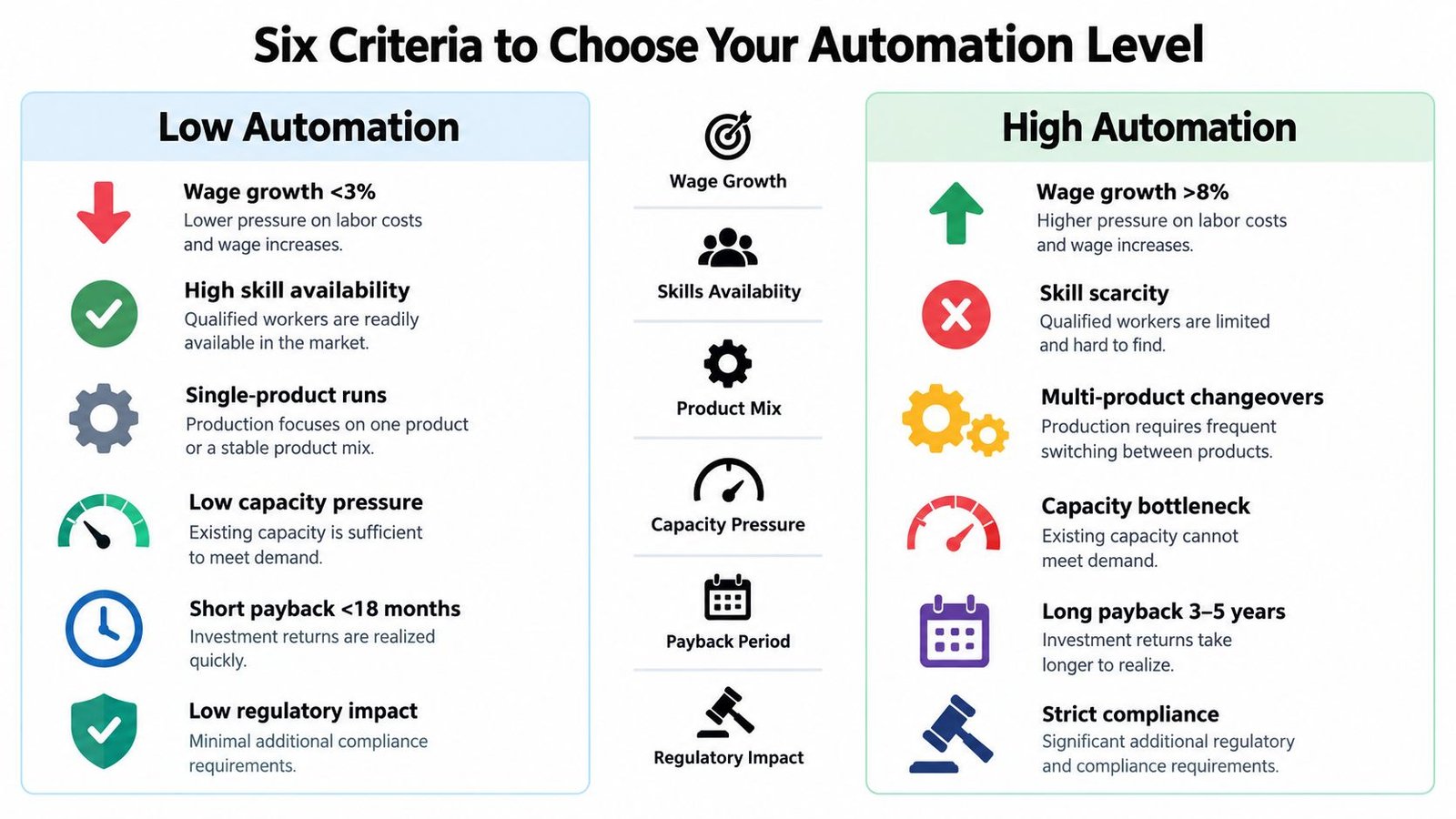
The right automation level emerges from the process constraints. Use six questions to expose those constraints before comparing machine quotations.
Start with labor reality
Identify where labor is limiting output. Is the bottleneck loading, inspection, packaging, material replenishment, or changeover? Review the skills available on each shift, not just the technicians who attended the vendor demonstration. In a 2026 survey of 214 U.S. manufacturers, 92% said automation is essential to long-term competitiveness, while only 37% reported significant or full automation in place, according to Kaizen Institute's analysis of the automation labor paradox. The same source notes that roughly 26% of the U.S. manufacturing workforce, about 3.9 million workers, is eligible for retirement. That makes support capability a design input, not a human-resources footnote.
Match throughput to takt time
Calculate the required production pace, then test whether the proposed equipment can sustain it with realistic stops, replenishment, inspection, and recovery. High volume alone doesn't justify a fully automated line if the product arrives inconsistently or the upstream process can't feed it. A semi-automatic station may deliver the needed capacity with less integration risk.
Define the quality consequence
Manual variability may be acceptable for a cosmetic operation but unacceptable for a critical fit, seal, dosage, or traceability step. In pharmaceutical and medtech manufacturing, automation systems may need GMP/GxP-oriented design, documentation, quality controls, and validation. Pharmaceutical and medtech automation guidance connects equipment design with compliance and traceability rather than throughput alone.
Remove the worst ergonomic exposure
Prioritize tasks involving repetitive force, awkward reaches, heavy handling, or sustained attention. Semi-automation often earns its place by removing the most damaging work, not the simplest work. A powered lift, feeder, manipulator, or pick-and-place unit can improve the working position while preserving operator control elsewhere.
Model the full return
Use annual savings minus annual operating costs, divided by total investment, as a starting payback calculation. Include labor, scrap, quality rework, throughput, maintenance, spares, training, integration, installation, and downtime during the project. Industry guidance commonly places collaborative robot payback in the 12 to 24 month range, while more complex projects can take longer, as outlined in this automation ROI and adoption roadmap. Treat that range as a planning reference, not a promise.
Test flexibility against product mix
A dedicated machine may perform beautifully on one stable SKU and poorly across frequent changeovers. Check how operators change formats, how many parts must be replaced, whether recipes are controlled, and whether manual fallback exists. In the U.S., industrial robot installations rose 11% to roughly 38,000 units in 2025, while food-industry adoption reportedly rose 30%, according to this industrial robotics market release. Those figures point toward targeted automation at difficult, repetitive stations, not an automatic case for replacing an entire line.
Use the answers to position the operation. Manual equipment may suit high variation, semi-automation may fit a constrained station, and full automation may suit stable, high-volume, tightly controlled production. The best answer is often a staged system that can expand as demand and internal capability grow.
Real-World Examples and Case Study Snapshots
The most useful equipment lessons often come from decisions that looked reasonable during quoting. A low-volume contract packager chose a fully automated line because the projected labor reduction looked attractive. Once installed, the line spent too much time waiting for product, handling changes, and being adjusted between short runs. Its utilization stayed under 25 percent, so the plant owned high capability without enough production demand to use it.
A metal-forming operation took the opposite approach. Instead of replacing the line, it inserted one semi-automatic robotic cell between two manual stations. The cell removed a repetitive transfer and reduced cycle time by 40 percent, with payback under 18 months. That result came from targeting a constrained operation, not from automating every task.
Compliance can change the economic decision
A regulated food manufacturer accepted a longer financial return because the project had to support GMP and traceability requirements. In that setting, documentation, controlled records, repeatability, and validation influenced the equipment choice alongside output. A shorter payback would have been attractive, but it wasn't the only acceptance criterion.
Another line failed for a less reason. The vendor demonstrated excellent running speed, but the team never established a practical changeover method. Operators searched for format parts, adjusted guides by trial and error, and waited for maintenance support. The machine met its headline specification and missed the production requirement.
| Scenario | Level Chosen | Primary Criteria | Outcome |
|---|---|---|---|
| Contract packaging with short, low-volume runs | Fully automated | Utilization, product mix, support burden | Capability exceeded practical demand |
| Metal-forming bottleneck at a repetitive transfer | Semi-automatic robotic cell | Ergonomics, cycle time, targeted ROI | Focused automation improved the constrained step |
| Regulated food production | Fully automated | Traceability, documentation, compliance, repeatability | Longer return accepted for quality and regulatory needs |
| Frequent-format line with weak setup planning | High automation without changeover design | Flexibility, tooling, operator method | Strong machine performance was undermined by setup losses |
These examples expose a consistent pattern. Equipment creates value when it addresses a measured constraint and fits the operating context. It disappoints when the buyer treats the machine's maximum capability as the same thing as usable plant capacity.
Integration and Commissioning From Concept to Production
Most commissioning problems begin before the equipment is ordered. The project team hasn't confirmed the process sequence, the product presentation, the takt requirement, or the utility conditions, so the vendor fills in the gaps with assumptions. Those assumptions become change orders later.
Build the sequence around evidence
Start by mapping the current process. Record material flow, operator motions, inspection points, replenishment, fault recovery, and changeover tasks. Confirm the required pace with actual demand and product behavior. Only then should the team finalize the equipment specification and shortlist integrators.
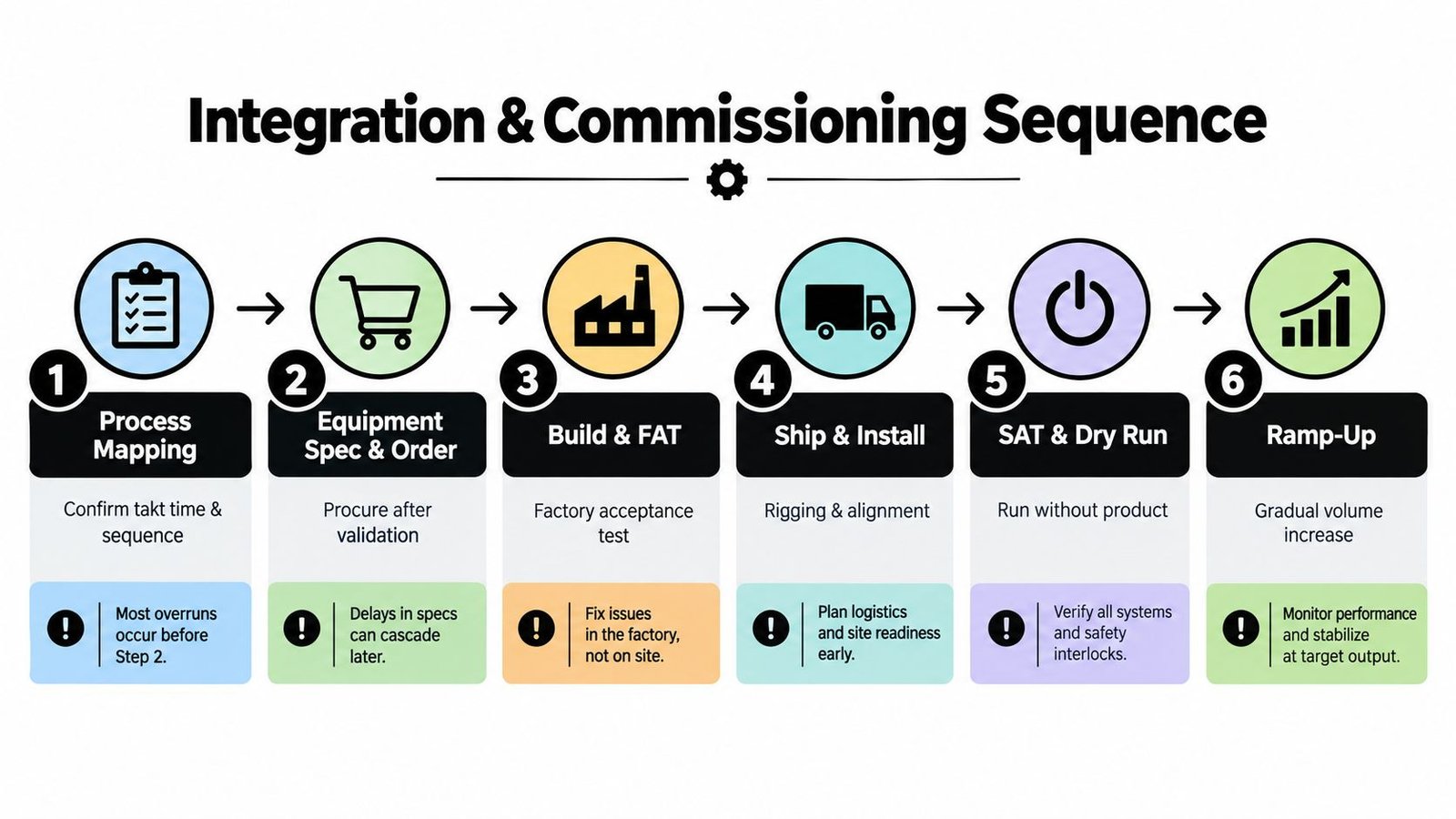
A useful sequence is:
- Process mapping: Confirm the sequence, takt requirement, interfaces, and acceptance criteria.
- Equipment specification and order: Procure after the process and technical assumptions have been validated.
- Build and Factory Acceptance Test: Test the machine against documented scenarios, not a casual demonstration.
- Ship and install: Complete rigging, alignment, floor preparation, guarding, utilities, and network connections.
- Site Acceptance Test and dry run: Run without product to verify sequence, safety, alarms, and recovery.
- Ramp-up: Introduce product gradually, document problems, and track agreed production measures.
Make the FAT difficult enough to matter
A weak FAT proves that the machine can cycle. A useful FAT tests normal production, empty product conditions, misloads, sensor failures, safety-door events, fault recovery, recipe changes, and operator access. For regulated applications, the documentation package, traceability functions, and validation evidence must be part of the acceptance discussion.
Controls integration often creates a separate risk. The PLC and HMI may work correctly while the MES or ERP handshake fails because IT and OT teams defined different data fields, timing, or ownership. Confirm network responsibilities, tag lists, user access, historian requirements, and alarm handling before site installation.
Utilities and floor preparation need their own schedule. Electrical feeds, compressed air, exhaust, drainage, network drops, anchoring, and access paths can delay an otherwise complete machine. Use a production equipment commissioning checklist to assign owners and verify readiness.
Commissioning usually slips through under-scoped training, late utility tie-ins, missing spares, incomplete documentation, and unclear escalation paths. A line isn't ready when it runs once. It's ready when trained operators and technicians can run, stop, recover, change over, and maintain it safely.
Maintenance, Support, and the Skills Gap Most Buyers Miss
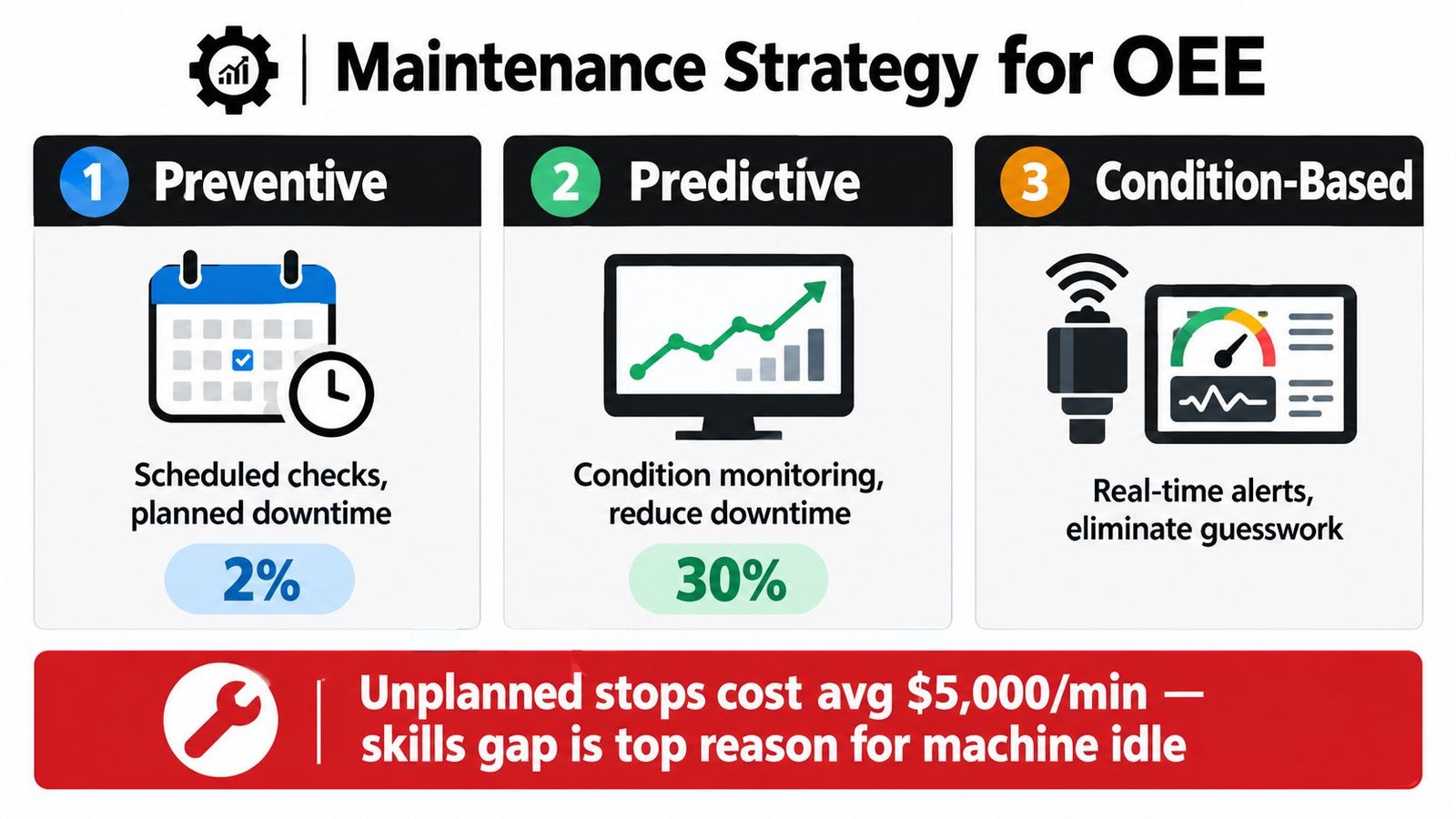
Maintenance isn't a post-purchase expense to minimize after the machine arrives. It's part of the line's production capacity. Preventive maintenance schedules planned inspections and replacement work. Predictive maintenance uses condition information to identify deterioration before failure. Condition-based maintenance ties intervention to a measured state, such as vibration, temperature, pressure, current, or sensor performance.
A manufacturing case study reported uptime rising from 82% to 95%, unplanned downtime falling from 18% to 4.9% of production time, and OEE increasing from 72% to 89% after predictive maintenance implementation, according to the predictive maintenance uptime case study. The value comes from moving work away from emergency repair and toward planned intervention.
Make changeover a maintenance concern
SMED provides a practical way to reduce setup losses. Separate internal tasks, which require the machine to be stopped, from external tasks, which can happen while it runs. Prepare fixtures, fasteners, recipes, tools, and inspection materials before the stop. Use locating features, visual settings, and standardized format parts instead of relying on operator memory.
Benchmark guidance cites changeovers of 3 to 10 minutes on high-volume lines and 8 to 15 minutes on medium-mix lines, with internal setup ratios targeted below 30% after SMED implementation, as described in this changeover reduction guidance. The exact result depends on the process, but the method is broadly useful.
Plan for the people who keep the line alive
A new PLC, robot, vision system, or servo architecture can exceed the skills of an otherwise capable maintenance team. Buyers should require vendor-led training, shadowing during commissioning, electrical and pneumatic schematics, software backups, fault-tree documentation, and a clear support agreement.
A usable maintenance plan should specify:
- Daily checks: Guarding, leaks, abnormal noise, sensor condition, product buildup, and visible damage.
- Scheduled service: Lubrication, filter replacement, fastener checks, calibration, and wear-part inspection.
- Controls upkeep: Backups, firmware management, approved software changes, and network documentation.
- Spare-parts control: Critical spares, lead times, approved substitutes, and storage responsibility.
- Escalation: Who responds first, how remote support works, and when an onsite visit is required.
Vendor Evaluation Checklist and Questions to Ask
A vendor meeting should produce engineering evidence, not just a polished cycle-time demonstration. Evaluate the proposal across four areas: capability, support, commercial terms, and project risk.
Capability questions
Ask the vendor to demonstrate the required throughput using your product, materials, formats, and acceptance conditions. Request documented reject handling, fault recovery, recipe control, safety functions, inspection performance, and changeover steps. For regulated manufacturing, ask for GMP-aware documentation, traceability architecture, validation support, and examples of quality records.
Support questions
Find out who will train operators and technicians, how long training lasts, what documentation transfers at handover, and whether local service is available. Ask for reference sites running the same configuration for two or more years. A reference that only confirms installation tells you less than a plant that can describe maintenance, software support, spares, and actual operator use.
Commercial questions
Request a total lifecycle cost, not a headline equipment price. The quote should identify integration, installation, tooling, commissioning, training, maintenance, spare parts, software, travel, and planned downtime. Ask for the assumptions behind the payback model and separate labor savings from quality, capacity, and ergonomic benefits.
Risk questions
Request a sample FAT report and insist that acceptance criteria include abnormal conditions. Ask for documented changeover times under SMED conditions, not only the vendor's ideal setup. Confirm the project manager's name, controls responsibility, utility requirements, data interfaces, cybersecurity responsibilities, and escalation process.
Watch for red flags:
- No site access: The vendor refuses reference visits or can't show comparable equipment in operation.
- Headline pricing: The proposal hides integration, tooling, training, or support costs.
- Outsourced controls: The sales team can't identify who owns PLC, HMI, safety, and data integration.
- Unclear ownership: Nobody can name the project manager or define decisions and deliverables.
- Weak acceptance tests: The FAT covers only normal cycling and avoids recovery, changeover, and quality scenarios.
- No maintenance handover: The vendor provides limited documentation and assumes your team can learn by observation.
A sound supplier will discuss limitations openly. The right production line equipment partner helps you match automation to labor reality, product stability, skills, compliance, and return, then supports the system through installation and ongoing service.
System Engineering & Automation provides manual, semi-automatic, and fully automated manufacturing solutions, including custom tooling, fixtures, integrated controls, conveyors, robotics, installation, commissioning, and maintenance support. Visit System Engineering & Automation to discuss a production line equipment project that fits your process, workforce, budget, and long-term operating goals.