You don't usually notice a systems problem on day one. The new workstation passes FAT, the demo looks clean, the first batch clears inspection, and everyone feels justified in the upgrade. Then the line starts to drift, operators add workarounds, QA starts asking for more records, and the “simple” automation project becomes another source of scrap, delay, and frustration.
That's the point where advanced systems engineering stops sounding academic and starts looking like common sense. On a shop floor with semi-automated equipment, legacy machinery, GMP expectations, and human-in-the-loop decisions, the primary question isn't whether the machine works. It's whether the whole production system still works after change, variation, maintenance, retraining, and audit pressure.
Table of Contents
- The Moment a Production Line Starts Drifting
- What Advanced Systems Engineering Means
- The Pillars That Drive Real Manufacturing Results
- Matching Automation Levels to Engineering Discipline
- A Practical Roadmap for Implementation
- Metrics That Prove ASE Is Working
- Short Case Examples and ROI in Practice
- Where to Start on Your Own Shop Floor
The Moment a Production Line Starts Drifting
The failure usually shows up as a nuisance before it shows up as a crisis. A workstation that ran clean in commissioning starts needing manual nudges after every changeover. One operator learns the trick, another doesn't, and the variation gets buried in tribal knowledge until quality opens a deviation and maintenance is chasing a symptom instead of a cause.
That's the moment many manufacturers discover they bought equipment, but they didn't engineer the system around it. A semi-automated line is especially unforgiving because the human side and the machine side are both part of the process, so drift can come from recipe logic, fixture tolerance, handoff timing, training gaps, or a weak definition of what “in spec” really means.
Practical rule: if the line only works when two people remember three unwritten steps, the architecture is already failing.
Advanced systems engineering earns its keep by forcing the team to connect requirements, architecture, verification, and lifecycle control before the first bracket is cut or the first PLC routine is copied from another machine. That matters in manufacturing because the cost of a bad assumption shows up later as rework, schedule slip, validation pain, and avoidable firefighting.
The historical shift is real, too. Fraunhofer's materials describe the formal rise of advanced systems engineering in the 2010s, alongside publication growth of about 8% per year in Germany and around 30% annual growth in China Fraunhofer ASE brochure.pdf). That growth matches what many plants have felt for years, complexity is no longer isolated in aerospace or defense, it's inside every production cell that mixes software, mechanics, traceability, and people.
For manufacturers optimizing production and services, the lesson is blunt. If the upgraded line is drifting, the fix usually isn't “more machine.” It's better system definition, tighter verification, and cleaner lifecycle control.
What Advanced Systems Engineering Means
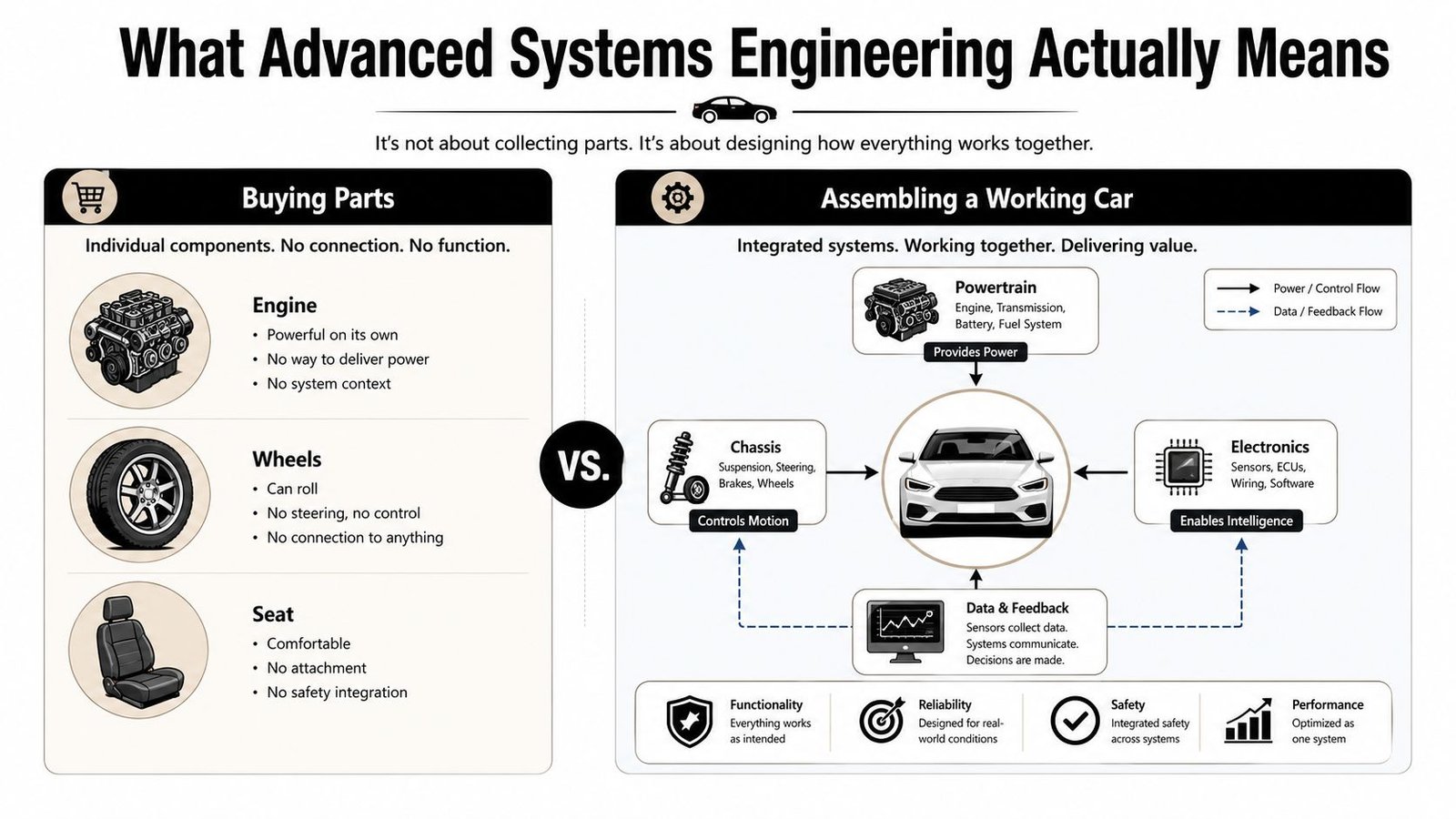
Buying parts is not the same as building a car. A line can have a good engine, decent wheels, and a comfortable seat, and still fail to move, fail to integrate, or fail under daily use. Advanced systems engineering is the discipline that keeps the whole machine coherent, not just complete.
Start with the system, not the component
In manufacturing terms, the system is the production outcome, not the robot, the conveyor, or the fixture by itself. The job is to tie stakeholder needs, requirements, architecture, verification, and lifecycle management into one practice, so every design choice supports the same production goal. That is the difference between buying automation and engineering a line.
NASA's handbook makes the maturity idea concrete by treating the technical data package as something that develops from early sketches or models into full drawings, parts lists, and implementation details. That matters on a plant floor because design maturity is what turns intent into something manufacturable and integrable across the lifecycle NASA Systems Engineering Handbook.
A useful manufacturing analogy is the reference system. The Cambridge paper describes it as the basis and starting point for the next generation, built from elements already existing or planned, plus their documentation Cambridge reference system paper. In a plant, that means you do not rebuild every line from zero. You reuse proven constraints, tooling logic, validation evidence, and maintenance knowledge, then adjust them for the next application.
Learn the terms that change decisions
A system-of-interest is the thing you are trying to improve. A trade space is where you compare options that cannot all be maximized at once, like throughput, footprint, and operator touch time. Model-Based Systems Engineering, or MBSE, puts those relationships into a structured model, which helps when mechanics, controls, data, and compliance all have to line up. A practical overview of that approach is here: Model-Based Systems Engineering in practice.
The point matters because modern manufacturing is not just hardware. It is software-heavy production assets, connected equipment, human-in-the-loop decisions, and traceable change. In semi-automated, GMP-aware environments, that mix is where architecture choices get expensive fast. A sensor change can touch batch records, alarms, training, and validation evidence, so the system view has to include the people and the paper trail, not only the machine.
The test is simple. If a change to a sensor, a fixture, or a software parameter ripples through quality, training, service, and validation, you are already in systems-engineering territory whether the org chart admits it or not.
The Pillars That Drive Real Manufacturing Results
Advanced systems engineering only pays off when the basics are treated as operating rules, not as paperwork. On a manufacturing floor, the four pillars are requirements rigor, architecture and reference systems, verification as evidence, and lifecycle data management. Leave one weak, and the others end up carrying the confusion.
Requirements first, because ambiguity gets expensive
Weak requirements handling is one of the quickest ways to turn a project into a margin leak. A Carnegie Mellon SEI summary citing a Government Accountability Office report says acquisition programs were typically 26% over budget, development costs were typically 40% above initial estimates, and programs missed delivery by an average of 21 months when disciplined systems engineering was weak SEI on the value of systems engineering. In the same source, only 15% of programs using the least systems engineering delivered the highest level of program performance.
On a plant project, that shows up in very ordinary ways. Someone says the team “knows what we meant,” the line gets built around that loose interpretation, and the bill arrives later in commissioning, deviation handling, or change control.
Rework gets ugly when integration grows
Once software, controls, and data handling get layered into a machine build, late rework stops being a nuisance and starts eating schedule. In the SEBOK example, insufficient systems engineering was associated with average rework of 18% for 10,000-SLOC projects and 91% for 10-million-SLOC projects SEBOK evidence quoted in SEI summary. That is software data, but the lesson fits semi-automated manufacturing because those systems now carry code, interface logic, recipes, alarms, and traceability records.
| Rework Cost vs Project Size Without Strong Systems Engineering | Average Rework | Implication for Manufacturers |
|---|---|---|
| 10,000-SLOC projects | 18% | Small automation projects still need disciplined scope and interfaces |
| 10-million-SLOC projects | 91% | Large integrated systems punish weak architecture and late discovery |
Architecture and reference systems keep teams from rebuilding problems they already solved on the last line. Verification proves the system does what it said it would do, and in a GMP-aware environment that means evidence that stands up to review, not just a green status in a test log. Lifecycle data management keeps the installed base aligned with the approved design, which matters every time maintenance changes something that touches traceability or validation.
A clean architecture also pays back in day-to-day support. When a vision station, a barcode reader, and an operator task all depend on one another, a good reference design makes troubleshooting faster and makes future changes less risky. That matters more on partial automation lines than on fully automatic ones, because the human handoff is often where the variation lives.
Operational takeaway: if requirements live in one spreadsheet, the machine lives in another folder, and validation evidence sits in someone's inbox, you do not have one system. You have three versions of the truth.
Matching Automation Levels to Engineering Discipline
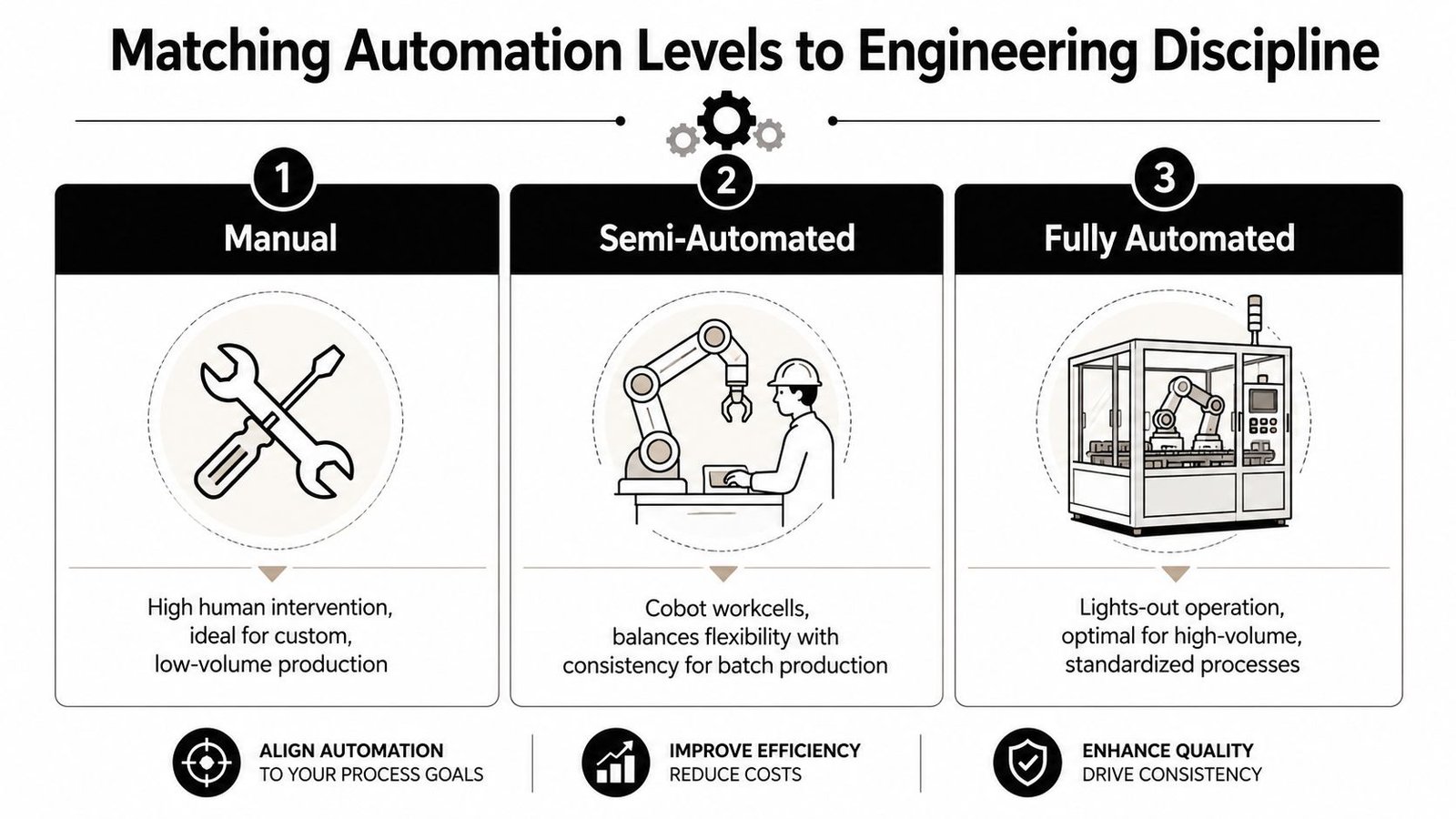
A line that mixes operators, fixtures, sensors, and software changes shape quickly. The right level of advanced systems engineering depends on where the risk sits and where the payoff shows up first. Semi-automated environments usually return the most value because they combine machine repeatability with human variability, and that is exactly where traceability gaps, handoff errors, and control issues tend to surface.
Manual lines need clarity, not heavy machinery
Manual production still benefits from formal requirements and clean work definitions, especially where quality and traceability matter. The discipline can stay lighter because the process is often easier to observe and correct in real time. Even so, vague work instructions and unstable setups still create variation, so a small shop still needs systems thinking.
Semi-automated lines need the most discipline
A cobot, a fixture, an operator, and a barcode scan sound simple until they start interacting across shifts. Semi-automated workcells need tighter architecture because the human-machine handoff creates more failure modes than either side alone. In GMP-aware manufacturing, that handoff also has to leave a trace the reviewers can follow, which is why requirement control, verification planning, and reference-system reuse usually pay back fastest here.
The practical win is not just fewer defects. It is faster troubleshooting, fewer ad hoc fixes, and cleaner evidence when a batch record or validation package gets reviewed. If the architecture does not account for operator decisions, barcode exceptions, and device states, the line will drift in ways that look minor on the floor and messy in audit logs.
Fully automated lines still need verification
A lights-out cell reduces manual touch, but it does not reduce integration risk. Sensors drift, software revisions change behavior, and upstream material variation still matters. Verification remains part of the job because automation shifts uncertainty into interfaces, control logic, and exception handling.
Fully automated systems also put more pressure on data separation. Performance data describes what the system must do, while technical data covers physical constraints like size, weight, power, and packaging. In hardware-heavy manufacturing, SWaP constraints shape thermal load, power architecture, and integration risk, so the architecture has to be built around them early. That is why teams studying automation systems design need to treat those limits as design inputs, not cleanup items found late in commissioning.
A Practical Roadmap for Implementation
The smartest way to bring advanced systems engineering into a plant is to start with one line or one workstation, not the whole factory. A realistic rollout usually fits inside a 6 to 12 month window if the team is disciplined and the scope is controlled. The work is mostly about making decisions early, then preserving them cleanly.
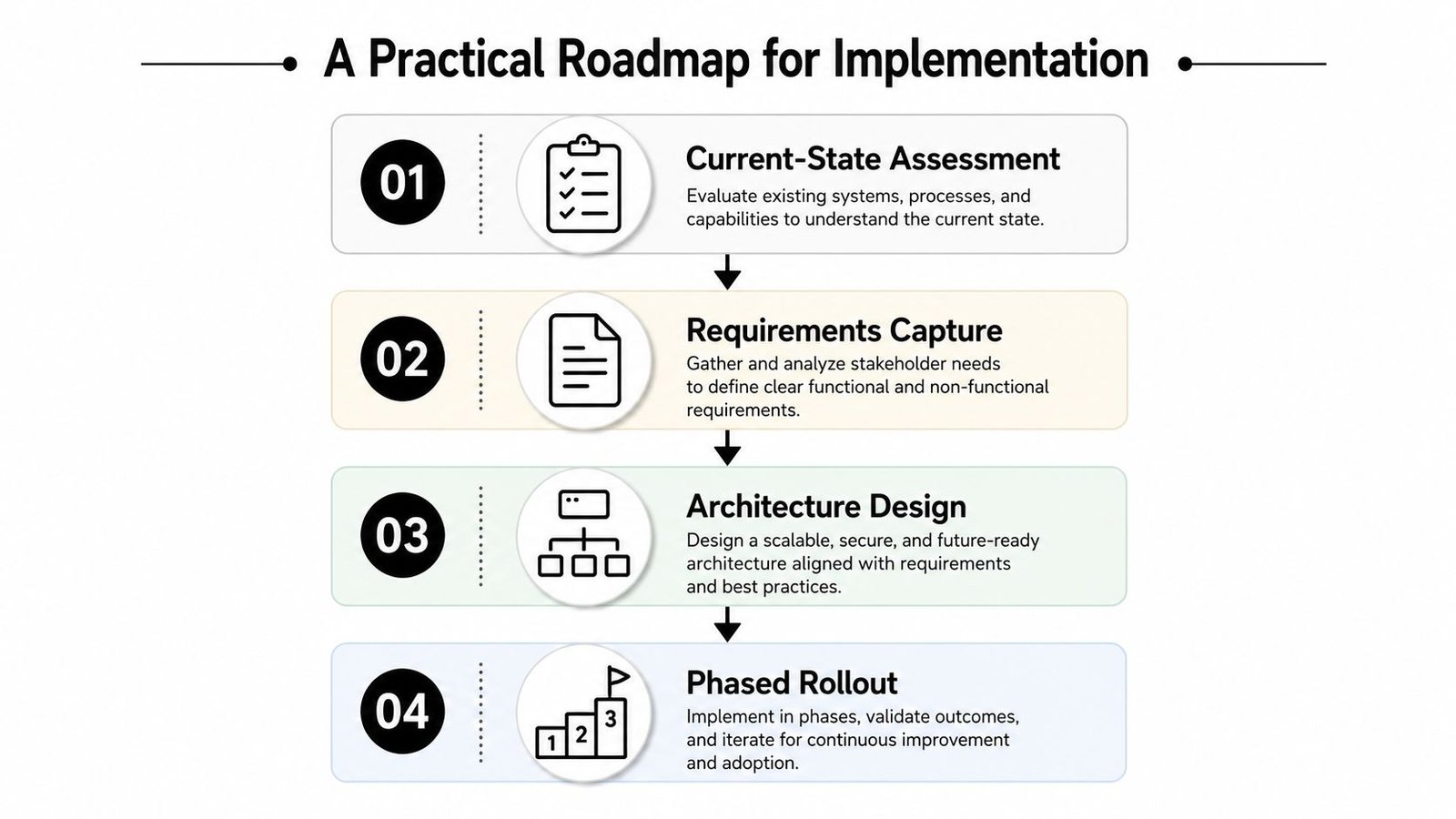
Phase 1 Current state assessment
Start by documenting how the line really behaves, not how the SOP says it behaves. Capture changeover steps, operator workarounds, recurring defects, maintenance interventions, and any GMP-sensitive checkpoints. If you can't describe the current state accurately, every later decision will be built on sand.
Phase 2 Requirements capture
Write down what the workstation must do, what it must not do, and what traceability evidence has to exist. A lot of projects fail at this stage, because teams skip from “we need automation” straight to “which vendor looks good.” Requirements should cover process intent, compliance expectations, operator interaction, data capture, and fault response.
Phase 3 Architecture and reference system
Define the reference system from proven assets, whether that's an existing cell, validated tooling, or a known-good control pattern. The point is to reuse what already works and to document why it works. That helps teams avoid expensive reinvention and gives QA a clearer basis for review.
Phase 4 Phased rollout and evidence
Roll out in stages, with verification evidence at each gate and change control tied to the actual installed base. For GMP-aware work, traceability, validation, and controlled change have to be embedded in the plan, not appended at the end. If the line changes, the evidence has to change with it.
The implementation path improves when engineering, operations, quality, and maintenance all look at the same artifact set. A good internal companion resource for automation design work is automation systems design guidance, because the strongest designs don't just solve the immediate process problem, they stay supportable after handoff.
Don't sign off on a line until someone has shown you how a minor change gets traced, tested, approved, and trained without chaos.
Metrics That Prove ASE Is Working
If advanced systems engineering is real, the shop floor should be able to prove it. The metrics don't need to be fancy, but they do need to be visible to operations, quality, and maintenance at the same time. Otherwise, the org just argues about opinions in different formats.
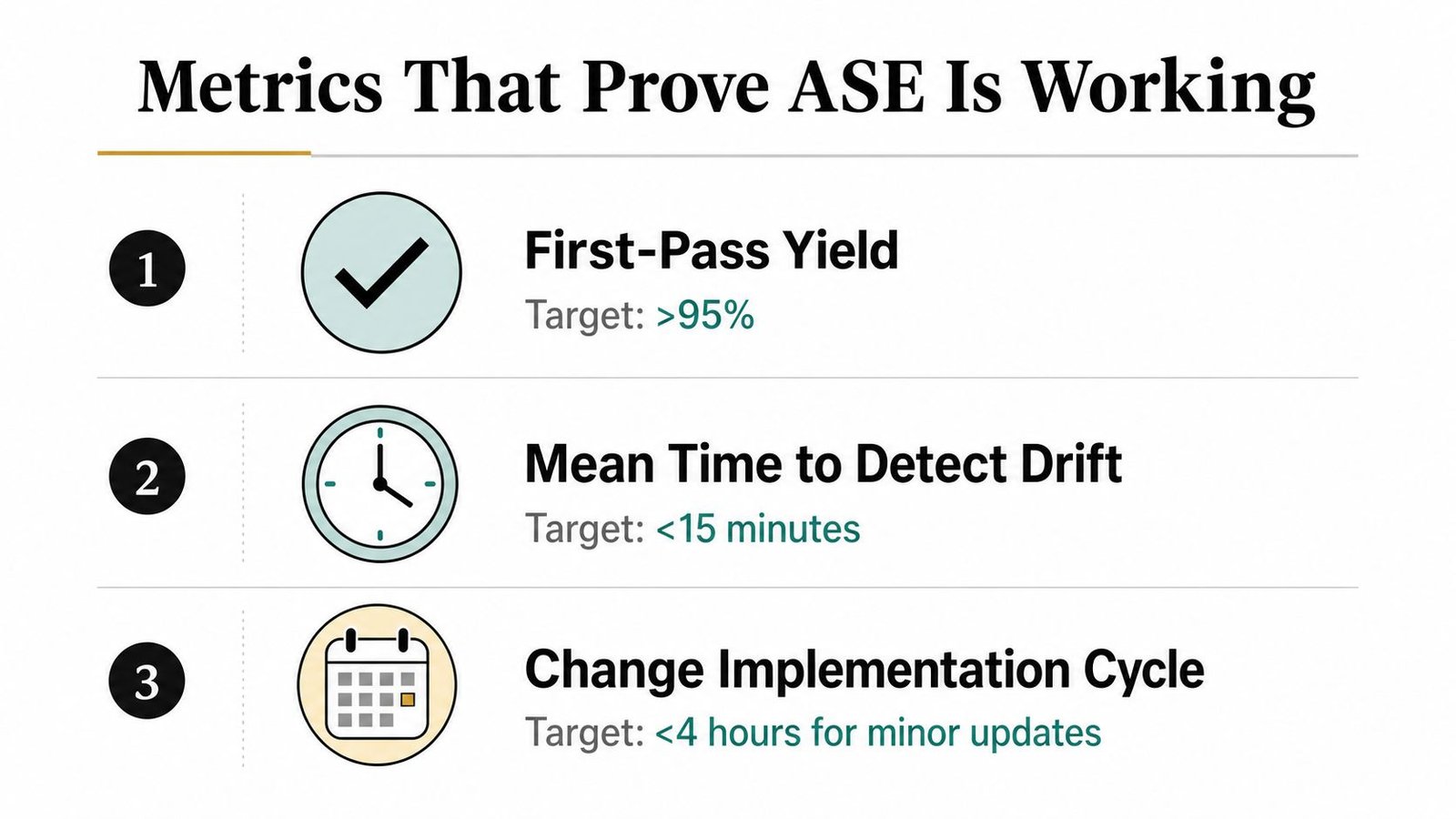
The metrics that matter most
First-Pass Yield. A healthy line should trend up because requirements are clearer and interfaces are better controlled. If yield is bouncing after every small change, the architecture is still too fragile.
Mean Time to Detect Drift. Faster detection means the system has better instrumentation, clearer ownership, and cleaner verification points. If drift shows up in scrap before it shows up in data, the monitoring is too weak.
Change Implementation Cycle. Small updates should move through review, approval, and verification without dragging the whole plant into a stall. If a minor change takes too long, the process probably has too many hidden dependencies.
For a practical way to connect these metrics to finance, the automation ROI calculator is useful after you've defined the engineering baseline. ROI only means anything when the process is stable enough to compare before and after with confidence.
Common warning signs
Verification should never be treated as a one-time sign-off. INCOSE defines verification as objective evidence that a system, subsystem, product, or service fulfills its specified requirements and characteristics, answering the question “Did we build the system right?” INCOSE verification guidance. That includes formal testing against requirements and qualification against the surrounding environment, including conditions like electromagnetic compatibility, thermal, vibration, humidity, and fungus growth.
If the reference system drifts away from the installed base, if change records lag behind the line, or if quality only discovers problems after release, the discipline is weakening. The dashboard should make that obvious before the next audit or customer complaint does.
Short Case Examples and ROI in Practice
A medical device manufacturer I worked around had a validation bottleneck that kept dragging every change into a long review cycle. The team tightened requirements early, separated must-have behavior from nice-to-have features, and linked verification evidence to the exact approved design intent. The result was not magic, just less ambiguity, fewer late changes, and a faster route through validation.
A small parts producer took a different path. It built a reference system from a proven cell and standardized tooling across multiple lines, which reduced the time spent reworking fixtures and changing over equipment. That mattered because the plant stopped treating each line like a custom one-off and started treating it like a controlled family of systems.
A GMP-aware facility caught a hidden integration risk during verification, before launch, not after. A change in one subsystem threatened traceability in another, and the team caught the mismatch because the evidence chain was mapped before rollout. The correction was still work, but it was controlled work instead of a post-release scramble.
What paid off wasn't the software or the label on the method. It was the habit of making decisions with evidence, then keeping those decisions traceable through change.
That's the commercial case for advanced systems engineering in manufacturing. It lowers avoidable rework, protects schedule, and keeps quality from becoming the department that discovers design mistakes after everyone else has moved on.
Where to Start on Your Own Shop Floor
Pick one workstation and treat it like a system, not a machine. Capture the requirements, define the reference system, and decide what verification evidence will prove the next change is safe before the upgrade starts. If the line is semi-automated and GMP-aware, that one exercise will expose where your current process relies on memory instead of control.
The next step is governance. Human-in-the-loop decisions, AI-assisted checks, and connected production assets are already pushing manufacturers toward stronger accountability and traceability, and the teams that will do best are the ones that define decision rights early. AI in systems engineering is still uneven in industrial validation, so don't chase hype, demand evidence, build the architecture, and keep the humans responsible for the decisions that matter.
System Engineering & Automation helps manufacturers turn that discipline into practical equipment, controls, and semi-automated systems that fit real production constraints. If you're upgrading a workstation, standardizing a line, or trying to keep GMP-aware change under control, visit System Engineering & Automation and start a conversation about what a cleaner system design could do for your plant.