A production manager watches another experienced operator leave, while the backlog keeps growing and quality checks take longer. The obvious response is to look at robots, software, and fully automated lines. But the largest capital project isn't always the best answer. In many small and mid-sized factories, a well-designed fixture, sensor, controlled fastening step, or semi-automatic workstation solves the core constraint faster and with less disruption.
Applied manufacturing technologies cover that full range, from manual process aids and smart tooling to robotic handling, machine vision, programmable controls, and production data systems. The practical question isn't whether your plant should automate everything. It's which operation deserves better control, what level of automation the process can support, and how to improve production without sacrificing flexibility, quality, or operator knowledge.
Table of Contents
- Modern Applied Manufacturing Technologies for Small Manufacturers
- Understanding the Core Components of Automated Production
- Choosing Between Manual, Semi-Automated, and Fully Automated Solutions
- The Real Benefits of Automation Beyond Simple Efficiency
- Automation in Regulated Industries, GMP and Medical Device Manufacturing
- How to Select the Right Automation Partner and Solution
- Planning Your Path to Manufacturing Optimization
Modern Applied Manufacturing Technologies for Small Manufacturers
A small manufacturing operation rarely has the luxury of building an ideal factory from a blank sheet. Existing machines, changing product mixes, limited engineering capacity, and labor shortages shape every decision. You may need higher throughput, tighter repeatability, and safer work without committing to a rigid line that only works for one product configuration.
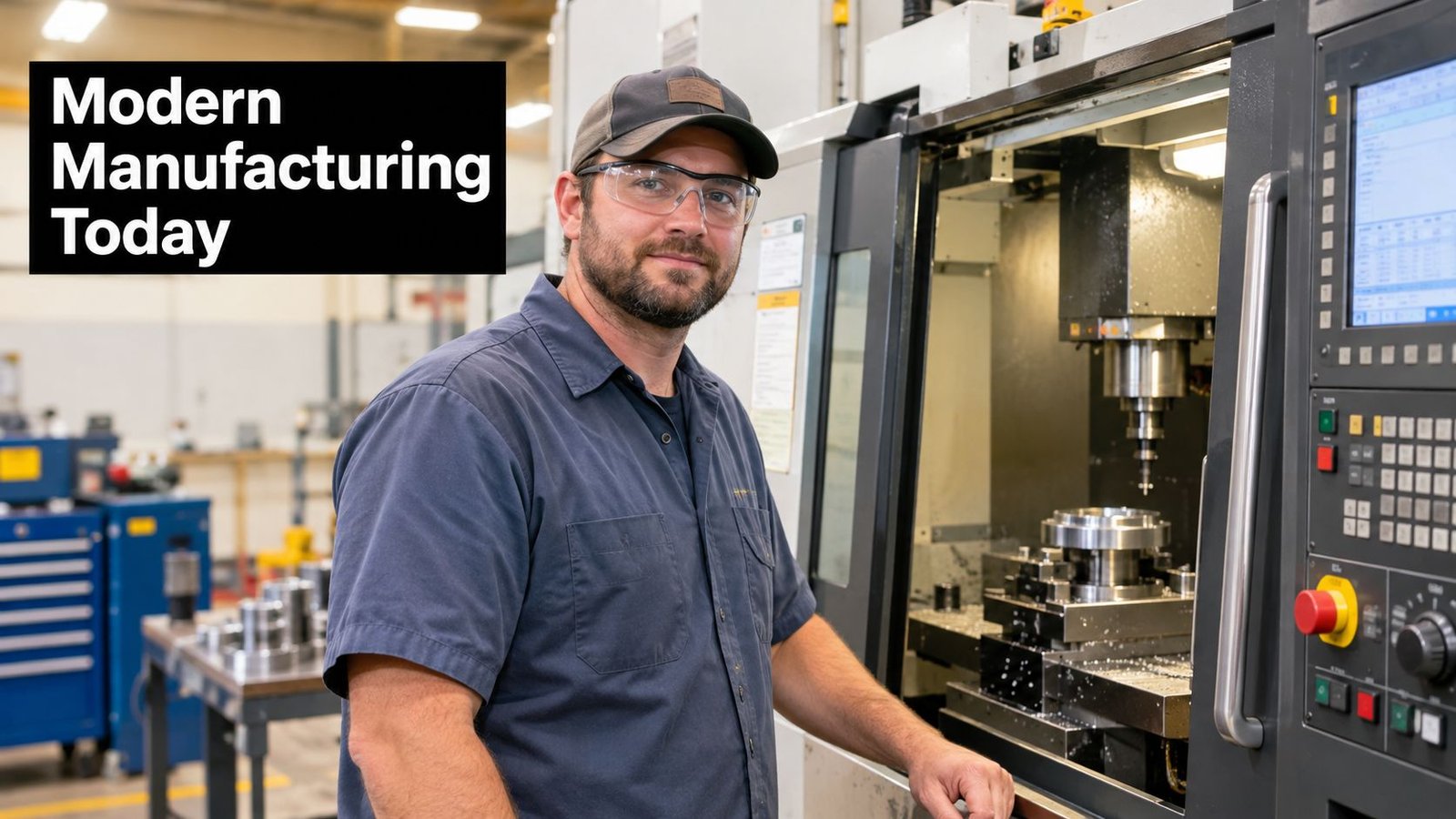
That's where applied manufacturing technologies become useful. They're not a futuristic category reserved for global corporations. They're practical engineering choices applied to a known bottleneck. A locating fixture can prevent incorrect orientation. A sensor can confirm part presence before the next operation. A controlled press can replace inconsistent manual force. A robot can handle repetitive palletizing while an operator manages exceptions and changeovers.
Start with the process, not the machine
The first question should be, “Where does the process lose time, quality, or capacity?” It shouldn't be, “Which robot should we buy?” A good assessment looks at manual touches, ergonomic strain, inspection delays, changeover work, material presentation, rework causes, and the decisions operators make when the process falls outside normal conditions.
Historical adoption supports this staged view. Robots first entered manufacturing assembly lines in the early 1960s, but current use remains concentrated in structured material movement. Palletizing accounts for 35% of reported robotic use, loading and unloading for 18%, material handling for 11%, and case packing for 11%, while assembly represents only 2%, according to the NIST assessment of robotics use and adoption.
That gap matters. Standardized movement is easier to automate than variable assembly, complex fixturing, or operations that depend on human judgment. A practical modernization plan often starts by stabilizing the manual method, then adding tooling and controls, then automating only the repeatable portion.
Practical rule: Automate the motion that creates predictable value, not the uncertainty that your process hasn't yet resolved.
Applied manufacturing technologies can therefore be viewed as a spectrum. Manual equipment remains appropriate where product variation is high. Semi-automation fits repeatable tasks that still need human loading, judgment, or exception handling. Full automation makes sense when volume, process stability, and product life justify a more integrated system.
Understanding the Core Components of Automated Production
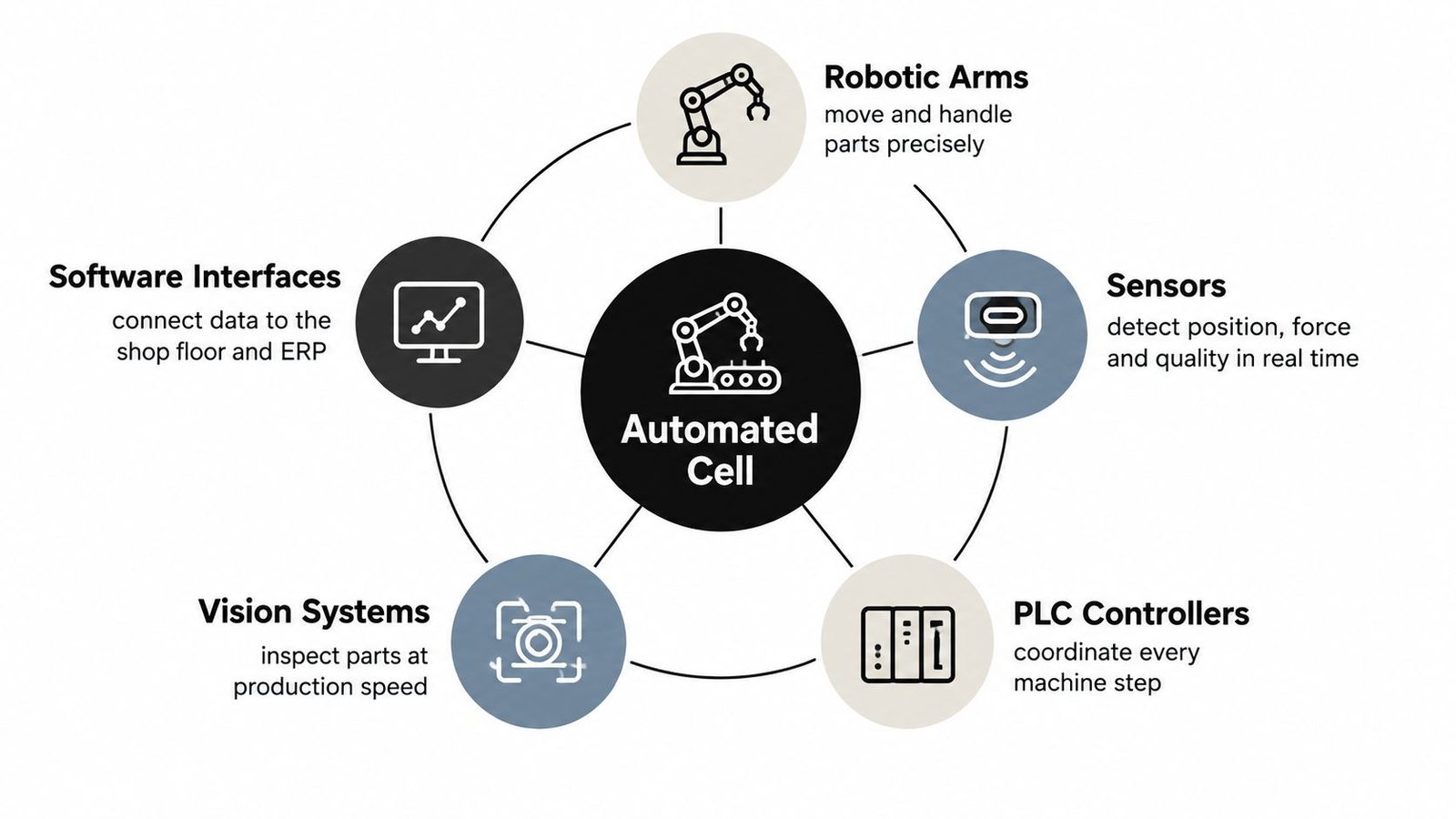
An automated cell works when its components share a clear sequence and a defined response to abnormal conditions. The robot, controller, sensors, and operator interface aren't separate purchases. They form one production system.
The control layer coordinates the work
A programmable logic controller, or PLC, acts as the cell's sequence manager. It receives signals from sensors, confirms that conditions are safe, starts actuators, communicates with robots, and stops the process when a required condition isn't met. The human-machine interface, or HMI, gives operators a usable view of status, alarms, recipes, setup instructions, and recovery actions.
The distinction is important. A machine that runs quickly but gives poor diagnostic information will create avoidable downtime. Operators need to know whether the problem is a missing component, an open guard, a failed sensor, an interrupted robot cycle, or an incorrect recipe.
Sensing and vision close the control loop
Sensors detect position, presence, force, pressure, temperature, and other process conditions. A vision system can check orientation, confirm component presence, guide a pick, or inspect a feature without relying entirely on visual judgment at the end of the line.
The camera isn't a substitute for process design. Lighting, part presentation, contrast, camera placement, and acceptance criteria determine whether vision performs reliably. If parts arrive randomly or the quality requirement isn't defined, adding a camera won't solve the underlying problem.
Tooling makes automation repeatable
Custom fixtures and smart tooling are often the most economical part of an automation strategy. A fixture can locate a part, constrain movement, expose the correct work area, and make an incorrect load physically difficult. Add a sensor or interlock, and the station can verify the setup before applying force, torque, adhesive, or heat.
Robotics then handles movement or manipulation where the task is repeatable. Conveyors, bowl feeders, pick-and-place units, and integrated controls connect material presentation to the work sequence. The automation control systems resource shows how control architecture supports that broader integration.
The shop-floor workflow usually follows a simple logic:
- Present the part in a controlled orientation.
- Detect the condition with sensors or vision.
- Confirm the recipe and safety state through the PLC and HMI.
- Perform the operation with tooling, actuators, or robotics.
- Verify the result and record the relevant production data.
- Guide recovery when the process detects an exception.
This short video provides additional visual context for automated production cells.
Choosing Between Manual, Semi-Automated, and Fully Automated Solutions
The right level of automation depends less on the appeal of the technology than on the behavior of the process. A manual station may be sensible when product variety is high and volumes are uncertain. A semi-automatic station often fits the middle ground, where the machine controls the critical operation but an operator loads parts, manages variants, and handles exceptions. Full automation becomes more defensible when the product, material flow, and operating conditions remain stable enough to support the additional integration.
NIST data illustrates the value of preserving human involvement in difficult operations. Among current robot users, picking accounts for 63% of use, sorting for 50%, and replenishment for 31%, according to the NIST report on robotics in manufacturing and related operations. These applications often automate a defined movement while leaving complex decisions and process variation under human supervision.
A practical comparison
| Approach | Where it fits | Main strength | Main risk |
|---|---|---|---|
| Manual | High variation, low repeatability, frequent product changes | Low initial complexity and strong operator adaptability | Inconsistent cycle time, ergonomic exposure, and dependence on individual technique |
| Semi-automated | Repeatable critical steps with variable loading or exceptions | Targeted control, manageable capital, and retained flexibility | Poorly designed interfaces can leave operators carrying the difficult parts of the process |
| Fully automated | Stable products, controlled material flow, and predictable demand | Integrated throughput and reduced routine handling | High integration effort, rigid changeovers, and greater dependence on maintenance and controls expertise |
The cost boundary should be calculated using total cost of ownership, not equipment price alone. Include labor availability, changeover time, scrap, rework, maintenance, validation, training, downtime, expected product life, utilities, spare parts, and the value of future expansion. A low-cost fixture can outperform a robotic cell if it removes the main source of variation without creating a complex maintenance burden.
Deloitte reports that 46% of manufacturers ranked process automation among their top two investment priorities, while 41% prioritized factory-automation hardware. The same 2025 smart-manufacturing survey identifies high cost as the leading adoption barrier. That combination should encourage disciplined scoping rather than oversized projects.
Use a staged investment decision
Start with the smallest intervention that addresses the constraint. Stabilize the work method, add poka-yoke features, capture the critical data, and observe whether the process is ready for more integration. If the product mix changes often or volumes remain moderate, semi-automation may provide a better balance than a dedicated robotic line.
For a more detailed comparison of the trade-offs, review semi-automatic and fully automatic manufacturing systems.
The Real Benefits of Automation Beyond Simple Efficiency
Cycle time is easy to discuss because it appears on a production report. The more durable benefits often appear elsewhere, in fewer ambiguous defects, safer work content, faster troubleshooting, and better evidence about what happened during production.
A controlled workstation can make the correct method easier to follow. A fixture limits orientation errors. A torque tool records whether the fastening operation reached its required condition. A vision check detects missing or misaligned components before the part moves downstream. These controls don't eliminate the need for skilled operators. They give operators a more stable process and clearer signals when something has changed.
Quality improves when the process captures evidence
Final inspection can identify a bad part, but it may not explain why the part became nonconforming. Process data can connect a result to force, temperature, pressure, position, torque, cycle time, recipe, operator prompt, or alarm history. That information helps engineers investigate causes instead of sorting symptoms.
The value is especially clear where manual judgment varies between shifts or where a defect is difficult to detect after the operation has been completed. Automation supports repeatability, but only when the manufacturer defines meaningful acceptance criteria and maintains the measurement system.
Safety and workforce design belong in the business case
Removing repetitive lifting, awkward reaches, hazardous exposure, and force-intensive work can improve the job without removing human responsibility from the cell. Material handling, machine tending, and palletizing are common candidates because the motion is structured and the ergonomic burden can be significant.
The human side still determines whether the installation succeeds. Deloitte found that human capital was the lowest-maturity smart-manufacturing category, with 35% of respondents concerned about upskilling employees and 48% reporting moderate or significant difficulty filling production and operations-management roles, as reported in Deloitte's 2025 manufacturing workforce findings.
Operators need practical training, not just a demonstration at handover. They should understand normal operation, setup, alarm recovery, inspection requirements, escalation rules, and the limits of the equipment.
The best automation doesn't hide process knowledge. It turns that knowledge into repeatable work, useful diagnostics, and safer decisions.
Maintenance ownership matters just as much. A station with sensors, drives, vision, and software creates more ways to detect problems, but also more components that require calibration, spare parts, backups, and competent troubleshooting. A benefits case that ignores those responsibilities is incomplete.
Automation in Regulated Industries, GMP and Medical Device Manufacturing
A semi-automated medical-device workstation isn't merely a mechanical improvement. Its software, controls, prompts, interlocks, data capture, alarm handling, recipe management, and inspection interfaces can affect product quality and therefore belong inside the validation strategy.
The FDA states that software used to automate device production or quality-system activity must be validated for its intended use under 21 CFR 820.70(i). The FDA guidance on software validation specifically includes automated design, testing, component acceptance, manufacturing, labeling, packaging, distribution, and complaint-handling activities within this expectation.
Build requirements before equipment
A sound project starts with a risk-based specification. Each automated function should connect to a product-quality requirement, a process risk, an acceptance criterion, and a verification method. That specification should cover the station's normal operating range as well as foreseeable faults.
For example, a controlled fastening station may need defined torque limits, tool calibration, part orientation checks, operator prompts, data-record requirements, and a response for a failed fastening cycle. A vision system needs defined image conditions, inspection logic, reject handling, and a controlled method for changing thresholds.
FDA process-validation guidance also requires equipment to be calibrated, inspected, or checked through a written program designed to assure proper performance. The FDA process-validation guidance supports practical controls such as operating windows, setup verification, preventive maintenance, sensor calibration, and monitoring of critical parameters.
Treat change as part of the validated lifecycle
Changing PLC logic, HMI screens, vision thresholds, torque limits, or electronic records can affect the validated state. Each change therefore needs documented impact assessment, testing, approval, and traceability.
Qualification should demonstrate correct installation and operation across the intended range. Ongoing monitoring should detect drift, abnormal variation, and departures from the approved process. Where later inspection can't fully verify the result, the process needs objective evidence that it consistently produces conforming output.
Medical-device manufacturers should also account for the FDA's Quality Management System Regulation, which became effective on February 2, 2026 and incorporates ISO 13485:2016 by reference into 21 CFR Part 820, as described in the FDA overview of device regulation.
Packaging and labeling show why compliance must influence equipment layout. FDA requirements address correct labeling, legibility, adhesion, incoming-material acceptance, controlled operations, and sufficient space. A fixture, barcode check, vision inspection, interlock, or controlled dispensing step can reduce mix-ups, but the manufacturer still needs documented procedures and evidence that the controls work, as outlined in the FDA labeling quality-system requirements.
For design-related changes, the FDA guidance on design controls and human factors reinforces the need to connect design inputs, outputs, specifications, controls, and verification. Validation belongs in the project plan from the beginning, not after installation.
How to Select the Right Automation Partner and Solution
A capable automation partner should be able to explain why a proposed control belongs in the process, what it will cost to maintain, and how operators will recover from common faults. A polished demonstration isn't enough. Ask for the engineering logic behind the design.
Evaluate the partner before the proposal
Look for evidence of experience with your process type, material behavior, production environment, and quality requirements. A partner working on medical devices should understand GMP-aware documentation and validation responsibilities. A partner serving general manufacturing should still be able to discuss guarding, controls, measurement systems, maintenance, and operator qualification in concrete terms.
Review how the company moves from concept to commissioning. The work may include:
- Process review: Identify the bottleneck, product variants, manual decisions, and sources of variation.
- Concept development: Compare manual aids, semi-automatic equipment, robotics, tooling, fixtures, conveyors, and integrated controls.
- Detailed engineering: Produce drawings, bills of material, control narratives, risk assessments, and interface definitions.
- Build and test: Verify the equipment against agreed requirements before shipment and during site acceptance.
- Installation and commissioning: Confirm the installed system, train users, and resolve production-floor issues.
- Lifecycle support: Maintain backups, spare parts, calibration, preventive maintenance, troubleshooting, and controlled upgrades.
System Engineering & Automation provides semi-automatic and fully automated equipment, custom tooling, fixtures, robotics, pick-and-place units, bowl feeders, conveyors, and integrated controls, with support from consultation and preliminary concepts through design, drawings, sourcing, installation, commissioning, and maintenance.
Ask questions that expose hidden cost
Ask who owns the PLC and robot backups, who responds to a failed vision inspection, how recipe changes are controlled, which parts are considered consumable, and what training is included. Request clear acceptance criteria for cycle sequence, safety functions, inspection behavior, documentation, and operator recovery.
A one-year guarantee and ongoing maintenance support can reduce the risk of being left with an unfamiliar system after handover. They don't replace sound design, but they create accountability during the period when production teams discover how the equipment behaves under real operating conditions.
A serious integrator designs for the morning after commissioning, when your maintenance team has to diagnose the first real fault.
Planning Your Path to Manufacturing Optimization
Modernization works best as a controlled sequence of decisions. Begin with the operation that causes the clearest production, quality, safety, or labor constraint. Document the current method, stabilize it, and identify which parts require human judgment versus which parts repeat reliably.
A practical roadmap is:
- Stabilize the manual process. Define standard work, critical parameters, inspection points, and failure responses.
- Add targeted tooling. Use fixtures, poka-yoke features, controlled tools, sensors, or material presentation to remove avoidable variation.
- Capture useful data. Record the process conditions that help operators and engineers identify drift or recurring faults.
- Automate the repeatable step. Consider a semi-automatic workstation, controlled actuator, robotic handler, or vision check where the process is ready.
- Plan the lifecycle. Assign ownership for maintenance, calibration, training, software changes, spare parts, and continuous improvement.
- Expand selectively. Use the first successful cell as a design reference, not as a reason to automate every operation identically.
The broader market supports deliberate investment. The International Federation of Robotics report reports that global robot density rose from 163 to 177 industrial robots per 10,000 manufacturing employees, with South Korea at 1,220, Singapore at 818, China at 567, Germany at 449, and Japan at 446 robots per 10,000 employees. Those figures show the scale of industrial automation, but they don't prescribe the right solution for your plant.
The best outcome isn't maximum automation. It's a production system that combines operator capability, controlled tooling, reliable data, and the level of robotics or software that your process can support. That balance improves resilience because the factory can respond to product changes, staffing constraints, maintenance needs, and quality risks without depending on one oversized project.
If you're ready to identify the right starting point, contact System Engineering & Automation for practical support with semi-automatic equipment, smart tooling, fixtures, integrated controls, robotics, and GMP-aware manufacturing solutions. Their team can help move your project from process review and concept development through design, commissioning, and ongoing maintenance, with the solution matched to your production goals and budget.