More automation isn't automatically a better manufacturing decision. It's often the most expensive way to solve a problem that should have been measured first.
The useful comparison isn't semi-automatic vs fully automatic. The question is where the line's break-even point sits. How many good units must the equipment produce before lower labor content, higher throughput, and reduced scrap recover the added investment? A semi-automatic station can be the higher-ROI choice when demand changes, operators are available, and product variants make a rigid line difficult to justify. A fully automatic line earns its place when volume is stable, manual handling is costly, and the process can tolerate limited human intervention.
Manufacturing adoption already reflects that middle ground. In Auburn University's 2024 smart manufacturing study, over half of surveyed respondents were in the implementing or using stage for automation over the prior three years, while the share of automation users increased by 7 percentage points from 2022 to 2024. That's steady progress, not proof that every plant should jump directly to a lights-out line.
Table of Contents
- The Automation Choice Most Manufacturers Get Wrong
- What Semi-Automatic and Fully Automatic Systems Actually Mean
- Throughput, Labor, and Flexibility Compared
- ROI Math Behind Each System
- Where Each System Shines in Real Manufacturing
- Why Semi-Automatic Is Often the Smarter Default
- A Practical Framework to Choose the Right Level
- Scaling Smart With Hybrid and Modular Automation
The Automation Choice Most Manufacturers Get Wrong
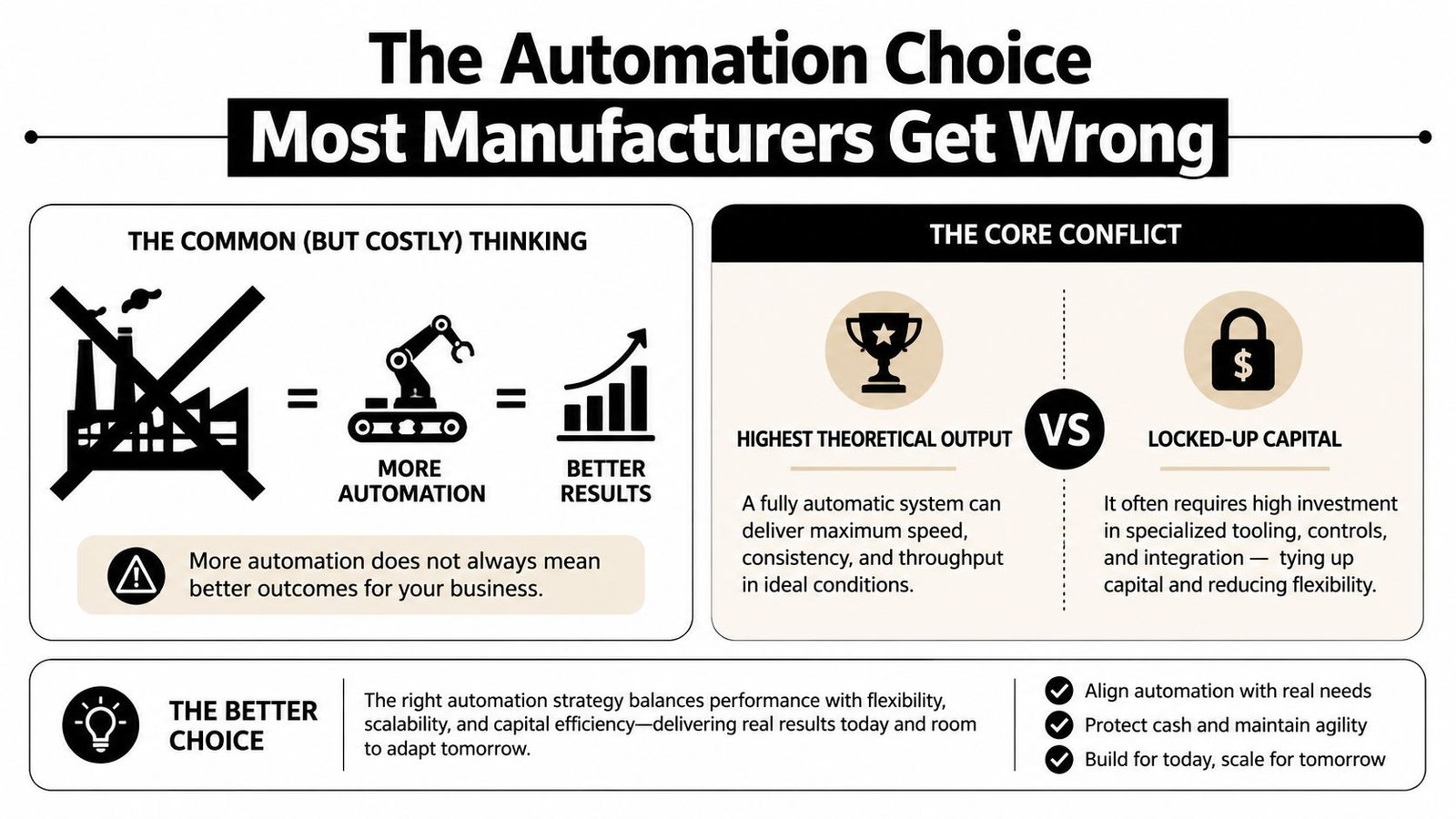
The popular advice says to automate as much as possible. I disagree. The right target is the least complex system that reliably meets output, quality, safety, and compliance requirements.
A fully automatic system may produce the highest theoretical output, but that output comes with tooling, controls, validation, guarding, integration, and changeover commitments. If the product mix changes frequently, the equipment can spend too much time waiting for new format parts, recipe approval, cleaning, or fault recovery. A line that looks impressive in a capital request can become an expensive bottleneck when demand stops behaving as forecast.
Semi-automatic systems often make more sense below roughly 1,000 to 3,000 repetitive cycles per shift, particularly when operators are available and batches change often. Full automation becomes easier to justify above roughly 5,000 to 10,000 stable cycles per shift, especially when downtime, ergonomic exposure, or manual inspection creates a measurable operating burden. Those are decision ranges, not universal laws. Cycle time, yield, staffing constraints, release testing, and demand stability can move the answer.
A useful industry benchmark reinforces the point. McKinsey's 2021 findings, summarized in industrial automation industry coverage, reported that 15% of manufacturers had fully automated their operations, while 30% were still in progress. The same source reported industrial automation adoption at 35% in discrete manufacturing and 20% in process manufacturing. Most manufacturers were moving beyond fully manual work without operating fully automated plants.
Practical rule: Don't approve automation because it raises the plant's technology profile. Approve it because the numbers show that added complexity will pay back.
What Semi-Automatic and Fully Automatic Systems Actually Mean
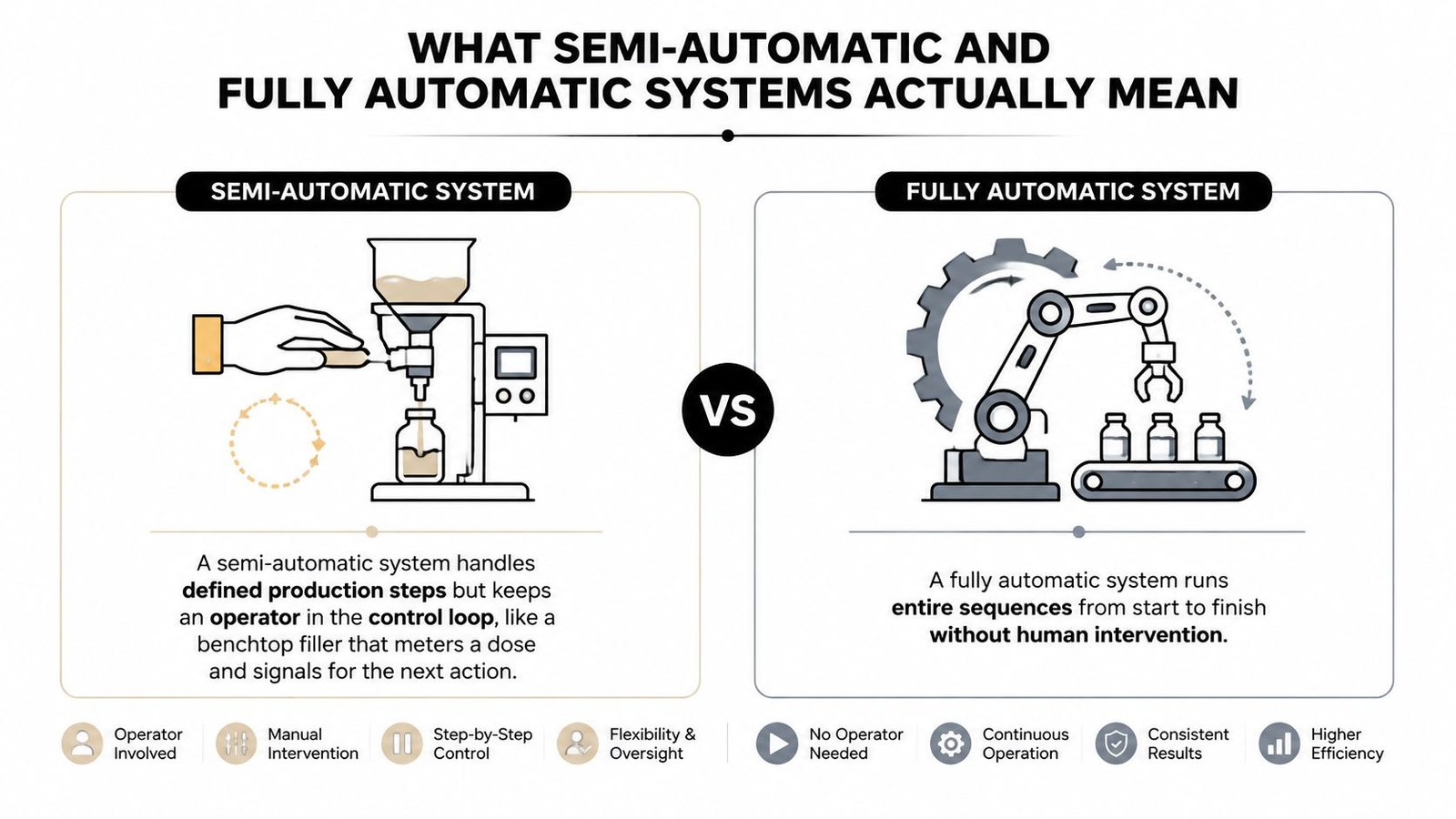
A semi-automatic system automates a defined task while keeping an operator in the control loop. The operator may load a part, confirm orientation, start the cycle, inspect the result, and remove the finished component. The machine handles the repeatable work, such as motion, force, timing, dosing, fastening, sensing, or pressing.
Consider a benchtop filler. The operator places the container, starts the cycle, and removes it after completion. The machine meters the dose, stops at the preset fill weight, and signals whether the cycle passed. Changeover may involve selecting a recipe, adjusting a fixture, cleaning the product path, and confirming the setup.
A fully automatic system coordinates a broader sequence with limited direct intervention. It can feed parts, assemble components, perform inspection, reject nonconforming product, and transfer accepted product to the next operation. Sensors, PLCs, servo drives, recipes, guarding, and interlocks manage the sequence.
That doesn't mean fully automatic equipment is unattended. Operators still replenish materials, remove rejects, respond to alarms, perform release checks, clear faults, and support maintenance. A technician may monitor several lines, but the human role shifts from repeating every cycle to managing the system around the cycle.
The quality boundary matters
Automating a measurement doesn't automatically automate the quality decision. In a GMP environment, people may still own deviation handling, line clearance, in-process checks, batch records, and final release unless validated systems explicitly support those functions.
The U.S. Census Bureau plant-level research found that more automated establishments had lower production labor share, higher capital share, and higher labor productivity. A separate firm-level finding in the same source linked a one-standard-deviation increase in an automation index to an 11% increase in total factor productivity, alongside improvements in setup time, run time, inspection time, and uptime. Automation can improve the process, but the plant still needs clear ownership of quality decisions.
Throughput, Labor, and Flexibility Compared
The right system depends on the process, not the automation label. Packaging shows the difference clearly. A packaging equipment comparison places semi-automatic equipment at roughly 20 to 60 packages per minute, while fully automatic systems reach 60 to 200 or more packages per minute. PLCs and sensors can coordinate continuous workflows, but that capacity only pays off when the line stays supplied and stable.
| Factor | Semi-Automatic | Fully Automatic |
|---|---|---|
| Operator role | Loads parts, starts cycles, confirms setup, handles exceptions | Monitors the line, replenishes materials, clears faults, manages exceptions |
| Throughput | Lower, with performance tied closely to operator rhythm | Higher, with integrated feeding, processing, inspection, and rejection |
| Labor | Direct labor remains part of each cycle | Direct touch time is reduced, but technicians remain necessary |
| Capital exposure | Lower and easier to scale by station | Higher because of controls, tooling, conveyors, robotics, guarding, and integration |
| Flexibility | Strong for high-mix work and frequent product changes | Strongest for stable products and repeatable formats |
| Changeover | Often involves fixture, recipe, and operator adjustments | May require validated recipes, format parts, programming, and mechanical changes |
| Failure mode | A station may slow down while the operator continues managing exceptions | One fault can interrupt a larger section of the integrated line |
Semi-automatic equipment usually wins on flexibility. An operator can recognize an unusual part, perform a visual check, or handle an exception without stopping the entire sequence. That advantage matters in medical devices, engineered products, and batch production, where each changeover brings a different setup burden.
Fully automatic equipment earns its premium when the process is stable enough to keep the machine fed and running. It reduces repetitive handling and keeps cycle timing consistent. It also concentrates risk: a bad sensor, misaligned format part, or software interlock can stop more production than one manual workstation would affect.
Use throughput optimization services to target the operation that limits capacity. If loading is the bottleneck, automate loading. If inspection is inconsistent, automate measurement or the poka-yoke step. Do not buy a complete automatic line when one constrained operation causes most of the lost capacity. In many plants, automating that single step produces a better break-even result than replacing the whole line.
ROI Math Behind Each System
Payback makes the semi-automatic versus fully automatic choice concrete. The marketplace guidance in this semi-automatic production line guide cites typical payback of 12 to 24 months for semi-automatic systems and 18 to 36 months for fully automatic systems. Treat those ranges as directional, not industry standards. Lower labor costs can extend payback because each automated station removes fewer labor dollars.
A semi-automatic system usually needs less upfront capital and can capture much of the available return at mid-scale volumes. Fully automatic equipment earns its premium when the plant can keep it loaded, maintain stable demand, and avoid quality losses caused by manual handling. The break-even point depends on volume, scrap, and loaded labor cost, not the automation label.
| Factor | Semi-Automatic | Fully Automatic |
|---|---|---|
| Typical payback | About 12 to 24 months | About 18 to 36 months |
| Upfront investment | Commonly 40% to 60% less than fully automatic systems | Higher investment for integrated controls, feeding, inspection, and handling |
| Labor savings | Partial reduction in direct labor | Larger reduction in direct touch labor |
| Scrap impact | Improves repeatability at selected operations | Can reduce handling variation across the full sequence |
| Changeover cost | Usually lower and easier to manage | Can be substantial when tooling, validation, or programming changes |
| Hidden costs | Operator training, fixtures, maintenance, and station balancing | Floor space, utilities, validation documents, spare parts, integration, and commissioning downtime |
| Best financial fit | Variable demand, mixed products, moderate volume | High volume, stable products, expensive labor, and costly manual defects |
Calculate the return from good units, not gross output. A line that produces more pieces while adding scrap can deliver a worse result than a slower line with better yield. Count labor per shift, loaded wage, scrap and rework, maintenance, utilities, floor space, validation, spare parts, and production lost during commissioning.
Run the model with assumptions that can change. If volume rises by 30%, fully automatic equipment may reach break-even sooner because the plant uses its fixed capacity more often. If labor changes by $2 per hour, semi-automatic equipment may remain the better choice when it removes limited direct labor. Test those inputs in a manufacturing automation ROI calculator. The right system is the one whose payback survives realistic volume, yield, and labor assumptions.
Where Each System Shines in Real Manufacturing
The same factory can need both approaches. Product mix, batch size, quality requirements, and regulatory burden matter more than the company's ambition to become “highly automated.”
Consider a medical-device manufacturer running 8 SKUs in lots of 200 to 500 units. Frequent changeovers make flexibility valuable. A semi-automatic filling or assembly station can control force, timing, dose, or inspection while an operator loads parts, confirms setup, and handles exceptions. The station can support repeatability without forcing every product variant through a complex automated feeding and change-part architecture.
In that environment, full automation may create more work than it removes. Each new SKU can require tooling review, recipe controls, validation evidence, line-clearance procedures, and additional inspection logic. Semi-automatic cells also give trained operators a practical role in identifying unusual conditions before those conditions propagate.
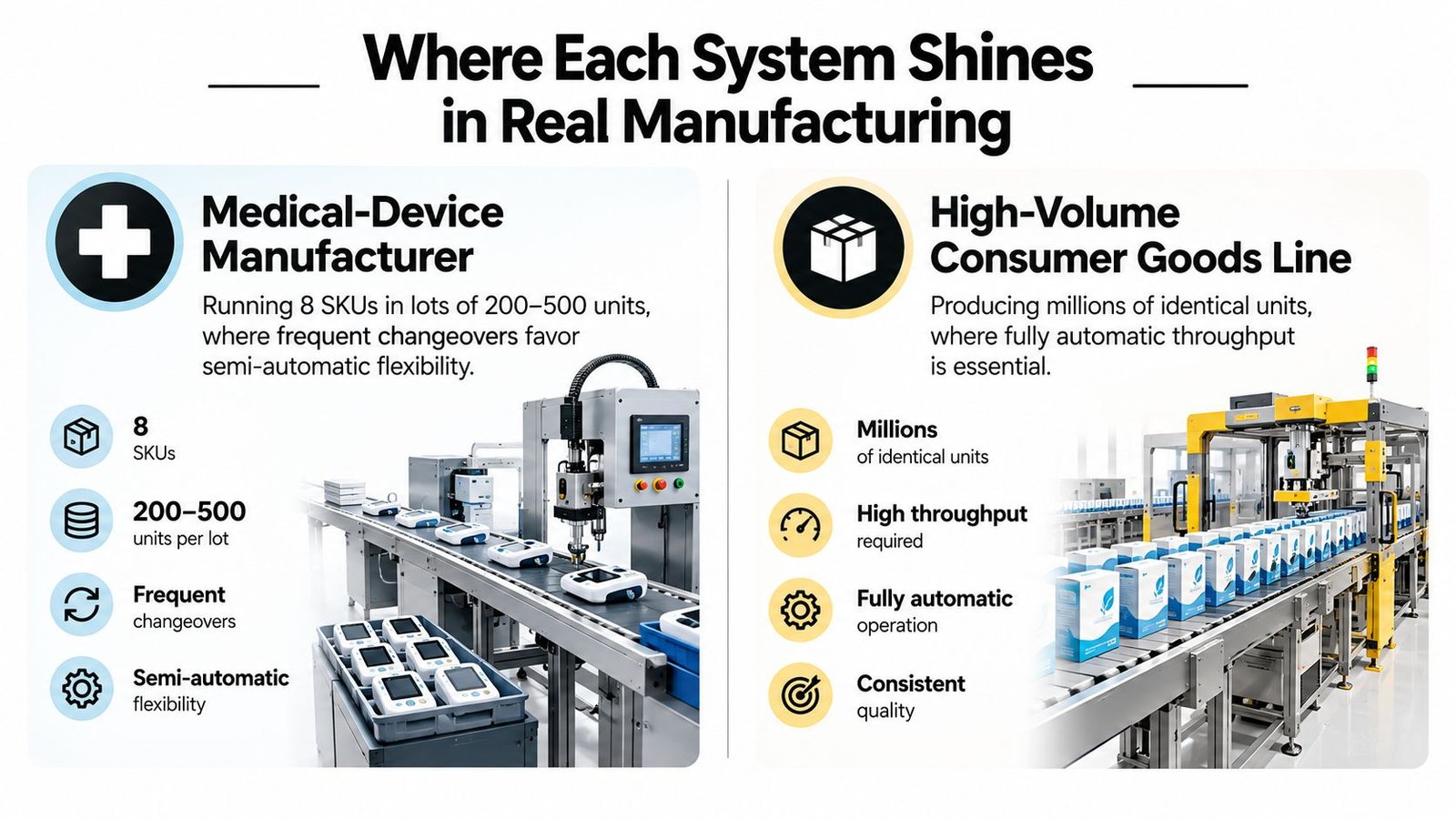
Now compare that with a packaging operation running one stable SKU at 15,000 units per shift. The process has predictable inputs, repeatable packaging, and enough volume to keep integrated equipment productive. A fully automatic cartoning line can justify its cost when it removes repeated loading and handling, keeps the line synchronized, and reduces reliance on manual pacing. In this scenario, the line's economic value comes from sustained utilization, not from the label “fully automatic.”
Match the equipment to the process
A medical-device plant may use semi-automatic assembly for one product family, automated vision inspection for another, and fully automatic packaging at the end of the line. A consumer-goods plant may use automatic feeding and cartoning but retain operator-led changeover and quality verification.
Manufacturers evaluating assembly line examples should ask where variability enters the process. If variability comes from product orientation, inspection, or exception handling, retain human involvement at that point. If the operation repeats the same motion at high volume and the inputs are controlled, full automation deserves serious consideration.
Why Semi-Automatic Is Often the Smarter Default
For most small and mid-sized manufacturers, semi-automatic is the better starting point. It improves the operation without forcing the company to predict every future product, volume level, and compliance requirement before the first machine is built.
The flexibility is practical, not theoretical. Operators can manage product variation, inspect parts, respond to exceptions, and support short runs while the machine performs the difficult repeatable work. That arrangement is particularly useful when a plant has several SKUs, changing batch sizes, or customers who expect engineering changes.
The financial argument is just as strong. Semi-automatic systems commonly cost 40% to 60% less upfront than fully automatic systems, and recent guidance notes they may still capture most of the ROI benefit when volumes remain below roughly 10,000 units per day, as described in the industry production-line guidance. The lower investment also limits the damage if demand changes or a product reaches the end of its life.
Use automation to remove the constraint
Start with the task that is repetitive, force-intensive, error-prone, or difficult to staff. A custom fixture may solve an alignment problem. A controlled press may stabilize insertion force. A sensor may prevent a missing component. A vision system may make inspection more consistent.
This approach avoids buying full automation to solve management problems. Poor work instructions, weak training, uncontrolled material presentation, and unclear quality ownership won't disappear because a robot was added. They may become harder to diagnose inside a more complex line.
The best first automation project usually removes one expensive constraint, not every operator from the process.
Higher automation levels are associated with measurable productivity gains, but that doesn't mean every operation needs the highest level. The Census Bureau automation study connects automation with higher labor productivity and changes in labor and capital share. For a plant manager, the actionable question is narrower. Which operation can produce a verified gain without creating a larger maintenance, validation, or changeover burden?
A Practical Framework to Choose the Right Level
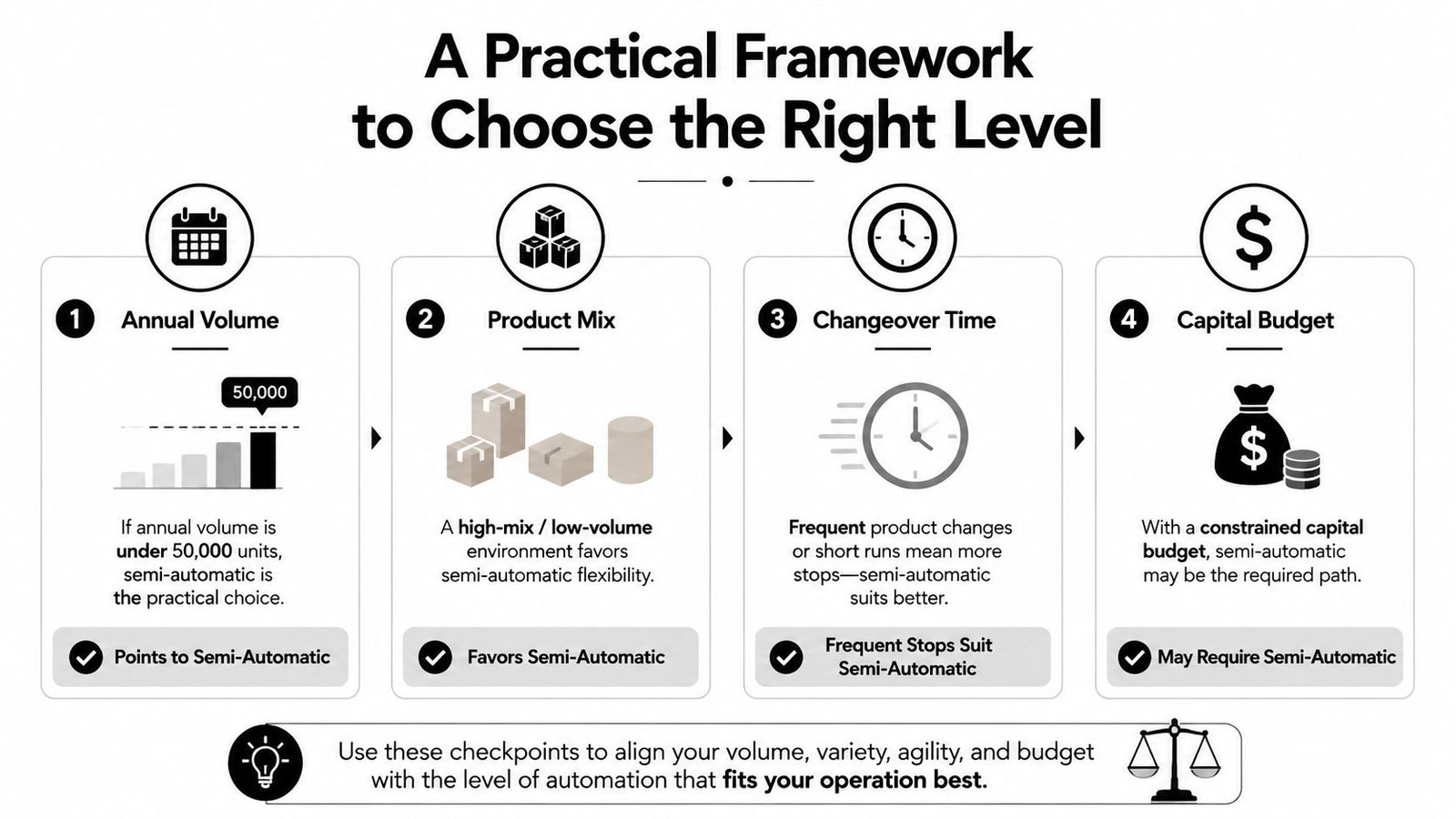
Use four checkpoints before writing a capital request. Each one should end with a clear yes or no. If the answer isn't clear, the plant doesn't have enough operating data yet.
Checkpoint one is annual volume
Under roughly 50,000 units points toward semi-automatic equipment. Between 50,000 and 250,000 units sits in the hybrid zone. Above 250,000 units usually supports a full-automation review, but only after product stability, labor cost, and quality requirements pass the other gates.
Decision: Will the line produce enough stable volume to keep the additional capacity occupied? If no, choose semi-automatic or modular equipment.
Checkpoint two is loaded labor cost
Use loaded labor cost, not base wage. Include benefits, overtime, supervision, training, and the coverage needed to keep the station staffed. A $22 per hour operator changes the payback calculation substantially compared with a $9 per hour operator, but the difference matters only if the automation removes meaningful direct labor.
Decision: Does full automation eliminate enough labor content to recover its added capital? If no, keep the operator in the loop.
Checkpoint three is product mix stability
More than 4 SKUs, frequent format changes, or uncertain product roadmaps favor semi-automatic stations and modular cells. Stored recipes help, but they don't eliminate mechanical change parts, validation, cleaning, or setup checks.
Decision: Can the plant run the same product and format long enough to justify automated tooling? If no, favor flexibility.
Checkpoint four is regulatory and quality load
Validated GMP environments with electronic batch records may require stronger traceability, controlled recipes, data capture, and audit-ready records. That can support automation, but it doesn't make a fully automatic line mandatory. A semi-automatic system can also use controlled parameters, interlocks, barcode verification, and documented operator checks.
Decision: Does the quality system require automated traceability that the proposed semi-automatic design can't support? If yes, automate the affected controls. Don't automatically automate unrelated operations.
Scaling Smart With Hybrid and Modular Automation
The semi-automatic vs fully automatic decision doesn't need to be binary. A hybrid line can automate the high-volume core while preserving human judgment where changeovers, inspection, and exception handling demand it.
A plant might begin with a semi-automatic cell for the primary operation, then add modular upgrades as production pressure develops. Vision inspection can follow controlled assembly. Automated capping can follow manual loading. Robotic palletizing can be added after packaging becomes the constraint. Each upgrade should have its own business case and acceptance criteria.
One operator may oversee three to four automated stations in a hybrid architecture, provided the stations are arranged for safe access, clear fault visibility, and realistic response times. The objective isn't to keep one person busy with alarms across a sprawling line. It's to combine machine consistency with human judgment at the points where the process still varies.
Modularity also protects capital. A staged plan can spread investment across 18 to 48 months, allowing the plant to confirm demand, learn the process, and upgrade only where the evidence supports it. That reduces the stranded-asset risk of buying a turnkey line that becomes difficult to adapt when the next SKU launches.
Build the first cell so the next upgrade has somewhere sensible to connect.
Start with a labor-content audit. Measure how much operator time each unit requires, identify the manual step with the highest cost or defect exposure, and automate that step first. System Engineering & Automation provides semi-automatic stations, fully automated equipment, custom tooling, fixtures, integrated controls, design, manufacturing drawings, sourcing, installation, commissioning, and ongoing support for manufacturers that need to optimize production without overbuilding the line.
Visit System Engineering & Automation to discuss a semi-automatic station, modular upgrade, or fully integrated line matched to your volume, product mix, labor cost, and quality requirements. Bring your current cycle times, staffing assumptions, scrap data, and changeover schedule, and ask for a design that proves its break-even point before you commit capital.