
When you're under pressure to improve throughput, reduce labor exposure, or modernize an aging process, a company like astro machine works inc can look like the obvious answer. The appeal is clear. One vendor, broad capabilities, large equipment, in-house inspection, fabrication, machining, electrical work, and custom automation under one roof.
That model can be a very good fit. It can also be the wrong fit.
The hard part of vendor selection isn't deciding whether a shop is competent. It's deciding whether its operating model matches your plant's actual problem. A broad contract manufacturer may be ideal if you need a complex machine, heavy assembly, precision parts, and coordinated quality control from one source. But if your real need is a targeted production upgrade, a retrofit, or a semi-automated cell with tight ROI discipline, a large one-stop-shop isn't automatically the best answer.
Due diligence matters. Buyers often get impressed by the capability list and skip the more expensive question: how will this partner make the right engineering choices for our constraints, not just build what we ask for?
Table of Contents
- Introduction: Is a Manufacturing Giant Like Astro the Right Partner?
- Who is Astro Machine Works? A 40-Year Snapshot
- Core Capabilities: From 5-Axis CNC to Custom Automation
- Astro's Strengths and Potential Gaps for Your Project
- How to Evaluate an Automation Partner: A Framework for Manufacturers
- Conclusion: Choosing the Right Partner for Your Production Goals
Introduction: Is a Manufacturing Giant Like Astro the Right Partner?
A manufacturing leader rarely starts a vendor search looking for “the biggest range of services.” The search usually starts with a pain point. Scrap is climbing. An operator-dependent process is unstable. A legacy machine is becoming impossible to maintain. A launch schedule is forcing a decision faster than the team would like.
In that situation, astro machine works inc is the kind of company that gets attention fast. It presents as a serious industrial partner with depth across machining, fabrication, automation, inspection, and assembly. For some buyers, that's exactly what lowers execution risk.
For others, that same breadth can hide the underlying issue. A large vendor can absolutely deliver a large solution. That doesn't mean the large solution is the right one. On the shop floor, the best result often comes from the partner that asks tougher questions about takt, changeover, operator interaction, validation burden, spare parts strategy, and how much automation you need.
Practical rule: Judge a vendor less by how many services it lists and more by whether it can explain what it would deliberately leave out.
The useful way to look at Astro isn't as a simple company profile. It's as a case study in how to evaluate any advanced manufacturing and automation partner. Their footprint, certifications, and process range show what a mature contract manufacturer can offer. Their public-facing gaps also show where buyers need to probe beyond the brochure.
If you're comparing a broad industrial supplier with a more targeted automation specialist, the decision should come down to fit. Not admiration.
Who is Astro Machine Works? A 40-Year Snapshot
A buyer looking at Astro is usually trying to answer a practical question. Is this a stable supplier with enough depth to take on a meaningful build, or is the company profile stronger than the execution model behind it?
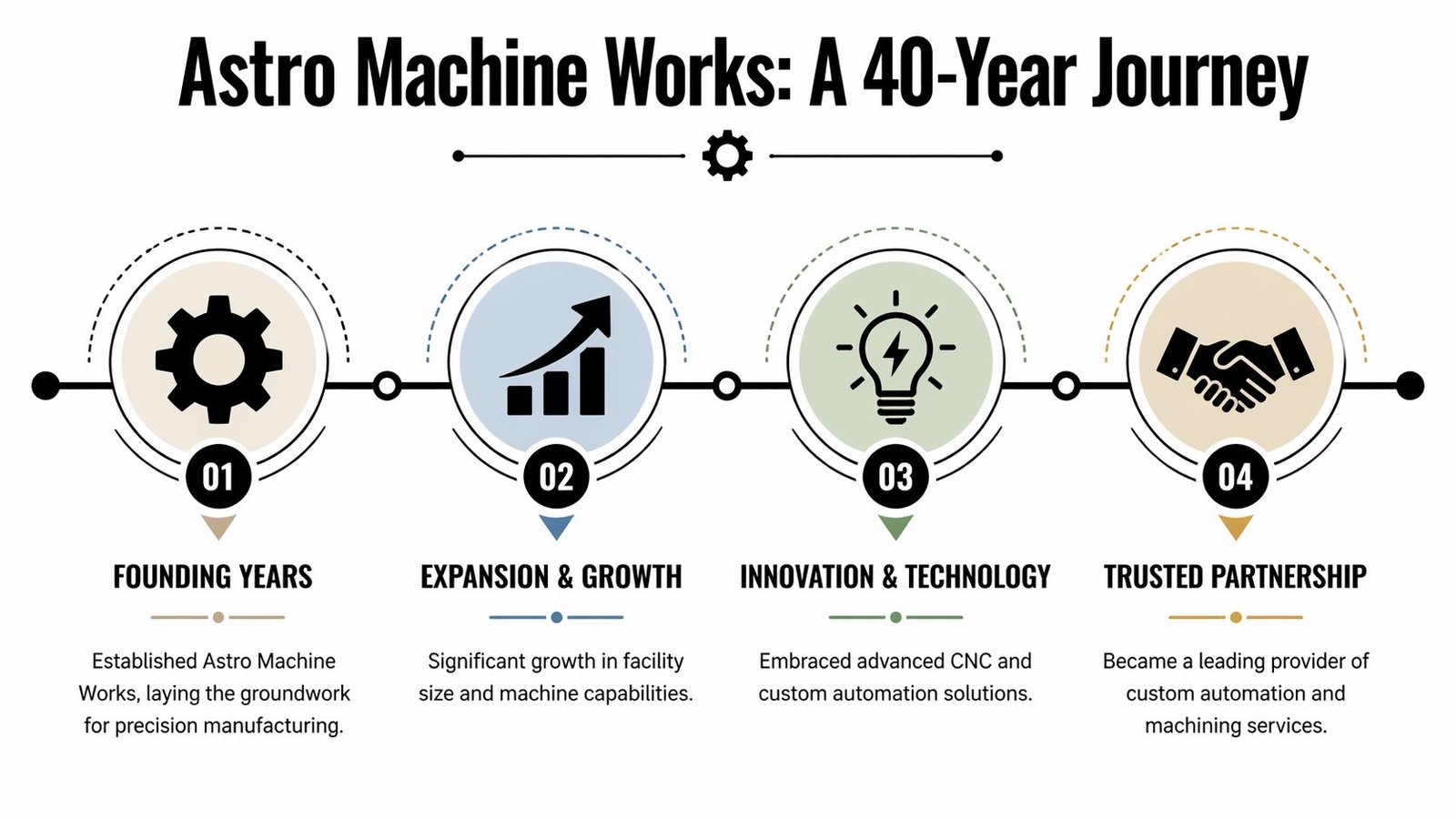
Astro Machine Works is a long-established manufacturer based in Ephrata, Pennsylvania. The company says it was founded in 1984, operates a 72,000-square-foot facility, employs about 115 people, focuses on custom machinery and precision parts, serves a wide range of industrial sectors, and became 100 percent employee-owned through an ESOP in 2018, according to the Astro Machine Works company overview.
A business built to stay in the market
Forty years in business does not prove a supplier is right for your program. It does tell you the company has likely worked through recessions, labor shifts, material volatility, and changes in customer demand without losing its footing. That lowers one category of risk.
Astro also fits a recognizable model in contract manufacturing. It appears to have started with a narrower base in custom machinery and precision parts, then expanded into a broader, more vertically integrated operation. For some OEMs, that is attractive. One supplier can machine parts, fabricate structures, build assemblies, and support automation work under one roof or close to it.
That model has clear upside. It can reduce handoff delays, simplify purchasing, and make scheduling easier when the project requires a broad build scope. It can also lead teams toward a larger system than the process requires. That is one reason some manufacturers compare a full-service firm like Astro with a specialist focused on custom-designed machinery for targeted production problems. The better choice depends on whether your bottleneck is enterprise-scale production support or a specific automation problem with a tight ROI target.
A vendor's customer mix reveals its internal habits. If a shop supports medical, aerospace, defense, food, semiconductor, and general industrial work, I expect to see stronger discipline around documentation, revision control, inspection planning, and customer communication than in a shop built around simpler commercial work.
Astro's 2021 acquisition of All Fab LLC also matters in a practical way. According to Trendline Capital's acquisition announcement, the deal added fabrication capacity in areas such as structural steel, aluminum work, forming, shearing, and parts production. For a buyer, that suggests Astro was expanding its ability to support larger frames, welded structures, and mixed-process builds instead of staying confined to machined components.
Why ownership still deserves a look
Employee ownership can influence execution, but it is not a shortcut for qualification. I treat ESOP status as a useful clue, not a verdict.
In some shops, employee ownership shows up as better retention, more care in workmanship, and less finger-pointing between departments. In others, it changes very little for the customer. The only safe approach is to test the culture through quoting, technical review, schedule discipline, and how the team handles difficult questions.
Astro's profile points to a company with staying power, meaningful internal scale, and an interest in broadening its manufacturing range. Those are strengths. They also place Astro in a category that buyers should evaluate carefully. Large, established suppliers are often a good fit for multi-process programs. They are not automatically the best fit for a narrower automation project where speed, simplicity, and payback matter more than vendor breadth.
Core Capabilities: From 5-Axis CNC to Custom Automation
A capability list only matters if it reduces project risk.
For a manufacturing team qualifying Astro, the practical question is whether one supplier can take a part or machine concept from raw material through inspection, assembly, and startup without forcing the customer to manage a string of avoidable handoffs. Astro appears built for that kind of work. The value is less about owning a long list of equipment and more about keeping machining, fabrication, electrical work, inspection, and machine build under one roof when the job is large enough to justify it.
What stands out on the machining side
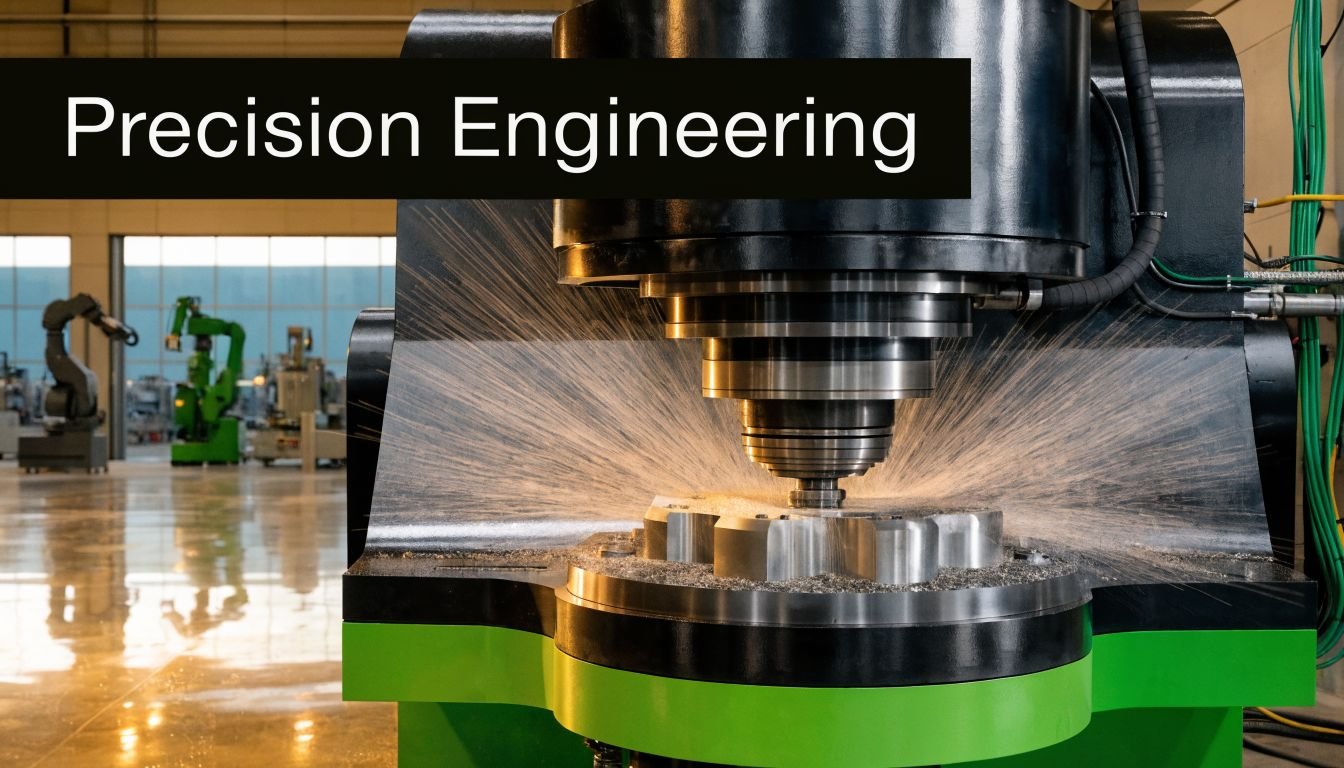
As noted earlier, Astro positions itself as a shop with serious 5-axis CNC capability and a machine inventory sized for both precision work and large parts. That combination matters for buyers dealing with complex surfaces, compound angles, or large workpieces that smaller job shops may need to split across setups or outsource entirely.
On the floor, 5-axis capacity pays off in a few specific ways. It can cut setup count, improve feature-to-feature alignment, and lower the odds that an operator has to reposition a part several times just to reach all required surfaces. Those gains are real, but they are not automatic. The right question for your team is whether your part mix benefits from simultaneous multi-axis work or whether a simpler process plan would be cheaper and easier to control.
The supporting processes are just as important as the headline machine tools. In-house CMM inspection helps close the loop on geometric verification. Wire EDM, waterjet, and laser cutting give process options when material, edge quality, or feature shape rules out a standard milling approach. That flexibility can save time during engineering changes, especially when a prototype build shifts into short-run production and the original routing no longer makes sense.
Large machine envelopes also change quoting strategy. A supplier that can hold oversized components in-house may save weeks of coordination on big tooling, bases, fixtures, and structural interfaces. If your program includes those parts, ask less about theoretical capacity and more about recent jobs with similar size, tolerance stack-up, and material removal demands.
What matters for automation buyers
Astro's machine-building profile is more interesting than its machining list alone. Based on the capability descriptions cited earlier in the article, the company can take on large custom automation builds, including projects that require structural fabrication, machined interfaces, electrical panel work, inspection, and final assembly in one package.
That is a different buying decision from sourcing a precision part.
For some teams, the appeal of a large one-stop supplier is obvious. Fewer vendors can mean fewer schedule gaps, fewer fit-up surprises, and fewer arguments over who owns a problem during assembly. For other teams, especially those buying a narrowly scoped cell or a fast-payback production improvement, a specialist may be the better fit. Buyers comparing broad machine builders with more focused partners often look at providers of custom designed machinery solutions for exactly that reason. The question is not which model sounds stronger on paper. The question is which one fits the project's complexity, budget, and expected return.
Before qualifying any automation partner with this breadth, I look at three items first:
| What to verify | Why it matters on the floor |
|---|---|
| Build envelope and lifting capacity | Confirms the supplier can assemble, move, and test your machine without workarounds |
| Electrical and controls integration | Reduces rework between mechanical build, panel fabrication, and commissioning |
| Inspection and test capability | Catches weld, fit, and dimensional issues before they show up during runoff |
A short plant-level look at their operation helps make those capabilities more tangible:
Certification status also affects the fit. Astro has quality and compliance credentials that matter in regulated and controlled work, including aerospace and defense settings, and industry reporting has noted its stated path toward stronger cybersecurity readiness, according to CNC West's report on the company's expansion and readiness. For buyers in those sectors, that should be part of the supplier review, along with the usual checks on documentation discipline, revision control, and how the team handles customer data.
Astro's Strengths and Potential Gaps for Your Project
Astro's clearest strength is also its defining business model. It operates like a large-scale, vertically integrated manufacturing partner. That model can simplify sourcing, reduce logistics friction, and keep more of the build path inside one quality system.
For the right project, that's a major advantage.
Where the one-stop-shop model wins
If you're buying a large custom machine or a complex manufactured assembly, fragmentation gets expensive quickly. One supplier handles machined bases. Another fabricates weldments. A third does controls. A fourth performs outside inspection. Every transition creates delay, communication loss, and finger-pointing when something doesn't fit.
Astro's in-house range addresses that problem well. A buyer with a heavy assembly, a fabricated structure, precision-machined interfaces, and inspection requirements may benefit from a supplier that can manage the package internally. That tends to work best in projects with these traits:
- Large physical envelope: Oversized equipment and structural frames aren't easy to split across vendors.
- Mixed process requirements: Machining, fabrication, electrical, and testing all need to move in parallel.
- Tight coordination needs: Mechanical and controls decisions affect each other early.
When a project has many process handoffs, internal coordination can be worth more than shaving a little off an individual line item.
This model also fits organizations that don't have a strong internal engineering team to integrate multiple outside contributors. A broader vendor can absorb more of that complexity.
Where buyers should press harder
The potential gap isn't technical capability. It's decision support.
Analysis of Astro's public-facing content shows strong emphasis on capabilities but limited specific guidance or case studies on the ROI of semi-automation versus full automation, which is a key issue for cost-conscious manufacturers, as reflected in Astro's industry content for energy manufacturers. That's worth noticing because many plants don't need a fully automated line. They need a bottleneck removed, a manual handling risk reduced, or a repeatability problem fixed without overbuilding the system.
That distinction matters most for mid-sized operations and retrofit environments. In those cases, the best answer often isn't a greenfield machine. It may be a staged upgrade, smart tooling, controlled operator interaction, or a targeted retrofit to legacy equipment. Buyers evaluating retrofit automation for legacy systems should ask whether the vendor regularly recommends less automation when that improves flexibility and payback.
A second gap is especially important for regulated sectors. Astro serves the medical industry, but its public materials don't clearly spell out GMP awareness, validation protocols, or material traceability documentation in the way many medical device manufacturers expect. That absence doesn't prove the capability is missing. It does mean buyers shouldn't assume it.
Use this checklist in medical or pharma-adjacent reviews:
- Validation support: Ask whether the supplier can structure documentation around your internal validation process.
- Traceability expectations: Ask how material, component, and revision traceability will be handled.
- Change control discipline: Ask what happens when a design revision lands during build.
- Documentation package: Ask to see examples of what the turnover package includes.
The lesson isn't that Astro is weak. The lesson is that buyers need to inspect the fit between Astro's broad capability model and their own project economics, compliance burden, and tolerance for complexity.
How to Evaluate an Automation Partner: A Framework for Manufacturers
A good automation partner doesn't just build equipment. It makes sound judgment calls before steel gets cut and before controls logic gets written. That's where projects either stay practical or become expensive monuments to overengineering.
The framework below is the one I recommend when a team is comparing a broad manufacturer like astro machine works inc with a more specialized automation source.

1. Automation philosophy
Start here, because bad automation philosophy ruins otherwise capable projects.
Ask the vendor whether it thinks in terms of full automation by default, or whether it actively evaluates manual, semi-automatic, and fully automated paths based on production reality. A serious partner should be able to explain where operator involvement still adds value and where it creates instability.
Questions worth asking:
- Can you show an example where you recommended less automation because it improved flexibility or reduced project risk?
- How do you decide whether a bottleneck should be solved with tooling, fixtures, a retrofit, or a new automated cell?
- What assumptions are you making about staffing, changeovers, and maintenance capability?
If the answer is always “more automation,” be careful. Buyers looking at an automated systems integrator that streamlines operations should expect a partner to discuss constraints openly, not just capabilities.
Field advice: The best automation decision is often the simplest intervention that stabilizes the process.
2. Regulatory and industry IQ
Sector experience must directly inform operational detail. Astro serves medical and pharmaceutical markets, but public materials don't provide specific content on GMP awareness, validation protocols, or material traceability documentation, which are critical for many medical device manufacturers, as noted in the Astro capability statement review context.
If you're in medical devices, don't stop at “we serve medical.” Ask the supplier to describe how it handles document control, revision traceability, validation support, and any customer-specific requirements tied to regulated production.
A useful comparison looks like this:
| Evaluation area | Weak answer | Strong answer |
|---|---|---|
| GMP awareness | “We work in medical” | Specific discussion of documentation, change control, and validation support |
| Traceability | “We can provide paperwork” | Clear explanation of how materials, parts, and revisions are tracked |
| Regulatory fit | Generic quality language | Evidence that the supplier understands your production environment |
3. Partnership model
Some vendors are transactional. They quote what you ask for, build it, ship it, and move on. That can work fine if your specification is mature and your team has already solved the process problem internally.
But if your process still has unknowns, you need a partner that will challenge assumptions. That means asking awkward but valuable questions about operator loading, maintenance access, spare parts strategy, fault recovery, and how the machine will behave when production reality isn't as clean as the concept drawing.
Look for signs of the right behavior:
- They push back intelligently: They don't accept every requested feature without discussing consequence.
- They speak in process terms: They ask about variation, not just dimensions.
- They think about life after FAT: They care about startup, training, and supportability.
4. Scalability and support
Many buyers focus on build capability and ignore what happens after installation. That's backward. Plenty of systems work during acceptance. The true test is how they behave after maintenance turnover, operator rotation, and real production pressure.
Ask practical questions:
- Can this solution start smaller and scale later without a full redesign?
- How dependent will we be on the original builder for troubleshooting?
- What spares, drawings, and service documentation come with the machine?
- How will future changes be handled if our product mix shifts?
A scalable partner designs for change. A rigid partner designs for the snapshot it was quoted against.
The cheaper machine on day one can become the more expensive decision if every product change forces a major rebuild.
Conclusion: Choosing the Right Partner for Your Production Goals
Astro Machine Works presents as a credible, capable industrial supplier with real depth. Its long operating history, broad manufacturing base, and ability to support machining, fabrication, electrical integration, inspection, and large custom builds make it a serious option for companies that need a coordinated one-source solution.
That said, a strong capability profile doesn't answer the only question that matters. Is this the right model for your production problem?
For some teams, the answer will be yes. If the job is large, mechanically complex, and best managed through one integrated supplier, Astro's structure lines up well with the need. If the project depends on heavy fabrication, large machining capacity, in-house quality infrastructure, and consolidated execution, the one-stop-shop model can reduce risk.
For other teams, especially those upgrading a constrained process step or trying to avoid over-automation, the smarter move may be a more targeted partner. The same is true for medical device manufacturers that need clearer support around validation thinking, traceability expectations, and GMP-aware execution. In those environments, the vendor's judgment matters as much as its equipment list.
Use four filters in every evaluation:
- Automation philosophy: Do they right-size the solution?
- Regulatory understanding: Do they grasp the burden your industry places on documentation and control?
- Partnership style: Will they challenge bad assumptions?
- Scalability and support: Can the system evolve without becoming a future headache?
A vendor should help you solve the production problem you have, not the one that looks most impressive in a proposal. That's the standard worth holding, whether you're considering astro machine works inc or any other automation partner.
If you're weighing semi-automated, fully automated, or retrofit options and want a practical engineering partner that stays focused on ROI, flexibility, and GMP-aware manufacturing needs, System Engineering & Automation is worth a conversation. SEA helps manufacturers develop right-sized solutions, from tooling and fixtures to integrated systems, with an emphasis on real production constraints, responsive support, and cost-effective execution.