A production line rarely fails at a convenient time. A custom fixture starts drifting out of tolerance during a busy shift, a controls integrator doesn't return calls fast enough, or a critical parts supplier misses a delivery and suddenly your team is firefighting instead of producing. In manufacturing and medical device environments, vendor problems don't stay inside procurement. They hit uptime, quality, validation schedules, and customer commitments.
That's why best practices for vendor management need to go well beyond basic purchasing discipline. Modern vendor management has evolved from simple supplier administration into a formal, risk-based governance process that uses written policies, tiered risk ranking, centralized records, standardized due diligence, and ongoing monitoring instead of one-time onboarding checks, as outlined in JPMorgan's vendor management guide. For manufacturers, that shift matters because a low-cost office supplier and a machine builder supporting a validated line should never be managed the same way.
The practical standard is straightforward. Treat vendors according to business impact, security exposure, compliance importance, and their ability to stop production if they fail. Build documented processes around that reality. The eight practices below are the ones that hold up in real operations, especially when you're managing automation partners, tooling vendors, GMP-aware suppliers, and service providers that directly affect throughput and product quality.
Table of Contents
- 1. Establish Clear Performance Metrics and SLAs
- 2. Implement Vendor Qualification and Certification Programs
- 3. Develop Strategic Long-Term Partnerships
- 4. Establish Vendor Risk Management and Contingency Planning
- 5. Create Clear Contracts with Defined Scope and Change Management
- 6. Implement Regular Performance Audits and Reviews
- 7. Manage Vendor Relationships Through Dedicated Leadership and Communication
- 8. Optimize Costs While Maintaining Quality and Strategic Value
- 8-Point Vendor Management Best Practices Comparison
- Build a Resilient, High-Performing Supplier Ecosystem
1. Establish Clear Performance Metrics and SLAs
If a vendor can't be measured, they can't be managed. In production environments, that usually means agreeing on a short set of operating metrics before a project launches or a service contract renews. Good vendor governance relies on measurable KPIs and regular review cadences, including on-time delivery, quality scores, responsiveness, invoice accuracy, and cost variance from contract terms, as described in Venn's vendor management best practices.
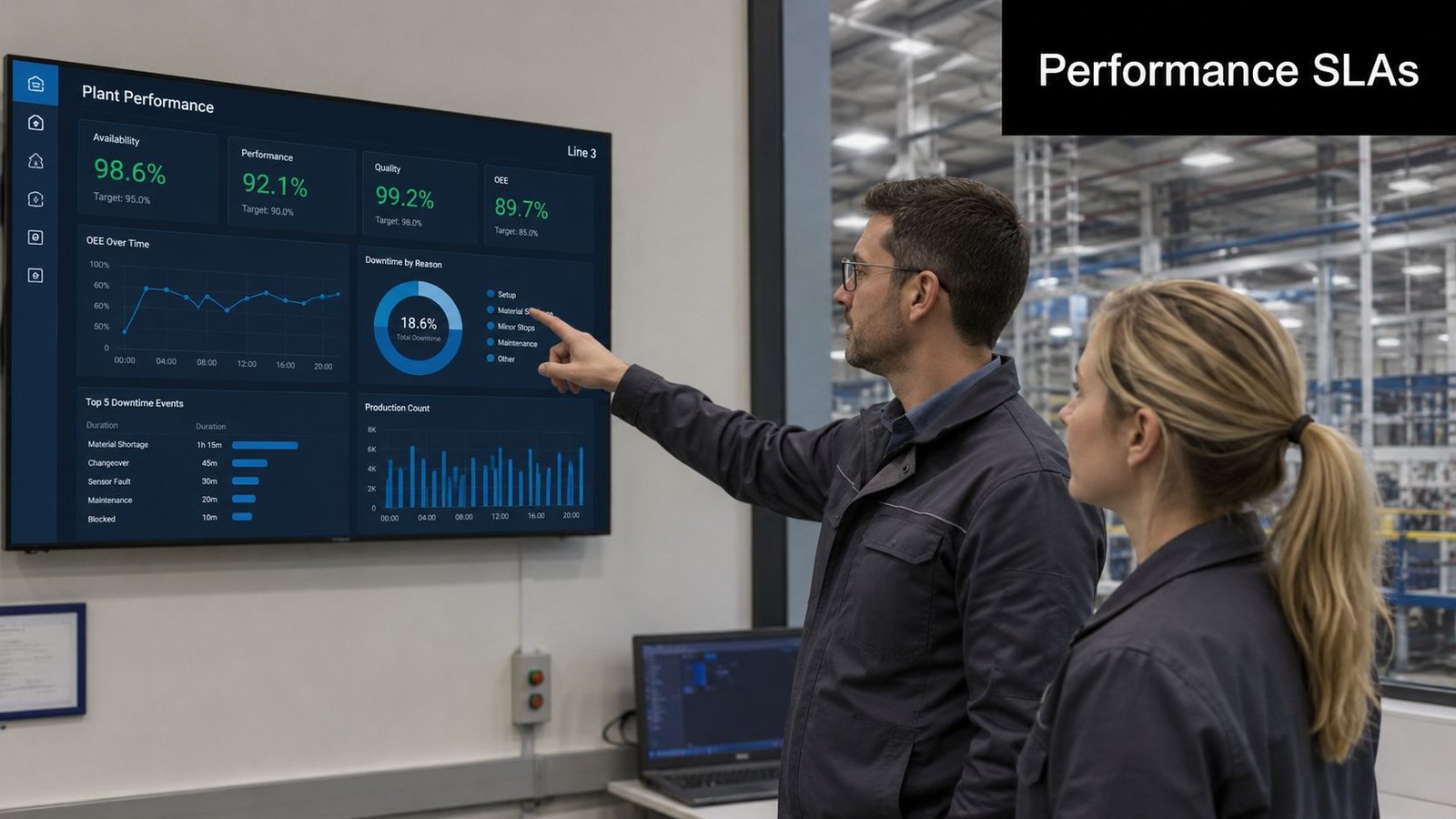
For an automation supplier, generic language like “timely support” is useless. Define response windows for line-down events, document what counts as acceptable startup performance, and spell out what evidence closes a service ticket. The same principle applies to tooling suppliers, contract maintenance teams, and OEM support providers.
Start with the numbers that affect production
Organizations often overcomplicate SLAs. Start with a few metrics that affect the floor.
- On-time delivery: Track whether promised ship dates and service visit dates are met consistently.
- Defect or rework performance: Define what quality failure looks like for fabricated parts, panels, assemblies, or software changes.
- Support responsiveness: Set expectations for acknowledgment, remote troubleshooting, and on-site escalation.
- Invoice accuracy: Check whether billing matches approved rates, milestones, and contract terms.
A medical device manufacturer might require documented support for validated equipment changes. An automotive plant may focus harder on repeatability and defect containment. A packaging line owner usually cares first about uptime and spare parts availability.
Practical rule: Tie each SLA to a business consequence. If the metric doesn't influence production, compliance, cost, or quality, it probably doesn't belong in the contract.
Teams also need a place to act on the data. Quarterly business reviews work well for strategic vendors, while active projects often need weekly or monthly operating reviews. For post-installation support, it helps to define how the vendor will stay engaged after startup. That's one reason many manufacturers look closely at maintenance and support services from SEA when evaluating ongoing vendor fit.
2. Implement Vendor Qualification and Certification Programs
A vendor should earn access to your plant, not just your purchase order. The strongest qualification programs check technical capability, quality discipline, documentation habits, financial stability, and the vendor's ability to support the equipment after installation. That matters more in manufacturing than in ordinary buying because the cheapest supplier can become the most expensive one once delays, rework, and support gaps show up.
In medical devices and regulated production, qualification should reflect the environment the vendor will work in. If a machine builder says they understand GMP expectations, ask for examples of their drawing standards, FAT support, change documentation, and training packages. If an integrator claims they can support a validated line, review how they control revisions and how they handle software changes in production.
Qualify for the real environment
A practical qualification process usually includes a weighted scorecard and an audit mindset, even when you're not doing a formal supplier audit.
- Technical fit: Review design tools, controls standards, previous machine builds, and commissioning method.
- Quality system fit: Check how the vendor controls revisions, nonconformances, and documentation release.
- Support fit: Confirm spare parts strategy, field support availability, and escalation contacts.
- Business fit: Evaluate whether the vendor can scale with your forecast and survive a difficult project.
An engineering vendor building semi-automatic equipment for a medical device manufacturer needs different scrutiny than a commodity supplier. You're not just buying fabricated steel or standard components. You're buying design judgment, programming discipline, debug support, and sometimes validation-ready documentation.
A polished sales presentation doesn't prove execution capability. Drawings, standards, references, and support records do.
Many manufacturers build a qualified vendor list and review it on a recurring basis. That makes it easier to avoid last-minute sourcing decisions when projects accelerate. If your team is vetting automation partners, SEA's guidance on finding automation machine manufacturers is a useful reference for what to compare before you commit.
3. Develop Strategic Long-Term Partnerships
Not every supplier deserves partner status. Some vendors should stay transactional because their work is interchangeable and the switching cost is low. But for automation, controls, critical tooling, calibration support, and specialized fabrication, a long-term relationship usually produces better results than constant re-bidding.
The reason is simple. Strategic vendors learn your plant, your tolerances, your operators, and your approval habits. They stop wasting time rediscovering how you work. That shortens problem-solving cycles and reduces the friction that slows every custom project.
Choose who earns partner status
A good strategic partner does more than meet the PO. They bring issues forward early, challenge weak assumptions, and help prevent avoidable downtime. In manufacturing, that often means involving a trusted vendor before equipment selection is frozen or before a process bottleneck turns into a capital emergency.
Here's what usually separates a real partner from a convenient supplier:
- They understand your constraints: Cleanroom rules, validation expectations, floor space limits, and operator skill levels aren't afterthoughts.
- They share workable recommendations: They don't oversell full automation when a semi-automatic cell is the smarter answer.
- They stay engaged after startup: They support tuning, troubleshooting, training, and improvement work instead of disappearing after installation.
- They communicate risk early: They raise concerns about components, lead times, serviceability, and design compromises before they become expensive.
This becomes even more important as automation changes the scope of outsourced work. Newer procurement guidance is moving toward more context-sensitive, outcome-based contracts and smaller incremental deliverables for complex services, while the World Economic Forum reports that 40% of employers expect staff reductions where AI can automate tasks and 50% expect AI to reshape business models. For manufacturing leaders, that means vendor scope can shift during the contract term. The partner who can adapt with you is worth more than the vendor who only knows how to execute the original statement of work.
4. Establish Vendor Risk Management and Contingency Planning
Vendor risk management isn't a spreadsheet exercise. It's the work of deciding which suppliers can stop production, create compliance exposure, or leave you stranded with unsupported equipment. Best practices now favor a risk-based tiering model where critical or high-risk vendors receive enhanced due diligence at onboarding and then at least annual review, while lower-risk vendors follow a lighter cadence, according to Warren Averett's guidance on vendor risk strategy.
That model works especially well in manufacturing because not every supplier deserves the same level of attention. A source for janitorial supplies and a sole-source controls programmer for a custom assembly cell don't belong in the same risk bucket.
Tier risk before you write the contingency plan
A useful vendor risk matrix should combine financial health, compliance history, security posture, business continuity capability, and operational criticality. Then tie that tier to measurable controls such as SLAs, defect rates, on-time delivery, and cost variance so the score isn't based on opinion alone.
A practical approach looks like this:
- Critical vendors: Suppliers whose failure can stop production, compromise quality, or affect regulated output.
- Important vendors: Suppliers who matter operationally but can be replaced with effort.
- Routine vendors: Suppliers with low operational impact and limited switching cost.
Once the tiers are set, contingency planning gets concrete. For a custom automation partner, that might mean securing source code access, maintaining current electrical drawings, documenting commissioning settings, and qualifying a backup service option. For a specialized parts supplier, it may mean approved alternates, buffer inventory, or dual-source qualification.
Don't wait for a disruption to define your fallback. By then, your choices are already worse.
Manufacturers with complex equipment often benefit from a formal automation risk assessment process because equipment failure risk, service dependency, and documentation gaps are usually connected. The point isn't to eliminate risk. It's to know where it sits and what you'll do when a critical vendor fails.
5. Create Clear Contracts with Defined Scope and Change Management
Most vendor disputes start long before anyone argues. They start in vague contracts. If scope is fuzzy, deliverables are implied instead of written, and acceptance criteria depend on “reasonable expectations,” the project will drift.
That's especially dangerous in custom engineering and automation work. A machine concept can look settled in a kickoff meeting and still change materially once safety review, operator access, part presentation, validation requirements, and controls integration are discussed in detail. Contracts need to reflect that reality.
Write contracts for the work that actually happens
Good contracts define scope in operational terms. They identify what the vendor will design, build, install, document, test, train, and support. They also define what the customer must provide, such as utilities, product samples, approvals, access windows, and signoff timing.
Three contract elements matter most:
- Objective acceptance criteria: Define what successful FAT, SAT, commissioning, or validation support looks like.
- Milestone-based payment terms: Tie payments to completed design reviews, released drawings, delivery, startup, or other verifiable outputs.
- Formal change control: Require written change requests with schedule, cost, and technical impact before additional work proceeds.
Execution is where many best practices for vendor management fail. Teams say they want change control, then approve “small” changes in meetings without documenting impact. A few undocumented changes later, the budget is off, the schedule is slipping, and both sides think the other caused it.
For manufacturing leaders, the safest approach is progressive detail. Start with a strong template, then add project-specific attachments for drawings, software standards, spare parts, validation support, training expectations, and warranty obligations. In regulated settings, make sure document deliverables are named explicitly. If it matters during IQ, OQ, maintenance, or troubleshooting, it should be in the contract.
6. Implement Regular Performance Audits and Reviews
A vendor score that nobody reviews is just archived disappointment. Performance audits work when they're tied to real operating decisions such as renewals, corrective action, supplier development, or replacement planning. They don't work when they're ceremonial meetings with no shared data.
Industry guidance increasingly recommends centralized scorecards and continuous performance analytics, including KPIs such as on-time delivery rate, defect rate, SLA compliance percentage, and cost variance against contract, combined with stakeholder feedback and periodic business reviews, as outlined in Cloudvara's vendor management best practices. For manufacturers, the valuable part is the implementation pattern. Pull data from ERP, quality systems, invoicing, and contract records into one view so trend deterioration appears early.
Make reviews operational, not ceremonial
Formal reviews should match vendor importance. A strategic automation partner might need quarterly business reviews and project-specific working sessions. A lower-risk supplier may only need periodic scorecard review and renewal checks. What matters is consistency.
Useful review agendas usually include:
- Performance against agreed KPIs: Delivery, defects, responsiveness, billing accuracy, and contract compliance.
- Open corrective actions: What's overdue, who owns it, and what evidence closes it.
- Forward-looking risks: Capacity concerns, parts obsolescence, staffing changes, or documentation gaps.
- Improvement opportunities: Cost reduction, standardization, training, and support process changes.
A medical device manufacturer may also add change-control performance and documentation quality to the review. A plant with frequent line modifications may put more emphasis on engineering response time and field support quality.
Review trends, not isolated wins. A vendor who hits a target once isn't necessarily stable.
The best audits feel demanding but fair. Vendors should know the criteria in advance, see the same scorecard each cycle, and have the chance to respond to issues with corrective action. That protects the relationship while keeping standards high.
7. Manage Vendor Relationships Through Dedicated Leadership and Communication
Vendors struggle when the customer has no clear owner. One engineer requests a change, procurement negotiates separately, maintenance escalates support issues, and quality raises documentation concerns through a different channel. The vendor hears four priorities and no single decision-maker.
That's why strong vendor management needs named ownership. One person, or one clearly defined small team, should coordinate the relationship, align internal stakeholders, and control escalation. In manufacturing, the best owner is usually someone who understands both plant realities and business priorities.

Assign one owner and one escalation path
A dedicated vendor lead doesn't need to do everything. They need to make sure the right people are involved at the right time and that decisions don't splinter across departments.
In practice, that means:
- Set a communication rhythm: Weekly during active builds or commissioning, monthly for routine operating issues, and quarterly for strategic review.
- Define escalation rules: Everyone should know when an issue stays at the project level and when it goes to plant leadership or executive sponsors.
- Document decisions: Verbal agreements during a debug session often become tomorrow's dispute.
- Provide backup coverage: If one relationship owner is unavailable, the vendor shouldn't lose continuity.
This matters even more when vendor work changes over time. Standard advice often focuses on selection and contracting, but concentrated supply chains, cyber threats, AI-related risks, and supply-chain disruptions continue to raise the stakes for active governance, as noted in Spendesk's discussion of vendor management risks. Communication discipline is part of resilience. If a critical supplier starts slipping, your team needs visibility early enough to act.
8. Optimize Costs While Maintaining Quality and Strategic Value
A plant approves the low bid on a new packaging cell. Six months later, the line is losing output because changeovers take too long, operators need constant workarounds, and replacement parts have to come from overseas with long lead times. The purchase price looked good. The operating result did not.
That pattern shows up often in manufacturing and medical device operations because the true cost sits in validation effort, downtime exposure, documentation quality, service response, and how well the supplier fits your production environment. A vendor that saves money upfront but creates installation delays, deviation risk, or recurring support calls usually costs more by the end of the first year.
Measure total operating value
For an automation integrator, machine builder, or GMP service provider, cost review should start with total operating impact. Include startup time, FAT and SAT quality, training needs, spare parts availability, troubleshooting support, documentation quality, cybersecurity expectations, and the effort required to keep the system in a validated state. In regulated production, weak documentation or poor change control can erase any savings from a lower quote.
This is also where strategic value matters. A supplier that understands your process, knows your plant standards, and can support future line expansions may be worth more than a cheaper vendor that treats every project like a one-off job.
A practical cost strategy usually includes:
- Use competitive bids with intent: Benchmark pricing on defined scopes, but avoid turning every engineered project into a price auction.
- Score suppliers on operating performance: Weigh delivery reliability, quality, service responsiveness, and documentation alongside commercial terms.
- Reduce waste at the design level: Standard parts, simpler controls architecture, and repeatable machine concepts usually lower lifecycle cost more than a last-minute price concession.
- Consolidate selectively: Fewer suppliers can improve coordination and support, but only if you monitor concentration risk for critical equipment or regulated services.
- Separate strategic suppliers from transactional ones: Buy commodity items aggressively. Manage high-impact engineering and compliance vendors for long-term value.
The strongest savings usually come from joint problem-solving, not from pushing for another discount. A good supplier will tell you when full automation is unnecessary, when a fixture can be simplified, or when a standard platform will outperform a custom build. That is the kind of cost discipline that protects margin, supports quality, and keeps the plant easier to run.
8-Point Vendor Management Best Practices Comparison
| Practice | Implementation Complexity 🔄 | Resource Requirements ⚡ | Expected Outcomes 📊 | Ideal Use Cases 💡 | Key Advantages ⭐ |
|---|---|---|---|---|---|
| Establish Clear Performance Metrics and SLAs | Medium 🔄, define KPIs, legal terms | Moderate ⚡, reporting tools, legal review, ops input | 📊 Clear accountability; reduced downtime; measurable vendor performance | 💡 Critical equipment, high-uptime lines, regulated production | ⭐ Objective tracking; enforceable commitments; continuous improvement |
| Implement Vendor Qualification and Certification Programs | High 🔄, audits, scorecards, re-certification | High ⚡, audit teams, facility visits, documentation review | 📊 Lower supplier risk; ensured compliance; better vendor fit | 💡 Medical devices, GMP environments, complex technical suppliers | ⭐ Risk reduction; documented evidence; quality assurance |
| Develop Strategic Long-Term Partnerships | Medium–High 🔄, governance, joint planning | Moderate ⚡, account management, co-development resources | 📊 Faster innovation; lower TCO over time; improved responsiveness | 💡 Staged automation upgrades, repeat-volume suppliers, co-design projects | ⭐ Deeper expertise; preferential pricing; collaborative innovation |
| Establish Vendor Risk Management & Contingency Planning | High 🔄, risk mapping, contingency protocols | Moderate–High ⚡, risk analysis, backup suppliers, spare parts | 📊 Greater resilience; fewer production disruptions; documented backups | 💡 Single-source dependencies, mission-critical systems, tight lead times | ⭐ Continuity of operations; IP protection; faster recovery |
| Create Clear Contracts with Defined Scope & Change Management | Medium 🔄, scope, acceptance, change approvals | Moderate ⚡, legal, PM, technical specifications | 📊 Reduced disputes; controlled scope creep; clear deliverables & payments | 💡 Complex engineering projects, long timelines, custom automation | ⭐ Legal clarity; enforceable milestones; reduced overruns |
| Implement Regular Performance Audits and Reviews | Medium 🔄, scheduled audits, corrective actions | Moderate ⚡, audit resources, dashboards, follow-up processes | 📊 Early issue detection; continual improvement; documented performance trends | 💡 Ongoing vendor support, compliance-heavy suppliers, SLA monitoring | ⭐ Accountability; trend visibility; corrective action tracking |
| Manage Vendor Relationships via Dedicated Leadership & Communication | Low–Medium 🔄, assign owners, set cadence | Moderate ⚡, account managers, collaboration tools, meetings | 📊 Faster issue resolution; consistent communication; stronger alignment | 💡 Commissioning phases, cross-functional projects, strategic vendors | ⭐ Single point of contact; quicker escalations; sustained coordination |
| Optimize Costs While Maintaining Quality & Strategic Value | Medium 🔄, TCO analysis, value engineering | Moderate ⚡, finance, procurement, vendor collaboration | 📊 Lower total cost of ownership; sustained quality; measurable savings | 💡 High-volume buys, lifecycle procurement, cost-reduction programs | ⭐ Improved ROI; aligned incentives; sustainable cost reductions |
Build a Resilient, High-Performing Supplier Ecosystem
Effective vendor management is operations management. In manufacturing and medical device settings, suppliers influence line uptime, product quality, documentation quality, compliance readiness, and the speed at which problems get solved. Treating vendor oversight as a basic procurement task leaves too much exposed.
The strongest programs share a few traits. They measure performance with a small set of meaningful metrics. They qualify vendors against real operating demands, not polished presentations. They distinguish strategic partners from interchangeable suppliers. They rank risk instead of spreading attention evenly across every vendor. They use contracts that define scope clearly and force changes into a controlled process.
They also review vendors consistently. That doesn't mean building bureaucracy for its own sake. It means using scorecards, business reviews, and corrective action tracking to spot deterioration before a late shipment, a service failure, or a documentation gap turns into a plant issue. In well-run operations, vendor data is visible, current, and tied to decisions.
Leadership discipline matters just as much. Someone needs to own each important vendor relationship, coordinate internal stakeholders, and drive escalation when performance slips. Without that structure, even good suppliers end up working through mixed signals and avoidable delays. With it, vendors know how to support the business, and your team knows how to hold them accountable.
Cost control belongs inside that same framework. Strong manufacturers don't chase low bids blindly. They look at total operating impact, service reliability, quality outcomes, and the vendor's ability to support production over time. That's especially important for engineering, automation, tooling, and GMP-aware suppliers, where the cheapest option can create the most downtime, rework, and frustration.
If you want to improve vendor performance quickly, start with one relationship that matters most. Review the SLA. Review the support history. Review the documentation. Review whether your team has a current risk view, a clear owner, and a defined escalation path. Most vendor problems become visible long before they become crises.
A partner like System Engineering & Automation reflects what good vendor relationships should look like in practice. Responsive support, practical engineering judgment, GMP-aware execution, and a focus on results on the floor are exactly what manufacturing leaders should expect from a strategic vendor.
If you're upgrading manual processes, planning semi-automated equipment, or need a more dependable engineering partner, System Engineering & Automation can help you build practical vendor relationships that improve uptime, quality, and ROI. Their team supports manufacturers from concept and design through installation, commissioning, and ongoing service, with solutions developed to meet real production constraints.