You've probably seen this happen on a line that's otherwise running fine. A bearing starts making noise, a motor draws a little more current than usual, and by the time anyone reacts, the shift has already lost output, the maintenance team is firefighting, and production is asking why a “routine” failure took down a critical asset two weeks before its scheduled replacement. That gap between calendar-based maintenance and real equipment condition is where predictive maintenance earns its place.
For manufacturers that need to optimize production and services, the appeal isn't abstract. Predictive maintenance works when it helps a plant intervene on the right asset, at the right time, with enough confidence to keep the line moving and the maintenance crew out of emergency mode. The practical challenge is that most plants don't start with perfect sensor coverage, clean history, or a modern stack, they start with legacy equipment, partial logs, and a CMMS that's been used more as a filing cabinet than a decision engine.
The implementation path has to respect that reality. A good program starts small, builds a defensible baseline, connects alerts to work execution, and proves value before asking for scale.
Table of Contents
- Why Predictive Maintenance Matters for Modern Manufacturing
- Defining Objectives and Selecting Pilot Assets
- Choosing Sensors and Designing Data Collection Architecture
- Selecting the Right Analytics and Machine Learning Approach
- Running the Pilot and Integrating with Maintenance Workflows
- Measuring ROI and Scaling Across the Plant
- Choosing the Right Automation Partner and Building Internal Capability
Why Predictive Maintenance Matters for Modern Manufacturing
A plant manager does not need theory when a line goes down. They need the root cause, the repair plan, and a way to keep the same failure from repeating on the next shift. Calendar maintenance often misses that goal because it assumes wear follows a schedule, while real assets drift with load, environment, product mix, operator behavior, and past repairs.
Predictive maintenance changes the question from “When is the next service due?” to “What is the asset telling us now?” That is why the strongest implementation roadmaps focus on continuous condition data, not blanket replacement cycles. A published deployment roadmap recommends starting with a readiness assessment, then a 3 to 5 asset pilot, with initial results typically in 3 to 6 months, validation in 6 to 12 months, and full ROI in 12 to 18 months. It also suggests starting with rotating equipment like pumps, motors, and fans, where vibration monitoring often gives the fastest operational wins, and tying the rollout to a target such as a 30% reduction in unplanned downtime for a concrete baseline. Predictive maintenance implementation roadmap
Why mid-sized plants cannot treat this as a luxury
The strongest business case is usually the most practical one. Industry reporting on AI predictive maintenance points to lower unplanned downtime, reduced maintenance cost, and longer equipment life compared with time-based maintenance, with benefits that grow once the program is tied to actual work execution. The same reporting says scaled deployments can produce strong returns over time, with ROI driven mostly by avoided downtime, then maintenance-cost reduction and deferred capital expenditure. 2026 predictive maintenance statistics roundup
The plants that get value fastest usually aren't the ones with the fanciest stack. They're the ones that choose one painful failure mode, measure it rigorously, and wire the result into maintenance execution.
That mindset fits manufacturers that need to improve production and service without building a program they cannot support. The objective is not to buy every sensor category at once. It is to reduce surprise events that wreck schedules, scrap material, and keep technicians from doing planned work. In legacy and semi-automated plants, that often means starting with the assets that hurt most, then proving the signal before anyone asks for scale.
Defining Objectives and Selecting Pilot Assets
The first decision isn't technical, it's operational. Before anyone orders a sensor kit, define what success means in plant terms. That means reducing unplanned downtime, controlling maintenance cost per unit, and improving asset reliability on the equipment that hurts most when it stops.
Start with a readiness assessment, not a shopping list
A readiness assessment should ask three blunt questions. Which assets create the highest downtime cost, which ones fail often enough to produce useful signals, and which ones are already monitored well enough to support a pilot without rebuilding the whole plant? That triage prevents the common mistake of spreading effort across dozens of low-value machines and getting no visible result.
A practical implementation pattern recommends a pilot of 3 to 5 high-impact assets and suggests starting with rotating equipment like pumps, motors, and fans because vibration data often reveals issues quickly. For many plants, that's the sweet spot between learning and containment. The work is focused enough to prove the concept, but broad enough to expose integration issues before scaling.
Pick targets that make the business case obvious
A pilot asset should be easy to defend in front of operations, maintenance, and finance. If a failed compressor or filler stops an entire line, that's a stronger candidate than a low-impact utility asset that only matters when someone notices it. In regulated environments, especially GMP-aware operations such as medical device manufacturing, the selection criteria also need to respect traceability, change control, and documentation discipline so the pilot doesn't create validation headaches later.
A useful way to frame this is to rank assets by downtime cost, failure frequency, and production criticality.
- High downtime cost: Prioritize assets whose failure halts a line, creates scrap, or delays shipment.
- Repeated failure patterns: Choose equipment with a known history of recurring faults, because it gives the pilot a clearer signal path.
- Monitoring feasibility: Select assets where sensors can be mounted safely, data can be transmitted securely, and the crew can access the equipment without disrupting production.
- Documentation readiness: In GMP-aware plants, choose assets that can be added to the maintenance and quality record flow without breaking approval processes.
A narrow, well-justified pilot almost always beats a broad, fuzzy one. The goal is to create one visible success that maintenance can trust, operations can see, and leadership can fund.
Choosing Sensors and Designing Data Collection Architecture
Hardware choices make or break the program. If the sensors don't match the failure mode, the data will look busy but won't tell you much. If the network layer is brittle, the best model in the world won't have dependable inputs.
Match the sensor to the failure mode
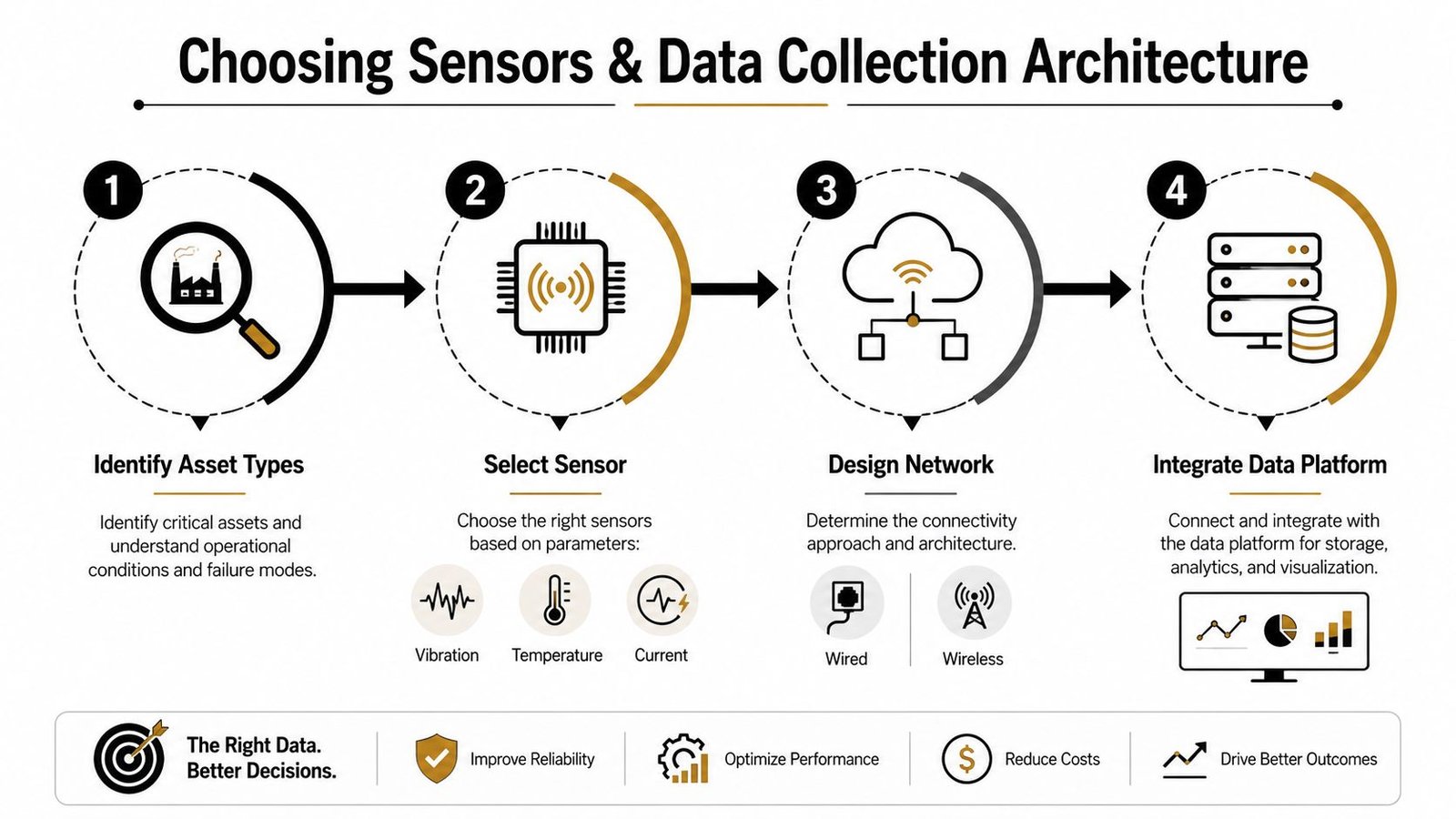
For most manufacturing assets, the useful shortlist starts with vibration, temperature, current, and in some cases acoustic monitoring. Vibration is the natural first choice for rotating assets because it shows bearing issues, imbalance, misalignment, and looseness before they become obvious in the work order queue. Temperature helps where friction, electrical loading, or heat buildup are part of the failure signature. Current monitoring is useful when motor load trends matter, and acoustic sensing can help in environments where sound patterns reveal faults earlier than a visual check would.
Legacy equipment needs a retrofit mindset. Many semi-automated plants don't have machines designed for native connectivity, so the question isn't whether the machine was built for predictive maintenance, it's how cleanly you can instrument it without creating downtime or a safety issue. In those environments, a practical rollout usually combines clamp-on or externally mounted sensors, edge collection hardware near the machine, and a transmission path that doesn't interfere with the PLC or HMI already running the asset.
Build the data layer for history, not just alerts
A strong data collection layer has to capture condition data permanently, automatically, and digitally. Without that history, the team can't learn how a specific asset behaves over time, and model tuning becomes guesswork. Guidance from building-facility implementation work lays out a concrete five-step flow, data collection, data processing, model development, fault notification, and model improvement, which is exactly how a useful program should behave in a plant as well. Five-step predictive maintenance framework
Edge versus cloud isn't a religious debate, it's a latency and reliability decision. Edge processing is useful when the plant needs local resilience, low latency, or tighter control over what leaves the site. Cloud processing helps when you need broader analytics, centralized fleet learning, or easier cross-site comparison. In legacy plants, the smartest approach is often hybrid, with secure local capture feeding a central platform once the data is stable.
The key habit is to integrate new sensing into the existing control and maintenance ecosystem rather than creating a parallel universe. If the data never reaches the work order process, the plant ends up with a dashboard nobody acts on. Machine monitoring software integration considerations
The biggest retrofit failure I've seen is not sensor choice, it's data discipline. Plants mount the hardware, but they don't standardize sampling, time stamps, or asset naming, and then everyone argues about whether the signal is real. If the baseline is inconsistent, the model learns confusion instead of condition.
Selecting the Right Analytics and Machine Learning Approach
Not every asset deserves advanced modeling on day one. If a pump gives a clean vibration signature when a bearing starts to drift, threshold-based alerts may be enough to create value fast. The mistake is assuming every predictive program needs deep learning before the plant has enough history to justify it.
Start with the simplest analytics that will act reliably
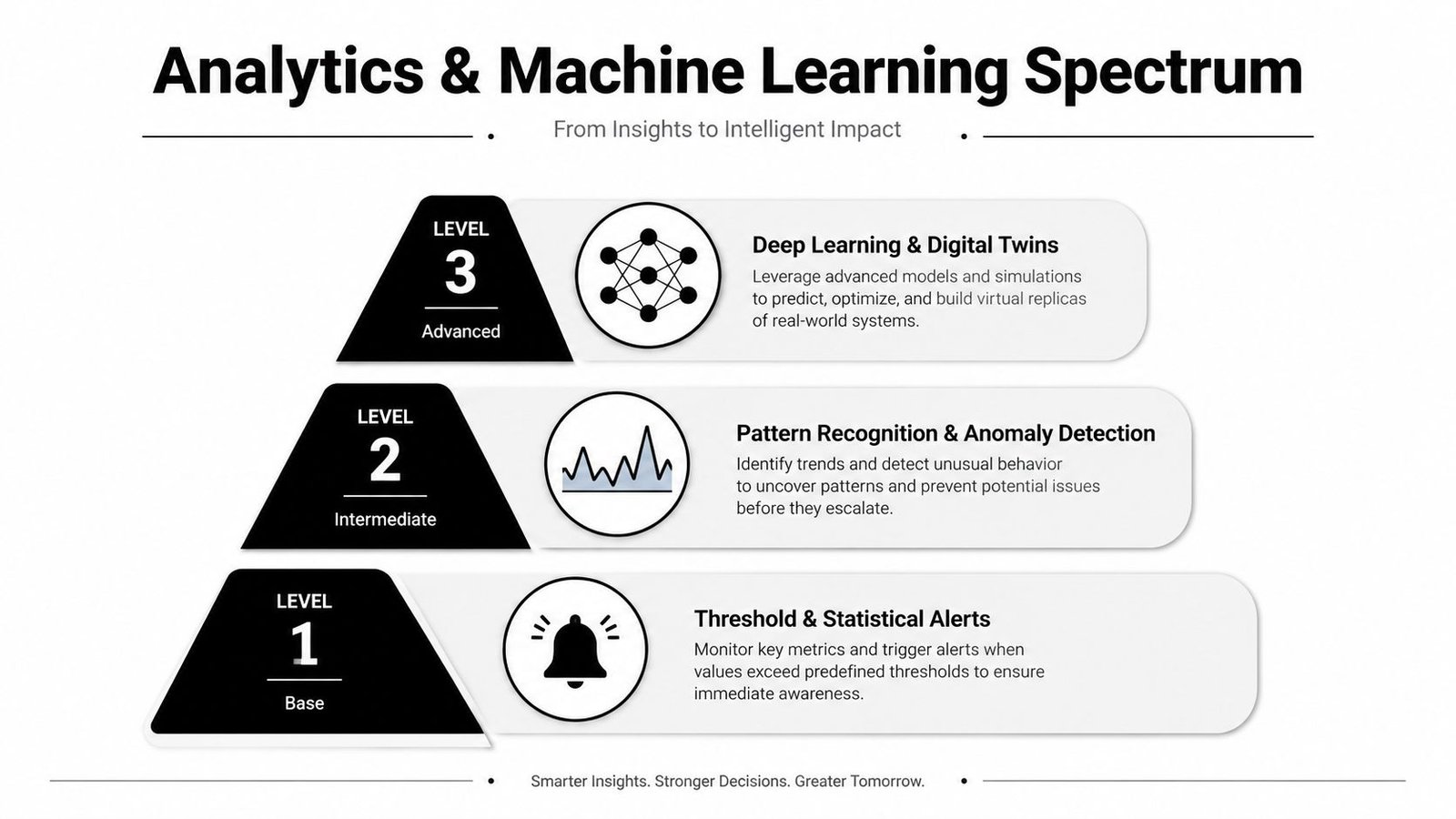
A useful spectrum runs from threshold and statistical alerts, to pattern recognition and anomaly detection, to more advanced machine learning. The right level depends on data maturity, failure frequency, and the cost of getting it wrong. For many mid-sized plants, rule-based monitoring is the fastest path to trust because maintenance teams can see exactly why the alert fired.
A survey of predictive maintenance in Industry 4.0 describes the modeling process as four connected stages, continuous deterioration analysis, service effects modelling, maintenance policies formulation, and performance assessment. That's a good reminder that the model is never the whole job. Prediction has to feed maintenance policy, and policy has to be reviewed against what happened in the plant. Industry 4.0 predictive maintenance survey
Don't overfit before the asset has something to teach you
Many programs stall at this point. If the asset hasn't produced enough historical fault and condition data, the thresholds and model parameters can't be optimized reliably. That's why the pilot phase should focus on gathering clean data, establishing failure history, and proving that the alert logic maps to real maintenance events.
Practical rule: if maintenance can't explain the alert in plain language, the model probably isn't ready for production use.
For some assets, the right answer is still a simple vibration threshold with a statistical check on trend movement. For others, especially where multiple symptoms interact, a more advanced anomaly model makes sense once the historical signal is strong enough. The point is to earn complexity, not purchase it upfront.
A digital twin can be useful later for simulation and policy testing, but it only adds value after the plant has enough reliable asset behavior data to make the virtual model meaningful. Digital twin predictive maintenance context
Running the Pilot and Integrating with Maintenance Workflows
A pilot should feel like a real maintenance process, not a lab demo. If the pilot produces dashboards but not work orders, it won't change how the plant runs. The team should see live condition data, a baseline, and the first-pass threshold logic while maintenance supervisors test how alerts move through normal work execution.
Keep the scope tight and the workflow real
A practical implementation pattern recommends starting with 1 to 2 critical assets, instrumented with sensors and secure data transmission, and running the pilot for roughly 3 to 4 weeks before deciding whether to expand. By the end of that window, the team should have live dashboards, initial baseline data, and a first-pass failure threshold model. The point is not perfect prediction, it's operational proof that the signal is useful and the workflow works. Predictive maintenance five-step implementation guide
The pilot also has to connect to the CMMS or GMAO from the start. When detections automatically create work orders and the result is stored in asset history, the program becomes part of maintenance operations instead of a separate analytics exercise. That integration matters more than a lot of vendors admit, because it closes the loop between condition, action, and outcome.
Train people to act on signals, not worship the dashboard
Maintenance and reliability staff need to understand what the sensor is telling them, what a normal trend looks like, and when to escalate. If they treat the system as a black box, adoption will stay shallow. If they can interpret the condition signal themselves, the program becomes a tool they trust instead of a report they ignore.
- Maintenance planner: Confirms whether an alert should become a work order, a follow-up inspection, or a watch item.
- Technician: Verifies the condition at the machine, then records what was found so the model can improve.
- Reliability engineer: Reviews recurring alerts, adjusts failure rules, and checks whether the data matches observed wear.
- Supervisor: Makes sure the pilot doesn't create hidden work that bypasses the normal scheduling process.
A good pilot should also surface what breaks in legacy plants. Missing tags, inconsistent asset naming, delayed sensor transmission, and old work-order habits all show up quickly once a real alert tries to flow through the system. That's useful information, because it tells you what needs fixing before you scale.
Maintenance support services and workflow integration
Measuring ROI and Scaling Across the Plant
Leadership does not approve a wider rollout because the dashboard looks polished. They approve it when the pilot shows a business case in downtime avoided, labor saved, and asset life protected. That means tracking the right numbers from the start, and holding back expansion until the results are documented in plant terms.
Build the case around avoided pain
Executive teams usually want a simple answer, but the plant-level case has to come from the failure modes you eliminated. Start with recurring breakdowns, the cost of emergency response, and the scrap or rework tied to those events. If the pilot on one critical asset stops repeated failures, quantify the avoided downtime, the labor that no longer gets pulled into fire-fighting, and the production losses that never hit the schedule.
A recent industry roundup and Deloitte's predictive maintenance position paper both point to strong outcomes at scale, but those figures matter only after the plant has a clean baseline and a credible way to measure change. What carries the conversation inside the plant is evidence from your own assets, not generic claims from a vendor deck. 2026 predictive maintenance statistics roundup, Deloitte predictive maintenance position paper
The best ROI discussion starts with the failure-mode frequency, the downtime cost, and the payback threshold the business can accept. In a semi-automated or legacy plant, that also means accounting for the hidden work that comes with every avoided breakdown, such as manual checks, overtime, expediting parts, and schedule disruption. If the pilot reduces those pressures on one machine, the scaling case becomes much easier than arguing about model accuracy in the abstract.
Scale by asset family, not by enthusiasm
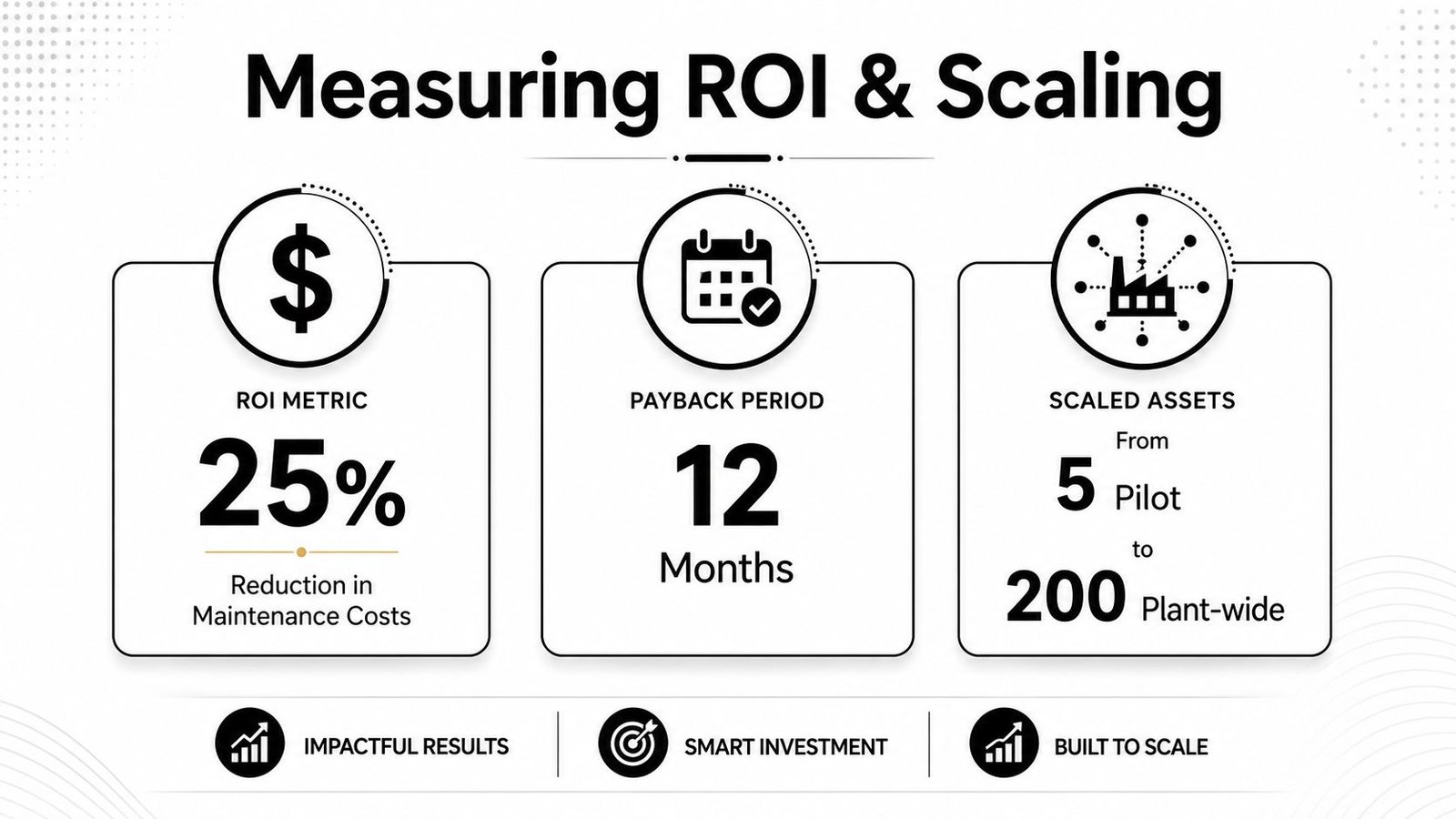
Once the pilot is stable, expand by asset family. If vibration monitoring works on one pump train, extend it to nearby rotating equipment before jumping to a different machine class with different failure behavior and a different sensor stack. That keeps the retrofit work manageable and lets maintenance reuse the same alert logic, inspection steps, and CMMS response.
Leadership often asks for a plant-wide program too early. The better answer is to show which assets have already proved value, which ones need different sensors or a different sampling approach, and which ones are not worth monitoring yet.
Scaling should keep measuring failures, availability gains, avoided downtime, and the operational burden created by the alerts themselves. A program only becomes scalable when it is measured, reviewed, and tuned against live plant conditions, especially in older environments where naming conventions, tag quality, and maintenance habits are uneven. That is how you avoid declaring victory on the pilot and then losing momentum when the rollout meets real plant complexity.
Choosing the Right Automation Partner and Building Internal Capability
The best predictive maintenance programs I've seen were never fully outsourced. The plant owned the maintenance logic, the operations team owned the workflow, and the partner helped with the parts that needed specialist engineering. That balance matters even more in semi-automated and legacy environments, where a generic analytics vendor usually misses the day-to-day realities on the floor.
Pick a partner who understands the plant, not just the software
A good automation partner should be able to work with retrofits, understand GMP-aware controls, and design around existing production constraints. They should also be comfortable with sensor placement, integration to PLCs and HMIs, and the kind of commissioning work that keeps a line from going down during installation. If they only talk about dashboards and never about work orders, validation, or operator adoption, they're not the right fit.
Internal capability is still the main success factor. Maintenance and reliability staff need to learn how to read condition signals, verify what the model is saying, and decide whether to act, wait, or inspect. If all the interpretation lives outside the plant, every alert becomes a dependency instead of a skill.
Use partners for acceleration, not dependency
The right partner shortens the learning curve, especially in mixed fleets where some assets are modern and others were never designed for connectivity. They can help with sensor strategy, secure data transmission, control-system integration, and the first commissioning pass. What they shouldn't do is create a black-box process that the plant can't maintain after go-live.
A strong implementation team usually has three shared traits.
- Semi-automated experience: They've worked in plants where not every asset is new, clean, or easy to instrument.
- GMP-aware discipline: They understand the documentation and change-control expectations in regulated manufacturing.
- End-to-end support: They can move from concept and preliminary design through drawings, sourcing, installation, and commissioning without handing the hard parts back to the customer.
That combination lets the plant move quickly without losing ownership. It also keeps the program tied to practical ROI, which is the only reason predictive maintenance survives beyond the pilot stage.
If you're planning a rollout and want it to work in the actual world, not just in a demo, start with a narrow asset list, make the data flow into maintenance execution, and build the case on downtime you can prove. Reach out to System Engineering & Automation if you want a practical partner for predictive maintenance, retrofit controls, and semi-automated manufacturing solutions that fit your plant's budget and production goals.