The line is down, the shift leader is standing at the cell, and nobody wants to be the person who guesses wrong. On a medical device assembly line, that kind of stop isn't just annoying, it can trigger missed shipments, overtime, quality holds, and a scramble through maintenance logs that don't tell you enough, fast enough. Predictive maintenance automation exists for exactly that moment, when the cost of waiting is higher than the cost of knowing.
For manufacturers trying to improve production and service at the same time, the essential question isn't whether AI sounds impressive. It's whether a practical maintenance system can help a plant choose the right assets, catch failures early, and keep decisions defensible in regulated environments.
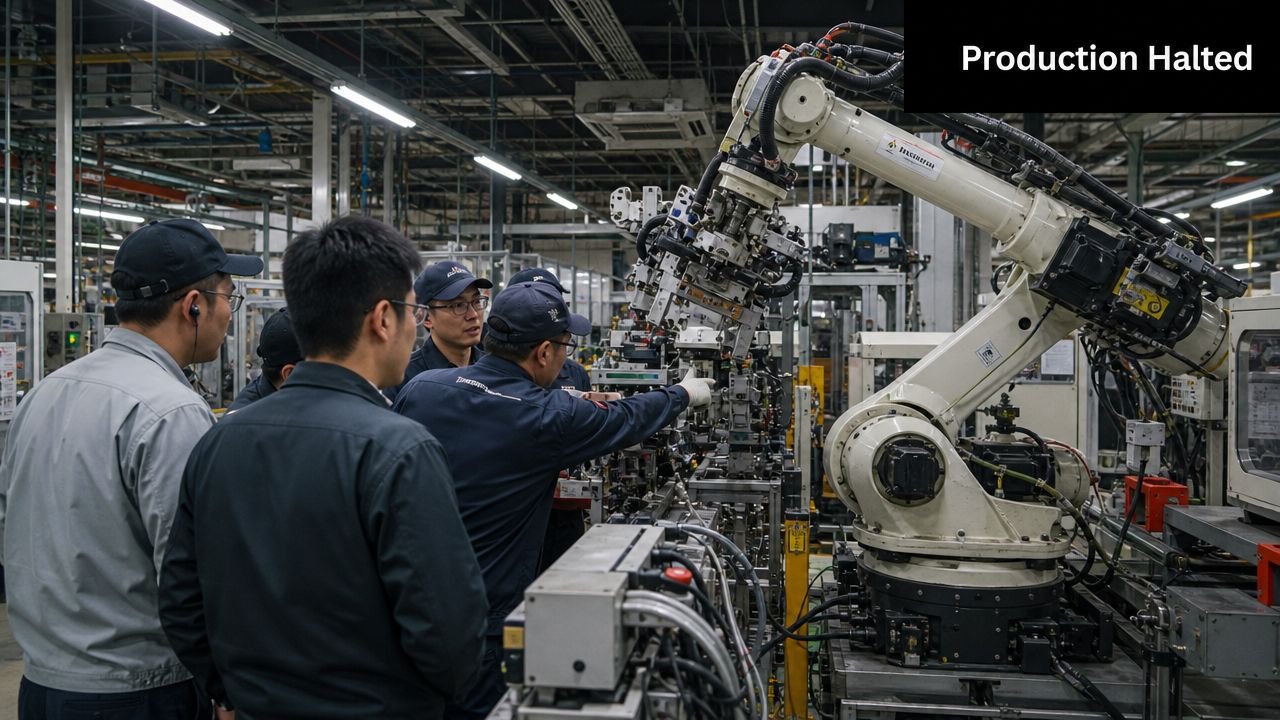
Table of Contents
- The Moment a Production Line Goes Quiet
- What Predictive Maintenance Automation Means
- The Five Layers That Make It Work
- Choosing the Right Assets to Automate First
- How Predictive Maintenance Looks on Real Production Lines
- Measuring ROI and the KPIs That Matter
- GMP, Medical Devices, and the Service Model Behind It
The Moment a Production Line Goes Quiet
A servo-driven station stops halfway through a cycle, the HMI shows no clean fault, and two technicians are already checking a motor that looks fine by eye. That's the kind of failure that burns time because it doesn't announce itself neatly. The machine was healthy enough to run, then suddenly it wasn't.
For teams that build and support manufacturing solutions, predictive maintenance automation transitions from a buzzword to an operating discipline. IoT Analytics reported that 38% of manufacturers had deployed predictive maintenance AI in at least one facility by 2025, up from 22% in 2022, and another 31% were running active pilots, which means most manufacturers were already past simple awareness (IoT Analytics via Stealth Agents research). That adoption makes sense when the payoff is tied directly to uptime, not theory.
The practical promise is straightforward. If a sealing jaw starts drawing more current, a spindle starts vibrating differently, or a pressure pattern drifts before failure, the plant can act before the line goes quiet. McKinsey manufacturing research cited in the same source says AI predictive maintenance can reduce unplanned downtime by 30% to 50% versus reactive maintenance, while Deloitte research reports 10% to 25% reductions in total maintenance costs within 18 months and up to 10x ROI over three years in scaled implementations (same source).
The rest of this article is written for the person who has to justify the investment, choose the right integrator, and prove the result. You'll get the definition, the core technology stack, the asset selection logic, the ROI measures that matter, and the GMP-aware considerations that matter when quality can't be compromised.
A short operational video can help connect the concept to the factory floor.
What Predictive Maintenance Automation Means
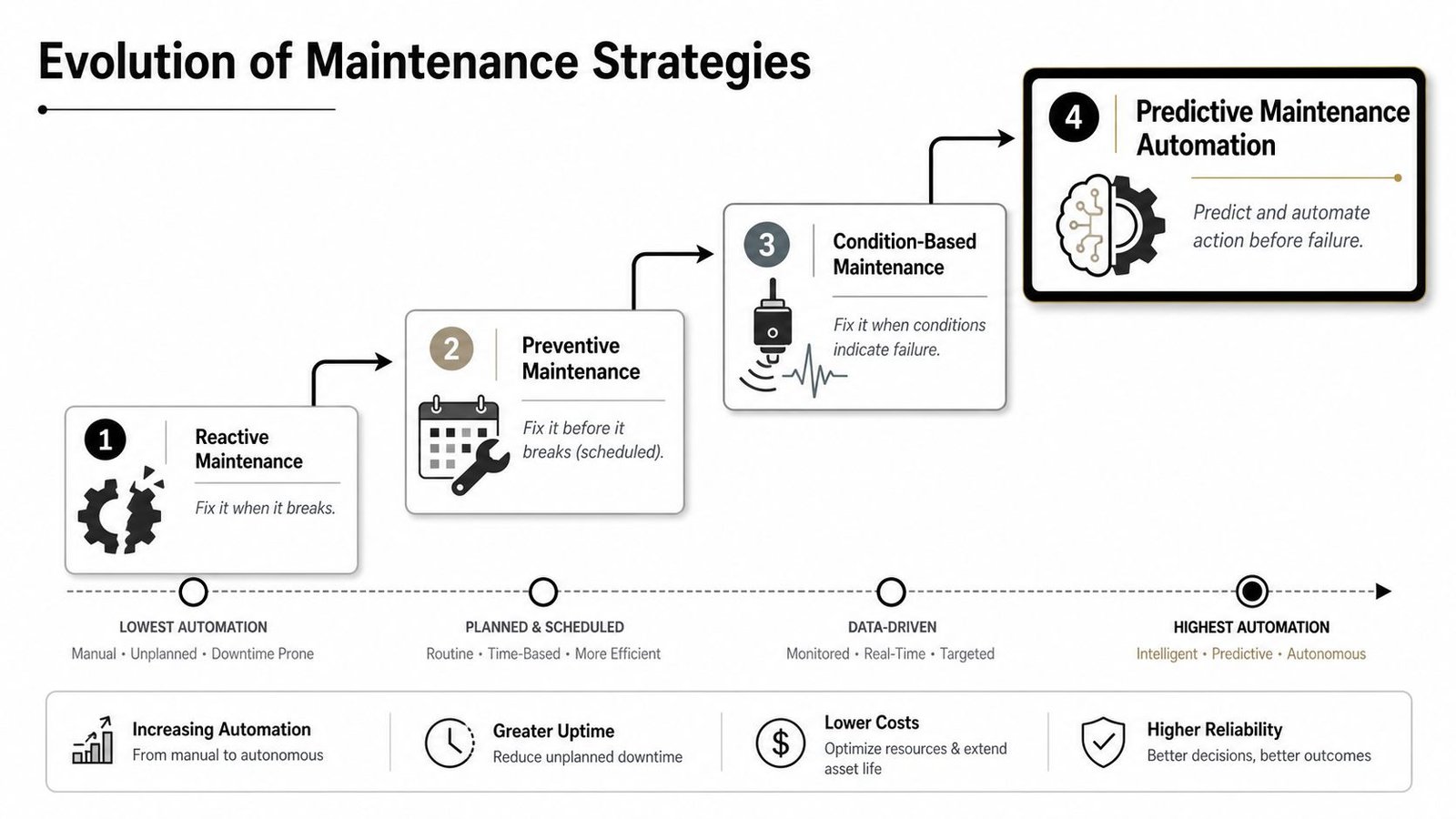
Predictive maintenance is not just another label for scheduled service. In the usual maintenance ladder, reactive maintenance waits for failure, preventive maintenance replaces parts on a calendar, and condition-based maintenance acts when monitored signals cross a threshold. Predictive maintenance adds the forecast step, so the plant estimates when service should happen from the asset's actual condition.
That definition matters in regulated plants because quality teams can defend it. A 2022 source citing EN 13306:2017 defines predictive maintenance as “condition-based maintenance carried out following a forecast derived from repeated analysis or known characteristics and evaluation of the significant parameters of the degradation of the item” (Springer article). The same source says predictive maintenance goes beyond ordinary condition-based maintenance by adding that forecast step and aims to maximize equipment life while reducing planned and unplanned downtime and maintenance costs.
How the automation piece changes the game
Once the forecast is automated, the system does more than show a trend. It pushes a decision, such as a work order, an alert, a maintenance ticket, or a quality hold when the condition warrants it. That is the difference between a dashboard that looks busy and a maintenance program that changes what people do on the floor.
Practical rule: If a system only visualizes vibration, temperature, or current data, it is condition monitoring. If it predicts failure timing and triggers a maintenance action, you are in predictive maintenance automation.
The sensor side is easy to describe and hard to execute well. A predictive system reads vibration, temperature, pressure, current, and oil-quality signals, then uses those streams to detect degradation before a breakdown occurs (arXiv maintenance review). That is why the doctor analogy works, as long as it stays accurate. The system checks the machine's vital signs, not waiting for a cardiac event, and not replacing parts on a schedule just because the calendar says so.
For small and mid-sized manufacturers, the point is capital efficiency. You do not need enterprise-scale AI to get value from predictive maintenance automation. You need the right asset, the right signals, and a service path that turns those signals into maintenance action. On a medical device line, that also means thinking about GMP from the start. If a semi-automated cell is already stable but still expensive to stop, a system integrator like SEA machine monitoring software can turn it into condition-monitored production without forcing a heavy data science program that the plant cannot support.
What predictive maintenance automation is not matters just as much. It is not a row of sensors with no response logic. It is not a generic dashboard that dumps data on a screen and leaves technicians to interpret it manually. It is not run-to-failure with a nicer interface.
The Five Layers That Make It Work
A PdM system fails when people buy analytics before they fix the data path. The stack has to start at the machine and end at an action someone trusts. That's why the useful way to think about predictive maintenance automation is as five layers, each one building on the last.
At the bottom are the sensors and IIoT devices. Vibration is the classic signal, but temperature, pressure, current, and oil-quality readings often tell a more complete story when the machine is under load (arXiv maintenance review). On real lines, I've seen the difference between a sensor mounted for convenience and one mounted for diagnostic value. The first looks good in a slide deck. The second catches the drift that matters.
From machine signals to usable decisions
The next layer is connectivity and edge or gateway equipment. Data leaves the machine cleanly and lands in a plant historian or cloud platform without choking the network or creating a blind spot at the wrong moment. The technical details vary, but the objective doesn't. Keep the machine talking often enough that the degradation pattern is visible.
After that comes the data pipeline. Clean time-stamps, remove obvious noise, line up signals from different sources, and engineer features that capture the shape of the problem rather than just the raw stream. The implementation literature is blunt about this, predictive maintenance depends heavily on data engineering and model selection, and common algorithms in recent Industry 4.0 work include SVM, random forest, and artificial neural networks (PMC review). If the historical failure data is messy or incomplete, the model will miss the small abnormal changes that often precede failure (same source).
The analytics layer is where the machine-learning model estimates remaining useful life or assigns an anomaly score. That can be enough to drive a practical decision if the plant already knows what to do when the score moves. A useful machine learning output is only useful when maintenance and production can act on it.
The final layer is what technicians see, alerts, dashboards, and work-order integration. That is where the maintenance program becomes real. In semi-automated cells, this is also where a system integrator earns its keep, because the sensor, the control logic, the HMI, and the response path all need to work together.
For a plant that wants the stack without a full enterprise rollout, the goal is incremental retrofit, not grand redesign. If you want a practical starting point for machine monitoring and integration, this machine monitoring software overview shows the kind of interface layer manufacturers usually need before PdM can be trusted on the floor.
Choosing the Right Assets to Automate First
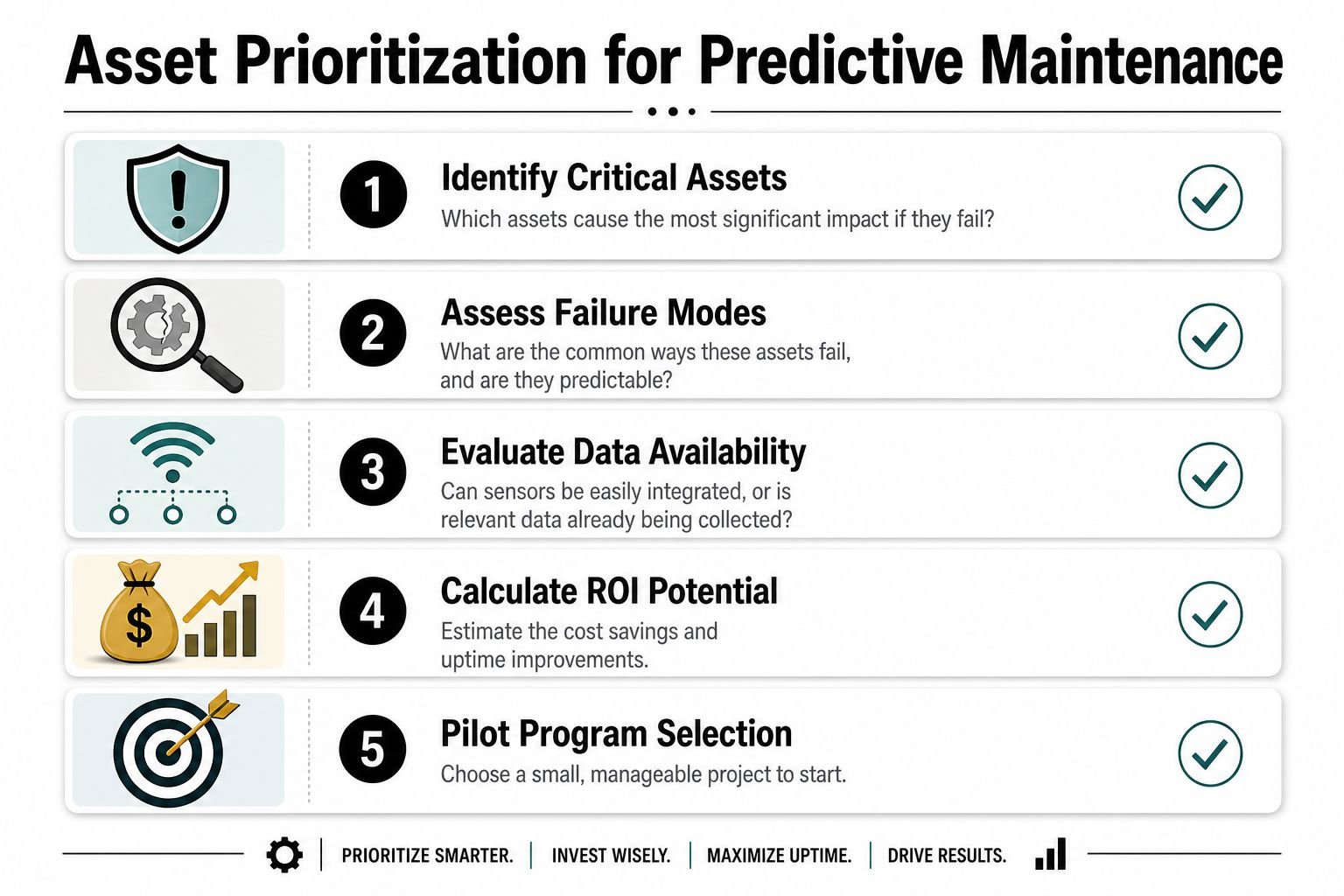
Most plants don't need predictive maintenance on every asset. They need it on the machines that hurt the most when they fail and the ones that can support a model. That's where the selection process should begin, because over-instrumenting weak candidates burns budget and patience.
Start with criticality, not enthusiasm
Criticality analysis should answer three questions. Which asset stops output if it fails, which failure creates the biggest safety or quality risk, and which one creates the messiest recovery? Those are usually not the same machine, and that's exactly why the review has to be explicit.
McKinsey's guidance is more nuanced than the popular advice to put sensors on everything. It says companies should first choose assets that are operationally critical, already have enough sensor or data coverage, and have enough historical failure or anomaly data to train models (McKinsey). That matters for small and mid-sized manufacturers, because capital and retrofit work are always finite.
A single bottleneck station can justify the program if its downtime cascades through the whole cell. A noncritical motor with no history and no sensor access usually can't.
Run a data-readiness check before you spend
The second filter is blunt. Does the asset already have instrumentation, a historian feed, or recorded failure history that's usable? If not, the predictive model may be built on guesswork. Recent Industry 4.0 literature keeps pointing back to criticality analysis, feature engineering, anomaly detection, and real-time monitoring because those steps are what make the forecast credible (PMC review).
A good pilot usually starts with one high-value machine family, not a whole plant. If a semi-automated cell has one station that repeatedly creates downtime, that is often a better first target than a facility-wide rollout. If the asset is simple, redundant, or too data-poor to generate a meaningful failure pattern, leave it out for now.
The 2024 concrete manufacturing study is a useful reminder that good results come from the right asset and the right signal mix, not from blanket deployment. It found CatBoost performed best with an F1-score of 0.985, accuracy of 0.984, recall of 0.983, and ROC AUC of 0.984, and highlighted 24-hour mean vibration, 24-hour mean pressure, Error3-count, and 24-hour mean voltage as especially important variables (study summary). That's not a license to chase the same model everywhere. It's a reminder that the asset and the signals drive the outcome.
How Predictive Maintenance Looks on Real Production Lines
A packaging line is often the cleanest place to start because the failure signature is obvious once you know where to look. A servo-driven sealing station can be monitored for current spikes and vibration drift, then serviced during a scheduled break instead of after an emergency stop. That's a small change on paper and a big one on the floor, because it protects both throughput and the maintenance schedule.
A CNC machining cell gives you a different pattern. Spindle vibration and load data can feed a model that flags tool wear before the first reject part appears. In practice, that means quality sees fewer bad parts, operators don't have to sort out mystery variation, and maintenance gets an early signal instead of a postmortem.
Where GMP changes the response path
A medical device assembly station is the most demanding of the three. Torque behavior and vision inspection data can be tied into condition monitoring so out-of-tolerance behavior triggers both a maintenance ticket and a quality hold under GMP rules. That's where the system becomes more than a reliability tool, because the alert has to respect product quality, traceability, and controlled process behavior.
In regulated assembly, the best predictive signal is the one that reaches maintenance fast without bypassing quality control.
The useful part is that each of these examples maps back to the same core layers, sensors, connectivity, data engineering, analytics, and action. The budget-conscious version usually starts with the station where downtime hurts the most and the signal is easiest to capture. If the machine already has a current trace, a vibration mount point, or an inspection feed, that's often the fastest path to payback.
Each line doesn't need the same sophistication on day one. A packaging line may only need alerts. A CNC cell may need an anomaly score. A medical device station may need a tightly controlled response path so the maintenance action and the quality action happen together. The architecture should match the risk.
Measuring ROI and the KPIs That Matter
The headline numbers look good on a slide, but a plant team still has to translate them into maintenance behavior and production output. Predictive maintenance can reduce unplanned downtime by 30% to 50% versus reactive maintenance, and Deloitte research cited in the same source reports 10% to 25% reductions in total maintenance costs within 18 months of deployment (IoT Analytics via Stealth Agents research). Those gains do not come from sensors alone. They depend on choosing the right asset, getting clean data from it, and changing how the team schedules work when the alerts start arriving.
The KPIs that deserve attention are the ones tied to production flow and spare-parts control. Track unplanned downtime hours, mean time between failures, mean time to repair, planned-maintenance percentage, spare-parts inventory turns, and cost per unit produced. That gives leadership an operating picture tied to output, not a dashboard full of noise.
Payback is often faster than skeptics expect
A 2022 industry survey found 90% of respondents who had started predictive maintenance achieved payback in under two years and 39% within one year (Manufacturers Alliance report). That lines up with what I see on the floor when the pilot stays narrow and the team changes the workflow around the alert. If maintenance planners, production supervisors, and quality teams do not agree on what happens after a warning, the system can still detect problems and fail to deliver financial value.
For a plant manager, the comparison gets clearer side by side.
| Approach | Unplanned Downtime | Maintenance Cost | Spare Parts Inventory | Typical Payback |
|---|---|---|---|---|
| Reactive | Highest, because work starts after failure | Highest over time | Often reactive and uneven | Hard to justify |
| Preventive | Lower than reactive, but still schedule-driven | Moderate, with some unnecessary work | Better than reactive, but not optimized | Incremental |
| Predictive | Lowest when the model and workflow are working | Lower when alerts are trusted and acted on | Better aligned to actual need | Depends on scope and asset choice |
Market growth backs the direction of travel. Industry sources cite a market size of roughly USD 13.65 billion in 2025 and project growth to about USD 97.37 billion by 2034, with a CAGR of 24.30% over that period (Fortune Business Insights). That growth shows sustained investment, but ROI at the plant level still comes down to execution, not market momentum.
For teams comparing forecasting with model-driven asset visibility, this digital twin predictive maintenance overview is useful because it connects maintenance insight with operational decision-making without losing sight of the work at machine level.
GMP, Medical Devices, and the Service Model Behind It
In GMP environments, predictive maintenance doesn't sit outside the validated system. Any sensor, alert threshold, or ML-driven action that influences product quality or process control can affect the validated state of the equipment, which is why the deployment has to be planned with quality and regulatory control from the start. The plant can't treat it like an IT add-on after commissioning.
That means the basics have to be documented. User requirements need to define what the system is allowed to do, the new data inputs need a risk assessment, alert thresholds need controlled configuration, and ownership between maintenance, quality, and production needs to be unambiguous. The maintenance team may own the repair, but quality still owns the product impact.
The service model is part of the program
Ongoing support matters. Sensors drift, thresholds need tuning, and models need updates as the machine ages or the process changes. A one-year guarantee is useful, but in a live plant the bigger value is responsive service that protects the program after go-live, not just during the install window.
If you're building under GMP, this overview of GMP in manufacturing is a good reminder that control, traceability, and disciplined change management are not optional when equipment affects product safety or consistency.
The right integrator treats predictive maintenance as part of the validated system, not as a side project handed to IT. That's the difference between a neat pilot and a program the plant can stand behind during an audit, a deviation review, or a production ramp.
System Engineering & Automation helps manufacturers turn semi-automated cells into condition-monitored production systems that fit real budgets and real constraints. If you're evaluating predictive maintenance automation for packaging, machining, or GMP-aware assembly, visit System Engineering & Automation to discuss a practical retrofit path that protects uptime, quality, and ROI.