You're probably dealing with the same mess a lot of plant managers are facing right now. Labor is tighter, quality complaints are harder to absorb, and the board wants automation, but nobody wants to spend six months chasing a full robotic line that turns out to be too rigid for the product mix. That's exactly where a semi automated assembly line earns its keep, not as a compromise, but as a deliberate way to put machines on the repeatable work and keep people on the judgment-heavy work.
The old mistake is thinking automation has to be all or nothing. It doesn't. The right move is to automate the stations that create the most pain, protect the rest of the line from variability, and build a system that can expand as demand and product maturity change. That's the lens I'd use in any factory that wants better throughput without betting the business on one giant capital decision.
Table of Contents
- When a Semi Automated Assembly Line Becomes the Smartest Move
- What a Semi Automated Assembly Line Actually Is
- Manual Versus Semi Automated Versus Fully Automated Lines
- Core Components and Workflow of a Hybrid Assembly Line
- Design and Integration Considerations Buyers Must Evaluate
- Which Stations to Automate First
- A Medical Device Case Study in Semi Automation
- Choosing the Right Integrator and Key Questions to Ask
When a Semi Automated Assembly Line Becomes the Smartest Move
The smartest semi-automation projects usually start with a plant manager staring at a line that's technically running, but barely. Operators are making it work, quality is drifting, and every extra order feels like it's being forced through a system that wasn't built for today's mix. In that moment, the question isn't whether automation is useful, it's whether the factory can afford to wait. Waiting to automate gets expensive fast, and the historical lesson is the same one Henry Ford proved on December 1, 1913, when the moving assembly line cut Model T build time from more than 12 hours to 1 hour and 33 minutes according to History.com.
That doesn't mean every line should become a robot showcase. It means the production logic should be broken into repeatable tasks, with machines handling the stable work and people handling variation, exactly the core idea Ford made practical and industrial robotics later extended. George Devol's programmable robot in 1954 and the 1961 Unimate deployment on a General Motors assembly line marked the move from purely human-paced lines to systems where machines take the hazardous and repetitive steps while operators supervise exceptions, as summarized by Idhammar Systems.
What I'd do first
If you're running a high-mix operation, medical device line, or any plant with frequent changeovers, don't ask, “Should we automate the whole line?” Ask, “Which stations are eating consistency, safety, or labor stability?” A semi automated assembly line is smartest when the product still needs human dexterity, visual judgment, or quick reconfiguration, but the line also needs better cycle consistency and less manual handling.
Practical rule: automate the stations that are repeatable and painful, keep the stations that depend on judgment or frequent changeovers.
That's also why semi-automation tends to beat both extremes. Pure manual work struggles with consistency. Fully automated lines can be too brittle when product variation is real. The hybrid middle is where many factories get the most useful improvement without overcommitting capital.
What a Semi Automated Assembly Line Actually Is
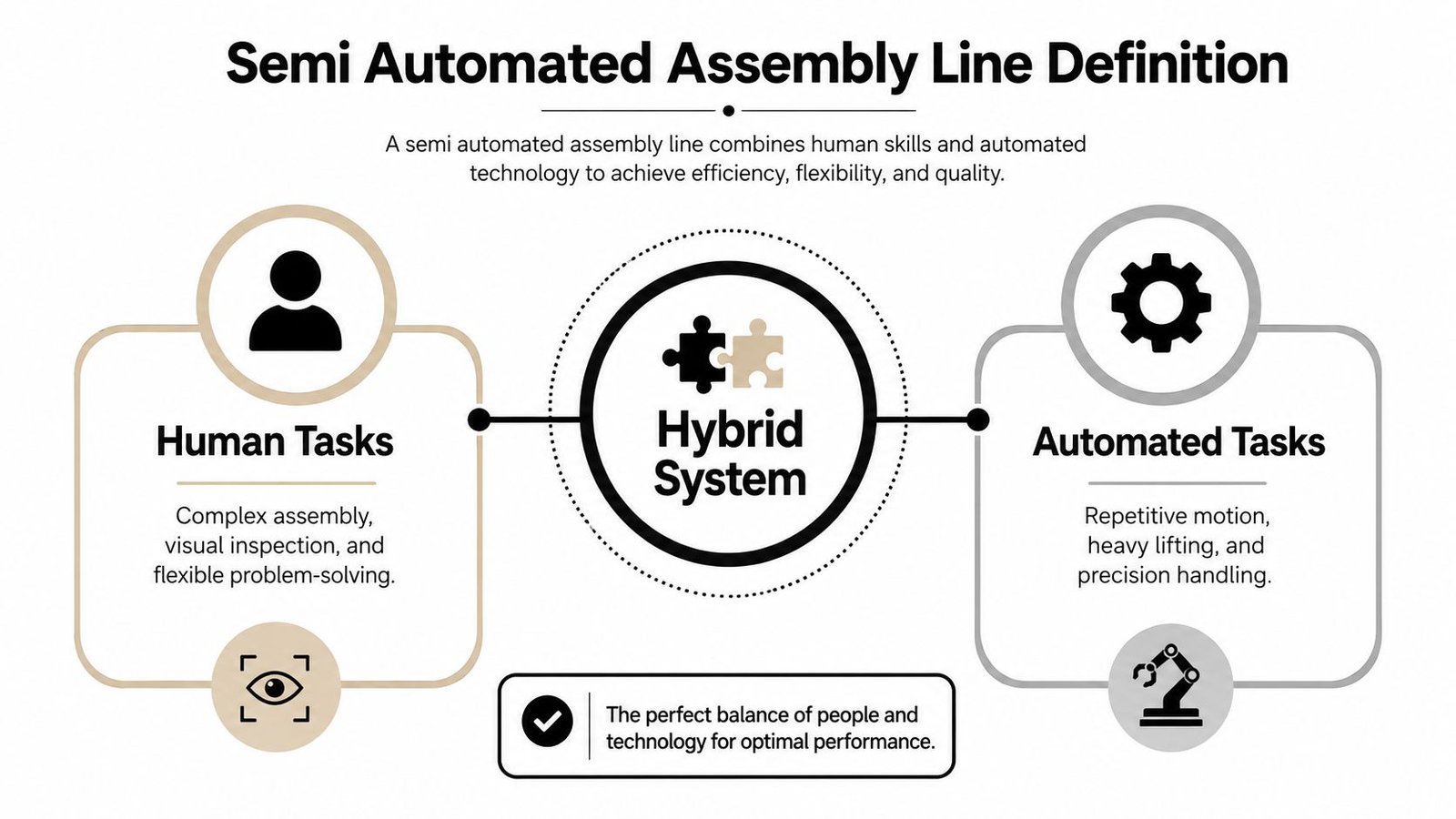
A semi automated assembly line is a hybrid production system where people and machines share the work. Machines do the repeatable, high-precision, or force-heavy steps. Operators handle the tasks that need dexterity, visual judgment, or exception handling. In plain language, it's the factory version of a chef using a food processor for the hard chopping while still deciding how the dish comes together.
The logic is simple. If a step is stable, measurable, and tedious, put a machine on it. If a step changes often, depends on feel, or needs a human eye, leave it with the operator. That division of labor is why hybrid lines are common in automotive, electronics, appliances, and medical manufacturing, especially when product variation is part of the business model.
The working vocabulary buyers hear
Vendors will usually talk about programmable stations, operator-controlled steps, exception handling, and visual verification. Those aren't buzzwords. They're the architecture of the line.
A programmable station is where the machine repeats the same action with predictable force, angle, or timing. An operator-controlled step is where a person loads parts, checks orientation, or completes a delicate fit. Exception handling is what happens when the line encounters a bad part, a skipped step, or a process flag. Visual verification closes the gap by confirming the right part is in the right place before the next station acts on it.
A hybrid line only works when the handoff points are designed on purpose, not improvised on the floor.
That's the key difference from older manual lines. Manual work depends on human consistency. A semi automated line uses the machine for consistency and the operator for flexibility. Compared with a fully automated cell, it gives you more room for product variation and lower-volume production without throwing away the benefits of mechanized flow. That's why this model stays relevant in real factories instead of just trade-show brochures.
Manual Versus Semi Automated Versus Fully Automated Lines
The buying decision gets clearer when you compare the three options against the things that matter on the plant floor. I'd start with cost, flexibility, throughput, validation burden, labor dependence, and failure recovery. Those are the core trade-offs, not the marketing language around “smart factories.”
Comparing Manual, Semi Automated, and Fully Automated Assembly Lines
| Criterion | Manual Line | Semi Automated Line | Fully Automated Line |
|---|---|---|---|
| Capital cost | Lowest upfront cost | Mid-range investment | Highest upfront cost |
| Operating cost | Labor-heavy | Balanced labor and machine cost | Lowest labor dependency, highest equipment dependency |
| Throughput | Depends on operator speed | Stronger and more stable than manual | Highest potential, but only when stable |
| Flexibility for changeovers | Very high | High, with selective automation | Lower, especially in mixed product runs |
| Validation effort | Lower technical validation, more human variability | Moderate, especially in regulated environments | Highest technical and integration effort |
| Labor dependency | Very high | Medium | Low |
| Failure recovery | Humans can adapt quickly | Good if buffering and handoffs are designed well | Often slower, because faults can stop the line |
A fully manual line looks attractive if you only care about initial spend. But it usually loses on consistency and labor strain. A fully automated line can look elegant on paper and still disappoint in a high-mix environment, because it has to be right all the time and it doesn't tolerate messy inputs very well.
Semi-automation sits in the practical middle. It's the right choice when you need better throughput and consistency, but you can't justify, or don't need, automation at every station. In regulated manufacturing, it also gives you a way to improve control without forcing every task into a rigid machine sequence. That matters because validation and operator training become part of the system, not an afterthought, which is exactly how modern assembly-line automation is being approached in industry guidance from INEA.
Core Components and Workflow of a Hybrid Assembly Line
A hybrid line lives or dies on the handoffs. The stations matter, but the interfaces matter more. If the transfer between a manual step and an automated step is sloppy, the line will spend its life chasing stoppages, misloads, and rework.
The core flow is straightforward. Parts arrive, an operator or fixture stages them, an automated station completes the repetitive action, the product moves through conveyance, and quality checks catch faults before they spread. That sounds simple until somebody pauses at a manual station and the whole downstream sequence starves because there's no accumulation buffer. That's the common failure mode. Rigidly connecting manual and automated stations without buffering is a good way to stop the line every time an operator's cycle slips.
What a robust workflow needs
A line like this needs takt-based balancing, targeted buffering, vision verification, and torque or force monitoring at the boundaries. Those controls are not decorative. They prevent one weak station from dragging down the entire flow.
Here's the practical sequence I'd expect in a working hybrid layout:
- Incoming parts are staged so orientation and supply are stable.
- Manual loading or dexterous assembly happens where human hands are better than fixtures.
- Automated action takes over for the repetitive or precision-critical step.
- Conveyance or accumulation decouples cycle variability.
- Quality control checks presence, position, torque, or force data.
- Final inspection catches exceptions before release.
That's the kind of structure that keeps throughput from collapsing when the human side of the line has natural variation. It also helps operators because they're not being forced to race a robot with no slack in the system. The best hybrid lines respect the fact that people don't run at machine precision, so the design has to absorb that reality.
For a deeper controls view, the integration around automation control systems is where line stability is usually won or lost, not at the shiny robot demo stage.
Design and Integration Considerations Buyers Must Evaluate
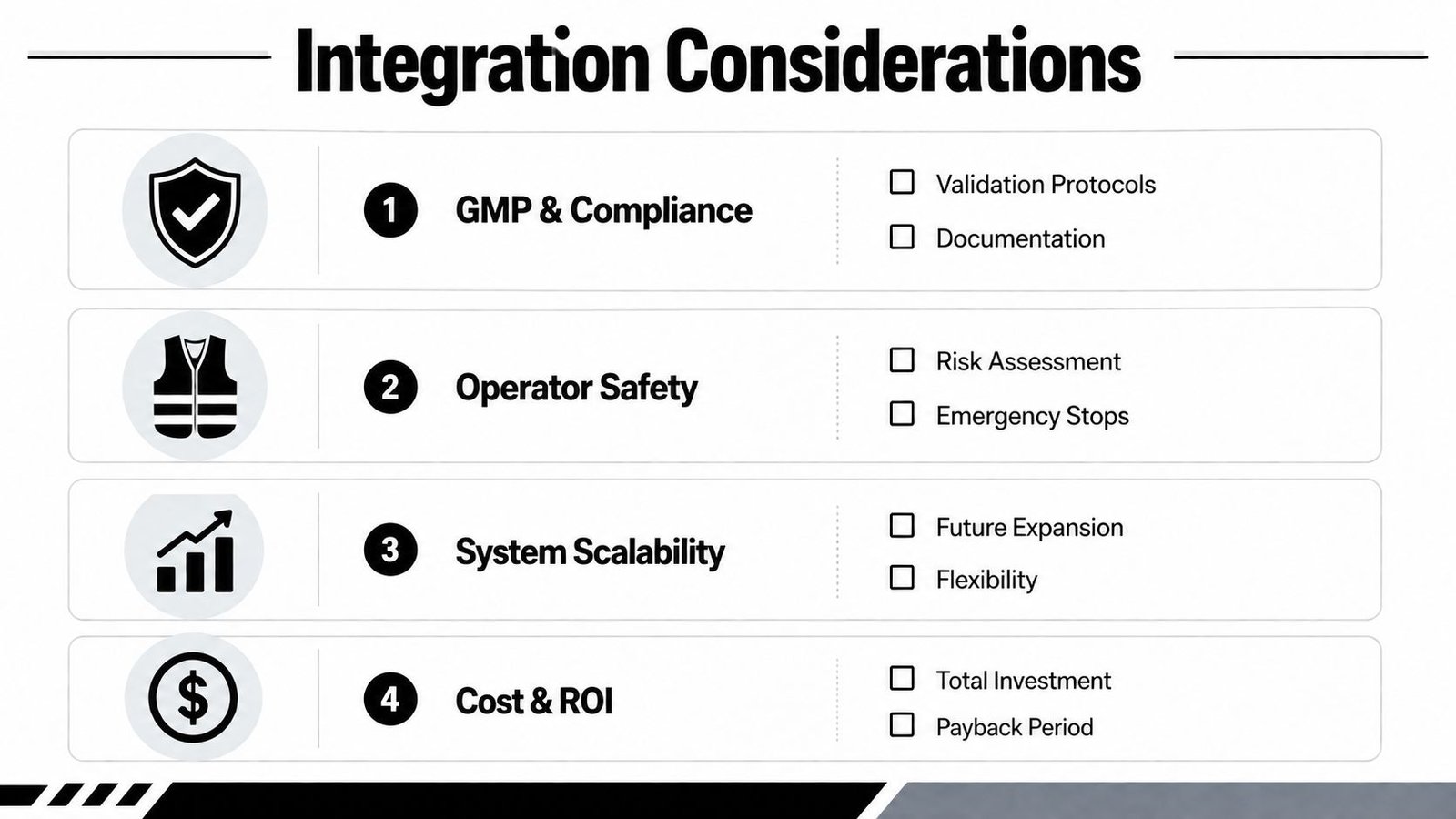
Most buyers overfocus on equipment and underfocus on system behavior. That's a mistake. A semi automated assembly line is not just a list of stations, it's a production system with compliance, safety, and scalability implications that change the economics fast, especially in regulated sectors.
GMP, safety, and future expansion
In medical device and other regulated manufacturing, GMP compliance, traceability, operator training, and validation don't sit on the side, they define the project scope. If you over-automate too early, you can bury the line in validation work that doesn't buy much operational value. If you under-design traceability, you'll pay for it later in investigations, rework, and training churn. The point is not “more automation.” The point is controlled human-machine collaboration that can stand up to quality and audit pressure.
Safety deserves the same blunt treatment. Don't design a hybrid line that asks operators to work awkwardly around moving equipment without a proper risk review, emergency stops, and clear access logic. If the human side of the line feels cramped or confusing, the line is poorly designed.
Long-term adaptability matters too. Research on adaptable production systems highlights automatibility, modularity, integrability, diagnosability, convertibility, scalability, and mobility as the characteristics that separate a flexible system from a dead-end install. I'd use those as a vendor scorecard. If a proposed line can't be upgraded station by station, integrated cleanly with controls, and diagnosed without tearing the whole thing apart, it's too rigid for a business that expects product or volume change.
My view: if a line can't evolve in stages, it's not built for real manufacturing, it's built for a one-time project.
That's why the old “install it and hope” mindset doesn't survive 2026 scrutiny. Buyers need feasibility studies, KPI validation, operator training plans, and a real optimization path, not just a machine list. The strategic question is whether the line can stay useful as the business changes.
Which Stations to Automate First
If you can only automate part of the line, start where the pain is measurable and repeatable. Don't chase the most impressive-looking station. Chase the one that affects flow, quality, or safety every single shift.
Where automation usually pays first
The best candidates usually have one or more of these traits: repeatable cycle time, ergonomic strain, quality sensitivity, or bottleneck behavior. Fasteners with torque sensitivity, press-fit steps, part presentation, and repetitive handling often make better automation targets than inspection-heavy or variant-heavy tasks. Human operators stay valuable where the work needs judgment, dexterity, or frequent changeovers.
The sequence matters as much as the station choice. A practical throughput-improvement workflow starts with a process flow map, then time-study review, problem definition, project objective and resource setting, timeline building, data validation, bottleneck identification, root-cause analysis, solution generation, and finally an action plan and SOP. That's not bureaucracy. That's how you keep the project from becoming an expensive guess.
If you want the cleanest sequencing strategy, I'd use this order:
- Automate the bottleneck first: The station that caps line output deserves priority.
- Automate the highest-risk manual step next: If the task creates defects or injury exposure, remove it early.
- Leave high-variation steps manual: Low-volume or judgment-heavy tasks rarely justify rigid automation.
- Standardize work before adding machines: Bad work instructions get amplified by automation.
The hybrid design proves its value. You don't need to force every task into a machine. You need to remove the work that hurts throughput most and keep the line flexible enough to absorb real-world variation.
A line that automates the right stations first usually gets better before it gets more complex. That's the win.
A Medical Device Case Study in Semi Automation
A medical device manufacturer I'd use as a representative example had the usual symptoms, manual bottlenecks, quality variation, and too much operator-training overhead every time staffing changed. The line wasn't broken, but it was expensive to run and hard to keep stable. The answer was not full automation. The answer was a targeted semi automated assembly line scoped around the stations that created the most repeatability and the highest quality risk.
The team automated the repetitive handling and precision-critical steps, kept the dexterous assembly and visual judgment manual, and tightened the work with standardized instructions before the equipment was even live. That mattered. The biggest surprise wasn't the machine performance, it was how much cleaner the process became once the work sequence was clarified and the manual steps were documented properly.
What changed in practice
The GMP burden did increase the scope, as expected. Validation, traceability, and operator training had to be planned from the start, not patched in later. That's normal in regulated manufacturing, and it's exactly why over-automation can be a trap if the line doesn't need it.
The study at DTU Orbit on parallel walking-worker flexible assembly lines demonstrates this. In a high-mix, low-volume environment, a semiautomated parallel walking-worker line delivered 30% higher productivity than a fixed-worker line under challenging demand conditions. That doesn't mean every medical device line should copy the same layout. It means semi-automation can materially improve output while preserving flexibility where it counts.
The lesson is blunt. In regulated production, the right semi-automation project reduces the number of places where human variation can hurt you, without creating a validation monster.
Choosing the Right Integrator and Key Questions to Ask
Pick an integrator the way you'd pick a production partner, not a machine seller. You want someone who will tell you when a semi automated assembly line is the wrong answer, because some projects need cleaner process design, better fixtures, or a narrower automation scope instead of a bigger capital spend.
A strong integrator should understand the actual tradeoffs in hybrid lines. That means knowing where hand work still carries the risk, where automation will pay back, and where GMP or quality requirements make the line harder to validate than the brochure suggests. If the integrator cannot explain those boundaries clearly, keep looking.
Questions that separate partners from vendors
Ask these directly:
- What regulated-industry projects have you delivered, and how did you handle validation and traceability?
- Can you design custom tooling, fixtures, and controls as one system, not separate purchases?
- What do you do after commissioning, and how do you support troubleshooting, training, and maintenance?
- How do you decide which stations should stay manual?
- Will you recommend a simpler solution if it fits the application better?
Ask one more question before you sign anything. How will they use the experience of an automated systems integrator to connect the controls, equipment, and support plan into one working line? That answer tells you whether they build for uptime or just install hardware. See how an automated systems integrator streamlines operations for the kind of thinking that separates real integration work from basic equipment supply.
That last question matters most. A real solutions partner will protect your throughput and flexibility, even if that means a smaller automation package. The wrong partner will sell you equipment that looks advanced and becomes a maintenance burden the first time the process changes.
If you remember nothing else, remember this checklist. Think station by station, not line by line. Demand modularity, diagnosability, scalability, and integrability. Measure whether the project improves the bottleneck, reduces the manual burden that hurts you, and gives your team a line that can adapt without a full rebuild.
If you are choosing a partner for a medical, consumer, or industrial build, start with the bottleneck, the quality risks, and the changeover reality. Then bring in System Engineering & Automation to pressure-test the stations, the controls, and the rollout plan, and get a build that fits your production goals instead of forcing your plant to fit the machine.