
The line is down, the next order is waiting, quality is asking for the first article, and somebody is still hunting for the right fixture bolts. Most plants don't lose capacity because the machine can't run. They lose it in the space between one good product and the next.
That problem gets worse when you run small batches, frequent SKU changes, or regulated product families. In medical device work and other controlled environments, the slowest part of the changeover often isn't the wrench work. It's the checking, documenting, confirming, and proving that the new setup is correct. If you speed up the mechanics but create more validation burden, you haven't improved the process. You've just moved the delay.
For manufacturers looking for practical ways to optimize production and service without overbuilding automation, changeover time reduction has to be treated as an engineering problem, a workflow problem, and in many plants, a compliance problem.
Table of Contents
- Why Changeover Time Reduction Matters on the Production Floor
- How to Measure and Map Your Current Changeover
- Separating and Converting Internal and External Tasks With SMED
- Quick Change Tooling Fixtures and Smart Automation Choices
- Validating Changeovers for GMP and Medical Device Compliance
- Your Pilot Plan KPIs and Implementation Checklist
Why Changeover Time Reduction Matters on the Production Floor
A long changeover rarely shows up as a dramatic failure. It shows up as a shift that never catches up.
Production misses the planned run rate. Shipping starts negotiating priorities. Maintenance gets pulled into setup support instead of preventive work. Operators wait on tools, material, or approvals. Then management sees overtime and asks why the line with solid nameplate capacity still feels tight every week.
The hidden cost isn't just downtime
Changeovers consume more than clock time. They also drive:
- Lost throughput: The machine isn't making saleable product.
- Labor drag: Operators, mechanics, quality, and supervision can all be tied up at once.
- Schedule rigidity: Long transitions push you toward larger batches, even when the customer mix wants flexibility.
- OEE erosion: Setup losses sit directly inside availability.
- Start-up scrap risk: If the first pieces after changeover need repeated adjustment, the loss extends beyond the stop itself.
This is why plant managers who want more output without buying another line usually end up back at setup time. It's one of the few places where disciplined process work can release capacity already sitting on the floor.
Practical rule: If your team can't explain the last three changeovers step by step, the plant is probably accepting more setup loss than it realizes.
Real results come from method, not heroics
The strongest examples in the literature don't come from telling operators to “move faster.” They come from redesigning the work.
A documented SMED case reduced die changeover time from 420 minutes to 20 minutes, which was a 95.2% improvement, by separating internal from external tasks, standardizing prep work, and tightening post-change adjustments into a repeatable sequence, as shown in the published manufacturing case summary. That's the right lesson. Big gains usually come from changing the method, not expecting better effort from the same broken sequence.
A separate lean-manufacturing study reported that average changeover time fell from 57 minutes 47 seconds to 3.72 minutes for the top 74 products after scheduling and process improvements. The same study reported overall changeover time fell by nearly 30%, labor costs dropped by 10%, and OEE rose to over 70%, according to the 2022 Cranfield case study.
This matters even more in semi-automated and regulated plants
On a fully manual line, you can often recover time with organization and fixture design. On a fully automated line, controls can enforce repeatability. The difficult middle ground is the semi-automated plant. That's where most operations live. You've got some tooling, some sensors, some operator judgment, and a lot of variation if the process isn't nailed down.
That's also where smart changeover time reduction pays off. You don't need to automate every motion. You need to identify which motions should never require judgment, which checks should be built into the setup, and which delays are self-inflicted through weak staging, poor fixture design, or approval bottlenecks.
How to Measure and Map Your Current Changeover
Most plants have a folklore number for setup time. It's usually wrong.
Somebody says the changeover takes half an hour. Then you record it from the last good piece of the old run to the first good piece of the next run, and you find waiting, walking, searching, cleaning, setup, adjustment, inspection, and restart delays nobody had separated before. If you don't baseline the full sequence, the team argues from memory instead of evidence.
Start with one complete, unedited baseline
Use one camera angle wide enough to capture the machine, the operator area, and the nearby staging zone. If the line is long, use more than one viewpoint. The point isn't surveillance. The point is sequence accuracy.
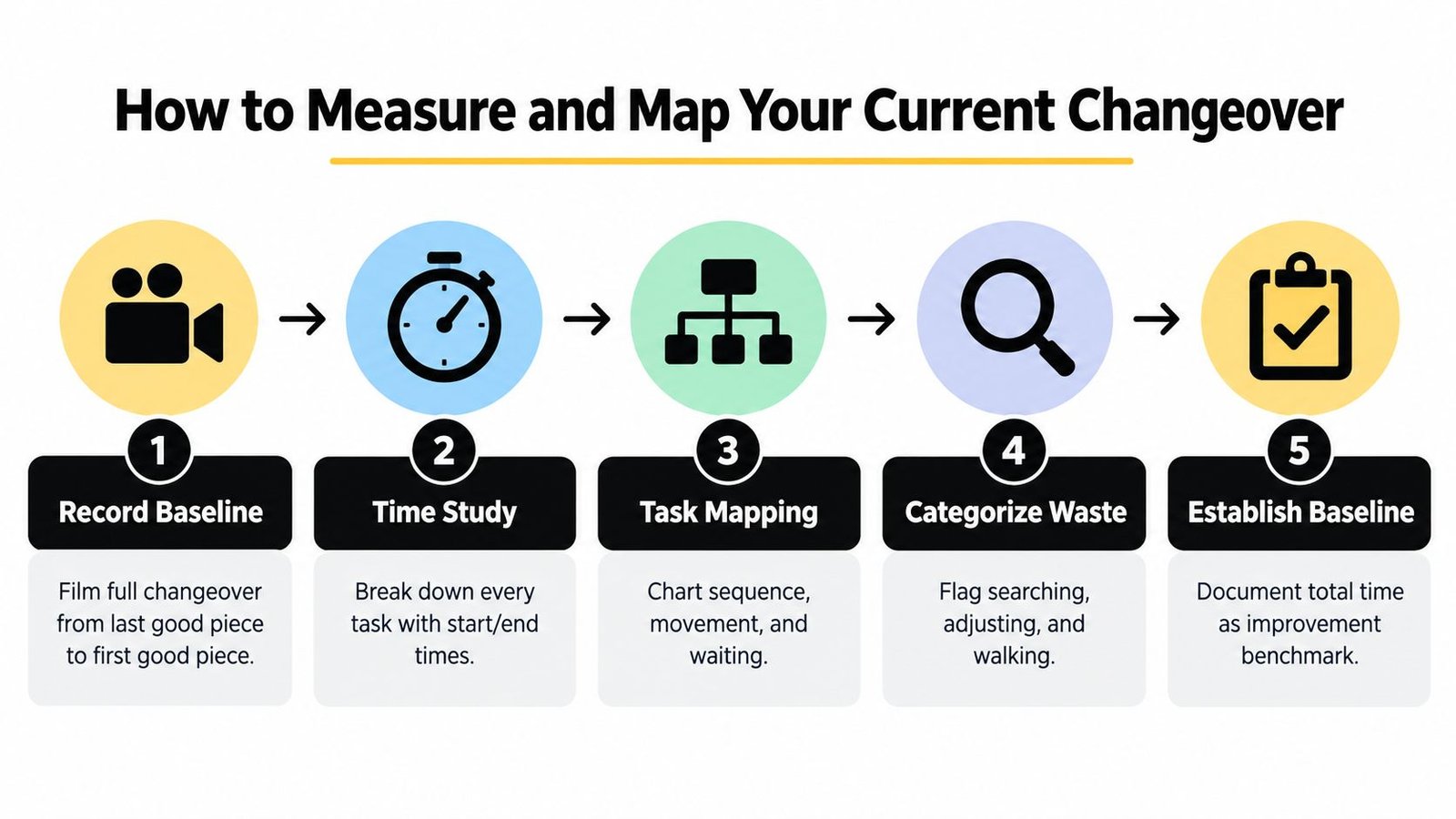
Record from the final conforming unit of the old product until the first conforming unit of the new product is accepted. In regulated production, that means your endpoint isn't “machine running.” It's “machine running correctly with required verification complete.”
A solid baseline usually includes:
- Video evidence: Full changeover footage with timestamps.
- Task log: Each action listed in order with start and stop time.
- Role mapping: Who did the work, who waited, and who approved.
- Distance and motion notes: Walking, reaching, searching, rework, and repeat adjustments.
- Quality checkpoints: First-article checks, line clearance, documentation review, and release points.
If your team needs a cleaner way to structure the workflow itself, this guide to process mapping best practices is the right discipline to apply before anyone starts redesigning the setup.
Break the changeover into task elements
Don't log the event as one block called “setup.” That hides the waste.
Use short task descriptions such as remove old fixture, wipe contact surfaces, fetch torque tool, install locator pins, load recipe, verify label stock, run dry cycle, inspect first part, and complete line clearance signoff. Once you do that, the pattern becomes obvious. The true delays usually sit in a handful of places:
- Searching: Missing tools, documents, or hardware
- Waiting: Quality, maintenance, material handling, or supervisor approval
- Adjustment loops: Trial-and-error alignment or repeated parameter tweaks
- Travel: Walking to crib, bench, printer, wash station, or QA desk
- Reversal: Undoing a step because something was installed in the wrong order
Baseline first. Improvement teams that skip this step usually “fix” the wrong task and leave the actual bottleneck untouched.
Involve the people who really touch the process
The best map never comes from one engineer alone.
You need the operator who knows where the sequence stalls, the mechanic who sees the bad fastener design, the quality person who explains why a check can't be skipped, and the production lead who knows what happens on second shift when support staff aren't nearby. Good changeover time reduction work is cross-functional because the wasted minutes are cross-functional.
A useful review format is simple:
| What to capture | Why it matters |
|---|---|
| Machine-stopped activities | Shows true internal setup burden |
| Tasks done before the stop | Reveals external work already happening |
| Delays between steps | Exposes coordination failures |
| Checks and approvals | Identifies compliance-driven bottlenecks |
| Start-up adjustments | Shows where fixture or recipe control is weak |
Document the baseline cleanly enough that you can run the same study again after improvements. If the before-and-after method isn't consistent, the result won't be credible to operations, finance, or quality.
Separating and Converting Internal and External Tasks With SMED
SMED, developed by Shigeo Shingo, aims to reduce changeover time to single-digit minutes. “Single-minute” means single-digit minutes, not exactly one minute. Its core mechanic is simple: separate internal tasks, which require the machine to be stopped, from external tasks, which can be done while production is still running, then convert as many internal tasks as possible to external ones, as outlined in this SMED overview.
That sounds basic. It isn't. Most plants say they understand this distinction, then stop a machine so someone can go print paperwork, find a torque wrench, or collect the next kit.
Internal work is usually overstated
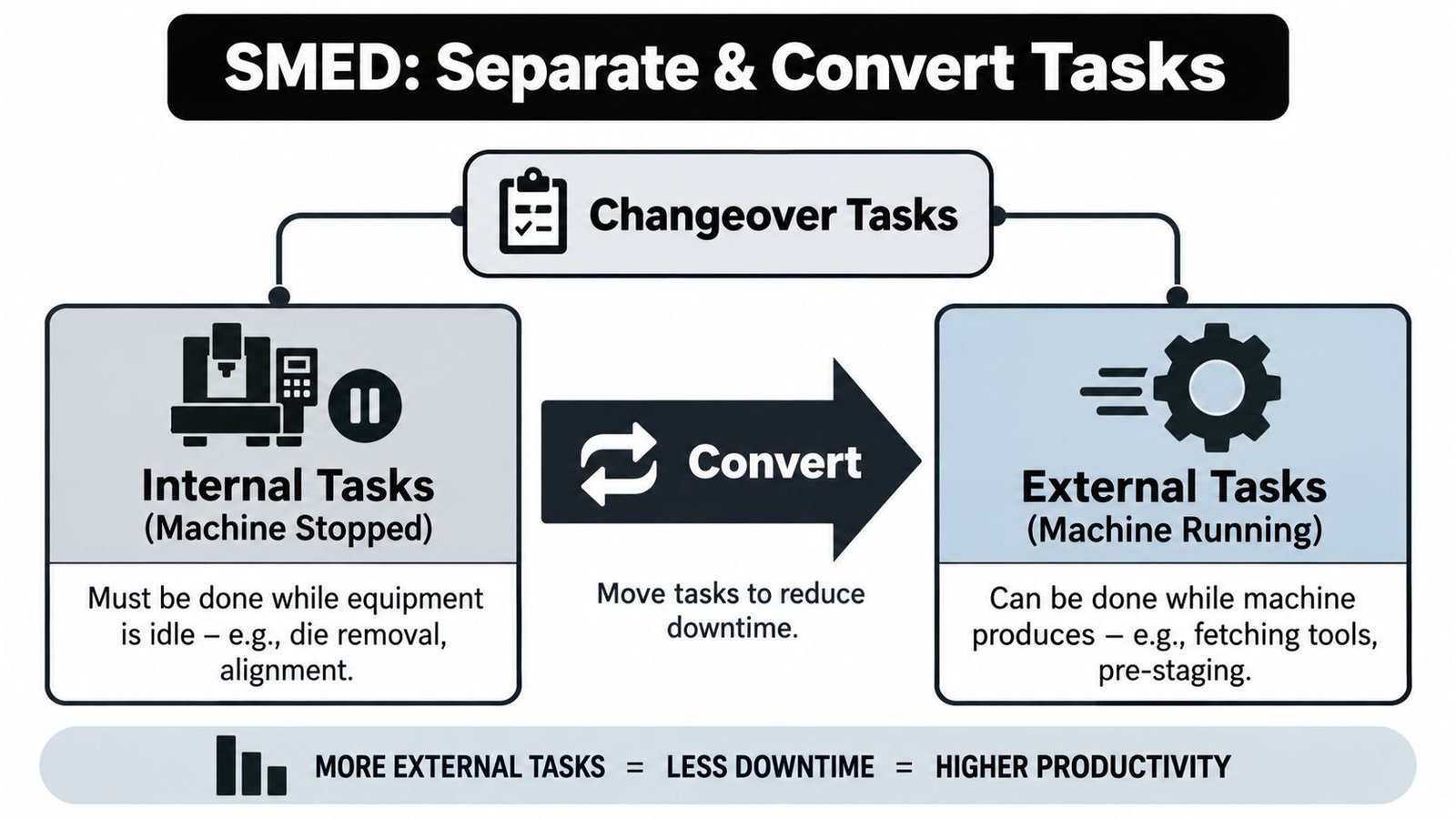
Internal tasks should be a short list. Remove the old tool. Install the new one. Make required machine-off connections. Perform the minimum machine-stopped verification.
Everything else deserves a challenge.
A lot of “internal” work turns out to be bad habit. Tool gathering, document review, preheating, presetting, staging labels, preparing fasteners, bringing in gauges, reviewing the next traveler, and confirming lot materials should happen before the line stops whenever possible.
What systematic SMED improvement looks like
Independent case-study evidence shows that quick-changeover programs often produce major reductions when plants apply them systematically. One production line fell from 57.5 to 23.7 minutes, about 59%, while another setup was cut from 51.2 to 13.4 minutes, about 74%, according to the University of Minho case-study review. That same review notes common failure points: not converting internal tasks to external tasks, not standardizing tool staging, and not involving operators across functions. It also notes that in many plants, 5–20% of planned production time can still be consumed by changeovers when those basics aren't handled well.
Those numbers line up with what experienced teams see on the floor. The first gains usually come from externalization, staging, and sequence discipline. The stubborn remainder usually sits in essential machine-off steps and post-start verification.
Here's a practical conversion playbook:
- Pre-kit the next job: Put all tooling, consumables, documents, gauges, and fasteners on one cart before the current run ends.
- Preset off-line: Set tool heights, stops, guide rails, and fixture elements at a bench whenever possible.
- Stage by sequence: Arrange parts in the order they'll be used, not just in a box near the line.
- Run parallel tasks: Have one person clear the old setup while another stages the incoming one, where safety and procedure allow.
- Eliminate adjustment loops: Use hard stops, locating pins, color coding, torque standards, and preset references so the first setup is close to final.
A short video can help align teams around the SMED mindset before they start redesigning the work.
Don't confuse speed with control
One academic paper reported SMED reduced a trimming-process changeover from 4,966 seconds to 2,792 seconds, a 44% reduction, while another study reported an 18% reduction in extrusion changeover time, as summarized in the IEOM paper on SMED case evidence. That spread matters. It tells you results depend on the process and on how much internal work can be externalized or eliminated.
Faster operators can help. Better task design helps more, and it lasts longer.
In semi-automatic lines, I'd take a slightly slower but repeatable sequence over a fast sequence that depends on tribal knowledge every time. If the setup only works when your best mechanic is on shift, the process isn't improved. It's fragile.
Quick Change Tooling Fixtures and Smart Automation Choices
Once the method is cleaned up, the hardware has to support it. If the fixture still needs hand shimming, if the clamp takes repeated wrench turns, or if the operator has to “feel” the right position every time, the line will drift back toward long changeovers.
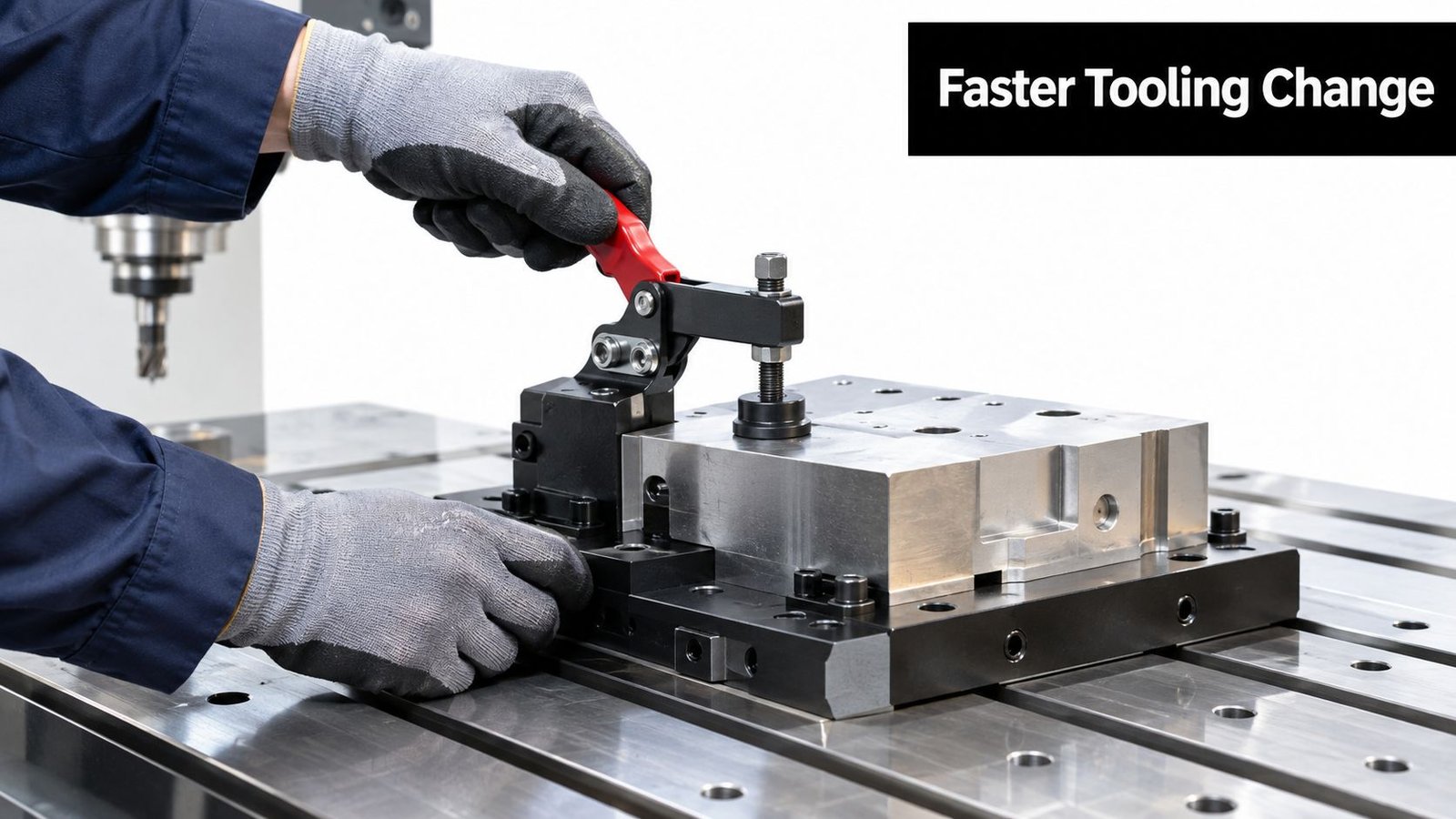
That's where quick-change tooling earns its keep. Good hardware removes judgment, reduces adjustment, and makes the correct setup easier than the wrong one.
The best tooling changes are usually simple
The most effective upgrades are often mechanical and boring in the best way:
- Toggle clamps and quick-release clamps: Faster than loose bolts and more repeatable when properly located.
- Locating pins and hard stops: Prevent drift and cut alignment time.
- Preset nests or cartridges: Let teams prepare one assembly while another run is still active.
- Standardized fasteners: Reduce the tool count and cut searching.
- Dedicated changeover carts: Keep each product family's components complete and visible.
If your plant is evaluating fixture design options, these examples of custom workholding fixtures reflect the kind of practical engineering that reduces setup variation without forcing unnecessary automation.
Choosing between manual, semi-automatic, and fully automatic
The wrong automation choice can lock you into higher cost and lower flexibility. Plants with mixed product families often benefit more from durable fixtures and assisted verification than from trying to automate every movement.
Here's the comparison I use when advising operations teams:
| Choosing the Right Quick-Change Solution | Best For | Investment Level | Changeover Impact |
|---|---|---|---|
| Manual fixture improvements | High-mix lines with basic setup issues | Low | Strong when searching, alignment, and adjustment are the main losses |
| Semi-automatic assists | Regulated or repeatability-sensitive processes | Medium | Strong when operators need guided positioning, sensor checks, or HMI prompts |
| Full automation | Stable, high-volume families with limited variation | High | Best when the product mix is narrow and the sequence rarely changes |
What usually works and what usually disappoints
Manual improvements work well when the problem is unstable setup discipline. A line doesn't need servo everything if a locator, clamp, and visual standard solve the issue.
Semi-automatic assists make sense when operators still perform the change, but the process needs help enforcing repeatability. Common examples are sensors that confirm part presence, HMIs that lock the sequence, recipe recall, and interlocks that stop the next step if a fixture isn't seated correctly.
Full automation can be the right choice, but only when the product mix and validation burden justify it. If every new fixture or variant creates more change-control work than production savings, the business case collapses quickly.
The right level of automation is the one that removes uncertainty without removing flexibility you still need.
Validating Changeovers for GMP and Medical Device Compliance
This is the part many SMED discussions gloss over. In regulated manufacturing, the bottleneck often shifts from turning bolts to proving control.
A fixture change, tooling swap, or new sequence can affect documented settings, in-process checks, cleaning requirements, traceability, and release discipline. If the revised method is faster but harder to validate, quality will slow it back down, and they'll be right to do it.
Faster is only better if the validated state is clear
A useful practitioner view from recent industry writing is that medical and precision manufacturing face a different problem than generic setup reduction. The constraint is often validated process control, documentation, and release discipline, not mechanical speed. That same perspective warns that the fastest line isn't always the best line if the new sequence increases validation burden, operator error risk, or change-control overhead, as discussed in this Guidewheel article on SMED in regulated environments and 2026 trends.
That's exactly right. In GMP-aware production, the target is a faster validated changeover, not just a faster physical change.
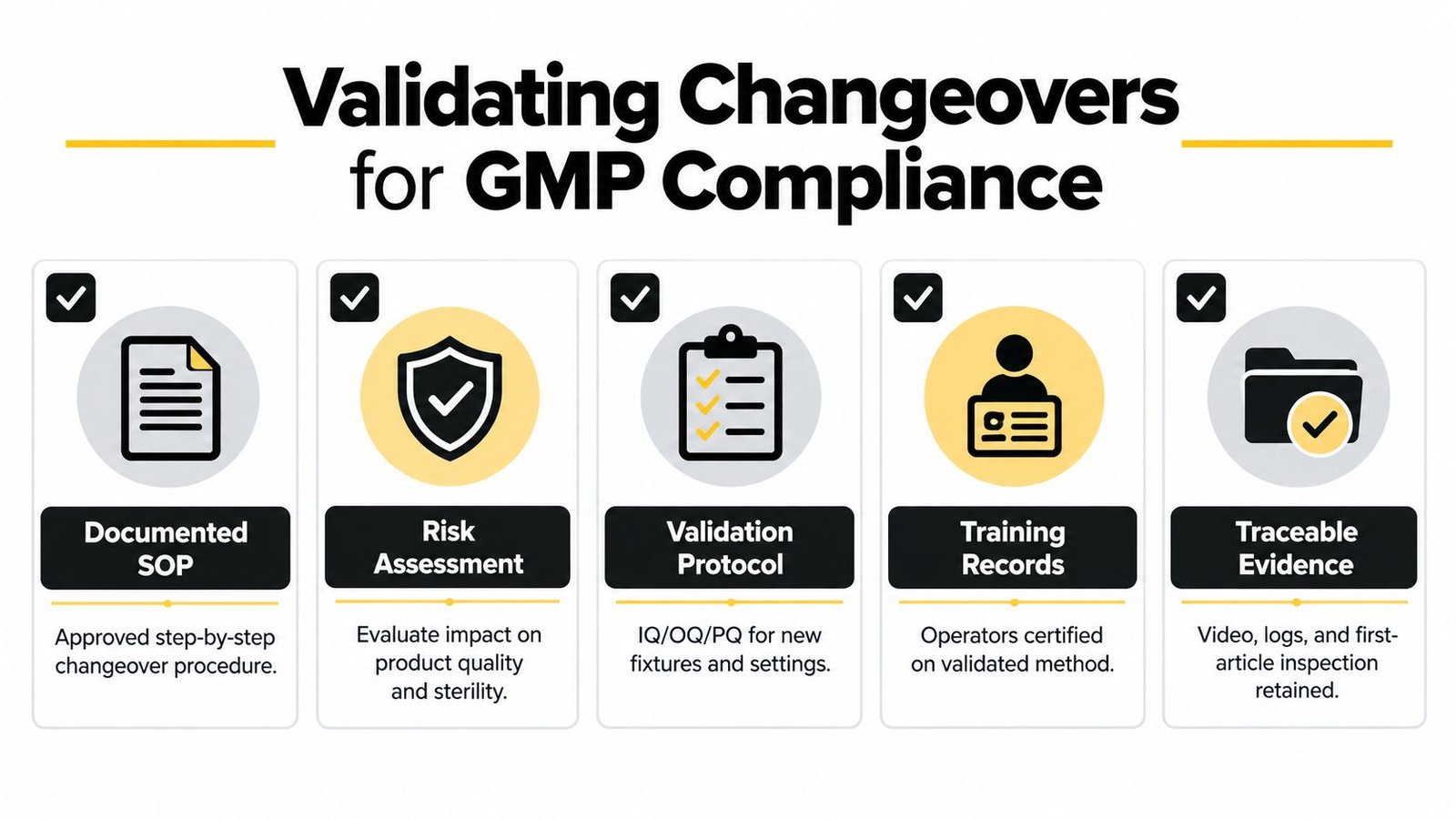
If your team needs a sharper foundation on the compliance side, this explanation of GMP in manufacturing is worth keeping in front of engineering and operations together.
Build the validation burden into the design
A good compliant changeover sequence usually includes:
- Documented standard work: One approved method, not three tribal variants by shift.
- Clear line clearance points: Operators know exactly what must be removed, cleaned, checked, and documented.
- Traceable setup confirmation: Torque records, lot verification, recipe confirmation, and first-article evidence are retained consistently.
- Mistake-proofed fixtures: Hardware helps prevent wrong-part installation or incorrect orientation.
- Automated verification where it makes sense: Sensors and checks reduce manual confirmation steps while preserving traceability.
Recent 2026 practitioner content also points toward growing interest in digital time studies, video baselining, and automated verification. Those should be treated as emerging directions, not universal standards, but they make sense where plants need repeatability across multiple cycles without adding manual paperwork.
Reduce operator discretion where quality risk is high
A regulated changeover should not depend on memory. It should depend on controlled sequence.
That means approved SOPs at the point of use, visual references tied to the exact product family, and setup features that physically guide the correct condition. If an operator can mount a part two ways and only one is acceptable, the fixture needs work. If a parameter entry can be skipped, the controls need work. If quality has to reinterpret what “ready” means on each shift, the documentation needs work.
In regulated production, a repeatable ten-step changeover beats a faster six-step changeover that creates doubt at release.
Your Pilot Plan KPIs and Implementation Checklist
Most plants don't need a plant-wide changeover initiative to start. They need one pilot that's chosen well, measured properly, and repeated enough times to prove the gain is real.
Pick a line with frequent changeovers, decent operator engagement, and a pain point the business already feels. Avoid the easiest line. Avoid the worst line. Choose the line where better setup performance will matter and where the team can sustain new standard work.
A pilot sequence that holds up
Run the pilot in a disciplined order:
- Select one product family or line: Choose a setup with recurring impact, not a rare special case.
- Capture the baseline: Use the mapping method described earlier and include the full quality acceptance point.
- Separate internal and external tasks: Strip out everything that doesn't need machine stoppage.
- Fix the hardware and workflow: Add staging, carts, locating features, quick clamps, or guided checks as needed.
- Run multiple repeat cycles: One fast setup proves nothing. Repeatability is the standard.
- Lock the new method: Update SOPs, train to one sequence, and confirm that quality accepts the revised process.
Track the KPIs that actually matter
Don't overload the pilot with vanity metrics. Use a short KPI set that operations, engineering, and quality all care about:
| KPI | What it tells you |
|---|---|
| Changeover time | Whether downtime between products is actually shrinking |
| OEE | Whether recovered setup time is improving line performance |
| Labor hours per changeover | Whether the new method reduces support burden |
| First-pass yield after changeover | Whether speed is hurting startup quality |
| Repeatability across shifts | Whether the gain is standard work or just one strong crew |
One hospital lean-improvement study is a good reminder that this discipline applies outside classic factory settings too. It reported average changeover time between surgeries was reduced by 25% without adding infrastructure, technology, or resources. Average improvements were 17 minutes for gynecology and 15 minutes for general surgery, with new minimums of 41 minutes and 48 minutes respectively within three months, according to the 2022 hospital study. The principle carries over cleanly to manufacturing. Better sequence and coordination often beat bigger capital.
Implementation checklist
Use this as a practical closeout list before scaling the pilot:
- Baseline captured: Video, timing sheet, and first-good-piece definition are agreed.
- Task separation completed: Internal and external work has been clearly classified.
- Externalization actions closed: Tools, fixtures, material, and documents are staged in advance.
- Adjustment sources removed: Stops, pins, presets, and references are in place.
- Compliance review complete: SOPs, approvals, and required verification reflect the new method.
- Training finished: All shifts can run the same sequence.
- Sustain plan set: Audit the method for drift after launch.
Good changeover time reduction doesn't end with one workshop. It sticks when the fixture, the sequence, the documentation, and the training all support the same way of working.
If your team is trying to cut setup time without creating quality risk or overspending on automation, System Engineering & Automation builds the kind of practical manufacturing solutions that fit real production constraints. They support everything from custom tooling and fixtures to semi-automatic systems, integrated controls, installation, commissioning, and ongoing service, with a strong fit for manufacturers that need to optimize production in GMP-aware environments.