Purchase price is usually only 20% to 40% of true lifecycle cost, and the rest hides in installation, energy, maintenance, and downtime. That's why a cheap machine can turn into the most expensive asset on the floor once it's bolted down, powered up, and expected to hit rate every shift.
For manufacturers, what is total cost of ownership really asking is simple, if uncomfortable, question: what does this equipment cost to buy, run, support, and eventually retire? If you only price the quote, you're not comparing machines, you're comparing paperwork.
Table of Contents
- Why the Sticker Price Misleads Most Equipment Buyers
- Defining Total Cost of Ownership the Way Manufacturers Use It
- The Lifecycle Cost Categories That Drive Automation Spending
- A Step-by-Step TCO Calculation Template Anyone Can Use
- Two Real Equipment Choices Compared Through TCO
- The Vendor Questions That Reveal the Hidden Lifecycle Cost
- Practical Strategies to Lower TCO on Automation Projects
Why the Sticker Price Misleads Most Equipment Buyers
Acquisition cost is typically only 20% to 40% of total lifecycle cost, which means 60% to 80% sits outside the quote and shows up later as installation, operating burden, maintenance, and downtime exposure, as summarized in IBM's TCO framing and related industry guidance on lifecycle cost IBM on total cost of ownership. That's why a buyer who stops at the purchase order can make a bad decision while still believing they saved money.
A plant doesn't run on invoice price. It runs on utility load, uptime, service response, operator skill, spare parts, and how often the line has to stop to recover from a bad design choice. If the initial machine is awkward to install, expensive to maintain, or slow to recover after faults, the budget gets hit again and again.
Practical rule: treat the quote as the opening bid, not the final cost. If the vendor can't explain the full lifecycle, the buyer is carrying the risk.
The common mistake is assuming the cheapest line item is the best commercial choice. In automation, low purchase price often means the integrator cut scope somewhere else, or the buyer will pay later in custom tooling, extra labor, more training, or avoidable downtime. That is why TCO isn't finance jargon, it's production protection.
A serious capital decision should answer one question before anything else. Will this equipment lower total operating burden over its useful life, or just move cost out of the quote and into the floor?
Defining Total Cost of Ownership the Way Manufacturers Use It
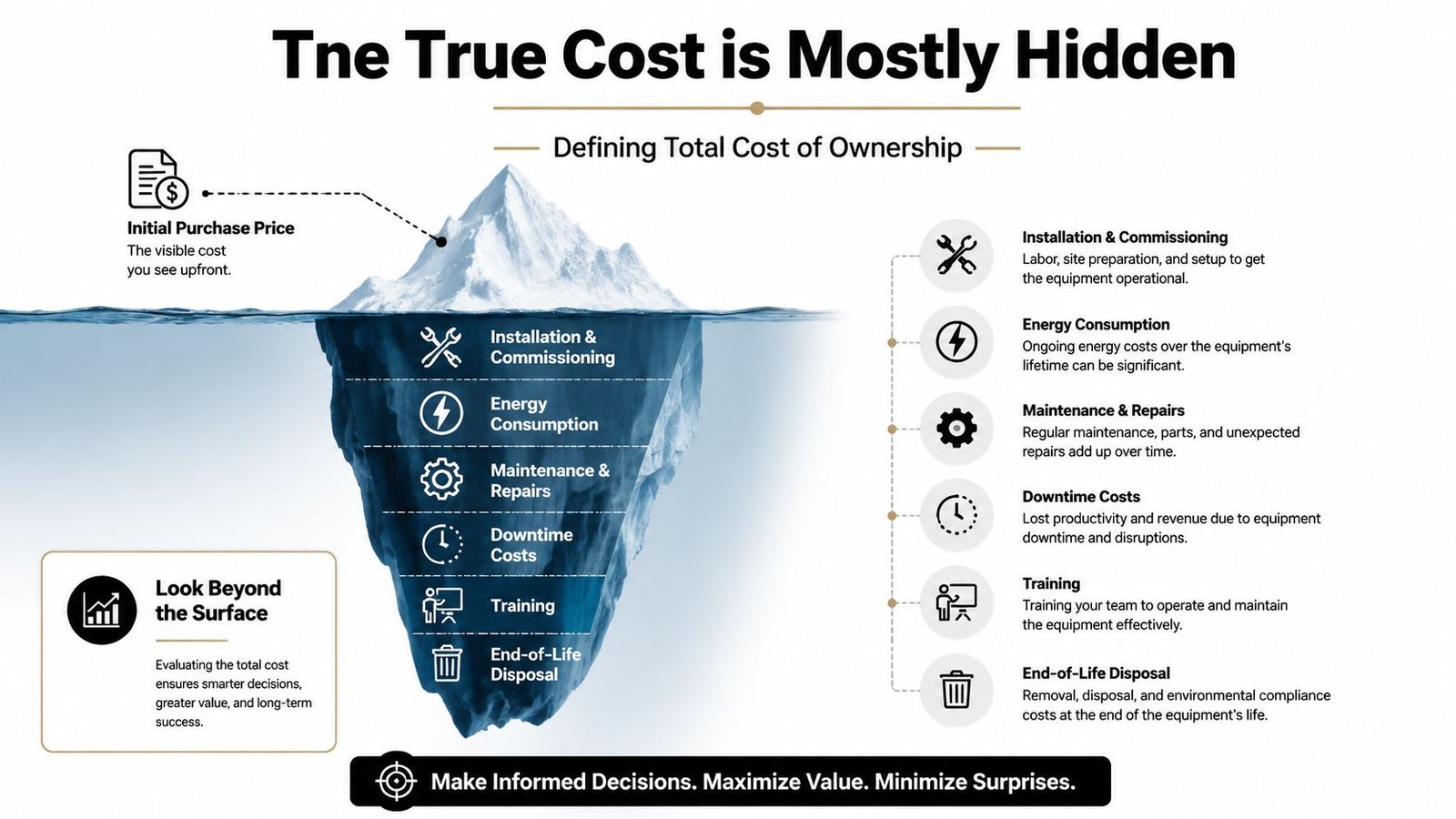
The fastest way to explain total cost of ownership is the iceberg model. The quote is the part everyone sees. The larger cost sits below the surface, where installation, support, downtime, and replacement decisions shape the final bill.
For manufacturers, that hidden portion is not a theory exercise. It is the difference between a line that pays back cleanly and one that eats margin after startup. Gartner's manufacturing and automation guidance frames TCO around the costs that show up after the PO, including installation, commissioning, training, spare parts, process disruption, and downtime Gartner's TCO glossary for manufacturing and automation. That is the right lens for a plant manager, because equipment keeps spending money long after procurement closes the deal.
In practical terms, TCO covers the cost of putting an asset into service, keeping it productive, and retiring it without creating extra pain on the floor. That includes installation, commissioning, operator training, maintenance contracts, spare parts, scrap from startup problems, and disposal or residual value. Manufacturing buyers cannot afford to treat those items as side notes, because production losses show up fast and hit hard.
Lifecycle definition: TCO is the full cost of acquiring, operating, maintaining, and retiring an asset, not just buying it.
SEA-CA's equipment lifecycle management guidance fits this view well. If a machine needs more support to deliver the same output, its true cost is higher even when the sticker price looks better on paper. That is the part line managers learn quickly after a rough startup or a long string of service calls.
A vendor quote should answer one question clearly. What will this asset cost to own from first install to final removal, not just what will it cost to buy?
TCO Cost Buckets Compared to Typical Share of Lifecycle Cost
| Cost Category | Typical Share of Lifecycle Cost | When It Hits the Budget |
|---|---|---|
| Acquisition | 20% to 40% | At purchase |
| Operating Costs | 20% to 40% | Every production run |
| Maintenance and Repairs | 15% to 30% | During service life |
| Downtime | 5% to 20% | During faults, changeovers, and recovery |
| Disposal | 1% to 5% | At end of life |
The table is not there to pretend every plant will match the same percentages. It is there to stop buyers from treating the quote as the whole story and to force a harder question, what costs will show up after the machine is already on the floor?
The Lifecycle Cost Categories That Drive Automation Spending
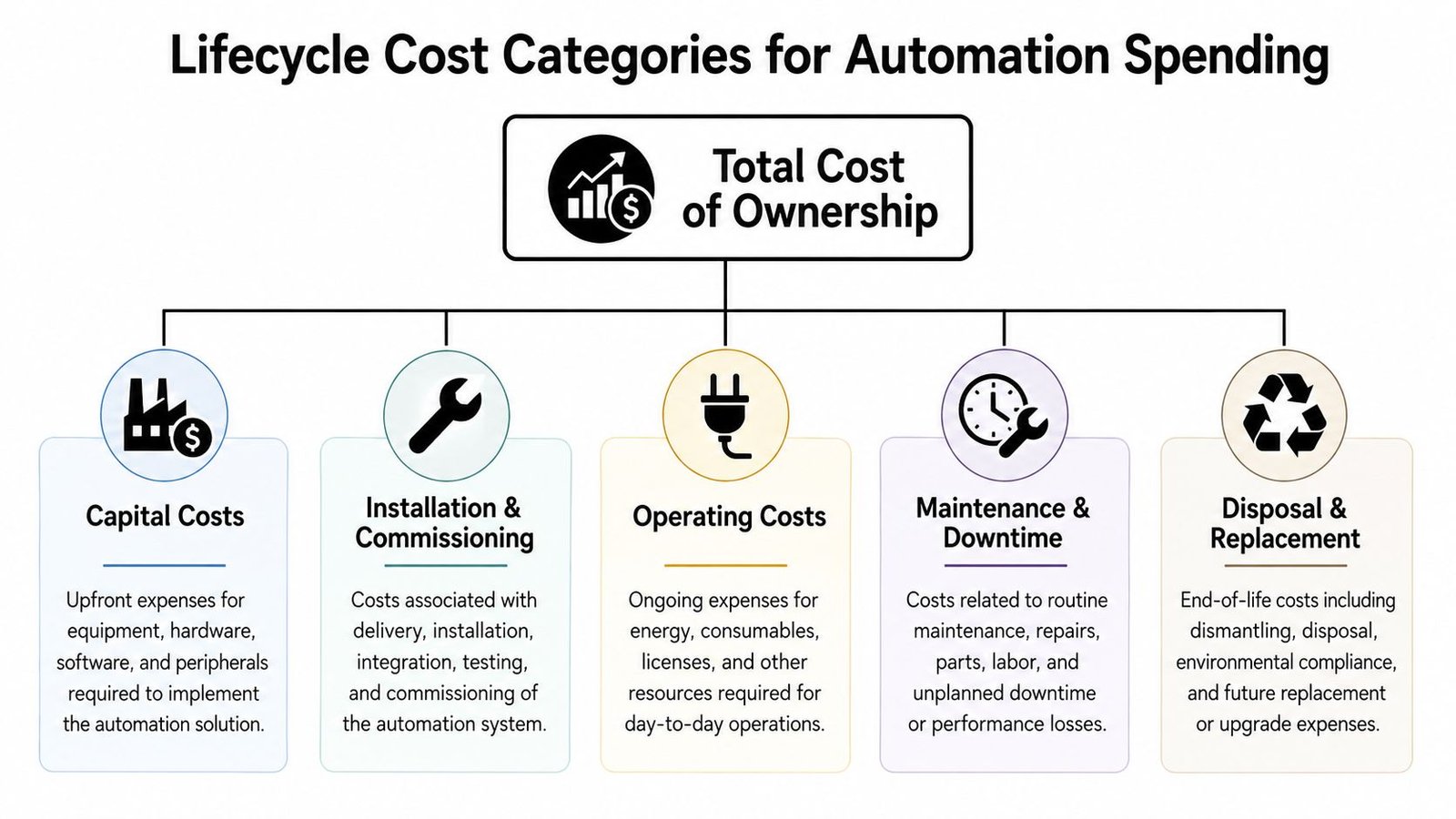
A good automation budget starts with a clean bucket structure, not a vague “hidden costs” line. The National Institute of Building Sciences breaks TCO into initial asset costs, operations and maintenance, utilities, renewal, and end-of-useful-life costs NIBS framework for total cost of ownership, and that structure maps well to equipment decisions on a factory floor.
Capital and setup
This is the machine, the guarding, the custom tooling, and the work needed to get it physically into the line. A semi-automated workstation that needs a dedicated fixture, electrical drops, and a conveyor tie-in may look affordable until the install crew starts charging for the scope.
Installation and commissioning
Many projects slip here. The equipment has to be leveled, wired, debugged, and proven in real production conditions. Commissioning is where a simple-looking workstation becomes a multi-day stop if the interface, sensors, or part presentation weren't thought through.
Operating costs
Utilities, labor, and consumables live here. A fully automated machine may reduce manual handling, but if it demands more compressed air, power, or operator oversight than expected, the savings can disappear fast.
Maintenance and downtime
This is the category most buyers underprice. Preventive maintenance, corrective repair, spare parts, and lost throughput all belong here. The SEA lifecycle management guidance is useful because it frames equipment as something that has to be managed through the full life, not just purchased and forgotten.
Training, compliance, and validation
A line doesn't earn money until people know how to run it properly. For medical devices and other regulated work, documentation and validation effort can become major lifecycle items, and GMP-aware practices matter because they affect how the machine is accepted and supported over time.
Renewal and end of life
Controls upgrades, refurbishments, changeovers, and eventual disposal all cost money. APPA and NIBS both treat TCO as a living model with revision points, which is the right mindset for equipment that gets modified or repurposed over time NIBS guidance on maintenance of essential data and review points.
The category list matters because it keeps teams honest. If a vendor quote doesn't touch these buckets, the buyer is still missing the actual job.
A Step-by-Step TCO Calculation Template Anyone Can Use
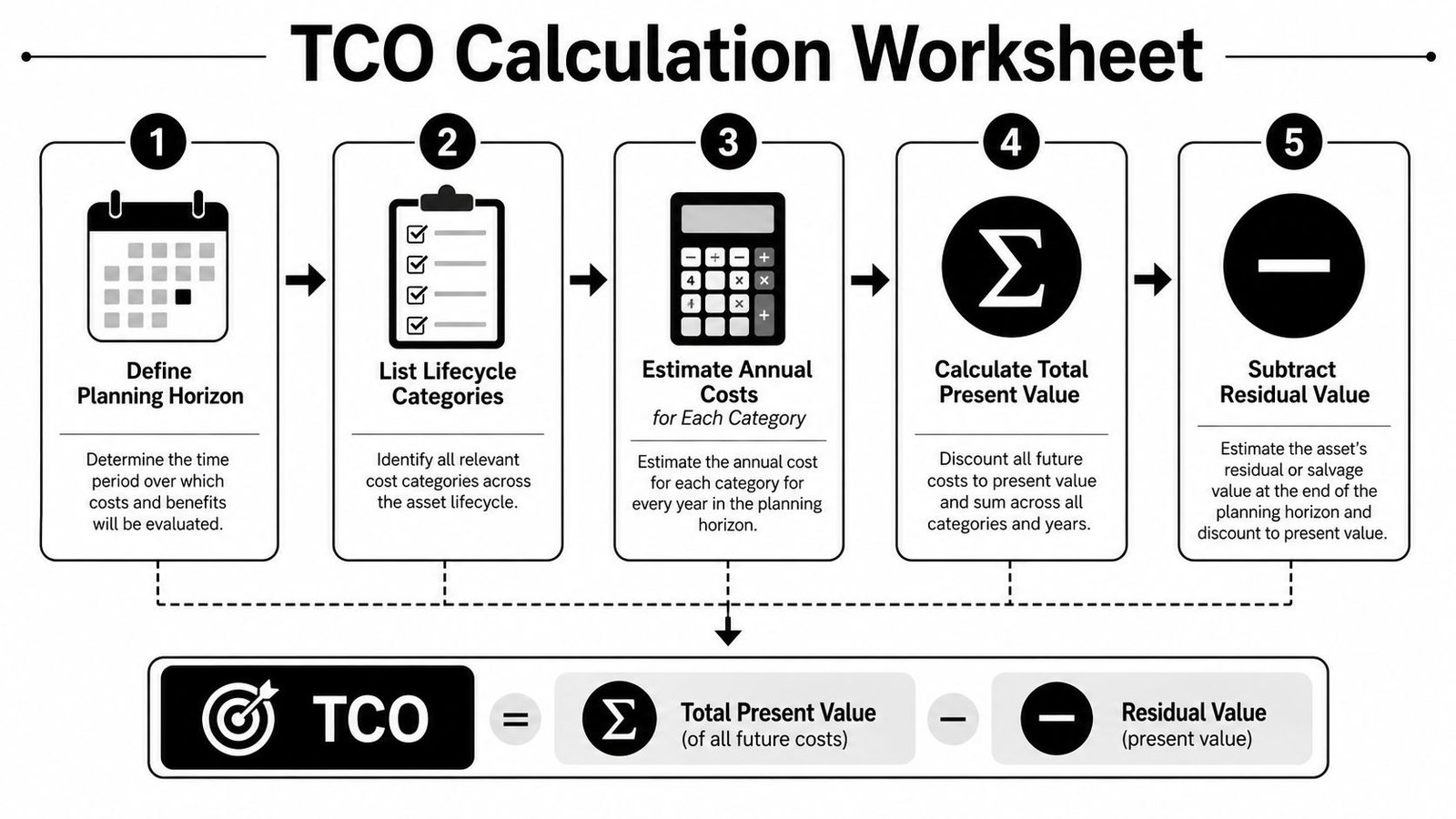
Start with a planning horizon that matches how long the asset will stay in service. Then list every cost bucket from the previous section and assign each one to the year it hits the budget. That's the only way to stop front-end optimism from distorting the decision.
The most defensible worksheet is simple:
- Define the useful life.
- List each lifecycle category.
- Estimate annual or event-based cost.
- Discount future costs to present value if you need an apples-to-apples comparison.
- Subtract residual value at the end.
That structure is consistent with the NIBS bucket model and with South African Treasury guidance that TCO captures direct and indirect costs over the whole life of goods, services, or construction works South African Treasury TCO guidance. It also matches how buyers should treat the model in practice, as a forecast that gets updated when commissioning ends, after a major overhaul, and whenever the process changes.
Working rule: if the assumptions changed, the TCO changed. Don't leave the model frozen after the PO.
For a single semi-automated workstation, the worksheet might show one row for purchase, one for install and commissioning, one for training, repeated rows for annual maintenance and utilities, a line for downtime losses during changeover, and a final line for residual value. The point isn't perfect precision, it's disciplined comparison.
If you want a shortcut for internal discussions, SEA's automation ROI calculator is a useful place to pressure-test assumptions before you commit capital. I've found that once teams are forced to put maintenance, uptime, and changeover cost into the same sheet as the quote, the “cheap” option usually stops looking cheap.
A small worked example helps. If a machine needs extra training, more spare parts, and a longer startup curve, the present value of those costs can easily outweigh a lower purchase price. That's what the worksheet is designed to expose.
Two Real Equipment Choices Compared Through TCO
A low-bid manual workstation and a semi-automated line can look close on paper if you only compare purchase price. They rarely stay close once production starts. In one general manufacturing case, the manual option usually carries more labor, more changeover friction, and more downtime exposure, while the semi-automated option moves cost into controls, setup, and maintenance but reduces the day-to-day drag on throughput.
The wrong way to compare them is to ask which quote is smaller. The right way is to ask which one produces the required output with the least total burden across its useful life.
General manufacturing example
The manual workstation often wins the bid because the build is simpler and the upfront scope is smaller. Then the buyer adds custom tooling, extra operator time, quality checks, and stop-start recovery when parts aren't presented consistently. The line keeps running, but only because people absorb the hidden cost.
The semi-automated line usually asks for more discipline during design. It needs a cleaner layout, better controls integration, and a more thoughtful startup plan. Once in place, though, it often reduces labor exposure and makes the process more repeatable, which matters when the same job runs day after day.
Medical device example
Medical device work changes the cost picture again. Validation, documentation, and GMP-aware practices add effort that a casual spreadsheet misses. A machine that is technically cheaper can become more expensive if it creates more documentation burden, more qualification work, or more process risk during audits and handoffs.
The comparison that matters here is not only price versus price. It's price, validation effort, supportability, and change control versus the cost of carrying a more capable system.
A classic peer-reviewed purchasing model from ETH Zurich also makes the same point in a different way, by showing how life-cycle factors can materially change the total compared with price alone ETH Zurich TCO purchasing model. That's exactly what happens on the floor. The quote is a starting number, not the answer.
The practical lesson is blunt. If the low-cost option needs more people, more recovery time, or more compliance work, it can be the most expensive choice in operation. Buyers who only compare acquisition price often discover that after the line has already been installed.
The Vendor Questions That Reveal the Hidden Lifecycle Cost
A vendor meeting gets useful only when the questions force hidden work into the open. Ask about installation scope, commissioning support, operator training depth, spare parts availability, maintenance intervals, energy under load, and end-of-life options. Those are the line items that usually decide whether the quote is honest.
- Capital and setup: What exactly is included in installation, calibration, and commissioning, and what gets billed separately?
- Operational burden: How much power does the system draw under real load, and what consumables or operator interventions does it need?
- Maintenance reality: What service interval is recommended, what are the parts lead times, and what does the maintenance contract cover?
- Future-proofing: What upgrade paths exist, and what happens if software, controls, or tooling need a retrofit later?
- End of life: Do you offer take-back, refurbishment, or trade-in support when the asset is retired?
The best vendors answer these questions without hand-waving. They know buyers are trying to compare full lifecycle cost, not just the headline number.
For teams building a repeatable procurement process, best practices for vendor management are worth aligning with internal sourcing and engineering reviews. A clean vendor process protects the plant from being sold a cheap problem.
Practical rule: if the salesperson can't tell you what makes the machine expensive to own, the maintenance team will find out later.
The goal isn't to make every quote look bad. It's to find out which vendor has thought through the operational reality of the line. That's the one worth taking seriously.
Practical Strategies to Lower TCO on Automation Projects
The fastest way to lower TCO is to right-size the level of automation. On small to mid-sized volumes, a semi-automated system often beats a fully automated one because it trims control complexity, reduces downtime exposure, and stays easier to adjust when the product mix changes.
Support matters just as much. A build that includes ongoing maintenance, responsive parts support, and practical commissioning help usually costs less over its life than a cheaper machine that turns into a support headache after the warranty paperwork is filed. The one-year guarantee should be treated as the start of a lifecycle relationship, not the finish line for vendor responsibility.
What usually works:
- Choose the simplest system that still meets the production target.
- Budget for maintenance and support from day one.
- Favor designs that are easy to troubleshoot on the floor.
- Treat training and handover as production work, not admin.
What usually fails:
- Buying the lowest-priced machine and expecting the plant to absorb the gap.
- Underestimating downtime during startup.
- Ignoring spare parts and controls support until a failure happens.
- Treating automation as a one-time purchase instead of a lifecycle asset.
Capital request line: A low initial price can hide a high operational burden.
System Engineering & Automation helps manufacturers choose the right level of automation, build around real production constraints, and support the equipment after startup so the cost story holds up in operation. If you are pressure-testing a quote or comparing semi-automated and fully automated options, visit System Engineering & Automation and talk through the line as a lifecycle decision, not just a purchase.