You’re probably in a familiar spot. Production targets are tightening, labor coverage is uneven, quality escapes are too expensive, and someone on the team has finally said, “We need automation.” Then the search starts, and big names like acro automation systems inc show up fast.
That’s where decisions often go sideways. Teams assume the most capable integrator is automatically the right partner. In practice, the right choice depends less on reputation alone and more on fit: product mix, changeover frequency, validation burden, staffing, floor space, support expectations, and how much disruption the plant can absorb during implementation.
Table of Contents
- Evaluating Your Next Automation Partner
- Who is Acro Automation Systems Inc?
- Acro's Core Capabilities and Technical Solutions
- Objective Strengths and Potential Limitations
- How to Choose the Right Automation Partner for Your Needs
- Comparing Full Automation and Semi-Automation Partners
- Aligning Automation with Your True Production Goals
Evaluating Your Next Automation Partner
Most plant managers don’t start by asking for a robotic cell. They start with a production problem. A bottleneck station falls behind. A weld or dispense path varies too much across shifts. Operators spend too much time loading, aligning, pressing, checking, and documenting.
That’s why automation partner selection should begin with constraints, not technology. Before you compare vendors, define what must improve first: labor dependence, repeatability, throughput, traceability, ergonomics, or changeover control. The answer affects whether a large turnkey integrator is the best fit or whether a more targeted solution will get you there faster.
A useful starting point is to review how different automation machine manufacturers approach system design and project scope. Some are built for enterprise-scale integration. Others are better at upgrading a station, adding tooling, or introducing semi-automation without rebuilding the entire line.
What to pin down before you call anyone
- Process stability: If your part design or routing is still changing, full automation can lock in the wrong assumptions.
- Operator role: Decide whether the goal is labor elimination, labor reduction, or operator-guided consistency.
- Validation burden: In regulated environments, documentation and repeatability matter as much as speed.
- Support model: A strong concept on paper won’t help if the plant can’t maintain it after launch.
Practical rule: Buy the level of automation your process can support every day, not the level that looks best in a capital request presentation.
When teams skip that discipline, they often overbuy complexity. When they define the problem clearly, they can judge a company like Acro on the right terms.
Who is Acro Automation Systems Inc?
Acro is a long-established automation builder with deep roots in industrial manufacturing. According to Datanyze’s company profile for ACRO Automation Systems Inc., the company was founded in 1936 and has more than 80 years of experience, evolving from welding technology into a provider of custom automation.
That history matters because it usually signals something practical. Companies that stay relevant that long tend to know how to engineer around messy real-world manufacturing conditions, not just ideal lab assumptions. They’ve likely seen enough part variation, fixture issues, launch pressures, and service calls to build systems with durability in mind.
What their scale tells a buyer
The same Datanyze profile says Acro has $40 million in annual production capacity, handles 10 to 15 projects each year that exceed $1 million, and can take on projects over $10 million. It also notes a staff of approximately 80 employees in Milwaukee, Wisconsin.
For a buyer, those numbers say Acro isn’t a small job shop dabbling in automation. They’re built to execute substantial custom machinery programs. That usually means stronger internal depth in design, build, assembly, and commissioning, and it often means they’re more comfortable owning a broad scope rather than just a fixture, feeder, or guard package.
What that usually means on the ground
Large-scale capability can be an advantage when your needs are equally large:
- Multi-station integration: When welding, handling, inspection, and test all need to work as one system.
- High consequence launches: When startup risk is expensive and the customer expects a complete turnkey line.
- Cross-functional engineering: When controls, mechanical design, tooling, and process validation all need coordination.
But scale also shapes the type of customer relationship you’re likely to have. A company with Acro’s profile often fits best when the project is technically dense, capital-intensive, and strategically important enough to justify a full integration effort.
That doesn’t make them the right answer for every manufacturer. It does make them a serious option when the project necessitates that level of horsepower.
Acro's Core Capabilities and Technical Solutions
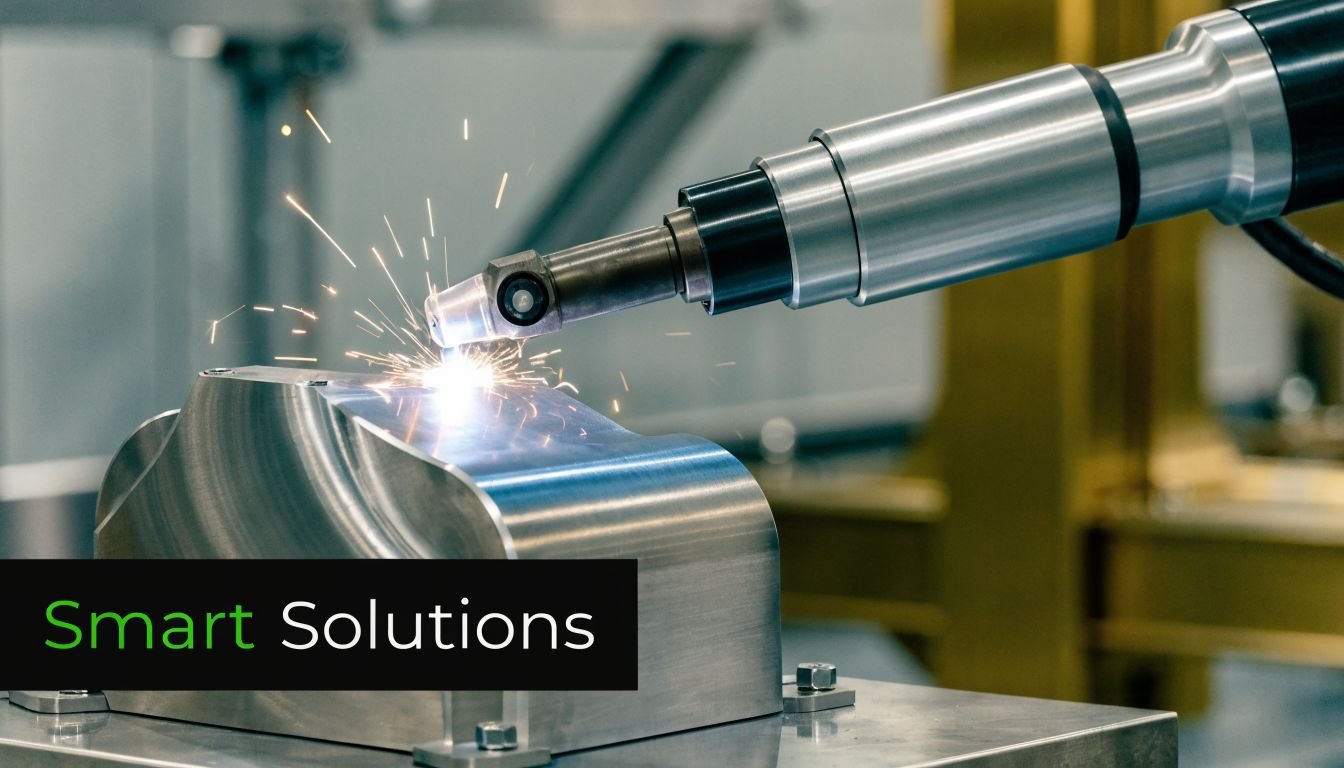
Acro’s value isn’t just in longevity. It’s in the kind of automation work they’re set up to deliver. Public descriptions of their offering point to automated welding, assembly, material handling, pressing, joining, forming, and function testing, with a strong emphasis on custom-built systems for demanding production environments.
If you’re evaluating them as a plant leader, don’t stop at the equipment list. Focus on how they engineer risk out before the machine ever hits your floor. That’s the part that separates a reliable system from a costly debug exercise.
A helpful reference point is how an automated systems integrator streamlines operations across design, controls, build, and launch. The core issue isn’t whether a vendor can design a robot cell. It’s whether they can verify, test, document, and support it in a way that survives production reality.
Where Acro tends to be strongest
According to Assembly Machinery’s profile of ACRO Automation Systems Inc., Acro uses SOLIDWORKS™ 3D modeling and robotic simulation software to verify robotic reach, payload, and cycle times before physical integration. That same source says virtual testing can reduce cycle times by 15-25%, and that their process is backed by ISO 9001:2015 certification.
That matters because early simulation catches predictable failures:
- Robot reach problems: A tool path that works in concept may fail when EOAT, guarding, and fixture access are added.
- Payload errors: A robot might lift the part, but not with the tool, orientation, and acceleration your cycle requires.
- Interference risks: Clearance issues rarely get cheaper after steel is cut.
The same source says Acro’s precision welding fixtures can reach sub-0.1 mm tolerances before assembly begins. For a quality engineer, that’s a meaningful signal. It suggests a build process centered on pre-verification, not trial-and-error tuning at runoff.
If a supplier can’t explain how they verify reach, payload, tolerance stack-up, and failure modes before build, expect those problems to reappear during launch.
What the engineering stack means on the plant floor
Acro is also described as using Six Sigma-oriented quality methods and statistical process control in its project work, with end-to-end solutions across major industrial applications. In practical terms, that tends to suit plants that need repeatable joining, handling, and inspection within a single controlled process.
Their broader public materials also reference vision inspection integrated with robotic operations and function testing. That combination is often useful when the process has to do more than move parts. It also needs to confirm presence, alignment, weld quality, dimensional condition, or downstream readiness.
A key trade-off is as follows: Advanced simulation, fixture precision, and integrated inspection improve confidence, but they also push the project toward a more engineered, more structured implementation model. That usually works well when the product is stable and the process window is tight. It works less well when the plant is still changing the recipe every month.
For readers who want to see how Acro presents its capabilities in motion, this video gives a visual sense of the kind of custom automation work associated with the brand:
A practical takeaway is simple. Acro appears strongest when the job requires disciplined engineering, integrated tooling, and a system that can run consistently once the process is well defined.
Objective Strengths and Potential Limitations
A fair evaluation of acro automation systems inc has to acknowledge two things at once. They appear to be capable of serious industrial automation work, and they won’t be the best fit for every manufacturer that needs production improvement.
Where a large integrator makes sense
Large integrators tend to shine when the project is too broad to split among multiple smaller vendors. If your program combines robotic joining, transfer, vision, test, and safety in one tightly linked build, a single accountable integrator can reduce handoff risk.
Acro also appears to have the market position and project flow to support that model. Public reporting notes a high volume of incoming RFQs, large quoted projects, and end-to-end systems designed for continuous operation with Six Sigma standards. That profile suggests strength in turnkey execution and in serving industries that expect full engineering ownership.
There’s also a service confidence factor with companies of this type. Buyers often value process depth, documentation discipline, and the ability to support a system beyond startup, especially when downtime affects multiple downstream operations.
Where buyers need sharper answers
The limitation isn’t necessarily technical. It’s commercial and operational fit. The public information gap matters.
As noted in the earlier video-linked material, there is limited publicly available quantified detail on average project costs, typical implementation timelines, and specific ROI performance across projects. Even where ranges or outcomes are discussed, the available public material leaves production engineers doing more inference than they’d prefer.
That creates real buying friction for small to mid-sized manufacturers. If your budget is constrained, your line is semi-manual today, and your process still changes frequently, you need direct answers to questions like these:
- Scope discipline: What is the smallest practical project they want to take on?
- Timeline realism: How do they handle phased implementation when shutdown windows are tight?
- Change tolerance: What happens when your part or test requirement shifts midstream?
- ROI transparency: Can they connect the design to labor, quality, scrap, and maintenance outcomes in a way your finance team can validate?
Buyer caution: The most impressive integrator on paper can still be the wrong partner if your plant needs a staged upgrade rather than a full-system leap.
None of that is a criticism unique to Acro. It’s a recurring issue with larger automation programs in general. Big systems can deliver excellent results, but they demand clearer assumptions, stronger internal alignment, and more tolerance for capital intensity than many plants have.
How to Choose the Right Automation Partner for Your Needs
The smartest buyers don’t ask, “Who builds the most advanced system?” They ask, “Who can solve this production problem at the right level of automation?”

That shift changes the entire conversation. It forces the vendor to engage with your process, staffing, quality requirements, maintenance capability, and validation burden, rather than just proposing a bigger machine.
Questions that expose real fit
Start the conversation with operating reality.
- How stable is our product and process today? If revisions are frequent, ask how the system will absorb future changes without major rebuilds.
- What does the operator still need to do? In many plants, the best answer isn’t lights-out automation. It’s controlled operator interaction with better fixturing, poka-yoke, or guided motion.
- How much support can maintenance provide? A system that needs specialist intervention for every fault won’t stay productive.
- What documentation comes with the build? This is critical in quality-driven manufacturing and even more important when GMP-aware practices are part of the requirement.
- How will training be handled after commissioning? Launch support is one thing. Sustained competence is another.
A practical scorecard
Use a simple evaluation matrix during vendor review:
| Evaluation area | What to look for |
|---|---|
| Process understanding | Did they ask detailed questions about part variation, fixturing, reject modes, and operator sequence? |
| Right-sizing | Are they proposing only the automation required to solve the current bottleneck? |
| Flexibility | Can the concept adapt to product changes, new SKUs, or revised test steps? |
| Quality approach | Do they define inspection, control plans, and documentation early? |
| Service model | Is post-installation support clear, responsive, and realistic for your location? |
A good automation partner doesn’t just automate motion. They reduce process uncertainty.
The strongest proposals usually feel grounded. They identify what should be automated now, what should remain manual for control or flexibility, and what should wait until the process is more stable. That’s the kind of discipline that protects ROI.
Comparing Full Automation and Semi-Automation Partners
When buyers compare partners, they often compare companies. A better approach is to compare delivery models. In broad terms, Acro represents the full-automation, large-integrator model, while a specialist provider can represent the semi-automation model built around focused upgrades and right-sized investment.
Public information on Acro points to a pipeline that includes hundreds of RFQs and more than 30 large automation projects with six-figure-plus values, along with end-to-end systems for major markets and operation built to Six Sigma standards, as described by Marketing Metrics Corp’s Acro success profile. That’s a strong indicator of where they fit best: larger, broader automation programs.
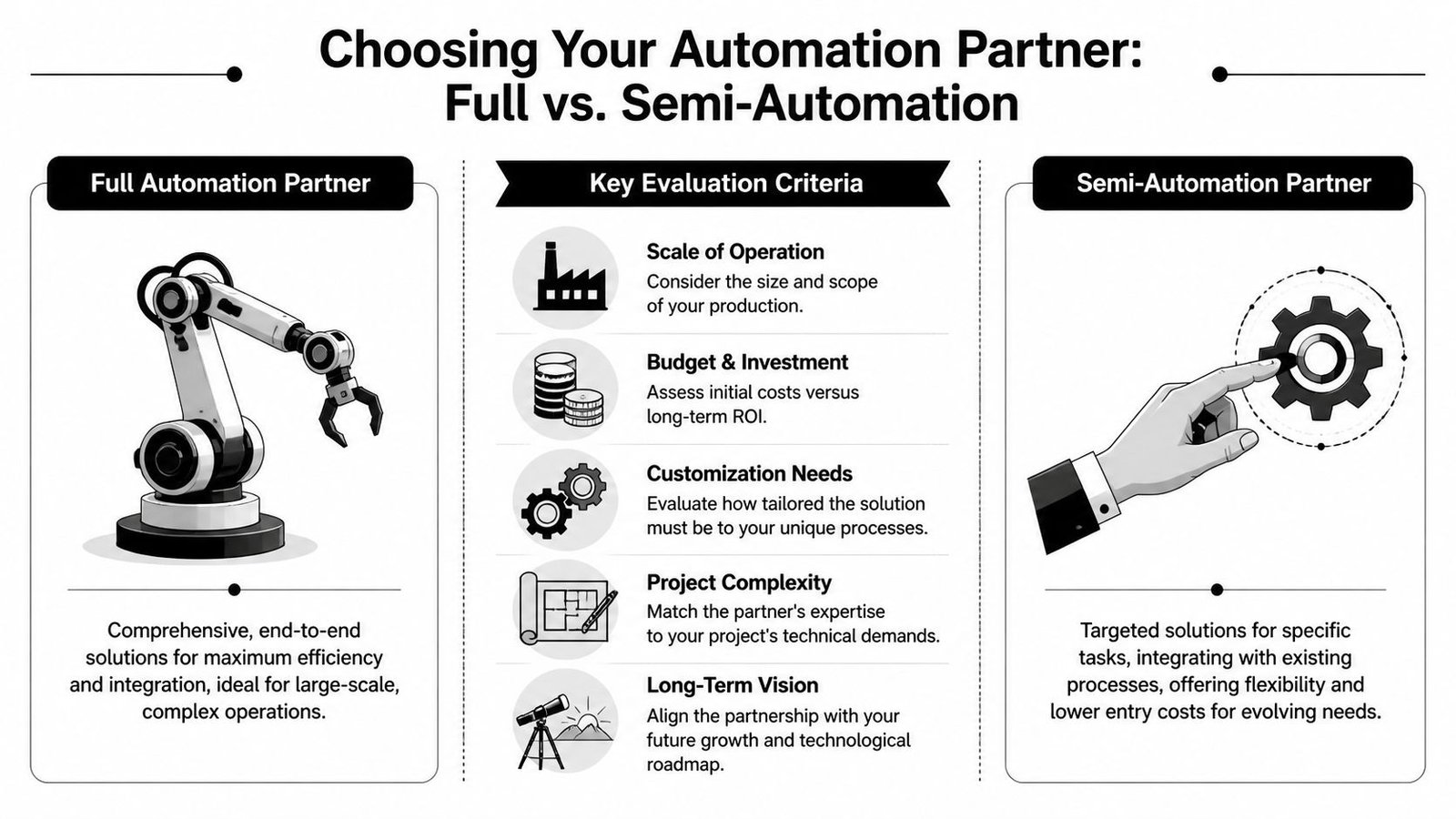
Plants looking at a more incremental path should also understand the logic behind semi-automated systems that fit budget and production goals. In many factories, that model solves the urgent bottleneck without forcing a whole-line redesign.
Automation Partner Models at a Glance
| Criterion | Large-Scale Integrator (e.g., Acro) | Semi-Automation Specialist (e.g., SEA) |
|---|---|---|
| Typical project scope | Broad turnkey systems with multiple integrated functions | Targeted cells, workstations, tooling, fixtures, and phased upgrades |
| Best fit | Stable, high-volume processes with strong capital backing | Evolving processes, constrained budgets, and selective bottlenecks |
| Engineering style | Heavy front-end design, simulation, integration, and validation | Focused problem-solving around operator interaction and practical throughput gains |
| Change tolerance | Best when requirements are well defined early | Better when product mix or process details may continue to shift |
| Implementation philosophy | Build the complete system for long-run consistency | Improve the current state without overcommitting capital or floor space |
| Support expectations | Often suited to plants that can absorb a formal integration process | Often suited to teams that need hands-on flexibility and ongoing adjustment |
How the decision usually plays out
A full-automation partner is usually the better choice when the line is mature, volumes justify a larger capital event, and the process benefits from complete integration across handling, joining, inspection, and testing.
Semi-automation usually wins when the plant is still learning. That includes cases where operators still add judgment, where upstream variation hasn’t been fully controlled, or where management wants measurable production improvement without turning one bottleneck into a massive implementation project.
The mistake is treating semi-automation as a lesser option. In many plants, it’s the smarter one. It lets engineering prove the process, reduce labor dependency, improve safety, and build a realistic roadmap toward higher automation later if the business case strengthens.
Aligning Automation with Your True Production Goals
The right conclusion on acro automation systems inc isn’t “yes” or “no.” It’s “for what kind of project?”
If your plant needs a highly engineered, large-scale system with integrated processes and the organizational readiness to support a substantial automation program, a company with Acro’s profile can make sense. If your real need is a faster, more flexible upgrade to improve one station, one family of parts, or one persistent quality issue, a right-sized semi-automated approach may produce a better operational result with less risk.
The best automation projects share one trait. They match the solution to the plant’s current maturity. Not the ideal future state. Not the most impressive concept rendering. The current state.
Use that as the filter. Define the bottleneck clearly. Decide what must be controlled, what can remain manual, and what your team can realistically support after launch. That’s how manufacturers optimize production and service without overspending on complexity they don’t need.
If you’re weighing a large turnkey system against a more practical station-by-station upgrade, System Engineering & Automation helps manufacturers choose the right level of automation for their process, budget, and quality goals. SEA builds semi-automatic, fully automated, and manual equipment, along with custom tooling, fixtures, and integrated controls, with GMP-aware engineering and end-to-end support from concept through commissioning.