
You’re likely dealing with a familiar mix of problems right now. Output targets keep climbing, operators are stretched, quality issues show up in bursts instead of patterns, and every proposed fix seems to land at one of two extremes: keep doing it manually, or spend heavily on full automation.
Most plants don’t need either extreme. They need performance assembly solutions that fit the actual process, the product mix, the compliance requirements, and the budget. In practice, that usually means tightening the process before chasing technology, then choosing the lowest level of automation that reliably delivers the result.
That approach matters even more in regulated and quality-critical environments. If you build medical, automotive, or other traceable assemblies, speed alone won’t save you. The line has to repeat, document, and recover cleanly when something drifts. The right solution is the one that improves throughput without creating a validation burden you can’t support.
Table of Contents
- From Production Bottlenecks to Performance Assembly
- Clarifying Your Assembly Goals and Metrics
- Choosing Your Automation Level Manual Semi or Full
- Specifying the Right Performance Assembly Solution
- Building the Business Case for Your Solution
- Ensuring a Successful Implementation and Partnership
From Production Bottlenecks to Performance Assembly
A line rarely fails all at once. It usually slips in smaller ways. An operator takes extra seconds to align a part. A torque step gets rechecked because the sequence isn’t enforced. A kit arrives short one component, so the station waits. Quality catches a defect late because the station never recorded the key process value that would have exposed the trend earlier.
Plant managers feel those losses as schedule pressure. Supervisors feel them as overtime, retraining, and escalation. Quality teams feel them as containment, review, and paperwork. Finance sees only that output isn’t matching labor and equipment spend.
That’s where performance assembly solutions are useful as a method, not a product category. The job isn’t to buy a robot because the market likes robotics. The job is to improve the assembly system so the line can produce repeatable output with fewer interruptions, better traceability, and less dependency on operator workarounds.
Shop floor rule: If the process only runs when your most experienced operator is present, you don’t have a stable process yet.
In some plants, the right answer is a smarter manual station. A well-designed fixture, poka-yoke features, digital torque control, and guided work instructions can remove enough variation to solve the problem. In others, a semi-automated station is the middle ground. The operator still loads, verifies, or handles changeover, while the machine controls the step that must be precise every cycle.
That distinction matters. Full automation can be powerful, but it also locks in assumptions about volume, changeover, and product stability. If those assumptions are weak, the line becomes expensive and brittle.
The real shift
The strongest assembly improvements usually come from asking different questions:
- Where does variation enter the process
- Which step causes the most rework or waiting
- What must be controlled every cycle
- What still needs human judgment
- Which upgrade can be validated and maintained by your team
Performance assembly solutions work when they answer those questions clearly. They fail when the equipment is impressive but the process underneath it is still vague.
Clarifying Your Assembly Goals and Metrics
Before anyone discusses tooling, sensors, or controls, define the problem in plant terms. “Improve efficiency” is too loose. It gives engineering one interpretation, operations another, and leadership a third.
Start with what the line is losing now. You’re usually looking at one of five categories: throughput loss, quality loss, labor strain, traceability gaps, or changeover friction.

Start with the loss not the machine
If a station misses target, don’t jump to the conclusion that it needs automation. First identify what is unstable.
Use a simple diagnostic list:
- Cycle time spread: Look at the range, not just the average. If one operator completes the station smoothly and another struggles, the issue may be fixture design, access, presentation, or sequence control.
- Defect escape point: Note where the defect is created and where it’s found. If the defect is found downstream, the upstream station may need confirmation logic or a go/no-go feature.
- Operator burden: Pay attention to repeated reaches, reorientation, force-heavy steps, or visual checks that rely on memory.
- Material flow friction: Short picks, mixed lots, or unclear kit presentation can stall a good assembly station just as easily as poor tooling can.
- Data blind spots: If you can’t tie a defect to torque, sequence, lot, or operator action, you’ll spend more time containing than fixing.
A useful target is concrete and tied to one station behavior. For example, instead of “reduce errors,” define the exact step that needs confirmation, validation, or lockout if it’s missed.
A station should never depend on memory for a step that can be confirmed by tooling, fixturing, or controls.
Build a baseline your team trusts
Bad baselines create bad capital requests. If the operators don’t trust the current-state numbers, they’ll resist the project. If leadership doesn’t trust them, the proposal stalls.
Capture the baseline in a way that operations, quality, and engineering can all use:
- Observe the actual cycle across shifts, not just during the best run.
- Separate manual touch time from delay time so you know whether the problem is assembly effort or interruption.
- Tag each defect by cause type such as orientation, missing component, incorrect torque, damage during handling, or documentation failure.
- Document rework effort because hidden labor distorts the economics.
- Record what the operator checks manually that a fixture or control could verify automatically.
A practical scorecard looks like this:
| KPI area | Current condition | Desired condition |
|---|---|---|
| Throughput | Output misses schedule during demand spikes | Stable output with less variation by operator or shift |
| Quality | Defects discovered after the station | Errors prevented or detected at the station |
| Labor | Operators spend time on alignment, checking, or searching | Operator time focused on value-added handling |
| Traceability | Key steps recorded manually or inconsistently | Critical process steps captured automatically |
| Flexibility | Process depends on tribal knowledge | Changeovers and training are more controlled |
Once that baseline is real, the solution becomes clearer. Some lines need a fixture. Some need integrated torque tools. Some need semi-automation because the process has one or two steps that must be mechanically controlled every cycle.
Choosing Your Automation Level Manual Semi or Full
A line is behind plan by midday. Supervisors add two operators to catch up. Quality finds mixed results by second shift because the extra hands changed the rhythm of the station, not the process. That is usually the point where plant managers start asking the wrong question: “Do we need automation?” The better question is, “Which part of this assembly needs control, and which part still needs people?”
Choosing the right level matters because each option solves a different problem, with a different cost structure and a different validation burden. In small to mid-sized plants, especially in regulated production, the best answer is often not full automation. It is targeted control at the steps that drive scrap, delays, and documentation risk.
Where enhanced manual stations win
Enhanced manual stations still rely on operators, but they remove avoidable variation. A good station can include fixtures, poka-yoke features, torque tools, part sensors, barcode checks, and guided work instructions. That combination often gives a strong return without committing the plant to a dedicated machine for every task.
Enhanced manual fits best when process knowledge is still developing or product mix changes often.
It works well when:
- Operator judgment still matters: Parts may vary slightly, cosmetic acceptance may require human inspection, or the assembly sequence may need small adjustments lot to lot.
- The main losses come from preventable errors: Wrong orientation, missed components, incorrect torque, and skipped checks can often be controlled with simple hardware and logic.
- Capital is limited: The plant can reduce defects and cycle variation without taking on the cost and lead time of a larger automation project.
- GMP discipline is a factor: Simpler controls are often easier to validate, train, clean, and maintain.
The trade-off is straightforward. Enhanced manual stations improve consistency, but they do not remove labor dependence. If output swings every time you change operators or add overtime, manual improvement alone may not be enough.
When semi-automation is the better fit
Semi-automation is the middle ground many factories in SEA should examine first. The operator loads the part, handles the judgment call, or manages changeover. The machine controls the step that must happen the same way every cycle, such as pressing, torqueing, dosing, sealing, force verification, or data capture.
That is why semi-automation often makes financial sense before full automation does. You spend capital only where repeatability pays back.
A practical review of semi-automated systems that bridge manual work and full automation shows why this approach suits plants dealing with mixed product families, moderate volumes, and regular engineering updates.
From a plant floor standpoint, semi-automation is usually the right fit when:
- One or two process steps create most of the risk: Press force, torque, dispense volume, weld time, or component presence needs mechanical control and recorded results.
- The line still needs flexibility: Operators can load different variants while the station keeps the critical process window under control.
- Traceability has to improve: Semi-automated stations can capture torque, cycle completion, barcode data, or pass-fail status without forcing the whole line into a fully automatic architecture.
- You need a faster payback path: A focused station upgrade often costs far less than a full line rebuild and disrupts production less during installation.
In medical device and other GMP-aware environments, this middle ground has another advantage. Validation stays more manageable because the system scope is narrower. You are validating the controlled step and its records, not an entire automated line with every transfer, interlock, and exception state.
The limit is clear too. If operators spend more time feeding, orienting, or clearing the machine than assembling product, the station may be only a temporary answer. Semi-automation works best when the human role is still useful, not when it is just compensating for poor upstream design.
Where full automation still makes sense
Full automation earns its place when the product is stable, demand is predictable, and the process window is already proven. It also makes sense when manual handling creates a contamination, safety, or precision risk that the plant cannot accept.
But many teams jump there too early.
If engineering changes are still frequent, incoming parts still vary, or the assembly method is still being refined, a fully automated system can lock expensive assumptions into steel and software. Changeovers become harder. Debugging takes longer. Validation expands. The machine may be impressive and still miss the business target.
That is why I usually advise plants to treat full automation as a scale decision, not a starting point. First prove the method. Then automate the stable parts aggressively.
Automation Level Comparison Matrix
| Factor | Enhanced Manual | Semi-Automated | Fully Automated |
|---|---|---|---|
| Capital intensity | Lowest of the three | Moderate | Highest |
| Flexibility | High | High to moderate | Lowest when product mix changes often |
| Operator involvement | High | Shared between operator and machine | Low during normal running |
| Changeover handling | Usually simpler | Manageable with good design | Can become complex |
| Best use case | Variable assemblies, guided manual tasks, quick upgrades | Precision-critical steps with human loading or oversight | Stable, repeatable, high-volume production |
| Validation burden | Lower | Moderate | Highest |
| Ramp-up risk | Lower | Moderate | Higher if assumptions are wrong |
| Typical failure mode | Too much reliance on operator discipline | Under-specifying controls or part presentation | Overbuilding for a process that still changes |
A simple rule helps. If the process is still changing every month, start by controlling the step that hurts yield or throughput most. If the process has been stable for a long time and volume keeps climbing, full automation deserves a serious business case.
Specifying the Right Performance Assembly Solution
A line stops at 2:10 p.m. because one fastener did not seat correctly, the operator is unsure whether the part can be recovered, and QA now has to sort everything produced since the last confirmed good cycle. That kind of loss usually starts with a weak specification, not a bad machine.
The point of the spec is simple. It must tell an integrator, your maintenance team, and quality exactly how the station should run, what it must verify, and how it should fail without creating scrap, delays, or GMP problems.
A good User Requirement Specification, or URS, turns a broad concept into requirements the plant can test and accept.

What belongs in the URS
Start with production conditions, not the machine brochure. Define the product family, takt target, shift pattern, part presentation, critical-to-quality features, acceptable variation, and the exact checks required before a unit can move to the next step. In GMP-aware environments, also state what must be recorded, reviewed, and retained for batch release or traceability.
Then lock down the details that usually cause trouble later:
- Tooling and fixturing requirements: Part location, clamping method, datum strategy, ergonomic loading, change parts, and access for cleaning or maintenance.
- Process control requirements: Torque, force, displacement, timing, sequence validation, barcode or lot capture, and pass/fail logic.
- Traceability needs: What has to be recorded, where it lives, and how operators or quality staff retrieve it.
- Safety expectations: Guarding, interlocks, operator access, e-stop layout, and recovery method after a fault.
- Serviceability: Tool access, wear part replacement, calibration points, and spare parts strategy.
For a critical fastened joint, “driver included” is too vague to be useful. Specify a torque-controlled driver with sequence validation, define the acceptable window, state what happens after a failed rundown, and confirm whether the station must block progression until the deviation is cleared. That level of detail protects output and makes FAT, SAT, and validation far cleaner.
For small and mid-sized plants, replacement is not always the best answer. If the base machine is mechanically sound, a focused retrofit on controls, sensing, poka-yoke, or operator guidance can remove the actual bottleneck at a lower cost and with less disruption. That approach is often the practical middle ground for plants that need better performance without committing to a full new cell. See these retrofit automation approaches for legacy systems.
Use controls and sensors where they prevent real losses
Sensors should be specified against a known failure mode. If a sensor does not stop a recurring defect, prevent a line stop, reduce checking time, or improve traceability, it is probably adding cost and maintenance work without enough return.
This short overview is useful before the spec gets locked in:
One common example is part availability at the station. If operators lose minutes every hour checking bins, calling for replenishment, or confirming the right component, a simple sensor, stack light, or connected replenishment signal may deliver more value than another axis or index table. I have seen semi-automated cells improve output with that kind of upgrade because the primary constraint was not assembly speed. It was waiting, checking, and recovering from avoidable shortages.
The same logic applies to quality checks. Add presence sensing where missing parts are a real issue. Add force or displacement monitoring where fit variation creates escapes. Add barcode or lot capture where traceability gaps trigger investigations. Match the device to the loss.
Specify fault handling just as carefully. A station that detects an abnormal condition but leaves the operator with no clear recovery sequence will still create scrap, queue time, and deviation work. The URS should define what the machine does on failure, what the operator is allowed to do next, what must be logged, and when supervisor or quality approval is required.
Building the Business Case for Your Solution
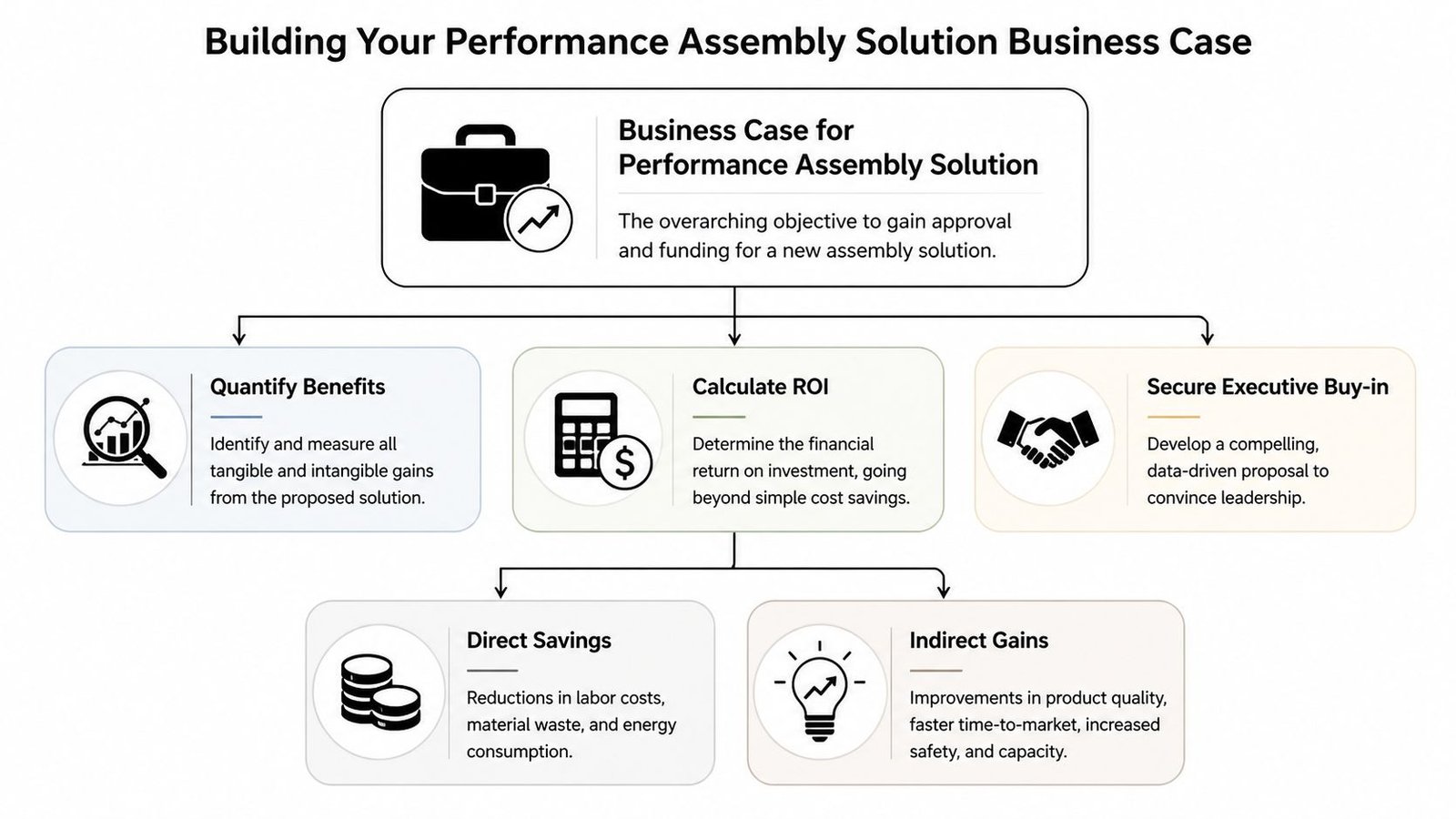
Good technical logic isn’t enough. Budget approval usually depends on whether the proposal shows clear financial impact, practical risk reduction, and a path to implementation the plant can support.
That means the business case has to connect the assembly problem to money the organization already recognizes. Labor matters, but it’s rarely the whole story. Scrap, rework, downtime, blocked capacity, deviation handling, and delayed release often matter just as much.
What leadership actually needs to see
Executives usually don’t need every engineering detail. They need confidence that the project solves a defined problem and won’t create a new one.
A credible business case should answer these questions:
- What loss is being removed: Missed output, repeated rework, manual inspection burden, compliance exposure, or labor dependency.
- Why this solution level fits: Not just why it works, but why it’s better than doing nothing or overbuilding.
- What operational assumptions sit underneath it: Product mix, staffing, shift pattern, expected changeovers, and maintenance support.
- How success will be verified: Ramp criteria, acceptance conditions, and owner by function.
A compact way to present that is with a before-and-after summary.
| Business case element | Current state | Proposed effect |
|---|---|---|
| Throughput | Capacity constrained by manual bottleneck | Higher output from a stabilized station |
| Quality | Rework and inspection consume labor | Better first-pass control at the point of assembly |
| Compliance | Manual records or fragmented traceability | Automated capture of critical process data |
| Staffing | Process depends on operator experience | Better repeatability across shifts |
| Scalability | Improvement requires more labor | Improvement comes from process control |
A practical ROI model for semi-automation
For capital approval, keep the model grounded. Start with direct savings, then add the operational gains that affect cost or capacity.
Use this structure:
- List the total project cost including equipment, integration, validation activity, training, and startup support.
- Calculate direct savings from labor removed, reduced scrap, reduced rework, and fewer interruptions.
- Add capacity value if the line can produce more without adding headcount or floor space.
- Include quality and compliance effects when the station captures required process data or prevents repeat deviation work.
- Show the downside of inaction so leadership can compare the project against ongoing loss, not against a perfect future state.
For medical device manufacturers, the business case for semi-automation is often stronger than teams expect. As cited earlier in the semi-automation section, the available data shows meaningful throughput gains, faster ROI than full automation, and fewer regulatory resubmissions when integrated controls are part of the system. That matters because those are not just engineering wins. They affect release speed, documentation burden, and the cost of recurring quality events.
Decision test: If the proposal only pays back on labor reduction, check whether you’re understating the value of quality control, traceability, and released capacity.
Plants often lose approval because the proposal is framed as “equipment purchase” instead of “controlled reduction of recurring operating loss.” The stronger argument is usually the second one.
Ensuring a Successful Implementation and Partnership
The quote is approved. The PO is issued. Six weeks later, the line is still arguing about part tolerances, sensor placement, validation scope, and who owns startup decisions. That is how otherwise sound assembly projects lose time and budget.
A successful implementation depends less on the machine itself and more on project control. In medical device and regulated production, the same discipline used in APQP, PFMEA, requirement reviews, and validation planning reduces late surprises because problems are pulled forward, before they reach commissioning. AIAG treats this front-end planning approach as a core part of launch readiness for exactly that reason.
Program discipline prevents expensive rework
Plant managers should expect a supplier to manage more than design and build. The partner also needs a clear method for handling requirement changes, documenting decisions, and closing risks before the machine ships.
The project should include:
- Early requirement alignment: Operations, engineering, quality, validation, and maintenance need the same definition of success before design freeze.
- Controlled supplier inputs: Drawings, material specs, tolerance assumptions, certifications, and acceptance criteria should be confirmed before fabrication and incoming trials.
- Formal risk review: PFMEA should identify likely failure modes, detection gaps, and operator misuse before they become startup issues.
- Milestone reviews with owners: Build review, software review, test readiness, documentation readiness, and launch readiness each need named owners and closeout dates.
Factory acceptance is one of the clearest pressure points. If the FAT is weak, site startup turns into debug time, and debug time on your production floor is expensive. A disciplined factory acceptance test process for assembly equipment helps catch sequence errors, recovery logic problems, interlock gaps, and missing documentation before the system reaches the plant.
Post-launch support decides whether the line actually holds
A station can pass FAT and still struggle in daily production. I see the same causes repeatedly. Operators were trained on the happy path only. Maintenance got drawings but no practical fault logic. Quality expected one data record format while controls delivered another.
Good implementation plans cover the first 30 to 90 days after launch, not just the handoff date.
Make sure the scope includes:
- Operator training tied to actual station conditions: Normal cycle, fault response, reject handling, changeover, and restart after interruption.
- Maintenance support that works on shift: Spare parts lists, troubleshooting steps, backup procedures, and clear ownership for controls issues.
- Defined escalation paths: Software edits, calibration, wear items, process drift, and validation-impacting changes should all have a decision path.
- Performance confirmation after startup: Actual cycle time, first-pass yield, downtime causes, and alarm history should be reviewed against the original target.
That last point matters in small and mid-sized plants. Full automation projects often have dedicated launch teams and bigger contingency budgets. Semi-automated lines usually do not. The practical middle ground only pays back if the system is stable, GMP-aware, and supportable by the team you already have. A good partner leaves behind a controlled process, usable documents, and a realistic path for the next upgrade without forcing you into more automation than the plant needs.