A line can run well at full volume and still depend on one or two people to hold quality, pace, and changeovers together. When those operators are absent, output slows, defects rise, and supervisors spend the shift solving the same problem again. That's the point at which automation earns a serious look, not as a technology showcase, but as a production decision.
The nine automation system examples below form a ladder. It starts with tooling that improves one workstation, moves through semi-automatic and hybrid cells, and ends with plant-wide control and production planning. The right rung depends on volume, product variety, changeover frequency, budget, workforce capability, and regulatory load. A medical device maker may need traceability and controlled processes before it needs maximum speed. A high-volume manufacturer may justify robotic handling, while a small batch producer may get better results from an adjustable fixture and an operator-assisted cell.
The objective is practical: optimize production and services without overbuilding. Each example shows where the system fits, what usually drives the return, and where implementation fails.
Table of Contents
- 1. Custom Tooling and Fixtures
- 2. Collaborative Robot Workstations
- 3. Semi-Automated Assembly Lines
- 4. Robotic Process Automation in Manufacturing
- 5. Automated Material Handling and Conveyor Systems
- 6. Automated Quality Control and Inspection Systems
- 7. Automated Testing and Validation Systems
- 8. Integrated Control Systems PLC and SCADA
- 9. Manufacturing Execution Systems and Production Planning
- 9-Point Automation Systems Comparison
- Choosing Your First Automation Step With Confidence
1. Custom Tooling and Fixtures
Custom tooling is often the best first automation step because it fixes the physical cause of variation without forcing a complete line redesign. A precision fixture can locate a part, control orientation, guide an operator's motion, or hold an assembly during fastening, inspection, or packaging. The result is a more repeatable process with less manual handling and fewer opportunities to load a component incorrectly.
In medical device production, a fixture might hold a kit during sterile packaging or verify that components are present and correctly positioned. An automotive plant may use a precision jig to align an engine block assembly. Electronics manufacturers use fixtures for PCB component positioning, while pharmaceutical operations may require fixtures designed around controlled filling work.
Practical rule: Design the fixture around the operator's actual motion, not the idealized motion shown on a drawing.
Production workers should participate alongside engineers during the design phase. They'll identify awkward reaches, poor access, difficult cleaning points, and changeover steps that aren't obvious in a CAD model. Build in adjustment for minor product variations, document tolerances, and define how the fixture will be cleaned, inspected, calibrated, and stored.
Material selection also affects lifecycle value. Aluminum may suit a lighter-duty, frequently changed fixture. Hardened steel may be appropriate for high-volume use or repeated clamping. Quick-change features can protect changeover time, but they add mechanical complexity that must be maintained.
For regulated manufacturing, the fixture's specifications, maintenance history, and use conditions need to support the quality system. FDA's quality framework includes equipment calibration, inspection, testing, controlled procedures, and records appropriate to the device and manufacturing process FDA quality-system overview. A simple fixture can still become a quality risk if nobody controls its wear or verifies its performance.
2. Collaborative Robot Workstations
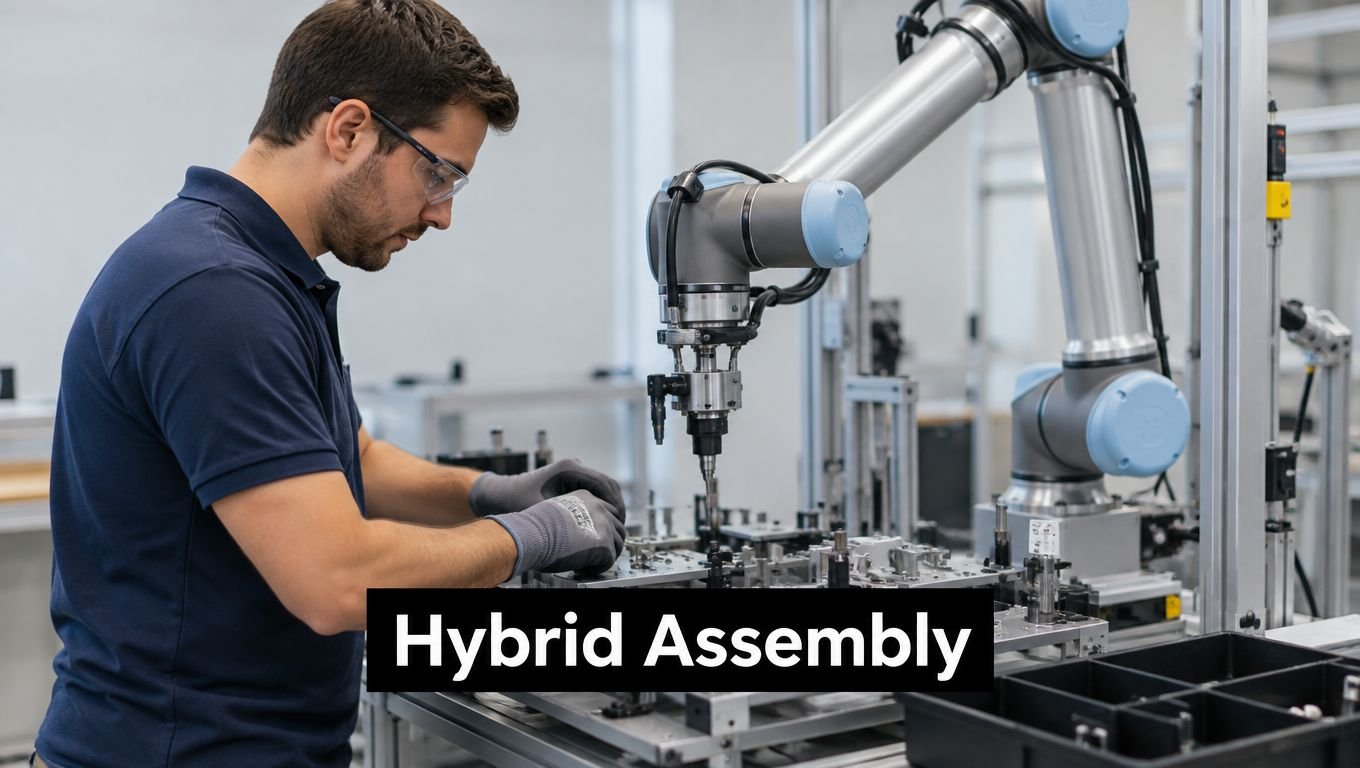
A cobot workstation suits manufacturers that need assistance with repetitive motion but still rely on people for judgment, dexterity, or product decisions. The robot may hold a component, pick parts, load a machine, position a product for inspection, or perform a repeatable placement while an operator handles the variable work.
That division is useful in small-batch and high-variety production. A medical device technician might complete a precision assembly while a cobot presents parts in a consistent orientation. In packaging, the cobot can pick products while the operator verifies contents and completes the pack. In CNC machine tending, the cobot handles loading and unloading while the operator manages setup and process decisions.
Start with a task that is repetitive, physically tiring, and easy to describe. Early success depends less on advanced programming than on the gripper, part presentation, and operator interface. A poorly designed end effector will turn a capable robot into an unreliable cell.
Design the human-robot boundary deliberately
A collaborative label doesn't remove the need for a safety assessment. Review pinch points, tooling hazards, unexpected restarts, dropped parts, emergency stops, and the effects of changes to the product or program. Train operators to use the controls and recover from faults rather than treating the cobot as a sealed appliance.
Vision can help when parts arrive in slightly different positions, but it also creates another system that needs lighting control, validation, troubleshooting, and change management. Wireless data collection may support maintenance alerts, though the network boundary and cybersecurity responsibilities should be defined before deployment.
The right hybrid station keeps human responsibility clear. If the operator is expected to verify a critical feature, the station should present the part consistently and record the relevant result. If the robot's only purpose is to replace a short walk, a simpler fixture or point-of-use material rack may deliver the better return.
A cobot earns its place when it removes strain and repetitive motion while preserving flexibility. It doesn't earn its place merely because a robot can perform the task.
3. Semi-Automated Assembly Lines
Semi-automated assembly lines are usually the strongest compromise for manufacturers with meaningful volume, multiple product variants, and limited tolerance for a long commissioning effort. Automation handles repeatable operations such as fastening, welding, dispensing, loading, or packaging. Operators retain tasks that require inspection, judgment, variant selection, or fine manipulation.
A medical device line might automate sterile packaging while an operator performs visual quality verification. An automotive process may use robotic welding followed by manual inspection. Electronics production may automate component placement but keep soldering or functional testing with trained technicians.
The build decision should come from a time and motion study. Measure where the operator waits, walks, reaches, repeats a forceful motion, or corrects a predictable error. Automate the constraint first. A line that automates a non-bottleneck operation can look impressive while leaving output unchanged.
See how semi-automated assembly lines are configured when comparing manual stations with integrated equipment.
Where the hybrid model wins
A semi-automatic line handles demand variation better than a dedicated fully automated line when products change often. It can also make maintenance and recovery more straightforward because trained operators remain part of the process. The trade-off is that output still depends on standard work, staffing, training, and ergonomic design.
Use clear work instructions, visual management, and defined handoffs between manual and automatic operations. Cross-training helps supervisors cover absences and demand peaks, but it doesn't replace good station design. If the operator has to fight the machine to keep the process moving, the cell will accumulate work-in-process and hide its real capacity.
The peer-reviewed robotic production study at PMC illustrates why product mix matters. In a large-scale production case, robotic automation increased throughput by 31.2%, with the improvement matching between simulation and live application. In an order-based environment, throughput improved by 12.0%, because product variability and order-specific requirements reduced continuous robot utilization. The lesson is direct: evaluate the hybrid architecture against actual mix and changeover conditions, not nominal machine speed.
4. Robotic Process Automation in Manufacturing
In a plant, robotic process automation can mean software-driven transactional work, industrial robots, or both. The physical examples are familiar: robotic welding, machine tending, pick-and-place, palletizing, case packing, and material handling. The software side can coordinate instructions, records, and data exchanges around those operations.
An automotive line may use robots for welding and engine-line material handling. Electronics manufacturers use pick-and-place equipment for component placement. Medical device operations may use collaborative robots in controlled assembly steps. Packaging plants often combine case packing with palletizing, while injection molding operations use robots to load and unload machines.
The business case is strongest when a task is repetitive, high-volume, hazardous, or difficult to staff consistently. The International Federation of Robotics recorded 4,281,585 industrial robots operating in factories worldwide in 2023, a 10% increase from the previous year World Robotics data from the IFR. Manufacturers installed 541,302 new robots during 2023, the second-highest annual total recorded and only 2% below the 2022 record of 552,946 installations. Those figures show that industrial robots are a mainstream production capability, but they don't tell you whether a robot belongs on your line.
Build around recovery, not just cycle time
Before committing, confirm floor space, safety zones, part presentation, maintenance access, and fault recovery. Simulate the cell to test cycle time and accumulation. Keep critical spare parts available, document programs, and train backup operators. A robot that stops the entire line because one gripper sensor fails is not an automated solution. It's a new bottleneck.
5. Automated Material Handling and Conveyor Systems
Material handling automation earns value by protecting production flow. Conveyors, automated guided vehicles, robotic arms, sortation equipment, and accumulation zones can move components and finished products without tying operators to transport work. That can reduce manual travel and handling exposure while keeping stations supplied.
An automotive plant may use AGVs to deliver components just in time. A medical device facility may use tracked conveyors to move products through controlled assembly zones. Pharmaceutical packaging operations can use carousel systems to stage batches. Food processors need equipment designed for washdown conditions, while distribution environments often depend on automated sortation.
The first engineering task is not selecting a conveyor. Map the facility, product routes, replenishment points, staging areas, and return flows. Identify where material waits, where operators cross traffic lanes, and where one blocked station backs up the rest of the process.
Protect the system from upstream variation
Buffers and accumulation zones can decouple stages, but too much accumulation hides problems and consumes floor space. Barcode or RFID identification can route products correctly, provided the plant controls label quality, scanner placement, and exception handling. PLC integration can coordinate movement, but operators still need clear controls and a practical recovery procedure.
Size for the process you run, with room for future product changes. Oversizing every conveyor and vehicle fleet increases capital and maintenance burden. Undersizing creates starvation and blockage. Predictive maintenance can help, but technicians still need access, spares, inspection routines, and training on basic troubleshooting.
For medical device makers, traceability must follow the product through each material move. A conveyor that speeds up transport but loses product identity creates quality work instead of removing it. The same principle applies to pharmaceutical, food, and other operations where lot control and controlled handling matter.
6. Automated Quality Control and Inspection Systems
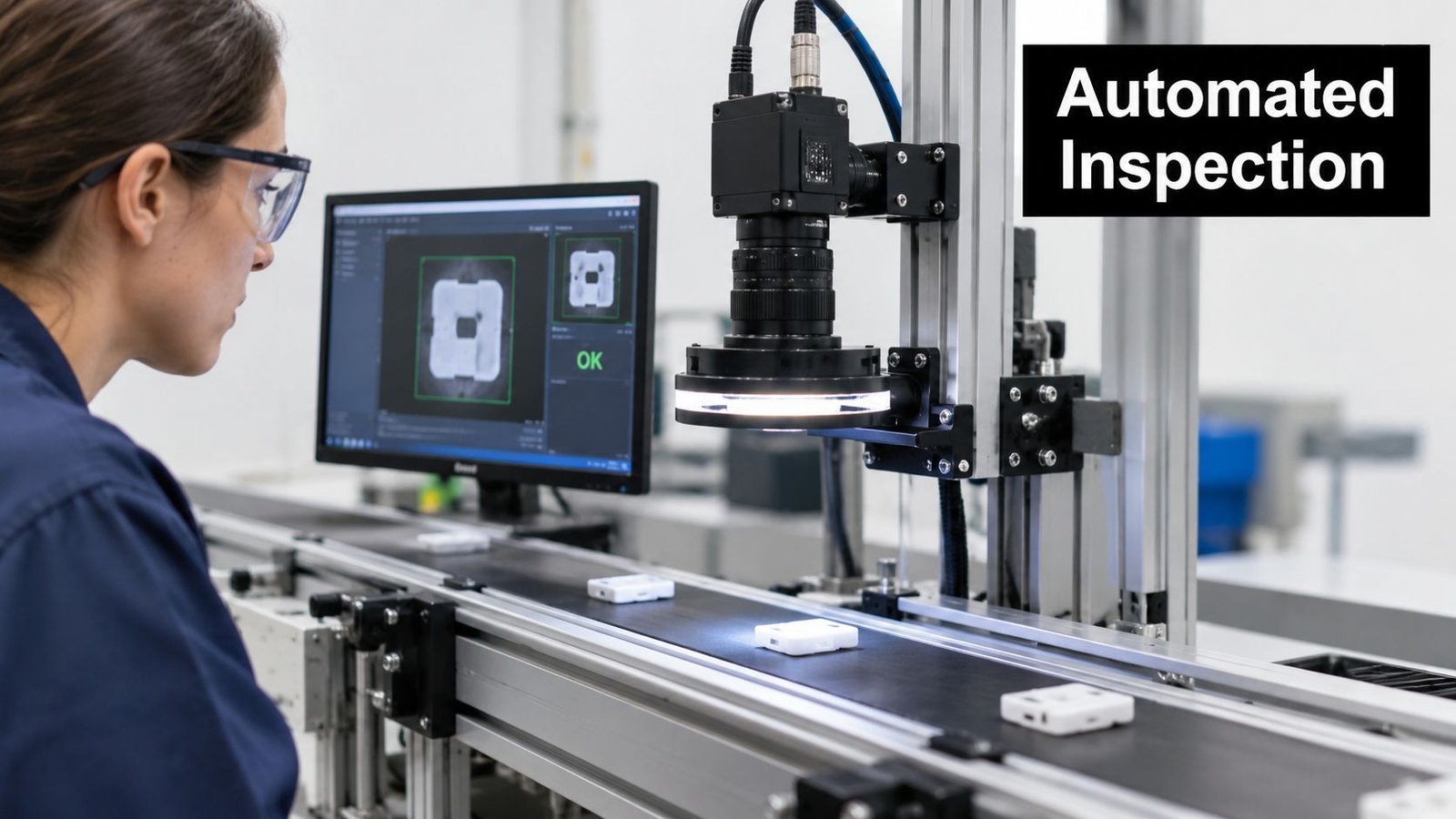
Automated inspection is a good fit when the acceptance criteria are clear, the feature can be presented consistently, and the cost of missed defects is high. Vision systems, sensors, measurement devices, and algorithmic classification can inspect products in line rather than relying entirely on end-of-shift sampling or manual checks.
Medical device packaging provides a clear example. A vision station can check for missing labels, damaged packaging, incorrect presentation, or other defined conditions. Electronics manufacturers inspect solder joints and component placement. Automotive plants examine painted surfaces and dimensional features. Food and beverage operations may verify fill level, seal integrity, or foreign-object conditions.
The system only performs as well as its acceptance criteria and product presentation. Define what counts as pass, fail, and review before selecting cameras or software. Control lighting, vibration, background, and part orientation. Build a representative image set that includes acceptable variation and known defects when an algorithm is involved.
Explore vision inspection system considerations before designing the camera, lighting, handling, and reject architecture.
Make every reject actionable
A reject mechanism needs a clear destination. Quarantine, rework, review, and release rules should be defined before the first production run. Operators need to understand what the system detects, what it cannot detect, and how to challenge a result without bypassing the control.
Integrate results with the MES or ERP where that supports production decisions and traceability. Establish calibration and verification routines, and document software or recipe changes. FDA guidance emphasizes controlled documentation, equipment calibration, inspection and testing, and processes that are adequate for their intended use FDA production and process controls. In regulated production, an image on a screen is not enough. The inspection method, result, disposition, and responsible personnel need to fit the quality system.
7. Automated Testing and Validation Systems
Testing automation is valuable when every unit needs a repeatable functional, electrical, pressure, leak, strength, or performance check. The machine may apply the test, measure the response, compare it with defined limits, and associate the result with the product record. That makes the station more consistent than a manual test that depends on individual technique.
A medical device manufacturer may automate functional testing and capture results against a serial number. Automotive operations may perform high-voltage checks on electrical components or battery systems. Electronics plants use automated functional testing and burn-in. Pharmaceutical manufacturers may automate selected tests for moisture, dissolution, or other defined characteristics. Plumbing manufacturers can automate pressure and flow validation for valves and fittings.
The correct automation level depends on test volume, product variation, and the consequence of a false result. A flexible test bench with operator loading may outperform a dedicated tester when variants change frequently. A fully automated system can make sense when the product is stable and the test sequence is repeated continuously.
A fast test that cannot prove what it tested, with which recipe, on which calibrated equipment, is not a controlled production test.
Quality engineers should define acceptance criteria, escalation rules, and traceability requirements early. Design fixtures for fast insertion and removal, but don't sacrifice part protection or repeatable contact. Build dashboards that reveal drift and out-of-spec trends, and schedule recalibration according to the equipment and quality system.
The documentation burden is part of the design, not an afterthought. Test procedures, software versions, calibration records, failed-unit disposition, and change approvals should be accessible to the people responsible for production and quality.
8. Integrated Control Systems PLC and SCADA
PLC and SCADA systems become worthwhile when individual machines need to behave like one coordinated process. A PLC handles real-time logic, sequencing, interlocks, sensor inputs, and actuator commands. SCADA gives supervisors and engineers a higher-level view of equipment status, alarms, recipes, trends, and production data.
A beverage operation may monitor filling, capping, and labeling stations together. A pharmaceutical process may use PLC logic for batch sequencing and recipe verification. Automotive production can coordinate robotic stations with quality checkpoints. Medical device sterilization requires controlled temperature and pressure behavior with records that support review. Packaging lines can use coordinated controls to manage multiple formats and changeovers.
Start with a modular architecture. Define equipment interfaces, naming conventions, alarm priorities, data ownership, and the boundaries between machine controls and supervisory software. A system that grows through undocumented additions becomes difficult to troubleshoot and expensive to modify.
Keep control ownership visible
Document PLC logic, SCADA configuration, network architecture, backups, and recovery steps. Train more than one technician. Protect networked systems with appropriate access controls and cybersecurity practices. Redundant power or control hardware may be justified for critical processes, but redundancy adds testing and maintenance responsibilities.
Integration also affects validation. If a recipe change alters a critical process parameter, the plant needs a controlled way to approve, deploy, and verify it. The same applies to barcode validation, torque or force verification, vision results, and pass or fail release logic.
Review SCADA system integration options with the physical equipment, controls, data, and maintenance team considered together. SCADA shouldn't become a dashboard project detached from the process. It should help the people responsible for output, quality, and uptime make faster, better decisions.
9. Manufacturing Execution Systems and Production Planning
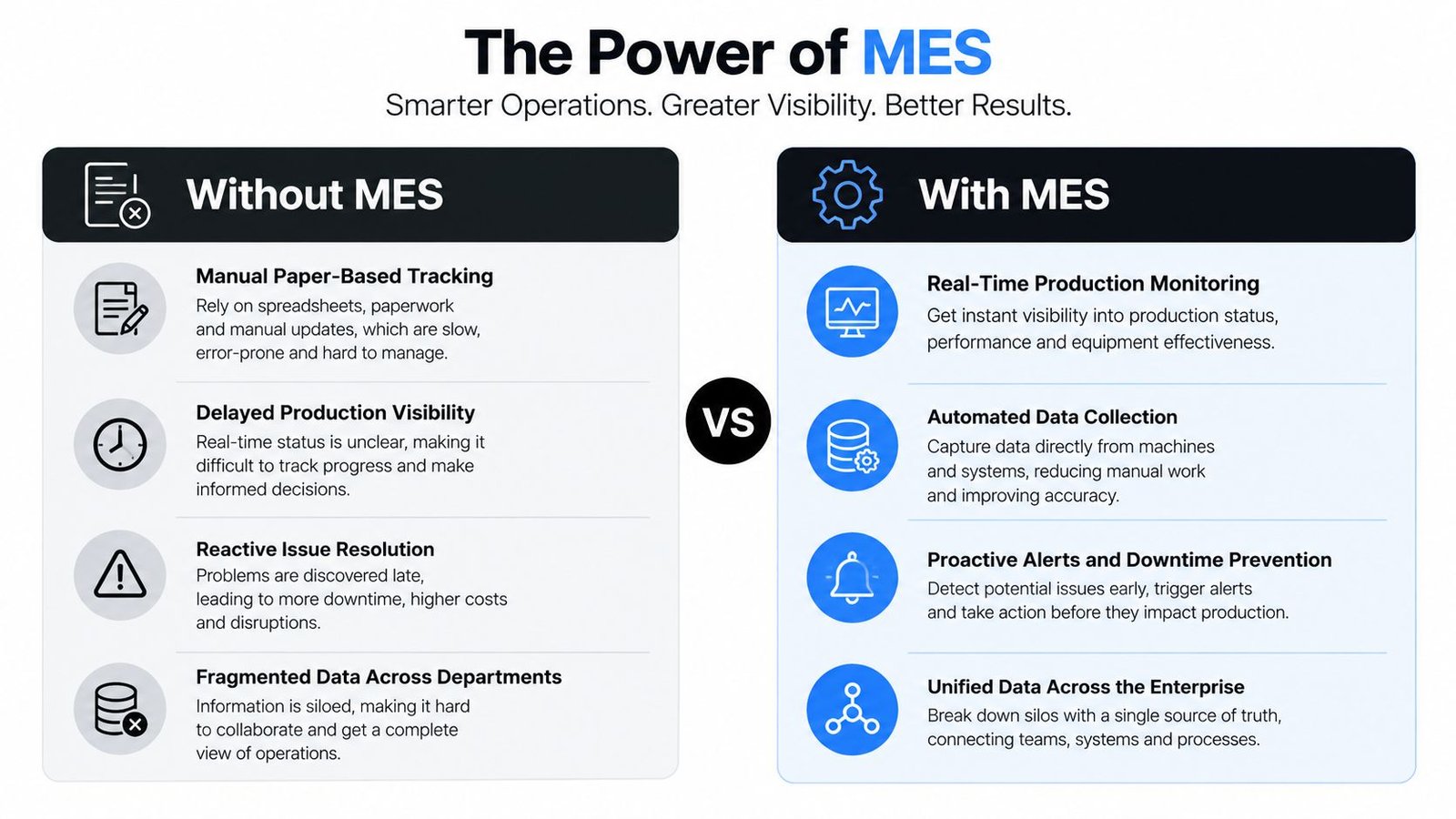
An MES connects plant-floor activity with business planning. It can show production status, manage work orders, collect process data, track material and labor, support scheduling, and preserve the relationship between a product and the operations used to make it. That makes it particularly useful when multiple products, work centers, recipes, and quality checks compete for the same resources.
A pharmaceutical manufacturer may use MES to maintain batch genealogy through production and support recall decisions. An automotive parts producer can coordinate schedules across work centers. A medical device operation can connect material delivery, assembly instructions, and quality verification. Electronics manufacturers benefit when bills of material and assembly sequences change frequently. Food and beverage producers can track lot information through production and distribution.
MES implementation fails when the plant automates bad data and unclear ownership. Map the current process first. Define the system of record for materials, work orders, recipes, quality results, and downtime. Then build dashboards around decisions supervisors make, such as whether to release a job, move labor, investigate a recurring stop, or hold material.
Phase the rollout around production value
Begin with a high-impact area rather than attempting a plant-wide transformation. Integrate with the existing ERP where practical so employees don't enter the same information in multiple systems. Establish data governance and clear responsibilities for data entry, master data, equipment interfaces, and issue resolution.
The business case should use a baseline rather than a promise. Historical production records can establish current cycle time, scrap, utilization, schedule adherence, and labor hours. After implementation, compare equivalent products and demand conditions. The goal is not more screens. It's better control over production decisions and fewer manual handoffs.
9-Point Automation Systems Comparison
| Solution | Implementation Complexity 🔄 | Resource & Cost Requirements 💡 | Expected Outcomes ⭐ | Speed / Efficiency ⚡ | Ideal Use Cases 📊 |
|---|---|---|---|---|---|
| Custom Tooling and Fixtures | Medium–High: precision design, fabrication and calibration lead time | Upfront engineering & fabrication costs; moderate maintenance/calibration | High repeatability, reduced scrap, strong ROI for steady products | Improves cycle times via ergonomics and repeatability | Small–mid manufacturers, medical device assembly, precision fixtures |
| Collaborative Robot (Cobot) Workstations | Low–Medium: easy programming but requires safety assessment | Lower capital than industrial robots; add grippers/vision as needed | Better safety, flexible tasking, improved consistency | Moderate; slower than industrial robots but flexible for mixed tasks | Small-batch/high-variety assembly, machine tending, ergonomic assist |
| Semi-Automated Assembly Lines | Medium: integrate manual stations with automated machinery | Lower upfront than full automation; ongoing labor and training costs | Balanced flexibility and efficiency; faster ROI for mid-volume runs | Moderate; throughput tied to human performance and automation mix | Mid-volume, customizable products, lean production upgrades |
| Robotic Process Automation (RPA) in Manufacturing | High: complex programming, safety zones, integration work | High capital and specialized programming/maintenance expertise | High consistency, error reduction, enable 24/7 operation | High for repetitive tasks; significant gains at volume | High-volume repetitive tasks, hazardous ops, palletizing, welding |
| Automated Material Handling & Conveyor Systems | High: facility layout changes and complex system integration | High installation and integration cost; maintenance and spare parts | Continuous flow, reduced manual handling, improved throughput & tracking | Very high throughput and reduced cycle times when optimized | Fulfillment centers, multi-line plants, JIT component delivery |
| Automated Quality Control & Inspection Systems | Medium–High: vision/AI tuning, lighting and fixture integration | Significant hardware/software and vision/AI expertise required | Consistent, bias-free inspection; 100% inspection and traceability | Very fast inline inspection; reduces manual inspection bottlenecks | Regulated industries (medical/pharma), high-value electronics, zero-defect goals |
| Automated Testing & Validation Systems | High: develop test procedures, fixtures, and calibration regimes | High equipment and engineering costs; periodic recalibration needed | Ensures spec compliance, reduces field failures, audit-ready records | Can add cycle time if not optimized; enables rapid pass/fail decisions | Safety-critical products, regulated manufacturing, functional test stages |
| Integrated Control Systems (PLC/SCADA) | High: detailed programming, I/O mapping, and configuration | Moderate–High hardware/software and skilled technicians | Real-time control and visibility; reduced downtime and coordinated ops | Enables optimized sequencing and faster fault response | Coordinated multi-machine lines, batch control, facilities pursuing Industry 4.0 |
| Manufacturing Execution Systems (MES) & Production Planning | Very High: complex implementation, data mapping and change management | High software licensing, integration, customization, and training costs | Significant visibility, traceability, OEE improvements and process control | Improves throughput via optimized scheduling; depends on data quality | Multi-product plants, regulated industries, continuous improvement programs |
Choosing Your First Automation Step With Confidence
Start with the problem that costs the plant attention every day. It may be a bottleneck, a recurring defect, an ergonomic exposure, an unreliable changeover, or a traceability gap. Name the problem in measurable operating terms before anyone proposes a robot, conveyor, vision camera, or MES module.
Then match the problem to the lightest system that can remove it. A custom fixture may solve a positioning problem better than a robot. A cobot may remove repetitive loading while preserving operator judgment. A semi-automatic station may fit mixed-model production where a fully automated line would struggle with changeovers. PLC and SCADA integration may be the correct investment when machines work well individually but lose time through poor coordination. MES belongs higher in the stack, when the plant needs reliable visibility and control across products, work centers, materials, and quality records.
Volume matters, but it isn't the only decision variable. The IFR reported 70% of new industrial robot deployments in Asia, 17% in Europe, and 10% in the Americas during 2023, with China installing 276,288 robots, equal to 51% of worldwide installations IFR global robotics distribution. Those figures confirm the scale of industrial automation, not a universal requirement for full automation. A smaller manufacturer may gain more from staged deployment, starting with a robot-assisted workstation, automated loading, or a semi-automatic fixture.
Cost and capability also set the practical boundary. A 2025 industrial automation survey found that 60% of respondents favored moderate, steady adoption focused on return on investment, while implementation cost was identified as the leading barrier by 55%, followed by legacy-system integration at 44% and workforce skill gaps at 35% Control Engineering's 2025 automation survey. That supports a disciplined sequence rather than a race toward the most complex system.
Use a pilot to expose the real work
Pilot one station or one line. Establish the baseline before installation, including scrap, cycle time, labor hours, quality results, changeover losses, equipment utilization, and relevant safety or ergonomic observations. The MANTEC robotics benchmark recommends baseline measurement and reports one implementation with 20% higher throughput, 30% fewer ergonomic incidents within three months, 15% fewer packaging defects, a 14-month payback period, and $73,000 in annual labor savings MANTEC robotics implementation benchmark. Treat those figures as a benchmark from that implementation, not as a promise for every plant.
For medical device manufacturers selling in the United States, the quality system must shape the build from the beginning. FDA's QMSR became effective on February 2, 2026, incorporates ISO 13485:2016 by reference into 21 CFR Part 820, and applies to finished-device manufacturers intending to distribute devices commercially FDA QMSR requirements. Equipment, fixtures, controls, testing, records, and changes need to support documented and controlled production, not just faster output.
Scale only after the pilot proves that operators can run the process, technicians can maintain it, quality can verify it, and supervisors can act on its data. Deloitte's 2025 manufacturing survey found 65% of respondents ranked operational risk among their top mitigation priorities, and process automation ranked as a first- or second-priority investment for 46%, compared with 37% for physical automation Deloitte 2025 smart manufacturing survey. A maintainable, auditable workstation may create more lasting value than an autonomous cell that the plant can't support.
Manufacturers and medical device makers weighing semi-automatic, hybrid, or fully automated builds should map production goals, product variation, compliance needs, available skills, and budget with an engineering partner. System Engineering & Automation designs around those constraints and supports projects through installation, commissioning, and ongoing maintenance. That approach keeps automation tied to the process and the people who must run it.
System Engineering & Automation provides custom tooling, fixtures, semi-automatic and fully automated systems, integrated controls, robotics, conveyors, and engineering support for manufacturers that need practical production improvements. Visit System Engineering & Automation to discuss a workstation, inspection system, or scalable automation build matched to your volume, changeover, compliance, and budget requirements.