A production manager at a mid-sized medical device manufacturer often reaches the same uncomfortable point: the manual assembly line still produces acceptable units, but output varies by operator, bottlenecks appear during demand spikes, and quality personnel spend too much time reconstructing what happened during a batch. The proposed automation project promises relief, yet the first question isn't which PLC to buy. It's whether the control system will support the process, the people, the facility, and the compliance burden for years to come.
That's the practical challenge of control system design. A technically impressive system can still become an expensive maintenance burden if it uses the wrong architecture, logs the wrong information, ignores recovery procedures, or leaves operators with an HMI they avoid. For manufacturers looking to optimize production and services, the right design connects automation investment to measurable operating needs, not to a catalog of features.
Table of Contents
- Why Control System Design Decisions Make or Break Production
- Defining Requirements Before You Design Anything
- Choosing the Right Architecture for Your Production Scale
- Control Strategies That Match Your Process Dynamics
- Safety and Compliance Requirements You Cannot Skip
- Testing and Validation Before Commissioning
- Commissioning and Long-Term Performance Planning
Why Control System Design Decisions Make or Break Production
The medical device manufacturer in this situation may begin with a straightforward request: automate fastening, inspection, part presentation, and traceability on a manual assembly line. The engineering team quickly finds that every decision affects another. A faster actuator may create product disturbance. A centralized cabinet may simplify programming but require long cable runs. A low-cost HMI may fit the budget but fail to present alarms clearly to operators wearing gloves.
The control layer determines how the machine behaves when parts arrive late, a sensor disagrees with an encoder, an operator opens a guard, or a recipe changes. It also determines whether maintenance staff can isolate a fault without calling the integrator. A sound design supports the operational goals manufacturers commonly associate with automation, including throughput, productivity, reduced variation, quality, flexibility, safety, and ergonomics, as described in McKinsey's analysis of manufacturing automation.
The hidden cost of a weak design
Poor decisions rarely fail in a dramatic demonstration. They surface after installation:
- Rework: The machine completes a cycle, but the process still requires manual correction because the control sequence doesn't manage real variation.
- Validation failures: A regulated manufacturer discovers that critical parameters, user actions, or recipe changes weren't recorded in a defensible way.
- Operator confusion: Alarms describe internal codes instead of telling a person what to check and how to recover.
- Maintenance dependency: Technicians need specialized software or the original programmer to diagnose ordinary faults.
- Scalability limits: A line can't accept another product family, station, inspection device, or data requirement without major redesign.
The stakes are broader than one machine. Control system design has roots extending more than 2,000 years, from Ktesibios's feedback device in Alexandria in the 3rd century B.C., through Cornelis Drebbel's temperature regulator around 1620 and James Watt's centrifugal governor in 1788. The same basic loop still governs modern PLCs, servo systems, and process controllers: measure an output, compare it with a target, and correct the error, as documented by the IEEE Control Systems Society history of control.
Practical rule: A control system should make the intended process easy to run, easy to verify, and easy to recover when reality departs from the normal cycle.
Manufacturers evaluating an upgrade through automation control systems services should treat the control architecture as the foundation of the business case. Labor reduction matters, but so do consistent quality, usable records, controlled change, and the ability to keep production moving when a sensor or actuator fails.
Defining Requirements Before You Design Anything
The most expensive control changes usually begin before anyone writes code. A project team accepts a vague statement such as “increase capacity” or “automate the line,” then discovers during integration that production, quality, maintenance, and validation each had a different definition of success.
Start with a written requirements package that separates must-have functional requirements from preferences. Record what the machine must do, what it must measure, what conditions must stop it, what information it must retain, and who must approve changes. A useful model-based systems engineering approach can help connect those requirements to functions, interfaces, tests, and design decisions before hardware becomes difficult to change.
Questions that expose the real process
Ask operations:
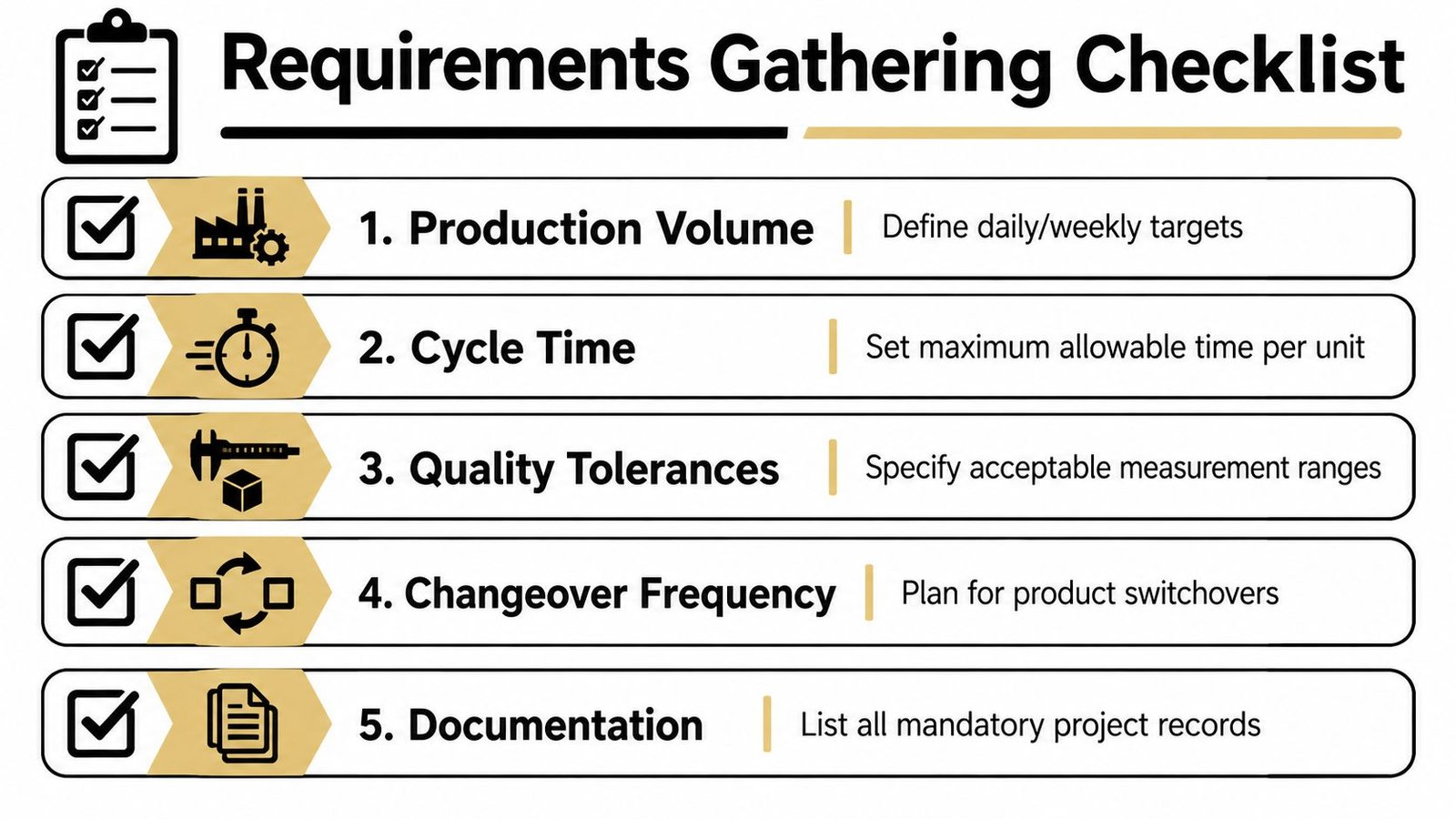
- What production volume is typical, and what volume is expected during the normal planning horizon?
- Which cycle time is required at the bottleneck, and how much variation is acceptable?
- How often do products, tooling, or recipes change?
- Which steps can operators perform reliably, and which steps create recurring variation?
- What happens to partially completed units after a stop or fault?
Ask quality:
- Which characteristics require automatic measurement or verification?
- What data must be associated with the unit, lot, batch, or work order?
- Which alarms require a documented response?
- What evidence will support release, investigation, or deviation review?
Ask maintenance:
- Which components fail most often?
- Can technicians access the cabinet, sensors, and actuators safely?
- What spares are already stocked?
- What diagnostic information is available without an integrator laptop?
Design for the actual run
A common mistake is designing for peak capacity while ignoring typical production. Peak capability can increase hardware, controls complexity, and validation scope without improving ordinary output. Define the normal operating window first, then identify which peak conditions justify additional capacity and which can be handled through scheduling, buffering, or a semi-automated step.
Regulatory needs belong in the first requirements workshop, not at the end of commissioning. For medical device and pharmaceutical production, GMP-aware controls may need recipe management, traceability, secure records, electronic approvals, and controlled changes. If those requirements arrive after the HMI, database, and controller structure are built, the team may have to redesign interfaces instead of adding a report.
Choosing the Right Architecture for Your Production Scale
Architecture selection is a packaging and service decision as much as a controls decision. A PLC-based system may be the most practical choice for a deterministic machine with conventional I/O, safety devices, drives, and a straightforward HMI. A PC-based controller can offer more computing flexibility for vision, advanced data handling, or complex coordination, but it introduces operating-system, software, and support considerations. Distributed architectures reduce field wiring and can suit larger lines, although network design and troubleshooting become more important.
| Architecture Type | Best For | Typical Cost Range | Key Limitations |
|---|---|---|---|
| PLC-based centralized | Standalone machines and compact cells | Project-dependent | More field wiring and cabinet concentration |
| PC-based control | Vision, data-heavy applications, and complex coordination | Project-dependent | Greater software and support complexity |
| Distributed PLC and I/O | Larger lines and equipment spread across a facility | Project-dependent | Network dependency and broader troubleshooting scope |
The table deliberately avoids universal dollar bands. Total applied cost depends on cabinet fabrication, wiring, installation labor, safety hardware, software licenses, validation, training, and integration with existing equipment. A low-cost controller can become the expensive option if it requires extensive point-to-point wiring or can't communicate cleanly with installed drives and instruments.
Centralized or distributed I/O
Centralized I/O keeps the system conceptually simple. It can work well when stations sit close to one cabinet and technicians prefer a single service point. Distributed I/O becomes more attractive when conveyors, fixtures, inspection stations, and actuators are physically separated. Shorter field wiring can improve installation practicality, but the network must be documented, diagnosed, and protected from avoidable disruptions.
HMI selection deserves the same realism. Operators use screens under production pressure, often while handling parts and responding to an abnormal condition. Favor clear states, guided recovery, role-appropriate access, and alarm messages that identify the affected station. A feature-rich screen that hides the next action isn't a successful interface.
For a manual line, semi-automation often delivers a stronger first step than a fully automated rebuild. A fixture, smart tooling, poka-yoke sensor, torque monitor, or pick-and-place unit can address the highest-variation operation while preserving human judgment where it adds value. Fully automated architecture makes sense when process consistency, volume, safety, or labor constraints justify the added feeders, guarding, inspection, and recovery logic.
Use automation systems design services to evaluate the complete applied system rather than selecting a controller in isolation. Future-proofing should mean reserving useful capacity, documenting interfaces, and choosing maintainable standards. It shouldn't mean paying for capabilities the process may never use.
Control Strategies That Match Your Process Dynamics
The process determines the control strategy. A discrete assembly sequence needs state logic, permissives, interlocks, part presence checks, and clear recovery paths. A continuous temperature, pressure, flow, or speed process needs feedback behavior that remains stable as conditions change. Batch systems add recipe selection, phase control, transitions, holds, and records of what occurred during each run.
Begin by classifying the process and its dominant dynamics. For a discrete medical device assembly station, motion control may position a component while force control confirms that insertion or pressing occurs within an acceptable profile. Speed alone isn't the objective. Repeatability, controlled force, and traceable results may matter more than reducing the nominal cycle.
Matching the loop to the disturbance
PID control remains useful when a measured process variable must track a setpoint. Proportional action responds to present error, integral action addresses accumulated offset, and derivative action can anticipate the direction of change, although noise may make derivative action counterproductive. Tune for the actual response requirement, not for the fastest movement seen during a commissioning test.
Cascade control is useful when a fast inner loop can correct a disturbance before it affects a slower outer variable. Feedforward can help when a measurable disturbance is known in advance, such as material flow affecting temperature demand. Neither strategy should be added because it appears sophisticated. Each extra loop creates another tuning and troubleshooting responsibility.
The practical digital-design rule is to sample at roughly 10 times the desired closed-loop bandwidth, use simple anti-aliasing filters to limit phase shift, and avoid attempting to cancel discrete sampling zeros. These recommendations are intended to reduce intersample problems and instability in digital implementations, as described in the digital control design guidance.
Control choice should follow process behavior, not controller fashion. A simple, well-tuned loop is usually easier to validate and maintain than a complex strategy no one on the plant floor understands.
For servo positioning, define acceleration, settling, following error, homing, and recovery behavior. For force-controlled assembly, define how the system responds to a missing part, obstruction, compliant component, or sensor disagreement. The controller must manage the abnormal cases as deliberately as the ideal cycle.
Safety and Compliance Requirements You Cannot Skip
Safety and compliance have different purposes, but the control design must make them work together. A risk assessment identifies hazards, required protective measures, foreseeable misuse, and the conditions that require a safe state. Hardware safety includes emergency stops, guards, interlocks, and safe isolation. Functional safety addresses whether the safety-related control functions achieve the required risk reduction and continue to behave predictably under faults.
Machine-safety guidance continues to evolve. A revised 2025 edition of guidance for the functional safety of machine controls under EN ISO 13849 has been released, which reinforces that safety validation and compliance remain active engineering responsibilities rather than one-time checkboxes, as discussed in the 2025 industrial automation trends overview.
GMP changes the information architecture
A GMP-aware line controller must do more than run a sequence. It must preserve evidence about recipes, parameters, operators, approvals, checks, changes, and production results. One documented GMP-compliant line controller provides tested recipes and parameters, digital checklists, secure data acquisition for traceability, electronic-signature batch approvals, and tracked change control for processes and recipes, according to CIMdata's description of GMP-compliant production control.
That requirement affects the controller, HMI, database, user management, audit trail, backup method, and validation plan. Don't bolt compliance onto an otherwise unstructured system. Define critical data, retention expectations, approval points, and change categories before selecting tags and screen behavior.
Cybersecurity belongs in the same design conversation. Connected systems need controlled access, account management, secure remote support, backup and restore procedures, network segmentation appropriate to the facility, and a documented response when a device or connection becomes unavailable. The objective isn't to isolate every machine from useful information. It's to make connectivity intentional and recoverable.
Use risk-based validation to focus effort on functions that affect safety, product quality, data integrity, and release decisions. A good validation package links requirements to design records, test protocols, executed results, deviations, approvals, and change control. It gives auditors evidence without forcing the organization to maintain meaningless paperwork.
Testing and Validation Before Commissioning
Commissioning should confirm a design, not discover what the design was supposed to be. Factory acceptance testing, or FAT, creates a controlled environment where the integrator and customer can review sequences, alarms, recipes, interfaces, safety behavior, and documentation before equipment reaches the production floor.
Write the FAT protocol around requirements and operating scenarios. Include the normal cycle, startup, shutdown, product changeover, empty conditions, full buffers, sensor failures, communication loss, rejected parts, power recovery, and interrupted operations. A simulated or staged environment can expose sequence problems without consuming production time, especially when a line contains complex handoffs between stations.
What to test at the factory
A practical FAT should verify:
- I/O behavior: Confirm every input, output, analog value, drive command, and device diagnostic against the approved drawings.
- Sequence control: Run each state transition, permissive, timeout, retry, and fault response.
- Safety functions: Test emergency stops, guard switches, safe motion behavior, reset conditions, and restart prevention.
- Data integrity: Confirm user access, records, timestamps, recipe controls, electronic approvals, and audit events where required.
- Recovery logic: Interrupt a cycle and verify that the operator receives a safe, understandable path back to production.
Record expected results before execution. A test that says “machine works correctly” creates weak evidence. A test that specifies the input condition, expected machine response, observed result, tester, date, and deviation reference creates an auditable record.
SAT and validation at the site
Site acceptance testing, or SAT, confirms the installed system under actual facility conditions. Check power quality, network behavior, utilities, guarding, material presentation, environmental conditions, upstream and downstream equipment, and operator access. Repeat critical safety and recovery tests after installation because wiring changes, field devices, and integration interfaces can introduce faults that were absent during FAT.
Train operators using realistic scenarios rather than a screen tour. Have them start a run, respond to a jam, change a controlled parameter, reject a unit, and recover from a stop. Maintenance staff should practice locating devices, reading diagnostics, replacing supported components, and restoring approved configurations.
In regulated production, organize executed protocols, deviations, corrective actions, approvals, and traceability records so the validation package reflects the released system. Thorough testing prevents the most expensive rework, changes made after installation while production, operators, and quality systems are already depending on the equipment.
Commissioning and Long-Term Performance Planning
Power-up is only the beginning of commissioning. A controlled handoff moves from pre-commissioning checks to initial diagnostics, point-to-point verification, loop tuning, integrated testing, and operator readiness. The sequence matters because tuning a loop before confirming instruments and scaling can hide an electrical or configuration problem.
Establish the operating baseline
At handoff, document the conditions under which the system performs acceptably. Capture cycle behavior, reject causes, alarm frequency, changeover steps, operator interventions, and critical process values. Use those records as the baseline for improvement, not as a promise that the machine will perform identically under every product, material, or staffing condition.
Parameter management needs discipline. Separate protected engineering values from operator-adjustable settings, identify who can change each value, and record why a change was made. A parameter that improves output but increases product risk should never be treated as an ordinary convenience setting.
Make maintenance part of the design
Maintenance planning starts with access and diagnostics. Label devices consistently, expose useful fault information, provide electrical and pneumatic drawings, and keep controller and HMI backups under controlled revision. Select spares based on failure consequence and replenishment time, not on the number of components in the cabinet.
Preventive maintenance should follow the actual equipment. Inspect grippers, tooling, belts, sensors, cables, filters, lubrication points, and safety devices according to their condition and duty. Remote diagnostics can reduce response time, but remote access must follow the facility's cybersecurity and authorization rules.
The investment case should connect the control design to labor dependency, quality consistency, throughput, safety, and service effort. Manufacturing automation is associated with higher labor productivity and lower production labor share in the U.S. Census Bureau working paper, while another empirical study reported that a 10% increase in automation was associated with about a 5% increase in labor productivity, as cited in the same source. Those findings don't replace a plant-specific calculation. They reinforce the need to measure the factors the project is intended to change.
Project complexity affects engineering, fabrication, integration, validation, training, and startup effort. A compact semi-automated workstation generally creates fewer interfaces than a fully automated line with feeders, robots, vision, safety zones, and plant connectivity. Plan the next modification during the first design, but don't purchase unused complexity upfront.
Manufacturers comparing options can include System Engineering & Automation when they need semi-automatic systems, fully automated or manual equipment, custom tooling, fixtures, and integrated controls delivered through design, drawings, sourcing, installation, and commissioning.
System Engineering & Automation helps manufacturers translate production goals into practical control architectures, integrated tooling, fixtures, semi-automatic systems, and scalable automation. Visit System Engineering & Automation to discuss a control system design that fits your budget, facility, GMP requirements, and long-term service plan.