The plant already has the new machine on the floor, the old manual step is mostly gone, and the first week looked promising. Then the shifts start drifting, maintenance asks who owns the spare parts, quality wants more records, and production is still waiting on the throughput the sales deck implied. That's the point where engineering consultation services stop being a nice-to-have and become the difference between a working upgrade and an expensive distraction.
Manufacturers don't usually fail because they lack intent. They fail because the project begins as a machine purchase and never becomes an operational system with clear ownership, validation, training, and support.
Table of Contents
- Why Manufacturers Need Engineering Consultation Services
- The Engineering Consultation Journey From Concept To Support
- Choosing The Right Automation Level Through Expert Consultation
- GMP And Medical Device Compliance In Automation Projects
- Measuring ROI And Avoiding Automation Cost Traps
- How To Evaluate Engineering Consultation Providers And Case Examples
- Next Steps For Safer Smarter Manufacturing Operations
Why Manufacturers Need Engineering Consultation Services
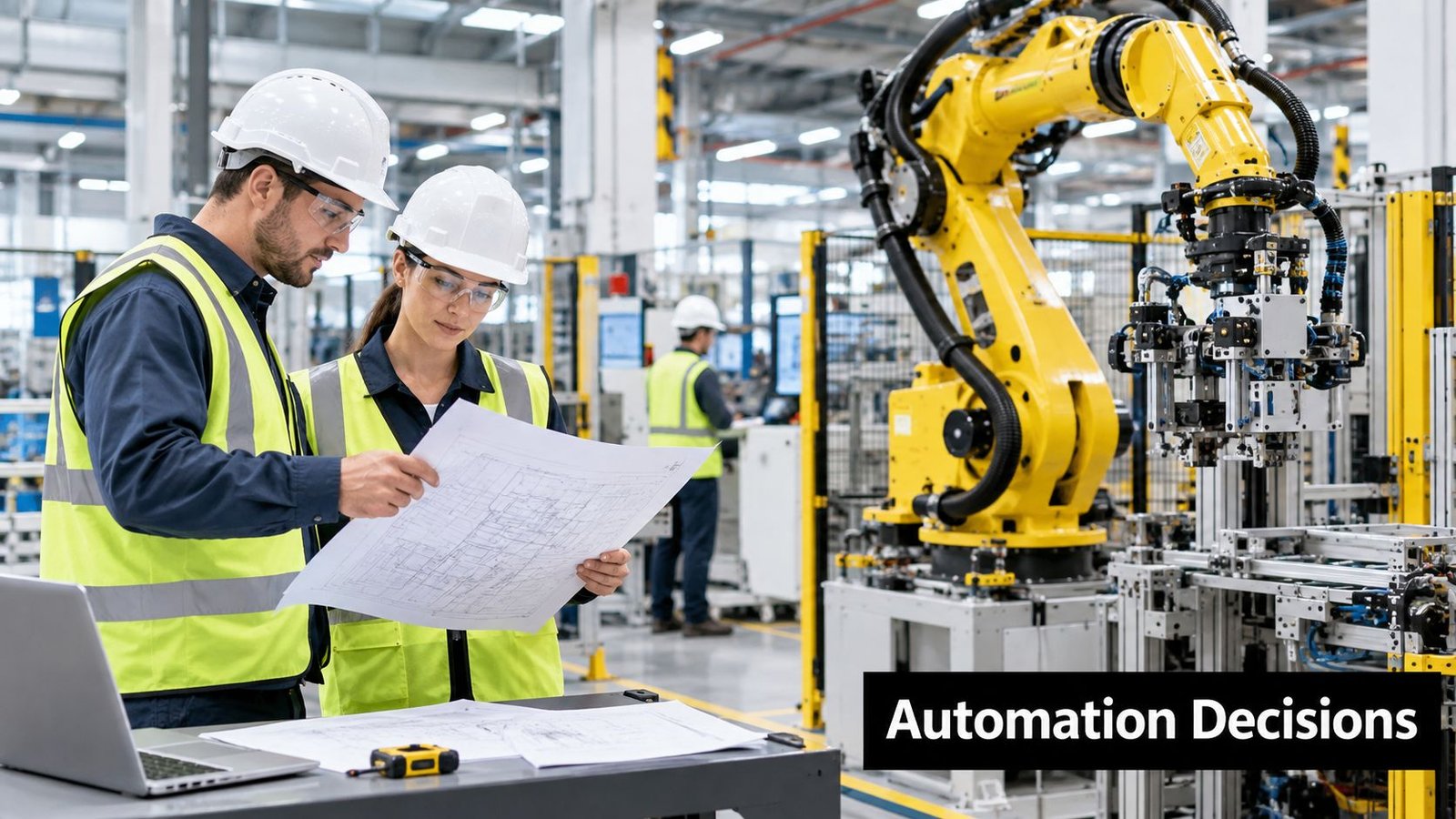
A common pattern starts with good intentions. A plant manager sees a bottleneck, buys a workstation, and assumes the problem is solved once the equipment powers on. The machine may run, but the line still misses takt, operators work around awkward fixtures, and no one can say who owns performance after the installer leaves.
That's where engineering consultation services add value. They turn a vague improvement goal into a set of decisions about process design, controls, documentation, and handoff. In practice, that means the team is not just buying hardware, it's defining how the process should work, how the result will be verified, and who stays accountable when the line is live.
The historical role of consulting matters here too. Engineering consulting grew from individual practitioners into a formal global industry over roughly three centuries, and the consulting model matured around the idea that clients can access specialized expertise without keeping every capability in-house. That's still the basic business case for manufacturers today, especially when internal automation depth is thin and the project touches production, quality, and maintenance at once. For a broader systems view, this systems engineering overview is a useful companion to the plant-floor reality.
Practical rule: If nobody can name the owner of ramp-up, training, and post-startup support, the project isn't finished, it's only installed.
Consultation also helps avoid the most common mistake, selecting equipment before the process is understood. The consultant should start with the bottleneck, not the brochure. Once the true constraint is clear, the plant can decide whether a fixture, a semi-automated station, or a deeper redesign makes sense.
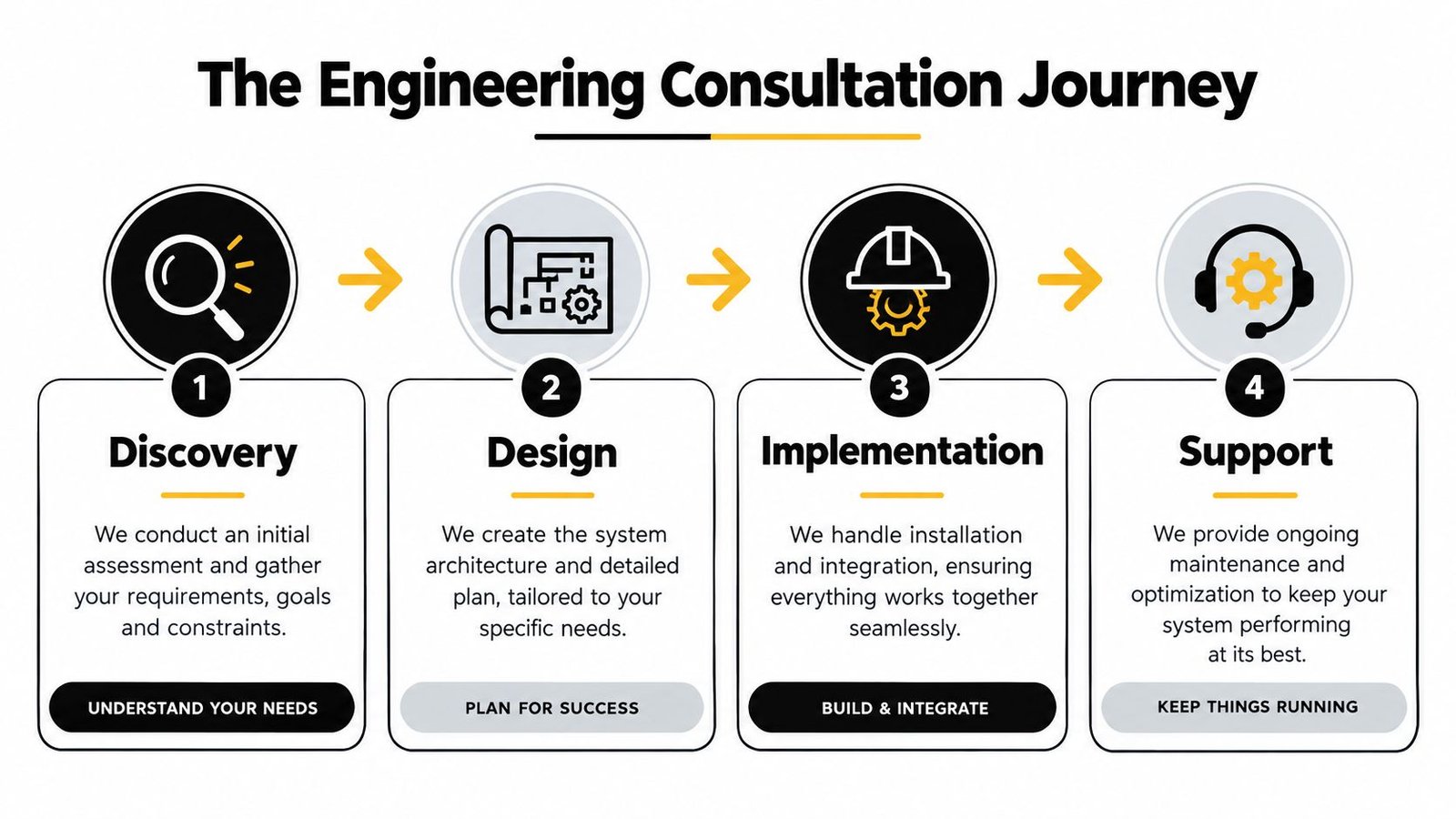
The Engineering Consultation Journey From Concept To Support
A solid engagement moves in phases, and each phase should produce something usable. Discovery comes first, with the consultant learning the product mix, layout, staffing reality, demand profile, and constraints on utilities, space, and uptime. If that stage doesn't establish actual cycle time, first-pass yield, unplanned downtime, changeover duration, and labor content, the later design work will be built on guesses.
After discovery comes concept selection. At that point, the team should compare options such as manual augmentation, semi-automation, and more integrated systems, then decide what level of control the process really needs. The output shouldn't be a vague recommendation, it should be a concept package with assumptions, risks, budget direction, and a reason for choosing one path over another.
What should be in the handoff package
By the time the project moves into detailed design, the plant should expect drawings, control narratives, equipment specifications, and sourcing support. If the work includes software or automation logic, traceable configuration records matter just as much as mechanical drawings. That's the point where a good provider also starts documenting acceptance criteria so installation and commissioning don't become arguments about what “done” means.
The project gets safer when the consulting team defines success before fabrication starts.
Implementation is where many projects get sloppy. Installation, commissioning, and startup need to be treated as separate activities with different purposes. Commissioning proves the system was installed correctly and behaves as intended, while ongoing support covers the period when operators, technicians, and quality staff settle into normal use.
The final phase is support, and this is the one many manufacturers underrate. Maintenance responsibilities, escalation paths, spare-parts strategy, and post-startup targets should all be settled before handover. For plants without deep internal automation expertise, the post-deployment period is where real value is either protected or lost, which is why this owner-readiness perspective fits the topic well.
Choosing The Right Automation Level Through Expert Consultation
More automation isn't automatically better. For a lot of small and mid-sized plants, a fully automated line is the wrong answer because the product mix is too variable, the capital burden is too heavy, or the maintenance team won't be able to support it reliably. A consultant earns trust by saying that out loud and by showing where semi-automation gives the better trade-off.
The U.S. engineering-services market is large and multidisciplinary, with 1,074,180 workers across all occupations and 490,030 in architecture and engineering roles, or 45.62% of total employment in the industry BLS engineering-services data. That mix matters because manufacturing projects usually need more than a mechanical drawing. They need process design, controls, documentation, software, and implementation support working together.
How to judge the automation level
A useful comparison starts with three questions.
- Can the process tolerate variability? If the answer is yes, flexible tooling or operator-assisted controls may beat hard automation.
- Is the bottleneck stable? If it moves around, staged upgrades are usually safer than locking into a fixed line.
- Who will maintain it? If the plant can't service the controls stack, sophistication becomes a liability.
For many operations, modular controls and semi-automated stations are the practical middle ground. They reduce labor dependence without forcing the plant into a rigid architecture that's hard to change later. They also preserve manual fallback, which matters when demand shifts or a downstream step goes out of spec.
Useful test: If the maintenance team can't explain how to troubleshoot the process in one shift, the system is probably too complex for the operation.
A consultation should also account for future growth without assuming it has to be built all at once. That's especially relevant when layout space is tight or when the production mix may change. SEA, for example, works with semi-automatic systems, custom tooling, fixtures, modular upgrades, and full automation, which gives a plant more than one path to the same production goal, but the right fit still depends on the process, not the catalog.
GMP And Medical Device Compliance In Automation Projects
Medical-device automation cannot be treated as a pure productivity project. Start with a clear definition of what GMP is in manufacturing, then design the equipment around the quality system. FDA requirements cover design, manufacturing, packaging, labeling, storage, installation, and servicing, not only end-of-line inspection FDA design control guidance. If equipment changes the process, document, verify, and control that change.

FDA guidance requires process validation when later inspection cannot fully verify the output. The process must produce objective evidence that it meets predetermined specifications FDA inspection guide. Define those validation needs before freezing the machine design. Waiting until commissioning often leaves gaps in the acceptance plan and evidence package.
What a GMP-aware project should define early
A practical consultation should establish:
- User requirements and process parameters, converted into measurable specifications.
- Installation qualification, where applicable, to confirm correct installation and operating range.
- Calibration and maintenance procedures, ready before validation begins.
- Traceable drawings and configuration records, including automation software and revisions.
- Operator training and change control, so the plant can identify and manage new process risks.
Commissioning is not validation. A machine may power up correctly while leaving the plant without objective evidence for release. That distinction matters after the February 2, 2026 effective date of the QMSR, which amended 21 CFR Part 820 by incorporating ISO 13485:2016 for finished-device manufacturers distributing in the United States FDA QMSR overview.
Compliance work continues after handover. The consultant should help the plant maintain training records, investigate deviations, manage software changes, and support revalidation when equipment or process conditions change. That post-deployment ownership prevents a validated cell from becoming difficult to defend months later.
Labeling and packaging introduce another control point. Incoming labeling materials must be inspected and tested, labeling operations controlled, and changes processed through formal change control FDA labeling requirements. In a semi-automated workstation, the fixture, scanner, verifier, and label-present logic must support the quality system, not merely increase operator speed.
Measuring ROI And Avoiding Automation Cost Traps
The most expensive automation mistakes usually happen before the purchase order is issued. A line looks promising in a proposal, but the model ignores ramp-up losses, operator learning, maintenance burden, or the fact that the bottleneck will move somewhere else after the first improvement. That's why engineering consultation services are a financial safeguard as much as a technical one.
Deloitte's 2025 smart-manufacturing survey reports average post-implementation improvements of 10% to 20% in production output, 7% to 20% in employee productivity, and 10% to 15% in freed capacity Deloitte smart manufacturing survey. Those ranges are useful, but they're not guarantees. Realized value depends on baseline accuracy, stable data capture, operator adoption, and whether the equipment solves the true constraint.
The baseline comes first
Before anyone talks about ROI, the plant needs hard numbers from the current process. Measure actual cycle time, first-pass yield, downtime, changeover duration, labor content, and demand profile. Then test the proposal against that baseline instead of against optimistic assumptions from a vendor slide.
Financial rule: If the proposal can't show how it performs against current bottleneck data, the payback model is too soft to trust.
Manufacturers also need to think about the hidden costs that don't show up in the purchase price. Training, spare parts, maintenance access, software support, and downtime during startup all affect total cost of ownership. If the project is in a regulated environment, documentation and validation work belong in the economic model too.
A sensible decision checklist looks like this. First, confirm the bottleneck is real and stable. Second, verify the proposed automation level matches the process complexity. Third, define who owns ramp-up, and fourth, establish the support model after handover.
How To Evaluate Engineering Consultation Providers And Case Examples
The easiest way to separate a real engineering partner from a sales-heavy vendor is to ask about the work after installation. Good providers can explain commissioning, training, documentation, support, and change control without drifting into generic promises. Weak providers tend to stop at layout concepts and equipment lists.
Ask direct questions. What deliverables are included after startup? Who owns validation evidence? How are spare parts handled? What does maintenance training cover? If the answer is vague, the plant will probably inherit the risk later.
What to compare when choosing a provider
- Lifecycle coverage: Discovery, design, build, installation, commissioning, and support.
- Validation experience: Especially for regulated or traceable production.
- Documentation discipline: Drawings, controls records, acceptance criteria, and training materials.
- Support responsiveness: Clear escalation paths after handover.
- Automation fit: Experience with semi-automated systems, fixtures, and modular upgrades, not only full-line projects.
One practical example is a plant that replaced a manual handling step with a semi-automated workstation, added proper guarding and fixturing, and kept the operator in the loop for inspection and loading. The result was a safer station with less physical strain and better process consistency, without the capital burden of a fully automated line.
A second example is a medical-device operation that chose flexible tooling and documented controls instead of a rigid custom cell. That gave quality a cleaner verification path and gave operations a system that could change with the product mix. It's the kind of trade-off a good consultant should surface early, not after the equipment is already on a truck.
The best provider doesn't just design the equipment, it leaves the plant able to run it, maintain it, and prove it meets requirements.
Next Steps For Safer Smarter Manufacturing Operations
Treat the next project as a lifecycle decision, not a hardware purchase. Start with a baseline, validate the bottleneck, choose the right automation level, and define training, documentation, and support before the build starts. If the operation is regulated, fold validation and change control into the plan on day one.
Use this checklist before signing off: confirm process data, define acceptance criteria, assign post-startup ownership, budget for ramp-up losses, and lock in maintenance and spare-parts responsibilities. That's the practical way to turn engineering consultation services into lasting operational gain.
System Engineering & Automation helps manufacturers assess workflow constraints, select the right mix of manual, semi-automatic, or fully automated equipment, and carry the project through design, sourcing, installation, commissioning, and ongoing support. If you're planning an upgrade and want a lifecycle-minded partner, visit System Engineering & Automation to review how their consultation and build services can fit your production goals.