You've already seen it on the shop floor. A new semi-automatic cell gets approved because the demo runs smoothly, the quote looks reasonable, and everyone wants to move fast. Six months later, scrap creeps up, operators work around the system instead of with it, the audit team asks for evidence nobody built, and the retrofit costs more than the original cell.
That's the primary reason good automated manufacturing practices matter. They're not pharma paperwork. They're the discipline that keeps an automation project tied to the process it's supposed to improve, so the line stays repeatable, traceable, and defensible when production changes, auditors ask questions, or the original engineer isn't in the room anymore.
For small and mid-sized manufacturers, that mindset changes the whole buying decision. You stop asking only whether a robot can move parts, and start asking whether the system can hold up across shifts, product variants, changeovers, and maintenance. You also get clearer specifications, cleaner handoffs, and fewer surprise edits after installation.
Table of Contents
- Why Good Automated Manufacturing Practices Matter on Any Shop Floor
- What GAMP Is and How It Evolved
- The Core Principles Behind Every GAMP-Aligned System
- How GAMP Categorizes Software and Hardware
- The Validation Lifecycle From Specification to Retirement
- Applying GAMP Thinking to a Real Automation Project
- Common GAMP Mistakes That Drain Automation ROI
- Where SEA Fits Into a GAMP-Aligned Automation Plan
Why Good Automated Manufacturing Practices Matter on Any Shop Floor
A mid-sized manufacturer buys a semi-automatic assembly cell to remove a repetitive manual step. The system integrates quickly, the first runs look acceptable, and the team skips a formal risk review because production is already behind schedule. By the time the line starts drifting, no one can prove where the variation entered the process, and the retrofit takes longer than the original build because the team has to reconstruct requirements after the fact.
That failure isn't unique to regulated pharma. It's a predictable outcome when automation is treated like a one-time equipment purchase instead of a controlled production change. Good automated manufacturing practices exist to stop that pattern by forcing the team to define what the system must do, how it will be checked, and who will own it after go-live.
What changes when the plant gets disciplined
The biggest shift is that engineering, quality, and operations stop working from different assumptions. Specifications become clearer, so vendors quote against real requirements instead of guesses. Testing becomes easier to plan because the team knows what “good” looks like before the hardware arrives.
That discipline also helps with changeovers. A well-scoped system is easier to adjust because the boundaries are known, the controls are documented, and the operators know which settings matter. When the line needs to run a different part or a revised fixture, the team can decide quickly whether the change belongs in the current design or needs a formal update.
Practical rule: if you can't explain the process variation you're automating, you're probably automating uncertainty, not capability.
For manufacturers that want to optimize production and services for customers, this matters even more. A cell that works only in the demo cell isn't an improvement. A cell that keeps producing consistent output after the first maintenance call, the first operator turnover, and the first product revision is the kind of investment that pays back in real operations.
What GAMP Is and How It Evolved
GAMP stands for Good Automated Manufacturing Practice, and it's a set of guidelines published by the International Society for Pharmaceutical Engineering. In plain English, it tells manufacturers how to specify, build, validate, and maintain computer-controlled systems so those systems stay fit for use in regulated production. The core idea is simple, the system has to be controlled, not just functional.
The term is commonly traced to the 1980s, when pharmaceutical and other regulated industries began formalizing how computer systems should be specified, validated, and controlled in manufacturing. That historical shift matters because automation stopped being judged only on speed or throughput. It also had to prove documented control, traceability, and data integrity in environments where regulators expect evidence that the process consistently produces conforming output.
Why the history still matters
The modern framework is associated with GAMP 5, which is designed to support a risk-based approach to computerized system lifecycle management in regulated environments. That's the key reason GAMP still resonates outside classic pharma. The logic is the same whether you're validating a tablet press, a vision inspection station, or a custom tooling fixture. If the process can drift, the controls need to be visible and the evidence needs to survive review.
GAMP's history also explains why the framework leans so hard on documentation and traceability. Those aren't decorative layers. They're the mechanism that lets an engineer prove what changed, when it changed, and whether the change still meets the original intent.
A good GAMP mindset doesn't ask, “Can we install it?” It asks, “Can we keep it under control after installation?”
That difference is why many SMBs find value in GAMP thinking even if they never operate in a fully pharmaceutical environment. It turns automation into a decision framework. You can use that framework to choose the right level of equipment, the right amount of testing, and the right amount of supplier dependence without turning the project into a paperwork contest.
The Core Principles Behind Every GAMP-Aligned System
A GAMP-aligned project usually lives or dies on five ideas. They're not glamorous, but they're the parts that keep a line stable after the original launch team has moved on. Risk-based thinking, lifecycle control, supplier selection and management, clear user requirements, and data integrity show up again and again because they answer the same operational question, what needs the most control, and what doesn't?
Five principles you can apply immediately
- Risk-based thinking. Put the most attention on what can hurt product quality, traceability, or safety. It's like deciding where machine guards matter most, you don't protect every inch the same way, you protect the hazard.
- Lifecycle control. Treat the system like a car from purchase to scrap, not a machine that ends when it ships. The useful life includes commissioning, maintenance, change control, and retirement.
- Supplier engagement. Use vendor documentation and test evidence where it's credible instead of redoing work that was already done well. That keeps the project lean without cutting corners.
- User requirements. Write down what the process needs before the build starts. A vague requirement gives you a vague system.
- Data integrity. Make sure records are trustworthy, traceable, and complete enough to support the production decision they're supposed to support.
These ideas show up in the current guidance because GAMP 5 is designed to support a risk-based approach to computerized system lifecycle management in regulated environments, with documented control, traceability, and data integrity as core expectations rather than optional add-ons. That's why the framework still works for regulated plants and also for small manufacturers who need clean accountability.
The practical benefit is stability. When the team knows what's critical, they stop over-testing low-risk areas and under-testing the parts that really matter. That's the difference between a validation effort that slows a project down and one that keeps the project from becoming a maintenance problem later.
How GAMP Categorizes Software and Hardware
GAMP becomes useful when you stop treating every component the same way. A commercial PLC, a configured HMI, and a custom inspection algorithm don't carry the same risk, so they don't deserve the same validation depth. The point of categorization isn't to impress an auditor, it's to protect engineering time and budget.
The practical split
Think of the software side in tiers. Infrastructure software sits at the lower end, things like operating systems, databases, and middleware. A non-configurable product needs less functional testing than a configured product, because the behavior is more fixed. Custom-built applications need the deepest review because the team is creating the behavior itself.
The hardware side follows the same logic, even if people don't label it the same way. Off-the-shelf sensors, standard PLC racks, and common safety devices usually need lighter evidence than custom tooling, integrated cells, or proprietary fixtures. The more the part is customized for your process, the more the team has to prove it will still work across the expected range.
For a useful practical comparison of how systems are connected and validated across hardware and software layers, see this integration overview.
A quick self-classification check
- Is it standard infrastructure? If yes, document installation and version control carefully, then keep validation focused on the application above it.
- Is it configured from known functions? If yes, verify the configuration and the required behavior.
- Is it custom logic or custom tooling? If yes, expect deeper testing, stronger design review, and tighter traceability.
- Does it directly affect product quality or traceability? If yes, treat it as high attention, even if it looks simple.
If the answer changes a lot when you change products, operators, or fixtures, it's not a low-risk component.
That triage approach helps a project stay proportionate. It's also one of the cleanest ways to avoid wasting weeks validating the wrong layer while the actual failure point sits one level higher.
The Validation Lifecycle From Specification to Retirement
Regulated production expects processes to be precisely documented, fully traceable, and always auditable, and they also have to meet strict requirements for GMP, GAMP, and ISO standards with high standards for sterility, hygiene, and certified product-contact materials as noted in this regulated manufacturing overview. Even if your plant isn't in medtech, the same lifecycle logic helps you keep a system defensible after go-live.
The cleanest way to think about the lifecycle is in evidence. On the left side, the team defines what's needed. In the middle, the system is designed and configured. On the right side, the installation, operation, and performance are verified against those original needs. The point isn't to build paperwork, it's to build a trail that survives real use.
What each stage should leave behind
- Concept and user requirements. A requirements document that says what the system must do, what it must not do, and which outputs matter.
- Design review. A record showing how the chosen solution maps to those requirements.
- IQ and OQ. Evidence that the equipment was installed correctly and performs its intended functions under defined conditions.
- Training and handoff. Records showing the operators and maintainers know how to run the system without guessing.
- Change control and review. A formal way to manage updates, recalibration, and periodic reassessment.
A common failure mode is “design on the fly.” The vendor builds quickly, the plant approves in pieces, and the team assumes the documentation will catch up later. That works until a defect, warranty dispute, or audit forces everyone to reconstruct the project from memory.
For teams that want a cleaner acceptance structure, this factory acceptance test resource is a useful reference point for organizing evidence before the machine reaches the plant.
The lifecycle mindset is powerful because it keeps validation from becoming a one-time event. The system doesn't stay compliant because someone signed a final report. It stays controlled because the plant kept the records, managed the changes, and didn't let calibration or review fall out of the routine.
Applying GAMP Thinking to a Real Automation Project
The best automation projects start with data, not enthusiasm. Before anyone chooses a robot, the team should quantify the part dimensions, weight, historical production volume, and labor content that the system has to handle. Those numbers tell you whether the project is a candidate for full automation, semi-automation, or a smarter manual station.
A practical benchmark many teams use is whether the system can capture roughly 80% of the product mix. If it can't, the remaining variation can eat the return on investment and make a semi-automatic or manual fallback the better choice. That's where good automated manufacturing practices become a business tool, not a compliance tool.
A project path that doesn't waste effort
Start with user requirements, not vendor brochures. Then move into risk assessment, because the team needs to know which functions affect quality, throughput, and operator safety. After that, supplier selection and design review should focus on whether the proposal matches the process shape you measured at the start.
From there, the handoff usually runs through factory acceptance testing, site acceptance, and operator training. Each step should produce evidence the quality team can reuse instead of retyping. That's the value of GAMP thinking, it separates the control points from the noise.
| Lifecycle Phase | Key Deliverable | Evidence Required |
|---|---|---|
| Concept and URS | User requirements specification | Approved scope, intended use, process limits |
| Design review | Design record | Traceability to requirements, approved drawings or logic |
| FAT | Test protocol and results | Pass or fail evidence, deviations, corrective actions |
| Site acceptance | Installation and site verification | Installation checks, integration evidence, functional proof |
| Training and operation | Training record and handoff | Operator sign-off, maintenance readiness, change control |
Project test: if the equipment can only justify itself on the easiest product, it probably isn't the right level of automation yet.
A simple checklist for a project manager works better than a long policy document. Confirm the product mix, document the high-risk functions, define acceptance criteria before ordering, and decide how the line will be supported after launch. If those points aren't clear, the project isn't ready, even if the quotation looks attractive.
Common GAMP Mistakes That Drain Automation ROI
Most bad GAMP projects don't fail because someone ignored compliance for fun. They fail because the team made an ROI mistake and then wrapped it in paperwork. The result looks like a validation problem, but the actual issue is usually a process, scope, or product-design problem.
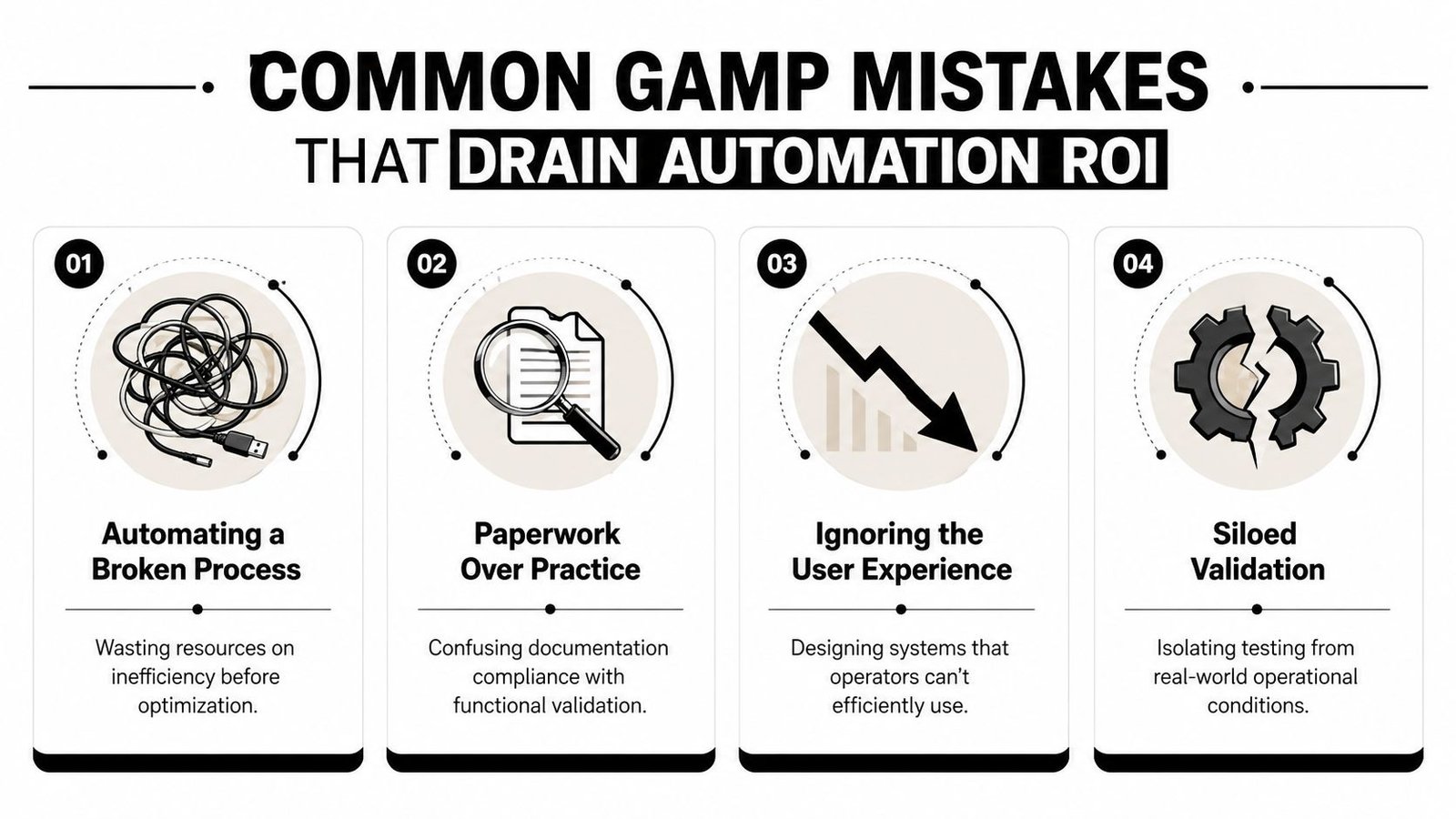
Four mistakes I see too often
- Automating a broken process. The team buys equipment before it fixes flow, workholding, or part presentation. The cheaper path is to redesign the process first, then automate the stable version.
- Paperwork over practice. The project team collects documents but doesn't prove the machine works in real conditions. The cheaper path is a tighter test plan with fewer low-value artifacts and more meaningful challenge tests.
- Ignoring the operator experience. If the interface, reach, or changeover steps frustrate the person running the line, throughput and quality both suffer. The cheaper path is to involve operators before the controls are frozen.
- Siloed validation. Testing happens in isolation, far from the actual plant constraints. The cheaper path is to test against the environment where the system will live.
You can also see this in the way companies over-customize. A configured product often does the job with less risk and less maintenance than a fully custom build, especially when the process doesn't need unique logic. That choice matters because overengineering usually hurts payback long before auditors ever get involved.
The biggest warning signs are easy to spot. A vendor says “we'll figure it out on site,” nobody can name the acceptance criteria, or the team treats change control as something for later. Those are all signals that the project is drifting away from good automated manufacturing practices and toward expensive rework.
Where SEA Fits Into a GAMP-Aligned Automation Plan
A good integrator adds value when validation is treated as part of design, not as a scramble at the end. That matters most for SMBs that need semi-automatic systems, smart tooling, or a carefully scoped fully automated line. The right partner should help turn process uncertainty into a buildable scope, then support the project all the way through commissioning.
A useful way to map the work is simple. Early consultation and preliminary concepts feed the user requirements. Custom tooling, fixtures, and design reviews support the build. Semi-automatic and fully automated systems provide the integrated controls, then installation, commissioning, and training close the loop through IQ, OQ, and operator readiness.
For a closer look at how an experienced integrator supports that handoff, see this overview of streamlined operations.
When to bring in an integrator
If the project affects product quality, requires custom fixturing, or has more than one plausible automation path, you'll usually get better results by involving an integrator early. That's also true when the team needs to keep flexibility for changeovers or wants a semi-automatic design instead of overcommitting to full automation.
SEA's value proposition fits that reality well, because it combines 30+ years of engineering experience, GMP-aware practices, a one-year guarantee, and a bias toward semi-automatic solutions when full automation would overengineer the job. That kind of support matters when the plant needs a solution that respects the process instead of forcing the process to fit a machine.
A partner like that is most useful when your internal team knows the product and the pain points, but doesn't want to spend months learning how to translate them into controls, tooling, and evidence. In that setting, good automated manufacturing practices become a shared language between operations, quality, and engineering, which is exactly what keeps the project practical.
If you want help turning a manual or semi-automatic process into a controlled automation plan, System Engineering & Automation can help you scope the right level of equipment, fixtures, and controls for your line. Their team works well on projects where validation, changeover, and ROI all need to make sense together, not in isolation. Reach out when you're ready to improve throughput without losing the flexibility your plant depends on.