
Commissioning of equipment is the formal verification step that happens after installation and before normal operation, where mechanical and electrical systems are tested and calibrated to confirm they perform safely to design specifications. In a plant that's under pressure to ship, that step is what separates a controlled handover from a trial by fire.
You're probably staring at equipment that's already on the floor, utilities are being tied in, and someone wants the line running yesterday. That's exactly where commissioning earns its keep, because a fast startup without documented verification usually turns into rework, unstable output, and a messy argument over who owns the fixes.
Table of Contents
- Understanding What Is Commissioning of Equipment
- Core Stages of the Equipment Commissioning Process
- Navigating GMP Qualification and Validation Requirements
- Key Roles and Documentation for Successful Handover
- Common Pitfalls and Modern Digital Solutions
- The Business Impact of Rigorous Commissioning
- Choosing the Right Automation and Integration Partner
Understanding What Is Commissioning of Equipment
A machine can pass a basic startup check while still being unfit for production. Motors turn, product moves, and operators may report no immediate problem. Later, miswired signals, drifting calibration, inconsistent interlocks, or undocumented changes create early-life failures, troubleshooting delays, and audit exposure.
Commissioning closes the gap between mechanical startup and operational handover. It is a formal, documented engineering process that verifies installed systems match the design, operate safely, and perform within defined conditions before operations take ownership. The work covers design intent, installation, calibration, function, and sustained performance, rather than only confirming that the equipment powers up (equipment commissioning overview).
What commissioning actually proves
A proper commissioning package should answer four practical questions:
- Was the equipment installed correctly? Wiring, alignment, guarding, instruments, and utility connections must match approved drawings and specifications.
- Do the controls behave properly? Interlocks, sequences, alarms, permissives, and safety functions require witnessed tests with recorded results.
- Can the asset operate under expected conditions? No-load operation is only an early check. The machine also needs evidence of stable performance at representative operating conditions.
- What is the accepted baseline? Recorded settings, test results, and outstanding actions let maintenance distinguish normal drift from a developing fault.
A useful rule is simple: if the line is merely “running,” commissioning is incomplete. Handover is stronger when the equipment is verified, documented, and formally accepted against defined criteria.
The distinction matters in regulated manufacturing. Commissioning links project completion to routine operation and creates the evidence later used to support GMP qualification, deviation review, change control, and audit responses. Lifecycle guidance treats commissioning as ongoing quality control, with baseline conditions established before an asset enters normal service (commissioning lifecycle guidance).
Plant managers should also assign ownership for every open item. A punch-list entry without a responsible person, due date, and acceptance record can remain hidden until production exposes it. A controlled commissioning record gives operations a defensible starting point, helps maintenance diagnose the first deviations, and reduces the chance that a rushed handover becomes an avoidable compliance problem.
Core Stages of the Equipment Commissioning Process
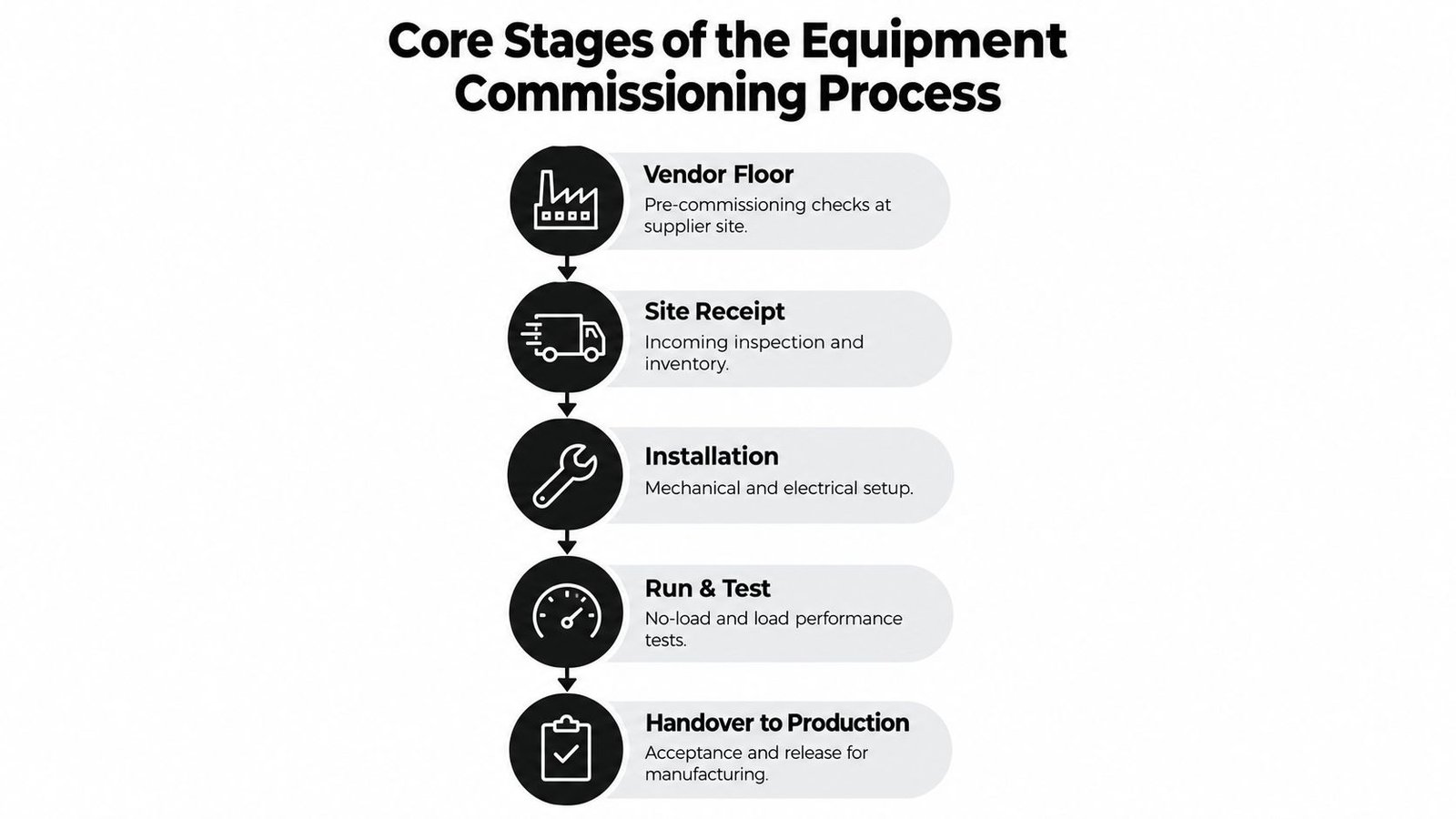
A machine can pass a basic startup check and still fail its first production campaign. The risk often begins before shipment, when the supplier is trying to close the build and the plant is preparing for delivery. Effective commissioning treats the path from supplier floor to operational handover as a sequence of controlled gates, with each gate addressing a different failure mode.
Vendor floor checks and factory acceptance
The first gate is the vendor's facility. The build is inspected and tested before shipment through Factory Acceptance Testing, or FAT. In regulated manufacturing, FAT is commonly performed at the manufacturer's site so the system can be checked before it leaves the supplier's control (commissioning and qualification sequencing).
This is the least expensive point to correct design problems. A conveyor sequence error, sensor mismatch, inaccessible guard, or incomplete alarm response can usually be fixed faster on the vendor floor than after installation, utility connection, and production scheduling.
Receiving, installation, and site acceptance
After delivery, the plant team verifies that transport caused no damage and that the received configuration matches the approved design and purchase requirements. Incoming inspection and installation oversight should cover mechanical condition, utilities, controls, guarding, documentation, and calibration status.
Site Acceptance Testing, or SAT, then confirms that the equipment still performs as expected after installation and utility hookup. SAT is a site-based check of the installed system, including its interfaces with plant services and connected equipment. A commissioning checklist for equipment helps keep these checks visible instead of leaving them to informal handover discussions.
Small discrepancies create expensive delays. A missing shield, loose fitting, incorrect cable route, or altered software setting may not be obvious during a visual walkdown, yet can create repeat faults once operators begin running the line.
Run, test, and hand over
Commissioning must continue under operating conditions. No-load checks, load tests, tuning, sequence verification, interlock testing, and checks across connected systems show whether the asset can sustain the work expected of it. For production equipment, verify positioning, mechanical assembly, utility performance, controls behavior, alarms, and recovery from foreseeable interruptions. These tests are where early-life failures and unstable throughput often become visible (GMP equipment commissioning guidance).
A completed startup is not a completed handover. The plant should receive test evidence, recorded settings, training records, operating documents, and a controlled list of remaining actions. Open items need an owner and an acceptance decision. Otherwise, a minor installation defect can become a maintenance problem, a production interruption, or an audit question after the vendor has left.
Navigating GMP Qualification and Validation Requirements
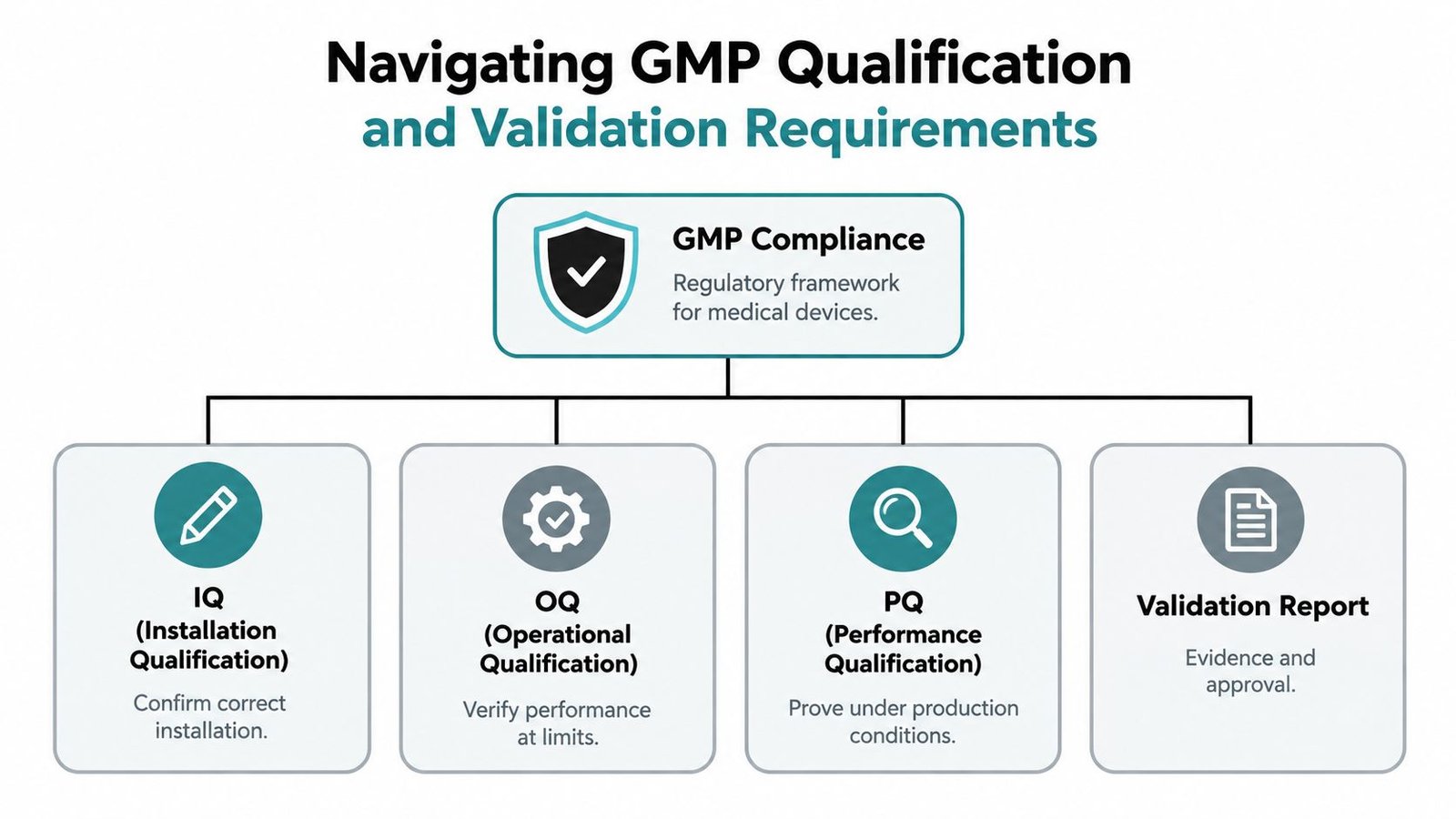
A machine can pass mechanical startup and still fail a GMP handover. It may run, yet lack the controlled evidence required for quality release. Commissioning therefore needs to connect engineering checks with IQ, OQ, and PQ, rather than treating qualification as paperwork added after startup.
Commissioning proves the asset works as intended from an engineering standpoint. Qualification proves it can be trusted for product-making under controlled conditions. The sequence matters. Commissioning establishes the baseline evidence that qualification uses, reducing duplicated testing and leaving a clear record of what was checked (commissioning and qualification bridge).
The bridge from installation to qualification
In GMP manufacturing, commissioning sits between installation and formal qualification activities, including Installation Qualification, Operational Qualification, and Performance Qualification. Records from FAT, SAT, calibration, and functional checks support the quality team's release decision. Engineering should define these records early, so tests produce usable evidence instead of disconnected startup notes.
Good sequencing also controls project cost. If commissioning confirms the installation and basic functions properly, quality personnel can concentrate on risk, compliance, and product-quality evidence instead of repeating every engineering check. The practical goal is a controlled handover with no uncertainty about which tests support which acceptance decision.
The handoff breaks down when engineering says “it runs” and quality asks “show me the evidence.” Complete commissioning records close that gap.
Why GMP teams care about the record set
Documentation provides traceability. Test results, calibration records, operating limits, deviations, and training evidence help establish whether the equipment is ready for qualification and later routine operation. They also give maintenance and operations a reliable reference when performance changes after release. A broader manufacturing GMP overview helps place these commissioning decisions in the context of controlled manufacturing and audit readiness.
For medical device manufacturing, the Springer reference on medical device GMP commissioning describes commissioning and qualification in relation to GMP requirements, life-cycle risk management, and integrated execution. The practical implication is clear: qualification should support controlled, repeatable production, not merely document that the equipment started.
What good qualification handoff looks like
- IQ confirms installation: The asset is installed according to approved specifications.
- OQ confirms operation: Controls, alarms, interlocks, and operating ranges behave as intended.
- PQ confirms performance in production: The system performs under defined manufacturing conditions.
- Validation reports close the loop: Results, deviations, approvals, and remaining actions form a traceable package.
The handover is complete only when the evidence supports a defensible release decision. Running equipment is the starting point. Controlled records determine whether the plant can operate it consistently and answer an auditor's questions.
Key Roles and Documentation for Successful Handover
Most handover disputes aren't really about machines. They're about responsibility. One team thinks the job is done once the equipment powers up, another team thinks acceptance only happens after the documents are complete, and nobody has written down the decision rule that settles the argument.
Who owns what
A clean commissioning effort needs clear roles from day one. The vendor usually owns build integrity and factory-side proof, the integrator owns control logic and system behavior, and the internal plant team owns acceptance criteria, production readiness, and long-term maintainability. When those boundaries are blurred, small issues linger because everyone assumes someone else is tracking them.
That's why commissioning has to be managed as a cross-functional process, not a vendor visit. The ISPE defines it as a “well planned, documented, and managed engineering approach to the start-up and turnover of facilities, systems, and equipment to the end-user” that results in a safe, functional environment meeting design requirements and stakeholder expectations (ISPE commissioning definition).
The documents that make handover real
The paperwork that matters is the paperwork that proves the asset can be owned, operated, and defended in an audit. Calibration certificates show that instruments were set correctly. Operator training logs show that people were prepared before release. Punch-list closure records show that known defects were either fixed or formally accepted.
A practical handover file usually includes:
- Test reports showing what was checked and what passed.
- Calibration records proving measurement devices were set correctly.
- Training evidence showing operators and maintenance staff were briefed.
- Punch-list closure notes confirming open items were resolved or risk-accepted.
- Acceptance sign-offs showing the asset was formally handed over.
Practical rule: If a field team can't find the evidence in minutes, the plant won't trust the handover later.
Why interface control matters
Interface control documentation earns its place. When a line includes multiple machines, utilities, software layers, and safety systems, the handover fails fastest at the seams. A clear interface document stops the classic problem where one subsystem works in isolation but fails when linked to the next one, and it helps prevent the “it's not my side” loop that drags projects out.
For teams that need to tighten that discipline, interface control documentation guidance is worth having in the project package, because the handover is only as good as the boundaries people manage.
Common Pitfalls and Modern Digital Solutions
A machine can start, run, and still be unready for production. The gap between basic mechanical startup and full operational handover is where early-life failures and audit problems often begin. Pressure to release the line encourages teams to skip checks that appear minor, only for those omissions to surface after the vendor has left.
Shortcuts that create rework
Skipping virtual testing is one common mistake. Another is leaving utility integration until startup, when compressed air, water, power quality, or the control network may already be limiting performance. Rushing through punch-list items because production wants the line released creates defects that remain hidden until they interrupt output or require a controlled quality investigation.
NIST's digital-twin publication explains that virtual commissioning can identify and resolve issues before investment and avoid costly adjustments during or after installation of manufacturing equipment. It can support work at machine, production-cell, production-line, and production-system levels (NIST digital-twin publication). Used properly, virtual checks expose control-logic and integration faults before they become physical rework.
The practical trade-off is straightforward. Time spent testing sequences and interfaces before installation may delay a milestone, but it reduces the risk of debugging controls, utilities, and machine behavior during a production launch. In regulated manufacturing, that early discipline also gives engineering and quality teams a clearer record of what was tested before release.
What better commissioning looks like
Effective teams use structured pre-checks, simulated sequences, controlled changes, and deliberate integration tests. They test the full operating sequence, not only each subsystem in isolation. A machine can pass its vendor checks and still fail when connected to upstream equipment, downstream equipment, utilities, safety circuits, or plant software.
Autodesk's industrial commissioning guide describes asset commissioning for newly installed or upgraded machinery, equipment, and production systems as covering installation, functional testing, performance verification, training, and documentation. The stated aim is to confirm reliable, safe operation and expected performance while reducing risk and supporting productivity (Autodesk industrial commissioning guide). That scope separates a credible handover from a simple mechanical startup.
Use these controls:
- Test control logic before hardware is under production pressure.
- Verify utilities within the commissioning plan.
- Close or formally assess punch-list items before release.
- Include operator readiness in the handover decision.
Incomplete commissioning costs more than the repair itself. It can produce unstable throughput, scrap, overtime, repeated troubleshooting, and weaker confidence between engineering, quality, and operations.
The Business Impact of Rigorous Commissioning
A machine can start, produce parts, and still be unready for routine operation. Plant managers feel that gap when early faults interrupt production, maintenance teams lack reliable reference data, and quality cannot prove how the asset was released. Rigorous commissioning closes the distance between mechanical startup and a controlled operational handover.
What rigorous commissioning protects
A disciplined program exposes weak points before production demand makes them expensive. Testing establishes documented baseline results for controls, instruments, safety functions, and operating performance. Maintenance can then compare future changes against known conditions, distinguish normal wear from a new fault, and plan service work with better information.
That baseline also reduces dependence on individual engineers who remember undocumented machine behavior. The handover becomes a usable operating record rather than a collection of unresolved assumptions.
For GMP-regulated production, the risk extends beyond downtime. Commissioning records can support audit readiness by showing traceable testing, calibration status, training evidence, and disposition of outstanding issues before the equipment enters routine use. Missing or inconsistent records can create questions about whether the asset was properly assessed, even when the machine appears to run correctly.
Why the return shows up in operations
The return appears as more predictable production after release. Operators spend less time learning equipment while engineers are still correcting basic faults. Maintenance receives clearer fault history and acceptance evidence, while production avoids some emergency interventions, scrap, and interruptions associated with unstable startup.
The business benefit is not limited to the first production run. A properly handed-over asset gives operations, maintenance, engineering, and quality the same reference point for troubleshooting and future changes. That shared record helps prevent repeated diagnosis of the same problem and makes ownership clearer after the project team leaves.
Business takeaway: Commissioning shifts effort to the project stage, where defects are easier to isolate and correct, instead of leaving operations to pay through downtime, labor, scrap, and audit exposure.
Skipping the work rarely creates one obvious expense. Costs surface as delayed release, recurring alarms, overtime, weak operator confidence, and maintenance activity that never resolves the underlying issue. In regulated plants, an incomplete handover can also delay approval or force corrective documentation after startup.
Choosing the Right Automation and Integration Partner
A good commissioning partner does more than install hardware and leave a binder behind. The right team understands how controls, utilities, mechanical systems, and validation expectations fit together, and it knows where projects usually fail when those pieces are handled by separate groups.
What to look for
Start with the technical scope. You want a partner that can handle preliminary concepts, material sourcing, installation, testing, and commissioning, not just one slice of the job. If the team can't explain how it manages pre-commissioning checks, point-to-point verification, loop tuning, and final sign-off, the handover will probably depend on luck.
Also look for GMP awareness if your environment is regulated. That doesn't mean paperwork for its own sake. It means the partner understands that commissioning records, traceability, and controlled turnover matter as much as machine performance.
Questions worth asking before you sign
- Who writes the acceptance criteria? If nobody owns the pass/fail rules, the project will drift.
- How are changes tracked? Late modifications need documentation, not memory.
- What does the handover package include? Ask for test results, training evidence, and acceptance records.
- How do they support maintenance after startup? A partner that disappears at turnover creates a gap the plant has to absorb.
System Engineering & Automation is one option that provides installation and commissioning as part of its automation and equipment services, along with end-to-end engineering support for manufacturers. That kind of scope matters when the problem isn't buying a machine, it's getting a line to operate cleanly in a live plant.
The practical standard
The best partner is the one that makes the handover boring. The controls work, the documentation is complete, the operators are trained, and the asset enters production with fewer surprises than anyone expected.
If you're planning a new line, a retrofit, or a GMP-aware equipment handover, talk with System Engineering & Automation about commissioning support that covers installation, controls integration, and practical startup readiness. They can help you reduce handover friction and move from project completion to stable production with a cleaner transfer of responsibility.