The line is down, the phone is already ringing, and someone wants to know whether the crew should repair the press, wait for the OEM, or keep the line limping along until first shift. That's the world of industrial equipment repair, where the decision is rarely just technical. It's a production call, a safety call, a parts call, and a cost call made under pressure, often while operators are standing around waiting for answers.
Manufacturers that treat repair as a one-off fix usually pay for it twice. They pay once in labor and parts, then again in lost output, rushed shipping, and repeat failures that trace back to incomplete diagnosis. Repair capability matters because it protects throughput, keeps aging assets productive, and gives operations managers a way to control risk instead of reacting to it.
The market reflects that reality. The Bureau of Labor Statistics places this work in NAICS 8113, the commercial and industrial machinery and equipment repair and maintenance group, which is there to restore machinery to working order and prevent breakdowns and unnecessary repairs. In the United States, the machinery repair and maintenance industry is estimated at $60.7 billion in 2026 with 56,406 businesses and 0.5% CAGR from 2021 to 2026 (BLS industry profile). That scale tells you this isn't a niche support activity. It's part of how industrial production stays alive.
Table of Contents
- Why Industrial Equipment Repair Demands a Strategic Approach
- Initial Diagnosis and Risk Assessment Protocols
- Emergency Response and Downtime Minimization Strategies
- Repair vs Replace Decision Framework for Legacy Equipment
- Parts Sourcing, Vendor Selection, and Documentation Requirements
- Integrating Repairs into Preventive Maintenance Programs
- Measuring ROI and Building a Sustainable Repair Strategy
Why Industrial Equipment Repair Demands a Strategic Approach
A line goes down at 2 AM, and the shift lead has to make a fast call. Getting the machine to run again matters, but so does whether that fix will hold through the next production window. A motor that hums after a reset can still be hiding misalignment, a worn bearing, or an electrical fault that shows up again under load, and that is how a simple breakdown turns into repeat downtime.
Industrial equipment repair sits inside a much larger service economy because uptime has direct value on the shop floor. Industry reporting shows the repair base is broad, with thousands of businesses supporting commercial and industrial assets, and that scale reflects one thing clearly, manufacturers are buying reliability, not a one-time patch (BLS industry profile). A separate industry source places the service market at about 20,500 firms, 209,200 workers, and $53.5 billion in annual revenue, which reinforces that repair spending is tied to keeping output moving, not just fixing broken hardware.
Repair is part of production continuity
The commercial and industrial repair classification is wider than many plant teams assume. The official 811310 description covers heavy machinery, machine tools, refrigeration equipment, construction equipment, mining machinery, welding repair, and industrial blades and saws (NAICS 811310 description). That breadth matters because plants usually do not lose output from every asset at once. They lose it from the one machine that sits in the middle of the process flow, the one nobody wanted to stop long enough to inspect properly.
A repair decision also has to protect the next run, not just clear the alarm.
Repair planning belongs with wider asset planning, including equipment lifecycle management, because the same machine can move through very different cost profiles over time. A low-cost fix on a young asset can make sense. The same fix on a tired legacy unit may only buy a short reprieve before the next failure, along with more lost production, more overtime, and more parts spending. That is why experienced maintenance teams look at failure history, serviceability, and remaining useful life before they authorize the work.
The economics point in the same direction. Maintenance and repair have moved from reactive shop-floor fixes to a discipline built around uptime and asset reliability. A separate industry estimate values the global maintenance market at $701.3 billion by 2026, up from $616.1 billion in 2020 (equipment maintenance statistics). For manufacturers, that growth reflects a simple truth, repair is not overhead if it prevents a line stoppage that would cost far more.
When I work with plant teams on manufacturing solutions that improve production and services, the conversation starts with the asset's role in output, how often it fails, and how much room the operation really has when it goes down. That is why repair strategy belongs with asset planning, not just with maintenance tickets.
Initial Diagnosis and Risk Assessment Protocols
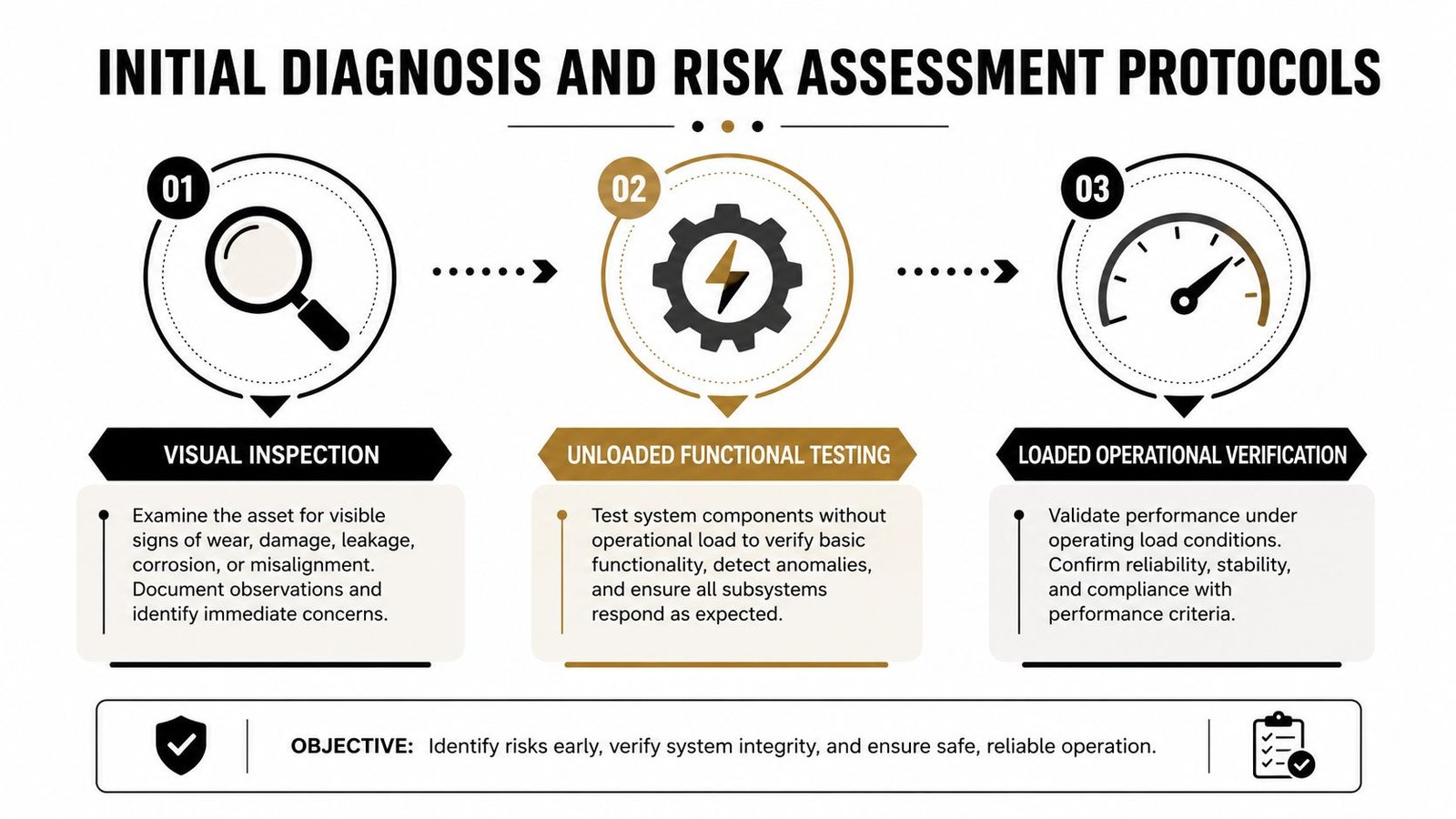
A good repair starts by refusing to guess. The fastest way to waste a shutdown is to declare success because the machine powers on, then discover that vibration is off, current draw is unstable, or a coupling was never aligned correctly. The right sequence is simple and strict, visual inspection first, unloaded functional testing second, loaded operational verification last.
Start with what you can see and measure
Visual inspection is where many failures announce themselves if someone is patient enough to look. Oil stains, loose guards, connector heat damage, rubbed insulation, foundation movement, and fastener witness marks tell you a lot before a wrench turns. The point isn't to be dramatic, it's to separate the obvious from the hidden.
Then move to unloaded functional testing. At this stage, the machine can run without process load, which helps isolate mechanical or electrical issues before you ask it to do real work. That's where you watch for abnormal sound, uneven motion, obvious drag, and startup behavior that doesn't match the asset's normal pattern.
Verify against baseline, not hope
Loaded operational verification is the final gate. The repair isn't complete until the asset returns to its pre-failure performance envelope, with checks such as motor amp draw staying within nameplate full-load amps, vibration matching a healthy baseline, and current imbalance staying within 5% (post-maintenance verification guidance). The same guidance cites insulation resistance greater than 1 MΩ per kV + 1, and soft-foot tolerance below 0.002 inches, both of which help prevent false confidence after restart (post-maintenance verification guidance).
A machine that only starts is not repaired. It's merely restarted.
That distinction matters because latent defects hide behind successful power-up events. Misalignment, friction, and electrical faults often show up only when torque, vibration, and heat return under load. A disciplined three-stage protocol gives the team a way to say the asset is actually ready, not just temporarily alive.
Emergency Response and Downtime Minimization Strategies
Unplanned downtime is expensive enough that managers should plan for it as a financial event, not just a technical failure. The costs are severe across industry. One source cites unplanned manufacturing downtime at up to $50 billion per year, with a single hour of equipment downtime costing about $260,000 on average (equipment downtime cost statistics). Another reported figure puts automotive downtime near $2 million per hour and oil and gas around $500,000 per hour (equipment downtime cost statistics).
Those numbers change how you build response plans. If a failure can burn through value that fast, then the emergency process has to be faster than the loss curve.
Build the response around the critical asset
Criticality comes first. Not every machine deserves the same response time, same spare depth, or same escalation path. The line bottleneck, the safety-critical system, and the asset with the longest replacement timeline should get the most aggressive response package, including documented contacts, staged parts, and a clear decision tree for temporary workarounds.
A fast response also depends on communication. Operations, maintenance, procurement, and production scheduling need to know who owns the failure, who approves parts, and who signs off on the restart. Without that chain, technicians lose time waiting for approvals that should have been pre-cleared.
Reduce repair time before the failure happens
The best plants shorten MTTR before the outage by staging the pieces that always slow work down. That means labeled spares, updated wiring prints, calibrated instruments, and cross-trained technicians who can touch more than one asset family. It also means maintaining repair documentation so the second outage doesn't become a fresh investigation.
The cost of downtime is also why some manufacturers keep a partial-production plan on paper. A temporary bypass, alternate routing, or reduced-throughput mode may not be elegant, but it can preserve some output while the permanent fix is underway. The point is not perfection, it's keeping cash flow moving while the right repair is completed.
Repair vs Replace Decision Framework for Legacy Equipment
Older equipment forces a harder question than new equipment does. You're not just deciding whether to fix a machine, you're deciding whether the next fix is a smart use of capital. That's where lifecycle economics matters more than habit, because repeated repairs on aging assets can either be sensible stewardship or a slow-motion waste of maintenance budget.
The hidden issue is that many plants keep repairing legacy equipment without a structured threshold for when to stop. That's risky because the cost isn't only the repair invoice. It's the downtime, the parts search, the uncertainty, and the opportunity cost of tying up technicians on a machine that may be headed for a larger failure mode.
Compare the options on operational terms
| Decision Factor | Repair | Rebuild | Retrofit | Replace |
|---|---|---|---|---|
| Asset criticality | Good for isolated failures on important machines | Useful when the core asset still matters but wear is broad | Strong when controls or instrumentation need modernization | Best when the machine no longer fits process needs |
| Obsolescence risk | Acceptable if parts are still available | Helps extend service life when original components are aging | Reduces control-system risk without scrapping the asset | Solves obsolescence only if the new platform is supportable |
| Parts availability | Works when spares can be obtained quickly | Better when worn assemblies can be restored | Useful when electronic or sensing components are the issue | Necessary when parts are effectively unavailable |
| Lifecycle economics | Best for localized damage and sound base structure | Better when the asset is valuable but degraded | Strong when a targeted upgrade unlocks better reliability | Right when repeated repairs are no longer rational |
| Production impact | Lowest disruption if the fix is fast | Moderate, often planned around a shutdown | Moderate to high depending on integration | Highest upfront disruption, but may reduce future risk |
The question is whether the machine still has meaningful productive life. A sound base structure with localized wear is usually worth repairing or rebuilding. A machine with chronic failures, impossible parts sourcing, or control hardware that can't be supported anymore pushes the conversation toward retrofit or replacement.
Use predictive thinking on legacy fleets
The under-discussed opportunity is predictive maintenance for legacy industrial equipment. Many organizations still lean heavily on reactive work while also trying to extend asset life and reduce downtime, which creates a practical gap for older fleets (industrial maintenance service context). That gap is where the repair, rebuild, retrofit, or replace decision should live.
Best call: choose the option that protects the next three production cycles, not the option that feels cheapest at the purchase desk.
For plants that need outside support, System Engineering & Automation fits naturally here as one option among several, because it provides engineering and automation work that can support retrofits, controls, and process improvements when a full replacement is not justified. The right decision still depends on the asset, but the framework should start with lifecycle economics, not with a reflex to either patch or scrap.
Parts Sourcing, Vendor Selection, and Documentation Requirements
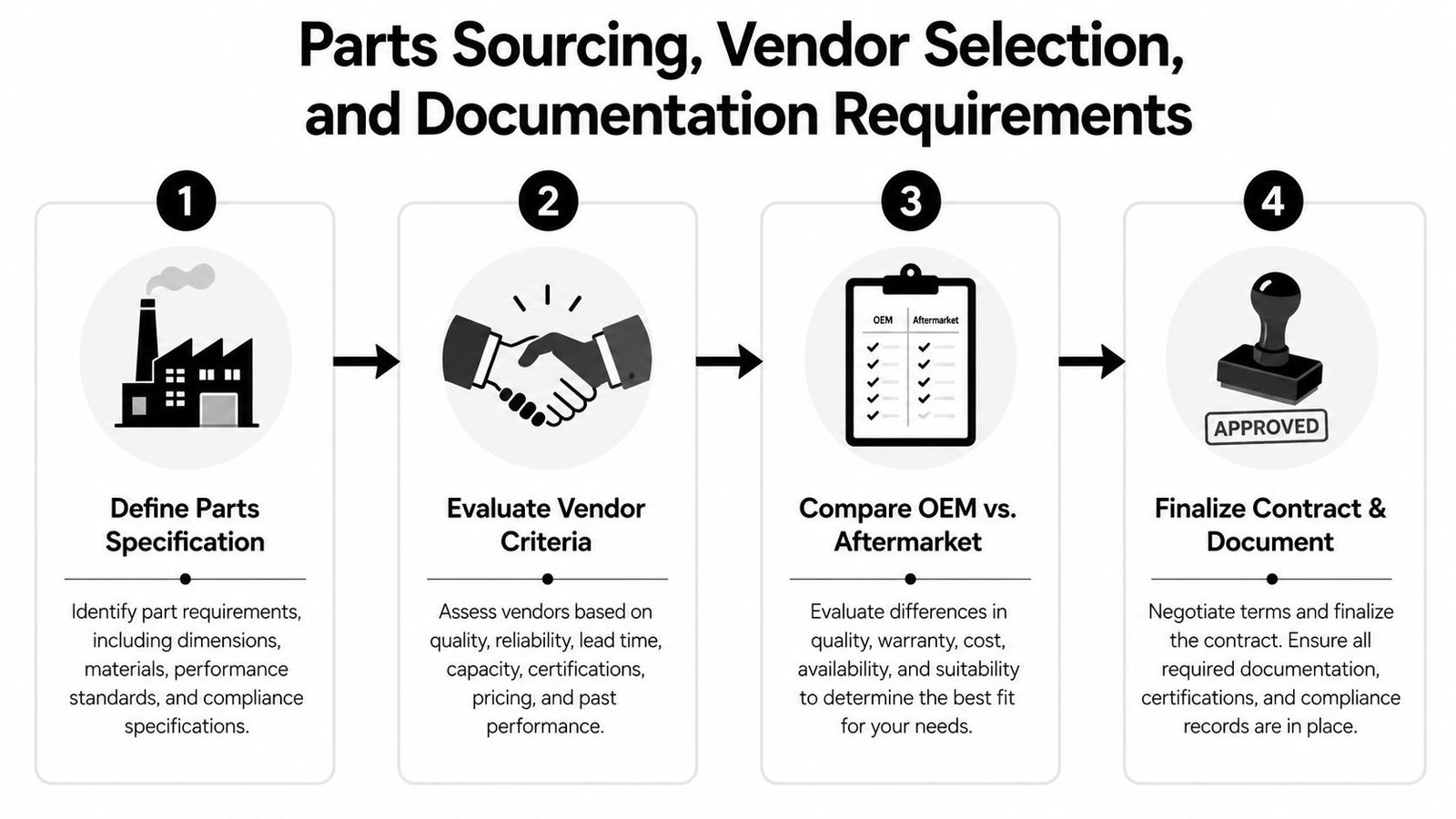
A repair plan fails fast when a part arrives late or the vendor cannot prove what was done. Legacy equipment makes that harder because procurement teams run into long lead times, obsolete part numbers, and aftermarket substitutes that do not always match the original fit. The mechanical fix is only one part of the job. The other part is supply discipline, because the hidden cost of a bad sourcing choice shows up later in repeat downtime, extra labor, and a shorter useful life for the asset.
Source parts like the outage depends on it
It usually does. Critical spares should be staged before they are needed, especially for assets with weak availability or long replacement times. For legacy fleets, that means confirming dimensions, materials, electrical ratings, and any fitment constraints before a purchase order goes out. A part that is close enough on paper can still create a costly delay on the floor if it needs rework, adapter hardware, or another shutdown to install.
The OEM versus aftermarket decision needs the same discipline. OEM parts are easier to defend when fit, validation, and warranty are at stake. Aftermarket parts can work when they meet specification and the plant accepts the trade-off, but that call should be documented and tied to the actual risk on the equipment, not decided at the dock door. If the repair team is also managing shelf levels and reorder points, our guide to spare parts inventory management helps connect sourcing decisions to what should already be on hand.
Qualify the vendor on capability, not slogans
Vendor selection should begin with technical scope, response time, quality control, and traceability. Ask who will do the work, what test method they use, how they document acceptance, and what happens if the repaired item fails early. A shop that answers those questions directly is easier to trust than one that hides behind broad promises.
The vendor file should also show how the parts flow is controlled from end to end. Purchase approvals, receiving checks, serialization, and return procedures matter because a repair program can look efficient while carrying the wrong spares, the wrong revisions, or no proof of conformity. That is how lifecycle cost rises on older equipment, one avoidable mismatch at a time.
For regulated environments, GMP-aware documentation is required. Traceability, validation records, and change control matter because the repair has to survive both operational review and audit review. If the work changes performance, configuration, or qualification status, the paperwork has to say so plainly, with the same clarity a plant manager would want before releasing the asset back to production.
A video walkthrough can also help teams standardize parts and vendor decisions when multiple departments touch the same asset family.
Integrating Repairs into Preventive Maintenance Programs
Reactive work shows where the plant is failing today. Preventive maintenance shows how to keep that same failure from returning tomorrow. The strongest programs use repair history as input, then feed it into FMEA, asset criticality, and task planning so repeated breakdowns stop consuming the same production window over and over.
Start with critical assets and failure modes
A workable sequence is direct, identify critical assets, define what they have to do, list plausible failure modes through FMEA, assess the safety, production, and economic consequences, then choose the mix of preventive, predictive, or run-to-failure tasks that makes sense for that equipment family (maintenance best practices framework). That approach beats ad hoc fixes because every task is tied to a consequence, not to habit.
The same guidance stresses keeping a master equipment list and ranking components by process importance before setting maintenance frequency with OEM manuals, equipment history, root-cause analysis, and engineering judgment (maintenance best practices framework). On paper that sounds straightforward. On the shop floor, it only works if the list is current, the failure codes are consistent, and the people entering the data know the difference between a symptom and a root cause.
Practical rule: if a failure repeats, treat the repair log as a design input, not a history file.
Measure whether repairs are actually improving reliability
The point of folding repair data into preventive maintenance is to change outcomes you can see. Common KPIs include downtime, MTTR, MTBF, schedule adherence, and preventive-maintenance compliance. If those measures do not move in the right direction after the repair process changes, the program is generating work instead of reliability.
The NIST publication Economics of Manufacturing Machinery Maintenance reports maintenance expenditures for NAICS 321-339, excluding 324 and 325, at $57.3 billion (NIST economics of manufacturing machinery maintenance). That figure is a reminder that maintenance already sits near the center of plant economics, so even small improvements in repair quality, planning discipline, and follow-up have a real effect at scale.
Predictive methods belong in the same conversation. How to implement predictive maintenance sits alongside repair logs because the better reliability teams do not separate the two. They use repair events to decide what to monitor, then use those monitoring priorities to keep the next failure from turning into a shutdown.
Measuring ROI and Building a Sustainable Repair Strategy
The ROI case for structured repair programs is simple, even if the accounting takes work. If downtime is costly, repeat failures are expensive, and aging assets still have usable life, then repairs that are planned, verified, and tied to preventive action should return more than they consume. The main challenge is that many plants never measure the full effect, so leadership sees repairs as expense lines instead of production protection.
Start by tracking what changes after the repair strategy changes. Capacity losses, repeat failures, emergency callouts, and time spent chasing parts are all visible signs. If the team also measures MTTR, MTBF, schedule adherence, and PM compliance, it becomes much easier to show whether reliability is improving.
The biggest barriers are rarely technical. Weak skills assessment, poor maintenance culture, and lack of proactive planning slow everything down. The fix is to standardize diagnosis, document the baseline, use criticality to prioritize work, and review recurring failures as part of the monthly maintenance conversation instead of waiting for the next breakdown.
The manufacturing reality is straightforward. Industrial equipment repair has moved from a reactive necessity to a strategic discipline that affects production efficiency, cost control, and competitive position. Plants that treat it that way get better uptime and fewer surprises. Plants that don't usually keep paying for the same failures in different ways.
If you want practical help tying repair decisions to production goals, System Engineering & Automation supports manufacturers with engineering, automation, controls, and maintenance-minded solutions that fit real plant constraints. Reach out if you need a repair or retrofit path that protects throughput, improves reliability, and fits the budget you have.