
Your plant is probably not deciding whether to automate. It's deciding where to start without disrupting production. A manual workstation may be missing output targets, operators may be spending hours on repetitive or awkward tasks, and quality teams may be demanding better traceability. At the same time, a fully robotic line can look too expensive, too rigid, or too difficult to validate.
That's why a practical manufacturing automation strategy should begin with the smallest intervention that solves a measurable problem. Smart tooling, custom fixtures, integrated controls, and semi-automated cells can improve repeatability while preserving the human judgment that variable production and regulated processes often require. The objective isn't to buy the most automation. It's to create a production system your team can operate, maintain, validate, and expand.
Table of Contents
- Why Most Manufacturers Fail at Automation And How to Succeed
- The Case for Semi-Automation and Smart Tooling
- Building Your Automation Roadmap in Five Steps
- Overcoming the Top Three Barriers to Adoption
- Ensuring Compliance and Future-Proofing Your Systems
- Implementing with Confidence From Pilot to Production
- Start Your Automation Journey Today
Why Most Manufacturers Fail at Automation And How to Succeed
A mid-sized manufacturer often reaches the same uncomfortable point. Orders are increasing, experienced operators are difficult to replace, and a manual process has become the bottleneck. A vendor proposes a complete automated line, complete with robotics, vision, conveyors, and a connected control system. The concept looks impressive, but the plant lacks clean production data, standardized work, spare-parts ownership, and the internal skills to support the system.
The project then grows before the team has proved the underlying process. Integration takes longer than expected, operators aren't involved early enough, and the original business case focuses too heavily on equipment price. The result can be a technically functional cell that never reaches stable production, a condition commonly called pilot purgatory.
Practical rule: If the plant can't define the current process in measurable terms, it isn't ready to automate the entire process.
The risk is visible in the broader manufacturing market. Factories installed approximately 542,000 new industrial robots worldwide in 2024, more than twice the annual installation level recorded a decade earlier, while global robot density reached 132 robots per 10,000 manufacturing employees, according to the International Federation of Robotics. Adoption varies sharply by market, with Western Europe at 267, North America at 204, and Asia at 131 robots per 10,000 employees. Those differences reflect labor economics, industry mix, capital availability, and production complexity, not a universal automation target.
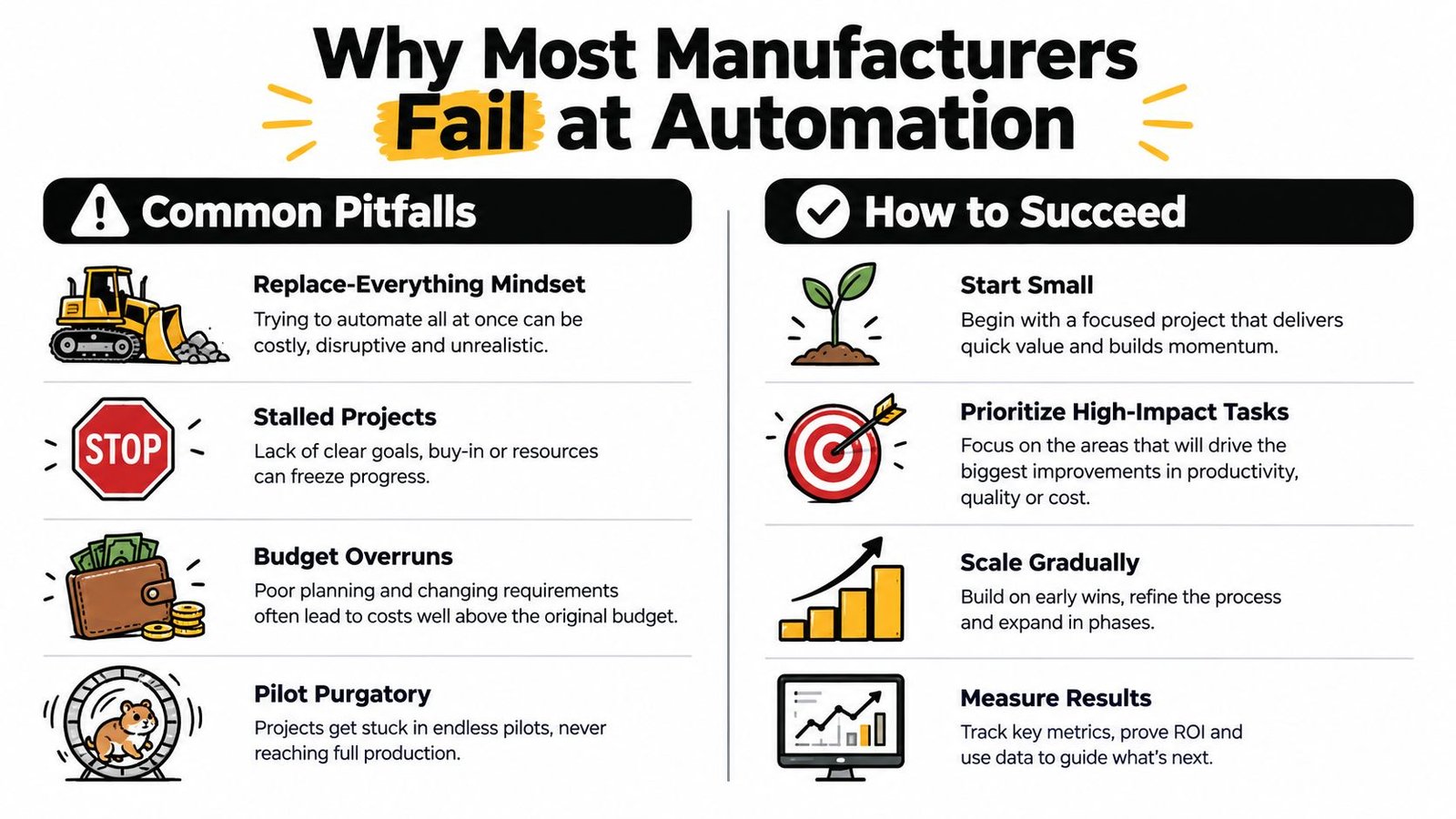
A graduated approach gives plant managers more control. Start with a repeatable operation, such as loading a fixture, applying a controlled force, dispensing material, inspecting a feature, or transferring a component. Add only the sensing, tooling, motion, and controls needed to improve that operation. Once the cell demonstrates stable performance and operators can recover common faults, expand the architecture.
This approach changes the investment question from “Should we automate the line?” to “Which task creates the clearest operational value?” It also creates a logical sequence for workforce training, quality documentation, maintenance planning, and future data connectivity. A smaller project can become the foundation for a larger system, but a large system rarely becomes simple after installation.
The Case for Semi-Automation and Smart Tooling
A manual assembly station does not need to become a fully robotic line to produce better results. A custom fixture can orient each part consistently, while a force sensor confirms that a press reaches the required condition. A vision-guided pick-and-place unit can handle repetitive transfers, leaving the operator to replenish components, inspect visual features, and respond to unusual product conditions.
Semi-automation is often the most practical middle ground for manufacturers with multiple products, changing volumes, or strict inspection requirements. It removes repetitive motion and controls key process conditions without forcing every product decision into a rigid machine sequence. That division of work matters in medical-device production, where documented inspection and controlled handling may remain part of the process.
The investment should follow the task, not an assumed target for robot adoption. Market-level automation figures can indicate how operating conditions differ, but they do not determine the right project for a mid-sized plant. Labor availability, product mix, engineering capacity, validation effort, and capital constraints should determine which operation receives attention first. Sequence investment around the process that offers measurable improvement with manageable technical and compliance risk.
Compare the practical entry points
| Automation Level | Initial Investment | Flexibility | Implementation Time | Best For |
|---|---|---|---|---|
| Smart tooling or fixtures | Lower and targeted | High | Shorter | Repeatable manual operations, ergonomic improvements, controlled assembly |
| Semi-automated cell | Moderate and modular | Moderate to high | Moderate | Bottleneck operations, multiple SKUs, operator-assisted production |
| Fully automated line | Higher and broad | Lower when product variation is high | Longer | Stable, high-volume processes with strong process definition |
The table is a selection aid, not a purchasing formula. Match system complexity to process maturity. A connected line may collect more information, but that information has limited value if the plant cannot maintain sensors, interpret alarms, control access, and act on findings. In regulated environments, the team must also define records, change control, and validation evidence before expanding the system.
Deloitte reported improvements of up to 20% in production output, 20% in employee productivity, and 15% in freed capacity from smart manufacturing initiatives in its 2025 Smart Manufacturing and Operations Survey. The survey also found that 46% of respondents ranked process automation among their top two investment priorities, compared with 37% for physical automation and 24% for factory synchronization. These findings support a practical sequencing principle: improve the process and its controls before pursuing maximum machine autonomy.
For a cost-sensitive plant, a smart fixture or semi-automated workstation may offer more value than a connected line the workforce cannot support. Semi-automated systems and smart automation provide a staged path when operators must inspect products, handle exceptions, or manage frequent changeovers. The first project should make the next project easier by producing usable work instructions, maintenance experience, and performance evidence.
Building Your Automation Roadmap in Five Steps
A workable roadmap begins with the operation and its constraints, not an equipment catalog. For a mid-sized manufacturer, a graduated approach often starts with smart tooling or semi-automation at one workstation, then expands only when the process, workforce, and controls can support it.
1. Establish the baseline
Record current cycle time, throughput, first-pass yield, scrap, labor content, downtime, safety exposure, changeover time, and maintenance events. Compare shifts and product types rather than relying on an average that conceals unstable conditions. In a regulated medical-device plant, also identify which measurements and records will support later review, validation, and change control.
The U.S. Census Bureau began collecting plant-level robotics information through the Annual Survey of Manufactures in 2018, covering approximately 50,000 manufacturing establishments. The Census Bureau's plant-level robotics data supports the same practical principle: automation decisions need to reflect actual process conditions, not anecdotes.
2. Rank candidate operations
Score each operation against four questions:
- Is the work repeatable enough for mechanical assistance?
- Does it constrain throughput or create a queue?
- Does it expose workers to ergonomic or safety risk?
- Can the process be controlled without removing necessary judgment?
Prioritize tasks that combine repeatability, bottleneck impact, and avoidable physical burden. A smart fixture, guided tool, torque-controlled driver, or assisted material-handling step may be a better first move than a fully robotic cell. Variable operations with frequent engineering changes can remain later candidates, even when they look impressive in a demonstration.
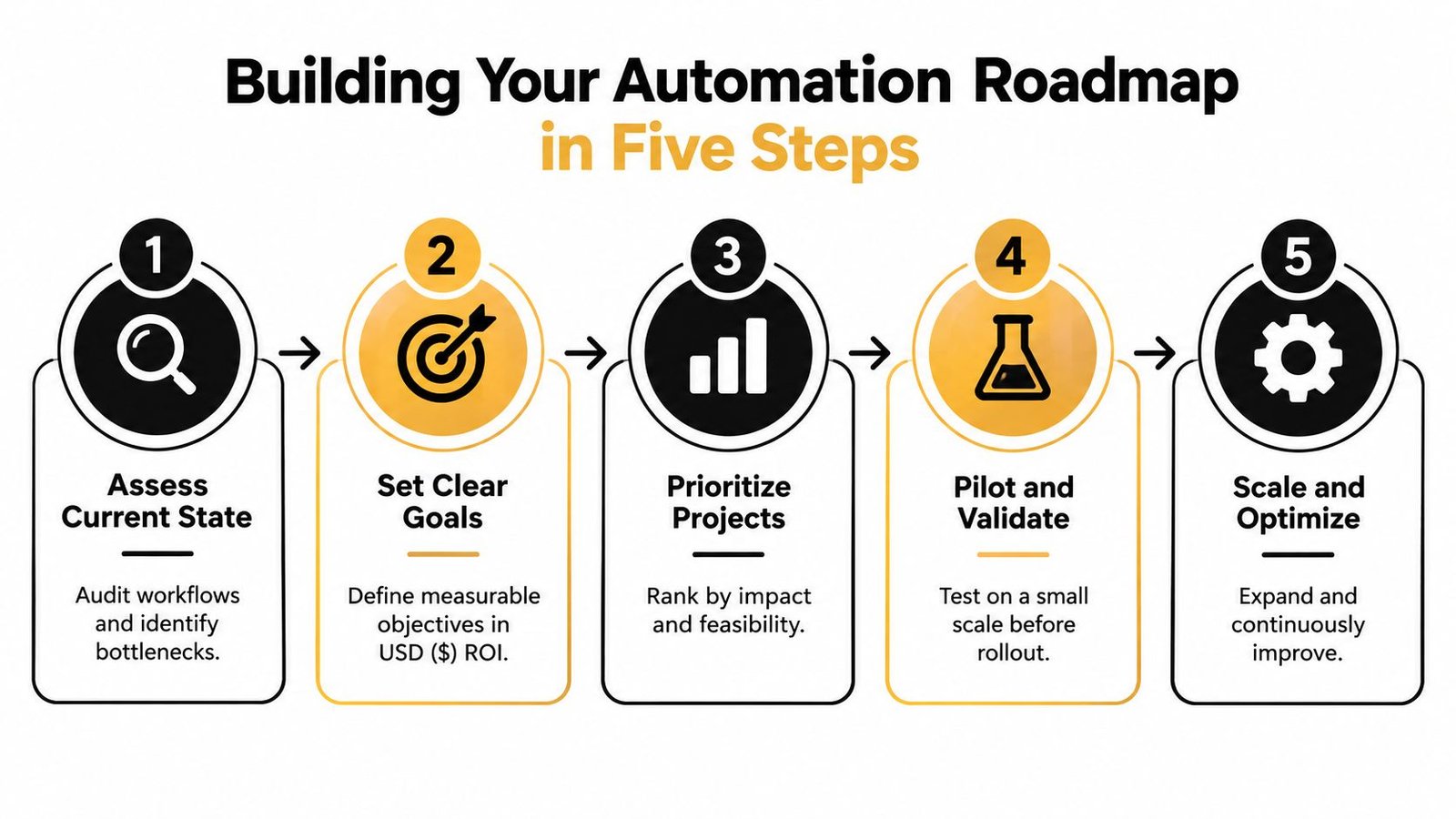
3. Build the total-cost case
Equipment price is one budget line. Include tooling, end effectors, controls, electrical work, guarding, integration, validation, training, maintenance, spare parts, quality documentation, and production disruption during installation. For a regulated product, account for the evidence needed to qualify the process and manage future changes.
McKinsey reports that successful automation programs combine a complete business case, agile implementation, and workforce capability investment. Its analysis cites 20% to 40% efficiency gains and positive return on investment within 12 to 18 months for the strongest transformations, as detailed in its automation and talent analysis. Use those figures as a reference for disciplined evaluation, not as a guarantee for a particular plant.
4. Instrument a pilot
Test the concept at one workstation or in a limited cell. Measure availability, cycle-time capability, defect escape rate, changeover time, operator intervention frequency, recovery time, and maintenance effort.
The pilot must answer operational questions. Can an operator load the station consistently? Can maintenance isolate a fault? Can quality review the records? Can the team change products without calling the integrator for every adjustment? These answers determine whether the next stage should add automation, improve the tooling, or stop the rollout.
5. Scale only after the gates are met
Approve expansion when the pilot demonstrates stable performance against the baseline and the plant has documented recovery procedures, trained ownership, acceptable changeover behavior, and controlled data handling. A modular design lets the team add stations, sensors, or material handling later without discarding the initial investment.
Manufacturers evaluating mechanical, electrical, and controls requirements can review automation systems and engineering designs as part of the design process.
Overcoming the Top Three Barriers to Adoption
Cost, integration risk, and workforce readiness are related problems. A phased manufacturing automation strategy addresses them together instead of treating each one as a separate procurement obstacle.
Cost requires scope discipline
The expensive mistake isn't always buying a costly robot. It's buying a system that requires extensive redesign after installation. NIST identifies cost, production disruption, limited data access, lengthy certifications, inadequate legacy sensors and controllers, and poor interoperability as barriers for small and midsized manufacturers, according to its guidance on collaborative automation.
NIST notes that organizations may need to budget up to approximately three times the cobot purchase price for integration, development, fixturing, end effectors, and deployment. Experienced implementers have sometimes integrated systems at roughly 0.5 to 1.0 times equipment cost, and the guidance cites a typical ROI horizon of about 14 months. The range illustrates why a narrow scope and experienced integration matter as much as the selected equipment.
Integration risk requires an architecture before a purchase
Map every interface before approving hardware. Identify controller protocols, safety circuits, sensor compatibility, recipe management, quality records, network boundaries, and manual fallback modes.
Legacy equipment often becomes the hidden project. A new vision system may require reprogramming when product variants change. A connector may not communicate with the existing controller. A cell may work in isolation but fail to exchange the data required for traceability. A modular architecture, documented interface map, and maintainability review reduce those surprises.
Workforce readiness requires role redesign
Automation changes work. It can remove repetitive handling while increasing the need for setup, troubleshooting, inspection, and process ownership. Deloitte's 2025 survey of 600 large U.S.-based manufacturing executives found that 48% faced moderate-to-significant difficulty filling production and operations-management roles, while 35% identified adapting workers to the Factory of the Future as a top concern, according to the Auburn ICAMS Smart Manufacturing Adoption Study.
That study also found that 41% of manufacturers were using AI, machine learning, and automation to address skills shortages, while 48% planned to repurpose or hire additional workers because of smart-manufacturing investments. Build the training matrix before the machine arrives. Include operator setup, fault recovery, safe intervention, quality checks, and maintenance escalation.
Field lesson: A cell that operators can't reset safely is not automated production. It's a new source of downtime.
Ensuring Compliance and Future-Proofing Your Systems
In a medical-device plant, the automation system becomes part of the controlled production environment. The design must support the quality system, not just produce parts at a faster rate.
The FDA's Quality Management System Regulation became effective on February 2, 2026, incorporating ISO 13485:2016 by reference into the device current good manufacturing practice requirements in 21 CFR Part 820, as explained in the FDA's quality and compliance guidance for medical devices. Automated and semi-automated processes therefore need documented procedures, equipment records, validation evidence, traceability, and controlled change.
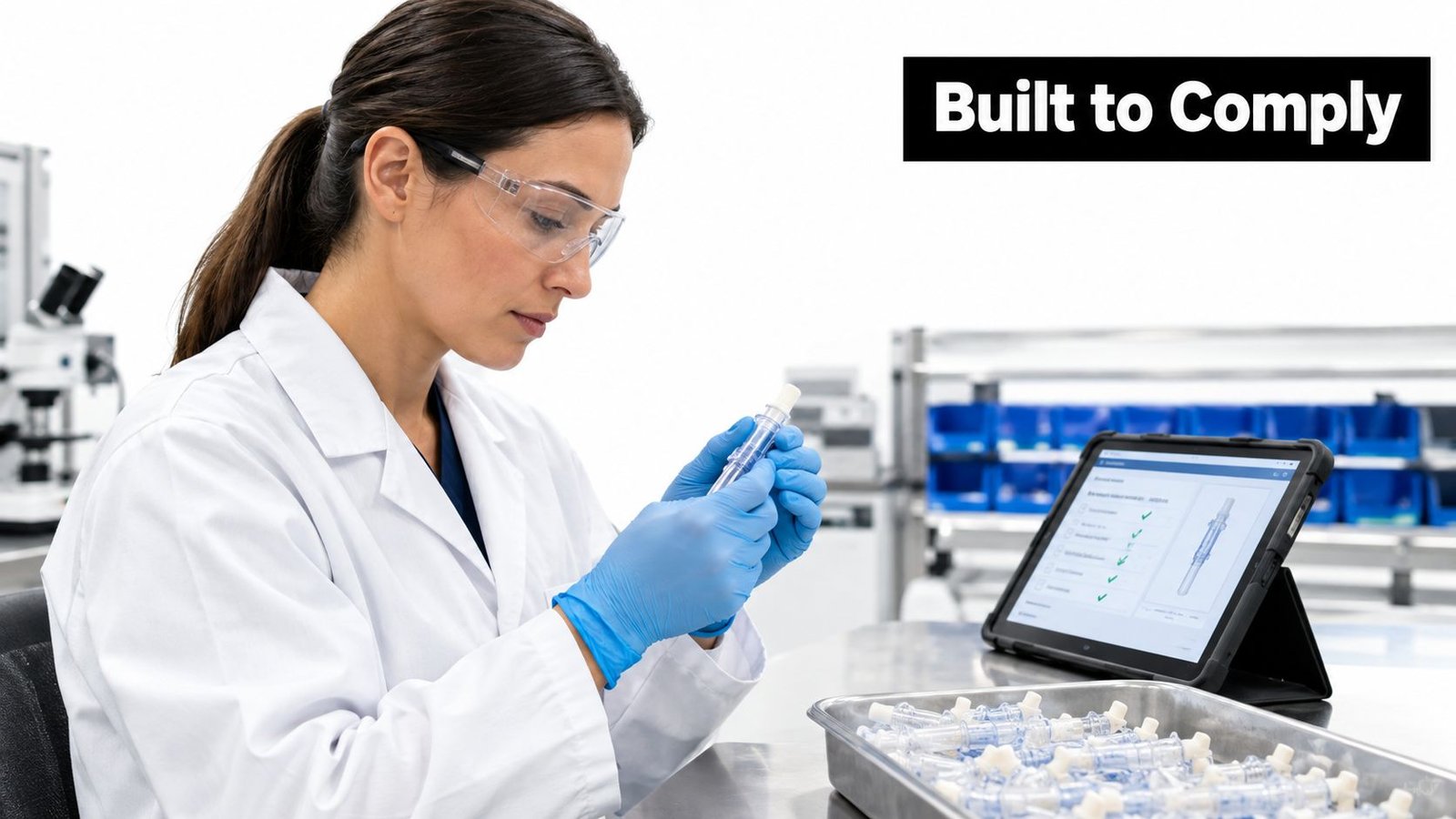
Design compliance into the cell
Define quality and validation requirements during concept development. Decide how the system will identify components, record process conditions, manage recipes, detect failures, preserve audit trails, and prevent unauthorized changes.
For a regulated operation, a force-controlled press may need more than a force sensor. The plant may also need calibration records, alarm handling, electronic or paper batch documentation, acceptance criteria, change-control records, and a defined response when the measurement falls outside limits. These requirements influence the controls architecture and should appear in the original project schedule.
Manufacturers can also align process planning with GMP considerations in manufacturing before equipment specifications become fixed.
Treat cybersecurity as an operating requirement
Connectivity creates access paths and maintenance responsibilities. Separate machine controls from enterprise networks where appropriate, document remote-access rules, control user permissions, and preserve a local operating mode when network services are unavailable.
Rockwell's 2025 global survey reported cybersecurity as the second-largest external risk, with 49% of manufacturers planning to use AI for cybersecurity in 2025, up from 40% in 2024, as reported in the Deloitte 2025 Smart Manufacturing Survey. More connectivity isn't automatically more strategic. A dependable semi-automatic station with targeted data capture may be easier to secure and maintain than a fully connected architecture that no one owns operationally.
Include people in the compliance model
Operators and technicians need controlled instructions, training records, escalation paths, and clear authority to stop or quarantine a process. That's where compliance and culture meet. A system that records every cycle but leaves workers uncertain about an alarm won't protect quality.
Future-proofing means preserving options. Use documented interfaces, replaceable sensors where practical, accessible controls, and a change process that allows the plant to improve the system without losing validated state.
Implementing with Confidence From Pilot to Production
The transition from approved pilot to production requires more than installation. It requires ownership.
Select an integrator that can support mechanical design, electrical and controls engineering, custom tooling, commissioning, documentation, and training. For medical-device work, ask how the team handles GMP-aware design, validation support, controlled changes, traceability, and equipment records. A partner that only delivers hardware may leave the plant with the hardest operational work.
Use a controlled cutover
Schedule installation around production constraints and define the fallback process before the first shutdown. Freeze drawings and software versions, document approved settings, verify safety functions, and run acceptance tests with operations, maintenance, quality, and engineering present.
Training should be practical rather than limited to a presentation. Operators should demonstrate normal operation, product changeover, safe recovery, inspection steps, and escalation. Maintenance staff should practice fault isolation, sensor replacement, backups, and preventive-maintenance tasks.
Create a handover package containing:
- Operating instructions: Normal cycles, changeovers, alarms, and safe intervention.
- Maintenance records: Parts lists, lubrication requirements, calibration needs, and service intervals.
- Recovery procedures: Defined responses to jams, failed checks, communication faults, and quality holds.
- Change documentation: Approved drawings, software versions, validation evidence, and revision history.
Deloitte reported that more than 80% of manufacturing professionals in a 2024 survey of over 600 respondents said labor turnover had disrupted production, according to its manufacturing trends analysis. That makes knowledge transfer a continuity control, not an administrative task.
After launch, review the original baseline at regular intervals. Track downtime response, first-pass yield, changeover performance, intervention frequency, and maintenance workload. If the cell performs well but creates new bottlenecks upstream or downstream, improve the surrounding process before adding more automation.
Start Your Automation Journey Today
A reliable manufacturing automation strategy doesn't begin with a robot. It begins with a measured bottleneck, a defined quality requirement, and a team that understands how the future process will work.
For mid-sized manufacturers, smart tooling and semi-automated cells can improve safety, repeatability, throughput, and workforce flexibility without forcing an all-or-nothing investment. For medical-device manufacturers, the same phased logic creates room for validation, traceability, controlled change, and operator training from the beginning.
Start with one workstation. Record its performance. Select an intervention that your team can maintain. Then scale only when the evidence supports the next step. This is how plants avoid pilot purgatory and build automation that survives real production conditions.
System Engineering & Automation provides consultation, concept development, custom tooling, fixtures, semi-automatic and fully automated equipment, integrated controls, installation, commissioning, and ongoing maintenance support for manufacturing teams. Visit System Engineering & Automation to discuss a practical automation assessment or pilot designed around your production goals, budget, workforce, and quality requirements.