You already know the feeling if you've walked a plant floor lately. Three machines from three vendors, three HMIs, a vision system nobody trusts, operators filling in gaps by hand, and production data trapped in a spreadsheet that's always a shift behind. Scrap climbs, audits get closer, and leadership still wants more throughput from the same floor.
A manufacturing system integrator is the person you bring in when the plant needs to behave like one system instead of a pile of equipment. The job isn't “hook up machines.” It's to turn shop-floor friction into a controlled production flow that operators can run, engineers can support, and management can measure.
Table of Contents
- The Production Floor Problem a Manufacturing System Integrator Solves
- What a Manufacturing System Integrator Actually Does
- Core Services from Design Through Commissioning and Support
- Benefits That Show Up on the P&L and the Shop Floor
- Choosing How Much Integration to Buy
- ROI, Cost Drivers, and Realistic Timelines
- A Semi-Automated Medical Device Line in Practice
- Questions to Ask Before You Sign with an Integrator
The Production Floor Problem a Manufacturing System Integrator Solves
The worst plant problems rarely announce themselves with a dramatic failure. They show up as little daily annoyances, a machine that needs a manual restart, a quality check that lives outside the MES, a label that gets rewritten by hand because the data never made it upstream. By the time anyone calls an integrator, the floor has already taught everyone to work around the system instead of through it.
That's the point where the role becomes strategic. A manufacturing system integrator translates between equipment vendors, controls logic, production software, and the people who have to run the line every day. The integrator is the one who notices that a clean mechanical layout still fails if the data model is sloppy, or that a fast machine is useless if changeovers are unmanageable.
What's really broken
Most plant managers don't have a “machine” problem. They have a coordination problem. The line may run, but the line doesn't communicate. One vendor's HMI says one thing, the MES says another, and the operator becomes the integration layer.
A strong integrator looks at the whole picture, fragmented equipment, mismatched data structures, compliance pressure, and a shrinking pool of skilled technicians. Those aren't separate issues. They all hit the same place, production stability.
Practical rule: if operators are compensating for missing logic, missing data, or missing handoffs, you're already paying for integration, just badly.
The market makes sense only when you look at it that way. System integrators have grown from a tiny niche, 103 firms in 1970 according to the referenced market history, into a broader category valued at USD 46.88 billion in 2025 and forecast to reach USD 63.73 billion by 2031 (market history and forecast). That growth reflects one thing clearly, manufacturers keep buying the same lesson in a more expensive form: disconnected equipment costs more than integrated equipment.
What a Manufacturing System Integrator Actually Does
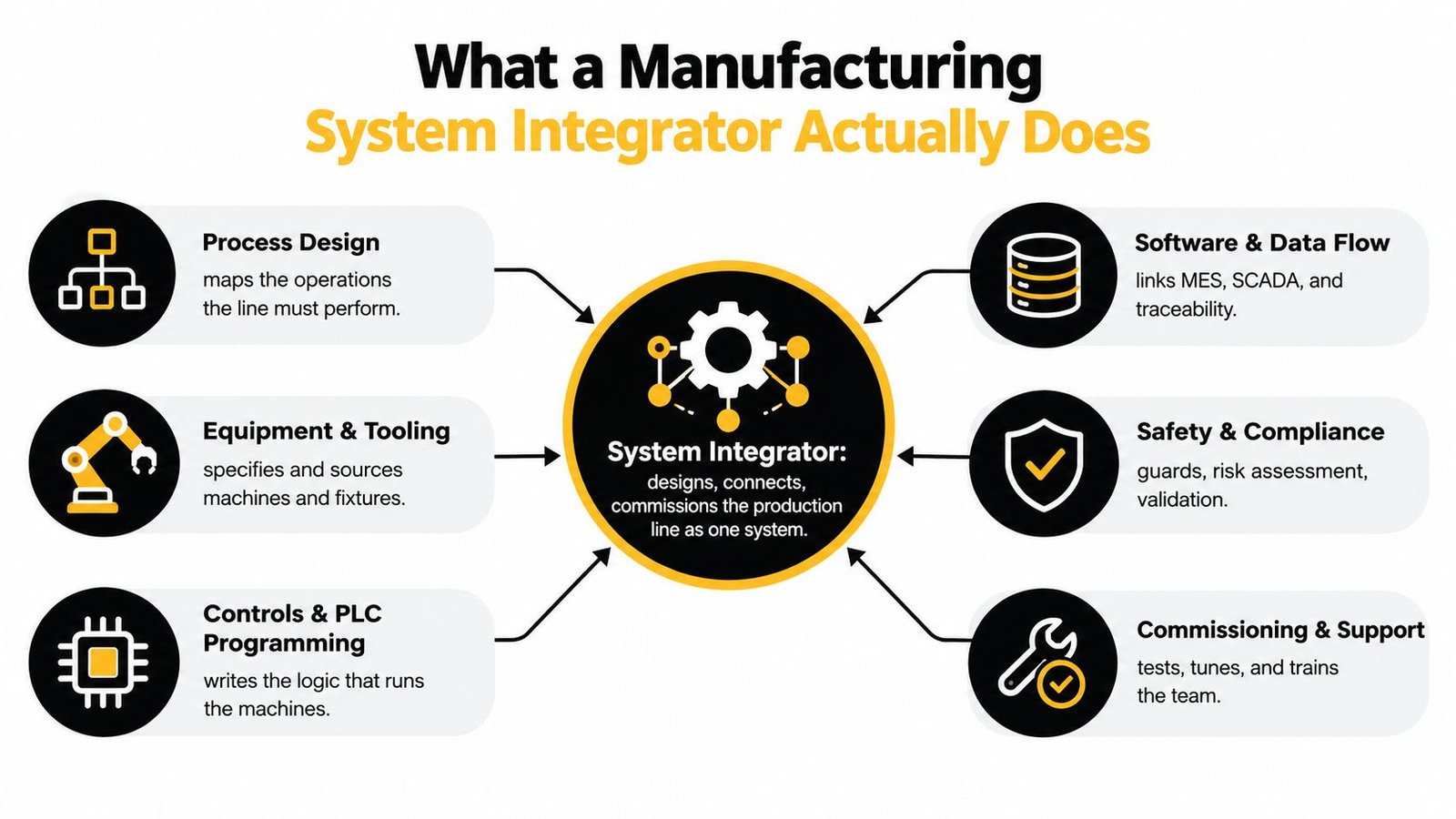
A good way to think about the role is simple. The integrator is the general contractor of the plant. They're not just the electrician, not just the machine builder, not just the software person. They're the party responsible for making sure every trade, every controller, every interface, and every handoff lands in the right order.
The systems they connect
In a typical plant, the integrator is connecting PLCs, robotics, motion control, machine vision, SCADA, MES, ERP handshakes, sensors, and the mechanical handoffs between stations. That work only looks glamorous from a distance. Up close, it's disciplined interface management, control logic, and a lot of validation that has to survive real production.
Manufacturing is one of the biggest demand centers for this work. One market estimate put the manufacturing vertical at approximately 31.6% of vertical-specific system integration revenue in 2025, and another put the manufacturing segment of industrial automation system integration at USD 3.8 billion in 2023 with an expected 3.6% CAGR from 2024 to 2032 (market vertical data). That lines up with what plant people already know, the complexity lives in the handoff between OT and IT.
Cognizant describes the modern approach well with its platform-agnostic blueprint that connects machines, sensors, controllers, and enterprise systems through a Manufacturing Service Bus framework (connected factories blueprint). Siemens makes the same point from the production side, end-to-end integration creates cross-organizational data transparency that improves production, logistics, and energy consumption (Siemens production operations overview).
Where the boundary sits
Don't confuse the roles. A machine builder delivers the machine. An OEM delivers its own equipment and native controls. An internal controls team usually knows the plant standards and maybe some of the assets. A system integrator stitches the whole thing together, especially when the project crosses vendors, software layers, and validation requirements.
A plant can survive with isolated expertise. It can't scale with it.
That's why the best integrators are strong in architecture, wiring, programming, commissioning, and support. They don't just install. They make the line understandable after they leave.
Core Services from Design Through Commissioning and Support
A serious integration project follows the lifecycle of the plant itself. The best proposals don't read like a list of random services, they read like a sequence of decisions that reduce risk before steel gets cut or code gets locked in.
From concept to support
Front-end engineering comes first. That's where the integrator maps process flow, defines operating logic, and decides what needs to be automated now versus later. If that work is weak, the rest of the project becomes expensive repair work.
Controls architecture and electrical design come next. At this stage the integrator decides how the production data will move, where the single source of truth lives, and how the line will recover when a device faults. Mechanical tooling and fixtures follow because good automation starts with repeatable physical handling, not pretty dashboards.
On site, the work shifts to installation, cable routing, software load, and commissioning. Commissioning isn't a ribbon-cutting exercise. It's the place where bad assumptions get exposed, and the line either proves itself or starts collecting excuses.
Lifecycle support is where weak vendors disappear and good ones stay useful. Preventive maintenance, retrofits, dashboard updates, and spare-parts planning matter because plants don't freeze in time. The line you commission this year will face a different product mix, a different team, and probably a different compliance burden later.
| Lifecycle Stage | Core Deliverable | Outcome Buyer Cares About |
|---|---|---|
| Front-end engineering | Process definition and scope alignment | Fewer surprises, tighter RFQ comparisons |
| Controls architecture | PLC, HMI, and data-flow design | One clear production data structure |
| Electrical and mechanical design | Panels, fixtures, tooling, handoffs | Stable operation and maintainable hardware |
| Installation and integration | On-site build and system tie-in | Faster readiness with fewer production interruptions |
| Commissioning and validation | FAT, SAT, and test records | Lower startup risk and cleaner handover |
| Lifecycle support | Maintenance, retrofits, dashboards | Less downtime and longer asset life |
Regulated sectors need even more discipline. Gerresheimer notes that its automation systems meet GAMP requirements, FDA 21 CFR Part 11, and cleanroom design standards for ISO 14644-1 classes 7 and 8 or GMP classes C and D (Gerresheimer automation solutions). Invetech also points out that custom automation can move developers from process development toward validated GMP manufacturing while reducing manual steps and improving control (Invetech manufacturing capabilities).
Benefits That Show Up on the P&L and the Shop Floor
The value of integration is not philosophical. It shows up in throughput, scrap, labor allocation, and audit performance. If the project can't move those needles, it's decoration.
What management sees
A well-scoped retrofit can lift throughput materially, and the brief's verified data points to 15% to 40% on retrofitted lines as a realistic planning range for output improvement in the right cases. I'd treat that as a target band only when the process is stable and the bottleneck is integration, not product chaos or broken upstream supply.
More important than raw speed is consistency. Closed-loop controls reduce drift, which means less scrap, fewer operator workarounds, and fewer firefights at shift change. That's where the profit hides, not in the machine spec sheet but in the steady-state behavior of the line.
What the floor feels
Operators gain a system they can trust. When logic is captured in PLC code, HMI prompts, and SOPs, the line depends less on tribal knowledge and more on repeatable instructions. That matters every time a senior operator retires or a new shift comes online.
The compliance upside is just as practical. Traceable data capture, batch records that can stand up to audit, and validated change control all reduce risk in regulated environments. This is especially important in medical-device and pharma work, where the difference between “working” and “validated” is the difference between shipping and stopping.
At market level, the benchmark data says demand is strongest where integrators can deliver throughput gains, quality improvements, and workforce efficiency. In one 2026 benchmarking set, 75 ranked firms generated $4.67 billion in system-integration revenue, roughly 18% year over year, and about three-quarters of firms in the comparison set grew SI revenue (benchmarking report). That lines up with what buyers reward, less friction, more output, fewer human dependencies.
| Benefit Category | Measurable Outcome | Shop-Floor Driver |
|---|---|---|
| Throughput | Faster output on the same assets | Better station synchronization |
| Scrap reduction | Fewer rejects and rework loops | Stable controls and clearer process windows |
| Labor leverage | People moved to higher-value tasks | Automation handles repetitive steps |
| Quality consistency | More repeatable product performance | Closed-loop logic and inspection |
| Compliance | Cleaner audit trail and records | Traceability and validated controls |
Choosing How Much Integration to Buy
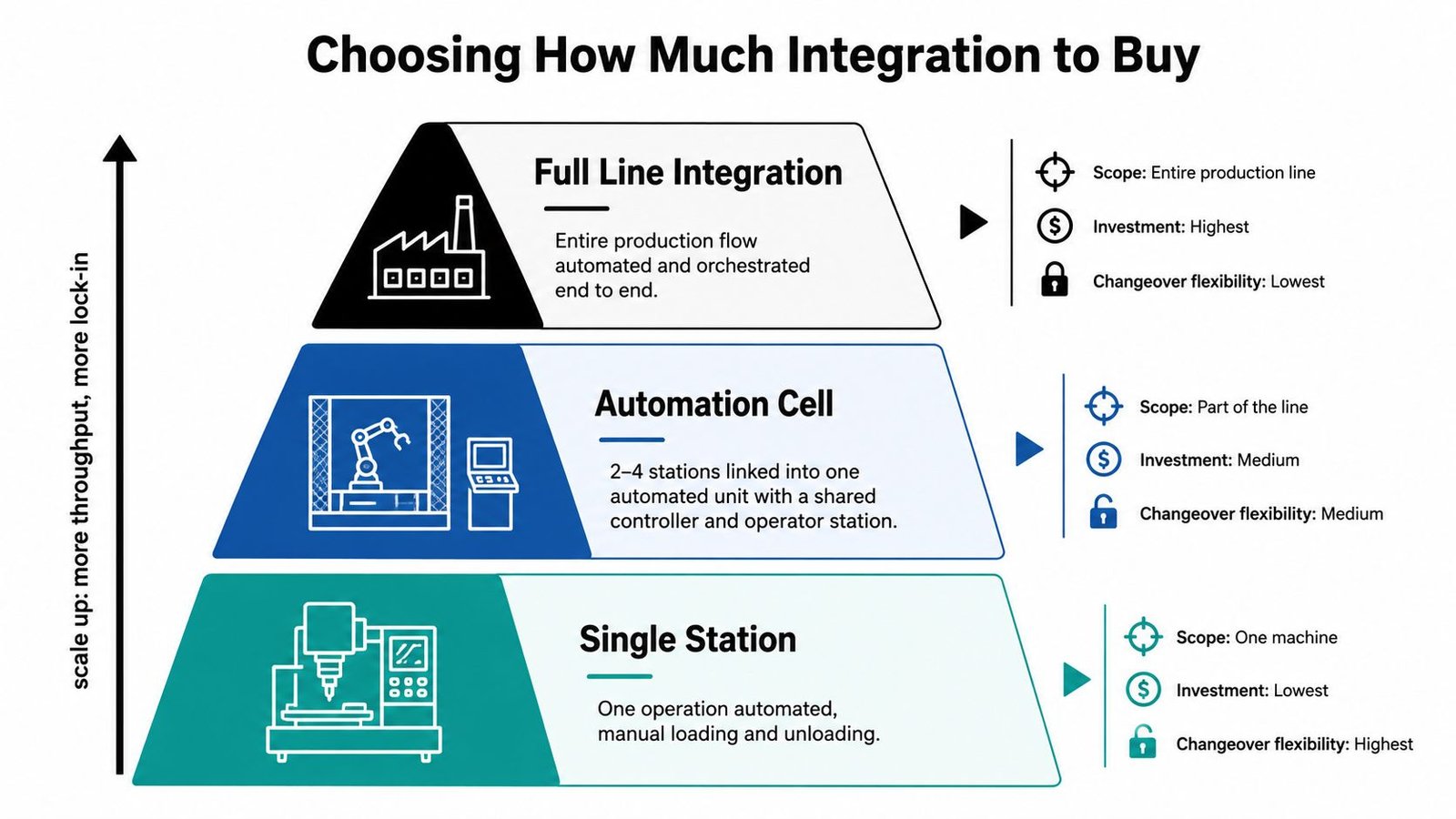
This is the part most vendors skip because it's not as convenient as selling the biggest project in the room. Buyers don't just need to choose a vendor. They need to choose how much integration to buy.
Start with the scope that matches the process
A single station automates one operation. It's the right move when one step is repetitive, error-prone, or physically awkward, but the rest of the process still needs human flexibility.
A cell links two to four stations with shared material handling and shared control logic. That's usually the sweet spot for manufacturers who need better flow without locking themselves into a giant capital program.
A full line integrates cells into an end-to-end production system. That only makes sense when the process is standardized, volume justifies it, and the plant can handle the operational discipline that full automation demands.
The market research in the brief points to a real shift here. Hardware integration is projected to grow at 5.27% CAGR and IIoT/edge platforms at 5.31% CAGR through 2031 (market research on integration scope). That tells me buyers are increasingly buying phased capability, not just giant one-shot projects.
Use a blunt decision test
- High mix, low volume: start with a station or a cell, not a full line.
- Regulated product: keep scope tight if validation effort will crush your timeline.
- Brownfield plant: retrofit before greenfield unless the existing process is unfixable.
- Tight budget: buy the bottleneck, not the fantasy version of the line.
- Short time-to-value: choose the smallest viable integration that proves the model fast.
If the manual process isn't standardized yet, don't automate it. You'll only automate inconsistency.
That last point matters more than most executives want to admit. A messy process doesn't become elegant just because you put servos on it. If you need help deciding whether to automate a station, a cell, or an entire line first, the most honest answer is to scale in the smallest useful step and prove the ROI before you commit deeper.
One useful resource on that decision boundary is this overview of automation levels.
ROI, Cost Drivers, and Realistic Timelines
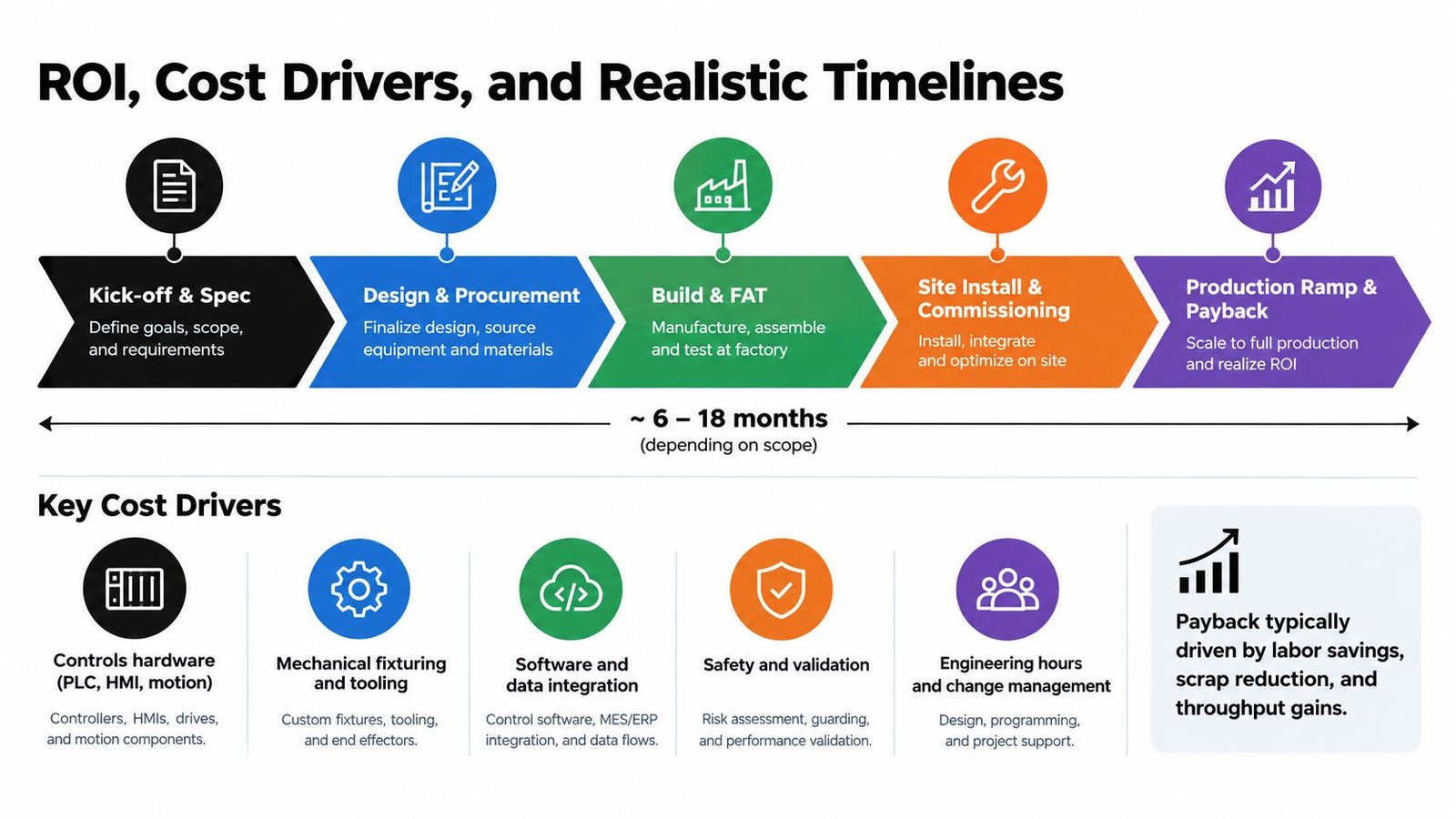
The quote is never just the quote. It reflects the controls stack, the mechanical scope, the validation burden, and how much design work the integrator has to do before the first part is ever loaded.
What moves the budget
The biggest cost drivers are usually controls hardware, mechanical fixturing and tooling, integration engineering hours, validation documentation in regulated industries, and ongoing support contracts. If the vendor quote is light on any of those, the number is probably low for a reason.
The brief's planning ranges are straightforward, and they're useful for sanity checking proposals, not for pretending every plant is the same. A single station typically runs $75K to $250K, a cell $300K to $1.2M, and a full line $1.5M to $5M+. I'd expect the wide spread because part handling, compliance, and software complexity change the game fast.
Project timing usually follows a similar pattern. Concept can take 4 to 6 weeks, detailed design 6 to 10 weeks, build and FAT 8 to 14 weeks, site install and SAT 2 to 6 weeks, and GMP validation 4 to 8 weeks. Those are planning bands, not promises.
Where projects slip
The classic failures are predictable. Scope creep starts when too many stakeholders get involved too late. Validation gets underfunded. Training is treated as a nice-to-have. The line then launches with a crew that doesn't fully trust the equipment.
Payback needs realism too. For most well-scoped projects, 18 to 36 months is a sensible expectation in the brief's guidance. That's long enough to demand discipline and short enough that a bad scope will punish you quickly.
If you want a practical benchmark, talk to vendors about how they handle change control, how they budget for commissioning risk, and what support looks like after the line goes live. SEA, for example, focuses on semi-automatic systems, custom tooling, fixtures, integrated controls, and end-to-end support from concept through commissioning, which is exactly the kind of scope discipline buyers should compare against other proposals. The value isn't in the pitch. It's in whether the proposed scope matches the process reality.
A Semi-Automated Medical Device Line in Practice
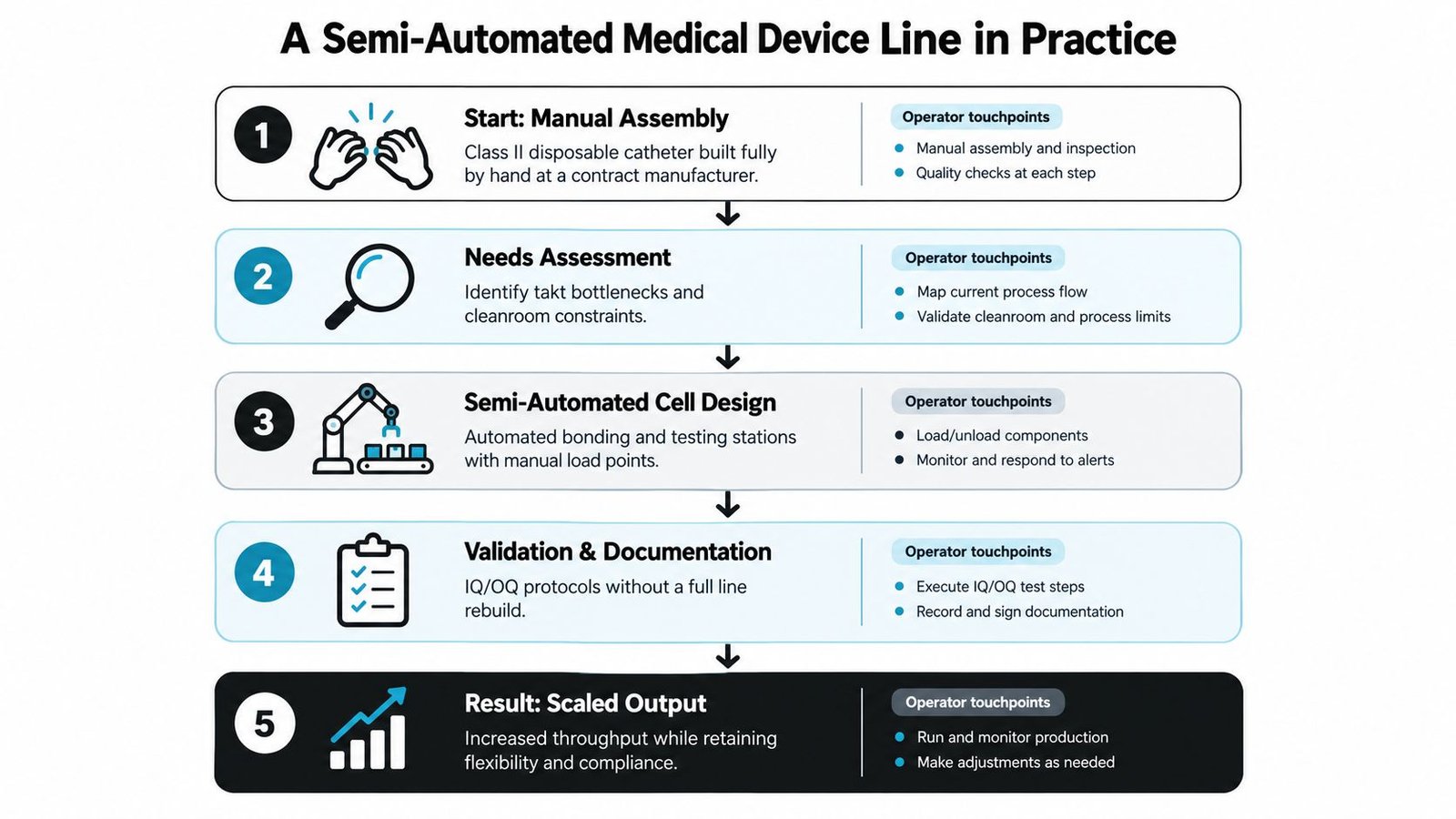
A contract manufacturer making a Class II disposable catheter doesn't need a heroic automation story. It needs a line that works, stays compliant, and doesn't blow up validation.
What changed
The starting point was three hand-build stations, a stubbornly low first-pass yield, and a cycle that lived or died by operator attention. The integrator didn't try to replace the entire process. That would've been the wrong move for a product family with low-volume SKUs and strict cleanroom constraints.
Instead, the scope focused on the bottleneck. Vision-guided dispense, automated bonding, a leak-test station, and an MES handoff for lot genealogy turned the line into a semi-automated cell rather than a full-line rebuild. That kept the process flexible and the validation burden manageable.
Why the rollout was staged
The team kept manual inspection in place. That was the right call. Full automation would have increased complexity without guaranteeing a better release decision, and the line didn't need that kind of risk.
They qualified the cell under existing IQ/OQ/PQ rather than revalidating everything from scratch. That saved time and kept the documentation tied to the actual change, not to a fantasy of redesigning the whole manufacturing model. Cleanroom compatibility, stainless versus anodized frame selection, and software audit trails all shaped the equipment choice.
The broader lesson is simple. Semi-automated lines win when they remove the most painful manual steps while preserving human judgment where it still matters. For medical-device manufacturers, that usually beats an overbuilt line that spends six months proving it can do what the manual process already did.
Questions to Ask Before You Sign with an Integrator
Start with ownership. Ask who owns what between the integrator, the OEM equipment suppliers, and your internal controls team. If that answer is fuzzy, the project will be fuzzy too.
Then move straight to validation and support. Ask how they handle IQ/OQ/PQ, change control, and data integrity under 21 CFR Part 11 or EU Annex 11. Ask what happens after go-live, not in theory, but when the lead engineer rolls off and a fault hits at 2 a.m.
The questions that expose weak vendors
- Scope clarity: Who is responsible for each interface, each handoff, and each sign-off?
- Validation readiness: What documentation do you deliver, and what do you expect from us?
- Lifecycle support: What are your response times, spare-parts practices, and remote-diagnostics options?
- Code review: Will a third party be able to understand your controls logic without tribal knowledge?
- Change orders: How do you price them, and what triggers one?
- Judgment: Have you walked away from a project that was the wrong fit?
One vendor-management resource worth reviewing alongside those questions is this guide on vendor management best practices. The purpose isn't to build a ceremonial checklist. It's to force a serious conversation before anyone starts cutting metal or writing code.
The best integrator will answer these questions plainly. Evasion is the red flag, not a firm answer.
If you're deciding how much integration to buy, not just who to hire, System Engineering & Automation can help you scope semi-automatic, fully automated, or manual solutions around your production goals and budget. Visit System Engineering & Automation to discuss a practical build that fits your line, your validation needs, and the throughput you require.