A production line can be fully staffed, properly programmed, and ready to run, yet still sit idle because one resin grade, metal lot, electronic component, or GMP-critical input hasn't arrived. The purchase order may exist in the ERP system. The supplier may have promised delivery. Neither fact helps the operator waiting for material at the point of use.
That situation is why manufacturers need to treat the material sourcing process as part of production control. Specification discipline, supplier qualification, traceability, lead-time management, and automation all influence whether a line runs continuously or absorbs disruption through expediting, rework, schedule changes, and excess inventory.
Table of Contents
- Why Your Material Sourcing Process Determines Production Success
- Building a Reliable Material Sourcing Process From Spec to Approval
- How to Qualify and Control Suppliers Without Slowing Production
- Balancing Cost Quality Lead Time and Compliance in Sourcing Decisions
- Practical Tips to Reduce Risk and Keep Materials Flowing
- Putting Your Sourcing Strategy Into Action
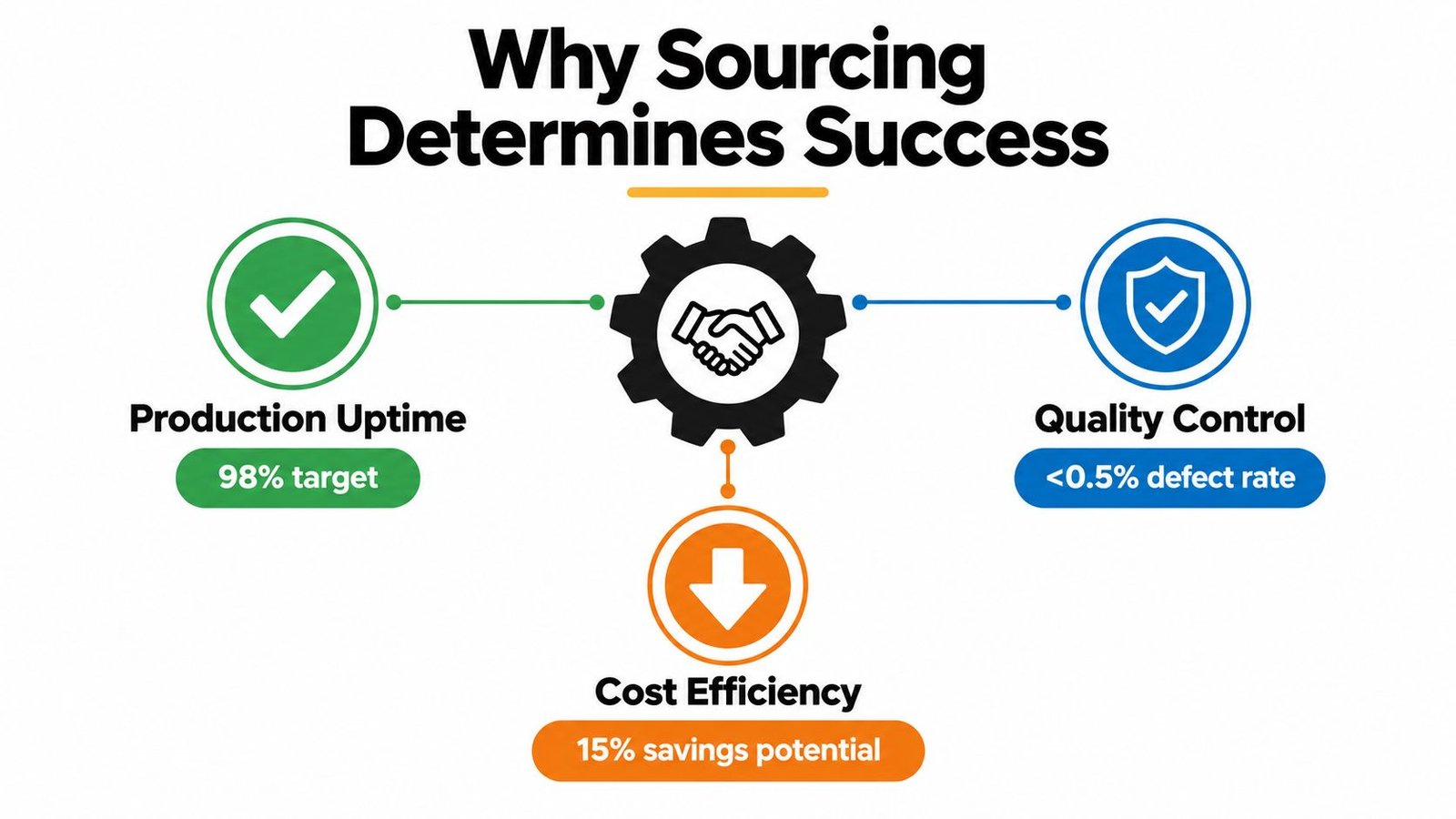
Why Your Material Sourcing Process Determines Production Success
A sourcing failure rarely appears first in the purchasing department. It appears on the shop floor as a missing work order, an idle fixture, a changeover that can't start, or a finished product held because the incoming material lacks the required documentation.
Consider a manufacturer preparing to run a scheduled batch. Production has labor assigned, tooling installed, and inspection equipment calibrated. During the final material check, the team discovers that the supplier shipped a substitute grade without the required approval. The material may look acceptable, but it can't enter controlled production until engineering and quality review the deviation. The line waits while buyers chase the supplier, quality reviews records, and planners rebuild the schedule.
Lead time is a production variable
APQC benchmarking based on 3,077 companies places median supplier lead time for purchased materials at 10.0 days across industries and company sizes. The same benchmark places top performers at about 4 days and bottom performers at 11 days, as reported in this supplier lead-time benchmark summary.
That difference isn't an accounting detail. A plant with unreliable supplier commitments must carry more protection in its schedule or inventory. A plant with dependable lead times can plan material arrivals around production demand, reduce emergency buying, and give engineering more time to resolve specification or quality issues.
Material sourcing also becomes more important during disruption. U.S. manufacturing data indicates that about 11% of plants reported raw material shortages as a key capacity constraint in 2024, compared with roughly 40% during Q3 2021 through Q2 2022 and about 5% during 2014 to 2016, according to the North American manufacturing report. Shortages may have eased from the disruption peak, but the remaining exposure is still operationally meaningful.
Shop-floor rule: If a material can stop production, its supplier, specification, approval status, and delivery commitment belong in the production risk system, not only in purchasing records.
Sourcing connects directly to automation
Automation doesn't remove sourcing risk. It makes specification and consistency more important. A semi-automated assembly cell depends on repeatable material dimensions, surface conditions, packaging, and lot identification. A fully automated feeder or inspection station may reject material that falls outside a narrow operating window, even when a person might have worked around the variation.
For medical device manufacturers and other GMP-aware operations, sourcing also supports controlled processes. The supplier must provide evidence that the material is what the specification requires, that changes are managed, and that records can support an investigation. SEA approaches sourcing as part of the wider engineering workflow, alongside concepts, drawings, tooling, controls, installation, and commissioning. That connection helps manufacturers select materials that work not only on paper, but also in the actual production system.
Building a Reliable Material Sourcing Process From Spec to Approval
A reliable workflow prevents the common mistake of asking purchasing to find a supplier before engineering has defined what may be purchased. Start with the material specification, then move through controlled gates. Each gate should produce a decision record and a clear owner.
Define the requirement before contacting suppliers
The specification should identify the material grade, dimensions, tolerances, performance characteristics, packaging, cleanliness requirements, certificates, labeling, shelf-life rules where applicable, and approved alternatives. It should also define what constitutes a nonconformance and who can approve a deviation.
Engineering owns functional requirements. Quality owns acceptance and documentation requirements. Operations contributes handling, storage, and process constraints. Purchasing turns the approved requirement into a market request. If these responsibilities aren't clear, suppliers receive mixed signals and buyers compare offers that aren't technically equivalent.
Screen the market with structured information requests
Use an RFI or supplier self-assessment to screen capability before requesting a firm proposal. Ask about relevant certifications, technical equipment, capacity, financial health, ownership, subcontracting, change notification, traceability, and experience with comparable materials.
The purpose isn't to create paperwork for its own sake. It removes suppliers that can't meet the basic requirement before the team spends time on samples, audits, or negotiations. For high-risk materials, include questions about calibration, preventive maintenance, operator competency, material segregation, and record retention.
Evaluate proposals on more than unit price
A quote should be reviewed against the complete supply requirement. Compare material equivalency, certificate content, inspection approach, minimum order conditions, packaging, delivery commitment, payment terms, and proposed substitutions. A low price is irrelevant if the material requires additional inspection, causes feeding problems, or arrives too late for the production schedule.
Use a controlled comparison sheet so engineering, quality, operations, and purchasing evaluate the same facts. Keep the approved specification under revision control. Don't let a supplier's quote become the new specification.
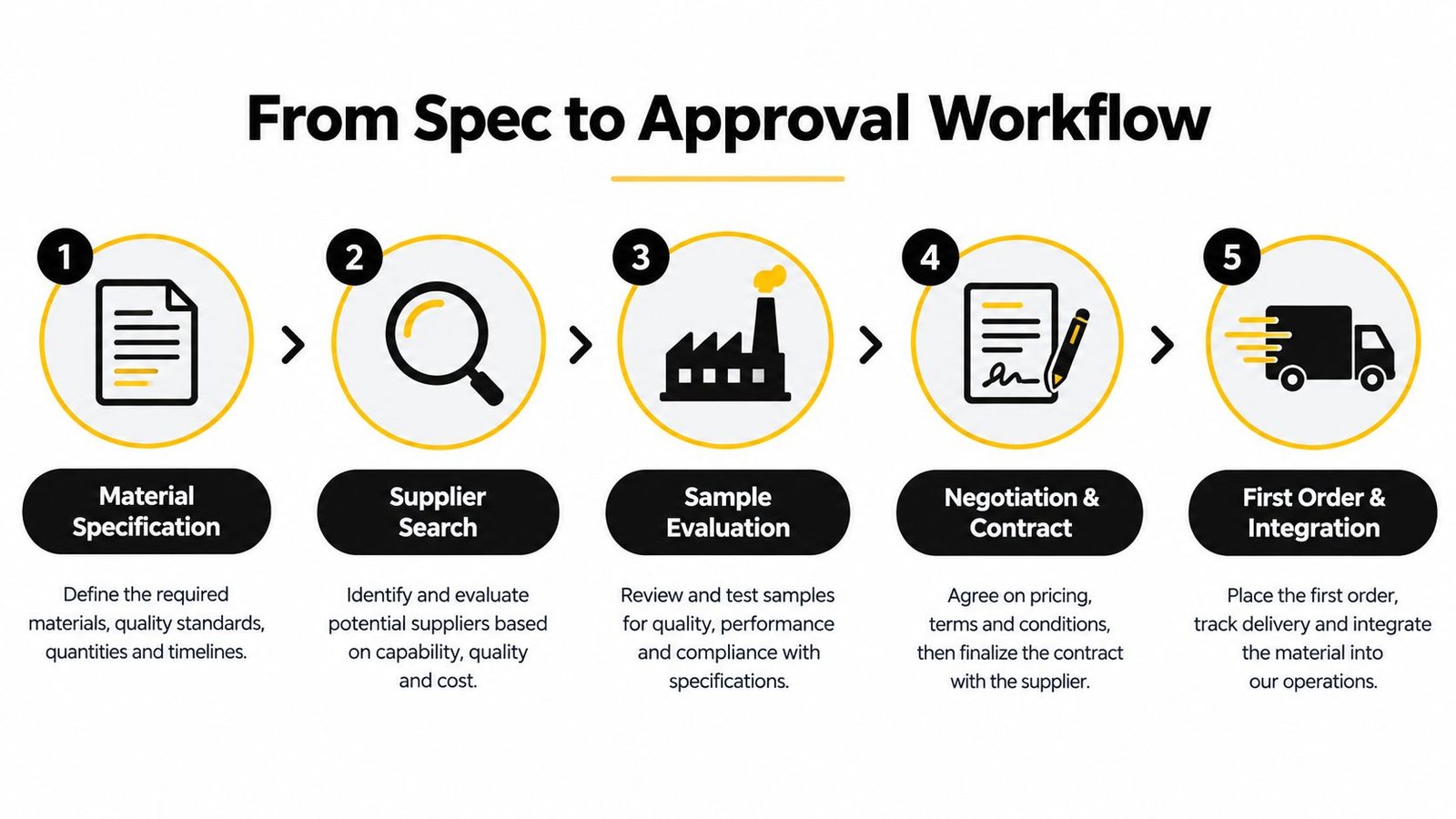
Test samples before approving serial supply
Samples should be evaluated in the process where the material will be used. Check dimensional and chemical requirements, but also assess feeding, forming, bonding, machining, cleanliness, packaging, and operator handling. A material that passes a laboratory check can still create jams or variation in an automated station.
For regulated manufacturing, complete first article inspection or a PPAP-style approval before serial orders begin. The approval package should connect the supplier's process evidence to the manufacturer's drawing, specification, inspection plan, and acceptance criteria.
Practical rule: Don't approve a supplier because the sample passed once. Approve the supplier when the material, documentation, process capability, and change controls support repeatable production.
Close the gate with documented approval
The final approval should identify the supplier, material revision, approved site, applicable certificates, inspection requirements, packaging instructions, and responsible approvers. Release the supplier for serial orders only after quality and engineering have signed off.
This stage-gated model follows the sequence of screening, audit, and first article or PPAP-style approval described in independent guidance on supplier controls in regulated manufacturing.
How to Qualify and Control Suppliers Without Slowing Production
Supplier qualification works best when the level of control matches the consequence of failure. A supplier providing a packaging item with no product-contact function shouldn't face the same approval burden as a single-source supplier providing a material that directly affects device performance.
Begin by classifying suppliers and materials according to quality impact, regulatory exposure, substitution difficulty, lead time, and production criticality. This classification determines the documents required, the audit depth, the performance review cadence, and the escalation path when results deteriorate.
Use a risk-based qualification file
A practical file normally includes the supplier questionnaire, certifications, technical capability review, financial and ownership information, risk assessment, sample results, audit report, corrective actions, and approval decision. The file should also identify the approved manufacturing site and any sub-suppliers that affect the material.
An on-site audit should examine the controls that determine whether the supplier can repeat the result:
- Calibration: Verify that measurement equipment is identified, maintained, and linked to current records.
- Traceability: Follow a material lot from receipt through processing, inspection, storage, and shipment.
- Preventive maintenance: Check whether production equipment receives planned maintenance and whether failures are recorded.
- Operator competency: Confirm that personnel performing critical operations are trained and their qualifications are documented.
- Quality records: Review nonconformances, corrective actions, inspection results, and change history.
The audit isn't a tour. It should test the supplier's actual control system against the risks identified during qualification.
Make approval an operating loop
ISO 9001 clause 8.4 requires criteria for selecting, evaluating, monitoring, and re-evaluating external providers, along with documented information about those activities and resulting actions. It also requires the type and extent of control to be determined on a risk basis, as explained in this ISO 9001 supplier-control overview.
Track delivery reliability, certificate accuracy, lot acceptance, defects, responsiveness, corrective-action closure, and change-notification performance. The exact review method can vary, but the evidence must support a clear decision: continue approval, impose additional controls, require corrective action, or suspend the supplier.
For a practical framework that connects supplier records, scorecards, issue handling, and re-evaluation, use SEA's best practices for vendor management.
Control principle: A supplier isn't controlled because the name appears on an approved list. The supplier is controlled when current evidence supports continued approval.
Keep production moving during qualification
Qualification doesn't have to delay every order. Identify critical suppliers early, run documentation reviews in parallel with commercial discussions, and reserve on-site audits for suppliers whose risk justifies the effort. Where a temporary source is unavoidable, define the temporary approval, inspection expansion, expiration date, and responsible owner.
What doesn't work is granting permanent approval because the line is waiting. That decision transfers a short-term schedule problem into a long-term quality and continuity risk.
Balancing Cost Quality Lead Time and Compliance in Sourcing Decisions
Manufacturers often say they want the lowest total cost, then evaluate suppliers almost entirely by quoted unit price. That approach ignores the cost of incoming inspection, rejected lots, line interruptions, expedite freight, engineering review, excess safety stock, and customer impact.
A useful decision matrix forces the team to discuss the tradeoff explicitly. The right choice depends on material criticality, process capability, regulatory requirements, and the consequences of a missed delivery.
Sourcing Tradeoff Decision Matrix
| Sourcing Option | Cost Impact | Quality and Compliance Risk | Lead Time and Resilience |
|---|---|---|---|
| Lowest-price single source | May reduce quoted purchase cost | Concentrates technical and continuity risk in one supplier | Vulnerable to capacity loss, disruption, or delayed recovery |
| Qualified regional supplier | May carry a higher quoted price | Easier communication and oversight can reduce control friction | Often supports faster response and simpler escalation |
| Dual qualified sources | Requires qualification work and may reduce volume leverage | More complex specifications and approval records | Reduces dependence on one source when both suppliers remain active |
| Lean, low-buffer purchasing | Reduces inventory carrying requirements | Leaves less room to investigate quality or delivery failures | Efficient when commitments are dependable, fragile when they aren't |
| Strategic buffer for critical material | Uses storage space and working capital | Can protect production while issues are resolved | Buys recovery time, but doesn't replace supplier correction |
| Standardized equivalent material | Can widen the qualified supplier pool | Requires careful validation to preserve performance | Improves substitution options when engineering controls equivalency |
| Specialized precision material | May cost more and limit competition | Supports demanding performance or compliance requirements | Usually requires earlier planning and tighter supplier oversight |
Choose the model by failure consequence
Domestic or regional sourcing can simplify communication, transport coordination, and audit access, but geography alone doesn't guarantee quality or capacity. A diversified model can reduce dependency, yet it creates more supplier records, inspections, change-control obligations, and opportunities for specification drift.
Imported polymers, steel, semiconductors, and precision metals may face tariff exposure, trade fragmentation, and regional disruption. Recent materials-sector analysis describes a movement away from pure cost optimization toward resilience as geopolitical and localized risks increase, as discussed in materials supply-chain resilience analysis. The practical response isn't to duplicate every supplier. It's to identify which materials justify a second source, a buffer, an approved substitute, or deeper sub-supplier visibility.
Traceability also affects the decision. A cheaper source that can't provide reliable lot and origin records may create unacceptable compliance exposure. Use SEA's traceability requirements guidance when deciding how much data a supplier must provide and how that data will support receiving, production, and investigation.
Decision test: Compare the cost of the sourcing option with the cost of the failure it is supposed to prevent. The cheapest quote isn't automatically the cheapest operating choice.
Practical Tips to Reduce Risk and Keep Materials Flowing
Strong sourcing controls are built into daily work. They tell buyers which orders need attention, tell planners which commitments can be trusted, and tell operators whether received material is released for use.
Start with the items most likely to interrupt production. Review open orders, supplier acknowledgments, promised dates, partial shipments, unresolved substitutions, and materials tied to near-term work. Don't ask buyers to chase every order with equal intensity. Direct attention toward bottleneck materials, single-source items, long-lead components, and materials with strict approval requirements.
Manage lead time with evidence
The APQC benchmark cited earlier provides a useful reference point, but each plant should manage its own demonstrated supplier performance. Record requested date, confirmed date, actual receipt date, quantity received, and any split or late shipment. Separate supplier lead time from internal approval, transportation, receiving, and inspection time so the team knows where the delay occurs.
Safety stock should protect against a defined risk, not compensate for poor data. If a supplier's dates are unreliable, increasing inventory may keep the line running temporarily, but it can also hide the underlying failure. Correct the commitment process, then revisit the buffer.
Contracts should address more than price. Include:
- Delivery commitments: Define dates, quantities, partial-shipment rules, and escalation contacts.
- Quality evidence: State certificate, inspection, packaging, and acceptance requirements.
- Change notification: Require advance notice for material, process, site, equipment, ownership, or sub-supplier changes.
- Nonconformance response: Establish containment, investigation, replacement, and corrective-action expectations.
- Traceability records: Specify the lot, batch, origin, and transaction information that must accompany each shipment.
Build traceability into receiving
Traceability must follow the material from receipt through production and delivery. Records may include facility identifiers, GPS coordinates, batch or lot numbers, transaction dates, certifications, transformation timestamps, and carbon-footprint information where the risk or customer requirement warrants it, according to the UN Global Compact and BSR traceability guide.
For GMP-aware or medical-device operations, maintain at least the identifiers needed to isolate affected material and reconstruct its movement. That commonly includes the material lot number, manufacturer date, expiration date where applicable, production batch assignment, and the smallest standard package marking. The raw-material supplier qualification guidance describes lot-level traceability through receipt, production, and delivery.
A focused pilot is easier to control than a broad rollout. Start with 5-10 high-risk suppliers, as recommended in the traceability guidance above, validate data quality and reconciliation, then expand once the fields, ownership, and exception handling work in practice.
For storage and point-of-use control, align material identification with spare parts inventory management. The same principle applies to production materials: clear identification, controlled locations, and current status prevent approved, quarantined, and obsolete stock from being mixed.
Putting Your Sourcing Strategy Into Action
A mature material sourcing process doesn't need to be complicated, but it does need clear ownership and evidence. Start with a short audit of the current state. Select a handful of materials that regularly create schedule pressure, quality questions, or emergency purchasing, then follow each one from specification through supplier commitment, receipt, inspection, and production use.
Use the findings to establish a prioritized action list:
- Identify production-critical materials. Mark single-source, difficult-to-substitute, long-lead, and GMP-relevant items.
- Clean the specifications. Remove ambiguity, control revisions, define approved alternatives, and assign engineering ownership.
- Review supplier qualification. Confirm that certifications, audits, samples, approvals, and re-evaluation records are current.
- Make commitments visible. Capture supplier acknowledgments, date changes, quantities, and exceptions where planners and buyers can use them.
- Strengthen traceability. Define the minimum lot, batch, origin, certificate, and transaction data required for each risk class.
- Connect sourcing to production engineering. Validate that materials work with tooling, fixtures, feeders, inspection stations, and automation controls.
- Measure and improve. Review delivery, quality, responsiveness, corrective actions, and material-related downtime as one operating picture.
The appropriate automation level depends on the product, volume, process variation, labor model, and available budget. A manual station may need better fixtures and material presentation. Another operation may justify a semi-automated system with controlled feeding, inspection, and data capture. System Engineering & Automation supports manufacturers from preliminary concepts and manufacturing drawings through material sourcing, installation, commissioning, and ongoing service, with GMP-aware practices for applicable production environments.
Treat sourcing as a continuous improvement loop. Each supplier issue should improve a specification, approval gate, contract term, traceability field, or automation decision. That approach helps manufacturing teams protect uptime without buying unnecessary inventory or imposing the same controls on every material.
If your material shortages, supplier changes, or traceability gaps are affecting production, System Engineering & Automation can help connect material sourcing with tooling, fixtures, semi-automated systems, and integrated manufacturing engineering. Visit SEA to discuss a practical improvement plan matched to your production goals, budget, and compliance needs.