A market estimated at US$8.7 billion in 2025 and projected to reach roughly US$17.8 billion by 2034, at a 9.2% compound annual growth rate, signals that automation in medical device manufacturing is no longer an optional efficiency project. The market analysis also reports that Asia Pacific represented 38.2% of revenue and that hardware accounted for 42.5% of spending, with robotics, machine vision, and integrated production equipment still central to investment. Medical device manufacturing automation market analysis
For an operations manager, the decision is less dramatic than the headline suggests. The work involves keeping traceability intact while managing high-mix, low-volume production, labor-dependent checks, qualification requirements, and the quality costs created by manual variation. A fully autonomous factory may sound attractive, but a well-designed semi-automated cell often addresses the constraint that is limiting output.
This guide takes a practical view. It looks at what automation includes, where it produces value, where it creates risk, how GMP and software assurance affect the project, and how to choose between manual tooling, semi-automatic equipment, and a fully automated line. The focus is straightforward: help medical device manufacturers select manufacturing solutions that improve production and services without sacrificing flexibility or compliance.
Table of Contents
- Why Medical Device Makers Are Automating Now
- Understanding Automation in Medical Device Manufacturing
- Benefits and Risks of Automated Production
- GMP Compliance and Validation Requirements
- Comparing Manual, Semi-Automatic, and Fully Automated Lines
- Implementation Roadmap and ROI Considerations
- Real-World Results and Best Practices
Why Medical Device Makers Are Automating Now
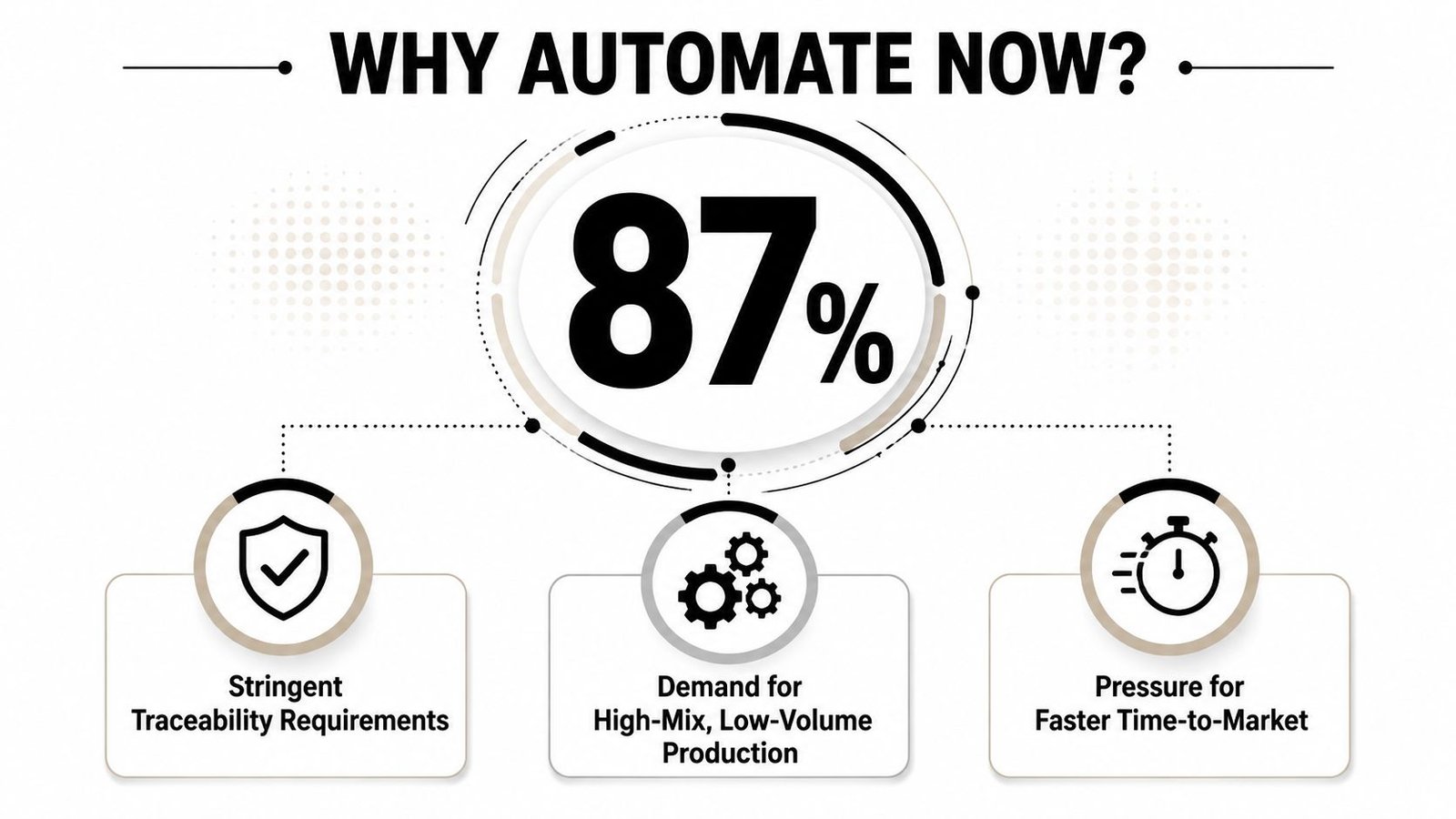
The strongest case for automation starts with the plant floor. Teams must prove what happened to every device, manage product variants, train operators, investigate defects, and maintain output under demanding quality requirements. High-mix, low-volume production, strict traceability, and extensive inspection and documentation make manual processes difficult to scale consistently. Automation is gaining attention because it can address these operating pressures directly, not because every facility needs a lights-out factory. Market analysis of automation drivers in medical device manufacturing
The competitive pressure is real. Industry coverage places medical technology among the top 10 sectors globally for industrial robot installations, reports annual robot adoption growth above 15%, and notes that U.S. medical manufacturing sites increased automation-related investment by more than 28% since 2020. For a plant manager, those figures point to a practical question: which process deserves investment first? Industry coverage of automation in medical device manufacturing
The operations problem behind the investment
A production manager may need to automate a difficult inspection, stabilize a repetitive assembly step, shorten changeovers, or capture process data without creating more administrative work for operators. These projects often produce a clearer return than replacing an entire line.
Automation can remove variation where variation creates the most trouble. A cell might guide component placement, confirm presence and orientation, record process values, reject out-of-specification results, and provide a repeatable handoff between production and quality teams. In high-mix work, quick tooling changes and controlled operator interaction can matter more than maximum robot utilization.
Practical rule: Start with the constraint causing the most disruption, not with the most impressive automation technology.
The decision is therefore how much automation each process can support. Smart tooling may suit one station, a collaborative workstation another, and a fully integrated line only a stable product with sufficient demand and a validation case that supports the investment. Semi-automated cells often deliver the better balance between cycle-time improvement, acceptance rates, flexibility, and compliance effort.
Understanding Automation in Medical Device Manufacturing
Automation in medical device manufacturing covers fixtures, sensors, vision systems, controls, and integrated cells. Each option addresses different production constraints. A fixture can improve positioning without changing the operator's broader role. Smart tooling can add sensing, guided actions, and process checks. An integrated cell coordinates material movement, assembly, inspection, controls, and records.
A practical system may combine custom fixtures, torque or force control, machine vision, pick-and-place units, bowl feeders, conveyors, programmable controls, operator interfaces, and automated data capture. The design also needs repeatable operation, controlled access, error handling, maintenance access, and evidence that the process performs as intended.
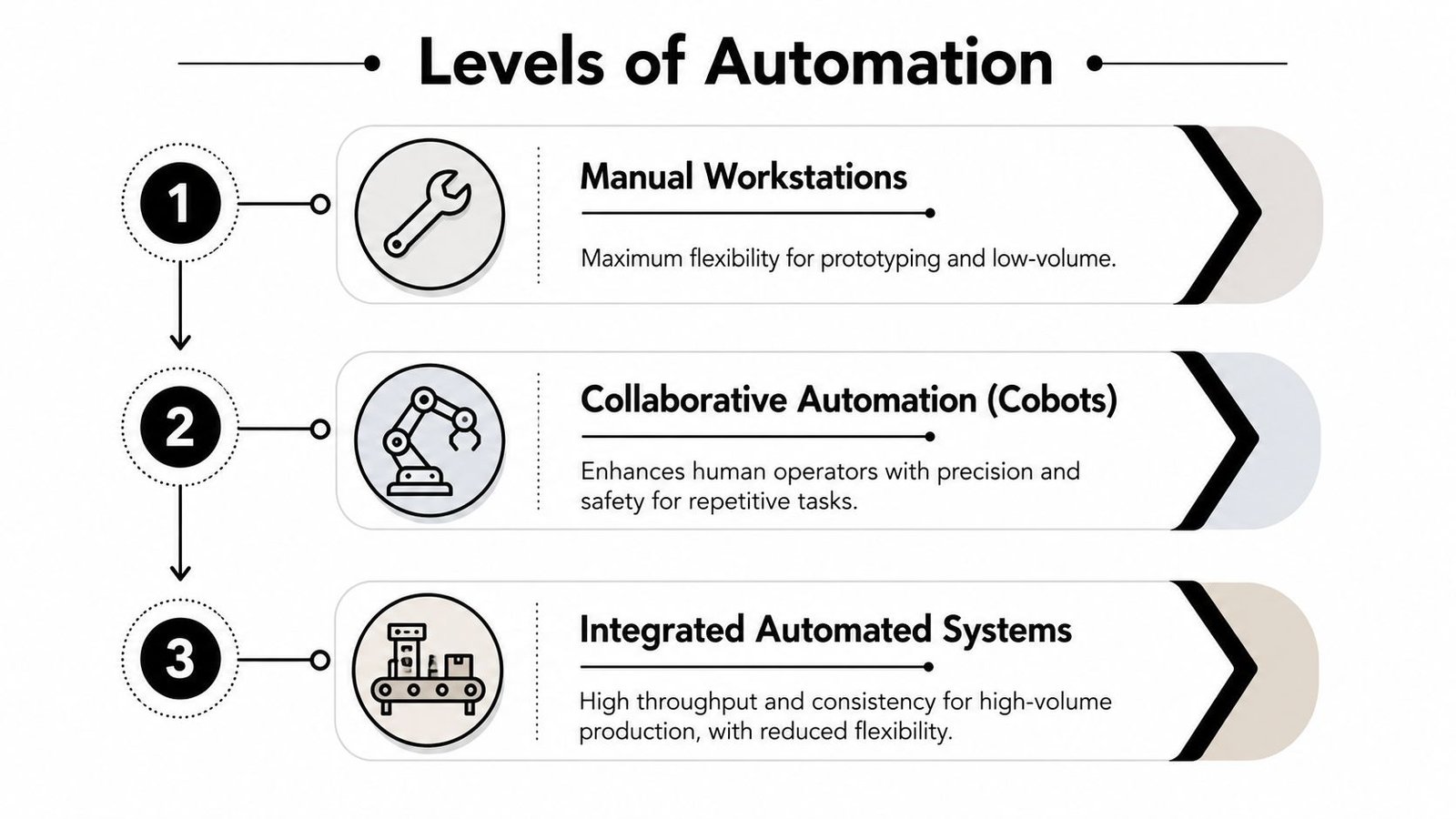
Three practical levels
Manual workstations with smart tooling retain operator flexibility while improving positioning, torque control, force application, and mistake prevention. They suit prototypes, frequent product changes, and tasks where human judgment remains important. Targeted tooling often delivers a better return than automating the entire station.
Collaborative automation places a robot or powered mechanism beside an operator. The machine handles a repetitive movement, presentation, or transfer. The operator manages variant selection, visual judgment, or exception handling. This division can fit high-mix, low-volume production better than a fully automated line.
Integrated automated systems coordinate several operations through controls, material handling, inspection, and digital records. They can provide consistent output when the product and process are stable. Their architecture must support recipe management, access control, fault recovery, and change control.
These levels are options, not steps every manufacturer must follow. A flexible semi-automated cell may outperform a rigid line when variants change frequently. Choose the design around the constraint, required cycle time, acceptance rate, and validation effort. A fully automated system makes sense only when demand, process stability, and the compliance case support its cost.
Benefits and Risks of Automated Production
Automation pays when it controls a known source of variation. A guided fixture can prevent incorrect orientation, while vision can verify an assembly feature before the device advances. A controlled workstation can also capture process data automatically, reducing dependence on handwritten records and operator memory.
A documented medical-device case study reported a semi-automated process that cut cycle time from 30 seconds per device to 10 seconds per device and raised acceptance from 40% to 90–93%. Medical-device semi-automation case study The practical lesson is narrower than “automate everything.” Targeted automation can improve output and quality when it addresses a repetitive, error-prone operation.
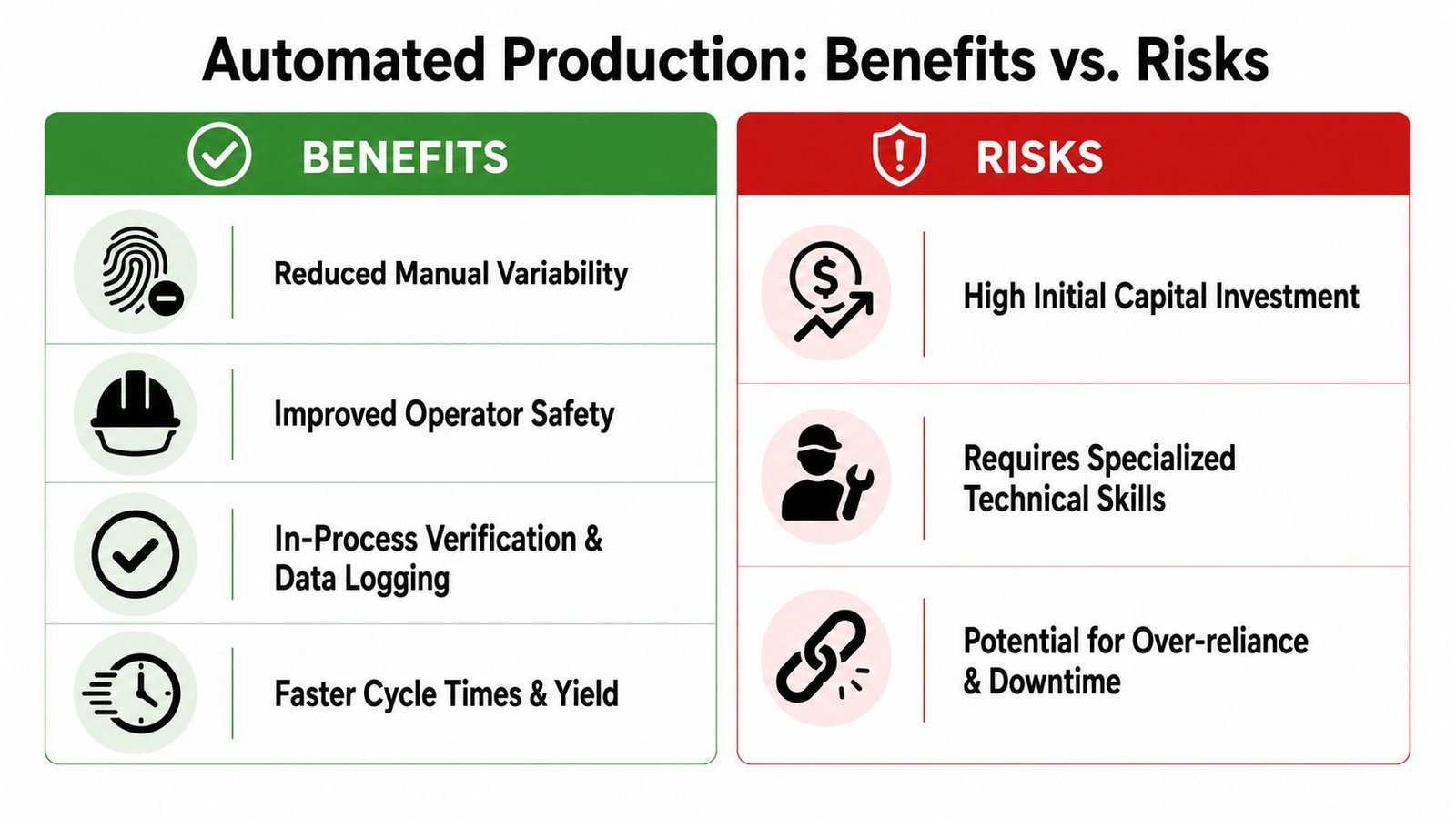
What automation can improve
- Manual consistency: Fixtures and controlled sequences reduce variation between operators and shifts.
- In-process verification: Sensors and vision can check critical conditions before defects move downstream.
- Traceability: Automated records connect process results with the device, batch, recipe, or work order.
- Operator safety: Material handling and repetitive-motion assistance can reduce exposure to awkward or fatiguing tasks.
- Production capacity: Stable cycle execution can improve use of available equipment and labor.
- Training effort: Guided interfaces and error-proofing make the correct sequence easier to follow.
The risks require equal attention. Equipment costs arrive before production benefits, and qualification work can become substantial when validation is treated as a late project phase. A highly customized line may also make product changes expensive. Supplier dependence can affect software updates, replacement parts, and troubleshooting.
Where projects go wrong
Over-automation is a common failure mode. Teams may automate a technically achievable step while leaving inspection, changeover, tooling, or traceability as manual bottlenecks. The result is an expensive machine that does not resolve the operating constraint.
Design test: If the product changes often, ask whether the automation can change with it. If it can't, the system may reduce labor while increasing engineering dependency.
Start with the pain point that limits acceptance, cycle execution, changeover, or records. Measure the result, then decide whether the next task deserves automation. In high-mix, low-volume production, a semi-automated cell often preserves the flexibility that a rigid line removes.
GMP Compliance and Validation Requirements
Automation becomes easier to manage when the quality team joins the design conversation early. The equipment, controls, software, records, alarms, and user access should be planned around intended use and process risk, not reviewed only after the machine has been built.
The FDA's Quality Management System Regulation became effective on February 2, 2026. It amends the device current good manufacturing practice requirements in 21 CFR Part 820 by incorporating ISO 13485:2016 by reference, creating a concrete quality-management baseline for manufacturers operating automated and semi-automated processes. FDA information on the Quality Management System Regulation
Match assurance to risk
The FDA's Computer Software Assurance guidance applies to computerized and automated data-processing systems used in design, development, manufacturing, and quality systems. It takes a risk-based approach rather than requiring exhaustive scripted validation for every software function. FDA guidance on Computer Software Assurance
In practical terms, a control that directly affects a critical device attribute or releases a product should receive stronger assurance evidence than a lower-risk convenience feature. A data-capture workflow, inspection station, or semi-automated cell can therefore be tested according to the harm that an incorrect result could create.
A GMP-aware automation project normally addresses:
- Intended use: Define what the equipment and software must do, including boundaries.
- Risk assessment: Identify failure modes, critical functions, and required controls.
- Testing evidence: Build appropriate installation, operational, and performance evidence.
- Electronic records: Control data integrity, access, auditability, and retention.
- Change management: Establish how recipes, software, components, and procedures will be updated.
- Maintenance: Document calibration, preventive maintenance, troubleshooting, and spare support.
Manufacturers can also use this GMP manufacturing overview to align production discussions with quality-system expectations. The purpose isn't to create paperwork for its own sake. It's to show that the process remains controlled when people, products, software, and equipment interact.
Quality perspective: The fastest qualification path usually begins with a design that makes the required evidence easy to collect.
Comparing Manual, Semi-Automatic, and Fully Automated Lines
The right automation level depends on product stability, demand, labor availability, process risk, and the cost of changing the equipment later. A manual workstation may be the most rational choice for a new product with uncertain requirements. A fully automated line can make sense when the product is stable and the process must run at sustained volume. For many small and mid-sized medical device manufacturers, semi-automation provides the most workable middle ground.
Decision table
| Criteria | Manual + Tooling | Semi-Automatic | Fully Automated |
|---|---|---|---|
| Initial investment | Lower, focused on fixtures and tools | Moderate, spread across targeted operations | Highest, with integrated equipment and controls |
| Flexibility | Very high for variants and frequent changes | High when tooling and recipes are modular | Lower unless flexibility is designed in from the start |
| Throughput | Limited by operator pace and handling | Improved at selected bottlenecks | Highest when the process is stable and balanced |
| Validation effort | Focused on tools, procedures, and process controls | Broader, covering equipment, controls, software, and records | Extensive across the integrated line and interfaces |
| Labor dependency | High | Reduced at repetitive steps | Lowest during normal operation, but technical support needs increase |
| High-mix, low-volume fit | Strong | Usually strong | Often difficult without substantial changeover capability |
| Maintenance profile | Simple and operator-centered | Requires mechanical, controls, and software support | Requires deeper technical expertise and spare planning |
| Best starting point | Prototyping, variable work, low demand | Inspection, assembly, changeover, tooling, and traceability constraints | Stable products, predictable demand, and repeatable processes |
Why semi-automation often wins
A semi-automatic cell lets the operator retain judgment where it matters while the machine controls repetitive actions that create variation. That could mean presenting components in a consistent orientation, applying a controlled force, verifying a feature with machine vision, or recording a result automatically.
The approach also supports incremental investment. A manufacturer can begin with a manual station enhanced by fixtures, then add sensors, automated inspection, or material handling as the process matures. This avoids committing the entire operation to a design that may not reflect future product requirements.
Full automation deserves consideration when manual handling is the dominant constraint, the product architecture is stable, the process sequence is well understood, and the business can support controls, maintenance, qualification, and spare-part requirements. It doesn't deserve consideration only because a supplier can build it.
For a more detailed decision between the two higher-level options, review this comparison of semi-automatic and fully automatic systems. An experienced automation partner should assess the actual process data, operator workflow, changeover demands, quality risks, and budget before recommending equipment.
Implementation Roadmap and ROI Considerations
A successful automation project is a controlled engineering program, not an equipment purchase. The supplier should help define the problem, document the concept, build the system, support qualification, and remain accountable after installation. Start with the process constraint, not with a robot or a fully automated line.
Build the project in phases
Consultation and preliminary concept: Map the current process, identify the dominant pain point, confirm product variants, and define measurable success criteria. Focus first on inspection, changeover, tooling, or traceability when one of these limits output or creates quality exposure.
Design and manufacturing drawings: Convert the concept into fixtures, tooling, guarding, controls, operator interfaces, inspection methods, and data requirements. Review maintainability, cleaning access, ergonomics, and changeover work before releasing the design.
Material sourcing and build: Select components that can be supported, document long-lead risks, and build testable modules. Incremental reviews expose tooling, software, and operator-workflow issues before final integration.
Installation and commissioning: Confirm utilities, floor space, safety, interfaces, and training requirements. Commissioning should use realistic products and materials, fault conditions, recovery procedures, and the records required for later qualification.
Ongoing support: Plan preventive maintenance, calibration, spare parts, software support, warranty coverage, and future modifications before handover. A line without a support path can become a production risk when a specialized component fails.
This staged method aligns with process improvement and automation services. It gives quality and operations teams repeated opportunities to review evidence, and it leaves room to expand a semi-automated cell as demand and process knowledge develop.
Calculate value beyond labor
Labor savings matter, but they are only one part of the ROI case. Include scrap avoided through earlier detection, rework reduced by error-proofing, capacity gained from shorter cycles, training burden reduced by guided work, and quality costs avoided through stronger traceability. For high-mix, low-volume production, also assign a value to faster changeovers and the ability to switch products without rebuilding the entire line.
Use a baseline before approving equipment. Record cycle time, acceptance rate, changeover duration, downtime, rework, and inspection effort. Then define which measure the project must improve and what maintenance, validation, and operator support that improvement will require.
A targeted automation project can produce a stronger return than a fully automated line when product variants change frequently. Approve the investment only after the team can explain which constraint will change, how the result will be measured, and how the system will be supported after launch.
ROI checkpoint: Link the business case to a measured process constraint, not to the automation level alone.
Real-World Results and Best Practices
Real-world performance depends on the constraint selected, not the largest possible system. A semi-automated cell can target inspection, assembly, changeover, tooling, or traceability while retaining operator judgment for product variants and exceptions. That approach suits medical production with frequent changes and limited volumes better than assuming a fully automated, lights-out line will deliver the best return.
Practices that hold up
- Automate the constraint: Start with the operation that limits output or creates repeat defects. Inspection, changeover, tooling, and traceability often offer clearer returns than automating every station.
- Keep flexibility deliberate: Use modular fixtures, recipes, and tooling where variants may change. Confirm that adjustments can be made without rebuilding the cell.
- Design for evidence: Define records, alarms, permissions, and test requirements before finalizing the controls architecture.
- Test with real conditions: Commission with actual materials, tolerances, operators, product variants, and fault-recovery scenarios.
- Plan support early: Specify maintenance access, spare parts, calibration, training, and software ownership before approving the equipment.
- Measure the whole result: Track acceptance, scrap, cycle performance, changeover effort, documentation, and launch readiness, not labor alone.
Commissioning exposes weaknesses that design reviews often miss. A sensor may detect a part reliably in a clean trial but fail when surfaces vary. A robot may meet its nominal cycle time while operators lose time clearing faults or loading awkward fixtures. Acceptance testing should therefore include planned defects, misloads, recipe changes, recovery steps, and representative operator shifts. The result is evidence that the cell can run under production conditions, not just demonstrate a successful sequence.
System Engineering & Automation applies this right-sizing approach through manual equipment, custom tooling and fixtures, semi-automatic systems, integrated controls, robotics, pick-and-place units, bowl feeders, and conveyors. The company states that it has 30+ years of engineering experience, provides delivery from concept through commissioning, follows GMP-aware practices, and offers a one-year guarantee.
Common pitfalls include specifying a complete line before stabilizing the process, treating validation as final paperwork, overlooking ergonomics, and choosing technology only the original supplier can maintain. The strongest projects remove a defined problem, preserve useful human judgment, and give quality teams clear evidence that the process remains controlled.
Talk with System Engineering & Automation about an automation assessment for your medical device process, whether the need is smart tooling, a semi-automated cell, or an integrated system. Bring the hardest inspection, changeover, assembly, or traceability constraint and define the support, budget, and GMP-aware requirements before selecting the automation level.