You're probably dealing with one of two problems right now. Either your line is still too manual and labor variation is hurting throughput, or you're being pushed toward automation that looks impressive on a plant tour but doesn't fit your product mix, budget, or validation burden.
That tension is where most assembly decisions go wrong. A fully automated line can lock a small or mid-sized manufacturer into expensive rigidity. A mostly manual line can keep quality dependent on tribal knowledge, operator pacing, and constant supervision. The best answer usually sits in the middle. It's a right-fit system that automates the bottlenecks, error-proofing points, and unsafe steps while keeping skilled operators where human judgment still matters.
Assembly lines examples are useful only if they help you choose the right level of automation for your own operation. That means looking past the headline and asking tougher questions. Where does material queue? Which steps require traceability? What changeovers are frequent? What work content should stay manual because the product family changes too often?
At SEA, that's the practical lens. The strongest lines aren't always the most automated. They're the ones designed around real takt constraints, real quality risks, and real ROI. The eight examples below move from manual-heavy and hybrid systems to highly automated environments, with a focus on what works, what usually fails, and where small to mid-sized manufacturers can win without overbuilding.
Table of Contents
- 1. Automotive Component Manufacturing Assembly Lines
- 2. Medical Device Manufacturing Assembly Lines
- 3. Electronics and PCB Assembly Lines
- 4. Food and Beverage Processing Assembly Lines
- 5. Pharmaceutical Tablet and Capsule Manufacturing Lines
- 6. Apparel and Textile Manufacturing Assembly Lines
- 7. Automotive Assembly Plants Final Assembly Lines
- 8. Contract Manufacturing and Job Shop Assembly Lines
- Comparison of 8 Assembly Line Types
- Your Next Step Finding Your Automation Sweet Spot
1. Automotive Component Manufacturing Assembly Lines
Automotive component lines are where manufacturers learn the difference between useful automation and expensive overkill. Parts like engine components, transmission subassemblies, and electrical modules usually need repeatability, controlled part presentation, and a tight quality loop. That's why these lines often blend conveyors, machining, robotic handling, torque control, and manual inspection instead of going fully lights-out.
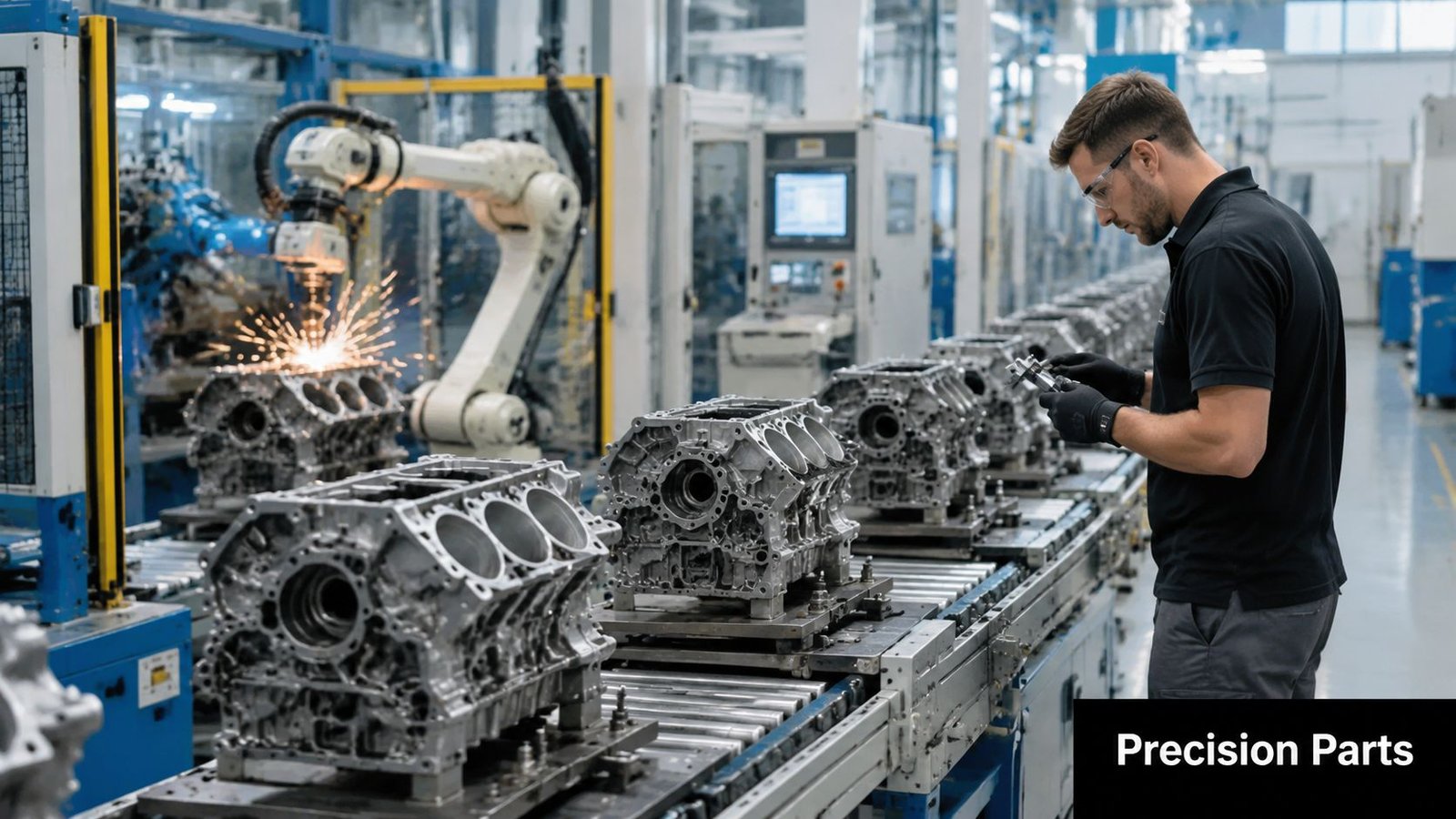
The benchmark history still matters here. Henry Ford's moving assembly line became a manufacturing milestone in October 1913 at Highland Park, where the Model T build was broken into 45 steps and production time fell to 93 minutes. As output scaled, the Model T price dropped from $850 in 1908 to $300 in 1925, and more than 15 million were produced between 1913 and 1927, according to this manufacturing history reference. The lesson isn't “copy Ford.” It's standardize the sequence, then automate only where the sequence is stable.
Where automation pays off
In automotive component manufacturing, the strongest return usually comes from a few targeted layers:
- Controlled transfer: Conveyors, pallets, or carts keep orientation and prevent operators from improvising how parts move.
- Precision stations: CNC machining, robotic welding, and torque-controlled fastening remove variation from critical steps.
- Manual quality gates: Skilled inspectors still catch cosmetic issues, fit concerns, and edge-case defects automation can miss.
- Line-side material discipline: JIT replenishment reduces clutter, but only if kits and replenishment timing are reliable.
A useful real-world example comes from an automotive capacity expansion project where the manufacturer increased capacity by 50% without taking the existing line down for a significant period. The team used a parallel build-out, testing, and final tie-in with an AGC system and Andon integration across five execution phases, as described in this factory automation case study.
Practical rule: If your product design changes often, automate fastening, transfer, and error-proofing first. Leave variant-heavy fit and finish work manual until the design stabilizes.
The downside is familiar. Capital cost is high, maintenance gets more specialized, and every design revision can ripple through fixtures, robot paths, and station timing. For smaller manufacturers, a semi-automated component line often beats a fully automated one because it preserves room for engineering changes.
2. Medical Device Manufacturing Assembly Lines
Medical device lines punish bad automation decisions faster than most industries. If a system is too manual, traceability and process discipline start slipping. If it's over-automated, the plant loses flexibility for product revisions, validation changes, and batch variation. That's why this sector is one of the clearest assembly lines examples for right-fit engineering.
For many small and mid-sized device manufacturers, the central question isn't whether to automate. It's how far to go without creating a validation burden that outruns the business case. Clean handling, documentation, batch traceability, and controlled workflows matter just as much as speed.
The right-fit automation range matters
A useful planning reference is the automation gap many articles skip. One industry source says small-to-mid-sized medical production often fits a 40-70% automation range, while high-volume automotive and electronics tend to run much higher. The same source states that 80% of medical device startups fail to optimize ROI because they either over-automate or under-automate, and it notes that recent 2025 industry data indicates 65% of mid-sized manufacturers are shifting to semi-automated systems with integrated controls to adapt to regulatory changes, according to this medical assembly line guide.
That lines up with what works on the floor. Semi-automated stations with custom fixtures, guided assembly, poka-yoke, barcode traceability, and integrated data capture usually deliver better balance than trying to automate every motion. Manufacturers also need to understand GMP in manufacturing before they decide what belongs inside the line and what belongs in documentation, environmental control, or validation.
- Best candidates for automation: Repetitive joining, dispensing, labeling, serialization, and in-process verification.
- Best candidates for manual or assisted work: Delicate handling, product-family variation, and judgment-based inspection.
- Most common mistake: Buying platform automation built for stable, high-volume products when the need is flexible tooling and controlled operator workflow.
Medical lines rarely fail because they lack enough robotics. They fail because the process, documentation, and fixtures don't match the product risk.
If you're building catheters, surgical accessories, diagnostics, or other regulated products in mixed volumes, the sweet spot is often a modular semi-automated line. It's easier to validate, easier to adapt, and usually much more realistic for budget control.
3. Electronics and PCB Assembly Lines
Electronics lines are fast, precise, and unforgiving. Once you get into PCB assembly, consistency depends on feeder setup, paste control, placement accuracy, thermal profile, and inspection discipline. This is one of the few line types where high automation usually makes sense early because the work itself is by nature repetitive and tolerance-sensitive.
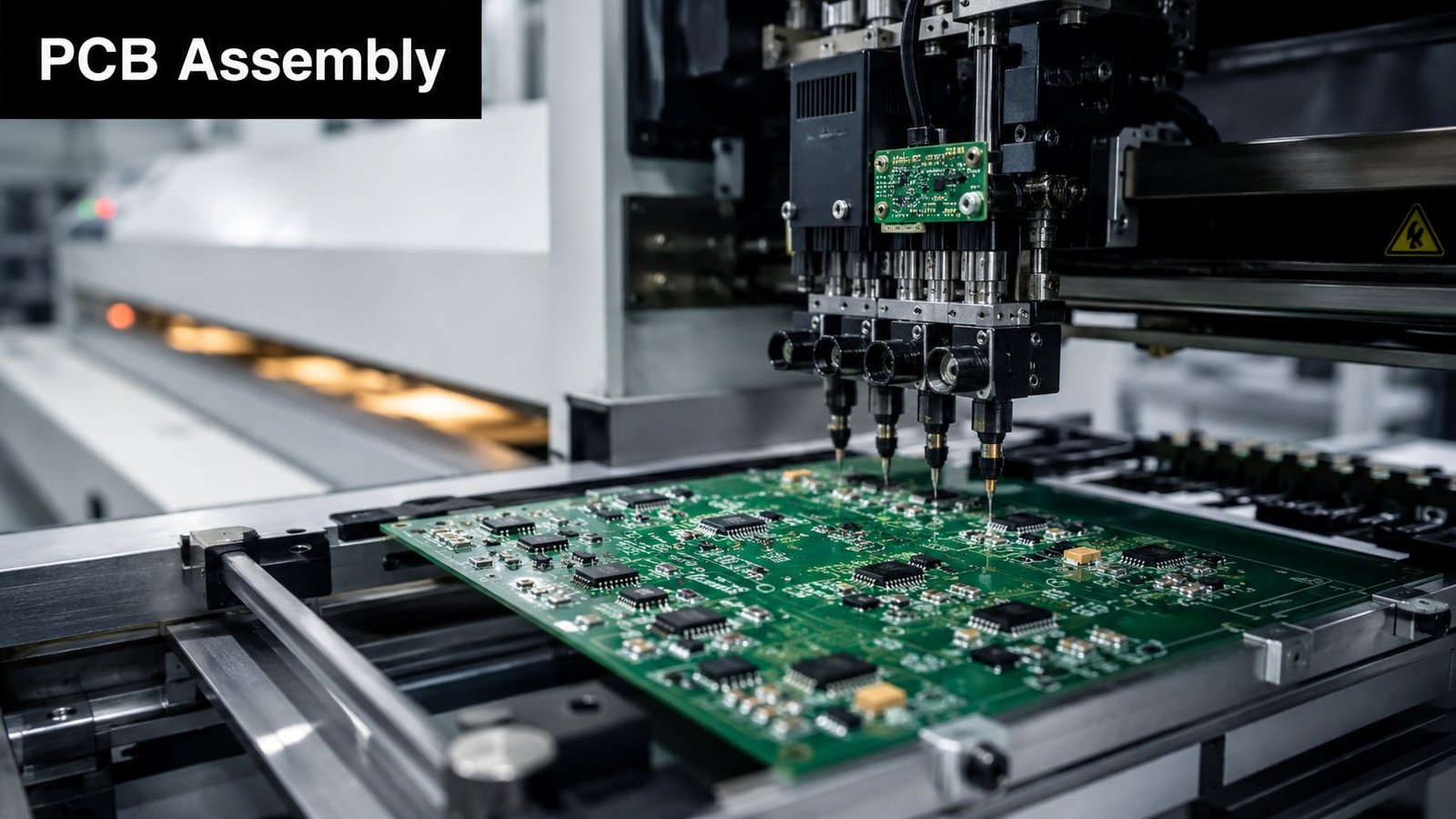
A typical line strings together printing, pick-and-place, reflow, AOI, test, and selective manual rework. The machine sequence has to stay synchronized, but the primary operational challenge is changeover discipline. A fast line with poor feeder management, weak program control, or inconsistent incoming components will still lose time and create scrap.
Best use case for this line type
PCB and electronics assembly works best when you have stable product documentation, disciplined revision control, and enough volume to justify specialized equipment. It's less attractive when engineering releases are still churning weekly or when component sourcing changes constantly.
A practical line design usually includes:
- Automated placement: Pick-and-place handles speed and repeatability that manual loading can't match.
- Thermal control: Reflow profile management determines solder integrity, especially on dense boards.
- Inspection close to the process: AOI catches placement and solder issues early, before downstream testing absorbs the problem.
- Manual technical intervention: Skilled technicians still matter for setup, first-article checks, debug, and rework.
The trade-off is rigidity at the equipment level. Troubleshooting often requires specialist knowledge, and a single process drift can create defects across an entire batch before someone intervenes. For smaller manufacturers, the smarter path is often to automate the core SMT process while keeping final assembly, enclosure build, labeling, and some testing semi-automated.
That hybrid approach protects quality where precision is critical and preserves flexibility where product variation is higher. In other words, don't force a medical diagnostic PCB line and a consumer accessory line into the same automation philosophy just because both use boards.
4. Food and Beverage Processing Assembly Lines
Food and beverage lines have a different center of gravity. In automotive or electronics, the discussion starts with cycle time and repeatability. In food, sanitation, contamination control, washdown design, and packaging integrity are often the first design constraints, with throughput built around them.
That changes what “good automation” looks like. Stainless construction, hygienic transfer, filling accuracy, capping, labeling, coding, and contamination screening often matter more than highly complex robotics. A line can be mechanically simple and still be very effective if it's easy to clean, easy to verify, and stable during product changeovers.
What usually drives equipment selection
Most food processors choose equipment based on four plant realities. Product characteristics, cleanup time, packaging variety, and inspection requirements usually drive the build more than raw speed on a spec sheet.
- Sanitary design first: Equipment needs accessible surfaces, appropriate materials, and layouts that reduce harborage points.
- Inline verification: Weight checking, label verification, seal inspection, and contamination screening belong in the line, not as an afterthought.
- Changeover discipline: Product variety can turn a fast line into a stop-start line if guides, recipes, and cleaning procedures are clumsy.
- Operator simplicity: Controls should support quick recovery after washdown, minor stops, and product switches.
The strongest semi-automated food lines use automated filling, capping, coding, or case handling while keeping inspection, replenishment, and some pack-out tasks operator-assisted. That's often the right move for regional brands and mid-sized processors with multiple SKUs but limited floor space and maintenance depth.
The weak version is a line packed with equipment from different vendors that never integrates. Operators end up bypassing sensors, maintenance fights recurring minor faults, and sanitation crews lose too much time disassembling machine guards and transfer points. In this sector, elegant simplicity usually beats feature overload.
5. Pharmaceutical Tablet and Capsule Manufacturing Lines
Pharmaceutical solid-dose lines are built around control. Tablet pressing, capsule filling, coating, inspection, packaging, and serialization all operate inside a system where batch integrity and documentation are as important as output. That makes these lines some of the most structured assembly lines examples in manufacturing.
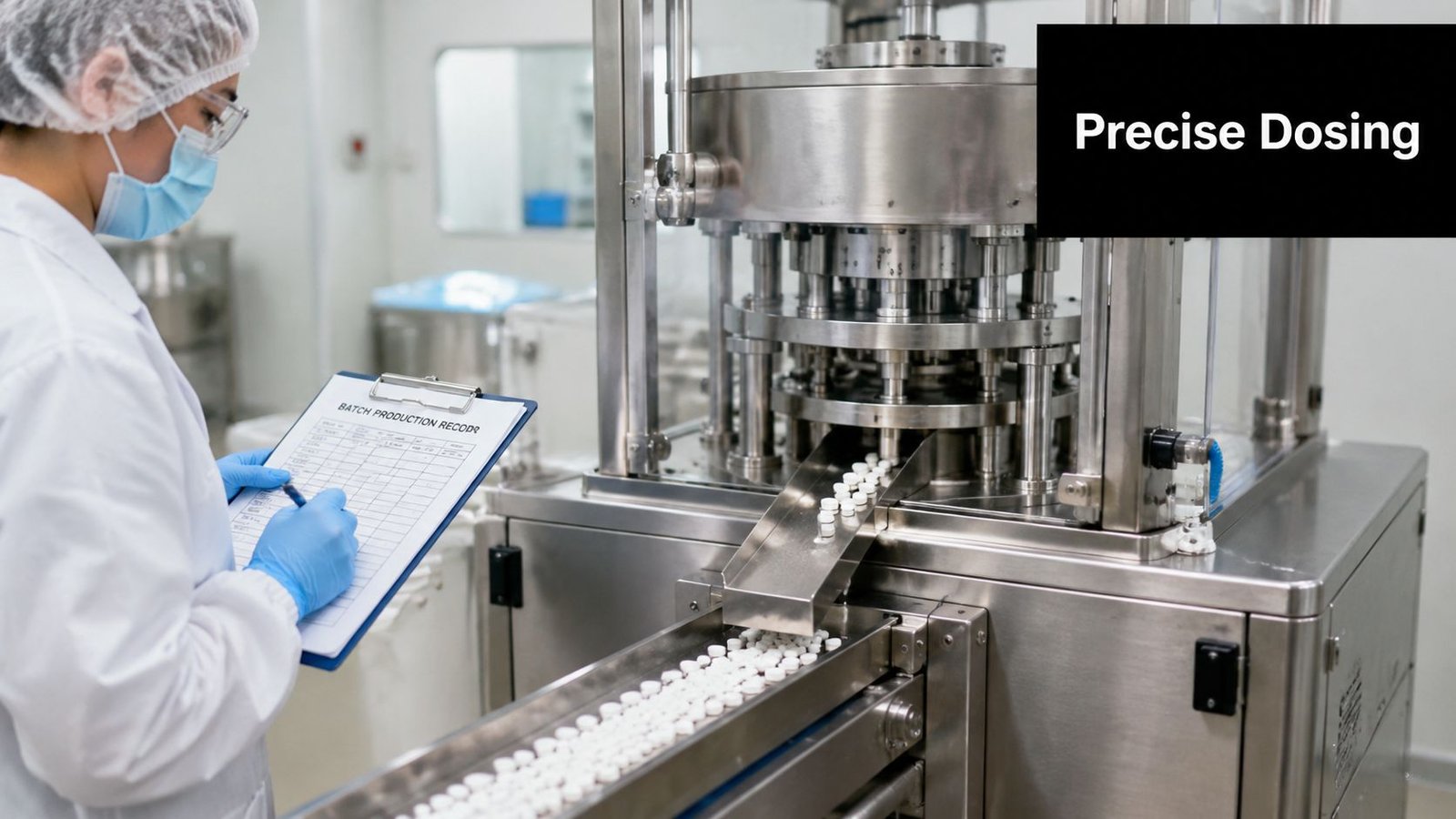
Unlike many consumer product lines, pharma equipment is intentionally conservative. Process windows, cleaning validation, line clearance, documentation, and anti-mix controls all shape the architecture. The result is often a line that looks less flexible than a modern contract manufacturing cell, but that rigidity is usually there for a reason.
Why these lines stay rigid by design
The main strength of a pharmaceutical line is process repeatability with documented proof. Weight control, hardness checks, dosing consistency, and serialization all need to connect back to validated procedures and controlled records. You don't win here by improvising clever workarounds on the floor.
That said, full automation still isn't always the best answer for every manufacturer. Smaller pharmaceutical operations often benefit from automating critical dosing, transfer, inspection, and packaging tasks while keeping some setup, sampling, and material presentation steps operator-managed under strict SOPs.
"Automate the risk, not the ceremony."
That principle matters because a line can become so burdened with complex automation that maintenance, changeover, and validation consume the gains. If your product portfolio changes frequently, or you run shorter campaigns across multiple SKUs, highly customized automation can turn every new product introduction into an engineering project.
The best systems make contamination control, electronic records, and in-process verification easier without creating unnecessary mechanical complexity. In regulated production, a line is only as good as its ability to run predictably after cleaning, setup, and release. Flashy hardware doesn't change that.
6. Apparel and Textile Manufacturing Assembly Lines
Apparel is one of the best examples of why full automation isn't always the smartest investment. Fabric moves, stretches, shifts, and behaves differently across lots. Skilled operators still outperform machines in many sewing, handling, and finishing tasks, especially when styles change often and the product mix stays broad.
That's why textile and garment production usually lands in the semi-automated category. Automated cutting, CAD-driven nesting, bundle handling, pressing, and some material transport steps can improve consistency and labor utilization. But the assembly portion often still depends on operator skill, station layout, and line balancing.
Where semi-automation works best
In textile plants, the biggest gains usually come from reducing wasted motion and improving workstation consistency rather than trying to robotically sew every seam.
- Cutting and preparation: Automated cutters and digital pattern control reduce variation before sewing begins.
- Operator-assisted sewing flow: Progressive stations with ergonomic setups usually outperform isolated workbench assembly.
- Finishing support: Pressing, trimming, sorting, and labeling are good candidates for simple automation or fixtures.
- Material presentation: Bundle control and clear routing reduce stoppages and lost work-in-process.
This is also where manufacturers can learn from failed attempts to eliminate the line concept altogether. One lean manufacturing analysis notes the historical problems with group assembly experiments such as Volvo Kalmar and VW Salzgitter, including the 3-year failure duration of Volvo's 1984 experiment, the 28-worker inefficiency in VW's 1975 experiment, and the role of material transport bottlenecks. The same analysis says 70-90% of failures in group assembly stem from unmanaged material flow, based on this review of undoing the assembly line.
For apparel operations, that lesson is straightforward. Don't romanticize all-manual team assembly if material flow is weak. Better fixtures, better transfer, and better station sequencing usually beat a loosely organized craft model.
7. Automotive Assembly Plants Final Assembly Lines
Final vehicle assembly is the iconic reference point for assembly lines examples, but most manufacturers shouldn't copy it exactly. These plants integrate body, chassis, powertrain, trim, electrical, testing, sequencing, and line-side logistics at a scale that only makes sense when volume, supplier infrastructure, and capital support it.
A useful historical reminder is that Ford's system didn't appear out of nowhere. An earlier industrial precedent was the Portsmouth Block Mills in England, built between 1801 and 1803 and widely described as one of the earliest continuous production-line systems. The works used 22 types of machine tools to manufacture rigging blocks for the Royal Navy, according to the assembly line history summary on Wikipedia. Sequential, standardized production is old. Modern automotive final assembly just industrialized it at extraordinary scale.
For a visual sense of the environment, this automotive final assembly video shows the kind of synchronized flow these plants depend on.
What large-scale final assembly teaches smaller plants
The biggest takeaway isn't robotics. It's line balance. If one zone starves, overruns, or carries too much manual content, the whole system feels it. That's why manufacturers who want to scale should pay attention to production line balancing before they start buying equipment.
A university study on assembly line balancing found that optimizing workstation allocation reduces takt time, which increases production volume. The same study found that reallocating operators between tasks can reduce the number of operators required while lowering labor cost and improving productivity, according to this assembly line balancing case study.
Shop-floor advice: Before you automate a bottleneck, confirm it's a real bottleneck. Bad task allocation gets mistaken for equipment limits all the time.
Small and mid-sized plants can use this lesson immediately. Rebalance labor, standardize work content, and improve material delivery first. Then automate the stations that remain unstable, slow, or quality-critical.
8. Contract Manufacturing and Job Shop Assembly Lines
A customer revision hits on Thursday. Production is scheduled for Monday. The line still has to ship good parts on time.
That is normal for contract manufacturers and job shops. They deal with mixed product families, uneven order patterns, late engineering changes, and customers who expect short lead times without paying for a dedicated line. In that environment, the best assembly system is rarely the most automated one. It is the one that can switch products quickly, hold quality, and protect margin.
The priority is controlled flexibility. Flexible fixtures, quick-change tooling, guided operator workflows, and adaptable controls usually produce better returns than highly specialized automation. A rigid line creates expensive changeovers. A loose, bench-based process creates training drift, inconsistent cycle times, and avoidable quality escapes.
Build around repeatable changeover
Strong job shop lines are designed so reconfiguration is planned, fast, and hard to get wrong. Stations should support multiple part families with predictable fixture swaps, clear digital work instructions, and simple recipe or parameter selection. Shared resources can reduce capital cost, but they only work when scheduling, kitting, and line-side staging are disciplined.
A few design choices pay off repeatedly:
- Modular workstations: Add, remove, or rearrange stations around the product mix instead of rebuilding the whole process.
- Purpose-built fixtures: Accurate part location and poka-yoke features often deliver more value than adding another axis of automation.
- Integrated controls and traceability: Guided steps, interlocks, and data capture help maintain quality across variable work.
- Cross-trained operators: Labor flexibility is part of the line design, especially when demand shifts week to week.
For small and mid-sized manufacturers, this is usually a right-fit automation decision, not a technology race. Manual assembly may be too variable. Fully automated equipment may sit idle when product mix changes. The middle ground often wins. Performance assembly solutions for high-mix production give manufacturers a practical way to improve throughput and quality without locking the business into a single product path.
System Engineering & Automation fits this model well because the challenge is usually process design. The goal is to build enough structure to control quality and labor, while keeping enough flexibility to absorb new work profitably.
Semi-automated lines often deliver the best result here. They give operators support where mistakes are costly or cycle time is unstable, and they avoid overbuilding stations that need to change again in six months.
Comparison of 8 Assembly Line Types
| Example | 🔄 Implementation Complexity | Resource Requirements | 📊 Expected Outcomes | Ideal Use Cases | ⭐ Key Advantages / 💡 Tips |
|---|---|---|---|---|---|
| Automotive Component Manufacturing Assembly Lines | High, multi-station integration, long commissioning | High capex, skilled technicians, complex maintenance, JIT supply | High throughput and repeatability; 📊 consistent quality; ⚡ optimized for volume | High-volume OEM component production, tier-1 suppliers | Superior consistency and scalability. 💡 Use modular stations and preventive maintenance |
| Medical Device Manufacturing Assembly Lines | Very high, GMP/validation, cleanrooms, strict documentation | High capex for cleanrooms, regulatory/QC staff, traceability systems | Regulatory compliance and enhanced safety; 📊 reduced recalls; ⚡ moderate speed due to validation | Sterile/implantable devices, regulated medical hardware | Meets FDA/ISO standards; reduces liability. 💡 Embed serialization and validation workflows early |
| Electronics and PCB Assembly Lines | High, precision SMT, tight tolerances, machine integration | Very high equipment cost (pick‑and‑place, reflow, AOI), trained operators | Very high throughput and low defect rates; 📊 excellent yields; ⚡ fast changeovers possible | High-volume PCB production, consumer and industrial electronics | Exceptional automation and defect detection. 💡 Modular heads and multiple vision checkpoints improve yield |
| Food and Beverage Processing Assembly Lines | High, sanitary design, frequent product changeovers | High capex (stainless steel, CIP), sanitation labor, energy/water resources | High-speed production with food-safety controls; 📊 consistent portioning and traceability; ⚡ high throughput | Bottling, filling, packaging lines, high-volume consumables | Enhanced food safety and consistency. 💡 Design for easy disassembly and CIP between runs |
| Pharmaceutical Tablet and Capsule Manufacturing Lines | Extremely high, cGMP, lengthy validation, precise dosing | Very high capex, specialized pharma engineers, long validation timelines | Precise dosing and full traceability; 📊 regulatory compliance; ⚡ high-volume output once validated | Commercial solid-dose pharmaceutical manufacturing | Meets stringent pharma regulations; minimizes dosing errors. 💡 Plan serialization and redundant safety systems from design |
| Apparel and Textile Manufacturing Assembly Lines | Moderate, semi‑automated sewing and cutting, flexible layouts | Moderate capex, skilled sewing operators, ergonomic stations | Improved consistency with flexibility; 📊 moderate throughput; ⚡ quick changeovers for seasonal lines | Garment production with frequent style/size changes, contract sewing | Balances flexibility and automation. 💡 Invest in operator training and standardized work procedures |
| Automotive Assembly Plants (Final Assembly Lines) | Very high, massive coordination, synchronized stations, supply-chain sequencing | Extremely high capex, large workforce, robots/AGVs, complex logistics | Enormous volumes and optimized efficiency; 📊 high quality consistency; ⚡ very high throughput at scale | Full-vehicle final assembly for OEMs (mass production) | Maximizes scale economies and automation. 💡 Build redundancy and predictive maintenance into critical systems |
| Contract Manufacturing and Job Shop Assembly Lines | Moderate-high, modular and reconfigurable, frequent changeovers | Lower capex vs dedicated lines, flexible tooling, skilled multi-role staff | High adaptability across products; 📊 variable throughput; ⚡ fast response to rush orders | Outsourced multi-product runs, prototyping, low-to-mid volumes | Flexible and cost-effective for diverse orders. 💡 Use quick-change tooling and robust scheduling systems |
Your Next Step Finding Your Automation Sweet Spot
These assembly lines examples all point to the same conclusion. There isn't a universally “best” line. There's only the line that fits your product, your volume, your compliance burden, your labor reality, and your capital constraints.
That's why manufacturers get into trouble when they chase automation by category instead of by need. They see a fully automated electronics line and assume more machinery always means better ROI. Or they stay manual too long because flexibility feels safer than committing to a process. Both decisions can be expensive. One locks you into a rigid system that's hard to change. The other keeps you paying for variability, rework, supervision, and inconsistent throughput.
For many small and mid-sized manufacturers, strategic semi-automation is the practical middle ground. It lets you automate what hurts performance. That usually means repetitive handling, critical fastening, dispensing, traceability, inspection triggers, error-proofing, and unsafe operations. At the same time, you keep operators in the tasks that still benefit from judgment, dexterity, and fast adaptation.
That approach also reduces a common implementation risk. When a plant tries to automate everything at once, commissioning drags out, debugging gets harder, and training becomes too dependent on a handful of specialists. A modular semi-automated line is easier to phase in. It also gives you room to add controls, tooling, transfer systems, or inspection later without ripping up the whole process.
The right path usually starts with a hard look at the current line. Where does work-in-process pile up? Which defects repeat? Which stations depend on your best operator? Which manual motions create safety exposure or uneven cycle time? Those answers matter more than whether a machine builder calls a system “advanced.”
Good engineering is disciplined, not flashy. It puts automation where it improves throughput, quality, ergonomics, and control. It avoids overbuilding. It respects changeovers, maintenance capability, and floor-space limits. Most of all, it keeps the business case in view.
SEA works in that practical zone. The value isn't just in supplying equipment. It's in helping manufacturers choose the right level of automation, then designing tooling, fixtures, controls, and line architecture around the process they run. That's how you improve performance without buying complexity you don't need.
If your team is weighing manual, semi-automated, or fully automated assembly options, System Engineering & Automation can help you make the decision with a clear operational and ROI lens. SEA designs cost-effective manufacturing solutions, from custom fixtures and smart tooling to scalable semi-automated and fully integrated systems, with support from concept through commissioning.