A production manager rarely starts the week asking for a new machine. More often, the question arrives after a fixture begins slipping, operators compensate by feel, and quality sees a pattern of scrap that wasn't present before. The practical choice is usually less dramatic than a fully automated line: rebuild the fixture, retrofit the existing cell, or commission a custom machine that removes the recurring constraint.
That's where Custom Machine & Design Inc. deserves a closer look. Its profile sits between a conventional machine shop and a large automation integrator, with machining, fabrication, tooling, fixtures, prototyping, repair, and assembly capabilities that can support production improvements without forcing every buyer into a high-capital automation project. The company has operated since 1988, changed ownership in 2005, and moved into a 22,000-square-foot facility in 2011, according to business-profile and BBB history. Those milestones suggest the staying power and physical capacity of an established private manufacturing firm.
Table of Contents
- Meeting Custom Machine & Design Inc in the Context of Modern Manufacturing
- The Core Capabilities Behind a Full-Service Machine Shop
- Tooling, Fixtures, and Prototypes That Solve Real Production Problems
- Choosing the Right Level of Automation for Your Operation
- Where Custom Machine & Design Inc Delivers Results in Practice
- Evaluating Custom Machine & Design Inc Against Other Suppliers
- Common Misconceptions About Custom Machine Builders
- Deciding If Custom Machine & Design Inc Is the Right Partner
Meeting Custom Machine & Design Inc in the Context of Modern Manufacturing
A mid-sized plant often has an awkward equipment problem. The process is too important to leave as a manual workaround, but the part mix is too variable to justify a dedicated robotic line. The production manager stands beside a worn locating fixture, comparing the cost of replacement tooling with the disruption of changing the entire cell. A maintenance supervisor wants a quick repair. Quality wants repeatability. Finance wants evidence that the investment will pay back.
Custom Machine & Design Inc. fits that decision point because it operates more like a job-shop manufacturing partner than a catalog-equipment vendor. The company's capabilities include CNC machined parts, waterjet cutting, industrial tooling, fixtures with assembly, prototype development, heat treating, welded fabrications, repairs, and material sales, as described on its manufacturing services website. That combination matters when the production problem isn't isolated to one component.
The middle ground matters
Large OEMs typically optimize around repeatable, high-volume programs. Small machine shops may produce excellent parts but lack the engineering or integration resources to turn those parts into a working production aid. Mid-sized manufacturers often need something between those models: a supplier that can understand the part, machine the fixture, fabricate the structure, assemble the result, and adjust the design after shop-floor tryout.
The South Carolina Department of Commerce industry directory lists Custom Machine & Design as a contract manufacturer in Myrtle Beach, with general machining, metal fabrication, CNC milling and turning, laser cutting, finishing, and assembly capabilities. Technically, that mix creates a connected process chain. Fewer external handoffs can reduce opportunities for tolerance drift, communication errors, and schedule variability.
Practical rule: Don't evaluate a custom supplier by its equipment list alone. Evaluate how much of the build can remain under one accountable workflow.
The rest of the decision comes down to fit. Custom Machine & Design Inc may be useful when you need a short-run fixture, a replacement component, a prototype, or a semi-automated mechanical foundation. It may be less suitable when your program requires a large controls team, extensive robotics engineering, or a globally scaled production supply chain. The right comparison isn't “custom versus standard.” It's whether the supplier's capabilities match the constraint you're trying to remove.
The Core Capabilities Behind a Full-Service Machine Shop
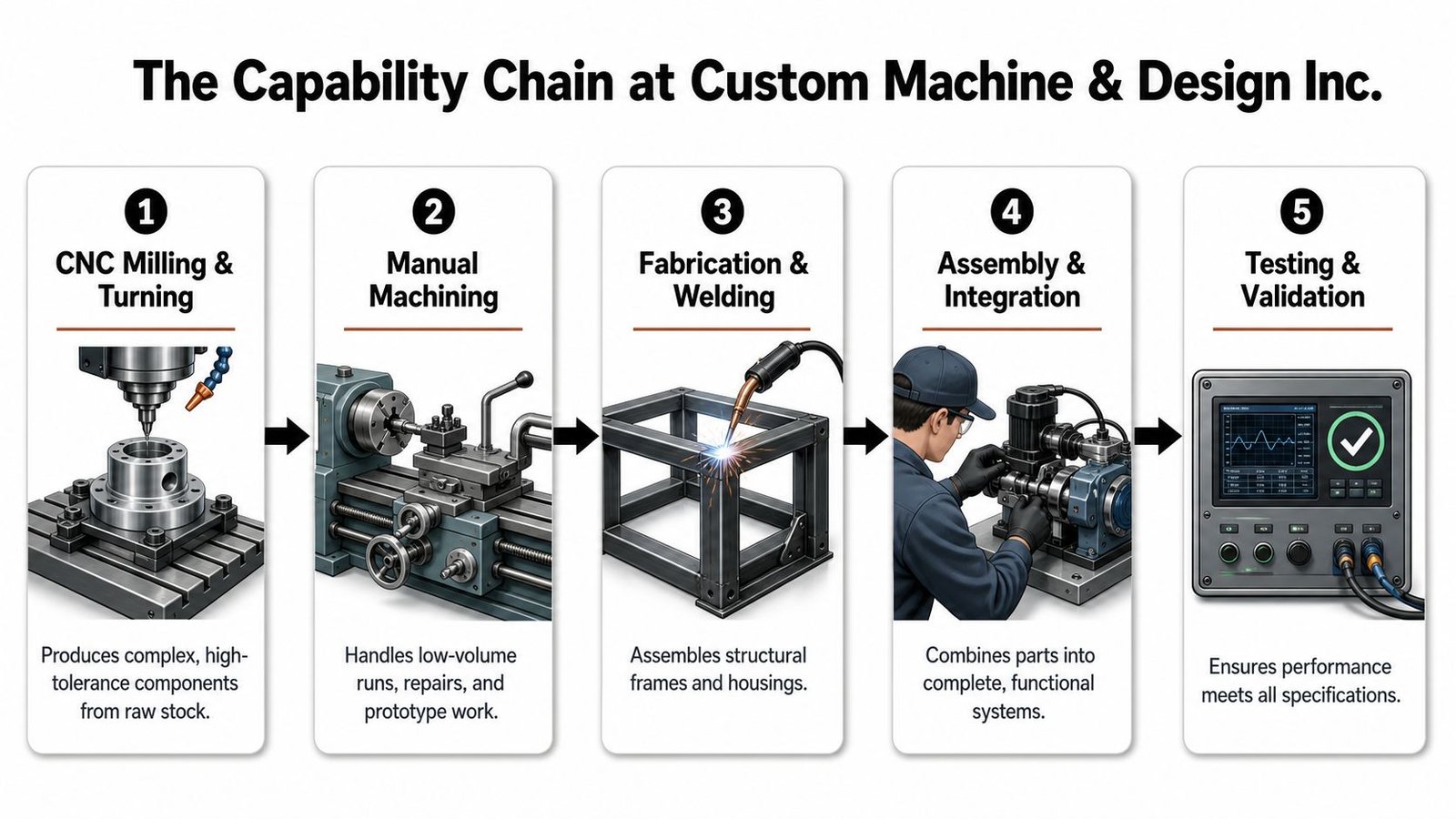
A custom machine project should follow the physical logic of production. Raw material becomes a precision component. Components become a frame or mechanism. The assembly becomes a usable system. Testing then confirms whether the result meets the requirement. Custom Machine & Design Inc's listed machining, fabrication, finishing, and assembly capabilities map to that sequence.
Start with the precision components
CNC milling and turning produce the parts that establish location, movement, and repeatability. A milled nest, turned bushing, shaft, spacer, or mounting plate may look simple, but each feature influences the final tolerance stack. CNC work is especially useful when a fixture has multiple locating surfaces or when a replacement part must match an existing machine.
Manual machining remains valuable for repairs, one-off parts, and low-volume changes. A manual operation can be the sensible choice when the part doesn't justify a programmed production route or when a technician needs to adjust an existing component quickly. For brownfield equipment, the ability to work from a sample part or field measurement can matter more than a formal drawing.
Build the structure and complete the system
Fabrication and welding create frames, guarding, brackets, housings, and support structures around the machined elements. The quality question isn't just whether the welds hold. It's whether the frame stays aligned, provides access for maintenance, and gives operators enough room to load and unload parts safely.
Assembly and integration expose design problems that drawings often hide. A technician may find that a fastener is inaccessible, a sensor has no adjustment range, or a removable insert can't be changed without disassembling the fixture. That feedback is where design-for-manufacturing becomes practical. You can review custom-designed machinery services when the project requires more than an individual machined part.
The final step is testing and validation against agreed specifications. A complete supplier should be able to discuss inspection points, functional checks, material requirements, and acceptance criteria before fabrication begins.
Capability depth is more valuable than a long catalog when the project crosses machining, fabrication, assembly, and production use.
Tooling, Fixtures, and Prototypes That Solve Real Production Problems
A dedicated tool earns its place when the process repeats often enough for consistency to matter. A fixture earns its place when operators need reliable location, clamping, orientation, or inspection access. A prototype earns its place when the team still has unanswered questions about fit, function, ergonomics, or manufacturability.
Custom Machine & Design Inc's listed tooling, fixture, prototype, and repair work supports all three situations. The mistake is treating them as interchangeable purchases. A tool that solves a repeatability problem may be wasteful if the product is still changing. A prototype that lacks adjustment features may create more learning delay instead of reducing it.
Match the investment to the uncertainty
Use a quick-change fixture when the plant runs several related parts and changeovers are frequent. Modular nests, replaceable inserts, dowel locations, and accessible clamps let the team preserve a common base while changing only the features that contact the part.
Use dedicated tooling when the geometry is stable and the process needs repeatable location, controlled force, or a defined inspection reference. Dedicated workholding can also improve ergonomics by removing awkward manual positioning. That benefit isn't limited to cycle time. A fixture that presents the part at a consistent height and orientation can make the work easier to perform correctly.
Use a prototype build when the team needs to test a concept before committing to hardened or highly specialized tooling. The supplier should be able to move from a sketch, sample, or preliminary model through fabrication, tryout, adjustment, and sign-off. A prototype isn't successful merely because it exists. It should answer the questions that determine whether production tooling is justified.
| Service | Best Use Case | Typical ROI Driver |
|---|---|---|
| Custom tooling | Stable process with defined, recurring requirements | Reduced variation and more consistent operator execution |
| Workholding fixtures | Part location, clamping, inspection, or changeover problems | Less handling time, fewer locating errors, and improved ergonomics |
| Prototype builds | New product, uncertain geometry, or unproven process | Earlier learning and fewer redesigns before production release |
The financial logic should be grounded in the floor. Calculate the operator time saved per shift, scrap avoided through better location, and rework eliminated by making the correct setup obvious. Then include the cost of maintenance, replacement inserts, and future product changes. A fixture that saves time but can't accommodate the next revision may not be the best long-term choice.
For a closer look at the role of tooling and fixtures in production improvement, focus on the transition from concept to tryout. That's where engineering collaboration usually determines whether the tool becomes a durable production asset or an expensive object stored beside the line.
Choosing the Right Level of Automation for Your Operation
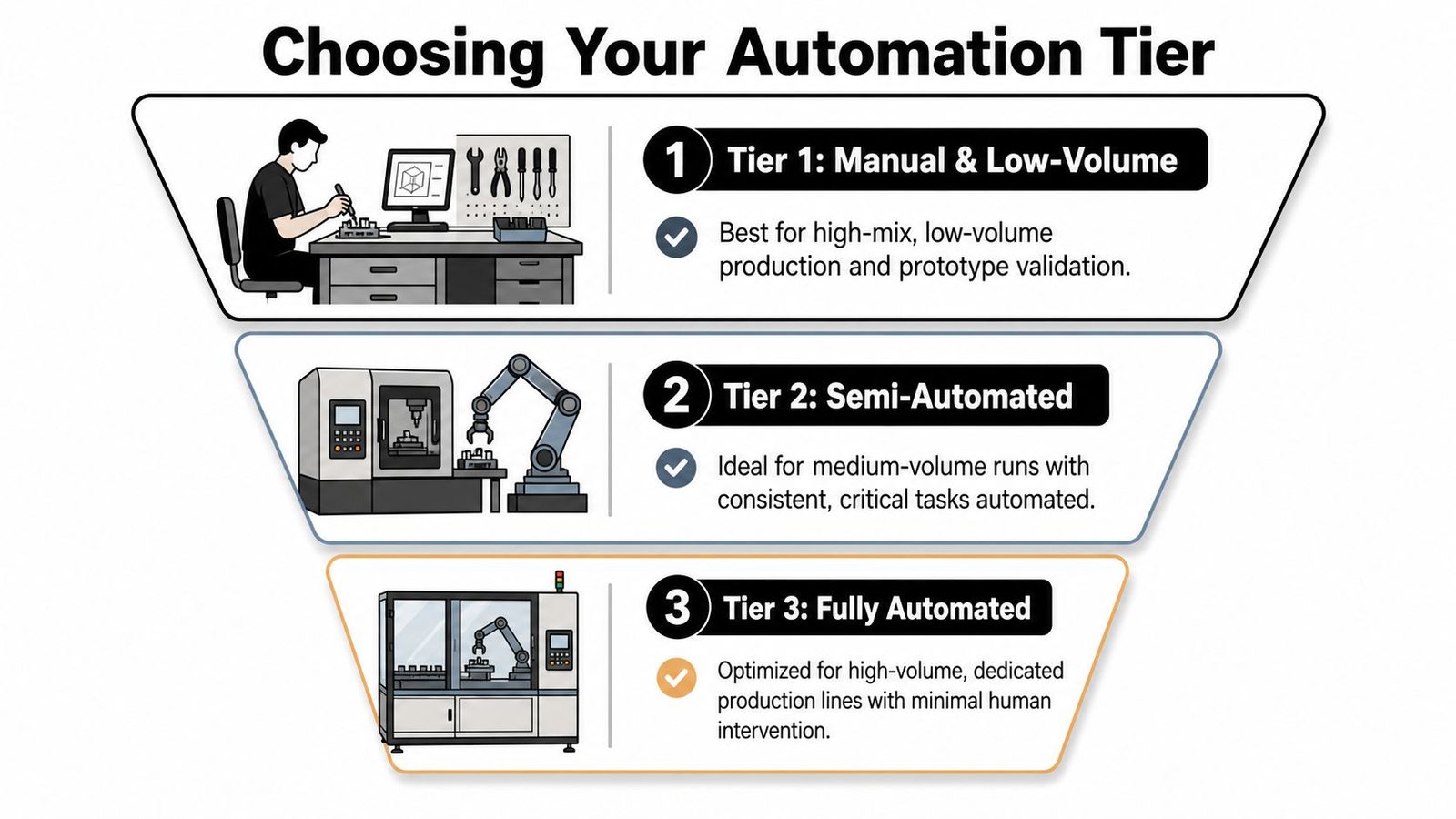
Manufacturers usually have three workable choices, not one. They can retain manual work with better fixturing, introduce a semi-automated cell, or build a fully automated line. The correct tier depends on the process, not on how advanced the equipment looks in a sales presentation.
Tier one keeps the operator central
Manual, fixtured work suits high-mix, low-volume production, prototype validation, and operations where judgment still changes from part to part. The improvement may come from a machined nest, poka-yoke feature, torque reaction arm, or better access to an inspection point. This tier often provides the lowest disruption because it improves the existing workstation rather than replacing it.
Tier two automates the repeatable task
A semi-automated cell can add pneumatic clamping, sensor feedback, indexing, controlled pressing, or a defined sequence while leaving loading, unloading, or product changeover with the operator. Custom Machine & Design Inc's job-shop capabilities are relevant here because machined brackets, jigs, nests, and indexing components form the mechanical backbone of many retrofit projects.
This is often the sensible starting point for a brownfield plant. The team can measure throughput, defects, changeover behavior, and maintenance needs before deciding whether a robot or more advanced controls are justified. Industry coverage on industrial automation trends also identifies modular, practical solutions as a strong direction for mid-sized plants and SMEs, with surrounding workflows such as quality data, maintenance scheduling, and reporting often creating important value opportunities.
Tier three removes most manual intervention
Fully automated systems make sense when the product mix is narrow, demand is predictable, and the process can be specified tightly enough for robots, PLCs, conveyors, inspection, and material handling to operate together. They're harder to justify when changeovers are frequent, parts vary substantially, floor space is limited, or the plant lacks controls and maintenance support.
Use automation level selection guidance to frame the decision around part mix, volume, changeover frequency, floor space, controls expertise, and capital budget. Over-automation creates its own burden. A complex line can become difficult to debug, expensive to modify, and poorly utilized if the underlying production demand doesn't support it.
Where Custom Machine & Design Inc Delivers Results in Practice
Consider a medical device contract manufacturer introducing a catheter assembly process. The team needs a validation fixture that holds delicate components consistently, provides controlled press-fit operations, and allows inserts to change without rebuilding the entire station. A custom builder can machine an aluminum nest, add dowel-pin location, integrate press-fit stations, and design replaceable inserts around the parts that wear or change.
The mechanical design is only part of the challenge. The fixture must also support documented setup, repeatable operation, inspection access, and the evidence required for qualification. Medical device automation can reduce variation and human error while supporting FDA, ISO 13485, and CE requirements, according to industry guidance on medical device manufacturing automation. That same source discusses predictive maintenance and connected MES or SCADA systems as tools for reducing unplanned downtime, but those features only help when the machine's basic mechanical process is stable.
A second scenario looks less glamorous
A Tier 2 automotive supplier may not need a new line. It may need to replace locating clamps on a stamping cell after wear has introduced positional inconsistency. Custom machined nests, replacement clamps, and verified contact surfaces can restore the intended location without forcing a complete equipment replacement.
That kind of repair sits in the space where job-shop responsiveness matters. The supplier must understand the existing cell, measure what has changed, produce compatible parts, and support tryout. The result may be operationally important even though it doesn't resemble a showcase automation project.
Prototype and pilot stages should be treated as controlled learning rather than rushed production. In regulated environments, buyers may plan prototype runs at three to ten units and pilot production at fifty to one hundred units, based on the project scenario described here, not as universal requirements. The appropriate quantities depend on the validation plan, risk profile, design maturity, and customer requirements.
The concept-to-prototype gap is where many custom equipment programs lose momentum. A supplier that can adjust the first build has a better chance of helping the project reach production than one that only delivers the original drawing.
Evaluating Custom Machine & Design Inc Against Other Suppliers
A fair supplier comparison needs more than quoted price. Compare the supplier's ability to understand the application, produce the critical features, iterate after tryout, and support the equipment once operators use it. Custom Machine & Design Inc should be evaluated against three different alternatives: a regional machine shop, a large automation integrator, and an overseas contract manufacturer.
| Criterion | Custom Machine & Design Inc | Large Automation Integrator | Overseas Contract Manufacturer |
|---|---|---|---|
| Machining tolerance capability | Confirm achievable tolerances on the actual drawing, especially locating and mating features | May subcontract or manage machining through an approved supply chain | Can offer capable machining, but verification and communication require close control |
| In-house design and CAD resources | Ask which design and manufacturing decisions are handled directly | Often strong in controls, robotics, and complete system architecture | Varies significantly by supplier and project |
| First-article fixture lead time | Often competitive for practical, low-volume custom work, subject to current capacity | May involve longer engineering and project-management cycles | Unit pricing may be attractive, while iteration and shipping add schedule exposure |
| Low-volume production capacity | A natural fit for prototypes, repairs, fixtures, and short runs | May prioritize larger integrated programs | Can be economical when drawings are stable and quantities support the supply chain |
| NDA and proprietary tooling | Confirm terms before sharing prints, samples, or process details | Usually has formal contracting processes | Confirm ownership, confidentiality, and control of tooling and files explicitly |
Don't accept vague claims about “tight tolerances.” Give each supplier a sample drawing with realistic tolerancing notes and ask what they can hold consistently, how they'll inspect it, and what datum scheme they recommend. A thousandth-level requirement may be appropriate for one interface and unnecessary for another, so the conversation should focus on function rather than impressive figures.
Due diligence should reach the shop floor
Use a short verification process:
- Review a sample drawing: Ask the supplier to identify tolerance risks, difficult setups, and inspection requirements.
- Tour the CNC floor: Look for material flow, workholding discipline, inspection practices, and evidence that repair work is handled systematically.
- Verify traceability: For regulated work, ask how material certificates, inspection records, revisions, and nonconformances are controlled.
- Check relevant references: Speak with customers in your industry and ask specifically about iteration, delivery communication, and post-installation support.
A large integrator may win when robotics, controls architecture, safety systems, and data integration dominate the project. An overseas manufacturer may win when the design is frozen and unit cost outweighs iteration speed. A job-shop partner may win when the design is evolving, the run is limited, and the production team needs direct engineering access.
Common Misconceptions About Custom Machine Builders
The largest supplier isn't automatically the safest choice. A large organization may have impressive controls expertise, but that doesn't guarantee its project team will understand a worn fixture, a difficult loading motion, or the tolerance interaction between an existing machine and a new nest. Scale helps when the scope demands it. It can create friction when the buyer needs fast, practical decisions from people close to the build.
Bigger doesn't eliminate integration risk
A custom automation project can fail through small mismatches. The fixture may locate the part correctly but block the operator's hand. The sensor may confirm presence but not distinguish a misloaded variant. The robot may reach every position in simulation but struggle with real part presentation. A drawing can meet nominal dimensions while the assembled system develops a tolerance stack-up that affects production.
Shop-floor experience helps expose those issues earlier. A supplier that machines, welds, assembles, and repairs equipment sees how design decisions behave after installation. That doesn't replace controls engineering, but it adds a practical layer that large project teams sometimes overlook.
Custom doesn't always mean slow
A custom build can move quickly when the scope is clear, the critical requirements are identified, and the supplier can handle the main work without excessive subcontracting. Conversely, a standard machine can take longer when it needs extensive modification, unusual guarding, or an interface to aging equipment.
The buyer's responsibility is to separate learning from production release. Prototype work should allow controlled changes, while a production machine needs a released baseline, acceptance criteria, documented work instructions, and defined support. A custom machine builder doesn't need to eliminate iteration. It needs to manage iteration so the plant doesn't confuse an engineering change with a production-ready solution.
Regulated work requires evidence
A job shop can support regulated manufacturing, but capability must be demonstrated through documentation and process control. ASTM E2500 applies to pharmaceutical and biopharmaceutical systems, including GMP utility equipment, process equipment, monitoring and control systems, and automation that can affect product quality, availability, or patient safety, as described in the standard's scope. Buyers should also ask how the supplier will support validation records, traceability, maintenance, and change control. Machine size or company size doesn't answer those questions. Evidence does.
Deciding If Custom Machine & Design Inc Is the Right Partner
Custom Machine & Design Inc is worth considering when the production problem sits between a simple replacement part and a large, fully integrated automation program. Its documented strengths in CNC machining, fixtures, tooling, fabrication, repair, prototyping, and assembly align well with short-run tooling, retrofit components, manual workstation improvements, and semi-automated mechanical systems.
The fit becomes stronger when your team needs a supplier to work from imperfect information. Existing brownfield equipment often has incomplete drawings, worn surfaces, undocumented adjustments, or legacy components that aren't available from the original builder. A partner that can measure, model, machine, assemble, and revise the solution has a practical advantage over a supplier that only quotes from finalized CAD.
Use a focused qualification checklist
Before issuing a purchase order, ask:
- Engineering depth: Who will review the application, and who will make design changes after tryout?
- Tolerance capability: Can the supplier explain how it will establish datums, inspect critical features, and control the stack-up?
- Lead-time honesty: Which items drive schedule, and what assumptions could change the delivery date?
- Iteration support: Is adjustment included in the development plan, or will every revision become a separate commercial event?
- Regulated-work readiness: Can the supplier provide the documentation, traceability, and validation support your quality system requires?
Request sample prints, a review of comparable fixture programs, and a clear statement of acceptance criteria. For a larger automation decision, a paid pilot or limited-scope prototype can protect both sides. It lets your team confirm loading, ergonomics, repeatability, maintenance access, and operator acceptance before committing to a full line.
Custom Machine & Design Inc makes the most sense when you need responsive custom machining and practical production equipment for a variable, low-to-moderate volume environment. A different supplier may serve you better when the program requires a large robotics deployment, advanced controls architecture, or global production capacity that exceeds a job-shop model.
Automation investment can support measurable business outcomes when it optimizes production and services rather than only replacing manual work. A peer-reviewed article summarizing a study reports that organizations automating at least one-third of their processes increased efficiency by an average of 15% and reduced costs by 12%, as documented in the published research summary. Treat those figures as evidence for evaluating an automation business case, not as a promised result for any individual project.
System Engineering & Automation offers semi-automatic, fully automated, and manual equipment, along with custom tooling, fixtures, integrated controls, installation, and commissioning to meet a manufacturer's production goals and budget. If you're weighing a retrofit, a semi-automated cell, or a complete custom system, visit System Engineering & Automation to discuss the right scope for your process.