Friday night, a product mix changeover runs late because a controls engineer has to come in, connect to a cabinet, edit ladder logic, test the sequence, and hope nothing else changes. By Saturday morning, production has lost time, operators are frustrated, and the plant manager is asking why a small recipe change required specialist intervention.
That problem is the practical starting point for software defined automation. SDA moves selected control logic and machine behaviour into configurable software running on standard industrial computing platforms, while keeping the physical equipment, field devices, and safety controls that production depends on. The result can be faster change management, better visibility, and more consistent integration, but only if the plant treats SDA as an engineering and operations decision rather than a software purchase.
For manufacturers looking to optimize production and services, the right question isn't whether SDA sounds modern. The right question is whether it will improve the specific lines, stations, quality controls, and maintenance processes that constrain output today.
Table of Contents
- What Software Defined Automation Means for Your Plant
- How We Got Here and How It Differs From Traditional PLCs
- The Core Architecture and Key Components
- Practical Benefits That Matter on the Production Floor
- A Realistic Implementation Roadmap With GMP and Safety in Mind
- ROI Signals, Market Context, and Honest Risks to Weigh
- What to Do Next as an Operations Manager
What Software Defined Automation Means for Your Plant
Software defined automation separates industrial control logic from dedicated hardware. Instead of storing every operational decision inside a fixed controller for one machine, the plant can run configurable control applications on industrial PCs, edge servers, or virtualized infrastructure. That makes the software more portable and reduces the need to rewire equipment every time the process changes, as described in this plain-language explanation of software-defined automation.
That definition matters on the floor because it changes who can act, how changes are tested, and how quickly a proven improvement can move from engineering into production. SDA doesn't remove sensors, drives, motors, fixtures, robots, or operators. It changes where the coordinating intelligence lives.
Start with the production change
A conventional changeover often requires a controls specialist to edit a PLC program, verify the machine sequence, and confirm that the new settings won't create a quality or safety problem. In an SDA environment, approved recipes, routes, machine parameters, and operating rules can be managed as software configuration. The exact implementation still depends on the equipment and validation requirements, but the intended shift is clear:
- Recipe changes: Operators and engineers can manage approved product settings without treating every adjustment as a wiring project.
- Station visibility: Supervisors can see production conditions at individual stations instead of relying only on line-level summaries.
- System integration: Machine data and production events can move into MES, ERP, and historian systems through defined interfaces rather than a collection of custom gateways.
SDA can also support centralized versioning, controlled deployment, and rollback. Those capabilities help a manufacturing team preserve a known-good configuration instead of relying on an engineer's laptop or a cabinet copy that may not reflect the live system.
Practical rule: If your current problem is poor process design, SDA won't fix it. Software makes a good operating model easier to manage, but it doesn't make an unstable sequence reliable by itself.
Decide what belongs in the software layer
The architecture should serve the production process, not the other way around. A plant may keep deterministic motion, interlocks, and safety functions in certified controllers while moving recipe management, coordination, data handling, and line-level orchestration into software. A retrofit may therefore add an SDA layer above existing controllers rather than replace every PLC.
Before approving a purchase order, answer three questions:
- What should be retrofitted? Identify stations with usable controls, accessible data, and a clear production constraint.
- What should be replaced? Replace obsolete or unsupported equipment when its hardware, software, or safety condition creates unacceptable risk.
- How will safety and quality remain intact? Define validation, change control, safety verification, and operator training before deployment.
For practical guidance on connecting automation decisions to plant performance, review real-time automation services. The value of SDA appears when a plant can change production deliberately, see the consequences clearly, and preserve control over safety and quality.
How We Got Here and How It Differs From Traditional PLCs
PLCs became the standard answer to hard-wired relay control because they made machine sequences programmable and easier to modify. Over time, manufacturers built dedicated controllers into individual machines, stored ladder logic on proprietary CPUs, and connected field devices through point-to-point wiring or vendor-specific networks. The approach remains dependable, especially where deterministic execution and certified safety functions matter.
The weakness appears during long change cycles. A machine may work exactly as commissioned, yet a product variation, new inspection requirement, or line expansion can require specialist access to a particular controller. Knowledge also becomes tied to equipment, vendor tools, and the engineers who know how that installation was built.
SDA changes the management model more than it changes the existence of control hardware.
Four differences that matter
| Dimension | Traditional PLC | Software Defined Automation |
|---|---|---|
| Control location | Logic runs primarily inside a dedicated controller | Selected control and orchestration software runs on standard industrial compute |
| Code portability | Programs are often closely tied to controller hardware and vendor tools | Applications can be designed for deployment across compatible computing environments |
| Update method | Engineers commonly connect to equipment for program edits, firmware work, or physical changes | Approved software configuration can be versioned, tested, deployed, and rolled back through managed workflows |
| Lifecycle economics | The plant carries controller-specific spares, tools, and specialist knowledge | Modular compute and software can reduce dependence on proprietary hardware, while adding software governance and support needs |
The distinction isn't “PLC versus no PLC.” SDA is an architecture, while a PLC is a control device. A practical deployment can retain PLCs for deterministic machine control and certified safety, then place virtualized control, coordination, recipes, and data services above them. That division lets the plant modernize without pretending that every legacy controller is a problem.
Match the model to the equipment
Traditional PLC control remains a strong fit for a self-contained machine with stable logic, limited integration needs, and a clear maintenance model. It also remains essential where the safety function requires certified hardware and a tightly bounded response.
SDA fits better where the plant manages frequent product variation, mixed equipment, repeated line standards, remote engineering needs, or integration across production and business systems. It can also make sense when the plant wants to preserve useful legacy machinery while adding a managed software layer.
Teams should understand the underlying controller before designing the next layer. The PLC programming basics guide provides useful context for evaluating what should remain in existing controls and what can move upward.
The best decision is usually selective. Keep the deterministic functions that already work, expose the data and interfaces that matter, and move only the logic whose portability will improve operations.
The Core Architecture and Key Components
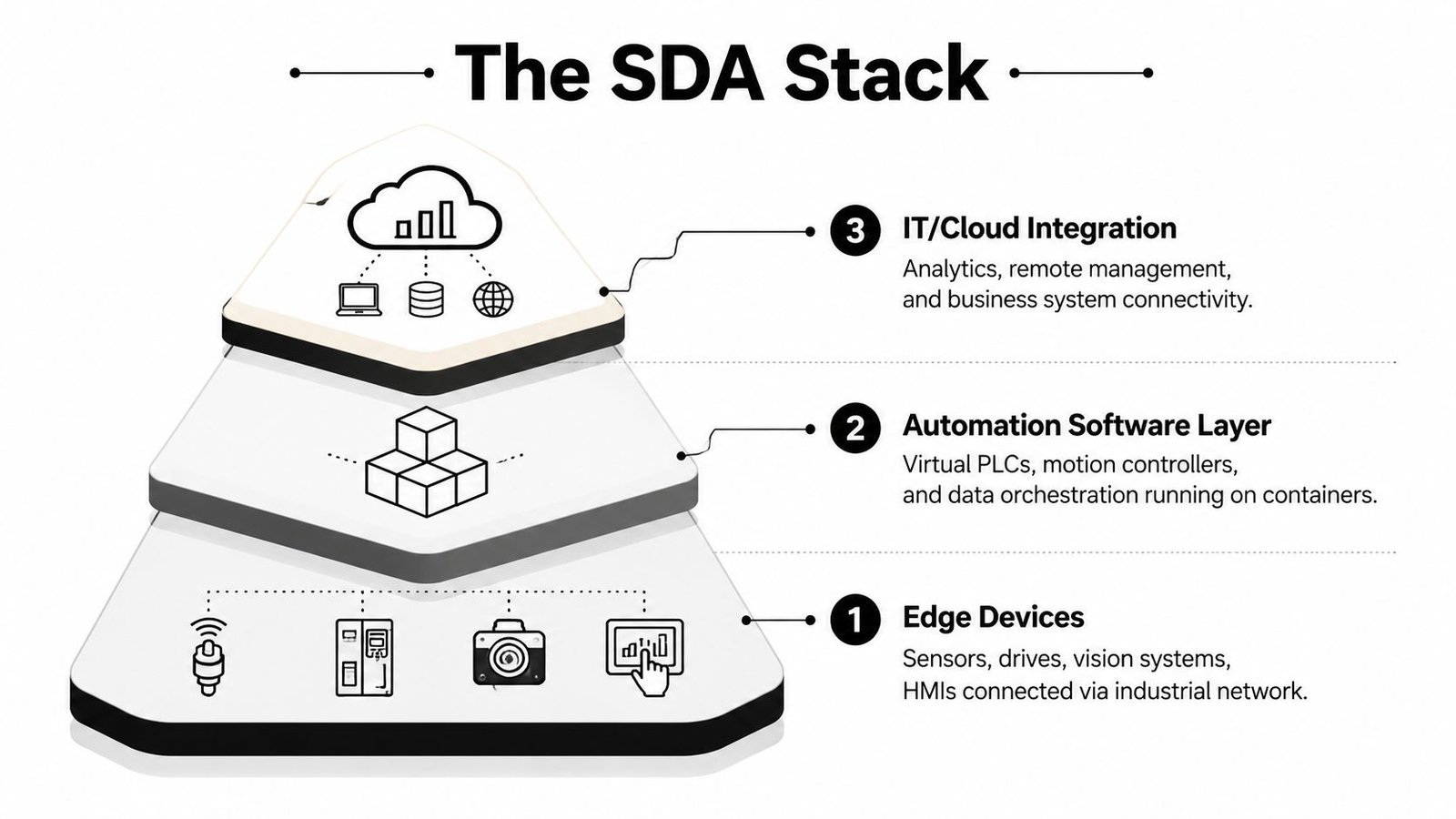
An SDA stack should be understandable to the people responsible for production, maintenance, quality, and cybersecurity. If the proposed architecture can't be explained from the sensor to the business system, it isn't ready for a purchase order.
Start at the edge
The edge includes sensors, drives, vision systems, actuators, and HMIs. These devices connect through industrial networks such as EtherCAT, PROFINET, or OPC UA. An edge gateway may collect signals from existing equipment, translate protocols, and provide a controlled connection to higher-level software without forcing the plant to replace every field device.
This layer is where physical events become usable machine data. A vision result, torque value, drive status, or operator command must arrive with enough context for the control system to act on it.
Keep deterministic control bounded
The deterministic control plane handles timing-sensitive sequences, motion, interlocks, and safety-rated logic. Depending on the risk assessment and design, that work may remain in PLCs or dedicated safety controllers.
SDA shouldn't blur the boundary between safety and convenience. A virtualized application can coordinate production, but the plant still needs defined safety functions, certified components where required, and independent verification of emergency stops, guards, and interlocks.
Run the SDA layer on managed compute
The SDA layer can use containerized control applications, container runtimes, and orchestration software on industrial servers or ruggedized compute. The platform should support versioning, staged rollout, health monitoring, and rollback. Those functions give engineers a controlled method for changing software rather than treating the live line as a development environment.
The plant may also use digital simulation or virtual commissioning before deployment. That can expose sequence problems earlier, but the team still has to validate the result against the physical machine.
Connect operations and enterprise systems
An MQTT or OPC UA broker can move structured data to MES, ERP, and historian systems. An API gateway can expose machine functions to plant-level software. A unified namespace can give teams a consistent way to find equipment, states, recipes, alarms, and production events.
The operations layer then turns that data into dashboards, recipe management, alarm views, and remote engineering tools. The value depends on naming discipline and data ownership, not on collecting every available tag.
A useful integration review should document each signal's source, meaning, frequency, owner, and permitted use. The hardware and software integration service context is especially relevant when existing machines use different protocols and control philosophies.
Practical Benefits That Matter on the Production Floor
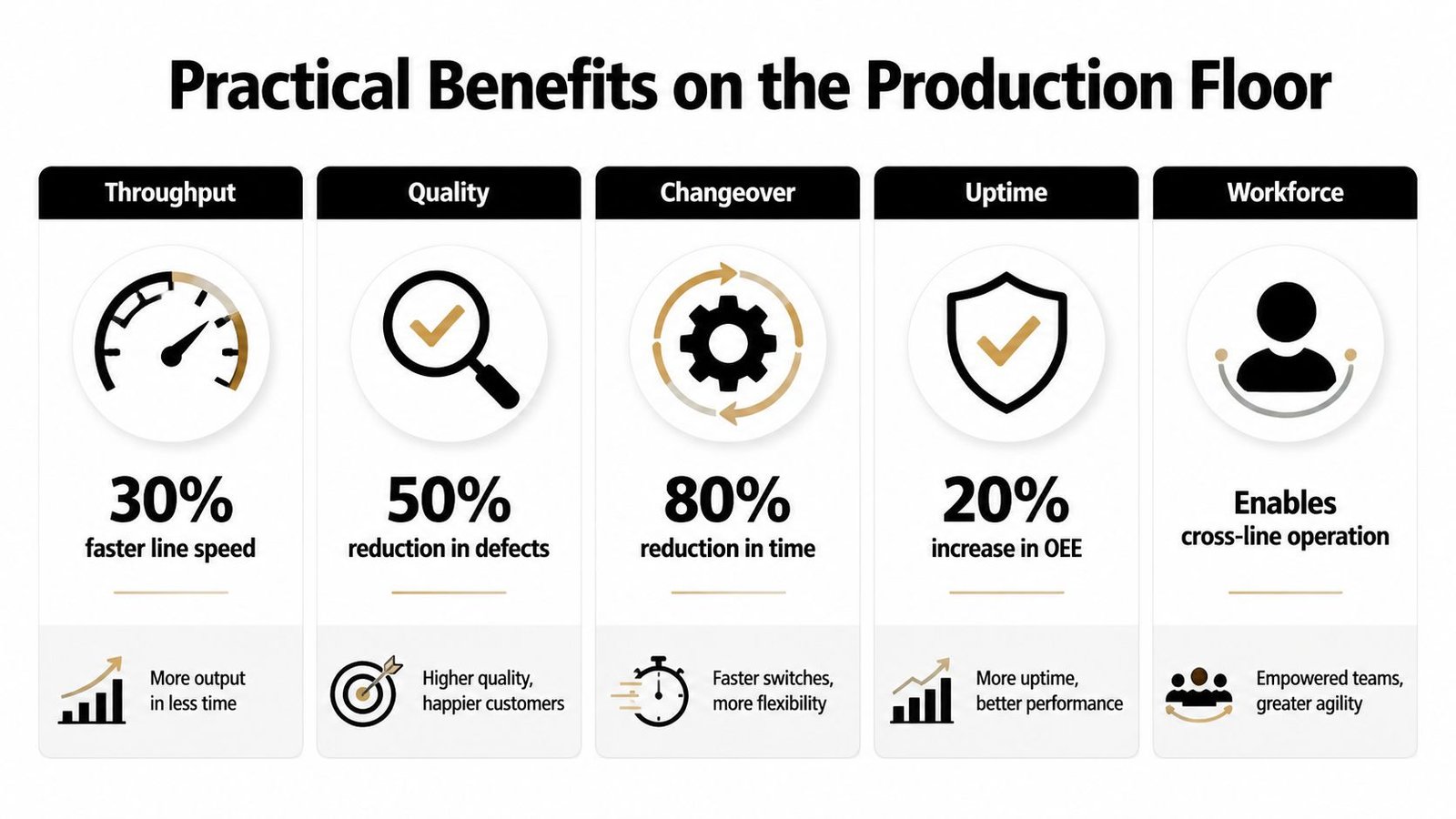
SDA earns its place by improving the measures already on the plant manager's dashboard. Throughput, quality, changeover, uptime, and workforce flexibility provide a better evaluation framework than a list of platform features.
Throughput and changeover
Centralized recipe management can reduce the number of manual steps required when a line moves between products. The plant manager should measure this through changeover duration, restart losses, operator interventions, and the engineering change-order cycle, not through a general claim about flexibility.
Virtual commissioning can also help engineering teams test line behaviour before introducing equipment or a new sequence. A shorter introduction cycle may improve time to production, but the project team must define what counts as ready, what conditions were simulated, and which physical tests remain mandatory.
Quality becomes more traceable
Soft sensors and data models can help the team identify process conditions associated with quality outcomes. A historian can connect machine states, inspection results, recipes, and operator actions, giving quality engineers a stronger basis for investigating first-pass yield and scrap.
That data doesn't replace calibrated inspection equipment or a validated quality process. It helps the team locate variation sooner and distinguish a process issue from a material, tooling, or equipment issue.
Uptime needs actionable signals
Condition-based monitoring can identify deteriorating equipment behaviour before it becomes an unplanned stop. The useful measures include unplanned downtime, mean time to repair, maintenance response, and the proportion of alarms that lead to a real intervention.
Pushing a software update without rewiring cabinets can also reduce the disruption associated with some changes. It won't eliminate planned downtime, testing, or line release procedures. It can reduce physical work when the change belongs in the software layer.
The right KPI question is simple: Which SDA capability changes a loss category you already track, and how will you prove that the loss changed?
Workforce flexibility
A governed software platform can make standard operating methods more repeatable across stations and lines. Engineers can spend less time recreating configurations and more time improving sequences, tooling, and process capability. Operators still need training, clear HMI design, and authority boundaries.
The industry perspective on SDA and industrial agility links the approach with flexibility, cost control, predictive maintenance, quality, and sustainability. Treat those as evaluation categories, not guaranteed outcomes. Your baseline data must show whether the proposed change affects OEE, scrap, downtime, or engineering workload.
A Realistic Implementation Roadmap With GMP and Safety in Mind
A semi-automated medical-device assembly line is a useful test case because production speed isn't the only acceptance criterion. The team must preserve traceability, documented procedures, validated operation, and functional safety while introducing a new software layer.
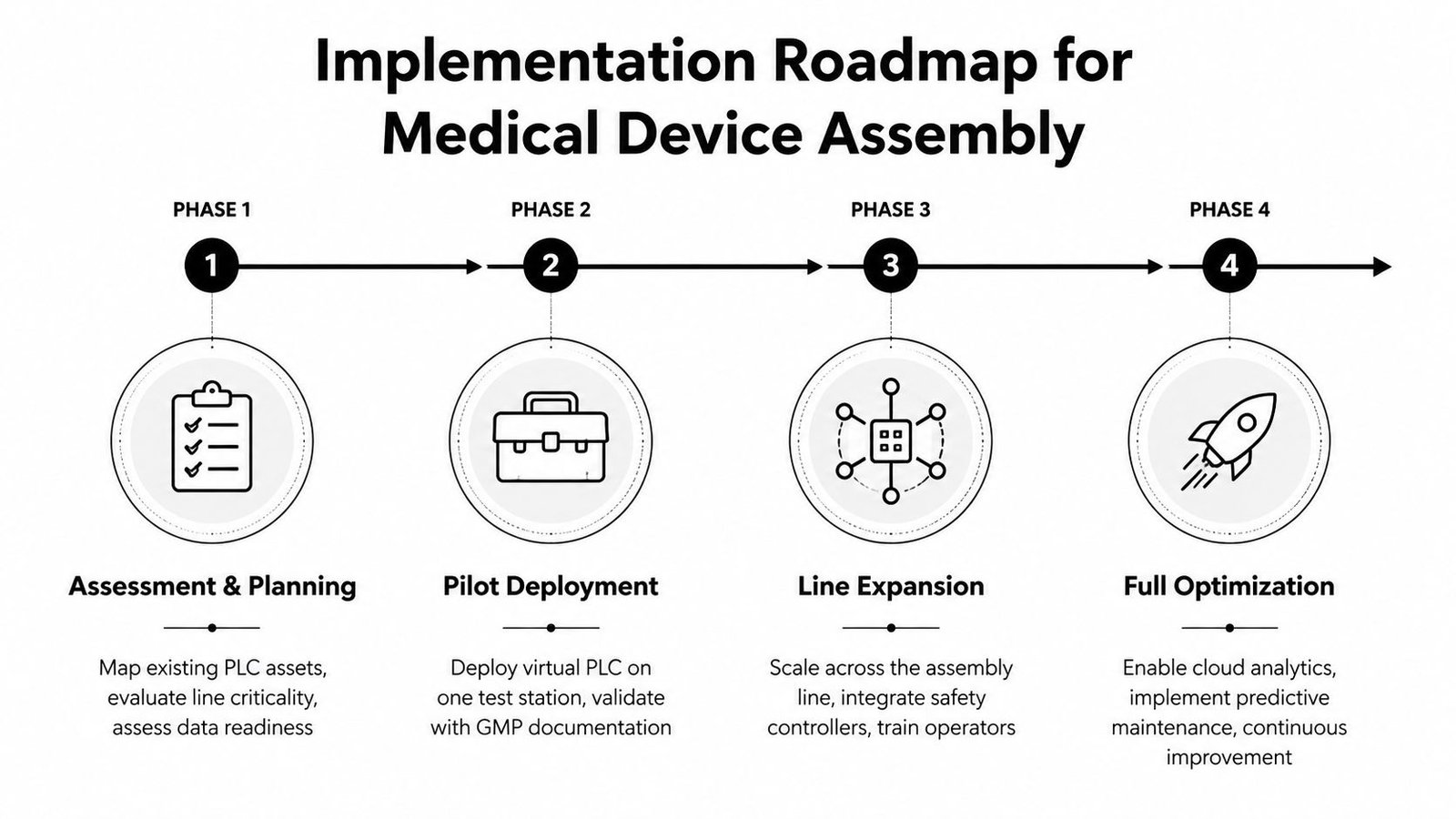
Phase one maps the real starting point
Begin with an asset and process assessment. Inventory existing PLCs, safety controllers, drives, HMIs, vision systems, fieldbus networks, machine interfaces, and historian connections. Record which stations affect product quality, which ones create the largest production constraint, and which assets have incomplete documentation.
The team should also assess data readiness. A tag that exists isn't automatically usable. Confirm its meaning, units, timestamp behaviour, source, and relationship to the product or batch record.
Functional safety starts here, not after the software design. Complete the hazard analysis, confirm the required safety integrity level classification where applicable, and define the separation between safety logic and non-safety control applications.
Phase two pilots away from product risk
Use a non-GMP auxiliary process for the first pilot where possible. A material handling station, test fixture, or utility process can validate edge controllers, connectivity, container runtime behaviour, historian integration, user access, and deployment workflows without placing a GMP-relevant product step at the center of the first experiment.
The pilot needs pass-fail criteria. Test data quality, recovery after a compute restart, loss of network connectivity, version rollback, alarm handling, user permissions, and operator response. Verify emergency-stop, interlock, and guard behaviours through documented testing.
Phase three migrates one GMP-relevant station
Once the platform works in the pilot, select a bounded production station. Build the validation plan before changing the control application. The documentation should address requirements, risk assessment, configuration, testing, deviations, approvals, and release.
For a regulated medical-device environment, the project may need electronic batch records, audit trails consistent with applicable electronic-record expectations, and a GAMP 5 review. The team must define how recipe changes are approved, how user actions are recorded, how data is retained, and how the system returns to a validated state after an update.
Quality and engineering should jointly review every change that affects a product characteristic, inspection step, or traceability record. Safety reviewers should confirm that the SDA layer hasn't altered the intended response of the safety system.
Phase four expands under control
After station acceptance, expand only where the architecture and procedures remain reusable. Train operators, maintenance technicians, controls engineers, and quality personnel on their specific responsibilities. Schedule cutover during a controlled window, keep a tested rollback path, and run hypercare with named owners for production, quality, safety, and support.
A manufacturing line doesn't become safer because its controls run on newer infrastructure. Safety comes from hazard analysis, certified functions, disciplined testing, and clear ownership.
ROI Signals, Market Context, and Honest Risks to Weigh
SDA has moved beyond architecture diagrams, but market growth does not establish a business case for your plant. One 2026 industry estimate valued the market at USD 46.63 billion in 2025, projected USD 54.09 billion in 2026, and forecast USD 112.5 billion by 2036, implying a 16.0% CAGR. See the 2026 software-defined automation market estimate for those figures. A separate industry analysis also describes strong projected growth, but differing definitions make direct comparisons unreliable.
Build your plant-level case from losses you can measure: engineering hours, changeover delays, scrap, unplanned stops, spare hardware, contractor dependence, and retraining. For a retrofit, compare the cost of adding an SDA layer with the cost and risk of replacing usable controls. For a greenfield line, compare platform standardization and commissioning effort with a conventional design.
Set an ROI range from your baseline, not from a vendor template. Verified market data does not establish a universal retrofit or greenfield payback period, so treat any fixed-return promise without site-specific evidence cautiously.
| Dimension | Positive Signal | Watch-Out Risk |
|---|---|---|
| Market direction | Industry estimates describe strong projected growth | Market growth does not equal plant-level ROI |
| Lifecycle cost | Standard compute and software updates may reduce proprietary hardware and maintenance dependence, as discussed in this industry analysis of software-defined industrial automation | Subscription, support, migration, and validation costs can offset savings |
| Engineering effort | Versioning, reuse, and centralized deployment can reduce repetitive work | Poor governance can spread a bad change faster |
| Cybersecurity | Managed updates can make patching more practical | More connected assets increase the attack surface |
| Workforce | IT and controls teams can share clearer deployment workflows | Convergence creates a skills gap if ownership is unclear |
| Regulation | Audit trails and controlled changes can support traceability | GMP re-validation can add significant project work |
| Legacy equipment | Edge gateways can connect existing fieldbus and PLC assets | Integration debt can make data inconsistent or incomplete |
Mitigate each risk before signing. Require network segmentation and access controls. Define who owns the runtime, document a migration path away from incumbent PLCs, involve quality early, and test legacy interfaces on a production-representative station. Require the vendor to show how the proposed design affects GMP records, safety boundaries, maintenance work, and rollback. If the team cannot connect the expected benefit to throughput, changeover, scrap, downtime, or engineering effort, the proposal is not ready for approval.
What to Do Next as an Operations Manager
Use the next 90 days to test the business case rather than buy a platform.
During the first week, pull throughput, changeover, and downtime data from Line A and Line B. Identify the two largest bottlenecks and establish the current baseline for OEE, changeover, scrap, and engineering intervention. Don't accept a proposal that can't connect its expected benefit to one of those measures.
In weeks two through four, run a vendor-neutral review of two options: replacing selected PLCs, or adding SDA above existing PLCs. Map both options against GMP documentation, functional-safety requirements, cybersecurity controls, maintenance capability, and the condition of the legacy fieldbus.
Weeks five through eight should focus on one non-critical station. Define pass-fail criteria for connectivity, historian data, deployment, rollback, operator usability, recovery, and safety verification. Use the remaining weeks to convert the findings into a board-ready business case with phased rollout costs, responsibilities, assumptions, and a live risk register.
Choose an integration partner that can show regulated-industry references, provide lifecycle support, document safety and validation work, and commit to a credible migration path off incumbent PLCs. System Engineering & Automation offers custom automation, integrated controls, tooling, fixtures, and semi-automated equipment, with support from concept and design through commissioning and ongoing service.
If your plant needs a clear retrofit-versus-replacement decision, System Engineering & Automation can help assess the line, define a practical SDA scope, and connect the automation plan to production, GMP, safety, and service requirements. Contact SEA to schedule an assessment of one workstation or a complete production line.