
A line that runs well enough on paper can still fall apart on second shift. An operator calls out. Parts arrive with a little more oil than usual. A tray jams. Inspection starts catching orientation errors that nobody saw during the trial run. If you're the person responsible for output, quality, and labor coverage, you don't need abstract talk about transformation. You need equipment that feeds parts consistently, handles variation without constant babysitting, and fits the budget you have.
That’s where companies like spectrum automation co enter the conversation. For many manufacturers, the right move isn’t a massive lights-out automation project. It’s a focused upgrade that removes a bottleneck, reduces manual handling, and stabilizes one weak point at a time. If you're evaluating custom feeding, orienting, or semi-automated material handling, Spectrum belongs on the shortlist.
This guide looks at Spectrum the way a manufacturing engineer would. Not as a brand story, but as a practical option. The key question isn't whether automation is good. It's whether Spectrum's mechanical specialization matches your production problem better than a broader integrator or a more standardized machine builder.
Table of Contents
- Your Guide to Optimizing Production with Automation
- Who Is Spectrum Automation Co
- An Inside Look at Core Capabilities and Solutions
- The Typical Spectrum Automation Project Lifecycle
- Measuring the Impact on Your Production Line
- Is Spectrum the Right Fit for Your Automation Needs
- Frequently Asked Questions About Spectrum Automation
Your Guide to Optimizing Production with Automation
Most automation projects start with a very ordinary problem. A manual station keeps pace when demand is steady, then becomes the constraint the moment volume rises or staffing gets tight. Operators compensate with workarounds. Quality drifts. Supervisors spend their day moving people around instead of fixing the root cause.
In that situation, full-line automation often isn't the first answer. A more realistic fix is targeted automation around feeding, orienting, loading, transfer, or simple assembly support. That approach is usually easier to justify because it attacks a visible bottleneck without forcing a complete process rewrite. Manufacturers of every size are moving in that direction, especially those exploring manufacturing process automation for every business size.
Spectrum Automation Co fits that middle ground well. Its niche is not general factory software or broad digital transformation consulting. Its value is more concrete. The company focuses on custom parts feeding and material handling equipment that helps production teams get parts where they need to go, in the right orientation, at a repeatable rate.
Practical rule: If your line problem starts with “we can’t feed or present the part consistently,” a specialized mechanical automation partner is often more useful than a broad strategy consultant.
That matters because many production issues are upstream issues in disguise. Vision systems don’t perform well if the part arrives inconsistently. Assembly stations struggle if operators spend too much time sorting or presenting components. Even a simple conveyor or feeder change can stabilize an entire downstream process.
The buying decision is less about whether to automate and more about scope. Do you need a custom feeder, orientor, or semi-automated handling system that solves one hard problem well? Or do you need a partner to architect controls, robotics, software, and line integration across multiple cells? Spectrum is strongest in the first category.
Who Is Spectrum Automation Co
A common buying scenario looks like this. A line runs well enough until one part starts arriving crooked, nested, or upside down. Operators compensate for a while. Scrap rises, cycle time slips, and the team starts debating whether the answer is a custom feeder, a robot cell, or a broader rebuild.
Spectrum Automation Company sits in that decision point. The company is a US manufacturer focused on custom parts feeding and material handling equipment. It was founded in 1969 in Livonia, Michigan and serves markets that include automotive, medical devices, food and beverage, aerospace, farm implement, fastener, hardware, and munitions, according to its company profile.
For buyers, the practical question is fit. Spectrum is best viewed as a specialist builder for part presentation, orientation, and semi-automated handling. That specialization matters because these projects usually fail on mechanical details, not on slide-deck strategy. Bowl geometry, track design, discharge consistency, jam access, changeover effort, and cleanability determine whether a system holds rate for months or turns into an operator-managed workaround.
Spectrum’s range is broad inside that niche. The company builds:
- Small parts feeders for compact, repeatable component presentation
- Rod feeders for elongated parts that are awkward to orient manually
- Conveyors that move parts between process steps
- Lazy Susan feeders for bulk part presentation
- Large parts feeders for heavier or higher-volume applications
- Magnetic feeders where magnetic handling fits the application
- Floorbin elevators with orientors for bulk storage and elevation
- Parts assembly units for semi-automated assembly support
- Orienting systems tied to downstream manufacturing requirements
That list points to a clear boundary. Spectrum appears strongest when the production problem is narrow, physical, and repeatable. If the need is a feeder, orientor, or semi-automated module that has to present parts at a stable rate, they are in their element. If the project also requires plant-wide controls architecture, multi-robot coordination, MES connections, or major line reconfiguration, buyers should also compare broader integrators with stronger automation control systems expertise.
There is also a naming issue worth screening early in vendor research. Spectrum Automation Pty is a separate Australian company. If you're sourcing a North American parts feeding solution, confirm that the proposal, references, and service footprint all point to the Livonia, Michigan business. That simple check avoids confusion during quoting, support planning, and reference calls.
An Inside Look at Core Capabilities and Solutions
A feeding system earns its keep when the downstream machine stops waiting for parts. That is the lens to use with Spectrum. Their published offering points to a company that is strongest in narrowly defined part presentation problems, especially where the part has to be singulated, oriented, and delivered at a steady rate without excessive handling.
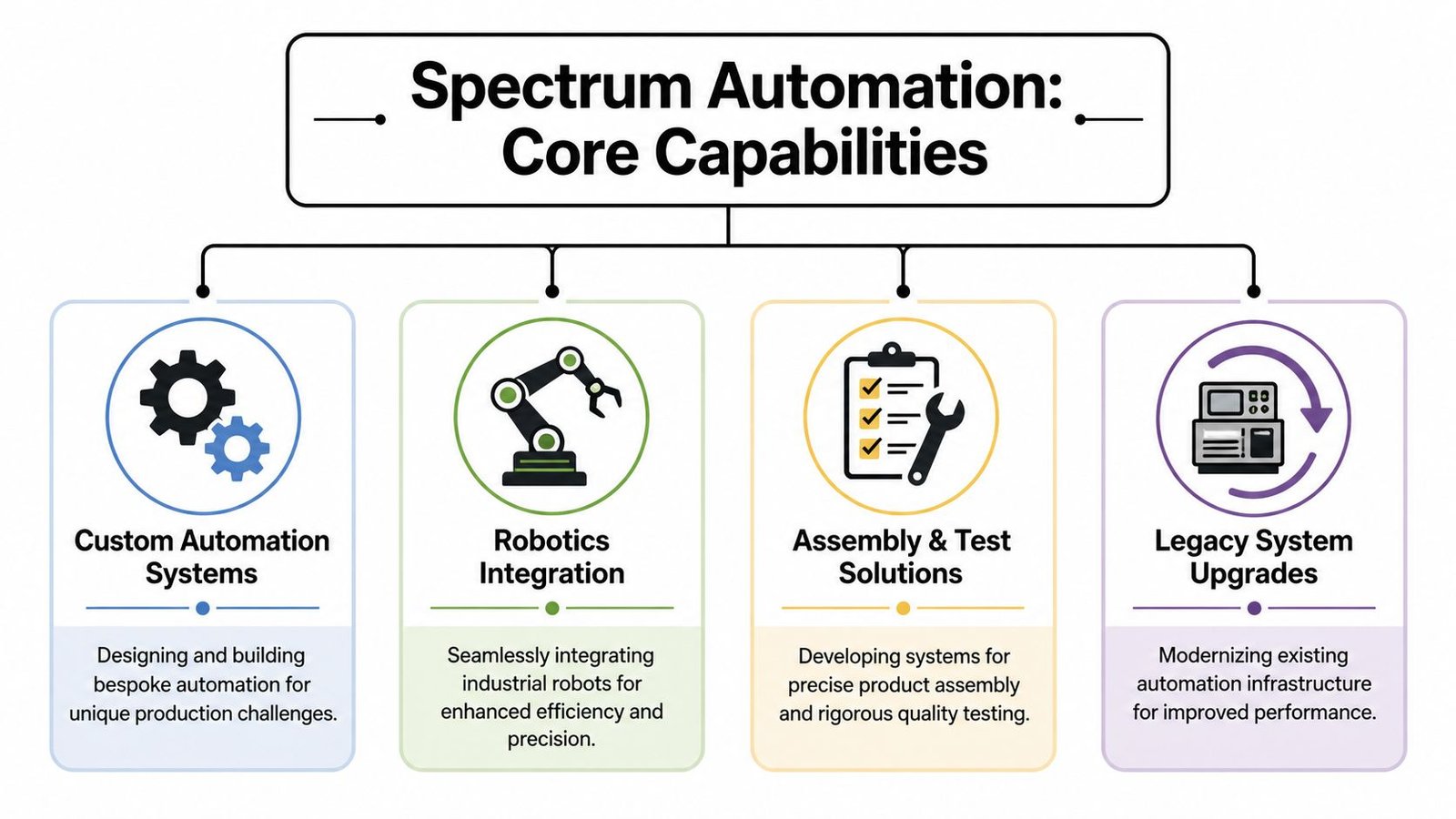
That makes Spectrum a good fit for a specific slice of automation work. It is less about full-line transformation and more about solving the stubborn mechanical problem in front of a press, assembly station, test cell, or packaging machine. If a buyer also needs plant-wide PLC standards, multi-cell coordination, or broader line integration, the controls side deserves separate scrutiny alongside the automation control systems architecture that will support the equipment.
Vibratory parts feeders and BRUSHLON technology
Spectrum’s clearest point of differentiation is BRUSHLON® Technology, described on Spectrum’s parts feeding page as a directional bristle surface used to move parts with less mechanical aggression than a conventional vibratory approach.
That matters for parts that mark easily, bounce unpredictably, or create noise issues in operator-facing areas. In those cases, gentler motion is not a marketing feature. It can reduce jams, cut cosmetic damage, and make orientation more stable before the part reaches the tooling.
The trade-off is straightforward. A softer conveying surface helps with part care, but it also puts more pressure on housekeeping and application testing. Dirt, fines, or oily residue can change how parts track across the surface. For clean stamped parts, molded components, or light assemblies, that may be manageable. For dirty bulk parts, it needs validation before purchase.
BRUSHLON makes the most sense where standard bowl feeding is technically possible, but too rough, too loud, or too inconsistent for the part and the process.
Floorbin elevators and orienting systems
Spectrum also appears well positioned for applications that start with bulk part storage and end with a controlled handoff to the next machine. Floorbin elevators and orienting equipment address a common bottleneck. The process upstream is simple, but the operator time required to keep parts flowing is not.
This category usually pays off when labor is tied up doing repetitive loading and sorting, or when the downstream station cycles faster than manual presentation can support. In those situations, consistency matters as much as speed. A line that starves twice an hour can lose more output than a slightly slower but stable feed system.
The main selection issue is part behavior. Bulk metal parts with oil, scale, or mixed orientation can act very differently than clean, uniform components during testing. Buyers should focus less on the concept drawing and more on how the actual parts move, separate, and recover from misfeeds.
| Application need | Likely fit | Watch-outs |
|---|---|---|
| Bulk metal parts with variable condition | Floorbin elevator with heavy-duty orienting stage | Test for oily or rusty part behavior |
| Delicate components | Static gravity orienting approach | Lower aggression can mean more application-specific tuning |
| High output lines | Vibratory orienting path | Requires stable downstream demand and good accumulation control |
| Limited floor access for operators | Elevated bin feed strategy | Confirm maintenance access and refill ergonomics |
Where these systems fit best is clear. They solve localized material handling waste on otherwise capable lines. They are less likely to be the right answer if the bigger problem is controls fragmentation, poor line balance, or a process that still changes every quarter.
Custom tooling controls and application fit
Spectrum’s custom-build model is a strength if the application is well defined. It is less forgiving if the customer is still sorting out part variation, changeover strategy, or true rate requirements.
That is a normal trade-off with specialized machine builders. Custom tooling gives better control over discharge height, orientation method, noise management, and footprint. It also means the result depends heavily on the quality of the inputs provided at the quoting stage.
Buyers should come prepared with real production data, not estimates pulled from memory:
- Part prints and representative samples
- Required sustained production rate
- Orientation and presentation requirements at discharge
- Available floor space and operator access limits
- Cleanliness, noise, or part-finish constraints
- Expected changeover frequency and part-family range
If those variables are stable, Spectrum’s approach can be a strong fit. If the scope keeps expanding into robotics, software layers, multiple machine interfaces, and future product families, a broader integrator may offer more flexibility over the life of the line.
The Typical Spectrum Automation Project Lifecycle
A custom feeding project usually succeeds or fails long before the machine is built. The early conversations determine whether the vendor understands the part, the process, and the source of the bottleneck. With Spectrum, the project path appears to follow a classic custom machine model from concept through build, testing, and delivery.

What the first conversation should cover
A good initial discussion is not a sales call. It should feel more like a process review. Spectrum’s published materials emphasize custom design, pre-delivery testing, and support from concept to execution. That only works if the customer provides enough application detail early.
Bring these items into the first technical review:
- Part samples and prints. Feeding systems live or die on actual part behavior.
- Target production rate. The machine has to support the line, not just run well in isolation.
- Orientation requirements. “Mostly correct” is useless if the downstream station needs precise presentation.
- Available space and discharge constraints. Height, lane count, and operator access matter.
- Part condition. Oily, rusty, polished, fragile, and lightweight parts behave very differently.
Teams that skip this prep tend to get slower quoting, more assumptions, and more redesign later.
From concept through build and testing
Once the application is defined, the practical flow is straightforward. Spectrum’s materials point to a process that includes design, fabrication, quality control, and pre-delivery testing. For buyers, that means the machine should be evaluated before shipment against the conditions that matter in production, not just whether motors turn on.
If you're buying custom automation, strong factory acceptance tests are part of the project, not a final formality. A feeder or orientor should be challenged with realistic part samples, normal variation, startup and stop conditions, and expected operator interactions.
Here’s a product video that helps show the type of equipment category involved:
A sound project lifecycle usually includes these checkpoints:
- Concept alignment: Agreement on the actual production problem being solved
- Application-driven design: Mechanical layout built around the part and presentation requirement
- Build and internal verification: Fabrication plus functional checks before customer review
- Pre-delivery testing: Running the machine with representative parts and expected conditions
- Installation and commissioning: Final adjustment in the plant where utilities, operators, and upstream variation all come into play
The best custom equipment vendors don't just ask for a cycle rate. They ask what the part looks like after it sits in a bin for a shift, gets oily, and arrives with mixed surface conditions.
That’s the right standard to apply.
Measuring the Impact on Your Production Line
The critical test starts after installation, when the line runs for a full shift and operators stop babysitting the infeed. That is where a feeding system either removes a constraint or becomes one more piece of equipment that needs attention.
Spectrum’s impact is usually easiest to measure at the line level, not the machine level. A custom feeder or floorbin elevator may sit upstream, but it changes how often downstream stations wait, how much operator time gets pulled into support work, and how often bad part presentation turns into scrap, rework, or nuisance stops. For buyers comparing Spectrum with a broader automation integrator, that distinction matters. Spectrum’s value tends to come from fixing a narrow mechanical problem well, rather than redesigning the whole process around controls, robotics, and plant-wide integration.
Where throughput gains usually show up
The clearest gains come from applications where part presentation is already the bottleneck. If a downstream machine is capable of running faster but keeps starving, pausing for reorientation, or recovering from misfeeds, a better infeed can raise effective output without changing the core process.
That shows up in a few predictable places:
| Operational change | What it affects |
|---|---|
| More consistent part presentation | Fewer short stops at the next station |
| Less manual loading | Lower dependence on operator attention |
| Better orientation control | Fewer bad entries that create scrap or rework |
| More stable infeed | More reliable cycle planning for downstream equipment |
The trade-off is straightforward. If the line is already slow, heavily attended, or buffered with plenty of idle time, the throughput gain may be modest. If the line loses production because parts arrive inconsistently, a mechanical feeding upgrade can pay back faster than a larger automation project.
Labor, quality, and safety often justify the project first
In many plants, labor savings are easier to verify than headline cycle time gains. Manual loading and hand-sorting consume operator time in small increments, which is why they often escape formal review. Over a shift, those interruptions add up. Operators leave their primary task, the infeed drifts, and minor shortages turn into short stoppages.
Safety deserves the same attention. Repetitive loading from bins, awkward reaches, and constant interaction with a temperamental feeder create ergonomic risk long before anyone logs an incident.
Quality improvements depend on the part. Delicate, cosmetic, or hard-to-orient components benefit most from controlled presentation and gentler handling. In those cases, the right feeder does more than keep parts flowing. It reduces the variation introduced before the product ever reaches the next process step.
A practical way to evaluate impact
I would not judge a Spectrum-style system on cycle rate alone. The better approach is to look at the current losses the feeder is causing or failing to prevent.
Use questions like these:
- How often does downstream equipment wait for parts, even though the machine itself is ready to run?
- How much operator time goes into loading, sorting, or correcting orientation by hand?
- Are recurring jams or misfeeds driving short stoppages that never show up as major downtime events?
- Does the current method mark, scratch, or mishandle parts before the value-added process begins?
- Would a stable infeed remove enough variation to let existing automation run closer to its intended rate?
If the answer is yes to several of those, Spectrum may be a good fit because the problem is mechanical and local. If the bigger issue is line controls, data collection, robot integration, recipe management, or coordination across multiple stations, a full-service integrator may create more value even if the initial price is higher.
That is the decision framework that matters. Spectrum fits best when better part handling solves the production loss. It fits less well when the feeder is only one piece of a broader automation gap.
Is Spectrum the Right Fit for Your Automation Needs
Buyers must be honest about project scope. Spectrum looks strongest when the job is mechanically centered. Feed the part, orient it, lift it, present it correctly, and support a semi-automated process with custom hardware. If that’s your core issue, a specialist can be the right call.
When Spectrum is a strong fit
Spectrum is a sensible option when your project looks like one of these:
- A chronic feeding bottleneck: Parts don't arrive consistently, and that instability hurts the rest of the line.
- Delicate part handling needs: Conventional feeders are too aggressive, too noisy, or too rough on the part.
- Bulk-to-oriented presentation: You need floor-level storage lifted and organized into a usable infeed.
- Custom mechanical problem solving: Off-the-shelf equipment won’t handle the geometry, finish, or orientation requirement.
- Semi-automated production strategy: You want a targeted machine that improves one section of the process without rebuilding the whole line.
The company’s long specialization supports that position. A vendor that has spent decades around feeders, orientors, conveyors, and part presentation usually sees practical issues early.
When a broader integrator may be the better choice
The limit is not capability in mechanical equipment. The limit is scope breadth.
Spectrum’s public materials lack detail on Industry 4.0 integration, which matters because 70% of manufacturers plan IoT adoption by 2026 to reduce downtime, according to the verified industry-gap summary tied to Spectrum’s public website review. That doesn’t mean Spectrum can’t participate in a connected system. It means buyers shouldn’t assume deep MES, ERP, predictive maintenance, or plantwide data integration without asking direct questions.
That distinction matters in projects like these:
- Multi-cell line integration
- Robotics plus vision plus traceability
- Advanced data collection and downtime analytics
- Cross-line recipe management
- Enterprise software connectivity
For those jobs, a broader system integrator may fit better because the project is no longer mainly about feeding hardware. It’s about how several technologies work together.
If the machine is the project, a specialist is often enough. If the machine is only one node in a larger digital production architecture, you usually need a partner with wider integration depth.
Budget also affects the decision. Small to mid-sized manufacturers often get better value from a focused semi-automated project than from an oversized fully integrated solution. But if you already know the future state includes data collection, smart controls, robotics, and plantwide coordination, it’s smarter to choose a partner who can design for that from day one.
Frequently Asked Questions About Spectrum Automation
Does Spectrum build full turnkey production lines
Spectrum reads like a focused automation supplier, not a broad line builder. The strongest fit is a custom subsystem where the production problem starts with part feeding, orienting, lifting, or presenting parts consistently to the next step.
That focus can be a real advantage. Plants do not always need a large integration firm if the bottleneck is one unstable manual or mechanical handoff. They need a feeder or handling system that runs reliably, fits the part geometry, and holds up in daily production.
For larger projects, define scope early. If the job includes upstream and downstream equipment, controls across several machines, plant data connectivity, or validation-heavy documentation, ask which portions Spectrum will handle directly and where another integrator may need to step in.
Is Spectrum suitable for medical or GMP-aware environments
It can be, if the machine is specified and built for that use case. Spectrum’s public materials point to work involving medical parts and applications where gentle handling, low noise, and controlled presentation matter.
That is a reasonable starting point, not a qualification by itself.
For medical or GMP-aware projects, buyers should press into the details before design approval. Ask about contact materials, cleanability, fastener and frame design, guarding access, change-parts, maintenance points, and how the system handles rejected or misoriented parts. Those decisions usually determine whether a machine works well on a regulated floor, not the category label on the proposal.
Is Spectrum Automation Pty the same company
No. Spectrum Automation Pty is a separate Australian business, as noted earlier in the article.
That distinction matters because search results can mix the names. If you are reviewing Spectrum Automation Co in Livonia, Michigan, confirm you are looking at the correct company, the correct product line, and the correct project history before comparing capabilities.
What should you prepare before contacting a vendor
A good automation quote starts with good production information. For a feeder, orientor, or custom handling system, send the material that answers how the part behaves, not just what it looks like on paper.
Prepare these items before the first serious discussion:
- Part samples: Actual parts show burrs, flash, oil, surface variation, and nested behavior that CAD files often miss.
- Prints and tolerances: Feeding performance depends on real dimensional spread, not nominal geometry.
- Rate requirements: Define target throughput, accumulation expectations, and acceptable downtime.
- Required orientation: State exactly how the part must exit the system and how consistent that presentation must be.
- Plant constraints: Include footprint limits, utility availability, discharge height, guarding requirements, and operator access.
- Process conditions: Call out contamination, fragility, part marking concerns, washdown needs, and changeover frequency.
This prep shortens the quoting cycle and improves the design conversation. It also makes it easier to tell whether a specialist like Spectrum is the right fit, or whether the project has grown into a broader integration job.
If you're weighing a custom semi-automated machine, a feeder upgrade, or a broader production optimization project, System Engineering & Automation helps manufacturers choose the right level of automation for their goals and budget. SEA delivers practical engineering support from concept through commissioning, with GMP-aware experience, custom tooling, integrated controls, and solutions designed to improve safety, quality, and throughput without overbuilding the system.