You're probably looking at a line that already runs hard, but not hard enough. Output is decent. Scrap is under control most days. Operators know the job. Yet the same issues keep capping performance: handling takes too long, setups eat into scheduled time, and small process variations turn into rework, downtime, or missed targets.
That's the reality of low mix high volume manufacturing. It looks simple from the outside because you're making a narrow product range at scale. In practice, it only works well when the process is disciplined, repeatable, and engineered around the product instead of patched together around yesterday's problems.
The mistake many plants make is assuming the only path forward is full automation. It isn't. In many LMHV environments, the better move is targeted improvement through semi-automation, custom tooling, and fixtures that remove friction where it actually hurts.
Table of Contents
- What Low Mix High Volume Manufacturing Really Means
- The Strategic Benefits and Inherent Challenges
- Smart Automation Strategies for LMHV Production
- A Practical Roadmap for Implementing LMHV Systems
- GMP Considerations for Medical Device Manufacturers
- Measuring Success and Calculating ROI
What Low Mix High Volume Manufacturing Really Means
The line tells you what the strategy is
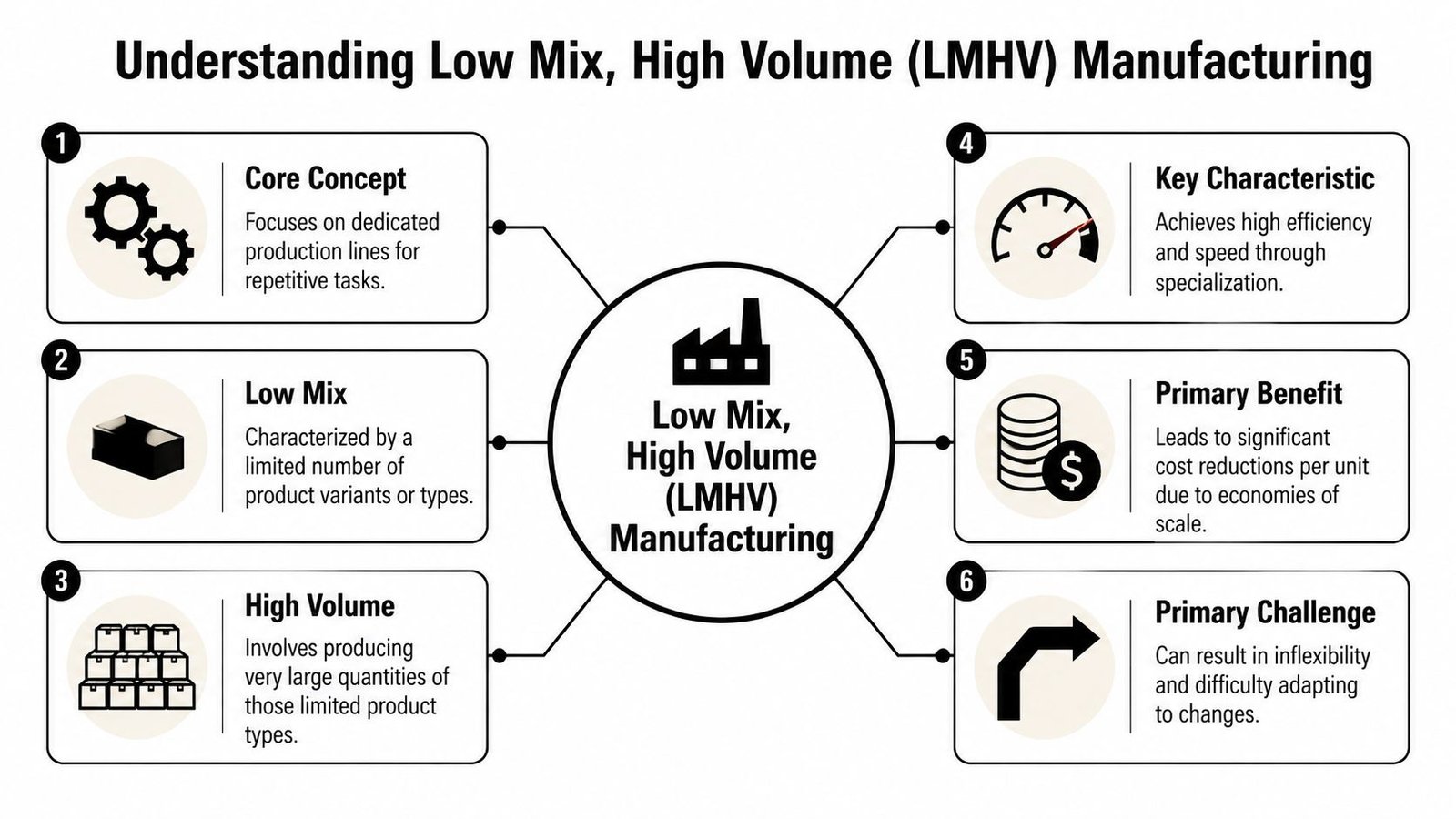
Low mix high volume manufacturing usually shows up as a dedicated line. The product family is narrow, the process sequence is stable, and the goal is to produce the same thing over and over with as little variation as possible. You're not chasing flexibility first. You're chasing consistency, throughput, and cost control.
That's why LMHV is better understood as an operating philosophy than a label. You design the line around repetition. You standardize work, reduce touches, simplify material flow, and remove anything that interrupts output. The closer the process gets to a repeatable rhythm, the more value the model creates.
A useful way to think about it is a specialized kitchen. A kitchen that makes one dish all day will lay out tools, ingredients, motion, and timing very differently than one that serves a broad menu. Manufacturing works the same way. Once variety goes down, the opportunity to optimize each step goes up.
Why repetition matters more than raw speed
Plants often describe low mix high volume as “high-speed production,” but speed alone misses the point. A fast line with unstable fixturing, inconsistent feeding, or awkward operator motions won't stay efficient for long. LMHV works because repetition makes optimization practical.
According to VKS on low mix high volume manufacturing, LMHV operations can achieve 40 to 60% production efficiency gains through highly optimized and repeatable processes compared to manual or semi-automated alternatives. The same source notes that high-volume manufacturers also gain advantages through bulk purchasing power, which lowers per-unit cost when raw materials are bought at scale.
Practical rule: If the product stays stable, invest in the workholding, material presentation, and control logic before you chase headline automation.
That's where many operations find the next level. Not with an immediate jump to a fully automated cell, but with engineering that tightens the process around the actual part. A guided nest, a poka-yoke fixture, a quick clamp, a sensor check, or an indexed semi-automatic station can do more for line stability than an expensive machine added in the wrong place.
Low mix high volume also doesn't mean zero need for flexibility. It means controlled flexibility. Most lines still need maintenance access, operator intervention points, and a way to absorb small product revisions without rebuilding everything. That's why many manufacturers evaluate LMHV lines against more adaptable concepts such as flexible manufacturing systems when deciding how rigid the process should become.
A strong LMHV operation has a simple signature:
- Few product variants: The line is tuned for a narrow range of parts or assemblies.
- Repeatable task sequence: Operators and machines perform the same motions with little variation.
- Stable tooling and setup: The process depends on consistency more than frequent adjustment.
- Cost focus: Unit economics improve when output stays high and interruptions stay low.
If your line depends on tribal knowledge, frequent hand adjustments, or operator workarounds, you may have volume, but you don't yet have a true low mix high volume system.
The Strategic Benefits and Inherent Challenges
Where LMHV creates real advantage
The appeal of LMHV is straightforward. If demand is steady and the product doesn't change often, specialization usually wins. You can dedicate floor space, tooling, labor, and controls to a narrower mission. That lowers complexity in daily production and makes process discipline easier to hold.
The strongest benefits usually show up in three areas.
- Lower unit cost: Standardized production lets you spread setup effort, engineering time, and equipment use across a large number of units.
- More consistent quality: Repetition exposes process drift faster. It's easier to control a line when the same steps repeat every cycle.
- Simpler training: When stations are purpose-built and work instructions are stable, operators ramp faster and variance between shifts tends to shrink.
You also gain predictability. Supervisors can schedule around a known process. Maintenance can stock the right wear items. Quality teams can focus on a narrower set of critical characteristics instead of managing constant product change.

A dedicated line pays you back when demand is stable enough to let the process mature.
That maturity matters. A line that runs the same product family long enough develops stronger standard work, better fixture design, cleaner troubleshooting, and fewer surprises during the shift.
Where the model starts pushing back
The trade-off is rigidity. A line built for a narrow range of products won't welcome product variation, short runs, or frequent engineering changes. The same specialization that drives cost down can make the plant slower to respond when customer demand changes.
That's why the strategic pressure on LMHV has increased. UHY's discussion of the shift toward high-mix low-volume manufacturing notes that growing demand for customization is pushing manufacturers away from traditional LMHV models toward more flexible HMLV strategies. The same source highlights the main weakness of LMHV: limited responsiveness to fragmented demand.
On the floor, that challenge shows up in familiar ways:
| Challenge | What it looks like in practice | Why it matters |
|---|---|---|
| Inflexibility | Product revisions require tooling changes, control updates, or layout changes | Response time slows when demand shifts |
| Capital concentration | Dedicated equipment serves a narrow process window | Risk goes up if volume assumptions change |
| Maintenance sensitivity | A single constrained asset can hold up the whole line | Throughput falls fast when uptime slips |
| Painful transitions | Setup, cleaning, and line adjustments interrupt output | Planned capacity disappears into non-productive time |
The worst response is pretending these are minor issues. They're structural. You don't eliminate them by asking operators to “work faster” or by adding labor to a process that was designed around narrow repeatability.
What does work is accepting the trade-off early and engineering around it. If the line is going to stay dedicated, then maintenance access, quick adjustments, modular tooling, and sensible operator interfaces need to be part of the design from the start.
Smart Automation Strategies for LMHV Production
Fix the bottleneck, not the entire factory
Most LMHV lines don't need a blank-check automation project. They need the right intervention in the right spot. That might be part presentation, a clamping method, an inspection step, a press cycle, or an unload motion that operators perform hundreds or thousands of times per shift.
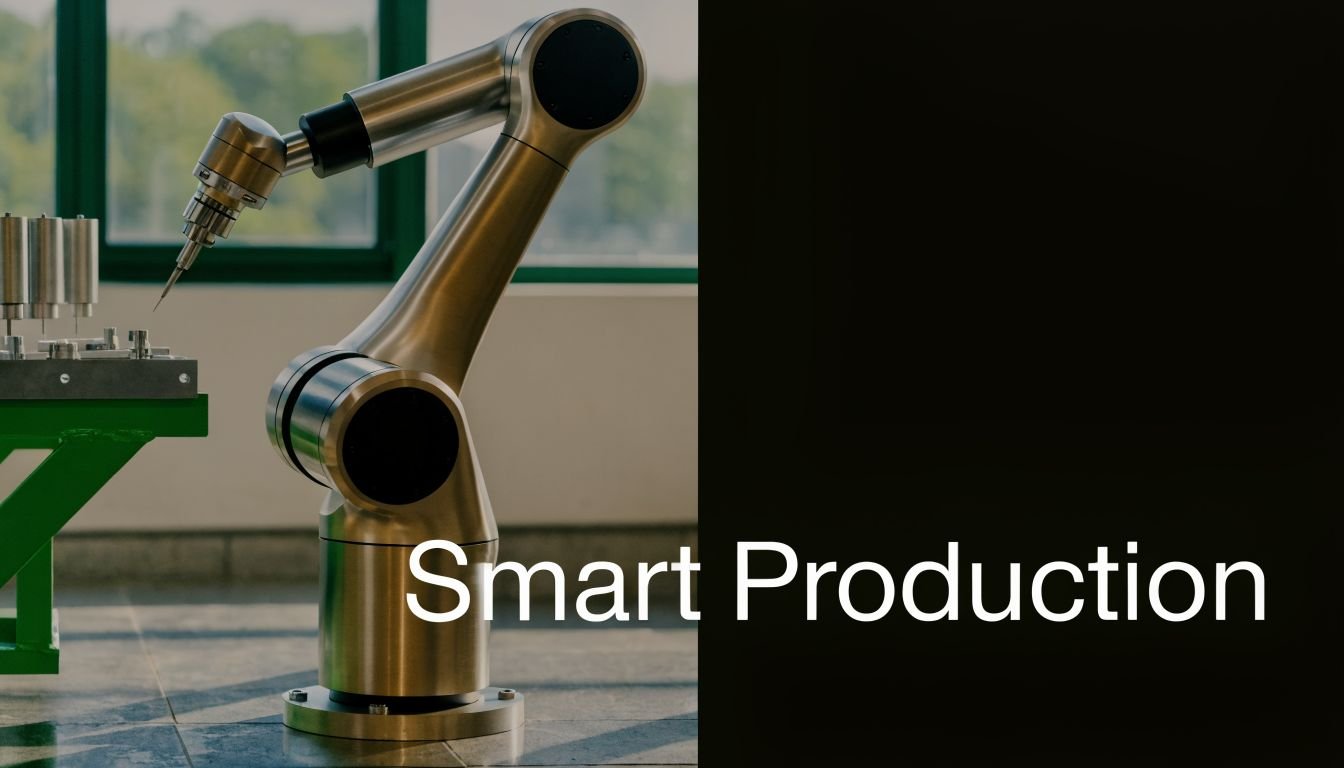
In practice, the biggest LMHV losses often come from the non-glamorous parts of production. Waiting for a part to be aligned. Reaching for tools. Resetting after a jam. Swapping a fixture. Verifying orientation by eye. Those aren't problems you solve by defaulting to a fully automated line. They're process design problems.
Fictiv's article on high-mix low-volume manufacturing identifies changeover time as the primary operational bottleneck and points to SMED, quick-change fixtures, and modular tooling as key practices for reducing production losses during transitions and maintenance. That lesson applies directly to low mix high volume environments. Even when product changes are limited, every setup event, tool replacement, and service interruption costs output.
The best automation projects remove delay from the cycle you already run every day. They don't force the plant to adapt to technology that solves the wrong problem.
A strong LMHV upgrade usually starts with one question: where does the line stop earning?
What smart semi-automation looks like on the floor
Semi-automation works well in LMHV because it keeps the process disciplined without overcommitting capital or locking you into unnecessary complexity. You preserve operator judgment where it helps, then automate the repetitive, fatiguing, or error-prone actions around it.
Common examples include:
- Quick-change fixtures: Reduce the time needed for maintenance, cleaning, or part-family swaps.
- Poka-yoke nests: Prevent misloads and orientation errors before the cycle starts.
- Indexing stations: Present parts consistently so the operator doesn't spend the shift repositioning material.
- Integrated sensing: Confirm part presence, orientation, force, or completion before release.
- Semi-automatic presses or assembly stations: Standardize critical operations while keeping footprint and cost under control.
That kind of system design often delivers a better operational fit than oversized automation. It's also easier to support. Maintenance teams can understand it. Operators can recover from interruptions. Engineers can modify tooling or sequence logic without rebuilding the entire process.
For plants evaluating controls and machine integration, it helps to think in terms of architecture instead of equipment categories. A solid automation control system strategy ties fixtures, sensors, HMIs, safety devices, and motion into one process that operators can run.
This short video shows the kind of production thinking that matters more than automation labels.
LMHV failure usually stems from overbuilding. Plants invest in complex systems to eliminate labor, only to find they have increased downtime, troubleshooting difficulty, and change friction. A simpler station with better part control often wins because it matches the actual process instead of an imagined one.
A Practical Roadmap for Implementing LMHV Systems
Start with the actual constraint
A good LMHV project starts on the floor, not in a catalog. Before anyone talks about robots, presses, feeders, or custom cells, you need a clear view of what is limiting output. In some plants it's cycle time. In others it's material presentation, inspection delay, ergonomic fatigue, maintenance access, or inconsistent workholding.
That first pass should be direct and uncomfortable. Watch the line. Time the waiting. Look at operator motion. Check where WIP piles up. Review recurring downtime causes. If the process relies on manual adjustment to stay within spec, that issue needs to be addressed before more speed is added.
A practical review usually answers four questions:
- Where does throughput stall most often
- Which step creates the highest quality risk
- What task depends too heavily on operator feel
- Which interruption repeats often enough to justify engineering
Don't automate a symptom. If the fixture is unstable, a faster machine just creates bad parts faster.
Build in phases so the line keeps moving
Once the constraint is clear, the next decision is level of automation. That choice should match the process, the production target, and the plant's ability to maintain the equipment. In many cases, the best path is phased implementation rather than a one-shot rebuild.
A phased roadmap often looks like this:
| Phase | Focus | Typical outcome |
|---|---|---|
| Process study | Observe cycle, variation, handling, and downtime | Clear problem definition |
| Concept development | Compare manual improvement, semi-automation, and full automation options | Right-sized solution |
| Pilot or limited deployment | Prove fixture design, controls, and operator interaction | Lower implementation risk |
| Scale-up | Expand to adjacent stations or full-line integration | Broader throughput and quality gains |
| Training and support | Lock in standard work, maintenance routines, and spare strategy | Sustainable performance |
This approach protects production while giving your team time to learn. It also prevents a common mistake in low mix high volume projects: overcommitting to a rigid solution before the process has been stabilized.
Operator training matters more than many teams admit. Even a well-built station underperforms if the handoff between production, maintenance, and quality is weak. Standard work, change parts, cleaning steps, alarm response, and preventive maintenance all need to be part of the implementation plan.
The plants that get the most from LMHV systems usually treat the installation as the midpoint, not the finish line.
GMP Considerations for Medical Device Manufacturers
Repeatability supports compliance
For medical device production, low mix high volume isn't only a throughput model. It can also support a cleaner compliance posture when the process is built correctly. Repetition makes it easier to define the validated state, control inputs, and hold the line inside approved parameters.
That matters during IQ, OQ, and PQ activities. A stable process with dedicated tooling, controlled material flow, and repeatable cycle conditions is easier to validate than one that depends on frequent judgment calls or inconsistent manual handling. When stations produce the same output through the same sequence, deviations become easier to detect and investigate.
Medical manufacturers also benefit from clearer documentation flow in LMHV settings. Device history records, batch documentation, in-process inspection steps, and traceability checkpoints are easier to structure when the route is fixed and the work content doesn't drift by shift or operator.
For teams aligning production design with regulated quality systems, understanding GMP in manufacturing helps frame automation decisions the right way. The question isn't only whether equipment runs faster. It's whether the process is easier to validate, monitor, document, and sustain.
Fixtures and controls can enforce good practice
Simple engineering often provides outsized value in these environments. In regulated assembly, a fixture does more than hold a part. It can control orientation, protect critical surfaces, prevent skipped steps, and reduce the chance of unrecorded variation. A sensor does more than detect presence. It can block a bad cycle before it creates a documentation or quality event.
Useful GMP-aware design choices often include:
- Guided loading features: Help operators place components correctly without interpretation.
- Interlocks tied to sequence: Prevent the process from advancing when a required condition isn't met.
- Cleanable tooling surfaces: Support routine cleaning and reduce hidden contamination traps.
- Part and lot traceability points: Make it easier to capture the right information at the right step.
- Controlled reject paths: Separate suspect product clearly for review and documentation.
In regulated production, consistency is a quality control tool, not just an efficiency tool.
Another common issue in medical device plants is overreliance on manual vigilance. Skilled operators matter, but compliance improves when the station itself helps enforce the process. A nest that only accepts the correct orientation, a sensor that confirms placement, or a controlled cycle that records completion creates a stronger manufacturing system than training alone.
That's especially useful when production scales. As volume rises, manual discipline gets harder to maintain. Well-designed semi-automation helps preserve both output and procedural adherence without turning the line into an inflexible black box.
Measuring Success and Calculating ROI
Track the metrics that change decisions
If you invest in low mix high volume improvements, you need to prove the result in operational terms, not just anecdotal feedback. The right metrics should tell you whether the line is running more predictably, producing better parts, and using labor and equipment more effectively.
The most useful KPI set is usually small and disciplined.
| Metric | What It Measures | Impact on LMHV |
|---|---|---|
| OEE | Availability, performance, and quality combined | Shows whether the line is truly converting scheduled time into good output |
| Cost per unit | Total production cost divided by acceptable units produced | Reveals whether specialization is actually lowering unit economics |
| First pass yield | Share of units that pass without rework | Exposes process stability and fixture effectiveness |
| Scrap rate | Material or units lost to defects | Highlights whether errors are being prevented or simply detected later |
These numbers matter because they connect engineering choices to business outcomes. A better fixture should improve first pass yield. Faster setup should lift availability. Cleaner material presentation should reduce scrap and operator delay. If the metric doesn't move, the solution probably didn't address the actual constraint.
A good review rhythm is simple:
- Check daily: Output, downtime causes, scrap events, and recurring alarms
- Review weekly: OEE trends, first pass yield, maintenance interruptions
- Evaluate monthly: Cost per unit, labor deployment, tooling wear, improvement payback
A practical ROI framework
ROI for LMHV projects doesn't have to be complicated, but it does need to be honest. Start with the current state. Then compare it to expected performance after the improvement. The gap between the two is where the business case lives.
A practical model usually includes:
Current losses
Capture downtime, rework, scrap, excess handling, and labor tied to the target process.Implementation cost
Include equipment, tooling, controls, integration, installation, training, and planned spares.Operational gains
Estimate where the project will reduce waste, stabilize quality, or free operator time. Keep this grounded in actual line behavior.Sustainment needs
Account for maintenance, consumables, calibration, and support. A system that performs well only when engineering is standing next to it isn't delivering full value.
If the payback depends on perfect uptime, perfect staffing, and zero process variation, the estimate is too optimistic.
The strongest ROI cases in LMHV usually come from targeted projects. A fixture that prevents misloads. A semi-automatic station that standardizes a critical assembly. A quick-change mechanism that cuts setup pain. Those improvements are easier to justify because they solve known losses you can already see.
When you measure success this way, you avoid the trap of buying technology for its own sake. You invest where the process needs discipline, repeatability, and control. That's how low mix high volume production gets better without becoming harder to run.
If you're evaluating how to improve a low mix high volume line without overbuilding the solution, System Engineering & Automation can help you assess the process, identify the right level of automation, and develop practical tooling, fixtures, semi-automatic systems, or integrated controls that fit your production goals and budget.