The most popular advice about manufacturing flow is also some of the least reliable: automate everything from raw material loading to final inspection. That approach can work for stable, high-volume production, but it can also leave a small or mid-sized manufacturer with expensive equipment, difficult changeovers, and a process that resists product variation.
Streamline flow by removing the delays, handoffs, movements, and quality risks that restrict output. Sometimes the right answer is a robot cell. Often it's a custom fixture, an assisted workstation, or a semi-automated process with an operator controlling the exceptions. The practical objective is not maximum automation. It's the best combination of throughput, flexibility, quality, safety, and maintainability for the line you operate.
Table of Contents
- Rethinking Maximum Automation on the Factory Floor
- Mapping Current State and Identifying True Bottlenecks
- Selecting the Right Level of Automation and Tooling
- Designing Layouts for Safety and GMP Compliance
- Estimating ROI and Planning the Commissioning Phase
- Executing Your Production Upgrade Strategy
Rethinking Maximum Automation on the Factory Floor
Full automation sounds like the cleanest answer to an inefficient production line. A manufacturer identifies manual work, replaces it with robotics, connects the stations, and expects output to rise. The problem is that automation doesn't remove process complexity. It can encode that complexity into controls, fixtures, recipes, sensors, and validation requirements.
A fully automated line may struggle when products vary, batches change frequently, materials arrive with inconsistent presentation, or inspection still depends on human judgment. A technician loading parts into a smart fixture may handle those conditions more effectively than a robot that requires a redesigned gripper and a new software path for every variation.
Start with the work, not the equipment
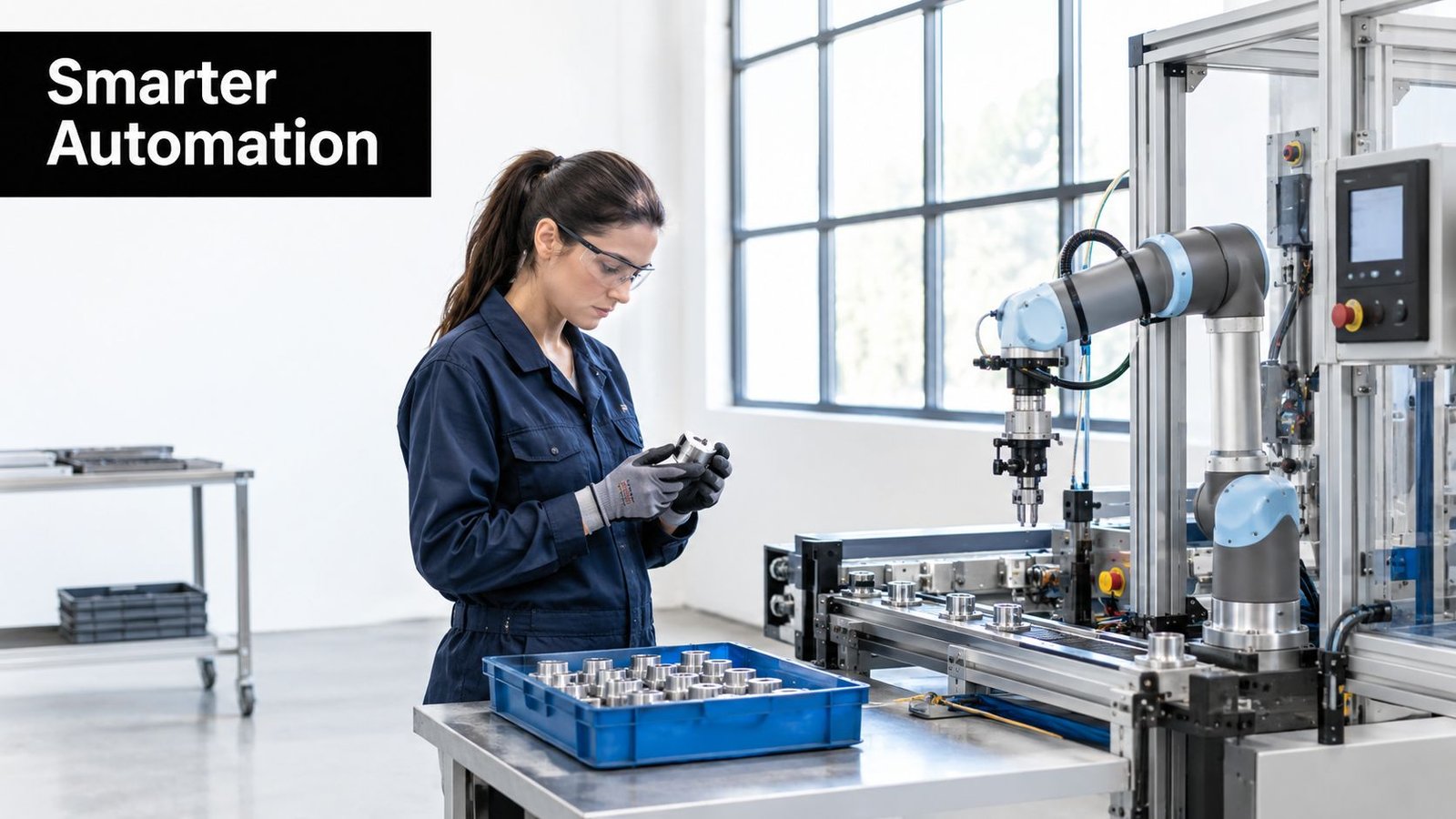
Before selecting a robot, conveyor, bowl feeder, or integrated control system, document what operators do. Walk the line during normal production and record every manual step, wait state, inspection, material handoff, adjustment, and recovery action. The written standard operating procedure tells you how the process is supposed to work. The floor tells you where production loses time.
That distinction matters. A workstation may have a short nominal cycle time but still constrain the line because operators wait for material, clear minor jams, search for tools, or repeat a measurement. Conversely, a task that looks inefficient in isolation may not affect finished output if it has sufficient capacity and doesn't create downstream starvation.
Recent guidance for medical-device and precision production recommends mapping manual steps and handoffs before choosing between assisted fixtures, semi-automation, and full automation. The decision affects cleanliness, inspection, line clearance, software controls, and validation burden, not just speed, as outlined in guidance on medical-device manufacturing automation.
Practical rule: Automate a constraint only after you can describe how that constraint behaves across a normal shift, a changeover, a minor stoppage, and a quality hold.
Semi-autonomous operations can be especially effective in bounded, low-risk domains. A fixture can orient a part, control clamping force, verify presence, and prevent an incorrect assembly while the operator loads components and handles variation. A semi-automated press can standardize the critical motion without forcing the plant to automate feeding, sorting, and every inspection decision.
Flexibility can be an economic advantage
Market commentary indicates that semi-automatic systems still dominate many installations and can retain a cost advantage below roughly 10,000 units per month, while fully automated systems demand higher capital and greater operational complexity, as discussed in this analysis of semi-automated production systems. The precise threshold won't apply to every product or industry, but the underlying decision principle does.
For a product family with frequent variants, a modular cell may outperform a rigid automated line. Manual loading, programmable processing, and human-in-the-loop inspection can preserve adaptability while controlling the work that creates the most variation. The result is a production flow designed around risk and value, rather than an equipment package assembled around an automation target.
Mapping Current State and Identifying True Bottlenecks
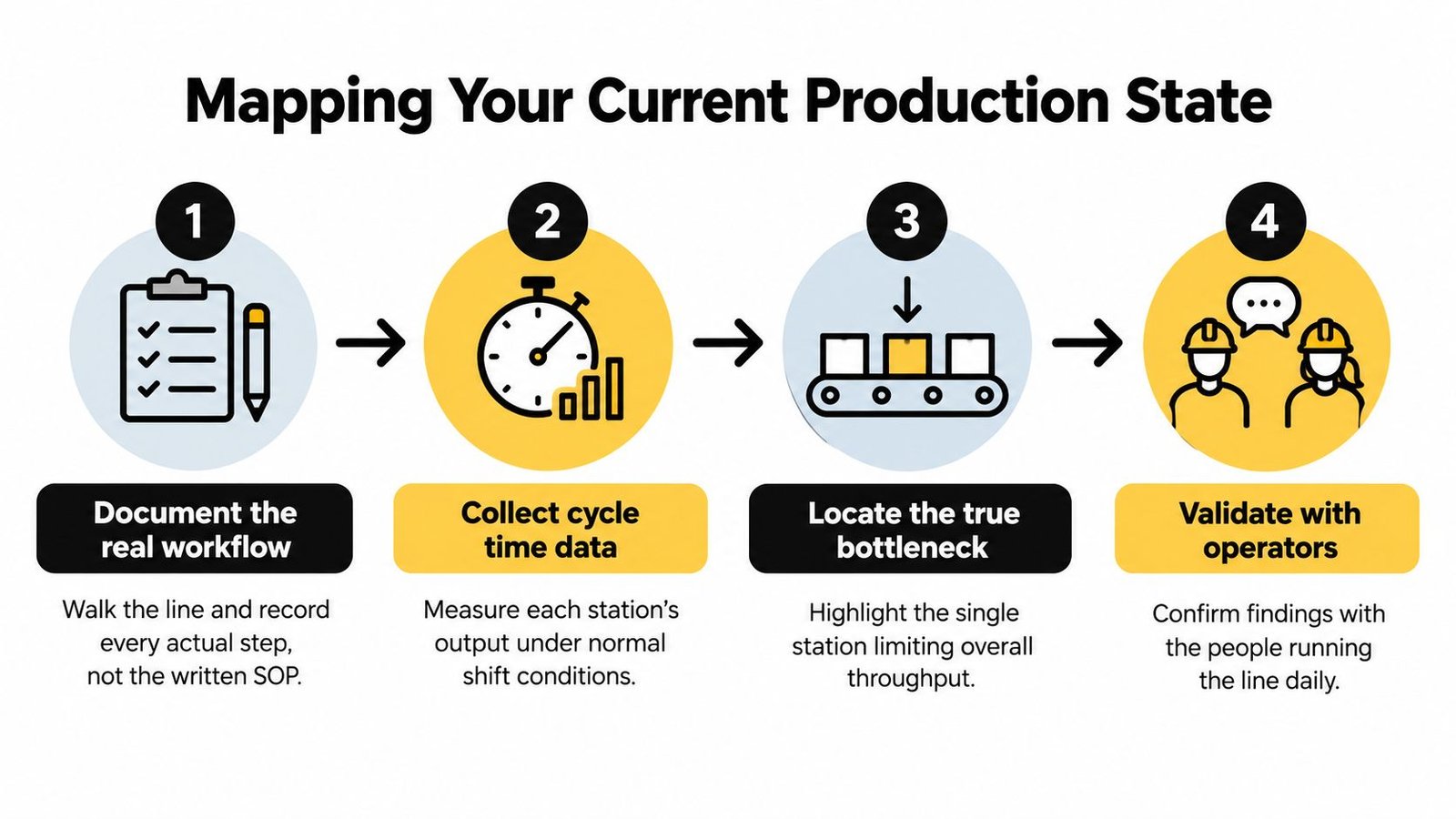
A production upgrade should begin with a current-state map based on observed work, not assumptions. The map needs to show the physical route of materials and the information required to release, inspect, rework, and move each part. Include operators, machines, fixtures, staging areas, quality gates, maintenance access, and every point where work waits for a decision.
Start by walking the line with a production supervisor and an experienced operator. Record the actual sequence, including activities that aren't visible in the standard process documentation. Note when an operator leaves the station to retrieve material, reset equipment, find a gauge, request approval, or resolve a control alarm.
Build a map that reflects operating reality
A useful mapping exercise separates four types of activity:
- Value-adding work: The operation changes the part or verifies a requirement that customers or regulators care about.
- Required support work: The activity supports production, such as tool checks, traceability entries, or controlled material presentation.
- Waiting: The part, operator, machine, or approval remains idle before the next action can begin.
- Recovery and rework: The team clears jams, corrects orientation, repeats a test, or routes a nonconforming part.
Don't convert every delay into an automation project. First determine whether the delay limits total output. A slow material presentation step may be frustrating but irrelevant if the next process has excess capacity. A short inspection step may be the true constraint if every downstream station waits for its release.
Measure the line under normal shift conditions. Capture actual station output, downtime reasons, changeover behavior, queue size, and the frequency of manual intervention. A single ideal cycle-time observation isn't enough to justify equipment. You need to know whether the process repeats reliably and what causes the deviations.
Find the constraint at system level
Flow analysis offers a useful engineering analogy. In a streamline simulation, engineers solve the global pressure field before calculating cell-interface velocities and tracing individual paths. That dual-grid approach prevents a local path from being optimized while the larger pressure solution remains wrong, as explained in the streamline simulation workflow.
Manufacturing engineers should apply the same discipline. Don't optimize the most visibly inconvenient station until you understand how material moves through the complete line. A faster upstream machine may create a larger queue. A new conveyor may move parts more quickly while leaving inspection, replenishment, or final assembly unchanged.
Use the following validation questions:
- Does this station limit finished output? Compare its sustained output with the requirement of the next process and the line as a whole.
- Does the constraint move? If the bottleneck changes between product variants or shifts, a flexible solution may be more valuable than a fixed high-speed machine.
- What causes the lost capacity? Separate mechanical downtime, material shortages, operator travel, quality decisions, and changeover losses.
- Can the problem be removed without automation? Relocation, point-of-use storage, better lighting, a poka-yoke fixture, or clearer work instructions may address the cause faster.
- Can operators confirm the finding? The people running the line know which alarms recur, which materials arrive poorly, and which tasks create hidden fatigue.
A focused bottleneck identification method helps turn observations into an intervention plan. The objective is to identify the single condition that restricts overall flow, then test whether the proposed change improves the system rather than merely improving one workstation.
Use the video below as a visual reference while reviewing how process steps, movement, and constraints can be documented.
Selecting the Right Level of Automation and Tooling
Once the constraint is clear, choose the smallest intervention that reliably controls it. The available choices range from a custom manual fixture to a fully integrated robotic cell. The correct selection depends on volume, part presentation, product variation, inspection requirements, operator skill, available floor space, maintenance capability, and the cost of a failed production launch.
Custom tooling is often the fastest way to stabilize a manual operation. A fixture can locate a part repeatably, expose the correct assembly surface, prevent incorrect orientation, and reduce the operator's need to hold components during a critical step. It can also make inspection easier by presenting the feature at a consistent angle.
Assisted tooling works well when the operator still adds judgment or handles variation, but the process needs controlled force, travel, alignment, or sequence. Examples include a pneumatic pressing fixture with force monitoring, an electrically actuated driver with torque verification, or a nest with sensors that confirms component presence before the next operation.
Compare the alternatives honestly
Semi-automation adds controlled machine action without removing the operator from the complete process. Manual loading and unloading can remain in place while a programmable station performs the repeatable operation. This arrangement often supports faster changeovers because the tooling can be exchanged or adjusted without rebuilding an entire automated material-handling system.
Full automation becomes more attractive when product presentation is consistent, demand is stable, the process has limited variation, and the cost of manual handling materially restricts output. It requires more than a robot. The plant also needs dependable feeding, part detection, safety circuits, controls integration, fault recovery, recipe management, maintenance access, and a defined response to every expected exception.
| Solution Type | Best For | Flexibility | Capital Cost |
|---|---|---|---|
| Custom manual fixture | Low-volume work, variable products, ergonomic or quality problems | High | Lower |
| Assisted workstation | Repeatable critical steps with operator loading and judgment | High to moderate | Lower to moderate |
| Semi-automated cell | Stable processing with variable loading, inspection, or changeovers | Moderate to high | Moderate |
| Fully automated line | Consistent products, stable demand, and continuous material presentation | Lower | Higher |
Modern precision-production guidance supports mapping every manual step and handoff before making this choice because automation changes the requirements for cleanliness, inspection, validation, and line clearance, not only labor content. A medical-device manufacturer may find that a semi-automated process provides better control without creating unnecessary software and validation scope.
Use mixed models where the risk is uneven
A mixed-model cell can combine manual loading, semi-automated processing, and human inspection. This arrangement makes sense when the process contains both highly repeatable and highly variable tasks. The equipment controls the operation that affects consistency, while the operator manages orientation, exception handling, or a visual judgment that is difficult to automate economically.
For example, a manufacturer might use a custom nest to locate a component, a servo-driven actuator to perform insertion, sensors to confirm seating, and a trained operator to inspect the finished assembly. That is a complete control strategy, even though it isn't a lights-out line.
The different levels of automation should be evaluated against measurable process risks. Ask whether the proposed system reduces the identified constraint, whether it can accommodate the product range, how quickly it can be changed over, and who will troubleshoot it at the end of a night shift.
Avoid buying automation to solve a labor-perception problem when the actual issue is poor material presentation or repeated quality rework. A fixture, feeder redesign, or error-proofing device may deliver a more durable improvement. Automation should remove a demonstrated source of lost capacity or variation, not just make the line look more advanced.
Designing Layouts for Safety and GMP Compliance
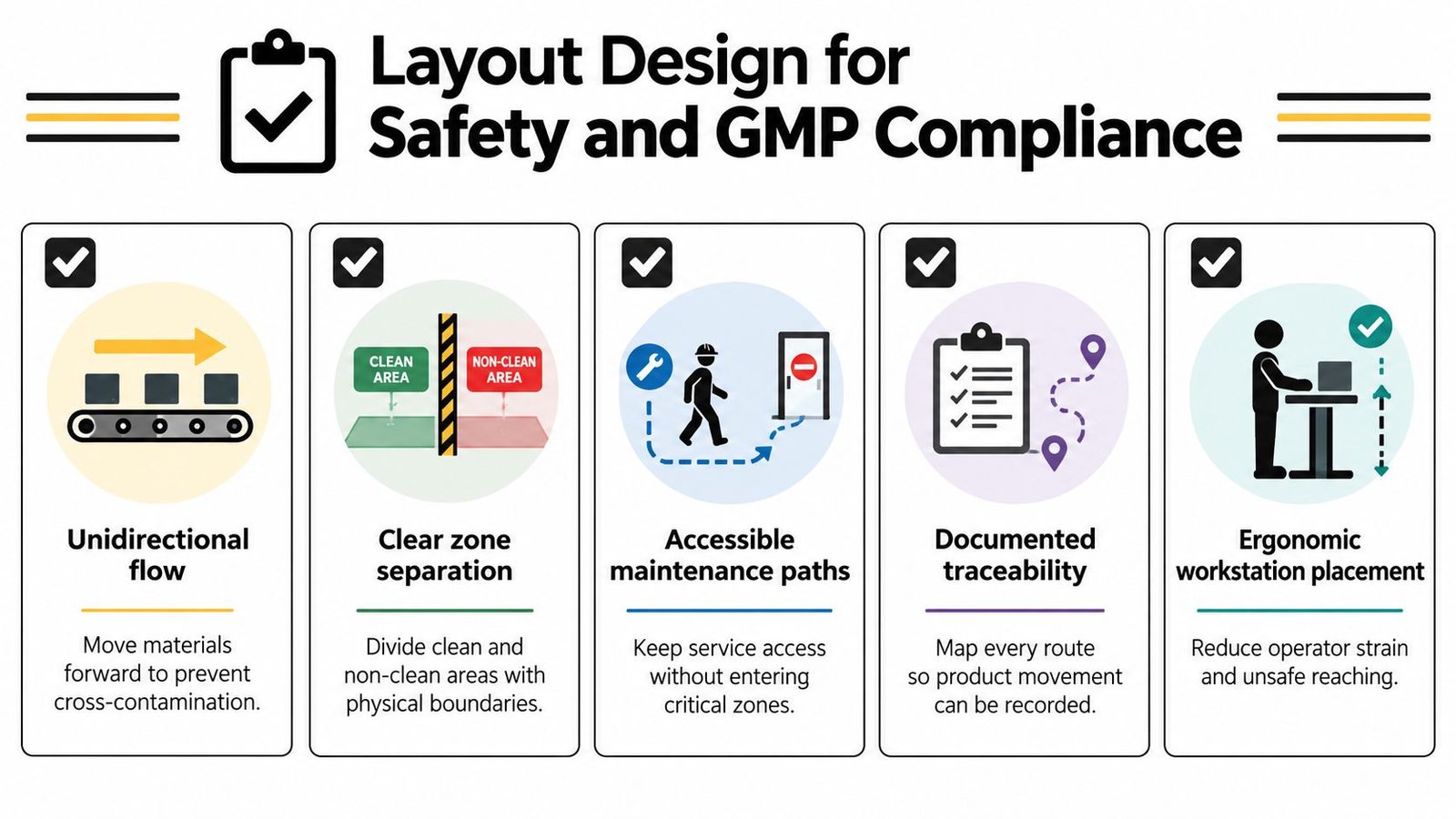
A well-organized layout must protect the product and the people making it. Shorter travel paths are useful, but a compressed cell can create unsafe reaches, obstruct maintenance access, mix clean and non-clean materials, or make line clearance difficult. In regulated manufacturing, a fast process that cannot demonstrate controlled movement and traceability isn't a successful process.
Start by separating the flow of people, materials, waste, finished goods, and maintenance activity. Define where incoming components are received, where they are staged, where they enter the controlled process, and where completed product leaves. Physical separation, visual controls, and documented routes make it easier to prevent accidental cross-contamination and to investigate a deviation.
Build compliance into the cell
The FDA states that medical-device manufacturers intended for commercial distribution in the United States must establish and follow a quality assurance program under the Good Manufacturing Practices framework. The Quality System Regulation sets general objectives, including calibrated equipment, training, management responsibility, process controls, and design controls, rather than prescribing one fixed manufacturing method, as described in the FDA overview of quality system requirements.
The updated QMSR incorporates ISO 13485:2016 as its foundational quality management system and adds risk management as a requirement for consistency across design, production, and lifecycle controls, according to the FDA QMSR guidance. That connection changes how engineers should approach a layout. The workstation isn't only a place to complete an operation. It is part of the evidence that the operation is controlled.
Design the physical arrangement around the risks you need to control:
- Material identity: Use dedicated locations, clear labels, barcode verification, or controlled presentation to prevent mix-ups.
- Line clearance: Provide visible, accessible areas for removing previous product, labels, components, and documentation before a new run.
- Inspection access: Place inspection where operators can perform it without awkward reaches or bypassing the intended sequence.
- Maintenance access: Allow technicians to service equipment without entering a critical product zone or disturbing released material.
- Traceability: Connect work instructions, equipment status, inspection results, and product records to the correct lot or serial information.
Treat safety as a flow requirement
A safe workstation supports the same flow objectives as an efficient workstation. Place frequently used materials within a comfortable reach zone, keep sharp edges and pinch points guarded, and position displays so operators can read them without twisting away from the work. Use poka-yoke features to make the correct action easier than the incorrect one.
Safety circuits must also support recovery. An emergency stop that leaves an operator unsure how to reset the cell can create extended downtime and unsafe improvisation. Controls should show the fault state, identify the affected station, and provide a defined recovery sequence for authorized personnel.
Before commissioning, review the layout with operators, quality personnel, maintenance technicians, and safety representatives. Ask each group to walk through a normal cycle, a material shortage, a rejected part, a cleaning activity, a line clearance, and a maintenance intervention. Those exercises often reveal risks that a two-dimensional layout drawing won't show.
Estimating ROI and Planning the Commissioning Phase
A credible return-on-investment case includes more than equipment price and estimated labor reduction. Include tooling, controls integration, guarding, facility changes, training, validation documentation, spare parts, preventive maintenance, software support, and the production time lost during installation. If the new cell changes an approved process, include the quality and regulatory work required to demonstrate that it performs consistently.
Start with a baseline that the plant can defend. Record output, good-part yield, labor allocation, downtime by cause, changeover effort, overtime, rework, scrap, and maintenance response. Then define the expected change in operational terms. “Improve efficiency” is too vague. A useful target describes the constraint, the intervention, the measurement method, and the conditions under which the result must hold.
A U.S. Census Bureau-linked analysis reports that establishments adopting automation technologies have 11.4% higher labor productivity, and that this difference explains about 20% to 30% of the productivity gap between large firms and the median firm in an industry, as shown in the Census-linked automation analysis. That evidence supports automation as a productivity lever, but it doesn't guarantee that every project will deliver the same result. The business case still depends on selecting the right constraint and implementing the system well.
Commission in controlled stages
Phased commissioning protects the existing operation and gives the team opportunities to find problems before the new flow becomes production-critical. A practical sequence may include:
- Design review: Confirm the process sequence, interfaces, safety functions, inspection points, operator responsibilities, and recovery modes.
- Factory testing: Run representative parts and known defects before shipment. Test alarms, sensor failures, part-present logic, recipe selection, and restart behavior.
- Site installation: Verify utilities, guarding, access, material presentation, software connections, and equipment calibration.
- Parallel production: Operate the existing process while the new cell demonstrates repeatability and operator readiness.
- Controlled release: Move production to the new flow only after quality, maintenance, and operations agree that acceptance criteria are met.
Commissioning isn't just equipment startup. It is the handover from a designed concept to a process that people can operate, maintain, inspect, and improve. The equipment commissioning process should include documented checks, training records, punch-list ownership, and clear acceptance criteria.
Transfer ownership to the plant
A supplier can install the equipment, but the plant must own its performance. Give maintenance technicians access to electrical drawings, pneumatic diagrams, software backups, spare-parts information, lubrication requirements, and fault-recovery instructions. Train operators on normal operation and controlled recovery, not only on how to press the start button.
Review performance after launch at an agreed cadence. Look for recurring alarms, manual bypasses, minor stops, inspection escapes, and workarounds. A cell that reaches its expected rate only when the most experienced operator is present hasn't reached a stable production state.
Executing Your Production Upgrade Strategy
The strongest upgrade strategy is a loop, not a one-time equipment purchase. Map the current process, identify the system constraint, select the least complex intervention that controls it, validate the new arrangement, and measure whether the constraint moved. Then use the operating data to decide what deserves attention next.
Manufacturing leaders can use this practical checklist:
- Define the business problem: State whether the priority is throughput, quality consistency, ergonomic risk, changeover flexibility, labor dependency, or traceability.
- Observe the actual process: Walk the line across normal production conditions and document manual actions, waiting, handoffs, downtime, and recovery.
- Confirm the bottleneck: Use station-level observations and operator knowledge to identify the condition limiting finished output.
- Compare intervention levels: Evaluate a fixture, assisted tool, semi-automated cell, and full automation against product variation, demand stability, capital, and maintenance capability.
- Design for compliance: Include line clearance, material segregation, inspection, calibration, training, risk controls, and traceability in the layout and control strategy.
- Commission in phases: Test representative parts, defects, alarms, recovery modes, and operator workflows before transferring production.
- Track sustained performance: Monitor the constraint, good-part output, downtime causes, rework, maintenance workload, and changeover behavior after launch.
A factory-of-the-future program can create substantial productivity opportunity. Bain reports that most machinery companies could improve productivity by 30% to 50%, while about 60% have already started implementing such a strategy, and many still leave 30% to 50% of that value unrealized without practical process redesign, according to its factory-of-the-future research. The lesson for plant managers is straightforward: technology matters, but process selection and disciplined execution determine whether the value appears on the floor.
Choose an integrator that will discuss fixtures, operator interaction, controls, safety, maintenance, and future product changes with the same seriousness as robot selection. A scalable semi-automated cell may be the right first step, with a path to additional automation if demand and process stability justify it. That approach gives the plant a chance to learn before it commits to a rigid end-to-end system.
System Engineering & Automation offers semi-automatic systems, fully automated and manual equipment, custom tooling, fixtures, integrated controls, installation, commissioning, and ongoing maintenance support for manufacturers upgrading production flow. Visit System Engineering & Automation to discuss a practical automation solution matched to your production goals, product variability, compliance needs, and budget.