The International Federation of Robotics counted 542,000 industrial robots installed globally in 2024, more than double the 221,000 units installed a decade earlier, with annual installations above 500,000 for a fourth straight year, Asia taking 74%, Europe 16%, and the Americas 9%. At that scale, the useful question isn't whether robots exist. It's whether this process, on this floor, with this crew, should get any automation, and how little of it still clears every test.
An automation feasibility study prices the fully loaded cost of leaving the line alone, then treats workforce readiness and validation as go or no-go gates. I would approve the smallest option that passes, not the fullest line that looks good on a labor-savings slide.
Table of Contents
- What an Automation Feasibility Study Decides
- Six Tests Every Feasibility Study Must Pass
- How to Run the Study from Baseline to Go or No-Go
- Why Doing Nothing Has a Real Price
- Choosing the Least Automation That Passes
- How Three Plants Reached Different Verdicts
- Confirm the Study Scope Before You Commit Capital
What an Automation Feasibility Study Decides
An automation feasibility study is a structured test run before capital is committed, closer to a pre-purchase building inspection than to an equipment brochure. It checks whether the process can be automated, whether the return survives realistic assumptions, and whether the plant can run and maintain the result.
The market already treats automation as ordinary capacity. The International Federation of Robotics executive summary reported 541,302 industrial robots installed worldwide in 2023, only 2% below the 2022 record of 552,946 units, and the third consecutive year installations exceeded 500,000. Operational stock reached 4,281,585 robots, up 10%, and manufacturing robot density rose from 151 to 162 robots per 10,000 employees.
Region changes the benchmark. Asia accounted for 70% of new deployments in 2023, Europe 17%, and the Americas 10%. Compare a concept with plants in the same labor market and product mix, not with a global average.
A study that starts from a vendor quote has already skipped the inspection.
Three decisions follow from the file: whether to invest, which automation level to choose, and how to phase the work. Full automation isn't the goal. Throughput, repeatability, available labor, floor space, integration effort, and the cost of converting a manual process decide the fit. You leave with a go, no-go, or conditional verdict, and with the conditions that verdict depends on.
Six Tests Every Feasibility Study Must Pass
Score every concept on the same six tests. Agree the pass mark before anyone prices hardware, so a favored design can't move the goalposts.
| Test | Question It Answers | Evidence to Collect |
|---|---|---|
| Technical fit | Can the process reach the required cycle time and repeatability with proven equipment? | Cycle-time spread, part variation, reach and access, sensor and actuator needs |
| Economic case | Does the return hold against the fully loaded cost of doing nothing? | Scrap, overtime, downtime, lost capacity, cost model over three to five years |
| Labor and maintainability | Can the current team run, troubleshoot and maintain it? | Training hours, controls skills, spare parts, fault-recovery steps, changeover effort |
| Safety and risk | Does the design remove hazards without creating new ones? | Task list for the cell, guarding, access logic, emergency-stop coverage, lockout points |
| Integration and scale | Will it connect to existing equipment and grow with demand? | Interfaces, data capture, floor space, room for added stations or tooling |
| Regulatory and quality | Does it support controlled, traceable production? | Validation scope, traceability records, label verification, change-control ownership |
Technical fit comes first. A cell that misses repeatability fails even if the quote is cheap. Record cycle-time spread and part variation on the current process, then check reach, access, and whether the sensors and actuators you name are already proven on that part family.
The economic case isn't a labor-savings slide. Build it against the fully loaded cost of continuing the current method, which is the comparison behind a real return on automation. Hold the model for three to five years and keep scrap, overtime, downtime, and lost capacity in the same sheet as wages.
Labor and maintainability is the test many teams skip. Ask whether today's crew can run, troubleshoot, and maintain the cell after the integrator leaves. Training hours, controls literacy, spare parts, written fault recovery, and changeover effort are the evidence. A fast machine with no recovery procedure is a downtime plan.
Safety and risk needs a task list, not a guarding sketch. Integration and scale needs interfaces, data capture, floor space, and a place to add a station later. On regulatory and quality, medical-device and GMP-aware lines use the full row: validation scope, traceability, label checks, and a named owner for change control. Other plants may mark the row not applicable, but only with a written reason.
Fail rule: A test with no evidence is a failed test, not an open item.
How to Run the Study from Baseline to Go or No-Go
Each step should hand the next step a number or a yes-or-no. We look at production workflows to find where a change would move output, quality, or labor, and the file should show that path.
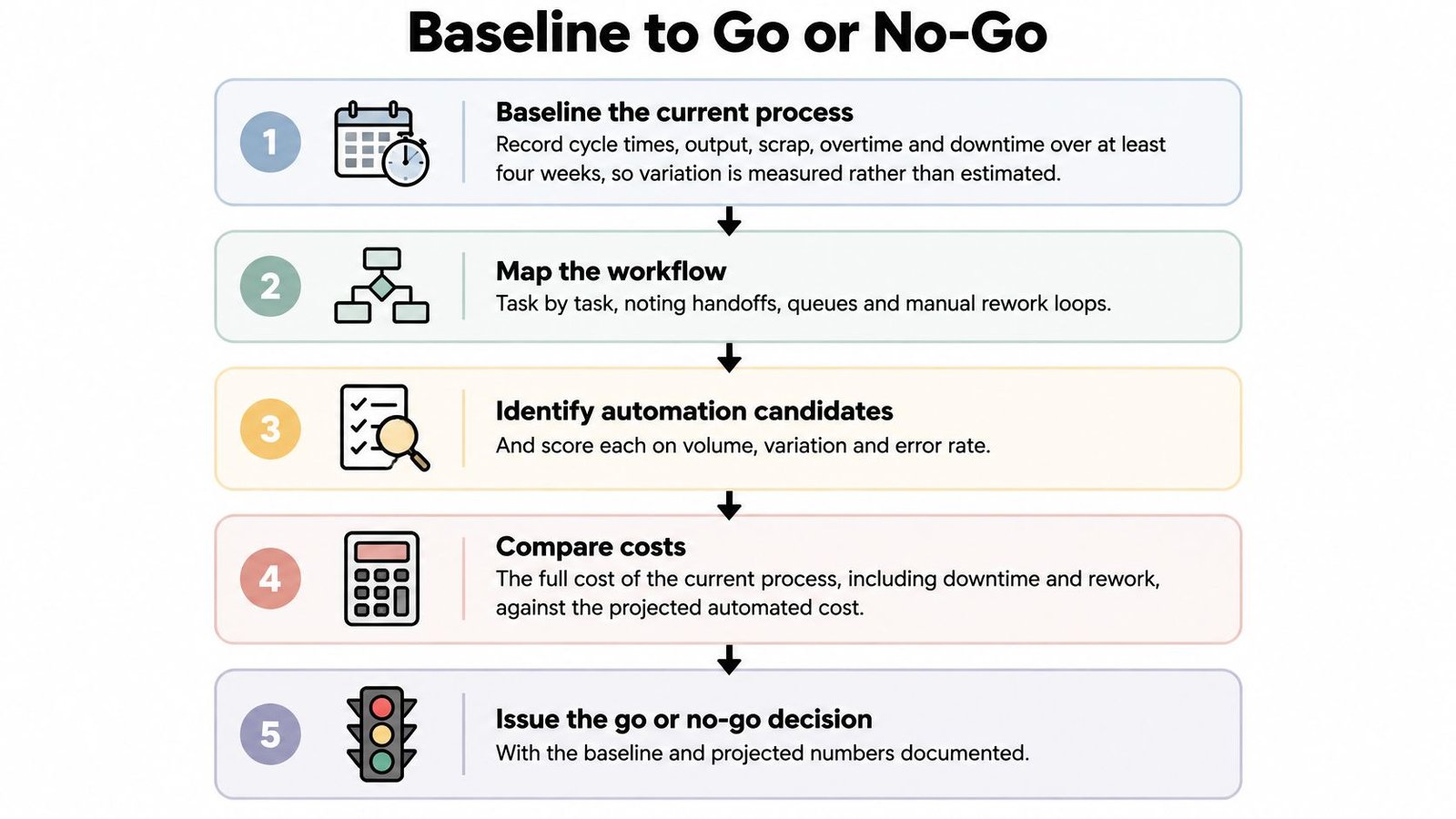
- Baseline the current process. Log cycle time, output, scrap, overtime, and downtime for at least four weeks. The output is a range, not a single "typical" minute. One good Tuesday isn't a baseline.
- Map every task. A useful manufacturing process map includes setup, changeover, cleaning, jam clearing, and maintenance. Hidden tasks often decide the concept. The output is a task list with who does each step and how often.
- Define two or three concepts. Use a manual setup with tooling and fixtures, a semi-automatic workstation, and a fully automated option when volume might justify it. The output is a one-page description of each, with the same scope boundaries.
- Score technical fit first. Apply the six tests in order, and stop a concept that can't hit cycle time and repeatability. The output is a pass or fail per test, with the evidence attached.
- Compare safety as a design input. OSHA robotics guidance calls for a hazard analysis and risk assessment on each robot application, redone through design, build, integration, operation, and maintenance. List every worker activity in and around the cell, including setup, material changes, cleaning, troubleshooting, and maintenance. Then compare safeguarded zones, access-control logic, emergency-stop coverage, lockout/tagout, and any safe-speed or reduced-force mode. A concept that hits nominal cycle time but needs frequent entry into the workspace should lose to a simpler layout with cleaner separation. OSHA also points to ANSI/RIA task-based methods, so documented risk reduction belongs in the concept, not in a punch list after install.
- Run the cost model. Use the fully loaded baseline and the sensitivity cases in the cost section: lower volume, a slower ramp, and operators moved to other work. Don't rebuild a second model here. The output is payback under each case, in the same units.
- Write the verdict. State go, no-go, or conditional. Name each condition and a review date. "Revisit if weekly volume holds above the tested rate for eight weeks" is a condition. "Looks promising" isn't.
A nominal cycle time that depends on someone stepping into the robot space several times a shift is a weaker concept than a semi-automatic station the crew can clear from outside the guarded zone.
Why Doing Nothing Has a Real Price
A packing cell on two shifts that reworks 6% of packed units, pays weekly overtime, and still carries two open positions looks cheap if you price only the wage line. Over three to five years, rework, lost hours, and orders the line turns away can outweigh that wage line. Downtime, escaped defects, open shifts, and a rival who ships on a shorter lead time sit outside today's labor bill. Those are the costs of leaving the process as it is.
Walk the cell before you model it. The costs that change the verdict are on the floor.
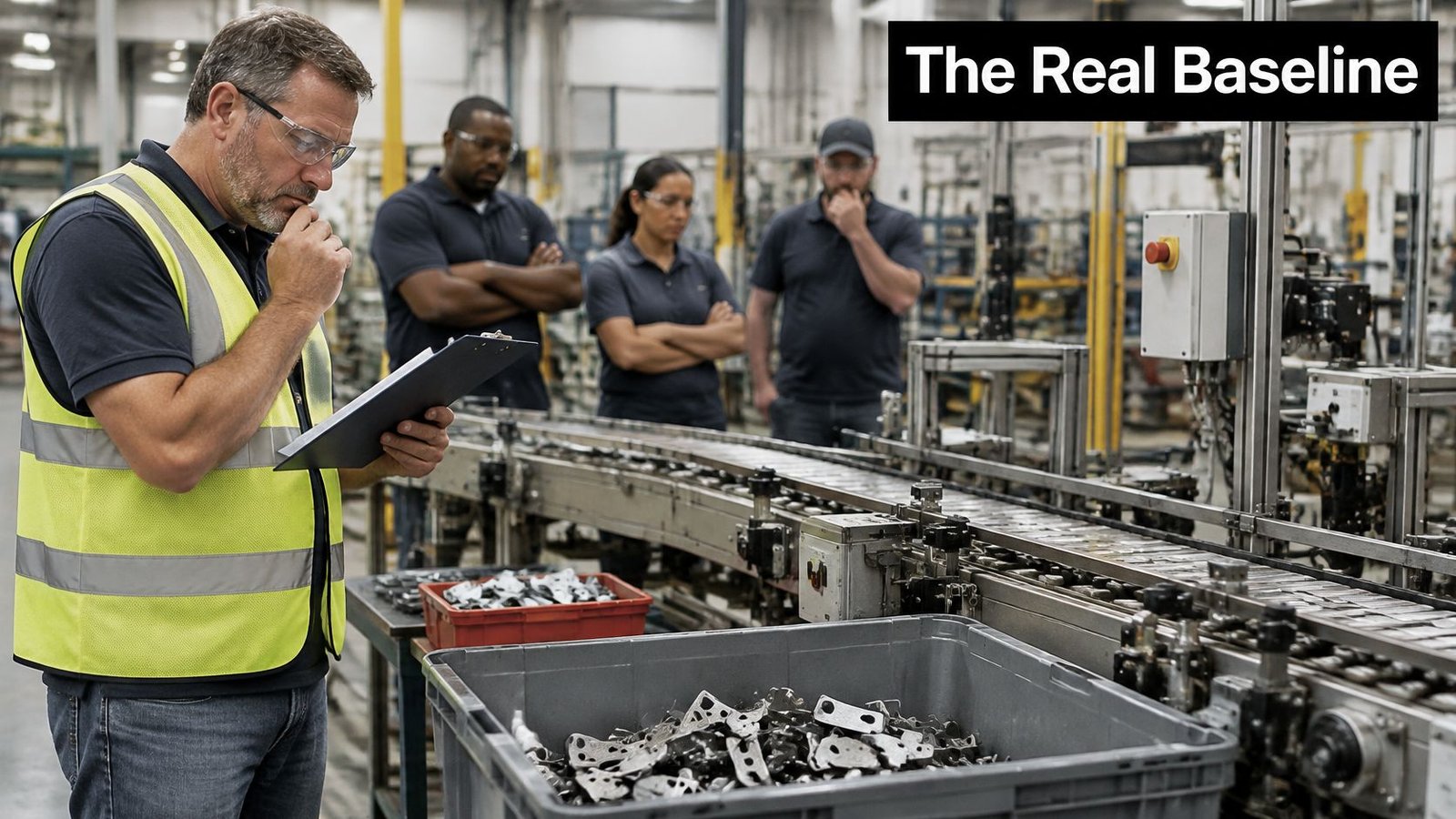
Waiting usually raises operating cost, and many plants never put that cost into the capital decision. Implementation complexity and a shortage of people who can run the new equipment stop more projects than the purchase price. Price the delay anyway. If the remaining crew cannot support the concept, or the numbers only work before anyone validates them on the floor, I treat that as a no-go, not a footnote.
| Cost Line | Example Input | Source |
|---|---|---|
| Direct labor and weekly overtime | Two shifts plus overtime hours | Measured |
| Rework and scrap | 6% of packed units | Measured |
| Downtime and cycle-time variation | Stop hours and cycle-time range | Measured over four weeks |
| Escaped defects and complaints | Returns and complaint cost per month | Estimated |
| Lost sales capacity when orders exceed the line | Units ordered above demonstrated capacity | Estimated |
| Two open positions and hiring cost | 2 open shift roles | Estimated |
| Competitive risk from a rival automating first | One annual contract lost to a shorter lead time | Estimated |
| Sensitivity: volume 20% lower | Payback test | Modeled |
| Sensitivity: ramp-up takes twice as long | Payback test | Modeled |
| Sensitivity: operators reassigned | Labor savings test | Modeled |
Measured rows come from the four-week log. Estimated rows need a named owner and a stated method, not a round number dropped in at the end. The three sensitivity rows stop the model from assuming a perfect ramp. If payback only holds when volume stays high, operators leave the cell, and startup is instant, the concept is not feasible yet.
This walkthrough shows where those hidden hours usually hide on a live line.
A smaller investment can beat a large one on risk-adjusted return when the large one fails the lower-volume case or the slow-ramp case. Small and midsize plants often cannot justify a full line. They can still justify fixtures, poka-yoke, or a semi-automatic station once this sheet is honest. Compare any option with the cost of continuing the current process, not with this year's wages.
Choosing the Least Automation That Passes
| Option | Relative Upfront Cost | Operator Dependence | Flexibility for Product Changes |
|---|---|---|---|
| Manual with tooling and fixtures | Low | High, operators do most steps | High |
| Semi-automatic workstation | Moderate | Reduced, operators keep control | Moderate to high |
| Fully automated line | Highest | Low, machines handle onload and offload | Lower, rigid setups |
Read the table left to right, then stop at the first row that passes all six tests at the volume you can defend. Upfront cost jumps on a full line because of extra design work, specialized components, wiring, and complex programming. That spend only pays when technical fit, safety, maintainability, and the cost model all pass. A rigid setup also fights product changes. If the mix shifts every quarter, high flexibility is a requirement, not a nice extra.
Automation doesn't have to mean a robot. Mechanical fixtures, conveyors, vision systems, and PLC-based controls often take the repeatable steps while people keep the judgment calls. A manual system can later take semi-automation, or additional stations and tooling, without a complete overhaul. Semi-automatic stations suit repetitive assembly, packaging, inspection, or testing while operators keep control. Full lines take both onload and offload, and they fit when the part family is stable and the crew can support the controls.
What the current crew can actually support
Workforce readiness is a design gate, not a training slide after shipment. In the Deloitte 2025 Smart Manufacturing Survey, 48% of surveyed large US manufacturers reported moderate-to-significant difficulty filling production and operations-management roles, 35% cited upskilling workers for advanced technology as a major concern, and only 48% had a smart-manufacturing training and adoption standard.
Score training time, controls literacy, spare parts, fault recovery, changeover complexity, cybersecurity ownership, and preventive-maintenance skills. On GMP-aware or medical-device work, also name who owns documentation, process validation, calibration, deviations, and change control. A simpler station the current team can validate, recover, and adapt will outperform a fuller line they can't support after the integrator leaves. The levels of automation worth comparing are the ones your people can still run on a bad Tuesday.
Choose the least automated option that passes all six tests at the required volume.
How Three Plants Reached Different Verdicts
A small contract manufacturer runs manual assembly and heavy overtime. The study tests a semi-automatic workstation built around fixtures, not a full line. Repeatability hits the target, changeover stays inside the crew's skill, and the phased plan adds a second station only after the first holds its rate. Verdict: go, fixture-based, with a dated review before any further spend. We will say outright when a fully automated system isn't necessary. Here, it isn't.
A medical-device plant with GMP duties looks at labeling and packaging. Label checks, reject isolation, and line clearance have to be requirements on day one, not features added after the mechanical design freezes. The FDA Quality Management System Regulation, effective February 2, 2026, incorporates ISO 13485:2016 into 21 CFR Part 820 and covers the methods, facilities, and controls used to design, manufacture, package, label, store, install, and service devices. In this file, quality-system documentation, traceability, and change control cost more than the hardware. FDA labeling controls already require inspection of labeling materials, space that prevents mix-ups, labels that stay legible, and a check of issued labels against the device master record. Verdict: start with a simpler station that can prove those controls, and don't buy the fuller machine until the records path is owned.
A mid-sized assembly plant wants full automation on a high-volume line. Nominal payback looks acceptable. The sensitivity case with volume 20% lower pushes payback past the equipment life. Verdict: conditional, tied to a volume target and a review date. If volume doesn't hold, the plant stays with a semi-automatic cell that can add stations later.
Each verdict came from a test the headline cost comparison hadn't shown: repeatability and phasing, documentation cost, and a down-volume case.
Confirm the Study Scope Before You Commit Capital
Decide now between a full study and a shorter baseline. Don't commission hardware concepts until that choice is explicit.
A no-obligation consultation is the right place to confirm scope. Bring the bottlenecks, labor constraints, quality concerns, budget, and timeline. Expect questions on the current workflow, the main bottlenecks, operational constraints, and long-term goals for scalability and efficiency, plus a straight look at the business case.
Before the study starts, gather three things.
- Four-week baseline: Cycle time, output, scrap, overtime, and downtime, so the first meeting starts from measured data rather than a remembered average.
- Task list: Setup, changeover, cleaning, jam clearing, and maintenance, not only the steady-state cycle.
- Fully loaded cost of the current operation: The same cost lines used in the packing-cell model, marked measured or estimated.
Then ask four questions. Will the study test at least two automation levels? Does it include the cost of not automating? Does it run sensitivity cases? Does it document a safety and maintainability review? If any answer is no, you don't have a study yet. If the baseline isn't in hand, run that shorter measurement first. If it is, commission the full study.
Request the consultation with System Engineering & Automation and bring that four-week baseline so the first meeting can score options instead of guessing them.
System Engineering & Automation builds practical manufacturing solutions, from tooling and fixtures through semi-automatic workstations and fuller lines, matched to the production goal rather than to a default machine. If you are deciding whether to automate and how far to go, bring your baseline to a consultation and we will test the least automation that still passes. Visit System Engineering & Automation to request that conversation.