You can usually tell when a plant needs manufacturing operations management before anyone says the term out loud. Expediting becomes normal. Supervisors spend too much time asking where a job is, why a line stopped, whether material is available, and if quality has released the last batch. Operators record data in one place, maintenance logs failures in another, and planning builds tomorrow's schedule on information that was already outdated by lunch.
That environment doesn't always look broken from the outside. Orders still ship. People work hard. But the operation runs on tribal knowledge, manual updates, and constant interruption. Small and mid-sized manufacturers feel this especially hard because they often can't justify a full enterprise rollout, yet they still need better control, cleaner traceability, and stronger throughput.
Table of Contents
- What Is Manufacturing Operations Management
- The Core Processes of an MOM System
- Key KPIs to Measure Manufacturing Performance
- Finding Your Automation Sweet Spot
- A Practical Roadmap for MOM Implementation
- Common Pitfalls and Real-World Success Stories
- Building Your Future-Ready Operation
What Is Manufacturing Operations Management
A plant manager usually meets manufacturing operations management when the day starts with three different problems that are really one problem. Production is behind. Quality is holding product. Maintenance is working from memory because failure history is incomplete. Nothing is isolated, but the plant still manages each issue as if it is.
Manufacturing operations management brings those moving parts into one operating discipline. It's a way to coordinate scheduling, execution, monitoring, and resource allocation across production, quality, maintenance, and inventory so the plant can respond faster and work with fewer surprises. That broader definition is consistent with industry guidance on modern MOM as a holistic, integrated approach.
Most small and mid-sized facilities don't lose margin in one dramatic event. They lose it through small gaps. Operators wait for instructions. Material arrives late to the cell. A machine stops and no one classifies the reason the same way twice. Quality findings come too late to prevent rework. Scheduling changes, but the update doesn't reach the people running the work until the line is already committed.
You don't need more reports first. You need one operating view that connects what planning expects with what the floor is actually doing.
MOM isn't just software for output tracking. It's the management structure that turns disconnected plant activity into coordinated action. That's one reason adoption has expanded so broadly that the global MOM market is projected to reach about $15 billion in 2025, according to this market projection on manufacturing operations management growth.
For a plant manager, the value is practical. Better visibility into downtime. Cleaner handoff between production and quality. Faster reaction when demand shifts. Less dependence on spreadsheets and memory. In smaller operations, that usually starts with a focused problem area, not a massive system replacement.
The Core Processes of an MOM System
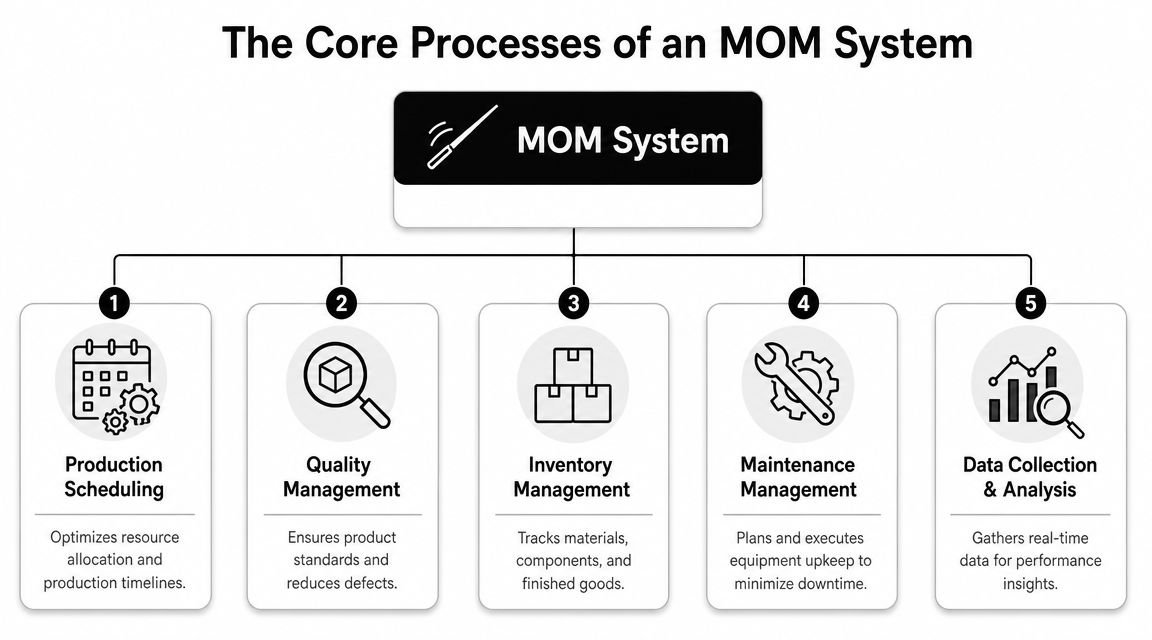
A useful way to think about MOM is as the conductor of a factory. The machines, operators, planners, quality staff, and technicians all know their part. What breaks down is timing, coordination, and feedback. MOM's job is to keep the whole operation playing from the same score.
Why MOM behaves like an orchestration layer
The simplest mistake is treating MOM and MES as the same thing. They overlap, but they don't do the same job.
MES is closer to point-of-production execution. It handles shop-floor data capture, execution detail, compliance support, and quality control within production. MOM sits above that level. It coordinates planning, scheduling, maintenance, quality, inventory, and supply-chain flow across the manufacturing lifecycle. That distinction is outlined clearly in this explanation of how MOM differs from MES and integrates ERP, PLM, and SCM systems.
When that orchestration layer is missing, every department optimizes locally. Production pushes output. Quality protects release. Maintenance fights urgent failures. Planning keeps rescheduling around incomplete information. Each group does rational work, but the plant still underperforms because nobody is steering the full system.
The five operating pillars that matter on the floor
Most MOM conversations get too abstract. On the floor, the core processes are straightforward.
| Process | What it controls | What improves when it works |
|---|---|---|
| Production scheduling | Work order flow, priorities, labor, machine loading | Fewer schedule collisions, better throughput |
| Quality management | Checks, holds, deviations, traceability | Faster detection of defects, stronger compliance |
| Inventory management | Material availability, WIP visibility, part consumption | Less waiting, fewer shortages, cleaner handoffs |
| Maintenance management | Preventive tasks, response to failures, equipment status | Reduced avoidable downtime, better asset readiness |
| Data collection and analysis | Machine states, operator inputs, event tracking, performance trends | Better decisions, less reporting error |
A strong MOM system unifies these functions instead of treating them as separate software islands. The practical payoff isn't elegance. It's fewer blind spots.
Here's what that looks like in daily use:
- Scheduling reflects reality: Planners can see whether capacity is available before releasing or changing work.
- Quality issues surface earlier: Nonconformances are tied to specific jobs, lots, stations, or process steps.
- Maintenance stops being reactive only: Equipment condition and stoppage data support smarter intervention.
- Inventory becomes operational, not just transactional: Teams know whether the line has what it needs now, not only what the ERP says should be there.
- Plant KPIs mean the same thing across teams: People stop arguing over whose spreadsheet is correct.
Practical rule: If your scheduling, quality, maintenance, and material decisions still depend on separate manual logs, you don't have an operations system. You have a collection of workarounds.
Key KPIs to Measure Manufacturing Performance
Plants collect a lot of numbers that don't help anyone make a decision. A useful KPI changes what a supervisor does on the next shift. If it doesn't help you act, it's probably just reporting.
Which KPIs actually help you run the plant
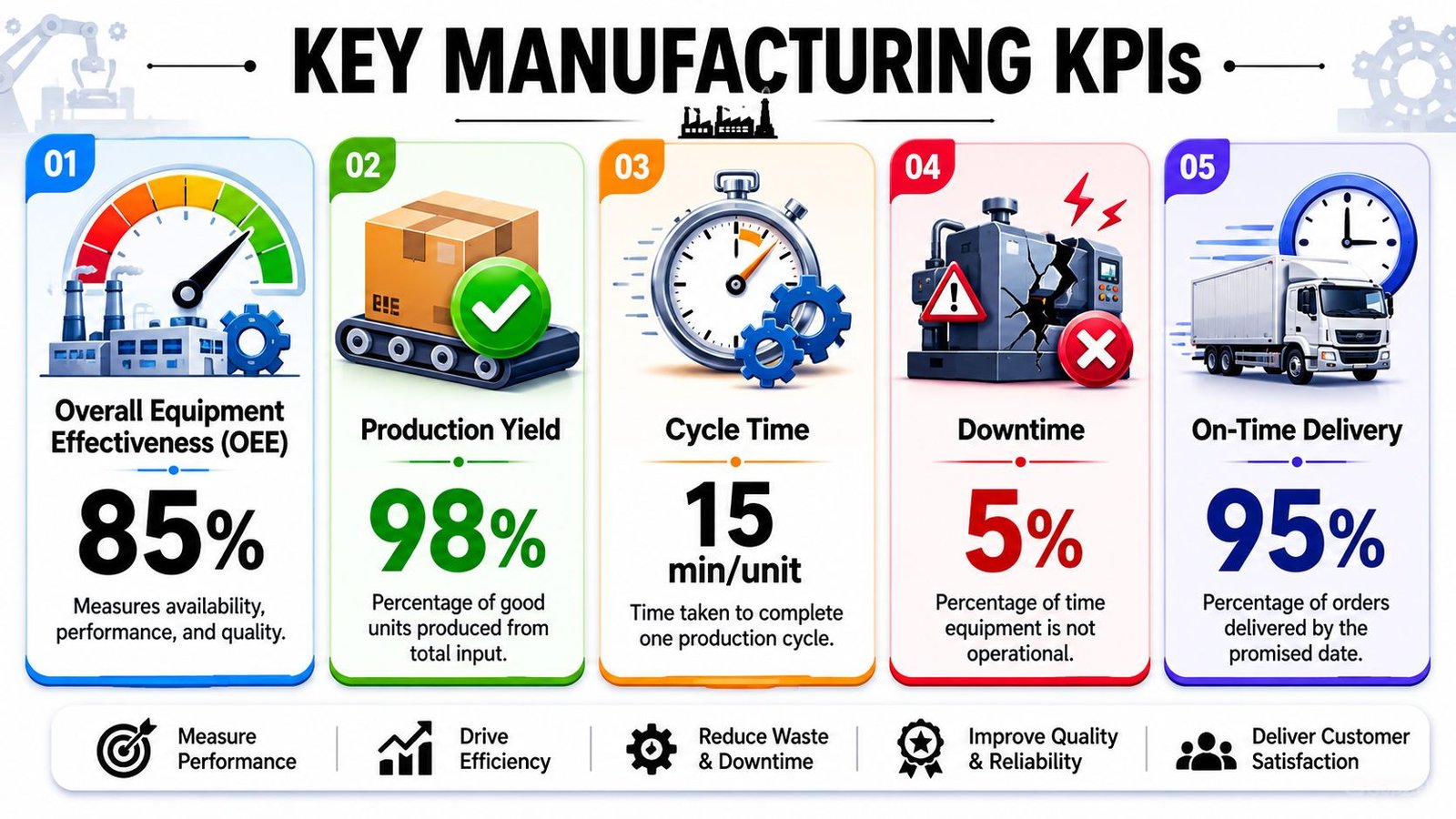
A practical KPI set is small enough to manage and specific enough to expose real constraints.
OEE is one of the most useful metrics when it's based on actual machine data instead of estimates. In a high-value MOM deployment, connecting bottleneck and legacy assets first lets the system automatically collect the data needed to calculate OEE, which combines uptime, speed, and quality. That approach creates the biggest impact on throughput and reduces human error in reporting, as described in this guidance on machine connectivity and OEE-driven improvement.
That's why many plants begin with constrained assets and machine monitoring software for production visibility, not with a plant-wide dashboard project. The bottleneck tells you more than the average.
Other KPIs matter because they answer different questions:
- Cycle time: Are jobs taking longer than the routing assumes, and where does the delay start?
- First pass yield: Are you making good product the first time, or hiding waste inside rework loops?
- Downtime by reason: Are losses mechanical, changeover-related, waiting on material, or caused by operator interruptions?
- On-time delivery: Is the plant's internal instability starting to show up in customer performance?
- Production yield: Are material losses or process variation eroding margin before anyone sees it in finance?
What these metrics reveal when you read them together
Single KPIs can mislead. OEE can look acceptable while on-time delivery slips because schedule changes are chaotic. First pass yield can appear stable while cycle time expands because operators are compensating for poor fixture design or inconsistent part presentation.
A better approach is to read KPIs as a system.
For example:
- Low OEE and high downtime usually point to equipment reliability, setup discipline, or poor response to stoppages.
- Normal uptime with weak first pass yield often points to process control, training, tooling wear, or inspection timing.
- Stable cycle time but poor delivery can indicate scheduling logic, material flow problems, or release bottlenecks outside production.
- Good output with rising inventory suggests the plant is producing, but not in the sequence or mix the business needs.
Industry guidance around MOM also emphasizes tracking production output, yields, material costs, quality, inventory levels, and downtime as part of continuous improvement. The key is not to flood the plant with measurements. The key is to select KPIs that reveal where labor, equipment, and material are being wasted.
When KPI definitions change by department, improvement efforts stall. One shared definition matters more than one more dashboard.
Finding Your Automation Sweet Spot
Most manufacturers don't need to jump from manual work straight to a fully automated line. In fact, that move often creates more risk than value. The better answer is usually semi-automation. It keeps skilled operators where they add judgment and dexterity, while using fixtures, controls, sensors, guided workflows, and data capture to remove variability.
Why semi-automation fits many small and mid-sized plants
Small and mid-sized operations live with practical constraints. Product mix changes. Volumes fluctuate. Engineering resources are limited. Capital has to compete with every other priority in the business. In that environment, full automation can become too rigid, too expensive, or too slow to deliver.
Semi-automation solves a different problem. It doesn't try to automate every touch. It targets the steps where inconsistency, manual data entry, or poor ergonomics create repeat losses.
Good applications include:
- Guided assembly stations: The workstation prompts the operator, verifies the sequence, and records completion without adding paperwork.
- Smart tooling: Torque tools, presses, and poka-yoke devices confirm the process happened correctly before the part moves on.
- Data-capture fixtures: The fixture identifies the part or lot, ties it to the job, and records the result at the point of work.
- Operator-assisted cells: The operator loads and unloads while the machine handles the repeatable action that benefits most from control.
This is often the sweet spot because it improves repeatability without stripping away flexibility. It also gives the plant a clean path to MOM by generating reliable event data at the actual point of production.
For plants evaluating options, custom automation system design for mixed manual and automated processes is usually more valuable than a generic platform promise. The right level of automation depends on the process, not the marketing.
Where regulated manufacturers should focus first
Medical device and other GMP-aware environments have an added challenge. They don't just need output. They need traceability, controlled processes, and records that stand up to review.
That doesn't mean the answer must be a full enterprise MES from day one. In many regulated operations, the first wins come from semi-automated controls around the riskiest steps:
- Electronic work instructions to reduce variation in operator execution
- Part and lot traceability at the station level
- Interlocked quality checks so the process can't proceed without required verification
- Digital capture of process results to improve batch or device history records
- Fixture-based error prevention where incorrect orientation or component mismatch is a known failure mode
What doesn't work is bolting on digital paperwork after the fact. If the operator does the work manually and then records it later, traceability remains fragile. The stronger model is to build verification into the process itself.
In regulated manufacturing, compliance is easiest when the workstation naturally creates the right record as the work happens.
A Practical Roadmap for MOM Implementation
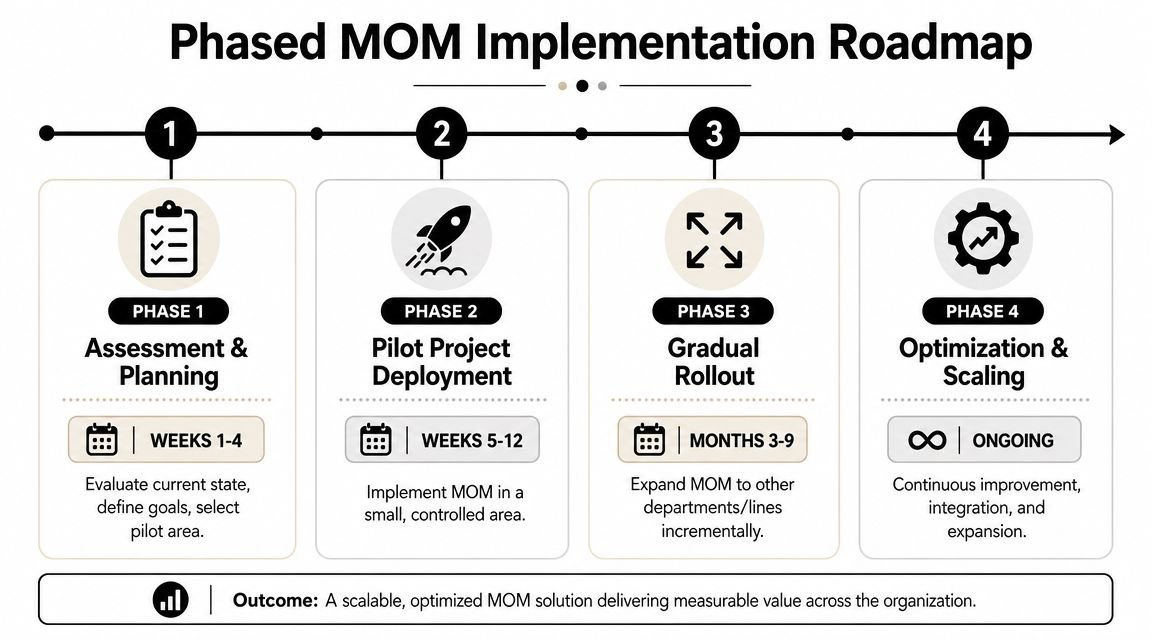
The biggest mistake in MOM implementation is starting with software selection before deciding what problem the plant is solving. If your team can't name the constraint, the rollout will drift into a broad IT project with weak adoption.
Phase one starts with visibility not ambition
Small and mid-sized plants usually get the best return by starting narrow. The most useful decision framework is to choose which functions to automate first, such as work instructions, traceability, downtime capture, or quality events, based on labor savings, compliance risk, and line constraints. That phased logic is captured well in this discussion of MOM sequencing for small and mid-sized manufacturers.
The first phase should answer basic questions with confidence:
- Where is the constraint
- What stops it most often
- How is downtime classified
- Which data is still being written down and re-entered
- Which quality checks are creating delay or risk
In many plants, this begins with one line, one cell, or one recurring pain point. The goal is a baseline, not a transformation announcement.
Then add control where operators feel the pain
Once the plant has trustworthy visibility, phase two should improve the workflow around the work itself. That usually means digital work instructions, guided checks, simple traceability, and event capture at the station.
A practical rollout often follows this order:
- Digitize downtime and reason codes on the bottleneck asset.
- Add digital work instructions where operator variation causes scrap, rework, or training issues.
- Capture quality events at the point of use instead of on paper after the shift.
- Introduce material or lot traceability where compliance risk or recall exposure is highest.
- Connect scheduling inputs only after shop-floor data is stable.
That order matters. Plants often try to integrate scheduling too early, before the floor data is clean enough to support it. Then nobody trusts the system because the schedule looks organized while the execution data underneath it is still unreliable.
When older equipment is part of the constraint, legacy system modernization for existing machines and controls is often the hinge point. You don't need to replace every legacy asset. You need enough connectivity and control to make the process visible and manageable.
Build the business case one constraint at a time
A good roadmap earns support because each phase solves a visible problem. Supervisors spend less time chasing updates. Operators stop duplicating entries. Maintenance gets clearer failure history. Quality gets cleaner records. Planning works from current information instead of yesterday's assumptions.
Use these decision criteria before expanding:
| Question | If yes | If no |
|---|---|---|
| Did the pilot reduce manual reporting effort | Expand the same model to similar stations | Fix workflow friction first |
| Do operators trust the event data | Standardize reason codes and dashboards | Improve input method and training |
| Can supervisors act on the KPIs | Add the next function in sequence | Simplify metrics and escalation rules |
| Did compliance or traceability improve | Extend to other high-risk steps | Redesign record capture at the source |
Plants get into trouble when they scale a bad pilot. Prove value in a contained area, then copy the principles, not every detail.
Common Pitfalls and Real-World Success Stories
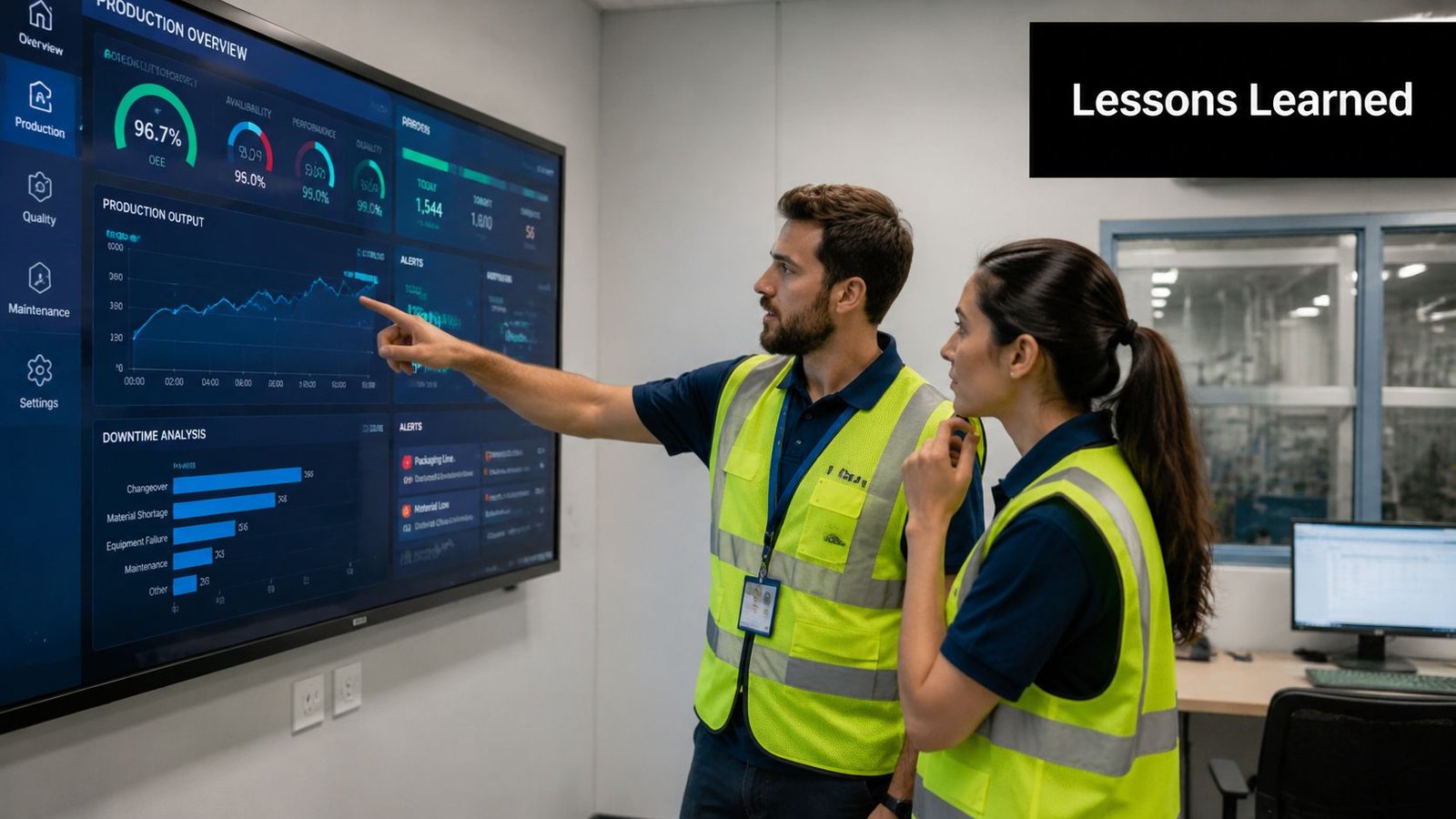
Most failed MOM efforts don't fail because the idea was wrong. They fail because the plant tried to digitize confusion. If the process is unclear, the system will make that confusion more visible, not solve it.
Why implementations stall
A few patterns show up repeatedly in struggling projects.
- Goals are too vague: “Improve efficiency” doesn't help anyone choose what to connect, what to measure, or what to automate first.
- The tool is too complex for the problem: A small plant trying to solve downtime capture doesn't need a giant architecture before it needs a reliable input method.
- The floor team is brought in too late: Operators and technicians know where the process really breaks. If they don't shape the workflow, adoption drops fast.
- Bad manual habits are copied into digital form: Ten paper fields become ten touchscreen fields, and the station gets slower instead of better.
- Leadership expects instant standardization: Different lines and products need local adjustment. Rigid uniformity too early usually creates workarounds.
One warning sign is when managers say the system is live, but supervisors still walk around with notebooks because they don't trust the screen. At that point, the project isn't complete. It's competing with reality.
A rollout succeeds when the digital method is easier than the old workaround.
What success looks like in real plants
Consider a small machine shop with recurring changeover delays. The first instinct might be to buy a broad platform. The better move is narrower. Start by capturing downtime and setup events on the bottleneck machine, standardize changeover steps, and give operators a simple digital checklist at the point of use. Once the data is consistent, the shop can see whether the issue is tool staging, first-piece approval, missing material, or setup sequence discipline. The gain comes from clarity and repeatability, not from software breadth.
A different example is a regulated manufacturer assembling high-mix products with paper-heavy records. A practical improvement is a semi-automated inspection or verification station that ties part identity, operator action, and quality confirmation together in one step. That reduces record gaps, shortens review effort, and improves traceability because the record is generated during the process instead of reconstructed later.
Both examples share the same pattern:
| Weak approach | Strong approach |
|---|---|
| Start everywhere at once | Pilot one constrained process |
| Automate broad functions first | Automate painful, repetitive, high-risk tasks first |
| Focus on reports | Focus on point-of-use control |
| Force the floor to adapt to the software | Configure the workflow around real plant behavior |
The common thread in real success stories is restraint. Plants get better results when they solve the next operational problem completely instead of partially digitizing ten problems at once.
Building Your Future-Ready Operation
Manufacturing operations management isn't reserved for large enterprises with massive digital budgets. For most plants, it's a practical operating model that starts with one stubborn problem and builds from there. Better downtime visibility. Cleaner work instructions. More reliable traceability. Less manual reporting. Those are not abstract transformation goals. They are daily operating improvements.
The strongest MOM strategies don't chase technology for its own sake. They connect process control, people, and data in a way the floor can use. That's why a phased approach works so well in small and mid-sized manufacturing. It respects budget limits, protects flexibility, and gives the plant time to standardize what matters before scaling.
If you're responsible for output, quality, or compliance, the right first question isn't “Which full platform should we buy?” It's “Where are we still managing by interruption, and what would happen if that one process became visible and controlled?”
Start there. One machine. One workstation. One quality checkpoint. One traceability gap. That's often enough to begin building a future-ready operation that performs with more consistency and less friction.
If you're looking for a practical partner to improve production without overbuilding the solution, System Engineering & Automation helps manufacturers design the right level of automation for the job. Their team supports semi-automatic, manual, and fully automated systems, along with tooling, fixtures, controls integration, installation, and commissioning. For plants that need better throughput, stronger quality, and GMP-aware execution without unnecessary complexity, SEA brings an engineering-first approach focused on what works on the shop floor.