Say your assembly line failed its last risk review because a torque check could be bypassed. The team added a control, then changed the fixture, updated the controller and increased production without repeating the review. Now a missed reading reaches packout, and nobody can show whether the original safeguard still works.
That's where a manufacturing risk assessment earns its place on the production schedule. Start with the line as operators run it, document how it can fail, and compare improvements against safety, quality, cybersecurity, validation and recovery, not cycle time alone.
Table of Contents
- Pick the Framework That Fits Your Line
- How to Run a Manufacturing Risk Assessment Step by Step
- Severity, Occurrence and Detection Scales to Use
- Compare Risk Across Manual, Semi-Automatic and Automated Options
- Validation Evidence and Reassessment Triggers for GMP Lines
- Book a Risk Review Before Your Next Line Change
Pick the Framework That Fits Your Line
The framework sets the questions your team asks. Choose poorly and you can produce a tidy register that misses the most dangerous part of the process. A component-focused review won't necessarily expose a solvent-release scenario, while a broad hazard workshop may miss repeated fixture errors that drive scrap.
Use the framework that matches the failure mechanism, then add another method only where it answers a different question.
Which framework fits which process
| Framework | Best for | Output | Scoring basis |
|---|---|---|---|
| FMEA (process or design) | Equipment, fixtures and multi-step processes | Ranked failure modes with corrective actions | Severity, occurrence and detection scales |
| HACCP | Food, beverage and device processes with contamination points | Critical control points with limits and monitoring | Hazard likelihood and severity, decision tree |
| 5×5 risk matrix | Quick triage of many hazards before deeper study | Risk bands from low to high | Likelihood against severity grid |
| Process hazard analysis (HAZOP or what-if) | Chemical, utility and high-energy processes | Deviations, consequences and safeguards | Team judgment against existing safeguards |
Failure mode and effects analysis, or FMEA, is a practical starting point for most semi-automated stations, fixtures and multi-step assembly processes. It connects a specific failure to its effect, existing controls and corrective action. Use design FMEA for equipment-design weaknesses and process FMEA for how production steps can go wrong.
A 5×5 risk matrix helps triage a long hazard list before committing engineering time to deeper analysis. It's useful for sorting work, but a colored square isn't evidence that a safeguard works.
Use HACCP when contamination control depends on identifying a critical point, setting an acceptable limit and monitoring it. For device processes, treat it as a targeted contamination-control tool, not a substitute for the broader product and production risk assessment.
Match the method to the highest-consequence hazard
Chemical handling and high-energy utilities call for process hazard analysis. The OSHA Process Safety Management standard, issued on February 24, 1992, made structured process hazard analysis mandatory for covered high-hazard chemical processes. Its broader engineering lesson is useful beyond those regulated operations: examine what could go wrong, identify consequences and safeguards, and keep those safeguards effective throughout the process life cycle.
That doesn't mean every automated line falls under PSM. It means machinery reviews shouldn't stop at normal production or assume operator training will compensate for weak process design.
Consider a dispensing cell using a solvent. Run a process hazard analysis on solvent storage, delivery, ventilation and release scenarios; run FMEA on the pump, nozzle, fixture and dispense verification. Merge both outputs into a single register so shared controls have clear ownership.
Practical rule: Choose the framework that fits the most dangerous part of the line. Use the others where they add a distinct view, not another spreadsheet.
How to Run a Manufacturing Risk Assessment Step by Step
Work from the physical process toward the score, not the other way around. If the team starts by filling cells in a template, it will tend to describe the intended process rather than the one operators use.
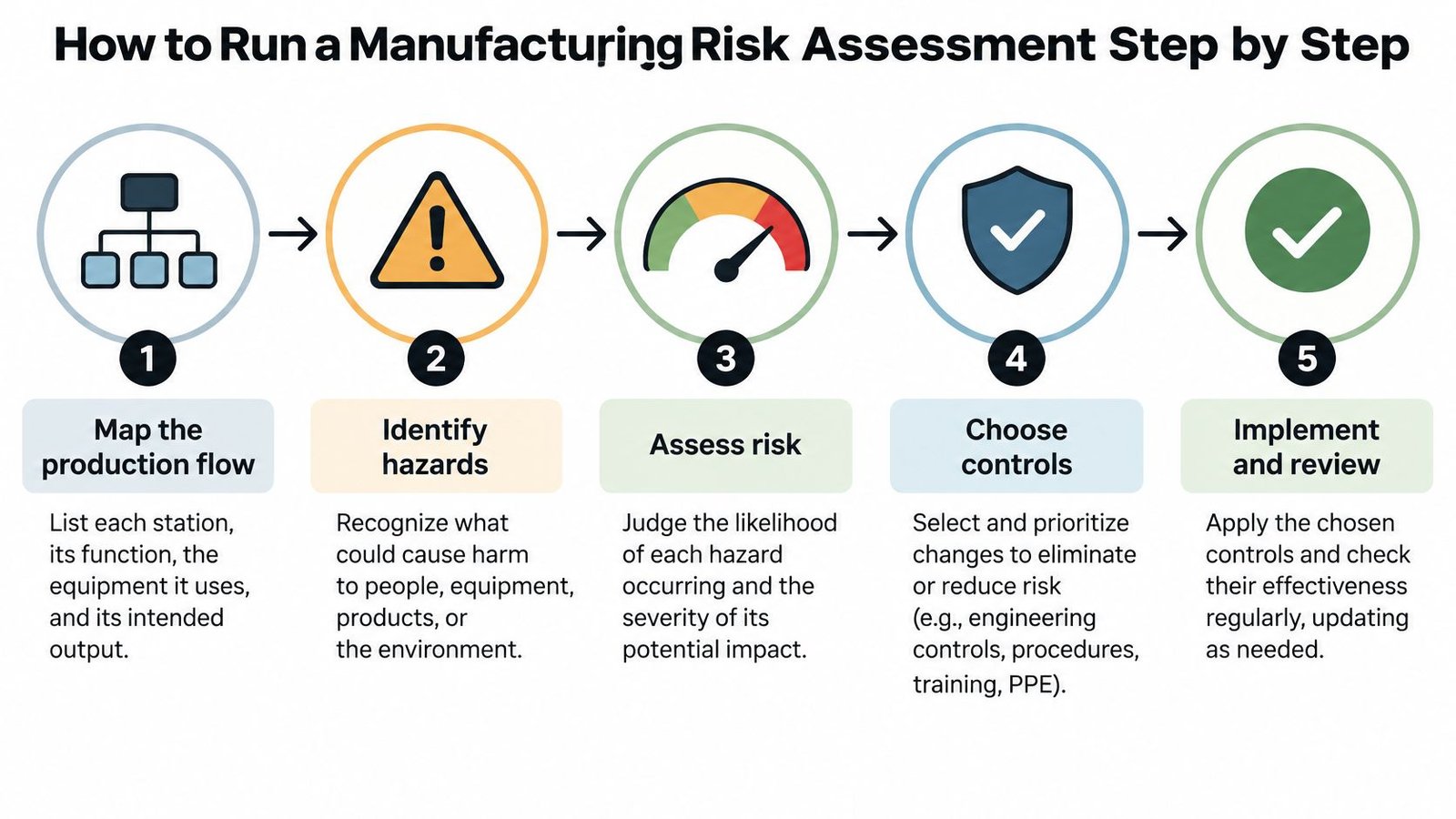
The workflow below summarizes the assessment cycle.
Build the assessment at the workstation
Map the production flow. List each station, its function, equipment, inputs and intended output, then walk the line with operators, maintenance and quality. Include setup, replenishment, changeover, jam clearing and restart because the production drawing rarely captures every operator interaction.
Identify failure modes using records and observation. Review maintenance reports, nonconformance logs, scrap records and operator explanations, recording frequency per shift, lot or production quantity wherever evidence exists. A disciplined hazard identification process helps the team distinguish the initiating cause, the failure itself and its consequence instead of combining them into a vague entry such as machine problem.
Score severity, occurrence and detection. Apply agreed anchors, identify the evidence behind each rating and mark estimates explicitly. Don't let a persuasive opinion carry the same weight as a documented failure history or a tested detection control.
Calculate and rank risk, then challenge the ranking. Review high-consequence events manually even when their multiplied scores look modest. Ask whether common utilities, shared software, maintenance practices or operator workarounds could defeat several controls together.
Assign actions that can be closed with evidence. Give each priority risk a corrective action, a named owner, a due date, a verification method and a residual-risk approver. Replace improve inspection with a testable instruction, such as reject the assembly when the controller has no valid torque result and challenge that response during verification.
Model station dependencies. Identify series steps that stop the whole line and parallel resources that provide alternative capacity. Include shared power, air, networks, tooling and inspection dependencies before treating apparently separate machines as independent.
Connect failure modes to delivery performance
A published production-system study combined FMEA with reliability-structure analysis and used shop-floor observations alongside maintenance-system reports. That combination matters because FMEA identifies what fails; the reliability view shows how failures affect the line's ability to complete an order.
A failed station may stop output immediately, consume a buffer gradually or be covered by another resource. Those are different production risks even when the failed component is identical. Use operating history, repair duration and actual routing constraints before estimating the probability of missing an order.
The common slip is at identification: teams list failures from memory and skip the maintenance log. Intermittent sensor faults, repeated resets and short stoppages then disappear from the assessment despite consuming maintenance attention and production time.
Our team evaluates manufacturers' production workflows to identify where automation can create the greatest impact. That evaluation needs the same evidence discipline: improving the visible bottleneck isn't enough if the change creates a harder-to-recover dependency elsewhere.
A finished assessment should show every station covered, every priority risk assigned and a reassessment date recorded. Unresolved assumptions belong in the action list, not hidden in scoring comments.
Severity, Occurrence and Detection Scales to Use
Consider a hypothetical torque station assembling a medical component. A missed reading receives severity 9, occurrence 3 as a provisional estimate after a fixture change, and detection 6 because someone checks the torque log only at the end of the shift. Those example scores produce an RPN of 162, but the serious consequence, not the arithmetic alone, should determine the response.
Treat the following as working reference anchors, not a universal compliance scale. Agree on product-specific definitions before scoring, especially where a seemingly minor functional defect could affect patient or operator safety.
Severity, occurrence and detection rating scale
| Rating | Severity | Detection |
|---|---|---|
| 10 | Hazard without warning, safety or regulatory breach | Defect cannot be detected |
| 9 | Hazard with warning, regulatory non-compliance | Very remote chance of detection |
| 8 | Primary function lost, product unusable | Remote chance of detection |
| 7 | Major loss of function, customer very dissatisfied | Very low chance of detection |
| 6 | Reduced function, customer dissatisfied | Low chance of detection |
| 5 | Comfort or convenience function lost | Moderate chance of detection |
| 4 | Minor defect noticed by most customers | Moderately high chance of detection |
| 3 | Minor defect noticed by some customers | High chance of detection |
| 2 | Minor nuisance, barely noticeable | Very high chance of detection |
| 1 | No effect | Almost certain detection |
Rate severity at the worst credible consequence, not the most convenient outcome. A warning doesn't make a hazardous event acceptable, and the distinction between the highest anchors must fit the process being assessed.
Rate detection against the control already operating, assuming it functions as intended. Also record when detection occurs: an end-of-shift review may identify a missing reading, but it doesn't prevent an affected assembly from advancing.
Give occurrence its own evidence-based anchors
Define occurrence bands using your logged failure rate and a consistent denominator. Don't compare failures per shift at one station with failures per lot at another without accounting for exposure.
- Use a clear numerator: Count the defined failure, not every alarm associated with it.
- Record the exposure: Include cycles, units, lots or operating time alongside the failure count.
- Separate estimates: Label provisional ratings and schedule a production-data review rather than implying precision.
For the hypothetical torque assessment, the team could revisit its estimated occurrence score after 90 days of production. That's a proposed review interval for the example, not a prescribed standard.
Calculate Risk Priority Number = severity × occurrence × detection. As an internal escalation rule, require action on any severity rating of 9 or 10, regardless of the total; action may include additional analysis, stronger controls or a documented decision by the authorized risk owner.
When adjacent scores both seem defensible, choose the higher score and record why. Resolve the uncertainty with evidence rather than averaging opinions.
Compare Risk Across Manual, Semi-Automatic and Automated Options
Automation removes some exposures and introduces others. A robot can eliminate repetitive handling while adding hazardous motion, software dependencies and a recovery procedure that requires specialist support.
Compare equipment options against the same operating conditions, product requirements and demand. Otherwise, the team may credit full automation with ideal performance while scoring manual work against its worst day.
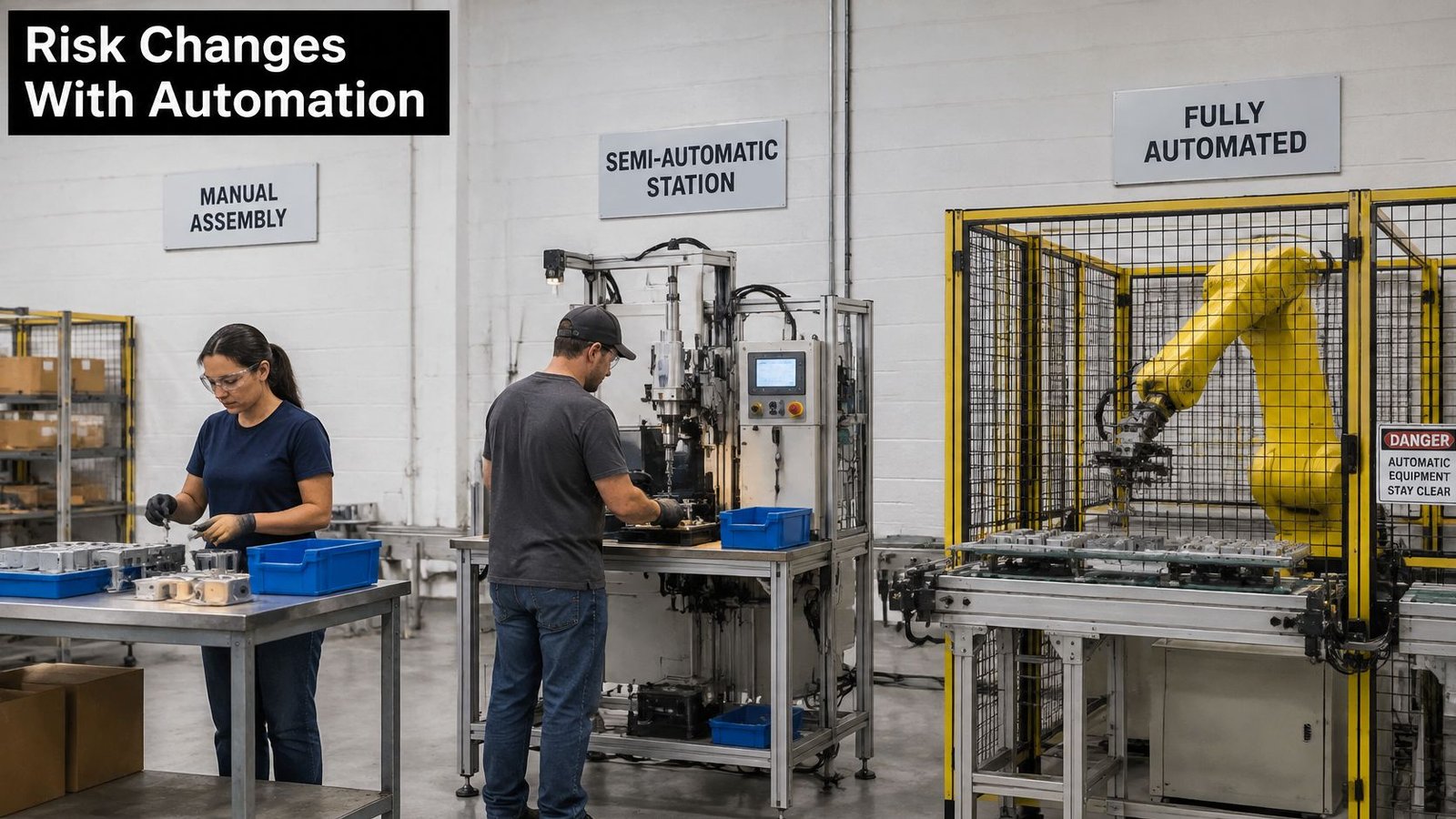
Risk profile by automation level
| Option | Main hazards | Cyber exposure | Validation burden | Recovery |
|---|---|---|---|---|
| Manual workstation | Operator error and ergonomics | None to low for an unconnected station | Low, mostly procedures, unless process validation is necessary | Simple manual recovery when safe and documented |
| Semi-automatic workstation | Pinch points, interlock bypass, operator-machine interface | Low to moderate with limited networking | Moderate, parameter and interlock checks | Operator retains control; manual fallback where designed |
| Fully automated line | Interlock faults, robotic motion, network loss, data corruption | High when networked or remotely accessible | High, software validation and change control | Governed by tested backups and the recovery plan |
Manual equipment is typically recommended when production demand is low or the goal is better quality than traditional hand operations. Semi-automatic workstations can automate repetitive assembly, packaging, inspection or testing while the operator retains process control. That can reduce complexity, but operator involvement alone doesn't make a station safe.
The practical comparison between semi-automatic and fully automatic equipment should include recoverability and lifecycle support alongside throughput. Neither automation level deserves a favorable risk score because it uses newer equipment.
Make cybersecurity consequences physical
Define the assessment boundary around controllers, HMIs, robots, sensors, networks, engineering workstations, remote access and enterprise interfaces. Document assets and dependencies, then categorize consequences separately for safety, environment, product quality, equipment damage, downtime and recovery.
The NIST manufacturing cybersecurity profile draft recommends calculating, documenting, categorizing and prioritizing cybersecurity risks with manufacturing's operational consequences in view. An IT-only checklist won't explain what an altered recipe does to a press.
Suppose a remote change modifies a semi-automatic press recipe, increasing force without an alarm. Connect that scenario to an independently enforced force limit, authorized recipe changes, change logging and a qualified fallback method. Verify restoration from a known-good configuration rather than assuming a saved file is usable.
Apply mitigation in a deliberate order:
- Remove the hazard by design. Consider lower-complexity equipment where it eliminates an exposure, but don't mistake manual intervention for safer design.
- Add guarding and interlocks. Test hazardous motion, access and restart behavior.
- Protect connected assets. Apply network segmentation and controlled, authorized remote access.
- Support the controls operationally. Define procedures, training and alarm response.
Record residual risk after each change so reviewers can distinguish hazard removal from risk reduction. Before approving full automation, ask: Would the lower-complexity option deliver the required safety and quality with less exposure and easier recovery?
Validation Evidence and Reassessment Triggers for GMP Lines
When process results cannot be fully verified through later inspection and testing, validation must demonstrate consistent output against predetermined specifications, as described in FDA process-validation guidance. The risk register can support that evidence, but it doesn't replace an approved validation protocol or its results.
For example, replacing a torque controller in a medical-device assembly cell triggers a validation-impact review. Define the affected functions, revalidate the torque step to the justified extent, and update the register entry covering missing readings, acceptance decisions and product release.
Link each hazard to signed evidence
A validated process needs a defined product and process flow, identified validation needs, protocols, specifications and approved records with dates and signatures. Qualified personnel must use equipment that meets established requirements, while production teams monitor and control critical parameters.
Use a shared hazard reference across the risk register, test protocol, deviation record and approval. That gives quality and operations a traceable route from the concern to the evidence that the control works.
Risk register fields
| Field | What to record | Example |
|---|---|---|
| Hazard ID | Unique reference for the failure mode or cyber scenario | TORQUE-MISSING-READING |
| Station | Equipment and station where the hazard sits | Torque station, assembly cell 2 |
| Failure mode | What goes wrong and the consequence | Missed torque reading passes to packout |
| Severity, occurrence, detection | Scores from the scales with the data source | Illustrative S9/O3/D6; consequence review, provisional occurrence estimate, log-review method |
| Control | Existing or planned control, including manual fallback | Torque log checked each shift; inline check and qualified fallback planned |
| Owner | One named person for the action | Named process engineer, not department alone |
| Due date | Date the action must be complete | Calendar date agreed at review |
| Verification evidence | Test, record or inspection proving the control works | Torque verification run with results |
| Residual risk | Scores after the control is in place | Retain severity; reassess occurrence and detection from completed testing |
| Approval signature | Dated sign-off by quality and operations | Quality manager and operations approver, dated |
Don't reduce residual scores because equipment has been ordered or code has been written. Reduce them only when verification supports the change.
Reopen the register when assumptions change
Build reassessment triggers into change control rather than relying on someone to remember the spreadsheet. Practical good automated manufacturing practices connect equipment decisions, software behavior and controlled production evidence.
- Software or firmware changes: Review acceptance logic, interfaces, permissions and stored records.
- Cybersecurity incidents: Establish whether recipes, calibration, configurations or product records remain trustworthy.
- Process drift: Investigate trends before accepting a wider operating window.
- Supplier changes: Check materials, components and replacement-part equivalence.
- Safety-function modifications: Reassess access, stopping and restart conditions.
- Validated-parameter deviations: Evaluate affected product and the continued suitability of the process.
Interview operators about the steps they take, including workarounds during faults. For every automated station, document a manual fallback and recovery-time target where continued operation is safe, qualified and feasible; otherwise, specify a controlled stop and recovery route.
A register written once and filed isn't a control. Reopen it when the process no longer matches the assumptions that supported approval.
Book a Risk Review Before Your Next Line Change
Choose a line or workstation this week and review it before approving its next change. Gather the process flow, the last six months of failure and maintenance records, the current risk register, the network and remote-access diagram, and a clear description of the proposed modification.
Don't postpone the review because a document is missing. Record the gap and assign someone to obtain the evidence before the decision depends on it.
Arrive with a decision package
Bring these outputs into the consultation so the discussion starts with your line rather than a generic template:
- Scored register: Defined failure modes, current controls and evidence behind the ratings.
- Ranked priorities: Top risks with named owners and completion dates.
- Validation impact note: Affected processes and evidence needs where GMP requirements apply.
- Reassessment date: A scheduled review supported by explicit change triggers.
In our no-obligation consultation, we work to understand current bottlenecks, labor and production constraints, quality or consistency concerns, and budget and timeline expectations. We evaluate where automation can have the greatest impact without assuming the most automated option is the right answer.
Our support extends from concepts and design through manufacturing drawings, sourcing, installation and commissioning, backed by a one-year guarantee. Our Safety Enhancements service identifies risks and engineers solutions that protect the workforce.
Call when labor shortages slow production, quality issues affect your reputation, recurring bottlenecks delay orders, or the process could run smarter. Bring the decision package so we can discuss a practical change against your production needs.
System Engineering & Automation offers manufacturing engineering, automation and safety improvements grounded in your production constraints. Visit System Engineering & Automation to book a no-obligation consultation, and bring your risk register, priority actions and planned line change so we can assess the next step together.