You've got a line running, orders in the queue, and one station that keeps turning into a bottleneck. Someone on your team types automation services near me, and the results look busy, but not useful, home-automation listings, generic lead-gen pages, and vendors who can talk about equipment but not about your product flow. That's the trap. Proximity can help, but only if the partner can improve output, quality, and uptime on a manufacturing floor.
Manufacturers don't need a vendor who can sell a box. They need someone who can look at the work, decide what should stay manual, what should be semi-automated, and where custom tooling or controls will reduce friction without trapping the plant in a brittle design. That's especially true when the goal is to optimize production and services, not just buy machinery. For a quick reality check on how broad the search can be, see this local manufacturing vendor resource.
Table of Contents
- Why Finding the Right Local Automation Partner Matters
- Defining Your Automation Scope and Production Needs
- Building a Realistic Automation Budget and ROI Case
- Vetting Local Automation Providers With a Structured Checklist
- What to Look for During a Site Visit and Scoping Conversation
- Navigating GMP and Quality Requirements in Regulated Manufacturing
- Taking the Next Step Toward Smarter Production
Why Finding the Right Local Automation Partner Matters
An operations manager usually starts with urgency. A line is underperforming, a labor gap is widening, or quality checks are too dependent on a few experienced operators. The first search is often automation services near me, but the first page rarely answers the core question, which is whether the provider understands production constraints, changeover pain, and how to keep a line supportable after startup.
That matters because the market itself has moved far beyond a handful of niche integrators. The U.S. home automation services industry counted 712 businesses in 2024, up from 654 in 2023, and it grew 14.0% annually on average from 2019 to 2024. IBISWorld also projects U.S. industry revenue at $36.2 billion in 2026 with 5.7% CAGR from 2019 to 2024. Those figures point to a service category that's now substantial, not experimental, and that growth helps explain why manufacturers are looking for local automation support instead of relying only on in-house engineering expertise. IBISWorld industry data
Proximity Is Useful, Capability Is Decisive
Local presence still matters. A nearby provider can get to the plant faster, see the process in person, and respond more quickly when commissioning exposes a fault that nobody predicted in the proposal stage. But speed only helps if the provider can cover the full lifecycle, design, specify, build, install, program, train, and maintain.
Practical rule: A vendor that can't explain how it supports a system after handoff is not a partner, it's a quote.
That's where a lot of searches fail. The results are crowded with companies that are optimized for lead capture, not manufacturing outcomes. The right partner needs to understand downtime windows, operator ergonomics, quality checkpoints, and the reality that a “simple” retrofit can become a production problem if material flow, utilities, or acceptance testing are under-scoped.
The better lens is not “who is closest,” it's “who can reduce risk from concept through commissioning.” That lens changes the conversation immediately. It moves the discussion from price shopping to production reliability, from brochure language to lifecycle support, and from generic automation claims to the hard work of making a line perform on Tuesday morning, not just in the demo room.
Defining Your Automation Scope and Production Needs
Before any vendor visit, the scope has to be clear enough that the conversation stays grounded. The worst projects I've seen started with a broad wish list and no boundary between what needed automation, what needed tooling, and what still required a human decision. That's how budgets drift and timelines slip.
Match the Automation Level to the Task
A useful way to frame the work is by task type. Manual with custom tooling works best where the operator still needs judgment, but the process is slowed by awkward handling, inconsistent positioning, or repeatability problems. Semi-automated workstations fit repetitive or error-prone steps, especially assembly, inspection, part presentation, and packaging. Fully automated lines make sense when the process is stable, high-volume, and well understood.
McKinsey's analysis supports that selective approach. It found that 60% of all occupations have at least 30% of activities that could be automated, but only a minority of work in most roles is fully automatable. That's why semi-automation often delivers the cleanest fit for small and mid-sized manufacturers. It lets you automate the repetitive step without forcing the whole process into a rigid machine-centered design. McKinsey automation analysis
The practical question is simple. Which steps are repetitive, measurable, and error-prone, and which ones depend on human judgment, exception handling, or product variation?
- Assembly stations: Automate part location, fastening, or dispense control where cycle consistency matters.
- Inspection points: Use guided fixtures or vision-supported checks where operator variation is creating scrap.
- Packaging lines: Target case packing, labeling, or transfer points when throughput is being lost to manual handling.
Write the Scope in Production Language
Don't hand a vendor a vague wish list. Describe the current state, the defect modes, the handoffs, the takt pressure, and the quality checkpoints. If you know the painful step, name it. If you know the product family that causes the most trouble, say that too.
The best scope documents don't describe machinery first. They describe the production problem first, then map the machine to it.
That approach keeps the vendor honest. It also makes it easier to compare semi-automated, fully automated, and tooling-based options without falling into the false assumption that more automation automatically means better economics. In many plants, the right answer is targeted, not total.
Building a Realistic Automation Budget and ROI Case
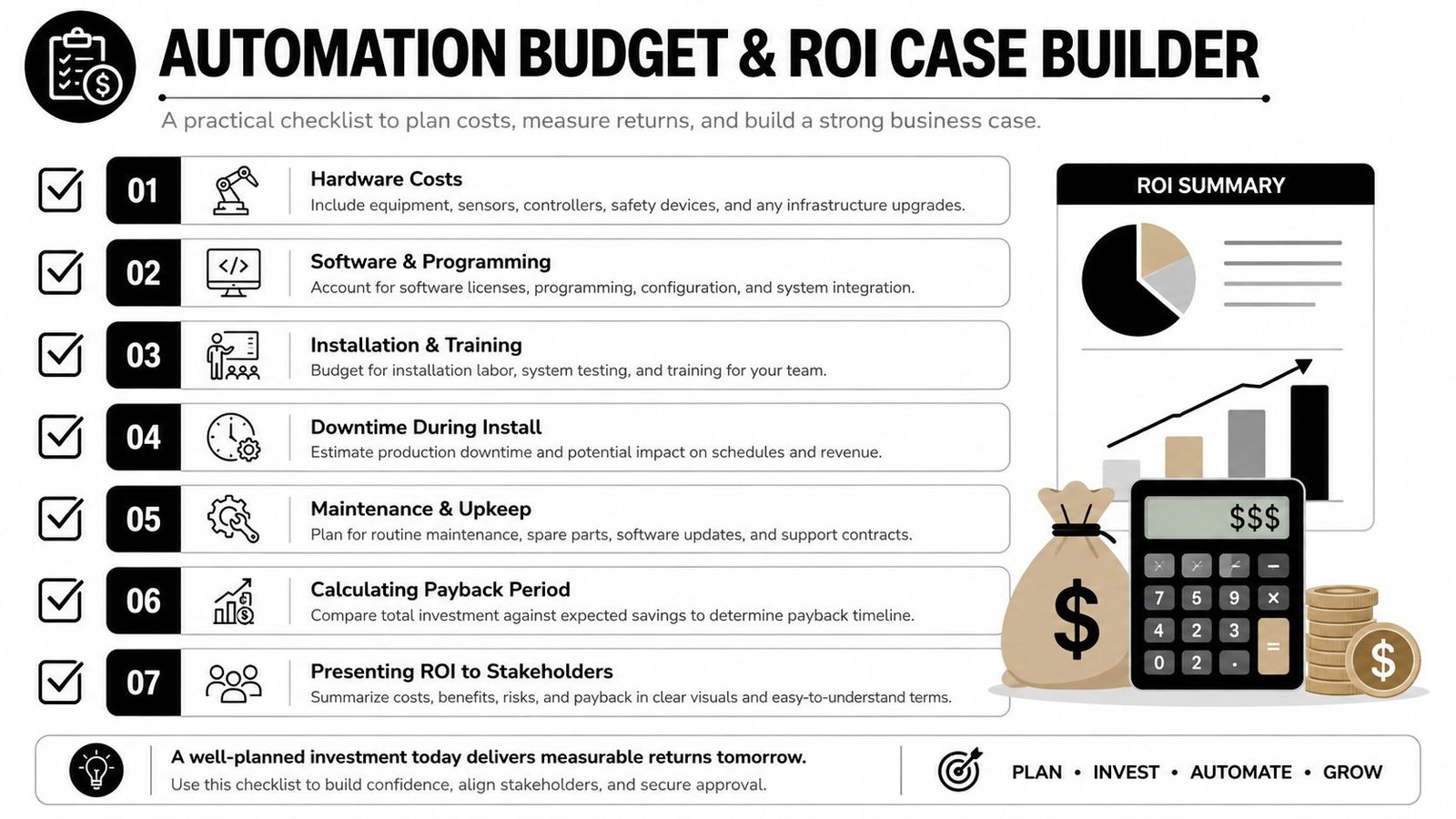
Budget failures usually start with optimism. A team prices the equipment, adds a rough installation allowance, and sends it up as a capex request. That misses the full cost structure, because a manufacturing automation project usually includes hardware, software, programming, integration, labor, testing, startup support, and maintenance.
The earlier the team names those categories, the fewer surprises show up late. That matters even more when data and workflow complexity are involved, because those are the hidden variables that can stretch both timelines and scope, and a "simple" retrofit can become a production problem if material flow, utilities, or acceptance testing are under-scoped.
Build the Budget Around the Whole Delivery
A credible budget should separate line items, not blur them together. Hardware costs are only one part. You also need software and programming, installation and training, downtime during install, and maintenance and upkeep. If the proposal includes integration work, that should be visible too, because integration is where many projects become more complex than the original quote implied.
The implementation benchmark from DataSpeaks is useful here. It describes an 8 to 12 week delivery window when discovery, workflow mapping, and success-metric definition happen in the first two weeks, and it also notes a 94.12% success rate tied to intelligent retry logic and zero-touch provisioning in under 5 minutes. The lesson is the discipline behind it. Lock acceptance criteria and exception-handling rules before buildout, or ambiguity becomes a cost later. Implementation planning benchmark
Translate ROI Into Plant Logic
Finance teams do not approve automation because the machine looks elegant. They approve it because the project reduces labor dependency, improves throughput, cuts scrap, or stabilizes quality. The payback case should connect directly to those operational levers. If the proposed system only shifts labor from one station to another, the return is weak. If it removes rework, reduces changeover pain, and smooths output, the case becomes stronger.
Use the same language your plant already tracks. Cycle time, scrap, uptime, rework, and staffing flexibility are much more persuasive than broad promises. The point is to show how the project pays back in actual plant performance, not in abstract technology enthusiasm.
For a practical starting point, use this ROI calculator resource to structure the internal conversation. Then compare that internal view against the vendor's estimate. If the vendor cannot explain how each cost category affects the payback period, the quote probably is not mature enough.
Vetting Local Automation Providers With a Structured Checklist
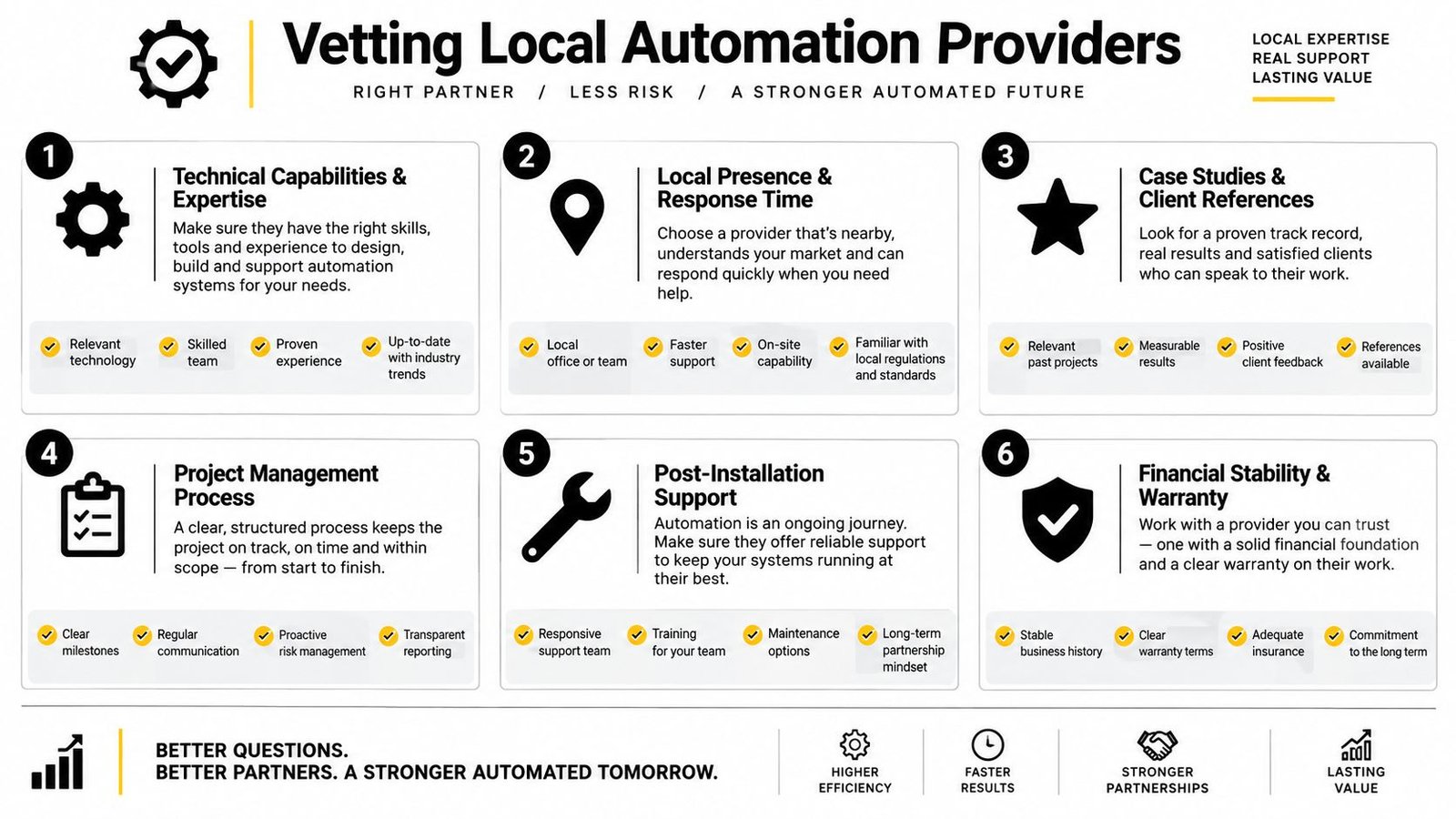
The fastest way to separate serious providers from sales-driven ones is to stop asking, “Can you do automation?” and start asking, “What part of the lifecycle do you own?” A provider that only installs off-the-shelf components is not the same as one that can design, build, program, train, and maintain a system that survives real production use.
Check the Lifecycle, Not Just the Pitch
A3's system-integration guidance is a good benchmark because it makes the lifecycle explicit. Integrators can design, specify, build, install, program, train, and maintain systems, so the buyer should confirm which of those functions the vendor handles. Thumbtack's estimating guidance also points to a practical standard, estimates should be itemized and include hardware, labor, programming fees, timeline, and integration details, along with license, insurance, and post-install training and support questions. A3 system integration guidance
That's the right standard for manufacturing too. If the estimate hides programming inside a vague lump sum, or if maintenance support is treated as an afterthought, you're likely looking at a handoff gap. Those gaps always end up on the plant side.
Ask for Proof, Not Promises
A capable local provider should be able to show relevant project examples, explain how it handled troubleshooting, and describe the support model after startup. Don't accept generic “we've done many projects” language. Ask for examples close to your process, your industry, or your compliance burden.
Use this checklist:
- Technical capability: Can they design custom systems, or only assemble off-the-shelf parts?
- Industry fit: Have they worked in manufacturing, and better yet, in your product category?
- References and outcomes: Can they explain what changed after the project launched?
- Warranty terms: What's covered, what's excluded, and how is response handled?
- Support model: Who maintains the system after handoff?
- Training: Will your operators and maintenance team get usable training, not just a quick walk-through?
Don't Skip Business Risk Checks
License, insurance, financial stability, and service responsiveness matter because automation projects fail in the gaps between design and operation. A provider can have impressive technical language and still leave you with poor documentation or no clear path to support. The best partners are confident enough to discuss warranty terms, maintainability, and what happens when a component fails on a Friday afternoon.
If a provider avoids maintenance questions, assume maintenance will become your problem.
That's the simplest filter I know. It saves time, and it keeps the plant from becoming the test bed for someone else's learning curve.
What to Look for During a Site Visit and Scoping Conversation
The site visit is where the brochure stops mattering. You can tell a lot from the first ten minutes. Strong providers ask about bottlenecks, quality issues, upstream and downstream effects, and operator pain points. Weak ones jump straight to equipment names and configuration options.
Watch How They Study the Floor
A serious scoping conversation starts with observation. The provider should want to see the process as it runs, including the messy parts, not just the ideal path. That means watching material handling, handoffs, rework loops, downtime patterns, and how operators work around the current process.
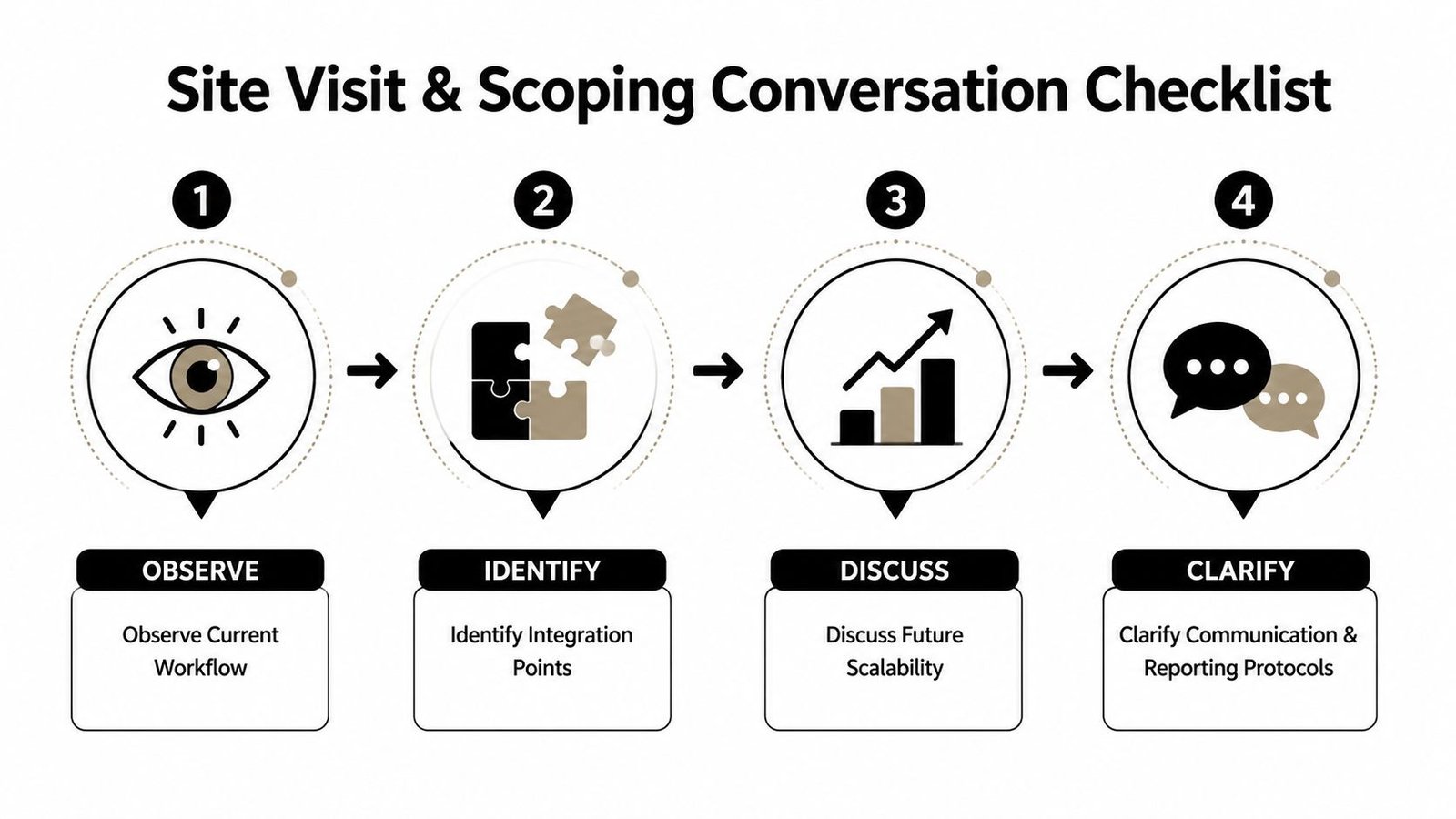
If the vendor doesn't ask where the variability lives, they don't yet understand your process. If they do ask, pay attention to whether the answers get translated into a practical concept or just into a generic machine proposal.
Compare the Questions That Matter
There are a few scoping questions that expose whether the provider is thinking like a builder or a salesperson.
- Timeline clarity: What happens from concept to commissioning, and what has to happen before buildout starts?
- Change order handling: Who approves scope changes, and how are they documented?
- Material sourcing: Who owns long-lead items, substitutions, and supply timing?
- Acceptance testing: What does success look like before the system is handed over?
- Communication cadence: How often will the team hear from the provider during build and startup?
A vague answer on any of those points is a warning sign. So is a provider that cannot explain its design process in plain language. The good ones don't hide behind jargon. They talk through trade-offs, downtime windows, and what the system can do on day one versus after tuning.
Read the Red Flags Early
Two patterns show up often. One is the vendor who promises speed but can't explain how it will handle exceptions. The other is the vendor who avoids maintenance questions because post-install support isn't part of its normal operating model. Neither one is a good fit for a production environment where uptime matters.
A vendor who listens carefully, documents clearly, and asks good questions is already reducing project risk. A vendor who tries to close the sale in the parking lot is usually creating it.
Navigating GMP and Quality Requirements in Regulated Manufacturing
In regulated manufacturing, the wrong automation choice can create a compliance problem even if it improves speed. That's why GMP-aware design is not a side topic. It shapes equipment layout, surface choices, cleaning access, maintenance planning, and validation documentation from the start.
The FDA's current GMP rule for finished pharmaceuticals requires that equipment used in production be appropriately designed, adequately sized, and suitably located to support operations, cleaning, and maintenance, and that it be maintained at appropriate intervals to prevent malfunctions or contamination. The rule also requires written procedures for equipment cleaning and maintenance. For regulated plants, that means the automation decision and the validation plan can't be separated. FDA GMP overview
Design Around Cleaning and Contamination Control
A machine that's fast but hard to clean is a liability. So is a fixture that traps residue, a layout that blocks access, or a control approach that makes maintenance harder than it needs to be. In a medical device or pharmaceutical environment, those shortcomings show up quickly during audits and routine quality review.
That's why materials, finish, access, and maintenance path matter so much. The equipment has to support sanitation cycles, routine inspection, and reliable operation over time. A good automation partner thinks about those constraints while the concept is still fluid, not after the drawings are already locked.
Build Validation Into the Scope
For manufacturers in regulated industries, the project should include documentation discipline, change control, and clear acceptance criteria. If the provider treats validation as a separate problem, you'll lose time and create rework. If the provider designs with GMP constraints in mind, the project is easier to defend during quality review and simpler to maintain after launch.
For a deeper manufacturing-specific view of those constraints, see this GMP manufacturing reference. The key takeaway is straightforward. In regulated environments, automation has to fit the process, the sanitation routine, and the documentation burden, not just the throughput target.
A semi-automated cell with the right tooling can be safer and easier to validate than a more aggressive full-line build that's hard to clean, hard to inspect, and hard to support. That's not a compromise. It's good engineering.
Taking the Next Step Toward Smarter Production
The best local automation partner is the one that understands your line, your budget, and your support needs after startup. That sounds basic, but it's exactly where many searches go wrong. Proximity helps, yet what really matters is whether the provider can improve output without creating a maintenance burden the plant can't carry.
System Engineering & Automation fits that model for manufacturers that want a practical, semi-automation-first approach. SEA brings 30+ years of engineering experience, builds custom tooling and fixtures when they solve the core problem, and supports regulated work with GMP-aware practices. The company also backs projects with end-to-end support and a one-year guarantee, which matters when you're trying to move from concept to stable production without unnecessary risk.
If you're evaluating automation services near me, focus on lifecycle support, realistic ROI, and a partner who understands the floor, not just the proposal. The right conversation should leave you with a clearer process, a better scope, and a path to smarter production.