Most plants don't have a machine problem. They have a connection problem. Buying another robot, conveyor, or vision system won't fix a line if the data still dies at the handoff between PLCs, SCADA, MES, and ERP, and that's exactly why so many automation projects underperform.
The blunt truth is this, automation system integration pays back when you connect what you already own, not when you keep adding islands of equipment. The advantage goes to the plant that can move reliable data from the floor into planning, quality, and finance, because that's where decisions get made.
Table of Contents
- Why Most Automation Investments Underperform
- What Automation System Integration Actually Means
- The Five Layers of an Integrated Stack
- Project Phases From Consultation to Validation
- ROI and Cost Factors Manufacturers Actually Track
- When Semi-Automated Beats Full Automation
- Common Pitfalls and How to Avoid Them
- Choosing the Right Integration Partner
Why Most Automation Investments Underperform
Plant managers love equipment because equipment is visible. It's easy to walk the floor, point at a robot cell, and say money was spent. The problem is that throughput doesn't improve just because the hardware is new, especially when the seam between systems stays manual.
A better way to think about it is simple. The expensive part of many projects isn't the robot arm or the conveyor, it's the missing connective layer that lets production data reach the people who can act on it. In practice, that gap shows up as manual transcription, late reports, and decisions made after the shift has already lost time.
Practical rule: if a new asset doesn't reduce manual handoffs, it's probably just a nicer way to spend capital.
The market evidence backs that up. A 2026 North American factory automation report found that higher-success firms were 3 to 4 times more likely to have fully integrated automation across the stack, with fully integrated rates reaching 62% for enterprise applications, 55% for manufacturing operations management, 60% for process monitoring, and 74% for physical-device monitoring among high-success firms. The same report said only 30% of automobile makers had integrated automation systems with enterprise-wide platforms, and just 15% of companies had fully integrated structured automation data for analytics and decision-making, which is a clean warning that hardware alone isn't the win. MarketScale summary of the 2026 factory automation report
The right KPI isn't “how many robots did we buy.” It's how many production decisions are now fed by connected data instead of someone retyping numbers into a spreadsheet. That shift is what turns automation from a capex event into an operating advantage.
What Automation System Integration Actually Means
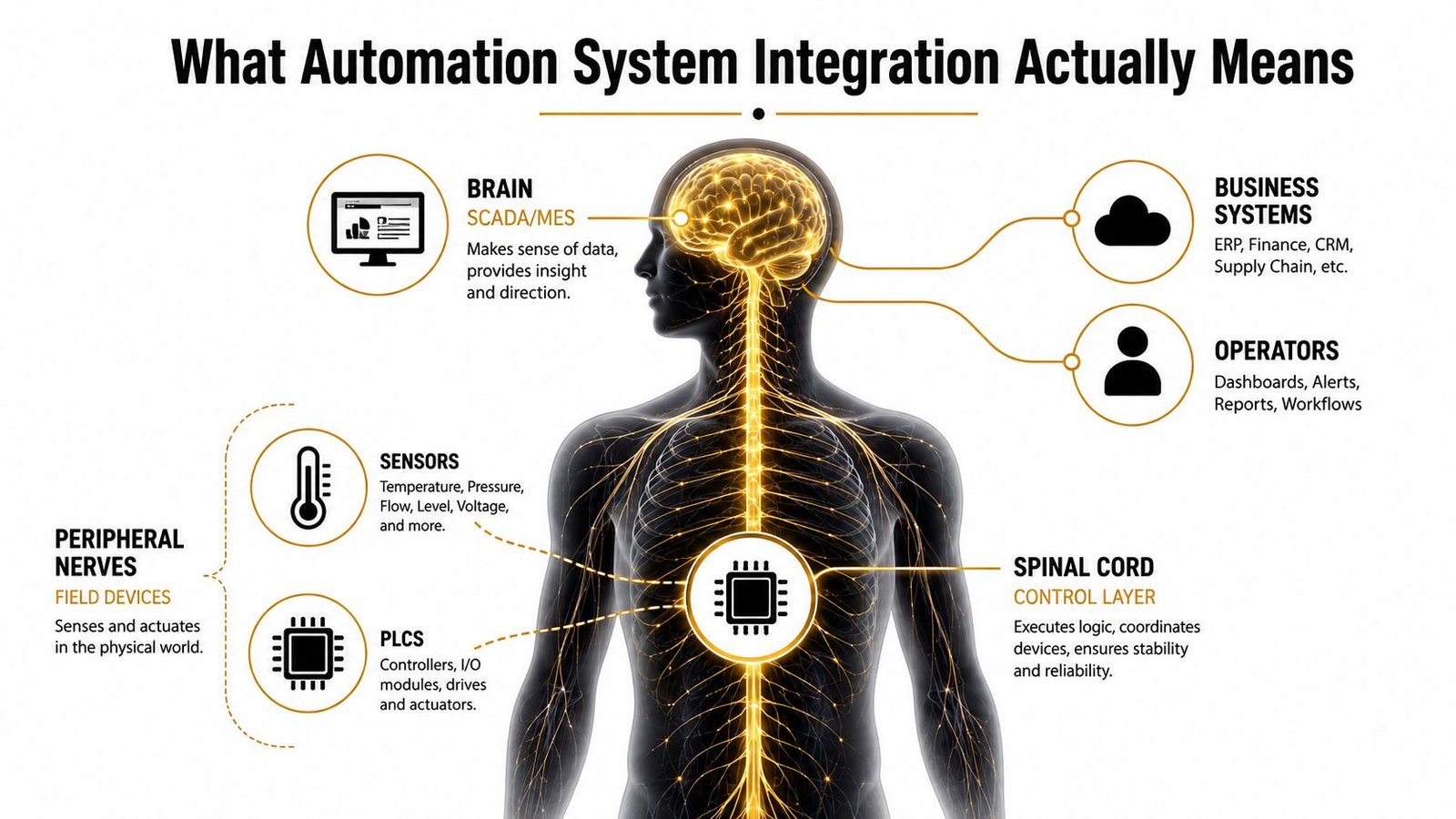
Think of a plant like a nervous system. Sensors and PLCs collect signals the way peripheral nerves collect sensation. SCADA and HMIs route and display those signals like the spinal cord and reflex pathways. MES coordinates timing, work orders, genealogy, and execution the way a control center coordinates motion. ERP sits higher up, making planning, procurement, and costing decisions.
That's the mental model worth keeping. Automation system integration is the engineering discipline of making those different layers exchange the right data at the right time, reliably, with audit trails. It's not just “connecting software,” and it's definitely not buying one vendor's whole stack because procurement found it easier.
The real work happens in the translation layer
Integration is where protocol translation, clock synchronization, tag normalization, and exception handling live. If line 3 goes down, that event should not sit trapped in a local controller while planning keeps releasing jobs as if nothing happened.
That's why bad naming kills good automation. A downtime reason called one thing in PLC tags, something else in SCADA alarms, and a third thing in MES reports guarantees confusion. The plant doesn't need more dashboards, it needs a consistent data model that lets one event become one decision.
The point is operational, not theoretical
A good integration stack lets operators see reality, lets supervisors trust the history, and lets planners react before the day is gone. It also leaves an audit trail, which matters the second a quality team asks why a batch moved, paused, or failed.
If the data can't survive the trip from machine to business system, the plant is still operating on memory and guesswork.
The Five Layers of an Integrated Stack
The stack works when each layer owns a narrow job and hands off cleanly. Problems start when a layer tries to do somebody else's work, or when nobody owns the seam between layers. That's where tag drift, batch reconciliation gaps, and sync latency wreck the project.
| Layer | What It Solves | Typical Protocols | Common Handoff Failure |
|---|---|---|---|
| 1. PLCs and device-level controls | Motion, I/O, interlocks, and local safety | EtherNet/IP, PROFINET, Modbus, digital I/O | Tag naming diverges from SCADA or MES expectations |
| 2. HMI and SCADA | Visualization, alarms, operator response, historian capture | OPC UA, native PLC drivers, historian connectors | Alarms exist locally but never become usable production events |
| 3. MES | Work orders, genealogy, recipes, OEE, execution logic | REST APIs, message queues, SQL connectors | Batch and lot data don't reconcile cleanly with ERP |
| 4. ERP | Planning, costing, procurement, and business controls | APIs, file exchange, middleware connectors | Bidirectional updates lag behind production reality |
| 5. Middleware and data fabric | Protocol translation, buffering, routing, normalization | OPC UA, MQTT, REST APIs, historians | Point-to-point hacks create brittle dependencies |
The layer that dies most often is the middleware layer. Nobody complains about it in the kickoff meeting, then everyone complains about it six months later when the tag database mutates and a simple change request requires three teams and two weekend windows.
The fix is architectural discipline. Use ISA-95-aligned boundaries, define data ownership early, and force naming conventions before the first connector is built. If you skip that work, you don't have an integrated stack, you have a pile of interfaces.
Project Phases From Consultation to Validation
A medical-device assembly line is the right example because it forces rigor. You can't bolt validation on at the end and hope the paperwork catches up. Validation documents have to start in consultation, because retrofitting traceability into a finished line is where these projects get expensive and unstable.
At consultation, the plant team should complete the site audit, the GMP gap analysis, and the user requirements specification. That's where scope gets pinned down, and it's also where teams decide whether the line needs full automation or a semi-automated architecture with smart data capture.
The next gate is design. That means the functional specification, P&ID, network architecture, and validation plan all get written before anyone starts coding. A late ERP API request belongs in this phase, not after the panels are built.
Validation rule: if it isn't in the URS, FRS, or change log before coding starts, expect rework.
Here's how the work usually progresses on a disciplined project:
- Consultation. Site audit, gap analysis, URS.
- Design. FRS, P&ID, network layout, validation strategy.
- Controls integration. PLC programming, HMI build, SCADA setup, MES connector work.
- Installation. Panel build, cable schedule, FAT execution.
- Commissioning. SAT, loop checks, IQ and OQ.
- Validation. PQ, traceability matrix, final report.
The deliverables matter more than the labels. Plant managers should expect to sign off on the URS, FRS, SAT report, and the IQ/OQ/PQ packets at the right gates, not at the end when everyone is exhausted. For a practical acceptance checklist, see factory acceptance test guidance.
The video below is useful if your team still treats commissioning like a single event instead of a controlled sequence.
ROI and Cost Factors Manufacturers Actually Track
A serious ROI case starts with four cost buckets. First is controls hardware, which covers PLCs, HMIs, network gear, and related components. Second is installation labor, including panel build, cabling, and contractor time. Third is validation overhead, which includes IQ/OQ/PQ documentation, execution, and review cycles. Fourth is downtime, especially the difference between a planned cutover window and an unplanned outage.
The cost line that gets underweighted most often is middleware and software licensing, especially when MES and ERP need to stay synchronized. That expense doesn't feel dramatic in month one, but it compounds the second the plant adds a second line or a second site.
What should you measure instead of raw equipment count? Measure first-time-right batches, mean time between operator interventions, OEE lift attributable to data handoffs, and scrap at station-to-station transitions. Those tell you whether integration is reducing friction.
| Cost Category | Typical Range | Payback Metric Tied To |
|---|---|---|
| Controls hardware | PLCs, HMIs, switches, scanners, gateways | Reduction in manual intervention and downtime events |
| Installation labor | Panel build, wiring, contractor time | Faster cutover and fewer commissioning defects |
| Validation overhead | IQ/OQ/PQ execution, document review, traceability | Lower rework and fewer compliance delays |
| Downtime | Planned stoppage or surprise outage | Lost production avoided during changeover and launch |
The market still rewards realistic scopes. A $400k semi-automated integration that closes the 78% data-transfer gap can return capital faster than a much larger greenfield effort, because it improves the actual workflow instead of replacing everything around it. For budget modeling, a manufacturing automation ROI calculator is useful only if it forces you to price validation and downtime.
When Semi-Automated Beats Full Automation
Full automation gets oversold because it sounds elegant in a sales deck. In a real plant, semi-automated, interoperable systems often win because they protect flexibility while still removing the manual steps that create errors and delays. That's the architecture that usually fits mixed-volume production and regulated work.
Changeover speed matters more than purity
If you build around standardized OPC UA or REST connectors, you can swap product families without ripping out the line logic every time. That matters when product mix changes often, because the business doesn't want a six-week software project every time engineering releases a new SKU.
Risk control matters in GMP plants
A smaller integration surface means fewer validation touchpoints. In medical-device environments, that's not a convenience, it's a cost-control strategy, because every code change pulls documentation, review, and sign-off into the loop. For teams in that space, SEA's semi-automatic systems fit naturally alongside tooling, fixtures, and integrated controls when the line needs flexibility more than a fully robotic footprint.
Capital flexibility is a real asset
Leaving some stations manual but instrumented gives you room to automate later without stranding sunk cost. You still capture data, but you don't lock yourself into a rigid layout before the process is stable.
| Decision Point | Semi-Automated Architecture | Full Automation |
|---|---|---|
| Changeover speed | Modular, easier to reconfigure | More rigid, harder to retune |
| Risk control | Smaller validation footprint | More code and documentation burden |
| Capital flexibility | Preserves future options | Higher commitment upfront |
A good rule is simple. Go fully automated only when volume is sustained, labor scarcity is structural, or quality defects clearly trace back to operator variability. Otherwise, build a stack that can be expanded later. A practical entry point for that mindset is semi-automated assembly line design.
Common Pitfalls and How to Avoid Them
Integration debt is the first trap. Plants glue systems together with point-to-point hacks, then discover those shortcuts block the next MES rollout. The mitigation is boring and effective, standardize architecture early with ISA-95 naming, OPC UA conventions, and a real data model.
Scope creep is the second trap. A supervisor wants a new screen, then another shift wants a different alarm view, and suddenly the HMI is a custom software project. Freeze change control before coding starts, and make every request pass through the same signed log.
Cybersecurity gets treated like a firewall purchase at the end. That's too late. Network segmentation, account inventory, and patch planning belong in the controls design phase, because once the system is live, retrofitting access control is painful and disruptive.
Validation shortcuts are the fourth failure pattern. Teams skip FAT or compress SAT because the schedule is tight, then pay for it in the field when defects surface under load. Use risk-based validation, tie IQ/OQ/PQ to documented user requirements, and don't hand off undocumented tags to the validation team.
The most expensive rework usually starts at the handoff between controls integration and validation.
Choosing the Right Integration Partner
A real systems integrator answers hard questions before anyone signs a purchase order. They work across more than one PLC platform, show MES and SCADA references in your regulatory class, and keep a validation engineer on the job instead of pushing that work into subcontracting limbo.
They also hand over the functional spec before purchase, not after the deposit clears. Ask for a cyber-hardening package with the network architecture diagram, account inventory, and patch plan, plus a commissioning protocol tied to acceptance criteria. If they cannot produce those deliverables, they are selling hardware, not integration.
| Capability | True Integrator | Equipment Vendor |
|---|---|---|
| PLC experience | Vendor-agnostic across multiple platforms | Narrow to one preferred stack |
| Validation support | Dedicated validation engineer on staff | Outsourced or optional |
| Documentation | Functional spec, FAT, SAT, and handover records | Light documentation, heavy assumptions |
| Cyber hardening | Network diagram, account inventory, patch plan | Added late, if at all |
| Source code ownership | Clear handover terms and version control | Ambiguous or restrictive |
Ask three direct questions. Who owns the source code on handover? How do you version-control tag databases? Is the FAT fixed-scope or open-ended time and material? A real integrator answers those cleanly.
System Engineering & Automation fits this model by providing semi-automatic systems, custom tooling, fixtures, and integrated controls with GMP-aware support for manufacturers that need practical production upgrades rather than a full floor rebuild. For a plant manager trying to improve throughput without losing flexibility, System Engineering & Automation is worth a direct conversation.