A familiar scene plays out on manufacturing floors every week. Two operators build the same medical device subassembly on adjacent lines, using the same work instruction, yet one finishes consistently sooner while the other produces more defects. Both completed training. Both believe they're following the process. The gap sits in the details the document never controlled, including tool condition, fixture fit, sequence, parameter selection, and the shortcuts that become normal under production pressure.
Process standardization closes that gap by connecting the paper standard to the executed standard. It gives operators an agreed method, gives engineers measurable process controls, and gives quality teams evidence that the approved method is being followed. For manufacturers pursuing higher throughput, safer work, stronger audit readiness, and cost-effective automation, the objective isn't more paperwork. It's repeatable output.
Table of Contents
- What Process Standardization Really Means on a Shop Floor
- The Business Case for Process Standardization
- Assessing Current Processes and Identifying Real Gaps
- Designing Standardized Work, Controls, and Semi-Automated Fixtures
- Validation, GMP Considerations, and Proving the Standard Is Followed
- KPIs and Audits That Catch Drift Before It Costs You
- Change Management and Common Pitfalls to Avoid
What Process Standardization Really Means on a Shop Floor
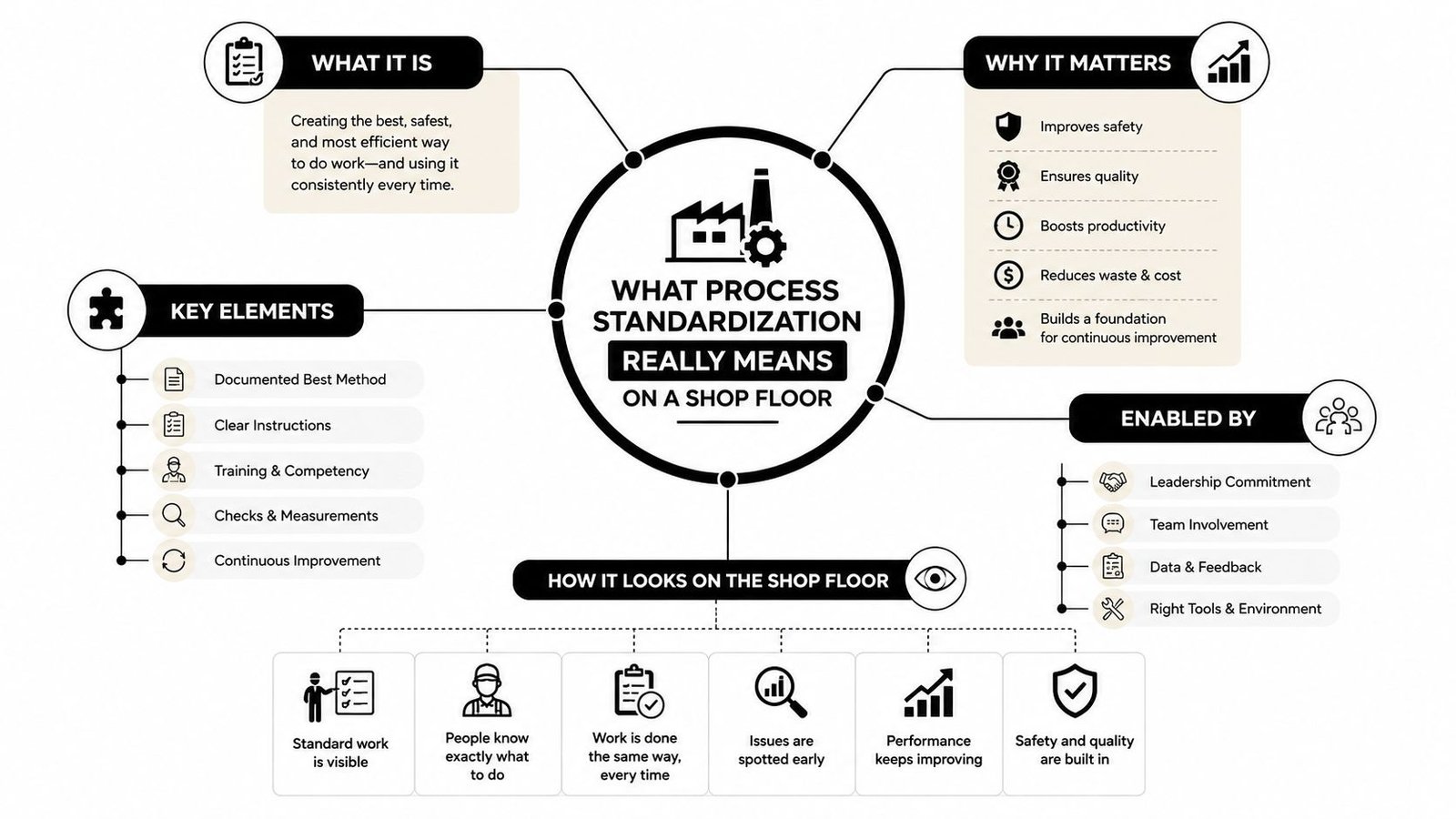
Process standardization means defining and controlling the way a repeatable task is performed so the result doesn't depend on which operator, shift, or plant runs it. The standard includes the work sequence, tools, equipment settings, inspection points, material presentation, ergonomic arrangement, and response to abnormal conditions.
A binder of work instructions isn't a standardized process. It's only one component. The system combines a documented method with the physical and digital controls that make the method practical to execute.
Shop-floor rule: If the operator can follow the document and still choose several materially different ways to complete the task, the process isn't standardized.
The strongest standards remove unnecessary interpretation while preserving flexibility where it doesn't affect safety, quality, or flow. A fixture can locate a component, a torque tool can verify fastening, and a semi-automated station can prevent a cycle from advancing until a critical step is complete. Those controls turn an approved instruction into an executable sequence.
The discipline has deep roots in manufacturing quality control. Walter A. Shewhart issued a memorandum on May 16, 1924, with a sketch of a modern control chart, and his 1931 book Economic Control of Quality of Manufactured Product helped establish the tone for later process-control methods, as described in this history of statistical quality control. The National Institute of Standards and Technology notes that statistical quality control began being applied effectively to quality control in the 1920s.
A practical rollout follows seven checkpoints:
- Assess the current process on the floor.
- Design the target method around demand, risk, and actual equipment capability.
- Build controls and documentation together.
- Validate the method and equipment under defined conditions.
- Measure adherence and results with leading and lagging indicators.
- Manage changes deliberately through ownership and revision control.
- Roll out the proven standard without stripping away necessary site-specific controls.
Standards decay when one checkpoint is skipped. A polished SOP can't rescue an unworkable fixture. A capable fixture can't rescue unclear ownership. A validated method won't stay valid if operators, supervisors, and engineers don't have a controlled way to report and resolve deviations.
The Business Case for Process Standardization
A line can hit its planned cycle time and still lose capacity every shift. One operator follows the documented sequence, another adds an inspection step, and a third adjusts a fixture to compensate for poor access. The paper standard remains intact, but the executed standard has already drifted. Plant leaders should fund standardization when it protects OEE, cost per unit, scrap, internal defects, customer PPM, and audit performance.
The business case is strongest where variation consumes capacity. Different sequences, inconsistent equipment adjustments, and shift-specific interpretations of critical parameters create rework, waiting, extra inspection, repeated training, and unstable schedules. Standardization exposes those losses and gives operators a repeatable method. SEA's semi-automated tooling and fixtures help close the gap by making the approved sequence easier to execute, while GMP-aware controls keep critical settings and checks visible at the point of work.
Documented standard work has been associated with defect-rate reductions of 25% to 35% compared with teams relying on informal knowledge, according to the standard-work reference summarized by Rework. That matters during shift changes, turnover, overtime coverage, and new product introductions, when unwritten methods are most likely to disappear.
Manufacturing evidence also supports tying standardization to measured performance:
- One study reported a 6.5% productivity improvement after standardized work was implemented, as reported in the Journal of Manufacturing Technology Management research.
- The same research reported cell configuration efficiency rising from 31% to 84.2% after implementation.
- A separate lean-manufacturing analysis found execution time across production operations fell by about 23%, while process efficiency rose by 11 percentage points.
These figures are benchmarks, not promises for every line. They identify where to look first. A process with high operator-to-operator variation, excessive motion, unclear inspection criteria, or repeated rework offers a stronger case than a stable process with little measurable loss.
Typical Gains From Process Standardization by Manufacturing KPI
| KPI | Typical Improvement Range | Why Standardization Moves It |
|---|---|---|
| Productivity | 6.5% in one manufacturing study | A defined sequence reduces variation in task execution and supports better workload balance. |
| Cell configuration efficiency | From 31% to 84.2% in one study | Time study and work design convert more shift time into value-added activity. |
| Execution time | About 23% reduction in one lean analysis | Wasteful motion and inconsistent methods become visible and removable. |
| Process efficiency | 11 percentage-point rise in one analysis | Standard work connects the intended method to measurable operating performance. |
| Defect rate | 25% to 35% lower for teams with documented standard work in one cited finding | Operators use a shared method instead of relying on informal knowledge. |
Inaction creates recurring cost. Plants duplicate fixtures because each line solves the same access or positioning problem differently. Supervisors repeat training because the existing method is difficult to trust. Quality teams find the same weakness during later audits. Operators spend labor correcting preventable errors instead of building good product.
ISO 9001 adoption shows how far standardized management systems can reach. A Harvard Business School paper cited in this ISO 9001 manufacturing overview states that nearly 900,000 organizations in 170 countries had adopted ISO 9001. ISO's process approach connects defined processes with consistent, predictable results and customer satisfaction, as outlined in ISO 9001 process guidance. For manufacturers, the practical test is simple: the fixture, tooling, controls, and operator actions must produce the same approved result that the document describes.
Assessing Current Processes and Identifying Real Gaps
Don't start by editing the SOP. Start by watching the work.
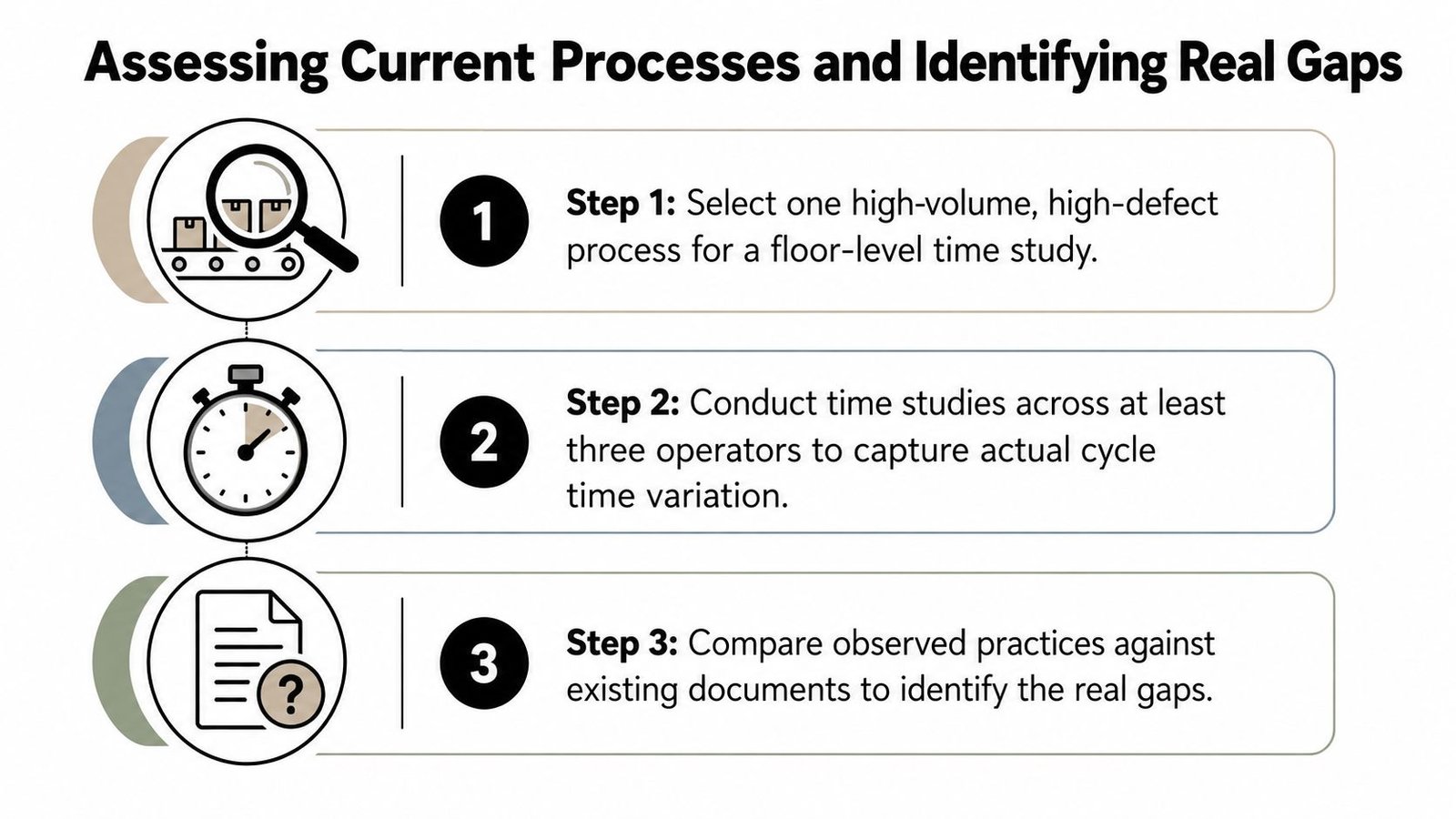
Choose one high-volume, high-defect process where variation is already expensive. Stand at the station across at least three operators and three shifts. Record actual cycle time, sequence, waiting, tool changes, material searches, inspection behavior, and interruptions. The average matters, but the spread between the fastest and slowest execution is often the more useful signal.
The first two actions should be current-process data capture and variation identification. A standardized-work case study makes those activities the starting point because the team can't lock in a reliable sequence until it understands how methods and task times vary, as described in the standardized-work case study.
A floor-level assessment method
- Select the process. Pick a product family and operation with enough volume or defect history to expose meaningful variation.
- Run the time study. Capture repeated cycles across operators and shifts. Record the sequence, not just the stopwatch result.
- Track critical parameters. Use simple SPC charts for the two or three variables most connected to yield, such as torque, temperature, or dwell time.
- Compare reality with the document. Note what the operator does, what the instruction says, and what the equipment permits.
- Rank the gaps. Prioritize safety first, then critical quality characteristics, then throughput and labor losses.
A current-versus-target map should include each process step, the observed method, the documented method, the required method, the risk created by the gap, and the proposed control. A line may apply torque without a calibrated wrench. One line may use a locating fixture while another positions the part by hand. A cleaning step may occur on second shift but not first shift. These aren't documentation details. They're different processes producing supposedly identical output.
Use SEA's process mapping best practices to organize the observation before deciding what to automate or document. The map should make disagreements visible to operators, engineering, maintenance, and quality at the same time.
Don't confuse compliance with understanding. A signed training record proves that someone completed an activity. It doesn't prove the method was clear, the tool was capable, or the operator could reproduce the required result under normal production conditions.
Designing Standardized Work, Controls, and Semi-Automated Fixtures
Design starts with demand. In lean manufacturing, takt time equals available work time divided by customer demand, defining the pace the process must match to avoid overproduction. One published example uses 27,000 seconds of available time and demand of 450 units, producing a takt time of 60 seconds per unit, as shown in this takt-time and standard-work explanation.
Translate that pace into a work sequence. Decide what the operator does, what the equipment does, where the part sits, which checks occur during the cycle, and what happens when a condition falls outside the approved range. The standardized work sheet remains the human-side anchor, but it should be designed at the same time as the fixture, tooling, controls, and station layout.
A practical sequence often moves from manual guidance to active prevention:
- The instruction shows the approved method and acceptance criteria.
- The fixture locates the part and prevents incorrect orientation.
- The torque tool provides feedback instead of relying on feel.
- Vision checks confirm presence, position, or assembly condition.
- Semi-automated controls clamp critical parameters and hold the cycle when a required step fails.
SEA's GMP-aware tooling and fixture approach fits this integration model. Its fixture design and manufacturing capability can be considered where a manufacturer needs custom tooling, semi-automatic equipment, or controls that connect the written sequence to the physical work.
Work Element vs. Control Type vs. Fixture Role
| Work Element | Control Type | Fixture/Tooling Role |
|---|---|---|
| Part orientation | Poka-yoke and presence detection | Keyed nests, locating pins, and sensors prevent incorrect loading. |
| Fastener application | Torque feedback and parameter limits | Tool interface and fixture stability support repeatable fastening. |
| Adhesive or process dwell | Recipe control and timer interlock | Fixture holds the assembly in the required position during the cycle. |
| Visual inspection | Vision check or defined manual criteria | Tooling presents the part consistently for inspection. |
| Cleaning or handling | Checklist gate and material identification | Dedicated surfaces and controlled presentation reduce mix-up risk. |
Don't automate every motion. Automate the failure mode that costs you quality, safety, or repeatability. Leave flexibility where operator judgment doesn't alter the critical result, such as replenishing approved materials or arranging noncritical motions. Enforce strict conformance where bypassing the method can create a defect, contamination risk, injury, or untraceable condition.
Single-piece flow is useful when the station can meet demand without creating excessive handling or waiting. A batch may still make sense for a controlled curing, cleaning, or equipment constraint. The decision should follow process capability and risk, not a blanket lean slogan.
Before pilot release, verify:
- The sequence fits the available work content and takt requirement.
- The operator can reach every control without unsafe posture or unnecessary motion.
- The fixture prevents foreseeable loading and orientation errors.
- Tool parameters are controlled, visible, and recoverable after a fault.
- Inspection evidence is recorded at the correct step.
- Abnormal-condition instructions are clear.
- Cleaning, material, and changeover requirements are defined.
- Maintenance can access wear parts without altering the validated method.
- The work instruction, recipe, drawings, and checklist carry matching revisions.
Validation, GMP Considerations, and Proving the Standard Is Followed
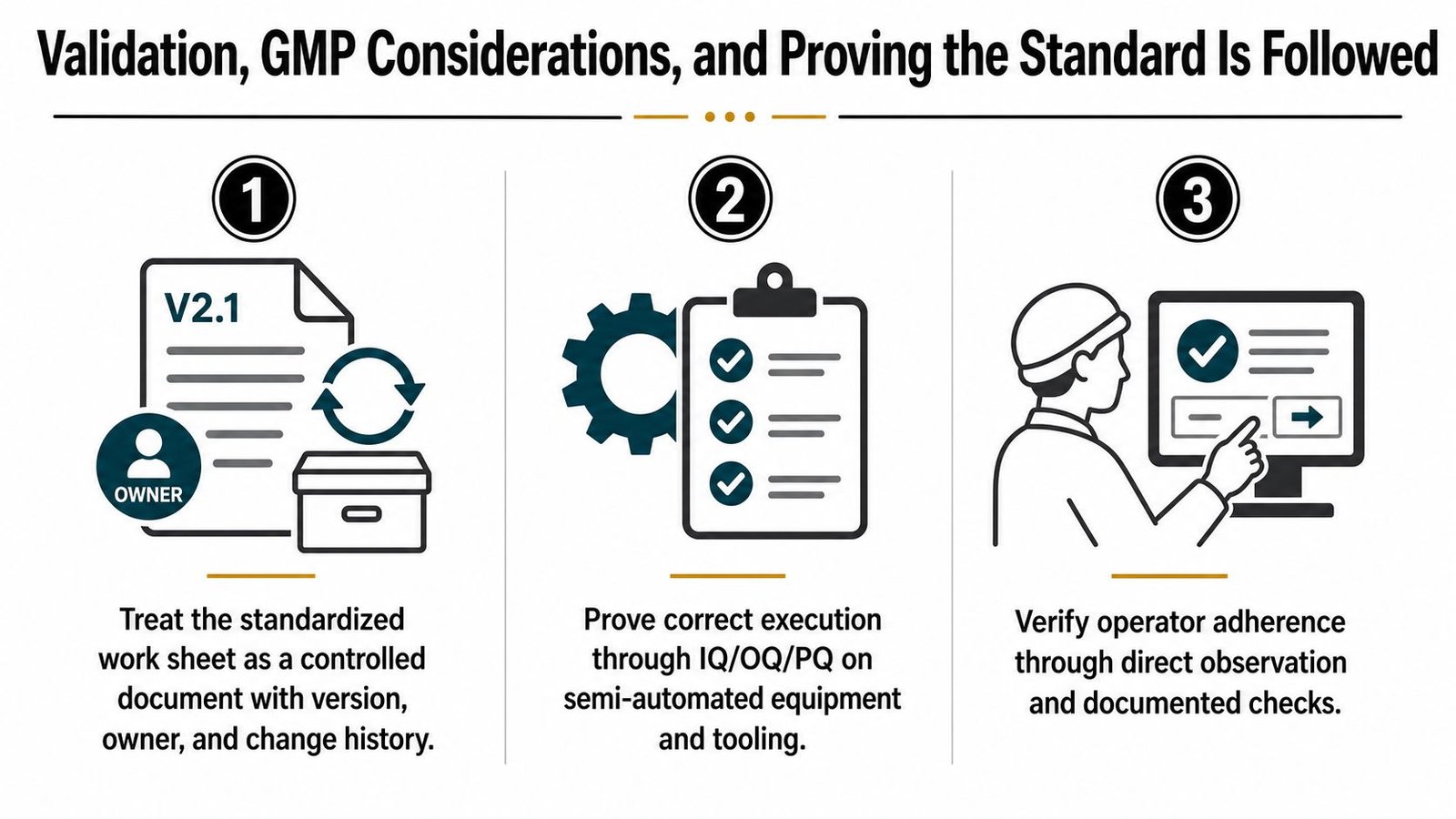
Treat the standardized work sheet as a controlled document, not a laminated suggestion. Assign an owner, revision identifier, approval path, effective date, and change history. If the fixture, recipe, software, inspection method, or work sequence changes, the team must determine whether the change affects validation, training, risk, or records.
For semi-automated equipment and tooling, use IQ, OQ, and PQ where the application requires it. Installation Qualification confirms that the equipment and supporting components are installed as specified. Operational Qualification challenges the operating ranges and controls. Performance Qualification demonstrates that the integrated process performs acceptably under defined production conditions.
GMP-aware manufacturing adds an evidence requirement. Critical control points need records that connect the approved method to the actual run, such as torque values, vision results, equipment parameter logs, material identification, and operator sign-off at defined gates. SEA's explanation of GMP in manufacturing provides relevant context for connecting process controls with manufacturing discipline.
Training must demonstrate competence
A signature isn't enough. Observe every shift, test each relevant product variant, and require the operator to demonstrate the task under normal conditions. Set requalification based on risk and deviation history, rather than assuming one training event will remain sufficient forever.
Use several forms of evidence:
- Direct observation: Watch first-piece and normal production cycles.
- Layered audits: Have operators, supervisors, engineering, and quality check different aspects of adherence.
- Video sampling: Review selected first-piece runs where permitted by site policy.
- As-run reconciliation: Compare equipment logs, inspection records, and completed checklists with the approved sheet.
- Deviation review: Trace every unexplained result back to the method, equipment, material, or training condition.
Validation discipline: An unvalidated recipe change or an altered fixture can invalidate confidence in the process even when the operator follows the visible instruction.
The failure usually appears in the gap between the paper standard and the executed standard. A 2026 manufacturing commentary reports that digital rollouts may reveal 15% to 30% cycle-time variance and 20% to 50% stop-reason variance across shifts and plants running the same stated standard, as discussed in this analysis of process standardization in manufacturing. Use that finding as a warning about measurement, not as a target for your plant.
The work instruction proves intent. The records, observations, and equipment data prove execution.
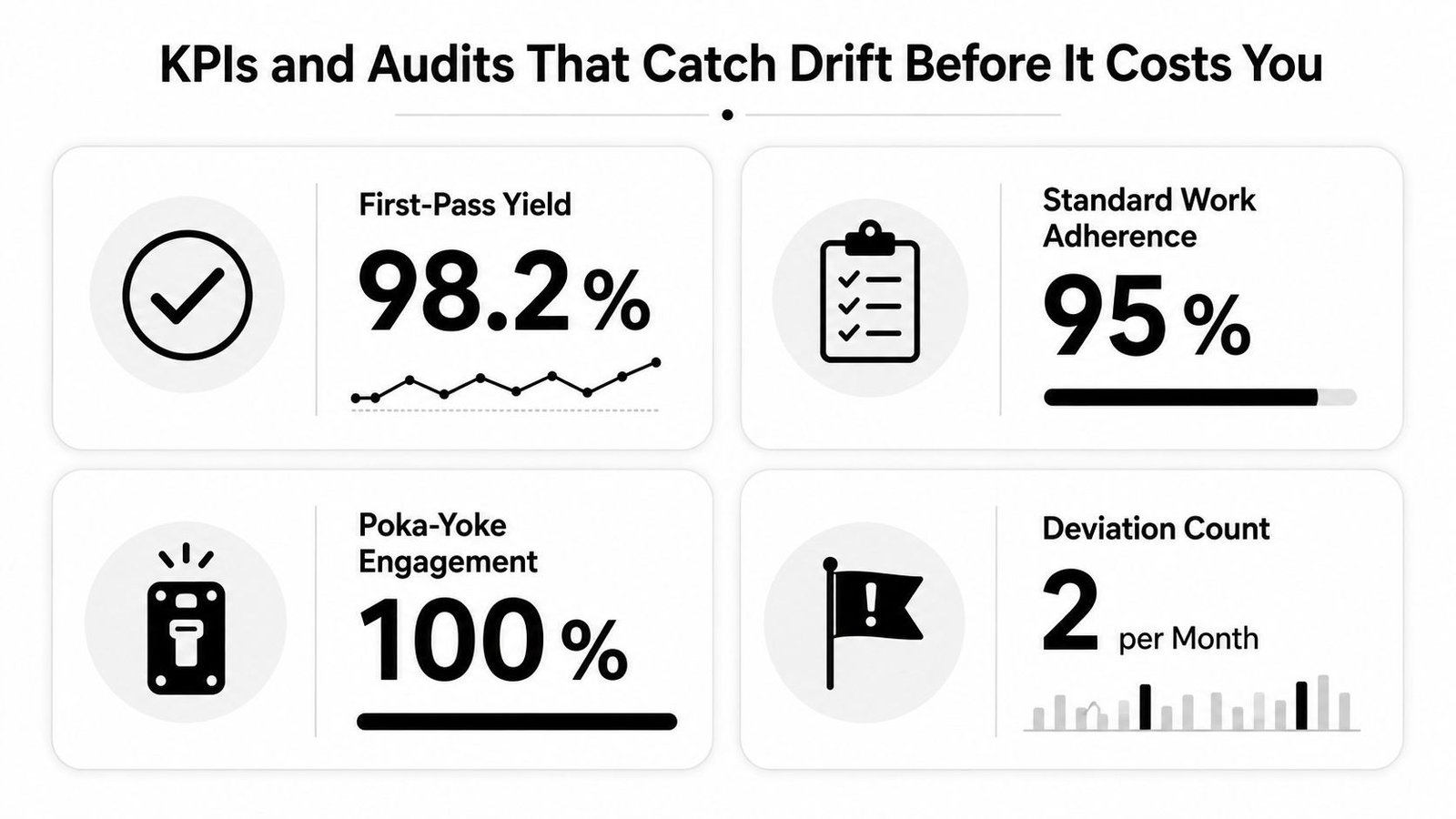
KPIs and Audits That Catch Drift Before It Costs You
A standard can drift while production still appears normal. The right dashboard catches the difference before a defect, audit finding, or missed shipment forces the issue.
Track a compact mix of leading and lagging indicators:
- First-pass yield: Shows whether the process produces acceptable product without rework.
- Standard work adherence: Measures whether operators perform the approved sequence during layered audits.
- Poka-yoke engagement: Confirms that required fixtures, sensors, and interlocks are being used rather than bypassed.
- Deviation count: Isolates events tied to undocumented steps, uncontrolled changes, or unclear instructions.
- Mean time to detect a deviation: Shows how long the organization permits a process to operate outside the standard.
Don't publish a metric without assigning a response. A red adherence result needs a named supervisor or process owner, a containment decision, and a due date. A recurring deviation needs engineering and quality review. A failed poka-yoke engagement check needs investigation into usability, not merely a reminder to operators.
Match the audit to the risk
Daily operator self-checks should confirm the basics at the station. Critical steps deserve line-side review during production. Weekly area audits can compare work instructions, tools, fixtures, and actual behavior. Monthly cross-functional reviews should examine cycle time, yield, deviations, maintenance changes, and training status together.
Set escalation rules before the dashboard turns red. Repeated bypasses, unexplained cycle-time movement, a critical parameter outside its approved range, or a fixture modification without review should trigger formal containment and a re-validation assessment.
ISO's process approach links consistent achievement of objectives, intended results, performance, and customer satisfaction, as described in ISO's 2015 process-approach guidance. The practical implication is direct: use audit data to improve the process, then revise the standard through change control. Audits should not only police operators. They should expose weak design.
Change Management and Common Pitfalls to Avoid
Standardization fails socially before it fails technically. Operators may see a new standard as surveillance. Supervisors may treat document approval as project completion. Engineers may write procedures so densely that the person doing the work stops reading them.
The response isn't motivational language. It's better ownership and better design.
Invite operators to co-author the method, then test the draft at the station before release. Ask where the sequence slows them down, where the tool doesn't fit, which step requires interpretation, and what happens during a material or equipment abnormality. A gemba review should occur before the revision is locked, not after the audit finds that the instruction can't be followed.
Use a tiered documentation model. Keep line-side work instructions visual and readable. Put regulatory rationale, detailed acceptance criteria, risk controls, and approval records in the governing SOP or controlled procedure. This separation protects compliance without turning the operator's instruction into a technical report.
Common Pitfalls vs. Countermeasures
| Pitfall | Countermeasure |
|---|---|
| Operators view standards as surveillance | Involve operators in observation, drafting, testing, and revision review. |
| Supervisors treat document approval as the finish line | Make floor adherence and KPI movement part of the release criteria. |
| Engineers over-document the task | Use concise line-side instructions with supporting controlled procedures behind them. |
| The paper standard drifts from the floor standard | Schedule gemba reviews, reconcile as-run evidence, and assign a process owner. |
| Plants maintain different versions in separate systems | Establish one canonical standard, shared data definitions, and controlled local appendices. |
| Automation hides an unresolved process problem | Stabilize the method and failure modes before selecting the automation level. |
| A fixture is modified without requalification | Route tooling changes through engineering, quality, and change control. |
Cross-plant standardization creates a second problem. The same standard stored in multiple document systems can develop different revisions, KPI definitions, exception rules, and data fields. A 2026 smart-manufacturing commentary identifies limited end-to-end data standards, weak canonical operational data models, and site-by-site KPI definitions as significant constraints, while a European manufacturing standardization study found respondents most often reported lacking awareness of which standards to use, discussed in MESA's smart-manufacturing commentary.
That doesn't mean every plant should run an identical process. Regulatory requirements, equipment capability, product mix, and facility design may require local differences. Standardize the shared backbone, including definitions, critical quality controls, data fields, deviation categories, and change governance. Document the justified local variation instead of allowing it to emerge informally.
A practical 90-day rollout
Days 1 through 30, baseline and gap analysis
The operations manager owns the charter and selects the process. Engineering leads time studies and current-versus-target mapping. Quality identifies critical parameters, records, and validation needs. Maintenance reviews equipment capability and fixture condition.
Deliverables include the baseline data set, variation map, risk-ranked gap list, current document review, and named process owner. Exit requires agreement on the problem, the target result, the critical steps, and the evidence needed to prove control.
Days 31 through 60, pilot cell design and validation
The process engineer designs the sequence and standardized work sheet with operators. Tooling and automation teams define fixture requirements, parameter controls, inspection gates, and abnormal-condition handling. Quality leads the applicable qualification and approval work.
Deliverables include the pilot design, controlled documents, training plan, validation package, and audit checklist. Exit requires trained personnel, accepted validation evidence, and demonstrated execution across relevant shifts and product variants.
Days 61 through 90, controlled expansion and KPI reporting
The process owner releases the standard to the next approved area only after reviewing pilot results. Supervisors run layered audits, engineering resolves equipment or fixture gaps, and quality reviews deviations and records. Operations reports the selected KPIs with owners and corrective-action dates.
Deliverables include the rollout record, training evidence, KPI trend, open-risk register, and change-control backlog. Exit requires stable adherence, understood escalation rules, and a repeatable deployment package for other lines or sites.
Practical FAQ
Should you standardize before automating or after?
Standardize the required function and critical sequence before automation. Don't automate every current motion. Use the pilot to expose capability gaps, then design tooling and controls around the approved method.
What should you do when a legacy procedure contradicts the new standard?
Stop treating both as valid. Place the legacy procedure under controlled review, assess product and compliance impact, train affected personnel, and retire or supersede it through the formal change process.
What if the standard reveals that the equipment can't hold the required capability?
Don't lower the standard to match weak equipment without a documented risk decision. Contain the issue, define interim controls, and decide whether maintenance, tooling, process redesign, or equipment replacement is required.
How do you scale one proven standard across several plants without losing nuance?
Create a canonical process model with shared definitions, critical controls, data fields, and evidence requirements. Allow controlled local appendices for equipment, regulatory, or facility differences. Every local exception needs an owner and review date.
Process standardization works when people can execute it, equipment reinforces it, records prove it, and leaders improve it. A document that sits untouched in a repository does none of those jobs.
System Engineering & Automation helps manufacturers connect standardized work to practical semi-automated systems, custom tooling, fixtures, integrated controls, and GMP-aware production requirements. Visit System Engineering & Automation to discuss a workstation, fixture, or scalable automation concept that closes the gap between the approved process and what happens on your floor.