A vision-guided pick-and-place cell is running smoothly until a tray arrives slightly out of position. The robot reaches, misses the part, and stops the line. A lead operator reorients the tray, confirms the next cycle, and production resumes within seconds. That small intervention is not evidence that automation failed. It's evidence that the system was designed to use human judgment where the machine's programmed envelope ends.
Table of Contents
- What Human-in-the-Loop Automation Really Means
- HITL vs Full Automation vs Pure Manual Work
- Core Architectures and Control Strategies
- Manufacturing and Medical Device Use Cases
- Implementation Considerations for Safety, GMP, and ROI
- Deployment Checklist and Validation Metrics
- Choosing the Right Level of Automation for Your Line
What Human-in-the-Loop Automation Really Means
Human-in-the-loop automation, or HITL automation, is a control strategy that deliberately keeps people inside the operating cycle. The machine senses conditions, executes routine work, and identifies situations that need judgment. The operator then intervenes through a defined interface, returns the system to a known state, and records what happened.
This approach has deep roots. Early computing and control systems in the 1950s and 1960s required continuous human intervention for data input, monitoring, and error correction. Government and industry groups were already using the term for simulations requiring real-time human input by the 1970s and 1980s, as described in this history of human-in-the-loop automation. Manufacturing adopted the same practical pattern because production environments contain variation, ambiguous inputs, tooling wear, material differences, and unexpected faults.
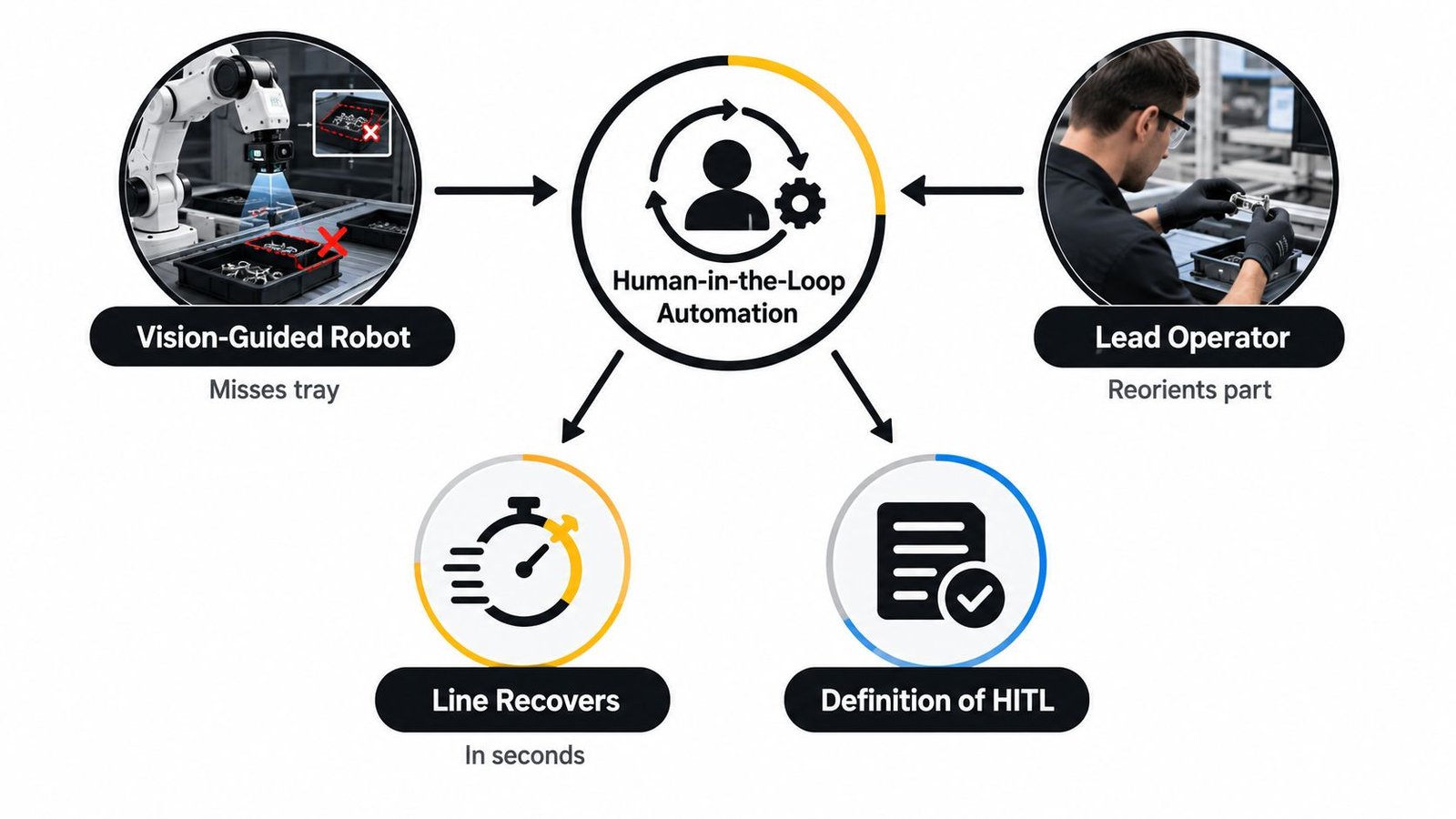
Three jobs the human must perform
A well-built HITL cell gives the operator a specific responsibility, not a vague instruction to “watch the machine.”
- Exception handler: The operator clears jams, corrects misalignment, responds to unusual part presentation, and restores the machine to a verified operating state.
- Decision approver: The operator confirms recipe changes, accepts a borderline inspection result, authorizes a controlled release, or blocks a suspect product.
- Quality conscience: The operator provides contextual judgment when a sensor result doesn't capture the full condition of the part, package, process, or environment.
That last role matters in high-mix production. A camera might detect a label, but a trained person can recognize that the label is technically present yet poorly positioned, damaged, or inconsistent with the approved presentation.
HITL is broader than AI
Human-in-the-loop automation isn't limited to machine learning, generative AI, or digital copilots. It applies to mechanical, electromechanical, robotic, and software-controlled systems, including semi-automated workstations. A person may load a fixture, approve a product recipe, inspect a final feature, or intervene when a servo-driven mechanism faults.
The distinction from other control models is straightforward:
- Human-in-the-loop: The system requires human action at defined decision or exception points.
- Human-on-the-loop: The system operates independently while a person supervises and retains override authority.
- Human-out-of-the-loop: The system operates autonomously without routine human decisions.
HITL is the right-sized engineering choice when normal production is repeatable but exceptions still require experience. It isn't a consolation prize for failing to automate everything. It's a way to keep throughput, flexibility, safety, and accountability aligned with the actual work.
Practical rule: Automate the predictable path. Engineer the human response for everything the predictable path can't safely handle.
HITL vs Full Automation vs Pure Manual Work
The wrong comparison is “automation versus people.” The useful comparison is how each operating model behaves under normal production and during exceptions.
Pure manual work handles variation naturally because the operator sees and interprets each condition. That flexibility comes with throughput limits, operator-to-operator variation, fatigue exposure, and a larger dependence on training. Manual work can be the sensible choice for highly variable, low-volume tasks, especially when the equipment required for automation would be difficult to justify.
Full automation is strongest when inputs, cycle conditions, and outputs remain stable. It delivers consistent execution and scales well across repetitive, high-volume work. Its weakness appears when the line encounters an exception that wasn't included in the control logic. A stalled cell can lose 30–60% of throughput during exception states, according to the planning data for this comparison, so the business case must include recovery behavior rather than only the ideal cycle.
HITL automation sits between those models, but it isn't an average of the two. The machine handles normal-path execution while an operator handles defined exceptions, approvals, and quality decisions. The human step stays narrow, visible, and repeatable.
| Dimension | Pure Manual | HITL Automation | Full Automation |
|---|---|---|---|
| Cost profile | Lower equipment investment, higher direct labor dependence | Balanced equipment and labor model | Higher equipment and integration investment |
| Normal-path accuracy | Depends on training, fatigue, and work instructions | Machine consistency with targeted human judgment | High consistency in stable conditions |
| Exception handling | Flexible and immediate when the operator is trained | Fast recovery through defined escalation paths | Can stall if the exception wasn't engineered |
| Throughput variability | Often follows staffing and operator pace | Near automated operation between interventions | Stable until faults, variation, or unplanned stops appear |
| Scalability | Requires more trained labor | Adds automation without removing necessary judgment | Scales efficiently where product and process variation are low |
| Best fit | Low-volume, high-variation work | High-mix, regulated, evolving, or mid-volume production | Stable, high-volume, repeatable production |
Research comparing these approaches reports that rule-based robotic process automation reaches about 95–99% accuracy on structured data, while HITL approaches reach about 90–95% on structured data and 92–98% on unstructured data, where ambiguity is higher, according to this HITL automation comparison. The same source reports that RPA can fail on 15–30% of exception cases, while humans correct about 95% of errors during exception handling. Those results reinforce a practical point: human involvement can lower ideal-path automation performance while improving the system's ability to recover when reality deviates from the script.
HITL typically costs 40–70% of a fully automated cell when the human step is tightly scoped, based on the planning assumptions for this comparison. For low-to-mid volume lines, regulated operations, and high-mix products, that can make HITL the lowest total-cost path. Evaluate batch size, product mix, tolerance stack-up, changeover frequency, and the consequence of a wrong decision before choosing the architecture.
For semi-automated production planning, this guide to semi-automated systems offers a useful way to think about the gap between manual work and full automation.
Core Architectures and Control Strategies
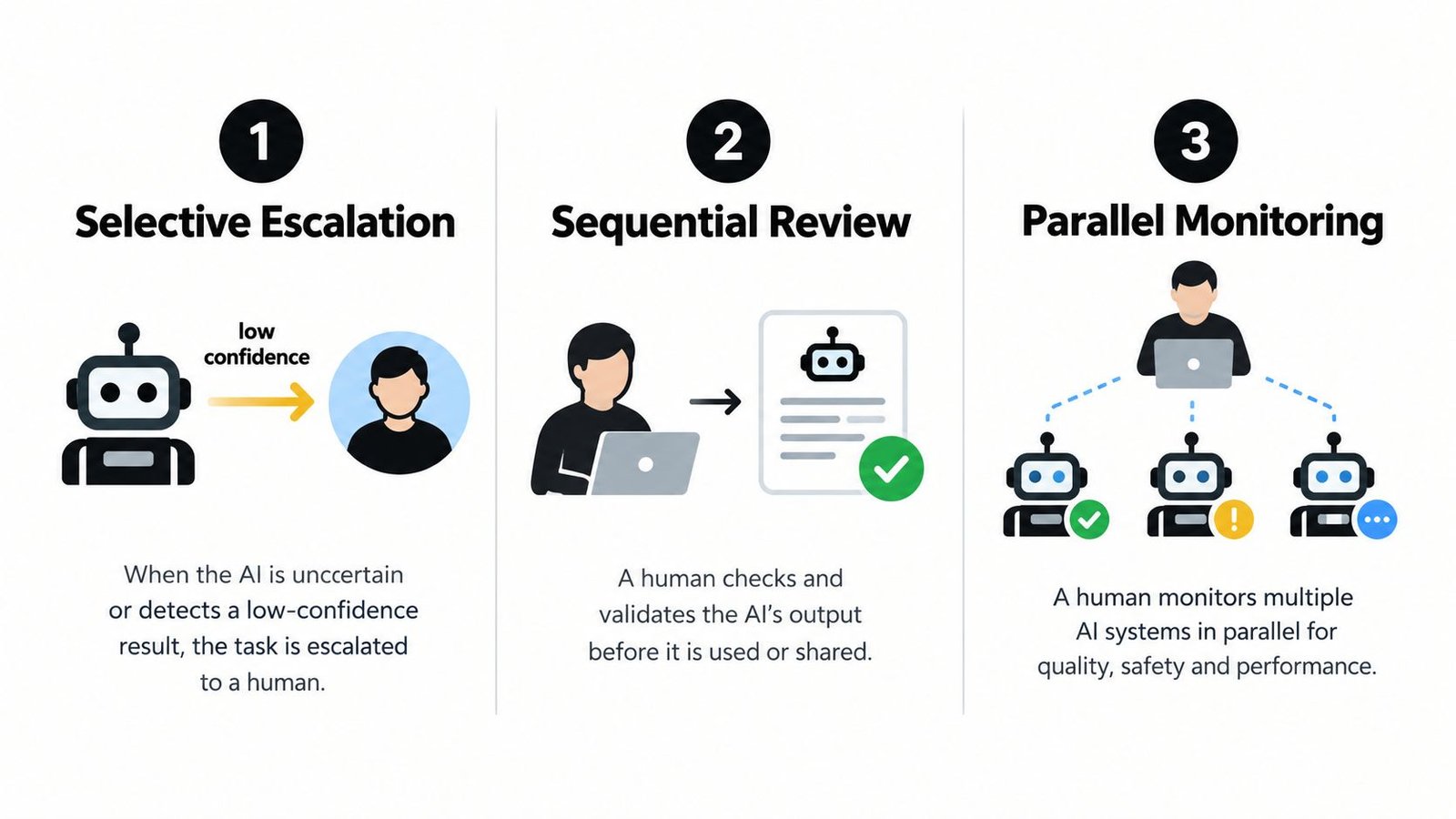
Most effective HITL systems use one of three control architectures. The choice depends on how often exceptions occur, how reversible the action is, and what happens if the decision is wrong.
Selective escalation
The machine runs normally and routes only uncertain or abnormal conditions to a person. A vision system may accept clear part presentations automatically, then stop and request review when the image contains an occlusion, damaged feature, or unfamiliar orientation.
The core loop is:
Sense, decide, act, verify, log.
The human enters after sensing and decision-making when confidence falls below a defined threshold. After the operator acts, the system verifies the new state before restarting. It then logs the event, the reason for escalation, the intervention, and the outcome.
This architecture preserves throughput, but it fails when the system can't detect its own uncertainty. Recent benchmark evidence found 300 tasks with 1,131 total blockers, or 3.8 blockers per task, and the strongest model achieved only 24% combined Pass@3 when it had to decide whether to ask for help. When all information was supplied upfront, performance reached 75–91%, as reported in this benchmark on blocker detection and help-seeking. The manufacturing lesson is direct: design sensors, alarms, and HMIs to expose ambiguity early.
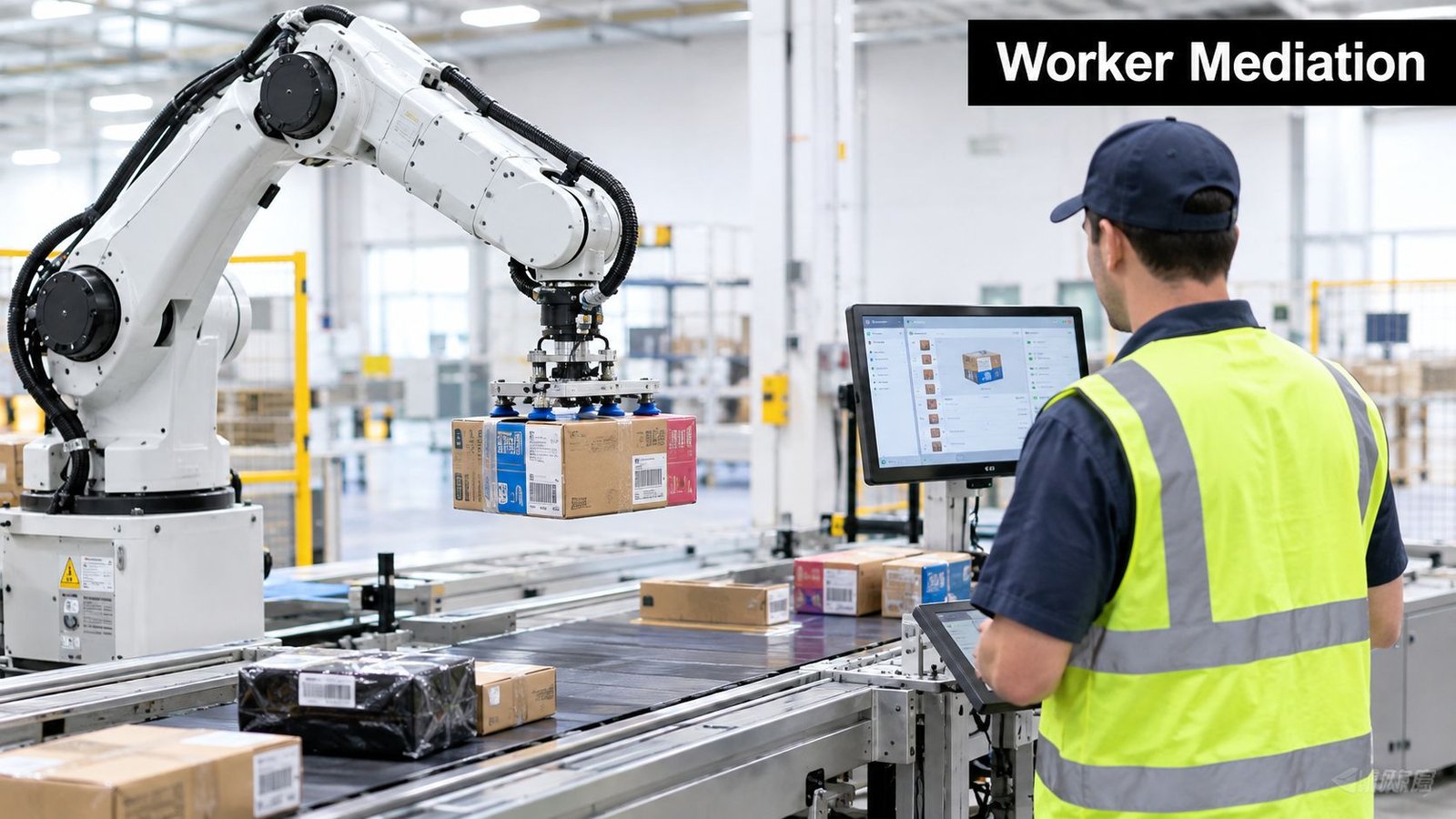
Worker mediation
Worker mediation puts the operator closer to each critical action. The machine prepares, positions, calculates, or executes within validated limits, but a person confirms the decision before the system proceeds. This pattern fits medical device assembly, controlled recipe changes, and operations where a release decision carries significant quality or compliance consequences.
The risk is approval fatigue. If the operator must approve every trivial action, the checkpoint becomes a delay rather than a control. Keep the gate on actions that require context, authorization, or accountability.
Oversight tiers
Tiered oversight assigns different review requirements to different conditions:
- Routine work runs without intervention.
- Non-routine work routes to a trained first-line operator.
- Safety-critical, quality-critical, or policy-related events escalate to engineering, quality, or another authorized role.
Manufacturing research emphasizes worker mediation around oversight, intervention, and exception handling rather than continuous manual operation. The IEEE Access survey on worker mediation also supports interfaces that expose machine state, uncertainty, and fault context so operators can intervene without dismantling the automation system.
Control logic, safety devices, HMI design, and escalation rules must agree. A reliable automation control system makes the human decision visible, authorized, reversible where possible, and recorded.
Manufacturing and Medical Device Use Cases
A contract manufacturer running mixed-SKU packaging rarely benefits from treating every product variation as a reason for full manual operation. In one practical model, vision-guided robots handle the standard pick-and-place work while operators manage barcode corrections, jam clearance, and quality holds.
The operator doesn't stand at the robot and manually supervise every movement. Instead, the station presents a clear exception prompt, identifies the affected package, and tells the operator what condition needs correction. After the operator fixes the issue, the robot verifies the station state and resumes the normal sequence.
The reported result was a changeover reduction from 25 to 11 minutes, scrap below 2%, and lights-out operation between human interventions. Those figures belong to the described use case and should not be treated as a universal benchmark. The engineering principle is more transferable: the human slot sits at the points where SKU variation, package presentation, and quality judgment create risk, while the robot owns the repetitive movement.
A GMP-aware medical device line
A Class II medical-device assembler needs a stricter arrangement. The robot performs a weld under validated parameters. An operator reviews thermal profiles on every unit before release, and a second operator completes a documented visual inspection according to the batch record.
The handoffs are explicit:
- The control system confirms that the approved weld recipe is active.
- The robot performs the weld and captures the relevant process data.
- The first operator reviews the thermal profile and records the disposition.
- The second operator completes the required visual inspection.
- The system links the decisions to the unit or batch through the MES and audit trail.
E-signatures belong at decisions that require individual accountability, not at every screen interaction. The quality team should be able to review the data without relying on informal paper notes or undocumented verbal explanations.
A 2026 smart-manufacturing paper argues that HITL control should be combined with verification, validation, and uncertainty management because AI-generated recommendations still require contextual validation, authentication, and authorization. Its discussion of HITL and large language models in smart manufacturing is especially relevant to medical device and GMP-aware operations where traceability must survive an audit.
Implementation Considerations for Safety, GMP, and ROI
The build decision gets easier when the plant team works through four separate frames. Don't start with the robot or software platform. Start with the task, the risk, and the evidence required to prove that the process remains under control.
Safety
Define the collaborative operating envelope before selecting the cell layout. Decide whether the task supports power-and-force limiting or requires a guarded workcell, then identify access points, safety-rated stops, reset behavior, and lockout/tagout requirements.
Ask whether the operator's new task changes PPE, reach, visibility, or exposure to stored energy. A human intervention point isn't safe merely because the robot moves slowly. The station must make the safe state obvious and prevent an operator from entering an uncontrolled zone.
GMP and data integrity
Map every manual handoff into the batch record or electronic production record. Identify which actions need an e-signature, what data the operator must review, and how QA will reconstruct the decision later.
For each intervention, define the event record:
- Identity: Who acted?
- Context: What did the operator see?
- Decision: Did the operator accept, reject, correct, or escalate?
- Evidence: Which machine data, image, profile, or inspection result supported the action?
- Authorization: Was the person qualified for that task?
A 2023 review describes a reliable smart-manufacturing structure combining HITL oversight, cyber-physical systems, large language models, and verification, validation, and uncertainty management. Its four-module framework for industrial AI supports treating human review as part of the control architecture rather than as an informal quality layer.
Ergonomics
Place the operator station where the person can see the relevant machine state without twisting, reaching across hazards, or repeatedly shifting attention between screens and the work area. Use fixtures, lift assists, adjustable displays, and clear status lighting where they reduce unnecessary effort.
Fatigue is a control risk. If the human step requires constant vigilance, the system has probably assigned too much work to the operator or failed to separate normal production from exceptions.
ROI
Model the three-year case against pure manual and full-automation alternatives. Include equipment, integration, validation, maintenance, training, scrap, rework, changeover, regulatory exposure, and labor reallocation. Don't count only headcount savings.
| Decision Frame | Key Question | HITL Implication | Verify Before Go-Live |
|---|---|---|---|
| Safety | Can the operator intervene without entering an uncontrolled hazard zone? | Define guarded and collaborative boundaries | Risk assessment, safety validation, reset tests |
| GMP | Can every human decision be reconstructed? | Build review, authorization, and audit events into the workflow | Batch-record mapping, e-signature testing, data review |
| Ergonomics | Can the station be operated through the full shift? | Keep intervention tasks short, visible, and physically sustainable | Reach study, workstation trial, operator feedback |
| ROI | Does the system outperform both alternatives over its life? | Compare flexibility and recovery value, not just labor reduction | Three-year cost model and sensitivity review |
Automation's economic effects are real but context-dependent. A U.S. Census Bureau plant-level study found that more automated establishments had lower production labor share, higher capital share, higher labor productivity, and a larger long-term decline in labor share, as documented in this study of automation and manufacturing establishments. A separate study of Thai manufacturing firms reported that automation adopters had, on average, 23% higher total factor productivity than non-adopters across 22 manufacturing sectors from 2017–2020, according to this panel-data study. Neither result eliminates the need for a task-level business case.
Deployment Checklist and Validation Metrics
Treat deployment as an operating change, not an equipment handoff. The machine may be ready while the human process remains untested.
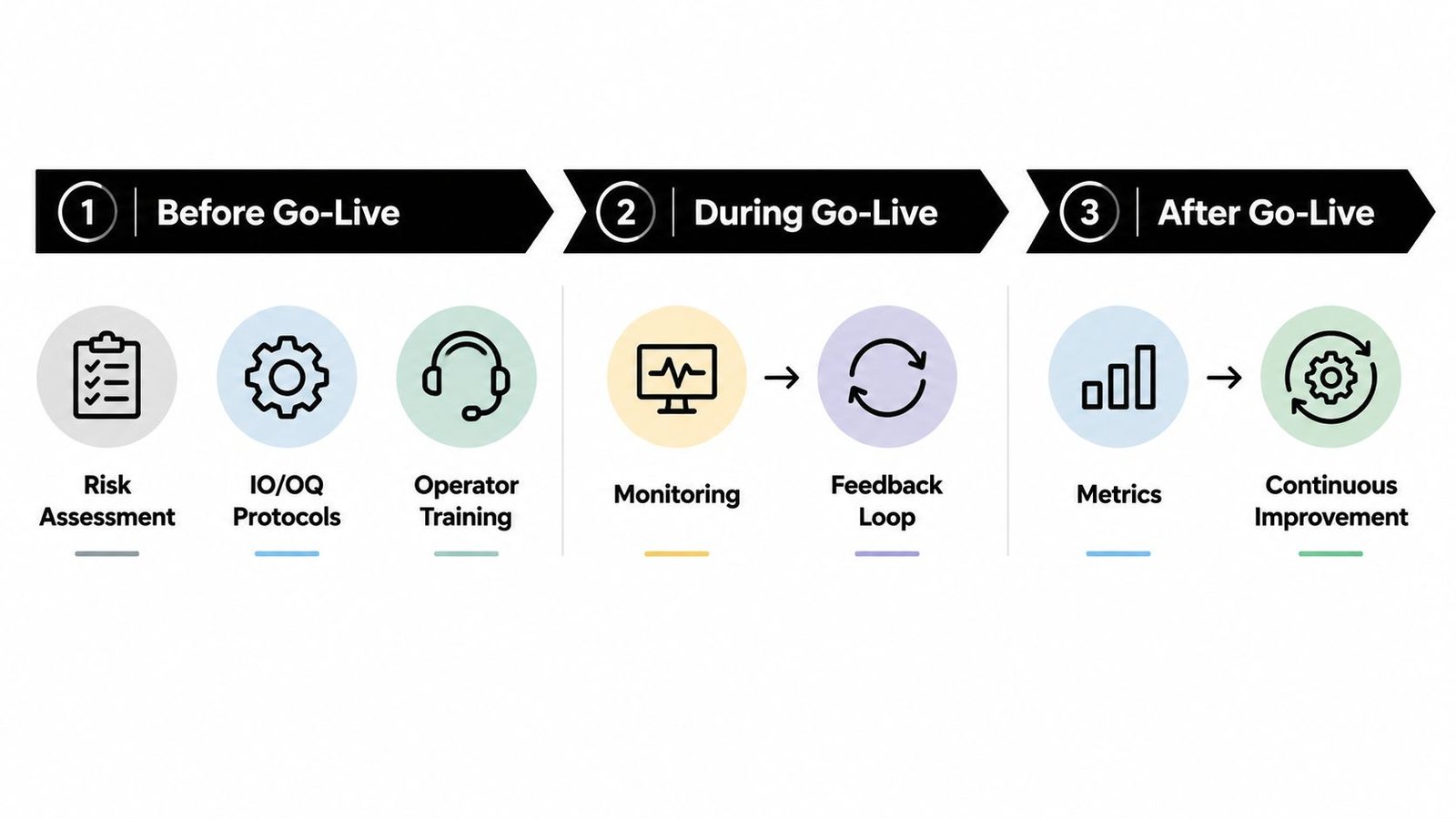
Before go-live
Confirm that the risk assessment is approved and that IO and OQ protocols cover both machine behavior and human actions. Training should be documented against specific station tasks, including normal operation, abnormal recovery, quality holds, escalation, and safe restart.
The factory acceptance test process should challenge the full operating envelope, not only demonstrate the ideal cycle.
During commissioning
Run shadow cycles with the operator integrated into the workflow. Capture first-article inspection data, test recipe selection, and verify that every expected alarm presents enough context for a fast decision.
Then deliberately create the difficult conditions:
- Misalignment: Confirm that the system detects the condition and identifies the correction.
- Sensor disagreement: Verify that the operator sees which signals conflict.
- Jam recovery: Confirm that the safe state, access procedure, and restart sequence are clear.
- Quality hold: Check that product status and disposition remain traceable.
- Communication loss: Verify that the cell fails safely and preserves the event record.
After go-live
Assign an owner and threshold to each metric before production starts. Track task completion time by exception type, false escalation rate, scrap and rework per shift, operator interventions per thousand cycles, and first-pass yield.
These metrics answer different questions. Completion time reveals whether the HMI gives the operator enough context. False escalation shows whether the system is asking for help unnecessarily. Scrap and rework expose poor recovery or weak decisions. Intervention frequency indicates whether the exception model reflects real production. First-pass yield shows whether the combined human and machine process produces acceptable units without downstream correction.
A 2026 systematic review warns that human capacity can become insufficient as AI decision volume grows, while fatigue, attention lapses, cognitive bias, and conflicting feedback can reduce review quality. Its review of scalable human oversight supports workload-aware interfaces, tiered review, and sampling audits instead of sending every event to the same operator.
Choosing the Right Level of Automation for Your Line
Start with two questions: How often does the process leave the normal path, and what happens when it does?
If exceptions are rare, consequences are reversible, product variation is low, and volume is high, full automation may be justified. If variation is high, the work is difficult to fixture, and every unit needs contextual judgment, stay manual or automate only the supporting tools.
Choose HITL when the machine can handle repeatable work but a trained person still adds clear value at loading, recipe changes, replenishment, inspection, fault recovery, or release. Use this decision path:
- Classify the consequence. Safety-critical, quality-critical, and compliance-sensitive decisions need stronger human control.
- Measure the variation. High mix and unstable presentation favor selective escalation or worker mediation.
- Separate normal work from exceptions. Automate the repeatable path and define the exact human trigger.
- Assign authority. Make clear whether the operator, engineering, or QA can approve the next action.
- Validate the evidence. Confirm that HMI prompts, machine data, MES events, audit trails, and e-signatures support the decision.
HITL is a right-sized engineering choice, not a compromise. It lets manufacturers improve production and services without forcing every uncertain task into an expensive full-autonomy design. System Engineering & Automation can map the process to the appropriate automation level, then design the human step into the controls, HMI, fixtures, and validation plan from the start.
If your plant is deciding between manual upgrades, semi-automated equipment, or a fully automated cell, talk with System Engineering & Automation. SEA provides custom tooling, fixtures, integrated controls, robotic systems, GMP-aware engineering, installation, commissioning, and ongoing support, with the human intervention points designed and tested as part of the system.