Your furnace still makes good parts on a good day. The trouble shows up on the other days, when a shift change loses a setpoint, a chart runs out mid-batch, or an auditor asks for evidence nobody can find. That's usually when integrated furnace controls stop being a nice upgrade and become a production decision. The question isn't whether you need more technology. It's whether your controls still match the risk, volume, and documentation your process now carries.
Table of Contents
- The Moment a Standard Furnace Outgrows Its Controls
- What Integrated Furnace Controls Actually Contain
- Recipe Management, Thermal Profiling, and Air-Fuel Coordination
- Standalone vs Integrated Furnace Controls Compared
- Safety, Quality, and GMP Considerations in One Architecture
- Designing Safe Recovery From Control Failure
- Cybersecurity and Lifecycle Governance for Legacy Furnaces
- A Practical Path From Audit to Commissioning
The Moment a Standard Furnace Outgrows Its Controls
It's 6 a.m. and the second shift left a clipboard on top of the control cabinet. Someone wrote the soak temperature in pen, crossed it out, and wrote another number beside it. The chart recorder kept running, but its trace doesn't tell you who changed the recipe, whether the door was opened during dwell, or why the high-limit alarm cleared itself before anyone arrived.
That scene repeats in plants that have outgrown standalone controls. A temperature controller holds its loop. A separate flame safeguard watches the burner. A hardwired annunciator shows a handful of alarms, and a timer in the back of the panel handles purge. Each device does its own job, but none of them talk to each other, so the operator becomes the integration layer.
Where the Cracks Appear First
Repeatability goes first. Two operators run the same job differently because ramp rates live in memory rather than in a locked recipe. One tech knows which cam or dial to adjust for a product change. Another guesses, runs a test load, and adjusts again while production waits.
Then the audit problem arrives. Quality asks for the temperature profile, dwell time, and alarm history for a specific lot from three weeks ago. The paper chart exists somewhere, but it doesn't connect to a batch number, a recipe revision, or a calibration record. You can't prove what happened, even if the parts test fine.
Safety exposure builds behind both problems. Historically, furnace operation depended on manual burner management, and modern architectures replaced that dependence with permissives before ignition, supervised flame establishment, fuel-valve proving, combustion-air verification, purge timing, emergency shutdown, and fault annunciation, as described in the Siemens burner management white paper on safety PLC systems. When those functions sit in disconnected relays and timers, testing them is slow and skipping a test is easy.
Watch for these signals:
- Recipe knowledge lives with one person: Turnover or vacation turns a routine changeover into a trial run.
- Alarms get acknowledged without a record: Nobody can reconstruct what faulted or how long it lasted.
- Troubleshooting starts with a meter and a ladder: Technicians chase interlocks device by device instead of reading a fault sequence.
- Calibration and setpoint changes aren't linked: A drifted sensor and a changed recipe look identical in the scrap bin.
None of these problems require a new furnace. They require the controls you already patch together by hand to become one monitored system.
What Integrated Furnace Controls Actually Contain
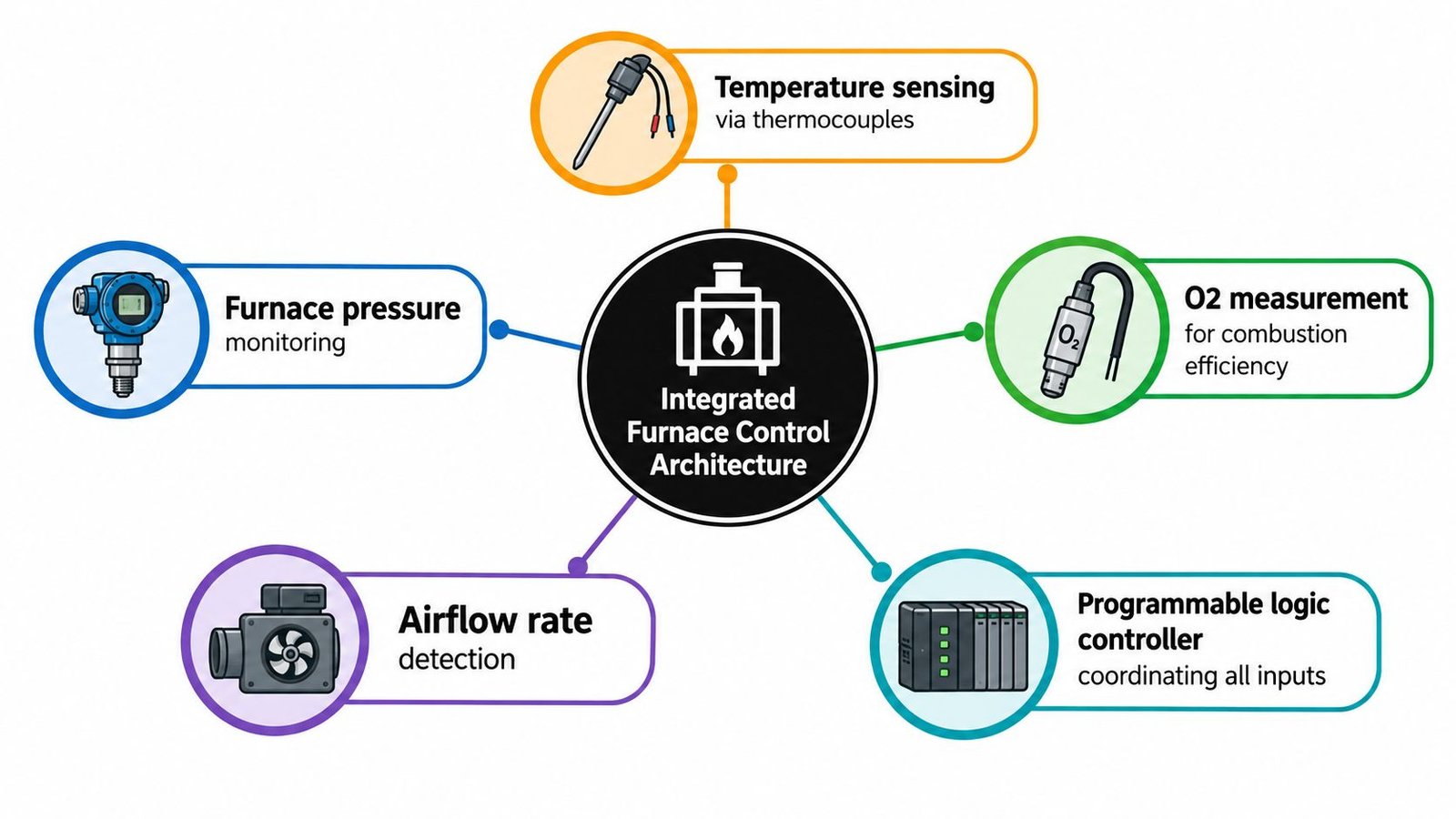
Think of the furnace as a small orchestra. The sensors are the musicians, each reporting one part of the performance. The PLC is the conductor, deciding what happens next based on what it hears. The safety interlock system is the off-switch nobody's permitted to disable, no matter how the music is going.
That analogy holds up in practice because integration is about coordination, not about buying a bigger screen. Combustion management, process control, and the operator interface used to occupy three separate cabinets. An integrated architecture brings them into one monitored system while keeping independent safety functions identifiable inside it.
The Sensing Layer
Thermocouples report chamber and load temperatures, often in multiple zones so the system sees uniformity, not just one point. A pressure transmitter watches furnace pressure, while airflow switches and sensors prove combustion air before and during firing. An oxygen sensor in the exhaust tells the controller whether combustion is running lean or rich, which a temperature reading alone can't reveal.
Sensor placement matters as much as sensor count. A thermocouple near the burner reads flame influence, not load temperature. A pressure tap in a turbulent spot feeds the loop noise. Good integrators walk the furnace and justify every tap and probe location before they quote hardware.
The Control and Interface Layers
The PLC runs sequencing, PID loops, recipe execution, and alarm logic. It checks permissives, commands valves and dampers, and timestamps what happened. The HMI gives operators one window for starting a cycle, watching the profile, and responding to faults with guidance instead of a blinking light and a manual.
SCADA sits above that when a plant needs visibility across multiple furnaces or cells. It collects trends, batch records, and downtime reasons for supervisors and quality staff. A single furnace in a semi-automated cell may not need full SCADA. It does need local logging that survives a network outage.
Practical rule: If a safety function can't be named, tested, and shown to act independently of the recipe logic, it isn't integrated. It's just consolidated.
What an integrator delivers is scope you can verify. That means a defined I/O list, a cause-and-effect matrix for interlocks, programmed sequences, HMI screens, alarm definitions, documentation, and testing records. Hardware is the visible part. The engineering that ties sensing, control, and safety together is what you're buying.
Recipe Management, Thermal Profiling, and Air-Fuel Coordination
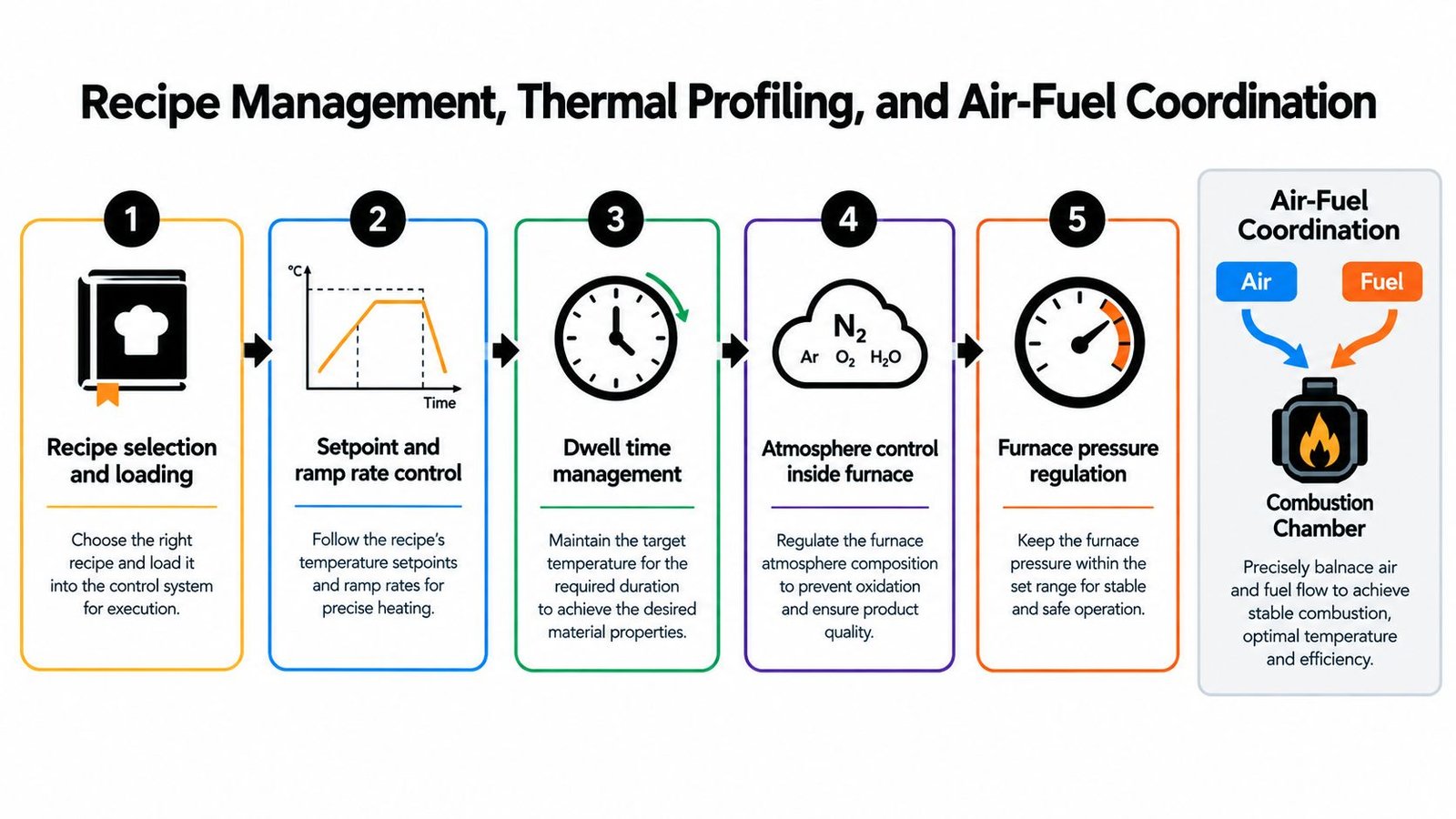
Ask most operators what furnace control means and they'll say holding the setpoint. That's the smallest part of the job. Real thermal processing coordinates temperature, ramp rate, dwell, atmosphere, furnace pressure, and air-fuel ratio at the same time, and a failure in any one of them can scrap a load that showed a perfect temperature trace.
A recipe in an integrated system is a controlled instruction set, not a sticky note. It stores setpoints by zone, ramp rates, soak times, atmosphere settings, and alarm limits under a revision that requires permission to change. When an operator selects a recipe, permissive logic confirms the furnace is in the right state before the cycle can start, and the system logs the run against a batch or lot identifier.
Why Air-Fuel Ratio Deserves Its Own Loop
The U.S. Department of Energy identifies excess air and exhaust flow as major sources of process-heating loss and recommends automatic air-fuel ratio control at all firing rates while preventing incomplete combustion products such as carbon monoxide, hydrocarbons, hydrogen, methane, or soot, according to DOE process heating guidance on combustion control. Every unit of unnecessary combustion air must be heated and then discharged through the stack, so holding the minimum safe excess-air level improves fuel utilization directly.
The catch is turndown. A ratio that's accurate at high fire can drift at low fire because burner pressure, mixing, and exhaust characteristics change. That's why combustion-ratio characterization, oxygen or combustion-quality monitoring, and high/low-fire interlocks matter, along with periodic verification of actuator and sensor calibration. High-turndown systems and programmed part-load temperature settings keep the furnace efficient when production slows instead of forcing operators to idle at full temperature.
Pressure Is a Quality Variable
Furnace pressure control isn't ventilation. DOE technical guidance describes maintaining slightly positive chamber pressure, typically a few inches of water gauge, to limit cold-air infiltration through doors and joints, using a pressure transmitter feeding a PID loop that modulates an exhaust damper, induced-draft fan, or combustion-air flow, as detailed in the DOE furnace pressure control technical brief. Negative pressure pulls in cold air that creates localized cold zones and raises fuel demand. Excessively positive pressure pushes hot gases through seals into the workspace.
Regulated pressure improves temperature uniformity and reduces cold and hot spots, which links the pressure loop straight to repeatability. Specify recipes so pressure, atmosphere, and ratio setpoints travel with the thermal profile. When those parameters survive operator turnover in a locked recipe, your process stops depending on who happens to be on shift.
Standalone vs Integrated Furnace Controls Compared
Integration isn't automatically the right answer. A small furnace that runs one forgiving process a few times a month may never repay a full controls retrofit. A furnace holding regulated product, running multiple recipes, or feeding a multi-cell line usually tells a different story, and the honest comparison is about total cost of ownership rather than the purchase order.
| Criterion | Standalone Controls | Integrated Controls |
|---|---|---|
| Capital cost | Lower upfront, device by device replacement | Higher upfront, engineered as one scope |
| Installation disruption | Small, incremental swaps | Planned outage for panel, wiring, and testing |
| Repeatability | Depends on operator practice | Locked recipes and permissive logic |
| Data visibility | Paper charts or local displays only | Batch logs, trends, and alarm history |
| Troubleshooting | Meter work across separate devices | Fault sequences and first-out annunciation |
| Support risk | Obsolete timers and safeguards get scarce | Documented platform with managed lifecycle |
| Safety testing | Manual, device by device | Structured proof tests with records |
How to Decide
Match the scope to three things: production volume, process risk, and compliance pressure. High volume punishes every manual step and every unexplained scrap load, so integration pays back through consistency and faster diagnosis. High risk, meaning large burners, flammable atmospheres, or product that can't be reworked, justifies independent safety functions and logged evidence even at modest volume.
Compliance pressure is the tiebreaker many plants underestimate. If customers or regulators can ask for batch-level thermal records, standalone controls force your team to assemble evidence by hand. That labor never appears in the controls budget, but quality staff pay it every audit cycle.
A retrofit beats full replacement when the furnace structure, burners, and refractory remain sound and the pain is concentrated in controls, sensors, and documentation. Firms such as System Engineering & Automation build integrated control panels for automatic and semi-automatic systems as one option in that retrofit path. Replacement wins when combustion hardware itself can't meet current safety requirements or the chamber can't hold uniformity no matter what controls command.
Don't compare quotes on hardware lists. Compare what each scope does to scrap investigations, audit preparation, and the next decade of spare parts.
Safety, Quality, and GMP Considerations in One Architecture
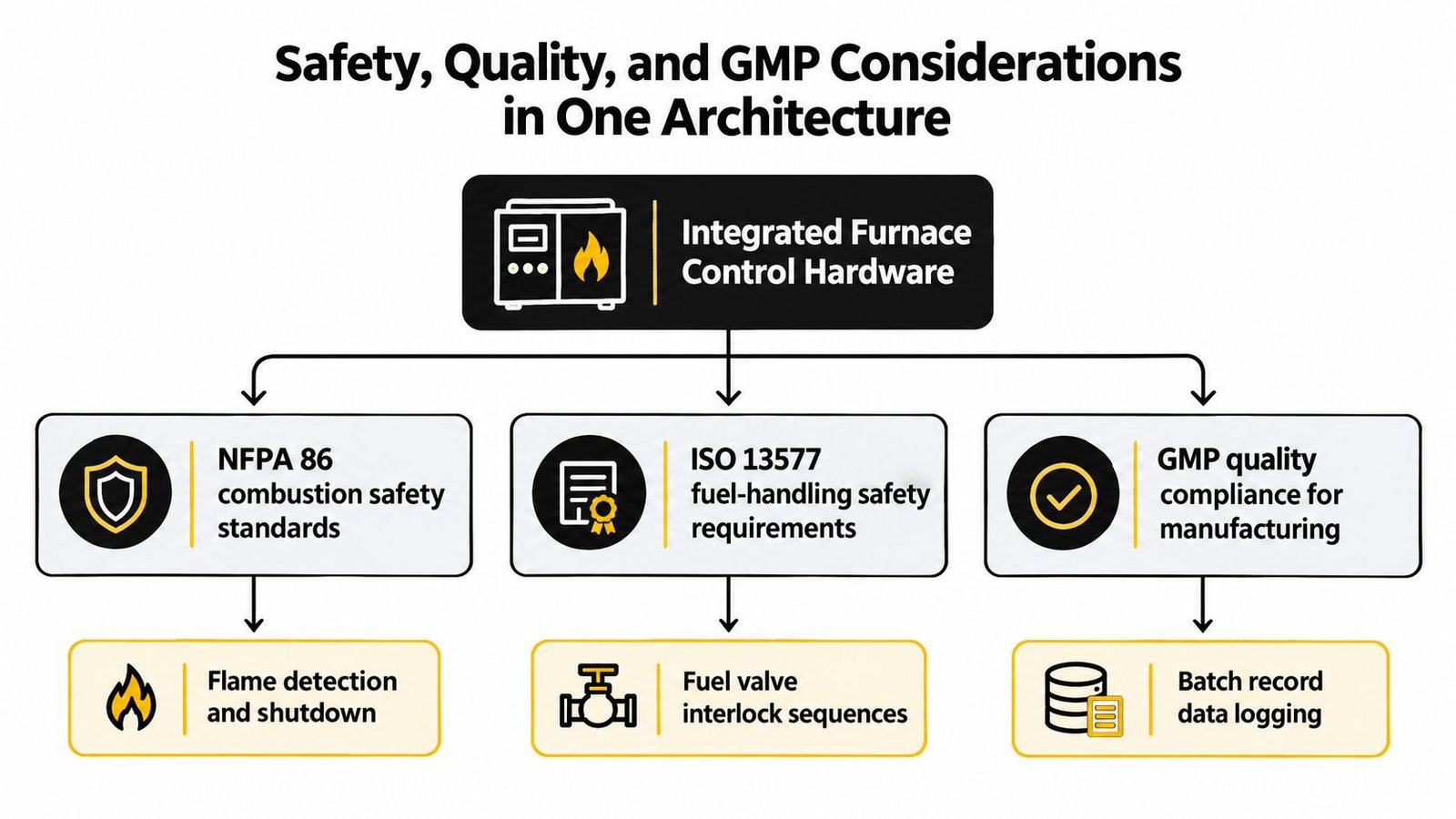
On paper, combustion safety, fuel-handling safety, and medical-device quality rules look like three separate binders. On the furnace, the same sensors, valves, and logic enforce all three. Treating them as one architecture decision produces a cleaner design than bolting compliance onto a finished panel.
The 2015 revision of NFPA 86, the principal fire-safety standard covering industrial ovens and furnaces, explicitly allowed safety PLCs for furnace safety functions, so previously separate relays, timers, and flame safeguards could consolidate into a monitored safety system. That milestone shifted the field from operator-dependent combustion management toward documented, testable safety logic. NFPA 85 addresses boiler and combustion-system hazards in parallel, with equipment below 12.5 million Btu per hour specifically identified in the related boiler-control framework.
The International and Quality Layers
ISO 13577-2:2014, later reflected in BS EN ISO 13577-2:2023, defines safety requirements for combustion and fuel-handling systems covering fuel pipework downstream of the manual isolating valve, combustion-air and flue-gas systems, burners, ignition devices, and safety-related control systems, per the BSI catalogue entry for the furnace combustion safety standard. Its practical demand is simple: connect temperature, pressure, airflow, and oxygen measurement to protective actions that place the furnace in a safe state on deviation.
For medical-device manufacturers, the FDA's Quality System Regulation covers the methods, facilities, and controls used to design, manufacture, and service finished devices, and manufacturers must document compliance with incorporated ISO 13485 requirements under the FDA quality system regulation in the electronic Code of Federal Regulations. Production and process controls sit among seven quality-system subsystems, and manufacturers must establish them wherever deviations could cause a device to fail specifications, as the FDA overview of the Quality System Regulation explains. If you're building that foundation, it helps to understand what GMP means in a manufacturing environment before you specify hardware.
The FDA framework is objective-based rather than prescriptive, and inspection guidance identifies calibrated equipment, employee training, process controls, and design controls as core objectives, according to the FDA guide to inspections of medical device manufacturers. That leaves room for right-sized automation. A small manufacturer can combine validated sensors, calibration records, password-controlled recipes, alarm escalation, preventive maintenance, and operator training at a scale matched to its risk. Machine safeguarding belongs in the same scope, since workers who operate and maintain machinery experience approximately 18,000 amputations, lacerations, crushing injuries, and abrasions annually, along with more than 800 deaths per year, figures reported in The Fabricator's review of OSHA machine-guarding data.
Keep the documented rationale for your chosen configuration. That rationale, tying each control to a hazard or a quality requirement, is what holds up when an auditor asks why the system looks the way it does.
Designing Safe Recovery From Control Failure
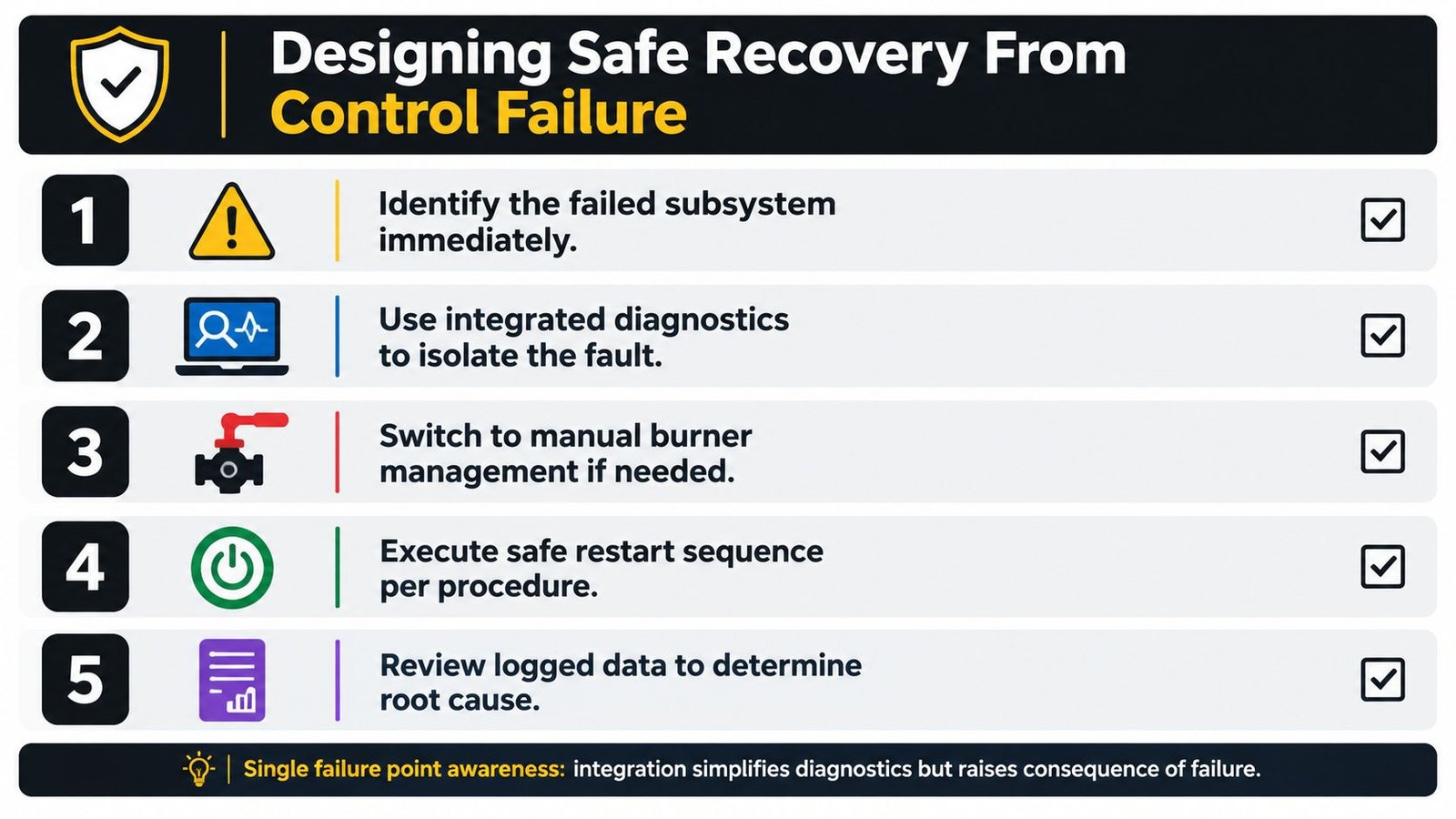
More integration doesn't automatically mean safer operation. Consolidating burner management, temperature control, recipe execution, and data logging simplifies diagnostics, but it also raises the consequence of a single failure. If one PLC, one network switch, or one sensor can take down every function at once, you've traded scattered small problems for one large one.
Most furnace content stops at PID tuning and alarm lists. Operators need answers to harder questions. Which functions must remain independent of the primary PLC? What happens when a sensor drifts slowly instead of failing outright? How is a restart validated after power returns, and who decides whether the interrupted load ships, gets reworked, or gets scrapped?
A Recovery Playbook That Fits on One Page
Design the failure behavior before you need it:
- Define fail-safe states: Fuel valves close, dampers go to a named position, and the furnace can't restart itself on power return.
- Separate safety from process control: High-limit and flame supervision act independently of recipe logic, so a programming error can't disable protection.
- Use sensor voting where drift hurts: Paired thermocouples that disagree beyond a limit raise a fault instead of averaging away a real excursion.
- Rationalize alarms: Every alarm needs an operator action, or it becomes noise that gets acknowledged and ignored.
- Write the controlled restart: Purge, permissive checks, and a documented decision point before product in the chamber is released.
Batch disposition deserves the same rigor as the restart itself. An excursion during a regulated run requires containment and evaluation of affected material, supported by logged evidence of what the load experienced. Without trustworthy data from before, during, and after the fault, quality has nothing to evaluate and the default answer becomes scrap.
The stakes justify the effort because a compromised or malfunctioning industrial control system can cause equipment damage, hazardous releases, or worker injury, not merely lost production, a risk profile described in the Trustwave manufacturing risk report on industrial control threats. Commissioning should therefore include proof testing of every protective function, a manual fallback procedure operators have practiced, and restart drills. A recovery plan nobody has rehearsed is a document, not a capability.
Cybersecurity and Lifecycle Governance for Legacy Furnaces
Plants are connecting legacy furnaces to networks faster than they're governing those connections. A vendor needs remote access for a weekend fault, someone adds a cellular gateway, and now a burner-management interface sits reachable from the internet with a default password. Cybersecurity for furnace controls isn't an IT add-on. It's part of the retrofit scope, because the consequences of a compromised control system are physical.
The exposure is growing. Publicly exposed industrial control devices increased 13%, from about 160,000 at the start of 2024 to more than 180,000 by year-end, with projections exceeding 200,000 during 2025, figures cited in ISACA's analysis of cybersecurity governance in smart manufacturing. Manufacturing OT environments are difficult to secure because they combine legacy ICS, PLCs, real-time automation, and IT networks, and IT/OT integration, IIoT, and cloud platforms expand the attack surface.
A Staged Approach for Small Teams
You don't need a security department to do the fundamentals:
- Inventory first: List every controller, HMI, firmware version, and dependency before connecting anything new.
- Segment the furnace OT network: Keep it separate from enterprise systems, following the principles behind sound industrial network security design.
- Control remote access: Monitored connections with multifactor authentication for vendor sessions, enabled only when needed.
- Test patches offline: Never let an untested update be the reason a production furnace won't start on Monday.
- Retain local safe operation: The furnace must run its safety and process functions with the network cable pulled.
Lifecycle governance is the unglamorous half that decides whether the system stays supportable. Assign an owner for backups, firmware, certificates, and end-of-support decisions. Store program backups somewhere other than the HMI that's going to fail. Review the inventory when staff change, because the person who knew the vendor password eventually leaves.
A modernized furnace that can't be patched, restored, or supported in five years isn't modernized. It's a future emergency with a new touchscreen.
Done in stages, this work lets an older furnace gain monitoring and data access without replacing the entire control system. That is the buyer question, and it deserves a better answer than ripping out working equipment.
A Practical Path From Audit to Commissioning
Start with an audit of what you have, not a catalog of what you want. Document existing sensors, safety devices, wiring condition, spare parts, and the failure modes your team already knows about. Then scope the retrofit against production volume, risk, and compliance pressure.
Specify sensors and safety functions in writing, with a cause-and-effect matrix both sides sign. Plan the integration outage, the validation evidence you'll keep, and operator training before startup day. Treat equipment commissioning as a documented verification process, not a ribbon cutting.
Ask any integrator these questions before signing:
- Which safety functions stay independent of the main PLC, and how will you proof test them?
- What evidence will I hold for calibration, recipe control, and batch records after handover?
- What happens on sensor failure, network loss, and power return, in writing?
- Who owns backups, passwords, and firmware after your crew leaves?
Right-sized controls aren't a budget compromise. They're the documented rationale that ties safety, quality, and return together into a furnace your team can defend at inspection and rely on in production.
If your furnace controls are holding back repeatability, audit readiness, or safe operation, System Engineering & Automation can help you scope a right-sized retrofit, from integrated control panels and semi-automated systems through installation and commissioning. Talk through your production goals and constraints with System Engineering & Automation and get a practical plan matched to your budget.