A line can run well for weeks, then lose a bearing, start throwing heat, and force everyone into the same bad meeting. Maintenance says lubrication was done. Production says output was fine until it wasn’t. Quality starts asking what drifted before the failure showed up. In automated and semi-automated equipment, that sequence is common because lubricant choice often gets treated like a consumable instead of a design decision.
That’s where kluber lubrication isoflex nbu 15 deserves a closer look. In the right application, it isn’t just grease in a tube. It’s part of how you protect spindle accuracy, stabilize motion, and keep maintenance from becoming a reactive scramble. For plants trying to improve throughput and reduce avoidable service work, that matters as much as any sensor, drive, or control upgrade. A broader operations view makes the same point in different language. Better component decisions support smarter manufacturing efficiency.
Table of Contents
- The Role of High-Performance Grease in Modern Automation
- What Is Klüber Isoflex NBU 15
- Decoding Its High-Performance Characteristics
- Optimal Applications in Automated Manufacturing
- Using Isoflex NBU 15 in GMP and Cleanroom Settings
- Real-World Implementation and Maintenance Practices
- Procurement Guidance for Automation Engineers
The Role of High-Performance Grease in Modern Automation
A seized spindle bearing rarely looks like a lubrication problem at first. It looks like missed schedule, scrapped parts, overtime, and a production manager trying to decide whether to keep running a machine that no longer sounds right. In automated systems, small mechanical decisions show up as business problems fast.
kluber lubrication isoflex nbu 15 belongs in the category of lubricants that should be selected with the same discipline used for bearings, guides, and servo hardware. It was developed as a high-speed spindle bearing grease using a blend of ester oil, synthetic hydrocarbon oil, mineral oil, and barium complex soap, with a density of about 0.99 g/cm³ at 20°C, worked penetration of 265 to 295 x 0.1 mm at 25°C, shear viscosity of 4,000 to 8,000 mPas at 25°C and 300 s⁻¹, and a service temperature range of –40°C to 130°C, according to the Klüber ISOFLEX NBU 15 product safety data reference.
Those numbers matter because they describe behavior under real plant conditions. Can the grease meter consistently through a centralized system. Can it avoid adding unnecessary internal friction. Can it stay stable from cold startup through steady operation. Those aren’t maintenance details. They influence bearing heat, component wear, and how often people need to stop production to intervene.
A good comparison is choosing fluid for a precision hydraulic circuit. You wouldn’t say all oils are the same if the wrong one changes valve response and system temperature. The same logic applies here. In high-speed automation, grease affects motion quality, repeatability, and uptime.
Practical rule: If the machine depends on precision rotation or loaded recirculating motion, grease selection belongs in the engineering review, not just the storeroom.
What Is Klüber Isoflex NBU 15
Some greases are broad-purpose shop supplies. Klüber Isoflex NBU 15 is not in that category. It’s a specialty grease designed for high-speed rolling contacts and precision mechanical assemblies where friction, heat, and wear have to stay controlled.
Why this grease is different
The formulation is the first clue. ISOFLEX NBU 15 uses ester oil, synthetic hydrocarbon oil, mineral oil at 15 to 40 percent by weight, and barium complex soap, with density around 0.99 g/cm³ at 20°C and worked penetration of 265 to 295 x 0.1 mm for consistent behavior in centralized lubrication systems, as listed in the ISOFLEX NBU 15 formulation and physical properties sheet.
A practical analogy helps. Standard grease is like regular fuel in a general-purpose engine. It may run, but it’s not tuned for a spindle, a loaded ball screw, or a precision gear set that sees sustained speed and tight tolerances. NBU 15 is closer to a purpose-built blend for a performance machine. The chemistry is there to solve a specific set of problems, not to check a box that says “lubricated.”
Its texture also matters in real use. The product is described as homogeneous, short-fibered, and beige, and it can be applied by brush, spatula, grease gun, or cartridge, according to the Klüber technical data sheet for high-speed spindle and screw applications. That combination tells an engineer two things. First, it’s intended for controlled application. Second, it can fit both manual service tasks and centralized systems without becoming awkward to handle on the floor.
Klüber Isoflex NBU 15 Technical Specifications at a Glance
| Property | Value | Standard |
|---|---|---|
| Density at 20°C | Approximately 0.99 g/cm³ | As listed in product data reference |
| Worked penetration at 25°C | 265 to 295 x 0.1 mm | DIN ISO 2137 via product data reference |
| Shear viscosity at 25°C, 300 s⁻¹ | 4,000 to 8,000 mPas | As listed in product data reference |
| Base oil kinematic viscosity at 40°C | About 21 mm²/s | DIN 51562 / ASTM D-445 via Silmid technical listing |
| Base oil kinematic viscosity at 100°C | About 4.5 mm²/s | DIN 51562 / ASTM D-445 via Silmid technical listing |
| Service temperature range | –40°C to 130°C | As listed in product data reference |
What plant managers should take from this is simple. The grease was built to support precision motion under speed and load while remaining workable in actual maintenance practice. That’s why it shows up in spindle bearings, threaded spindles, ball screws, cableway bearings, and precision gears. It has a job description.
Decoding Its High-Performance Characteristics
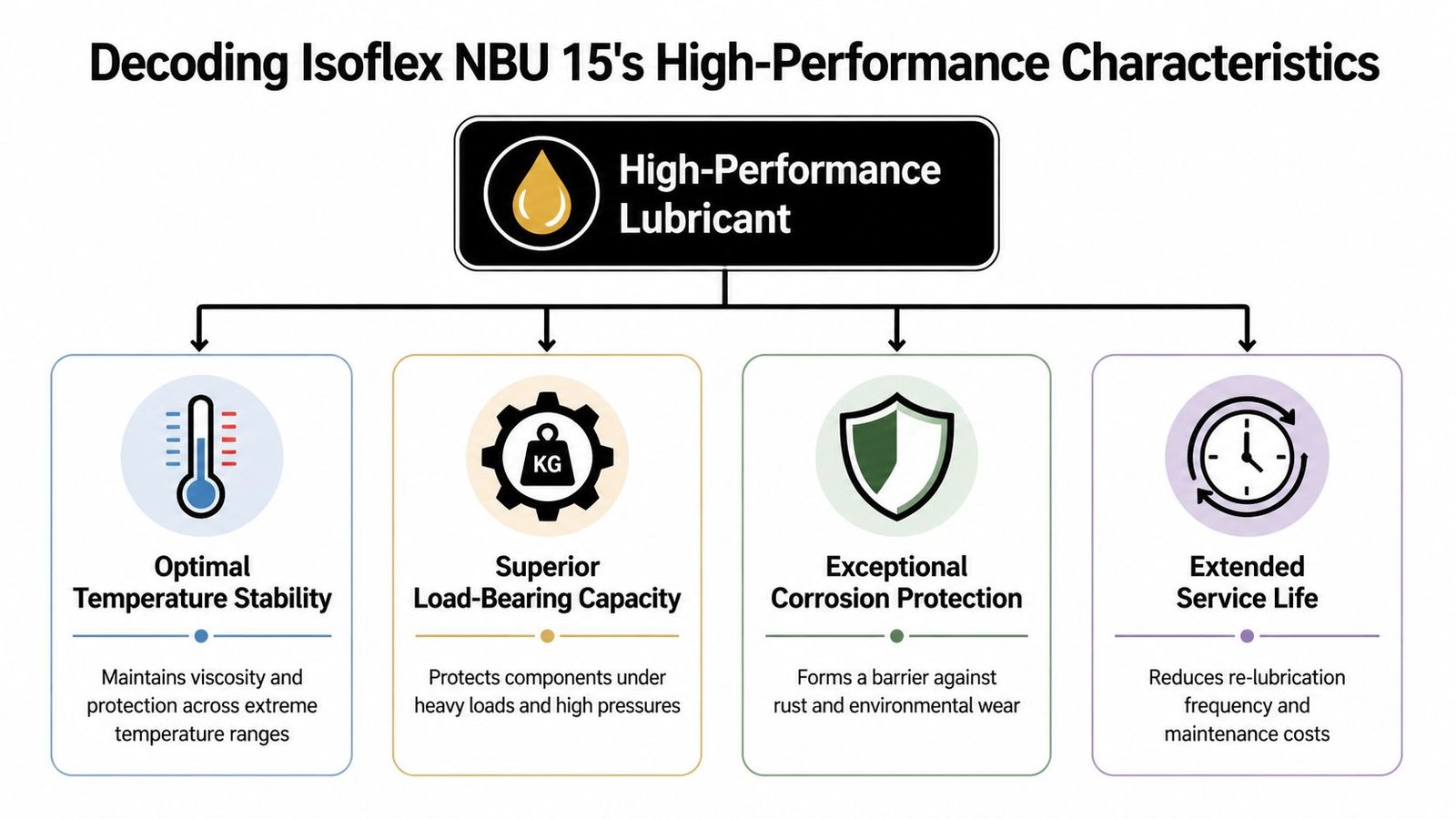
Numbers on a data sheet only matter if they explain what happens on the machine. With kluber lubrication isoflex nbu 15, the important point is that its formulation isn’t chasing one isolated benefit. It balances speed capability, load handling, thermal behavior, and corrosion protection in the same package.
What the numbers mean on the machine
In a high-speed CNC spindle, the first enemy is usually heat. ISOFLEX NBU 15 supports a speed factor up to 1,600,000 mm/min (n·dm), and that low-friction profile helps reduce frictional heat generation, based on the Silmid technical listing for Klüber Isoflex NBU 15. That matters because spindle performance doesn’t degrade in one dramatic step. It drifts through temperature, noise, and accuracy loss before anyone calls the failure.
Now look at a loaded ball screw in a fixture or transfer axis. Here the issue isn’t just speed. It’s pressure at the contact points. The same Silmid technical listing for Klüber Isoflex NBU 15 states that the barium complex thickener provides superior pressure absorption capacity, forming a strong EP film under high loads, with a dropping point of at least 220°C. In practical terms, that means the grease isn’t there merely to separate metal surfaces. It has to stay protective when the mechanism sees concentrated load and repeated cycling.
A grease that looks fine in low-duty testing can still fail you in production if it adds heat at speed or thins out where the load is highest.
Where it earns its keep
Consider a semi-automated medical device assembly station with rotating tooling, compact bearing arrangements, and regular sanitation pressure around the equipment envelope. The machine may not look extreme, but the operating demands are mixed. Fast starts, frequent stops, repeated indexing, and the expectation of stable output all push the lubricant in different directions.
That’s where this product’s profile makes sense. It offers good pressure absorption capacity, optimized wear protection, and superior resistance to water, media, and oxidation, based on the earlier product references. Those traits line up with what matters in production. Less avoidable friction. Better protection when contact stresses rise. Fewer maintenance-driven interruptions because the grease can be pumped and applied consistently.
Use the wrong grease in these systems and the symptoms arrive in a familiar order:
- First comes heat: Bearings run warmer, even though loads haven’t changed.
- Then comes instability: Motion quality slips, spindle sound changes, or backlash compensation starts working harder.
- Finally comes downtime: People pull guards, inspect hardware, and discover the grease choice was never matched to the application.
That’s why engineers who build reliable automation don’t treat lubrication as a late-stage purchasing decision. They treat it as part of machine behavior.
Optimal Applications in Automated Manufacturing
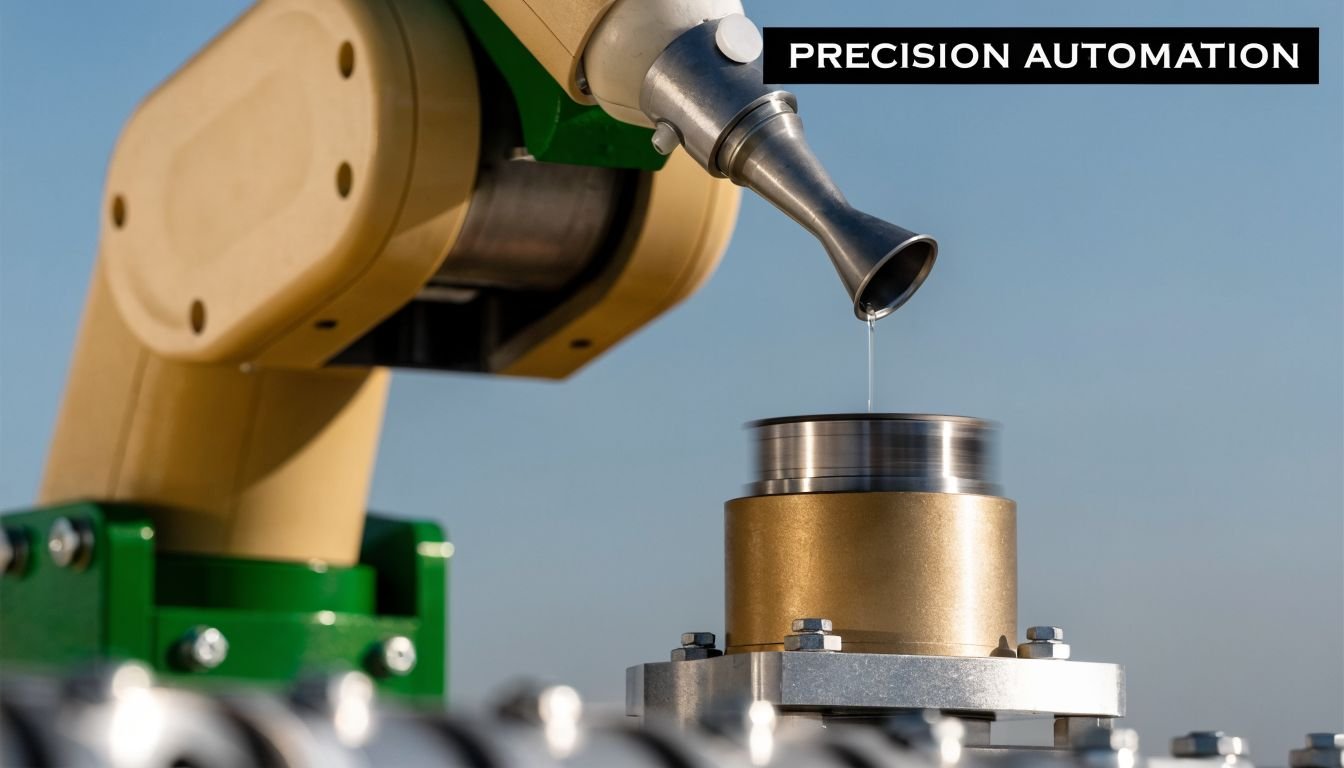
Some products become popular because they’re easy to buy. Others stay in use because they consistently fit specific machine problems. Klüber ISOFLEX NBU 15 falls into the second group. It is described as a cornerstone lubricant for high-speed spindle bearings in machine tools and textile machinery, as well as for threaded spindles and ball screws under high loads, with field-proven benefits that include extended machine uptime and cost savings from minimized maintenance, according to the Klüber technical data sheet for spindle and screw applications.
Where it fits best
The best fit is equipment where rotational speed, contact precision, or sustained mechanical load make a generic grease a bad gamble.
- High-speed spindle bearings in CNC equipment: These are the obvious application. The grease is built for this duty, and that shows up in lower friction behavior and more stable operation over long runs.
- Threaded spindles and ball screws under high loads: Here, pressure absorption and wear protection matter more than marketing language. If a fixture axis or tooling mechanism carries real load, the grease film has to stay dependable.
- Precision gears and compact drive elements: Small components often get ignored because they’re small. In reality, tight packaging and high rotational duty give them very little tolerance for poor lubrication choices.
- Semi-automated stations with centralized lubrication: The grease’s pumpability and application flexibility support systems that need repeatable delivery, not just manual touch-up.
What usually does not work is assuming that because NBU 15 performs well in a spindle, it is automatically the best answer for every slow or intermittent axis in the building. That’s where engineers get into trouble. Duty cycle matters. Motion profile matters. Environment matters.
The GMP question plant managers should ask
Medical device manufacturers and other regulated plants often make a dangerous assumption in the other direction. They see a premium grease with good water and corrosion resistance and assume it must be fine anywhere near a controlled production area. That’s too simple.
The product has real strengths for precision automation. But the barium complex soap also raises a practical question for clean manufacturing environments. Publicly available material does not detail leachables testing, particulate generation, or FDA 21 CFR 178.3570 compliance, and that creates a real data gap for GMP-aware users, as noted in the cleanroom suitability discussion for Isoflex NBU 15.
That doesn’t make it unusable. It means approval should be application-specific, not assumed.
A short visual overview of the product in industrial context can help teams align maintenance and engineering expectations before a rollout:
Plant-floor advice: For regulated production, the right question isn’t “Is this premium grease?” It’s “Has this exact lubricant been validated for this exact risk profile?”
Using Isoflex NBU 15 in GMP and Cleanroom Settings
If you run a medical device line, the lubrication decision can’t stop at bearing life. It also has to answer contamination risk, documentation quality, and whether your validation team will accept the material around the product zone. That’s where kluber lubrication isoflex nbu 15 becomes a nuanced choice instead of an automatic one.

The good news is that the grease is known for water and media resistance, and that kind of stability is useful around washdown-adjacent equipment, enclosed mechanical modules, and stations where corrosion protection matters. The unresolved issue is public documentation. Available datasheets do not provide public detail on extractables, leachables, particulate generation, or FDA 21 CFR 178.3570 compliance, which leaves a validation gap for GMP-aware operations, according to the cleanroom suitability discussion for Isoflex NBU 15.
What to verify before approval
A plant manager shouldn’t treat that gap as a reason to panic. Treat it as a reason to verify.
Use a practical review process:
- Define the exposure zone. Is the grease inside a sealed spindle cartridge, in a guarded mechanical drive, or near an open product path?
- Ask for supplier documentation. Don’t settle for a generic TDS if your quality system requires more.
- Review failure modes. Consider purge events, over-application, vibration, and residue migration during maintenance.
- Align engineering and quality. If those teams review the risk separately, one will approve performance and the other will reject contamination risk later.
For manufacturers working through regulated production requirements, a broader understanding of GMP in manufacturing helps frame why material documentation matters as much as mechanical performance.
Controlled production doesn’t just require a lubricant that works. It requires a lubricant you can defend during review.
Handling practices that reduce risk
Even when the application is acceptable, handling discipline matters. A good grease can become a contamination source through bad shop habits faster than through chemistry.
Use practices like these:
- Segregate tools: Don’t share applicators between general plant maintenance and clean-area service.
- Control opening time: Open cartridges and tubs only when needed, then reseal and store them to limit incidental contamination.
- Apply only where the design intends: Over-application creates migration risk. That’s a mechanical issue first, and a cleanliness issue immediately after.
- Document equipment-specific approval: One successful use in an enclosed spindle doesn’t qualify a nearby open fixture or guide assembly.
For GMP-aware environments, this is the honest answer. ISOFLEX NBU 15 may be a strong choice in enclosed precision mechanisms. It is not a grease that should be waved through a cleanroom review on brand reputation alone.
Real-World Implementation and Maintenance Practices
A premium grease doesn’t deliver premium results by itself. Application method, environment, and follow-up determine whether you get the benefit or create a new problem. This is especially true once kluber lubrication isoflex nbu 15 leaves the data sheet and lands in mixed-duty production.

One issue engineers should keep in mind is that real-world performance varies outside ideal high-speed spindle duty. In intermittent, high-load semi-automated systems, its shear viscosity is optimal for high RPMs, but users also report potential for excessive migration on low-speed ball screws. In humid plants, oxidation resistance can falter after 18 to 24 months without predictive maintenance, based on the field-use discussion for Klüber Isoflex NBU 15 in semi-automated machinery.
How to apply it without creating new problems
The first mistake is overconfidence. Teams hear “specialty spindle grease” and assume more is better. It isn’t. Excess grease can cause heat, churning, seal stress, and migration into places where no grease should be.
A better discipline looks like this:
- Match the grease to the axis duty: Use it where speed, precision, and contact conditions justify it. Don’t assume every slow actuator benefits equally.
- Clean out incompatible residue before changeover: Mixing old and new greases without a review creates uncertainty you won’t diagnose quickly once the machine is running.
- Use the right delivery method: Brush, spatula, grease gun, cartridge, or centralized feed can all work, but each should be tied to a documented maintenance method.
- Record the application point and date: If performance changes later, you need a maintenance history, not guesswork.
For automation programs trying to standardize maintenance around reliable equipment behavior, disciplined service methods fit naturally with broader performance assembly solutions.
What to watch after startup
After relubrication or a machine build, the equipment will usually tell you whether the choice and quantity were right.
Watch for these signs:
| Sign on the machine | What it may indicate |
|---|---|
| Rising bearing temperature | Overfill, wrong application point, or unsuitable duty match |
| Grease appearing outside intended zone | Migration, over-application, or low-speed use where retention is poorer |
| Change in spindle or screw noise | Film breakdown, contamination, or incorrect quantity |
| Shorter stable interval in humid areas | Oxidation stress and need for closer condition monitoring |
Maintenance checkpoint: If a low-speed ball screw starts pushing grease away from the intended contact area, don’t keep adding more. Recheck whether the lubricant is matched to that motion profile.
A practical maintenance plan should include trend monitoring, especially in humid plants or machines with mixed operating cycles. If the asset is important enough to stop production when it fails, it’s important enough to inspect before failure. Vibration review, thermal checks, and visual confirmation around seals and screw tracks are often more useful than relying on calendar-based relubrication alone.
The larger point is procurement logic. The grease itself may cost more than a generic alternative, but downtime, scrap risk, and reactive labor cost more than the cartridge ever will. When a lubricant supports uptime in the right application, it is not a consumable line item. It is part of production reliability.
Procurement Guidance for Automation Engineers
Buying kluber lubrication isoflex nbu 15 should follow the same logic used for bearings, linear components, and drives. Start with the mechanism, not the price list. If the application involves high-speed spindle bearings, threaded spindles, loaded ball screws, or precision gears where low friction and wear protection matter, this grease belongs on the shortlist. If the motion is slow, intermittent, exposed, or close to a regulated product zone, procurement should ask harder questions before standardizing it.
Use a simple decision screen:
- Confirm the duty: High-speed precision rotation and loaded recirculating elements are the strongest fit.
- Confirm the environment: Humidity, washdown exposure, and contamination control requirements can change the decision.
- Confirm the package format: Cartridge, tub, or centralized feed compatibility should match your maintenance workflow.
- Confirm the source: Buy through channels you trust and verify product traceability. Counterfeit or mishandled lubricant defeats the point of selecting a premium product.
- Confirm the validation path: In GMP-aware operations, quality approval has to be part of procurement, not an afterthought.
A good automation engineer doesn’t buy grease as a commodity if the machine depends on it for repeatability and uptime. The right lubricant can protect component life, reduce maintenance disruption, and support more stable production quality. The wrong one can gradually eat away at all three.
If you're evaluating lubrication choices as part of a broader equipment upgrade, System Engineering & Automation helps manufacturers build practical, cost-effective automation solutions that improve uptime, quality, and labor efficiency. From semi-automatic systems and custom tooling to integrated controls and GMP-aware production support, SEA works with manufacturers to make component-level decisions that hold up on the plant floor.