Most plants don't have a labor problem because people suddenly became less capable. They have it because work drifts, schedules get stale, changeovers drag, and too much time disappears into motion, waiting, rework, and bad handoffs. If you're staring at overtime spikes, uneven output, or a line that seems busy all day but still misses plan, the fix usually starts with the process, not the payroll list.
Labor cost reduction in manufacturing works best when you treat labor like a measurable production input, not a headcount target. The objective is lowering labor per good unit while keeping throughput, quality, and flexibility intact. That's where the practical playbook lives, and that's where smaller, targeted changes usually beat a big, risky automation gamble.
Table of Contents
- Beyond the Timesheet Uncovering Your True Labor Costs
- Pinpointing Your Best Improvement Opportunities
- The Strategic Power of Semi-Automation and Tooling
- Building a Business Case with Clear ROI and Payback
- Sustaining Gains Through Change Management and Support
- Your Path to Smarter Manufacturing Starts Here
Beyond the Timesheet Uncovering Your True Labor Costs
Labor cost in a plant is bigger than the hourly wage on a timesheet. A useful baseline includes wages, overtime, benefits, payroll taxes, training, supervision, and indirect support, because those costs all ride on each unit that leaves the floor. That matters because labor typically accounts for 30% to 50% of total manufacturing costs, depending on product complexity and automation level, so even a modest efficiency gain can change unit economics materially source.
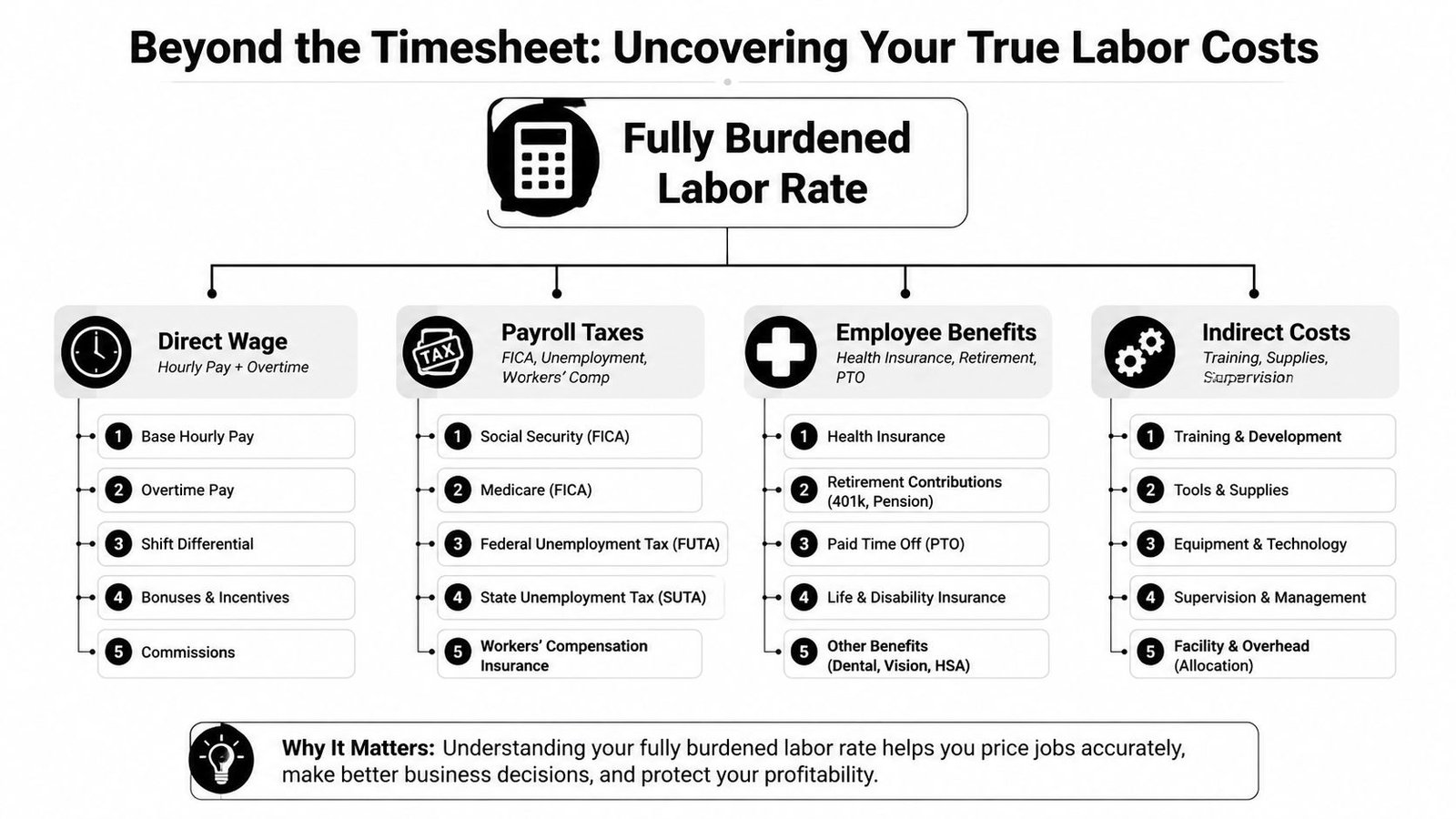
Start with the fully burdened rate
A fully burdened labor rate gives you the true cost of one labor hour, not the simplified payroll number. If you only track base pay, you'll understate the impact of overtime, benefits, and payroll taxes, and you'll end up comparing projects on the wrong financial footing. That's how companies approve changes that look cheap on paper but do not reduce the cost pressure on each finished unit.
Practical rule: if a project can't be tied back to labor-minutes per good unit, it's too easy to overestimate the savings.
A solid baseline audit should pull data from MES, CMMS, and shop-floor logs, then line up labor minutes with actual output. Track labor-minutes per good unit, OEE, scrap, rework, and idle time. If the line says it was busy but the output says otherwise, the gap usually points to hidden waste, not just a staffing issue.
Measure what the floor is actually doing
The best baseline is built from observed work, not estimates. Many plants discover that labor drain is buried in bottlenecks, unnecessary movement, missing materials, schedule changes, and weak standard work. That's why a production-cost review matters before any major change, and a deeper look at production economics can be anchored with an internal cost review such as production cost analysis.
Use this checklist to keep the audit grounded:
- Labor-minutes per good unit: Compare the time spent against usable output, not total pieces started.
- OEE by cell or line: Find where availability, performance, or quality is pulling labor into non-value-added work.
- Scrap and rework logs: Identify stations where labor is being burned fixing avoidable mistakes.
- Idle time by shift: Look for waiting, missing material, and unbalanced staffing patterns.
- Overtime by department: Separate true demand spikes from chronic scheduling inefficiency.
The point of this baseline isn't to make a prettier dashboard. It's to expose where labor dollars are leaking out of the process so the next decision lands on the right workcell, the right fixture, or the right line, not just the next open requisition.
Pinpointing Your Best Improvement Opportunities
Once the baseline is real, the next question is simple. Which job, station, or motion gives you the fastest payback? The wrong answer is the one that feels inefficient. The right answer is the one that shows up again and again in the data.
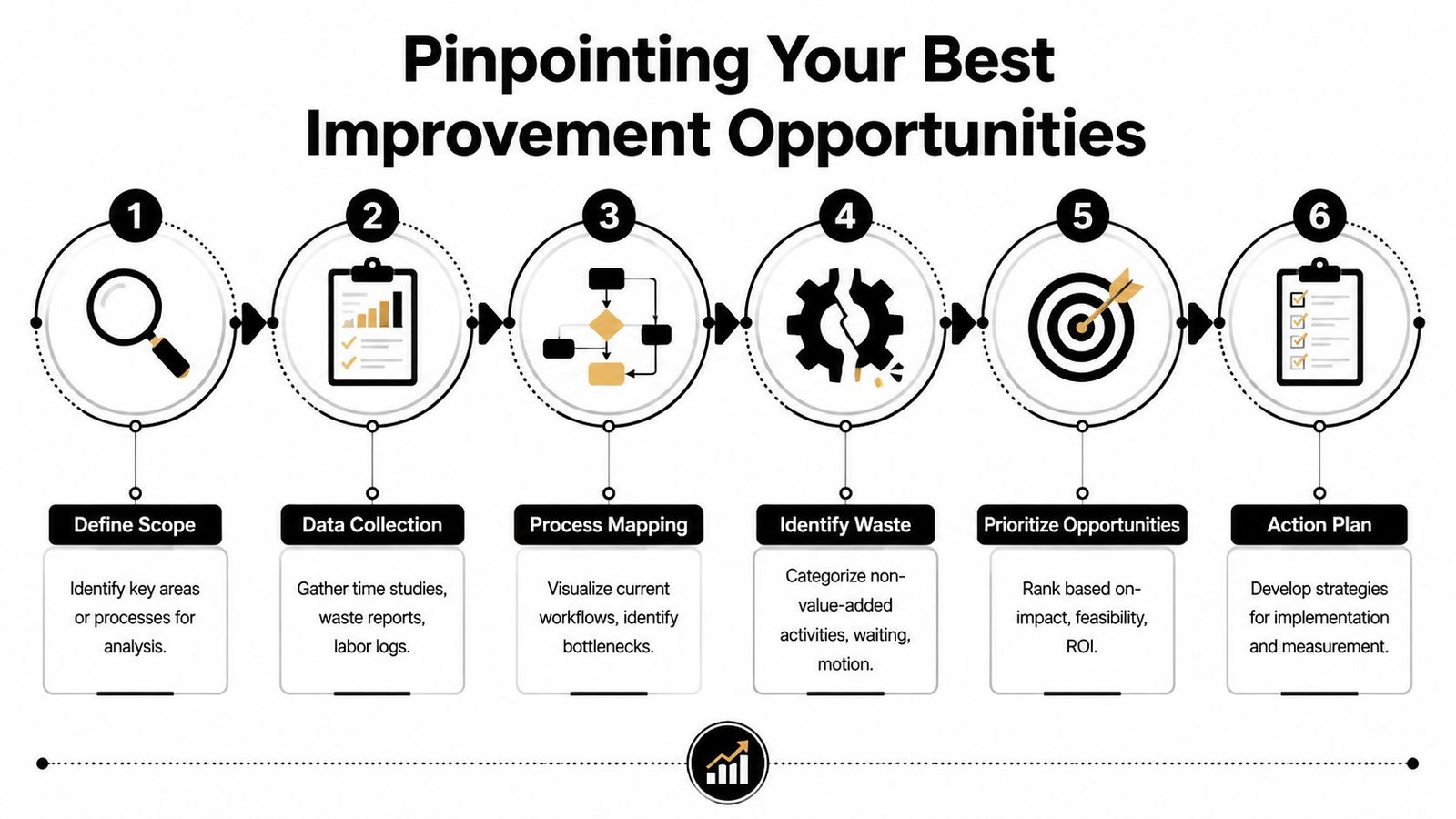
Focus on repeated loss, not isolated annoyance
A useful rule is to start with the highest-frequency loss process first, especially one that runs over 50 times per week and carries at least 5% scrap or similar recurring waste, because concentrating on one high-loss step improves the odds of measurable ROI source. That's a smarter filter than chasing the loudest complaint on the floor. A problem that happens once a day can hurt, but a problem that happens fifty times a week steadily eats labor every shift.
The usual suspects are easy to spot once you know where to look:
- Bottlenecks: One station piles up work while the rest of the line waits.
- High rework tasks: Operators spend time correcting defects that should've been prevented.
- Excess movement: People walk for tools, material, approvals, or missing information.
- Ergonomic strain: Slow, awkward tasks wear people down and lower consistency.
- Schedule churn: Constant change creates start-stop labor inefficiency.
Hidden waste is usually more expensive than it looks, because it steals labor in small chunks all day long.
Score each candidate before you spend
A simple scoring matrix keeps the team honest. Rate each opportunity on three things, frequency, cost impact, and implementation difficulty. A repetitive task with clear labor loss and a manageable change path should rise to the top quickly. A rare task with uncertain savings and a complicated redesign probably belongs lower on the list.
That logic matters because many automation projects fail when teams optimize for visibility instead of payback. A flashy process map won't save money if the target job only runs occasionally. A modest fix on a recurring bottleneck usually pays back faster because the savings compound every shift, every week, every month.
A good shop-floor review ends with a short, ranked list, not a giant backlog. The top entries should be specific enough to assign an owner, define a metric, and test a change without disrupting the whole plant. If the team can't say exactly where the labor is being lost, it's not ready to spend money yet.
The Strategic Power of Semi-Automation and Tooling
The biggest misconception in labor cost reduction is that you need a full robotic cell to make a meaningful dent. In smaller and mid-sized plants, that's often the wrong first move. Right-sized tooling, semi-automation, and custom fixtures usually give the best mix of speed, flexibility, and return.

Why semi-automation wins more often than full automation
Targeted automation can cut manufacturing labor costs by up to 40%, with some applications reducing expenses by 20% to 50%, and the average labor cost per unit can fall by 25% after the right technologies are implemented source. Those numbers matter, but the key lesson is structural. The savings come from removing friction from repetitive work, not from trying to replace every operator in one shot.
That's why semi-automated systems are so practical. They let skilled people keep control of the process while machines handle the dull, slow, or error-prone parts. A custom fixture can lock in positioning. A smart control can standardize a sequence. A semi-automated station can cut motion and protect quality without forcing a complete layout rebuild.
What actually works on the floor
The strongest projects tend to be narrow and specific. One station gets a fixture that improves repeatability. One assembly step gets an assist device that reduces handling. One changeover gets a smarter method that cuts wasted motion and stabilizes cycle time. That kind of change preserves flexibility, which is critical when demand shifts or product mix changes.
A peer-reviewed review on automation in manufacturing notes that automation is increasingly used to boost productivity, achieve consistent quality, reduce costs, and let human workers move to more creative and higher-value tasks source. That aligns with what plant managers need most. The best deployment is the one that augments good operators instead of fighting them.
It's also why a semi-automated path is often easier to defend internally than a full replacement strategy. A 2025 manufacturing paper says automation brings lower long-term operating costs, higher precision, and better scalability, especially in high-volume, standardized environments source. That last part matters. Standardized work is where automation shines. Mixed, unstable, or constantly changing work usually needs a lighter touch.
For a practical example of the middle ground, many teams start by comparing manual handling against a bridged approach like the power of semi-automated systems bridging the gap between manual and full automation. That mindset keeps capital focused on labor reduction per unit, not on building the biggest machine in the room.
Building a Business Case with Clear ROI and Payback
A project gets funded when the numbers hold up under scrutiny. That case does not need to be elaborate, but it does need to be believable to operations, finance, and the people who will run the line. If you cannot show how the change reduces labor minutes per unit, scrap, throughput loss, and quality problems, you do not have a business case, you have a wish list.
Build the case from measurable changes
Start with the current labor minutes per unit, current scrap or rework cost, current throughput, and current downtime exposure. Then estimate how the proposed change moves each one. If a fixture cuts handling time, convert that reduction into labor hours saved. If a semi-automated step lowers rework, count the labor that was previously spent fixing defects. If throughput rises, count only the part that turns into real capacity or avoided overtime.
If the savings only exist in theory, they will not survive the approval meeting.
The strongest ROI discussions stay close to the floor. Use a baseline that captures labor, production, quality, downtime, and energy before the change, then compare that baseline to the new process so the forecast stays grounded in actual shop conditions. That discipline keeps the numbers from drifting into wishful thinking.
Keep the payback view simple
Factory automation projects often target returns in the 20% to 35% annual ROI range, with payback periods of 15 to 30 months depending on complexity and scale source. That gives managers a realistic benchmark. If a project cannot compete with that range, the burden of proof goes up fast. If it can, the case is much easier to defend.
A basic template works well:
- Define the baseline. Capture current labor minutes per good unit, scrap, and downtime.
- State the change. Describe exactly what the fixture, system, or control upgrade does.
- Quantify the delta. Estimate labor minutes saved per cycle or per shift.
- Translate to dollars. Apply the fully burdened labor rate from the baseline section.
- Add secondary gains carefully. Include quality or throughput only if they are realistic and trackable.
- Check payback. Compare upfront cost to annual benefit and timeline.
A hypothetical station upgrade can follow that structure without inflating the numbers. If a manual task becomes semi-automated, the key question is whether the savings are durable and repeatable. A project that removes one labor-heavy step every shift can be more valuable than a bigger system that looks impressive but sits underused.
For teams that want a fast way to pressure-test the numbers, an internal automation ROI calculator is a practical starting point. The goal is not to over-model the project. The goal is to make sure the investment decision matches actual shop-floor economics.
Sustaining Gains Through Change Management and Support
The new equipment doesn't create savings by itself. People do, by using it the right way, every day. That's why the most durable labor cost reduction programs treat change management as part of the operating system, not a side task.
Train the work, not just the operator
When a process changes, standard work has to change with it. If the old method stays on the wall, operators will drift back to what they know under pressure. Training should be short, specific, and tied to the exact task sequence, the quality checks, and the response to exceptions. That matters even more in regulated environments, where documentation and validation have to match the actual process.
The best savings often come from redesigning work to eliminate hidden waste like bottlenecks, unnecessary movement, and poor standard work, rather than reducing headcount source. That's a useful reminder for supervisors too. If the workcell stays clumsy, labor savings fade. If the work is cleaned up, the savings stick.
The floor adopts what makes the job easier, not what makes the spreadsheet look better.
Keep the gains from backsliding
Support matters after launch. Fixtures need inspection. Controls need upkeep. New methods need refreshers when turnover happens or product mix changes. Without that follow-through, the line slowly reverts to old habits, and the savings leak out one exception at a time.
For medical device and GMP-aware operations, the standard work update is not optional. Any process change should be documented, validated where required, and folded into the quality system so the improvement doesn't create a compliance problem later. That's especially important when a semi-automated station changes how parts are handled, checked, or released.
A disciplined plant usually keeps three routines alive after implementation:
- Weekly review: Compare actual labor, scrap, and downtime against the baseline.
- Operator feedback loop: Capture what's awkward, slow, or error-prone before it hardens.
- Maintenance discipline: Keep tooling, sensors, and fixtures in spec so the process stays stable.
Labor cost reduction holds when the process becomes easier to run correctly than incorrectly. That's the core design objective. It's also why the strongest projects pair hardware with training, updated work instructions, and ongoing support.
Your Path to Smarter Manufacturing Starts Here
The fastest way to reduce labor cost isn't to chase labor cost alone. It's to remove wasted effort from the process, then support the new method until it becomes the new normal. Measure the true burdened cost, find the repeat losses, target semi-automation where it makes sense, and build a business case that stands up to scrutiny.
That approach works because it respects how manufacturing runs. People still matter. So do flexibility, quality, and changeovers. The plants that improve fastest aren't the ones that buy the most automation. They're the ones that choose the right process, the right fixture, and the right level of control for the job.
If you're trying to lower labor per unit without taking on unnecessary risk, start with one high-loss step and make it measurable. Then keep tightening the process until the savings are real on the floor, not just in the budget.
A CTA for System Engineering & Automation.