Process safety is the discipline of preventing fires, explosions, toxic releases and uncontrolled reactions by designing, operating and maintaining equipment, controls and procedures so abnormal conditions never become incidents.
You can be standing near a cell that looks fine right now. Gloves are on, the lost-time board is quiet, and the line is making rate. A technician has jumpered a light curtain so the changeover finishes, or someone edited a PLC recipe after the engineer went home. Nobody is hurt. The limit that was supposed to hold the machine is already gone.
That is the gap manufacturers hit when they ask what process safety means and they don't run a chemical plant. The same habits that stop a runaway reaction also stop unexpected motion, a press that still holds air, and a mix-up that scraps a medical-device lot. Any operation where equipment, controls, tooling or changeovers can create abnormal conditions needs the same thinking. The payoff is not only fewer incidents. Controls that keep energy and material where they belong also keep the process repeatable, which tightens quality, uptime and traceability.
Table of Contents
- What Process Safety Means in Plain Terms
- Real Accidents That Shaped Process Safety
- The Three Principles Behind Every Process Safety Program
- How Regulations Define Process Safety Obligations
- Common Misconceptions About Process Safety
- Build a Process Safety Routine on Your Production Line
- Decide Between an Internal Review and Outside Support
What Process Safety Means in Plain Terms
Say a day tank keeps filling after the high-level switch sticks. Everyone has the right PPE, nobody is in the splash zone, and the injury log stays blank. The tank still overfills.
Personal safety is the seatbelt. It protects the driver after something has already gone wrong. Process safety is the brakes, stability control and airbag logic that keep the vehicle from crashing. One watches the person. The other watches the conditions that can run away.
It is a structured management approach that joins technology, operating procedures and management practices. The U.S. milestone is OSHA's Process Safety Management standard, 29 CFR 1910.119, issued in February 1992 and effective nationally on May 26, 1992, as the OSHA PSM booklet records. Major chemical accidents had already shown that personal-safety programs alone couldn't control hazards built into complex processes. Covered employers manage 14 major elements, including process safety information, process hazard analyses, operating procedures, training, mechanical integrity, management of change, incident investigation, emergency planning and audits. The clock was explicit: at least 25% of required process hazard analyses by May 26, 1994, another 25% each following year, and 100% by May 26, 1997.
A parts plant doesn't get a pass because it lacks a tank farm. Safeguards have to be designed, documented, verified and maintained. They don't stay effective because last quarter's injury rate was low.
| Aspect | Personal Safety | Process Safety |
|---|---|---|
| Focus | Individual behaviour and injuries | Equipment, controls and process conditions |
| Typical hazard | Slips, cuts, manual handling | Fire, explosion, toxic release, runaway reaction, unexpected machine motion |
| Typical indicator | Lost-time injury rate | Overdue safety-critical maintenance, failed interlocks, bypass count |
| Main controls | PPE, training, housekeeping | Designed safeguards, procedures, mechanical integrity, management of change |
Run one test on your floor. Does any machine store energy, hold material above a set level, or depend on a control system to stay inside safe limits? If yes, process safety applies even with no chemicals on site.
Real Accidents That Shaped Process Safety
The sites that forced the rules into law didn't fail because nobody owned a hard hat. They failed because a known hazard met a safeguard that wasn't there when it was needed.
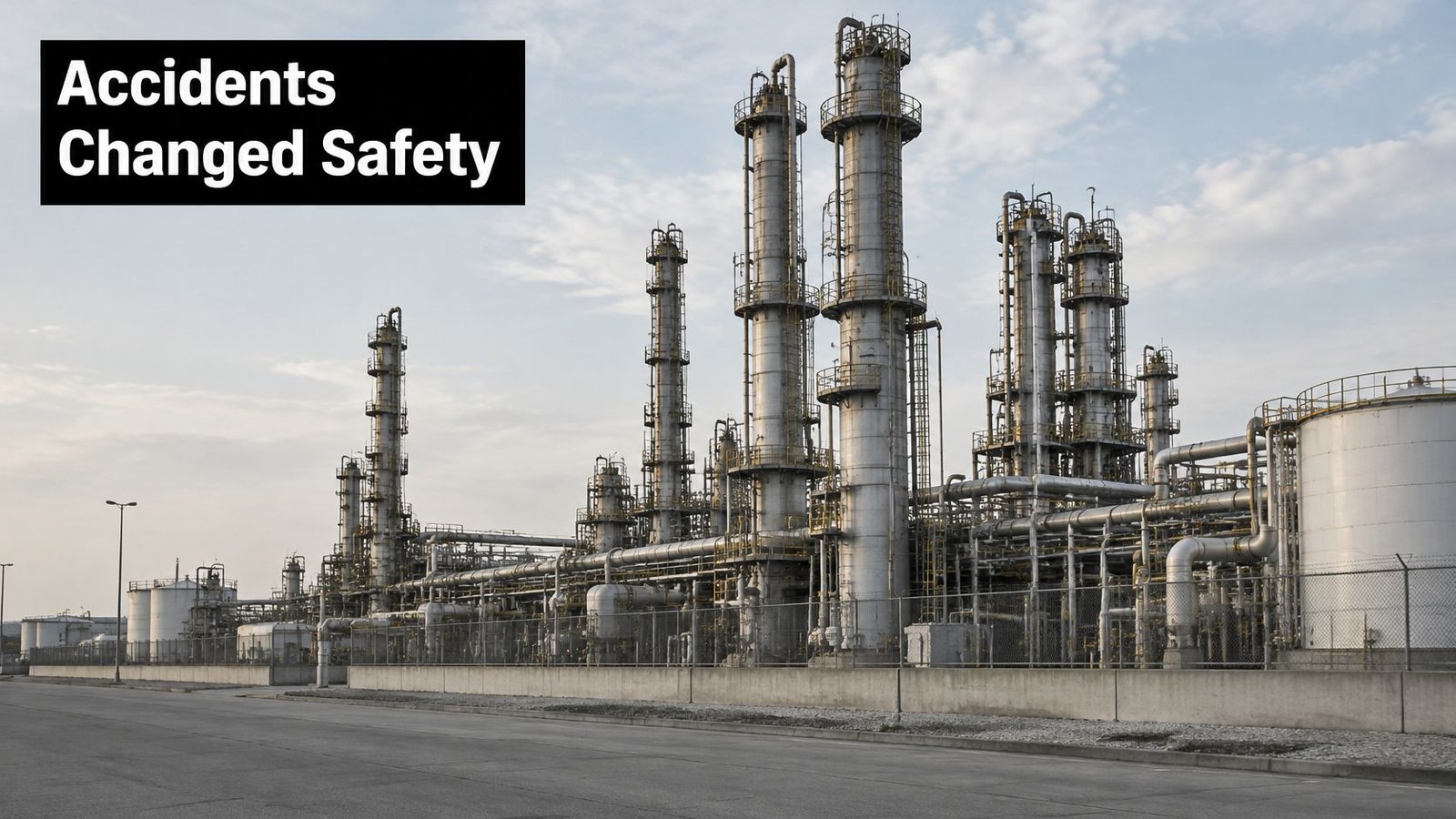
On December 3, 1984, in Bhopal, India, water entered a methyl isocyanate storage tank at a Union Carbide pesticide plant. A professional process-safety review records that the toxic release killed more than 3,800 people and injured more than 100,000, and that an Arco Chemical plant explosion in July 1990 killed 17 workers and helped prompt OSHA's proposed PSM rule. At Bhopal the failure was utility water entering a process that couldn't tolerate it. At Arco it was an explosion inside a chemical plant whose consequences reached the whole workforce.
A hazard that is known still becomes an incident when the safeguard is bypassed, untested or never written down.
A smaller plant should look at the same weak points. Changeovers, utility tie-ins and startup sequences are where one unverified step defeats a protection layer. A cooling hose on the wrong fitting, or a startup that skips the interlock check, is the same pattern at a different scale.
The record of those events is easier to follow on screen than in a paragraph.
The Three Principles Behind Every Process Safety Program
Each step answers the question the last one leaves open. Skip one and the next step is guesswork.
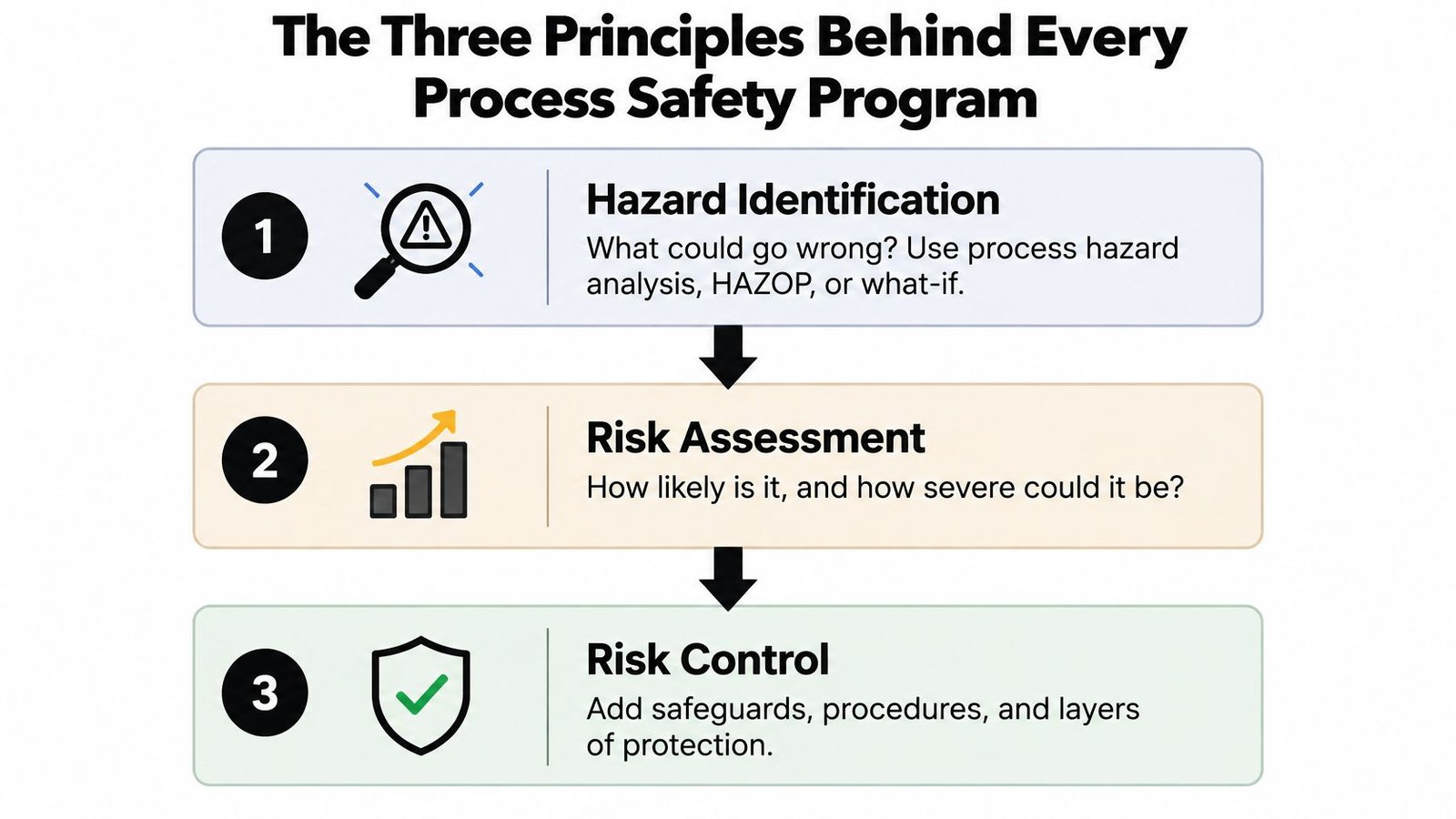
Hazard identification asks what could go wrong. A process hazard analysis, a HAZOP or a what-if review lists credible deviations: an unexpected start, overpressure, loss of cooling, a bypassed interlock. On a discrete line that list includes a robot that moves while a door is open, a fixture that clamps on a hand, or two similar parts loaded in the wrong nest. A failure mode analysis is the practical way to name those deviations before you rank them.
Risk assessment asks how likely each deviation is and how bad it gets. A simple risk matrix puts consequence against frequency so the team spends time on the scenarios that can hurt people or scrap a lot, not on every theoretical slip. A pneumatic press that can still hold line pressure during a tool change outranks a cosmetic scratch on a guard.
Mitigation, or risk control, asks what stops the event or limits the harm. Layers sit in order. Basic process control holds normal operation. An alarm only counts if an operator has a defined response and enough time to act. An interlock removes the hazard without relying on memory. A relief device or a hard stop is the last line, not the daily one.
Three shop-floor cases show the ladder in hardware.
- A robot cell's light curtain halts motion when an operator reaches in. That curtain has to work even if the normal program is wrong.
- A pneumatic press must vent stored air before anyone changes the tool. The vent valve is independent of the cycle start button.
- A PLC recipe change stays in a hold state until someone reviews it. The review is the safeguard, not the programmer's good intentions.
A safeguard has to be independent of the thing it protects, and each one needs a defined test with a pass criterion. A hazard you haven't named can't be ranked. A safeguard you haven't tested is only an assumption.
How Regulations Define Process Safety Obligations
The first question is whether your plant is inside a rule or only borrowing its ideas.
OSHA PSM applies to facilities that handle threshold quantities of highly hazardous chemicals or flammable materials. The Process Safety Management standard requires those 14 management elements, and it is specific about how protection stays alive after startup. Mechanical integrity means you identify and categorize equipment and instrumentation, set inspection and test frequencies, write maintenance procedures and acceptable test criteria, document results, and consider the manufacturer's failure information. Written operating procedures have to cover startup, normal operation and emergency shutdown.
What a change and an incident trigger
Management of change is the gate between an engineering edit and the line. A change needs a technical safety basis, an impact assessment, authorization, training for the affected workers, and updates to process information and procedures. An incident that caused, or could reasonably have caused, a catastrophic release must be investigated within 48 hours or sooner. Compliance audits run at least every three years.
The same logic hits automated lines that never see a covered chemical. A bypassed safety interlock, a pressure or presence sensor out of calibration, degraded guarding, or an undocumented PLC change defeats the layer you thought you had. Leading signals worth tracking are overdue proof tests, failed interlocks, alarm demand rates, maintenance backlogs, unauthorized bypasses and open PHA recommendations. Injury rates won't show those failures while they are still latent.
Medical-device makers sit under a different statute with the same instinct. FDA process validation guidance treats validation as objective evidence that a process consistently meets predetermined specifications, and where later inspection can't fully verify the result, the process must be validated with a high degree of assurance. Records include the activities and results, the date and signature of the approver, and, where appropriate, the major equipment validated. Separate FDA automation guidance states that software used to automate device production or the quality system must be validated for its intended use under 21 CFR 820.70(i), and that manufacturing equipment must meet specified requirements.
| Regulation | Who It Covers | Core Requirement |
|---|---|---|
| OSHA PSM, 29 CFR 1910.119 | Facilities with threshold quantities of highly hazardous chemicals or flammable materials | 14 management elements, including process hazard analysis and mechanical integrity |
| FDA process validation and 21 CFR 820 | Medical device manufacturers | Validated processes; production and quality software validated for intended use under 820.70(i) |
| Discrete manufacturers below PSM thresholds | Usually outside PSM coverage | No mandate in most cases; the same elements can be applied voluntarily |
If you sit in that third row, you still choose whether guarding, interlocks and change control match machine safeguarding standards. Voluntary doesn't mean informal. It means you write the same checks without waiting for a threshold quantity to force them.
Common Misconceptions About Process Safety
Managers usually hit the term and then try to file it under "chemical plants only." Five assumptions cause most of the trouble.
"We don't have a reactor, so this isn't ours." Any process that stores energy, moves material or depends on controls can leave its normal envelope. Unexpected machine motion, trapped pneumatic energy, a tooling failure, a guard bypass or a product mix-up in device assembly are process-safety problems. They don't need a listed chemical to hurt someone or to ruin a lot.
"Our safety program already covers this." Occupational safety and process safety can both be healthy, or only one of them. A worker can walk away unhurt while a single failed valve, or a single wrong recipe, affects the whole bay. Counting cuts doesn't tell you whether the high-level switch still opens.
"We installed the safeguard, so we're done." Protection decays. People bypass interlocks to make a changeover. Sensors drift. A PLC edit never gets written back into the drawing. The device is still bolted on. It no longer does the job you credited it with.
"Our injury rate proves we're in control." A quiet first-aid log can sit on top of overdue proof tests and failed interlocks. Those leading signals show a weakening layer before anyone is injured. If you only review the injury rate, you will congratulate the plant for a risk you haven't measured.
"The new software will catch it." A 2025 survey of 300 process-safety professionals across the U.K., U.S., Canada, Germany, Australia and New Zealand found that 42% were using or planning to use AI, while one-third lacked the internal expertise to use it effectively, and predictive or preventive systems stayed uncommon. Analytics can rank inspections and surface weak signals. They shouldn't replace an independent protection layer. A recommendation is not a safeguard until a person checks it against the hazard study and a defined response.
Process safety doesn't replace general safety programs. It works beside them, on the equipment and the changes those programs don't see.
Build a Process Safety Routine on Your Production Line
A routine is a short loop you can run on a semi-automatic cell without building a chemical-plant department. Each step has a reason, and each one has a usual way to fail.
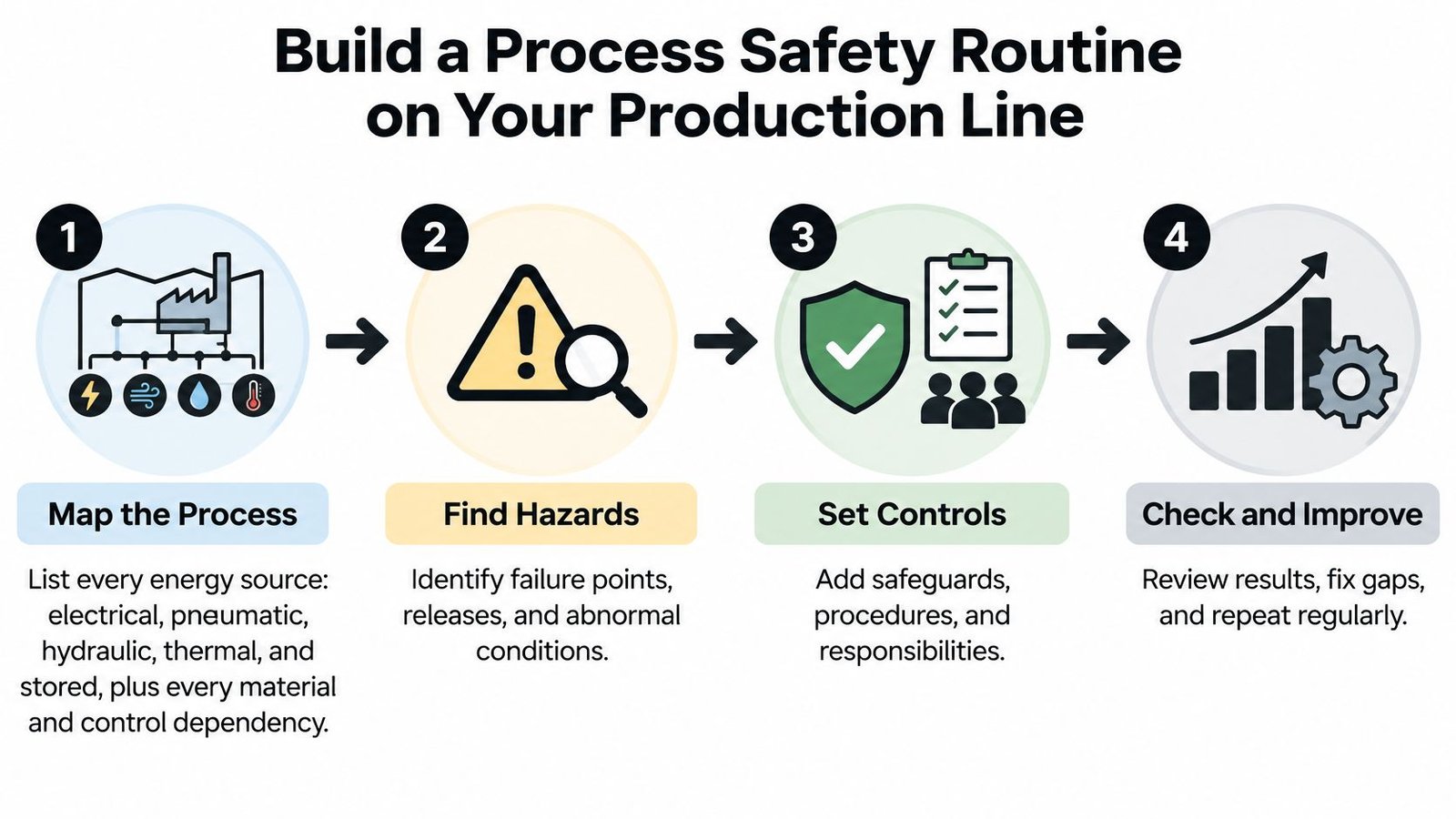
- Map the process. List every energy source, electrical, pneumatic, hydraulic, thermal and stored, plus every material and every control the step depends on. People skip stored air in a cylinder that looks "off."
- Review hazards at each new process, changeover and tooling change. Write the deviations that matter: unexpected motion, overpressure, overfill, mix-up. A standing hazard identification process keeps that list from living in one engineer's head. Skipping the changeover review is the most common way a bypass becomes normal.
- Name an independent safeguard for each high-ranked scenario. Confirm it works without operator memory. If the only barrier is "the tech knows not to," you don't have one.
- Put each safeguard on a test or inspection schedule and record what "pass" means. A test with no acceptance criterion gets pencil-whipped.
- Send every hardware, software or recipe change through management of change before it is released, and train the operators who will run it. Releasing first and filing later is how the drawing and the PLC diverge.
- Set a tolerance on leading indicators and escalate when you cross it. The UK Health and Safety Executive recommends a tolerance for each leading indicator as the point where deviations go to senior management. Overdue safety-critical maintenance is the example they use. The tolerance can be zero, so 100% of those actions finish on schedule, or you can accept limited slippage before you escalate. Pick the number in advance, or the backlog will set it for you.
- Investigate every near miss that could have caused a serious release or a serious motion event. Do it while the people on the shift still remember the sequence. Waiting for a recordable injury throws away the only free warning you get.
What healthy looks like
After about three months you should see no overdue proof tests, a bypass list that is shrinking, and every change traceable to an authorization and a trained operator. If the bypass list is growing, the routine is paperwork. Fix the step that lets the bypass stay, don't add another form.
Decide Between an Internal Review and Outside Support
You don't need a consultant because a poster says "safety first." You need a second set of engineering eyes when the line is telling you the current setup has run out of room.
Call for outside help when labor shortages slow production, quality issues hurt your reputation, bottlenecks keep causing delays, or you can feel that the process could be smarter, faster or better. An internal review is enough when your own team can still name the hazards, close the tests and hold the change process. Bring someone in when those lists are stale and the people who knew the cell have left.
In a consultation we look at the specific situation on your line, persistent quality-control problems, and whether you want to change the process itself. That is an end-to-end evaluation of cycle time, throughput, labor dependency and quality control, not a catalog pitch. Automation can be phased so the first step is the one that returns the most, including a small tooling or controls upgrade rather than a full line. In GMP-aware device production, those controls still have to be validated and documented against intended use. We're one option to weigh. You can keep the review inside if your team has the time and the independence to challenge its own bypasses.
Before the first conversation, put three things on the table.
- The process map, with energy sources and control dependencies marked.
- Recent near misses and changes, including recipe and PLC edits.
- The maintenance and bypass log, with dates and who authorized each bypass.
System Engineering & Automation designs and upgrades semi-automatic and automated equipment, tooling, fixtures and controls so production stays inside safe limits while cycle time, quality and traceability improve. If your line is carrying jumpered interlocks, unreviewed recipe changes or a maintenance backlog on safety-critical devices, that is the work we take from concept through commissioning. Visit System Engineering & Automation when you want that evaluation on your actual process.