A cleanroom can pass its tests while the manufacturing operation still fails its GMP review. The World Health Organization's GMP framework covers personnel, materials, processing, quality control, validation and documentation alongside premises and equipment. A particle-count report alone therefore can't establish that a facility consistently produces acceptable product.
For small and mid-sized medical device manufacturers, the expensive mistake is often overbuilding the room while leaving the workstation poorly controlled. A semi-automated cell needs more than cleanable guards and repeatable motion. Its recipes, operator permissions, inspection results and maintenance changes must fit into the same quality system as the device it makes.
Table of Contents
- Core Requirements Checklist at a Glance
- Medical Device Scope and Quality System Requirements
- Cleanroom Classes Matched to Contamination Risk
- Layout, Zoning and Material Flow Requirements
- Materials, Supplier Qualification and Goods-In Control
- Utilities, Equipment and Automation Qualification
- Airflow, Pressure and Environmental Monitoring
- Documentation and Validation Evidence Required
- Personnel, Gowning and QA Oversight
- Commissioning Steps and Your Next Decision
Core Requirements Checklist at a Glance
An inspector reviewing a GMP-compliant manufacturing facility follows the product and the evidence supporting its manufacture. A missing record is a compliance gap even when the installed hardware appears sound.
Facility requirement areas and the evidence each one needs
| Requirement area | What must be in place | Evidence an inspector asks for |
|---|---|---|
| Premises and layout | Zoned rooms with one-way flow and cleanable surfaces | Floor plans, room classification and flow diagram |
| Contamination control | Classes matched to product risk with validated airflow | Qualification reports and pressure differential records |
| Equipment and utilities | Designed for intended use, cleanable and calibrated | URS, IQ and OQ records, calibration certificates and cleaning procedures |
| Automation and software | Validated for intended use with controlled changes | Validation protocol, audit-trail review and change control records |
| Materials | Approved suppliers, controlled storage and identity checks | Supplier qualification, goods-in records and quarantine logs |
| Personnel | Trained, gowned and competent for assigned tasks | Training matrix, gowning qualification and competency records |
| Quality assurance and QC | Independent release authority and laboratory controls | Deviation log, CAPA records, release sign-off and lab data |
| Validation and documentation | Lifecycle evidence that the process stays in control | Validation master plan, PQ results and periodic review reports |
Read the checklist across systems
A semi-automated assembly cell touches several rows simultaneously. Its fixture belongs under equipment, its programmable logic controller (PLC) and human-machine interface (HMI) under automation, its incoming components under materials, and its output records under validation and documentation.
Don't accept a supplier's equipment checklist as the complete facility assessment. The supplier can demonstrate that a sensor detects a component, but the manufacturer must establish whether that detection supports identity, orientation, presence or another product requirement.
The same distinction applies to room classifications and gowning. These controls must follow the operation's contamination risks rather than becoming automatic requirements for every room and employee.
Practical rule: Every important control needs a named requirement, an acceptance criterion, an evidence record and an owner.
Close gaps before design freeze
Use the checklist during concept review, when changes to access, data capture and material presentation are still straightforward. Ask engineering, operations and quality to identify the actual document behind each row, not merely confirm that someone intends to write it.
Treat any area without a named document or record as an unresolved design input. Before design freeze, decide who will produce the evidence, who will approve it and what would prevent acceptance.
Medical Device Scope and Quality System Requirements
Does the quality system cover only assembly, or also the fixture shop, service activity and software that determines acceptance? That scope question should be settled before anyone orders production equipment.
The FDA's medical-device quality system regulation, including 21 CFR Part 820 and its applicable ISO 13485 requirements, calls for a system appropriate to the devices manufactured. Relevant activities include design, manufacture, packaging, labeling, storage, installation and servicing of finished devices intended for human use.
Establish the operational boundary
- List the products. Identify every device and product family made on site, including intermediate assemblies supplied to another manufacturer.
- Assess patient risk. Consider classification alongside the consequences of a failed joint, incorrect label, contamination event or missed inspection.
- Map activities to controls. Connect fixtures, workstations, semi-automated cells and supporting services to controlled procedures and records.
- Assign change authority. Name who approves equipment, software and tooling changes, including temporary substitutions.
A catheter subassembly crimping station needs a process specification, operator instructions, controlled fixture drawings and a calibration plan for relevant measurements. A manual visual-inspection bench needs defined acceptance criteria, suitable lighting, demonstrated inspector competence and a controlled reject process.
Include interfaces and service work
Contract manufacturing adds boundaries that deserve explicit agreements. Servicing production equipment at a customer's site isn't automatically the same activity as servicing a finished medical device; document which responsibilities belong to each party.
Manufacturers selling into several markets should maintain a common quality-system foundation with clearly identified market-specific additions. Duplicating entire documentation systems creates conflicting revisions without improving control.
When evaluating automation in medical device manufacturing, scope the production function before choosing the technology. These scope decisions determine how much environmental control, qualification, oversight and supporting evidence the operation needs.
Cleanroom Classes Matched to Contamination Risk
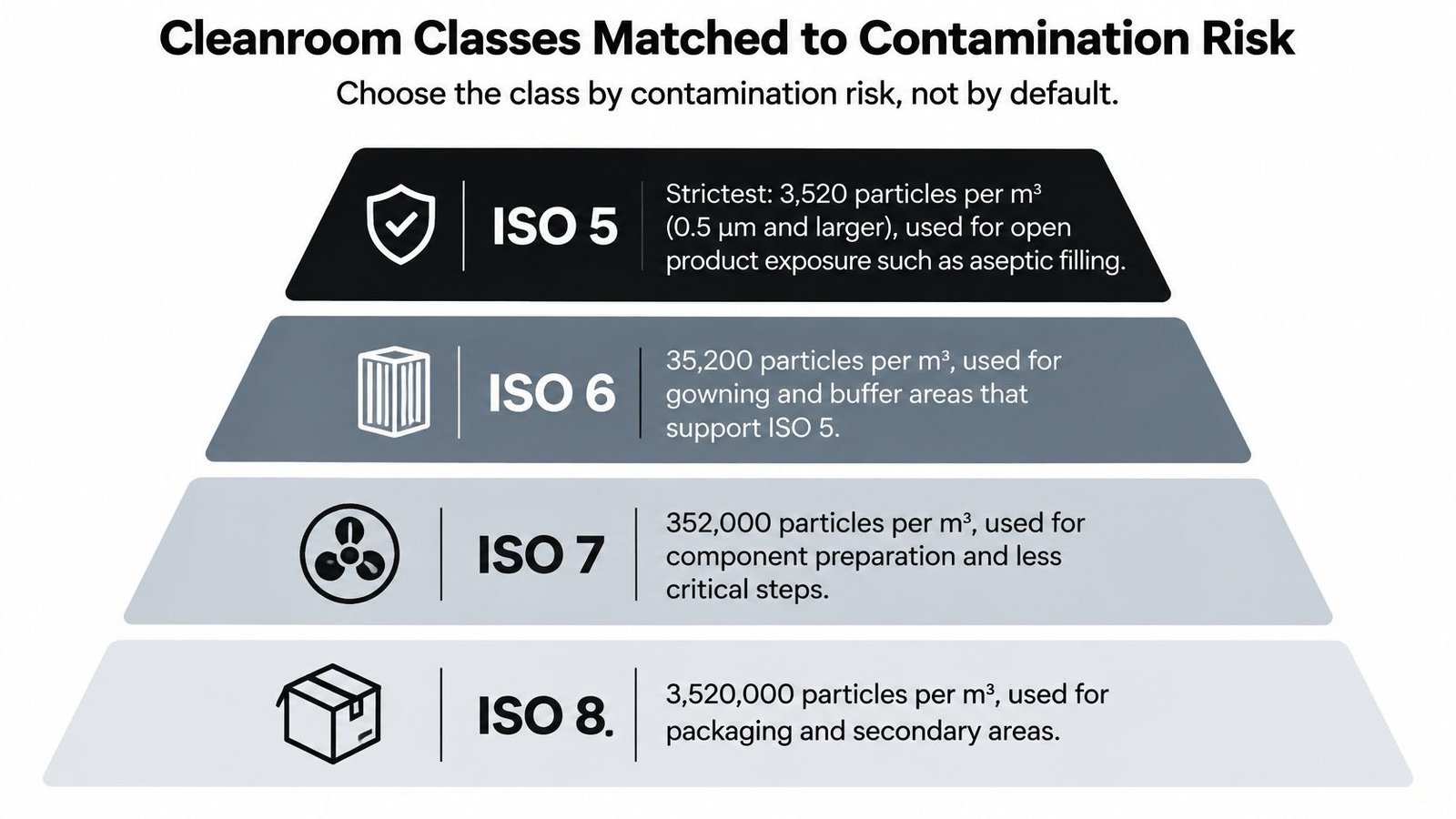
ISO 14644-1 classes with particle limits and typical use
The class identifies a particle-concentration limit, not a mandatory air-change rate or automatic authorization to perform a particular operation. Use the applicable classification standard to establish the numerical acceptance limits in the room qualification protocol.
| ISO class | Typical air changes per hour | Typical device use |
|---|---|---|
| ISO 5 | Set by qualified unidirectional airflow and recovery performance | Open handling of sterile or highest-risk product |
| ISO 6 | Establish through airflow design, loading and recovery qualification | Support zone around ISO 5 filling or assembly |
| ISO 7 | For an illustrative design scenario, 30–60, subject to qualification | Assembly of closed components and packaging of sterile-barrier systems |
| ISO 8 | For an illustrative design scenario, 10–20, subject to qualification | Non-sterile assembly, final cleaning and low-risk handling |
Those illustrative ventilation ranges aren't acceptance criteria. Equipment heat loads, occupancy, particle generation and recovery requirements can make a nominal air-change figure unsuitable.
The hierarchy is useful for comparing cleanliness levels, but the room and process still require their own assessment.
Select the environment for the exposed operation
Start by identifying where product is exposed. Assess whether an operator handles an open product-contact surface, a closed component or a protected sterile barrier.
Then choose the least stringent environment justified by that risk assessment and provide suitable support around higher-risk points. Don't classify an entire production floor to solve a localized exposure problem.
Consider a hypothetical housing-assembly process. Closed plastic housings might be assembled in an ISO 8 room, with an ISO 7 workstation proposed for a more sensitive exposed step. A tool opening a sterile fluid path could instead require ISO 5 protection at the exposure point, supported by the appropriate aseptic controls.
These are starting concepts, not universal device-class rules. A process requiring subsequent sterilization presents different risks from aseptic assembly of an already sterile fluid path.
Test the state that matters
As-built describes the completed room before production equipment and personnel are present. At rest includes installed equipment under defined conditions without operating personnel, while in operation represents the specified working activity.
At-rest qualification alone doesn't demonstrate acceptable performance with operators, moving equipment and material transfers. Define the required qualification states and monitor the actual operation.
A more stringent room classification won't compensate for a robot arm that blocks protective airflow over exposed product.
An enclosed automated cell may reduce the surrounding room's control burden, but only when its enclosure, transfers and interventions are qualified. The buyer should compare that localized solution with the construction, energy and maintenance burden of upgrading the whole room.
Layout, Zoning and Material Flow Requirements
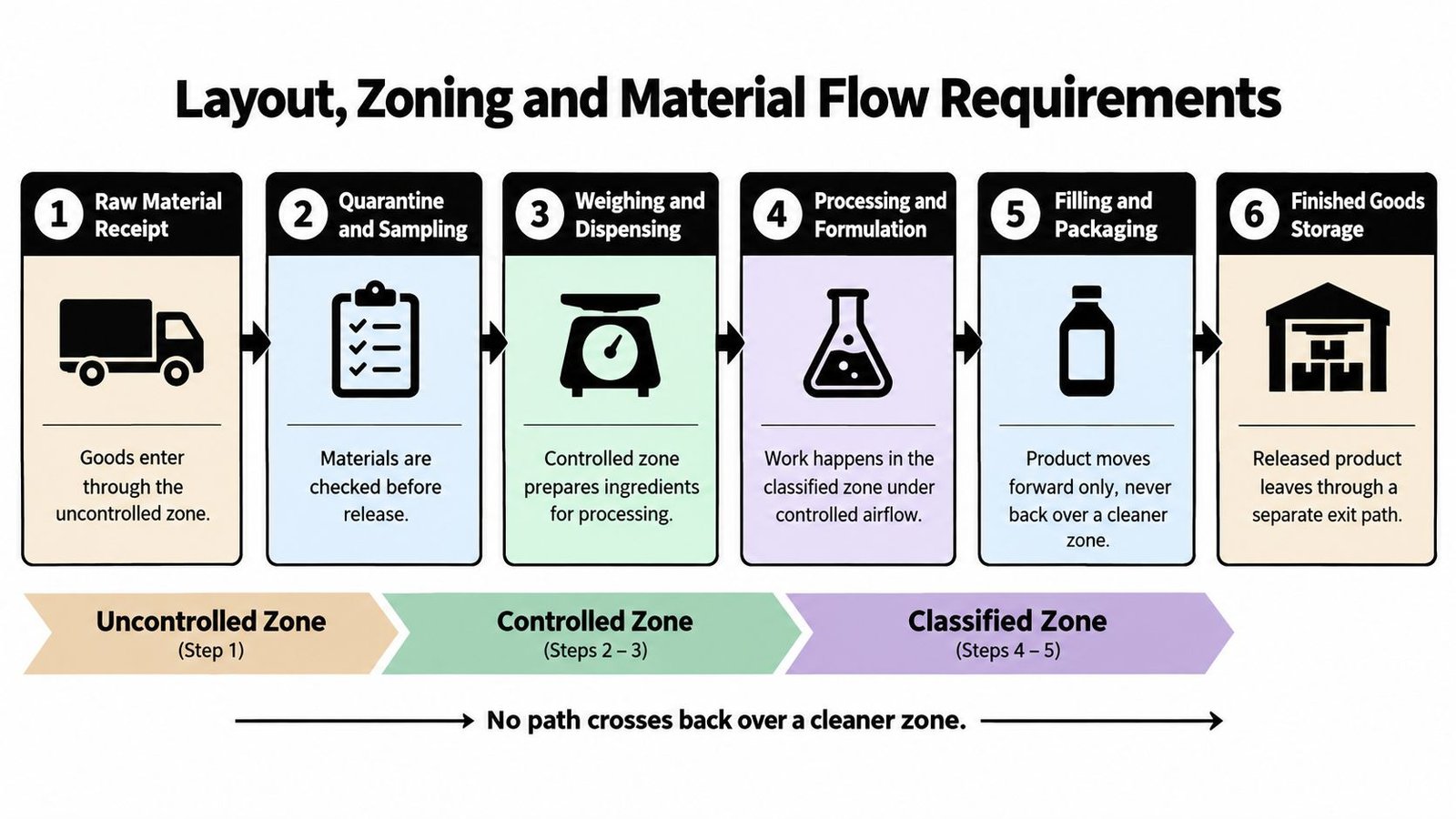
Draw the product route before drawing permanent walls. The layout should move material forward from receipt to finished goods without sending dirty containers, waste or rejected components back across cleaner work.
Separate uncontrolled receiving and external packaging from controlled preparation areas and classified operations. Not every device process needs a classified room, but every process needs clear status and contamination boundaries.
Use the material route as the starting point for the layout review.
Walk the stations in order
- Receipt. Accept deliveries in the uncontrolled zone and remove transport contamination before inward transfer.
- Quarantine and sampling. Hold stock until required checks and release decisions are complete.
- Preparation. Dispense, kit or stage approved components in the controlled zone.
- Processing. Perform assembly or formulation under the environmental conditions justified for the operation.
- Inspection and packaging. Protect exposed surfaces and the sterile-barrier system while verifying product acceptance.
- Finished-goods storage. Maintain release status and send approved product through the defined dispatch route.
Personnel should enter through a gowning anteroom with a fixed sequence. Where pass-through hatches form a contamination boundary, interlocked doors prevent both sides opening together.
Give rejects and waste a separate exit route. Where the building prevents complete physical separation, assess and document an effective alternative rather than relying on informal scheduling.
Inspect the details people work around
Specify smooth, non-shedding, cleanable walls and ceilings, coved junctions where needed, and sealed penetrations. Keep drain connections out of critical production spaces; where drainage is necessary, design it to prevent contamination transfer.
Leave enough clearance to clean behind guards and maintain utility connections. A workstation beside a busy doorway can suffer repeated airflow disturbance even when the room's average measurements look acceptable.
Use a physical walk-through checklist:
- Posted flow diagram: Confirm that actual movements match the approved route.
- Quarantine and rejects: Check that locations are identifiable and prevent accidental use.
- Entry hygiene: Position handwashing before the gowning transition without creating splash near exposed product.
- Storage and lighting: Separate labeled stock from production and record lighting measurements for inspection tasks.
Reject a hatch location that forces operators into a traffic lane. Likewise, reroute a conveyor rather than allowing it to cross a clean corridor merely because that makes the machine layout easier.
Materials, Supplier Qualification and Goods-In Control
Approve the supplier before placing the first production order. Review its quality system, change-notification arrangements, audit history and ability to provide traceable evidence for the material being purchased.
For product-contact parts, specify the required material certificate and retain it against the controlled part number. A certificate for a generic polymer family isn't evidence that the delivered tubing, seal or fixture insert matches the approved specification.
Control receipt through release
Build the material sourcing process around the checks receiving personnel can actually perform:
- Match the delivery: Compare the purchase order, part number, lot identification, quantity and certificate.
- Verify identity: Sample or test where the material risk and acceptance plan require it.
- Apply quarantine status: Use visible labels and controlled locations or electronic restrictions.
- Authorize release: Record the decision and the identity of the authorized reviewer.
Store approved material separately from active production, with defined environmental conditions where needed. Use first-expired-first-out rotation for dated stock and retain temperature or humidity records when those conditions affect suitability.
Resolve discrepancies rather than rewriting them
Suppose a silicone tubing certificate names a different grade from the purchase order. Keep the lot in quarantine and raise a deviation.
A corrected certificate is necessary if the supplier made a documentation error, but it isn't sufficient by itself. Obtain evidence that the delivered lot is the approved grade; if the material is wrong, a paperwork correction can't make it acceptable.
Distributors don't remove the need for traceability to the original manufacturer. Segregate, label and log returns and rejects so neither can re-enter production through an ordinary stock transfer.
The first records to have ready are the supplier approval file, goods-in log and quarantine release sign-off. Together, they should explain why this supplier, this lot and this release decision were acceptable.
Utilities, Equipment and Automation Qualification
Write the user requirements specification (URS) before selecting equipment. Define intended use, required output, product-contact surfaces, cleaning method, compressed-air or water needs, and the records the system must produce.
Include practical constraints such as changeover access, available maintenance skills and spare-parts support. An impressive machine that requires an unavailable controls specialist for routine recovery isn't a good fit for a small operation.
Verify construction and cleaning
The FDA's CGMP equipment guidance requires equipment suitable for its intended use, effective cleaning and maintenance, and product-contact surfaces that don't adversely alter drug quality. For pharmaceutical applications, documented cleaning and evidence of residue removal are particularly important at changeover; device manufacturers should establish corresponding controls from their own product risks.
Check material certificates against drawings and actual installed parts. Inspect drainability, dead legs in fluid systems, accessible maintenance points, lubricant separation and manual-cleaning or clean-in-place arrangements.
Set calibration and preventive-maintenance schedules before commissioning. For relevant water systems, the WHO pharmaceutical-water guidance treats design, installation, commissioning, qualification and maintenance as connected lifecycle activities.
Define software responsibilities
Classify functions by their effect on product quality. A torque limit, reject decision or recipe permission needs more scrutiny than a nonessential production dashboard.
Define critical parameters, recipes, alarms, interlocks and electronic records. Test interrupted cycles, sensor failures, incorrect components, communication loss and recovery after power interruption.
The FDA software-validation guidance discusses intended-use validation for production and quality-system software under the legacy 21 CFR 820.70(i) framework. Use an intended-use definition, approved protocol, documented results and controlled changes, while mapping the project to the current applicable quality-system requirements.
Compare the burden before choosing
| Approach | Validation and operating trade-off | Appropriate focus |
|---|---|---|
| Manual workstation | Little automation software to validate, but greater operator variability | Fixtures, instructions, competence and recorded checks |
| Semi-automatic cell | Targeted testing of PLC, HMI, sensors, recipes and interventions | Critical functions, exceptions and traceable output |
| Fully automatic line | Broader software, interface and data-integrity exposure | Integrated failures, recovery and system-wide record consistency |
System Engineering & Automation is one option for semi-automated cells, fixtures and integrated controls, with product-contact documentation and commissioning support. Compare such builds with improved manual tooling and fully automatic equipment against the same URS.
Define fallback procedures explicitly. A failed interlock must not become permission to finish the batch manually without an approved alternative process.
Airflow, Pressure and Environmental Monitoring
Qualification demonstrates that the room and clean-air equipment perform as designed under defined conditions. Routine monitoring checks whether the operating process remains within established controls; it doesn't replace qualification.
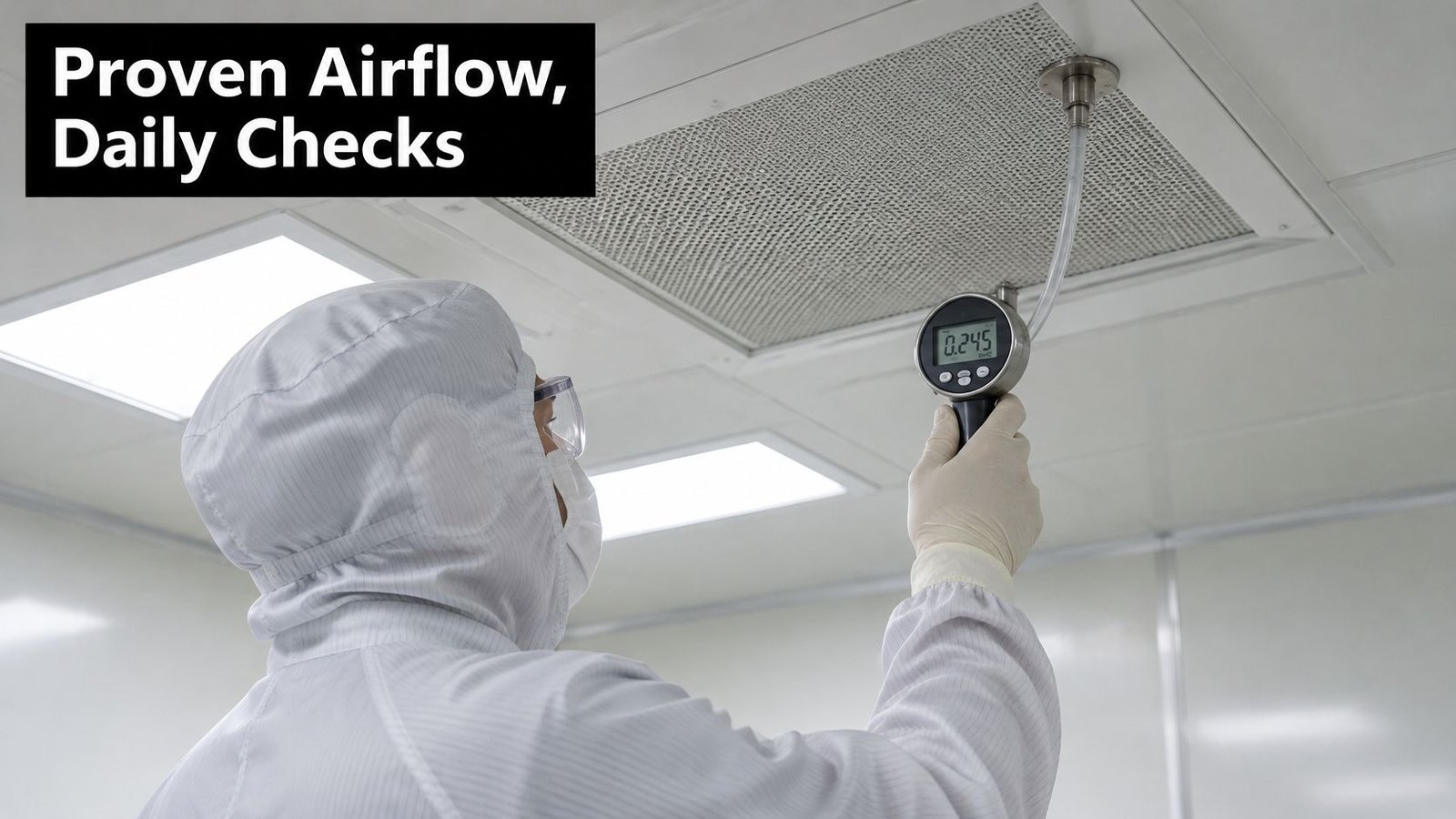
Under EU GMP Annex 1, qualification includes installed-filter integrity testing, airflow volume and velocity testing, pressure-differential verification and airflow-direction visualization. Its sterile-manufacturing framework also distinguishes qualification from monitoring throughout critical activities, including equipment setup and aseptic assembly.
The testing arrangement should represent the installed equipment, not an empty-room substitute.
Establish measurable operating conditions
Use smoke visualization to examine airflow around fixtures, guards and operator access points. Include the interventions people perform in practice, such as replenishing components or clearing a jam.
Typical environmental targets and monitoring methods
The numerical bands below are illustrative design targets, not universal acceptance limits. Approve actual targets through facility design, product-risk assessment and qualification.
| Parameter | Typical target | Monitoring method | Alarm approach |
|---|---|---|---|
| Differential pressure between adjacent zones | Illustrative design target of 10–15 Pa | Continuous transmitter with data logging | Alarm on loss of intended positive pressure and on drift trend |
| Unidirectional airflow velocity | Qualified velocity range at the defined working position | Anemometer during qualification and periodic checks | Action limit below the qualified minimum |
| Temperature | Set point within the range defined in design | Continuous sensor | Alarm band around the set point |
| Relative humidity | Illustrative design band of 30–60% where product or process requires it | Continuous sensor | Alarm outside the qualified band |
| Airborne particles | Applicable class limit specified in the classification protocol | Particle counter at defined locations during operation | Alert and action limits informed by qualification and operating data |
| Viable microorganisms | Limits set by product risk and applicable grade | Air sampling, settle plates, contact plates and glove prints as appropriate | Trend review and escalation of out-of-limit results |
Make the alarm response executable
An alarm needs an owner and an action, not just a colored HMI banner. Define a response sequence:
- Protect the operation. Stop or place the affected step in its validated safe state.
- Capture the event. Retain the time, measured value, duration and affected production.
- Assess impact. Have QA evaluate exposed product and relevant environmental evidence.
- Authorize recovery. Document product disposition and permission to resume.
Qualification should establish recovery after representative door openings. Maintenance that opens a protective enclosure needs an impact assessment and appropriate airflow re-verification before production restarts.
Don't label qualification a permanently completed exercise. Changes to guards, extraction, robot paths or access doors may invalidate the conditions originally tested.
Documentation and Validation Evidence Required
Set validation depth by process risk and scientific understanding, not by a fixed batch count. The FDA's production and process-control Q&A states that CGMP regulations and FDA policy do not prescribe a minimum number of process-validation batches. The evidence should show that the process is understood and controlled.
Inspection problems described in the same guidance include mismatches between HMI data and batch records, failure to follow batch instructions, inadequate process validation, and insufficient equipment or facility qualification. A cleanroom cannot compensate for missing or conflicting records. Automation, software and equipment need traceable evidence and controlled changes just as the facility does.
Build a traceable document set
Validation and quality documents by lifecycle stage
| Document | Purpose | When created | Owner |
|---|---|---|---|
| User requirements specification | Defines intended use and critical functions | Before equipment selection | Operations with QA |
| Functional and design specifications | Translate requirements into controls and materials | Before build | Engineering |
| Factory acceptance test | Confirms the build meets specification before shipment | At supplier site | Engineering and QA |
| Installation qualification | Verifies installed components, utilities and documents | After installation | Engineering and QA |
| Operational qualification | Tests operating limits, alarms and interlocks | After IQ | Engineering and QA |
| Performance qualification | Shows consistent output under production conditions | After OQ | Operations and QA |
| Standard operating procedures | Define how operators run, clean and maintain the cell | Before PQ | Operations and QA |
| Change control record | Approves software, tooling, material or process changes | Before each change | QA with engineering |
| Deviation and CAPA record | Documents unplanned events and corrective action | When an event occurs | QA |
| Training record | Shows each operator is qualified for assigned tasks | Before task assignment | Training lead and QA |
Use a structured factory acceptance test protocol to organize requirements, test evidence and issue closure. Each result should identify the equipment and software versions, state acceptance criteria, and record any exceptions and their review. A completed form without those details is difficult to trace back to the approved design.
Keep machine data connected to product disposition
Consider a torque-driving cell that stores results in its own database while an operator enters a summary in the batch record. Unless the device, cycle result and official record are reliably associated, the reviewer cannot establish which result supports release.
Define the authoritative record, identifiers, transfer checks, access permissions, retention and retrieval method. Preserve failed attempts and relevant repeat tests. A final passing value alone may hide an unresolved process problem.
Record review should let another qualified person reconstruct what happened without asking the original operator to remember it.
After commissioning, review alarms and deviations, calibration trends, recipe versions, audit trails, retraining needs and maintenance effectiveness. Set requalification triggers for software, tooling, material and process changes. For a small or mid-sized manufacturer, qualify the functions that affect product quality and process control rather than adding automation without a defined need. Each change still requires documented assessment and approval.
Keep records complete, consistent, accurate, trustworthy and retrievable throughout their lifecycle. Test that records can be restored and retrieved; a successful backup job alone does not demonstrate that evidence remains usable.
Personnel, Gowning and QA Oversight
Start with a training matrix that connects each person to authorized tasks. Record initial instruction, refresher expectations and observed competence, not just attendance at a presentation.
For gowning, observe the sequence in practice. Reassess after significant absence, procedural changes or an observed failure that calls the person's technique into question.
Match access to demonstrated competence
An operator authorized to load a fixture shouldn't automatically receive permission to alter a recipe. Separate operating access from setup, maintenance and administrator privileges.
Use task-based controls:
- Hygiene and health: Define reporting expectations, hand hygiene, personal-item restrictions and conditions that prevent entry.
- Recipe authority: Name who can select, edit and approve controlled settings.
- Tooling changes: Require the designated quality engineer's approval for fixture changes affecting product characteristics.
- Maintenance return: Identify who checks cleanliness, calibration status and readiness after service.
Small teams often combine roles. Document the responsibilities, name a qualified backup and separate execution from approval wherever staffing allows.
Give QA practical authority
QA needs independent release authority and permission to stop production when evidence is inadequate. Production targets shouldn't determine whether an unresolved deviation is acceptable.
Record the event, contain affected product, investigate the cause and approve corrective and preventive action. Verify that the action worked rather than closing the record when someone completes training.
Periodic review should connect recurring alarms, deviations and overdue training. Repeated “operator error” findings often mean the interface, fixture or instructions need redesign.
The quality-control laboratory also needs controlled methods, suitable instruments, sample identification and review of environmental and product-test results. An instrument printout without sample traceability doesn't support a defensible release decision.
Rehearse recall readiness
Run a mock traceability exercise from a finished device back through component lots and forward to distribution records. Set an internal completion window and record whether the team met it.
Test the awkward cases, including rework, split lots, replacement labels and distributor-supplied components. Recall readiness is demonstrated by retrieving the correct population, not by locating a written procedure.
Commissioning Steps and Your Next Decision
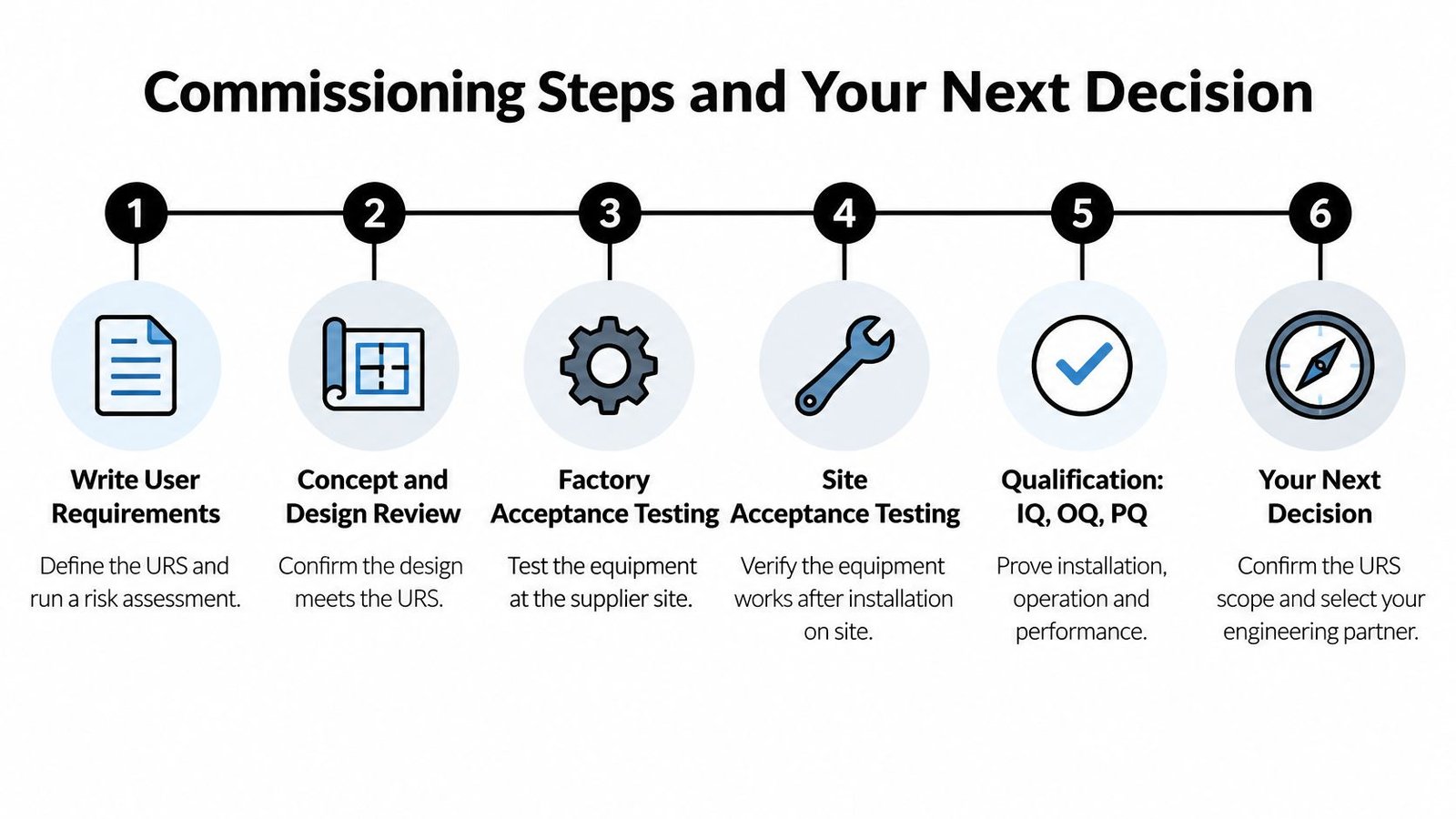
Commissioning should produce a connected chain of evidence, not a folder of unrelated supplier reports. Assign owners and timing using the lifecycle document table before starting the project.
The project milestones provide a useful overview of that path.
Release the equipment through defined gates
- Write requirements and assess risk. Approve the URS and risk assessment.
- Review the concept and design. Record how the design satisfies each requirement and resolve exceptions.
- Complete factory acceptance testing. Retain the FAT protocol, results and outstanding-action list before shipment.
- Install and connect utilities. Record installation checks and site acceptance results.
- Complete installation qualification. Verify components, utilities, drawings, manuals and certificates in the IQ record.
- Run operational qualification. Challenge operating limits, alarms, interlocks and recovery through the OQ protocol.
- Demonstrate performance. Use the PQ protocol to establish consistent output under representative production conditions.
- Authorize production. Obtain QA approval of the release package and any justified remaining restrictions.
- Schedule continued review. Establish records for reviewing alarms, deviations, calibration trends and maintenance outcomes.
Each gate should identify its supporting requirement and explain unresolved exceptions. Supplier testing can support qualification when its scope, execution and evidence are suitable; don't repeat tests automatically or accept them without review.
Choose what the team can maintain
SEA's project support can extend from consultation and preliminary concepts through full design, manufacturing drawings, material sourcing, installation and commissioning. Its stated support includes a one-year guarantee and ongoing maintenance; define deliverables, exclusions and service responsibilities in the project agreement.
The accompanying video offers another way to review the engineering approach.
Choose the automation level your validation, staffing and records can support, not the highest throughput on paper. I would require a URS-based review before committing to a design.
The first action is concrete: list every GMP-critical function in the planned cell, including acceptance decisions, parameter changes, manual interventions and record creation. That list gives operations, engineering and QA a common basis for deciding what to automate.
System Engineering & Automation offers manual and automated equipment, semi-automated cells, custom fixtures and integrated controls to help manufacturers optimize production and service their equipment. Visit System Engineering & Automation to discuss a URS-based review of your process, documentation needs and practical automation options before committing to a build.